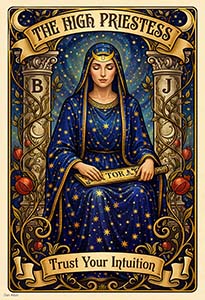
The High Priestess: What It Really Means to Trust Your Intuition

The High Priestess Archetype and learning to trust our intuition.

In my High Priestess affirmation poster, I chose the phrase:

“Trust Your Intuition.”

It sounds simple. Almost obvious.

And yet it’s one of the most misunderstood instructions in the entire Tarot.

We say things like:

“I have a feeling . .

“I just have a hunch . . .”

“I’m getting bad vibes about this . . .”

All human beings have intuition — some more than others. Some people sneer at it as a primitive, pseudo-mystical leftover from a less scientific age. Others practically swim in it, using it as their primary guide through life.

Most of us fall somewhere in the middle.

We occasionally get flashes of clarity about which path to take and which to avoid. But most of the time we default to logic. We try to predict outcomes. We use our brains rather than our hearts.

And then sometimes — usually in hindsight — we think:

“Damn, I knew better . . .”

So it’s worth asking:

What is intuition… and what is it not?

“Just the Tarot,” by Dan Adair – available on Amazon

It’s Not Fear

One of the biggest confusions we have is mixing intuition up with the limbic system — the ancient part of the brain responsible for fight-or-flight.

That system exists to keep us alive. It detects threat. It reacts instantly.

It was what warned our ancestors that something dangerous was hiding in the trees. We experience it today as:

  • The hairs rising on the back of our neck
  • A sudden jolt of anxiety
  • The feeling that someone is watching us

That reaction can feel mysterious. But it isn’t mystical. It’s biological.

True intuition does not trigger fight-or-flight.

It doesn’t flood the body with adrenaline. It doesn’t tighten the chest.

Real intuition is calm.

It arrives quietly, with a sense of understanding. It clarifies rather than agitates. Instead of panic, it brings steadiness — a subtle reassurance that says:

“This is right – you’ll be okay.”


It’s Not Rapid-Fire Prediction

The brain is constantly predicting the future based on the past.

When we encounter a new situation, the mind instantly searches its archives for similar experiences. It matches patterns, runs comparisons, and projects possible outcomes — all in a fraction of a second.

We’re mostly unaware this is happening.

So when we say we “have a feeling” about someone, what we often have is a memory.

If we once had a terrible experience with a brunette woman wearing purple socks, we may feel wary of a new brunette wearing purple socks. We call that a vibe.

It isn’t.

Some people process these patterns so quickly that it seems magical. Certain personality types — INFJs and INFPs, for example — are especially skilled at rapid, intuitive-seeming synthesis.

But that process is still rooted in past data.

True intuition is different.

It is not logical.

It is not based on memory.

It may have absolutely nothing to do with what has happened before.

It is a clear message about the present moment — even when there’s no obvious reason you should understand what you understand.


It’s Not Fragmented

You may have met highly sensitive or empathic people whose lives are chaotic.

On the surface, that seems contradictory. If they absorb more information than most, shouldn’t they navigate life more easily?

Not necessarily.

When someone takes in too much external input without discernment, they can lose track of what belongs to them and what belongs to others.

If they’re near someone who is anxious, they become anxious. If they’re around anger, they internalize anger.

Soon they feel as if they’re having five contradictory “intuitions” at once.

But intuition does not contradict itself.

It does not conduct committee meetings in your head.

It does not present twelve equally compelling paths and demand that you choose one immediately.

True intuition is singular.

It points.

It does not debate.


Clear, Calm, and Quietly Joyful

Perhaps the greatest hallmark of genuine intuition is that it brings relief.

It removes doubt.

It dissolves mental noise.

It doesn’t shout. It doesn’t demand. It doesn’t come with fireworks.

It simply settles into you and says:

“Yes, this is it.”

And when it does, there is often a subtle happiness attached to it — not excitement, not mania — but a deep rightness.

That is the High Priestess.

She does not force reality.

She does not argue.

She does not panic.

She knows.

And when that knowing arrives within you, the work is not to question it endlessly — it is to honor it.

That is what “Trust Your Intuition” really means.

The High Priestess and the Hallway in Our Brains

In my original definition of The High Priestess, I said:  

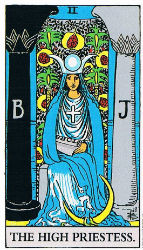
“The real message in the imagery of this card, though, is about balance between opposites and the center point where intuition reigns.  The cross on her chest is the solar cross rather than the Christian cross, its’ four arms all of exact equal length from its’ center. She sits exactly between the white and black opposites of the columns.  The crown she wears is a solar disk surrounded by crescent moons, emphasizing the opposites of night and day.”

I also pointed out that she symbolically corresponds to the center point of our brain, the place where communication takes place between the right side of the brain and the left side of the brain.  Because, of course, through some bizarre turn of evolution we ended up with two brains instead of one.

Our brains look very much like a whole walnut.  There are equal but separate sides, the left hemisphere and the right hemisphere. 

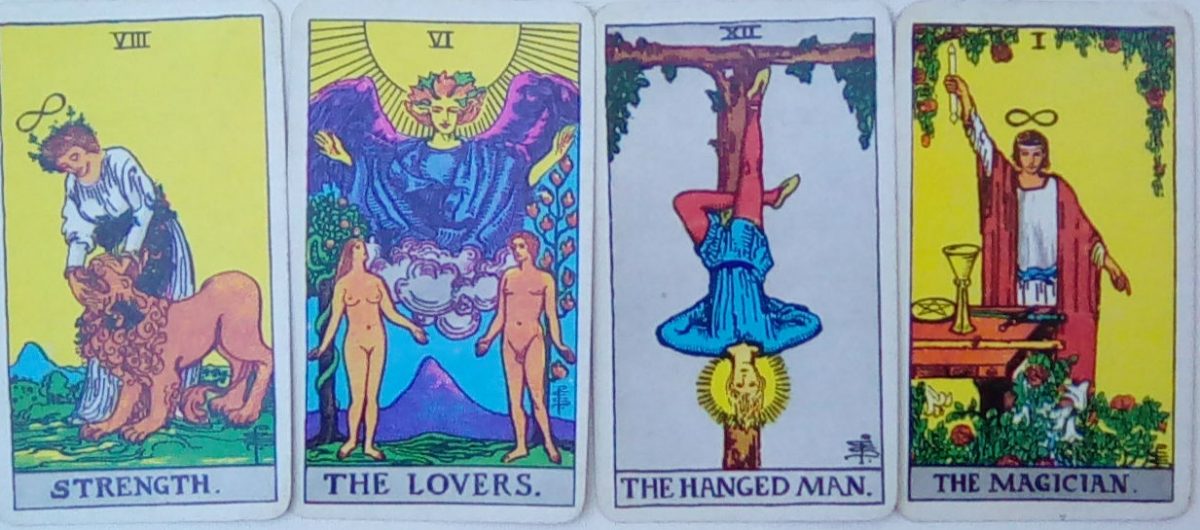
The left side does math, reads, writes, is logical, is ultra critical and is considered to be male energy.  The person who lives on the left hand side of our brain looks a lot like this:

The right side of our brains is creative, poetic, artistic, dreams a lot, thinks in symbols, and is associated with female energy.  She looks a lot like this:

Now, you can see where they wouldn’t be very happy roommates.  In fact, they barely talk to each other at all.  They do have more conversations in women’s brains than in men’s brains, but it’s still a pretty strained relationship.

If you want to think of them as two separate children who were born into the same body, then the left side of the brain definitely got most of the food and the right side of the brain was almost starved to death.  From the time that we’re tee tiny children we’re being encouraged to excel in left brain activities.  We’re forced to learn to read books, to memorize the alphabet, to figure out how math works.  The poor right side of the brain, though, is pretty badly neglected, if not abused.  We’re discouraged from day dreaming, told not to talk to our imaginary friends, and we get it drummed into our heads that art and poetry aren’t, “practical.”

To use a different metaphor, it would be like if we went to the gym and only lifted dumb bells with our left arm.  One arm would be beautifully sculpted and the other would be shriveled up, right?  On the other hand, we can look at the human brain and see that both halves are equal.  They take up the same amount of space and they weigh the same, which pretty much implies that we’re supposed to be using both sides equally, not just the left brain.

So how do we get the wonderful, artistic gypsy who lives in the right brain to come out and join the party?  How do we get her to engage more and force the left brain to quit being such a grouchy old tyrant who wants to run the whole show?

Well, imagine that there’s a hallway that runs between the two rooms that right brain and left brain live in.  The grouchy old tyrant can keep the door to his room locked tight, but he can’t keep the hallway locked.  The gypsy who lives in the right brain can come out and dance in the hallway.

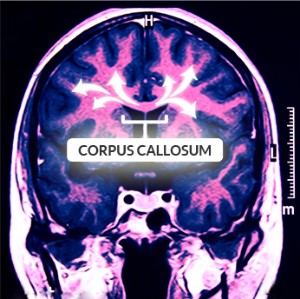
In the actual brain that hallway is called the, “corpus callosum.” 

It’s the brain tissue that connects left brain and right brain and messages between them travel back and forth in that hallway like secret notes that they’re throwing at each other.

The reason that all of that is important is that we now know that the brain can be physically changed through habits and behaviors that we adopt.  Scientists refer to that as, “neuroplasticity,” meaning that we can, to some extent, mold our brains into something entirely different.

We’ve known for some time that women have larger and more active corpus callosums.  They hypothesize that this is why women tend to be so much more in touch with their intuition than men – there’s a lot more connection with the right side of the brain.

What we didn’t know until a study at UCLA medical came out is that the corpus callosum can be strengthened and can actually gain in size in both sexes through the simple practice of meditation.  A control group that meditated daily for six months was found to have significant changes for the better in connectivity between the two hemispheres of the brain.

What that means in practical, day to day terms, is an increase in all of the qualities associated with the right brain.  Increased creativity, increased intuition, increased ability to live in the present moment instead of the past or future.  And, yes, increased intelligence because we’re now using both sides of our brains instead of just one.

And it all takes place in that magical middle, that center of the brain that’s exactly between male and female, logical and creative.  Like the High Priestess, we absorb and then synthesize BOTH of those opposing energies and release a new form of knowledge and a new way of knowing into our lives.