Just the Tarot Posts

Being a Misfit, Being Heard, and the Five of Pentacles

The pain of never being understood and how to use it for growth.

About a year and a half ago, I took the Myers-Briggs Type Indicator (MBTI) personality test and discovered that I belong to a group called the, “INFJ.”  INFJs are essentially introverted intuitives and are as rare as hair on a frog.  Only 1% of the population are INFJs and less than 1/2 of 1% of the population are INFJ males.

Americans love to think of themselves as being special and unique, of course, so a small cottage industry has arisen around being an INFJ.  Claiming to be an INFJ has become sort of a short hand to tell other people how incredibly evolved and spiritual and sensitive you are. 

There are a kazillion videos and books pointing out how FABULOUSLY wonderful INFJs are and you can even buy INFJ tee shirts and bumper stickers just in case some mere mortals missed the bulletin.

I, on the other hand, looked at the description of the personality type and thought, “Oh, I am SO fucked.”

One of the strongest human drives is the need to be heard and acknowledged.  To have the feeling that other human beings – or even ONE human being – truly hears what we’re saying and understands what we’re feeling and thinking.

American couples spend millions of dollars every year going to therapists to learn how to communicate and to listen to each other.  In other words, how to be heard by our partners.

Many of us derive a great deal of pleasure from social media sites like FaceBook because we feel that someone out there is actually hearing us and acknowledging our existence.

Thic Nhat Hahn and other Buddhist masters have stressed the importance of deep and compassionate listening.  Hearing what the other person is really saying rather than composing a clever response while they’re speaking.

Actually being heard for who we are seems to heal the human heart.

While Americans may worship the concept of being, “unique,” they don’t really see the flip side of it, which is that the more different you are, the less likely it is that other people will actually understand you.  Some people might look at the INFJ personality configuration and think, “Oh, boy, I’m SO special.”  What they’re not seeing is that 99% of the people in the world don’t see the world the same way that the INFJ sees it and probably never will.

And that can break your heart. That can drive you to end it.

There are, of course, many other ways besides being an INFJ that will cause a person to not, “fit in.”  I was born into an Army family and military brats are renowned for feeling like perpetual outsiders in the civilian community.  It might be caused by belonging to a racial or ethnic minority, or having a disability, or being gay or trans, or not fitting the cultural standards of being physically attractive.  Janis Ian expressed that so poignantly in her song, “At Seventeen”,:

I learned the truth at seventeen 

That love was meant for beauty queens 

And high school girls with clear-skinned smiles 

Who married young and then retired . . .

High School, perhaps above all else, teaches us the cruel realities of not fitting in.  

Oddly, not fitting in – being a misfit –  can eventually quit breaking our hearts and act as a springboard to spiritual growth.  That only happens, though, when we finally surrender and just give up.  

What happens to a person who truly doesn’t fit in when they try to fit in?  Essentially, they deny their own reality and desperately attempt to, “blend in.”  They try to become what they think other people will like.  They hollow themselves out more and more in the quest to have someone, even one person, understand them and love them for who they really are.

The paradox, of course, is that they’re trying to trick someone into loving them for who they are by being who they aren’t, so even if they snag a friend or a lover or a partner, they’re still not really being seen or loved.

Eventually, if we keep that up, we come to feel like the beggars in the Five of Pentacles, always on the outside in the cold while the, “normal,” people are inside the church receiving all of the blessings that seem to be their birthrights.

There’s something incredibly liberating, though, when we finally admit to ourselves that we don’t fit in and never will.  When we finally admit that we’re never going to be one of the beautiful, golden people who seem to wear their lives like a tailored glove.

No, it doesn’t mean that we’ll finally be heard or acknowledged by other people.  In fact, the more we become our authentic selves, the more likely it is that other people will not hear us.

But . . . we can finally hear our Selves.

The Secret, The Law of Attraction, and Game Show Gods

A look at manifesting what we think we want when the Universe has different ideas.

Once upon a time, when I was in my mid-forties, I found myself standing beside a wild, rushing stream in Northern California.  It was a chilly Autumn day and the forest was a wonderful mix of giant redwoods, twisting madrones, and towering, ancient oaks.

I was alone that day and the feeling of magic seemed to positively vibrate through the air.  I came to a rocky promontory where the stream poured over a limestone outcropping and dropped twenty feet into a crystal clear pool.  I thought that if there was any place in the world where the Fairie Folk would be likely to hide their enchanted treasures, it would be in that mystical glade.  And so I asked them, “Fairies, show me your gold!”

Seemingly out of nowhere, there was a powerful blast of wind in the tree tops and thousands and thousands of golden leaves fluttered to the forest floor.

I learned two valuable lessons that day.  First of all, don’t get uppity with the Fairies, particularly on their home turf.  Secondly, Fairies may have an entirely different idea of what’s really valuable than humans do.  I suspect that they may find a shower of golden leaves far more precious than a lump of yellow rock.

I was cogitating about all of that today because I just discovered that the movie, “The Secret,” is now available for free on YouTube.  If you haven’t seen it, it’s all about how we can have absolutely anything that we want in life, if we really, really understand the Law of Attraction.  It has a sort of a breathless, Dan Brown meets Norman Vincent Peale feeling to it, but it was a groundbreaking film at the time of its release and it’s been a positive force in many people’s lives.

The thing about the Law of Attraction is that it definitely works.  Sometimes.  And sometimes it doesn’t.  For most of us, it works just enough for us to scratch our heads and think, “There’s something going on here and I want to know what it is.”

There is  a general principle that if we think positive thoughts, more positive events and people will enter into our lives.  If we become more loving, then we’ll start to encounter more loving people.  If we’re grateful for the abundance that we have right now, then more abundance will flow into our lives.  On the other hand, if we’re constantly depressed and anxious, then the Universe will flow things into our lives to get anxious and depressed about.  If we’re constantly cynical and negative, we’ll attract cynical and negative people.

So, yes, “like attracts like,” and the energy we’re putting out will attract energy just like it.  The problem seems to be that the Universe may have very different ideas than we do about what we’re looking for.

I have a friend who was completely jazzed when, “The Secret,” came out.  She literally watched it several dozen times and took reams of notes so that she could get The Method of Manifesting down perfectly.  She made vision boards and spent many hours visualizing and writing out affirmations and she was so relentlessly positive that it was irritating to be around her.

Shortly after that, her husband lost his job, their house was repossessed and they had to live in a travel trailer parked at a camping site in the forest.

Quite understandably, she threw up her hands, pronounced it all, “New Age bullshit,” and even went so far as to become a dedicated atheist.  So what went wrong there?

Most Americans approach spirituality and religion as if it were a television game show.  For most of us, those are issues we don’t much think about right up until we get our asses caught in a crack.  We float right along through life, mostly happy, mostly decent to other people, mostly content with our new cars, new computers, new lovers.  

And then – KABLAM!!! – something awful happens.  We learn that we have some terrible illness or our life partners leave us or we get fired from our jobs and our houses get repossessed.  That’s the point where a lot of us get POWERFULLY religious and we suddenly remember that there’s a God-person who’s supposed to fix everything that’s bad.

We might call that particular God-person the, “Let’s Make a Deal God.”  As in, “Let’s make a deal, God.  If you’ll just get me out of this mess, I PROMISE I’ll never be bad again.  I’ll be a lot better person, God, and . . . and . . . I’ll start going to church and I’ll adopt a puppy and . . . I’ll be good, God.  Just PLEASE get me out of this!”

Now, here’s the thing:  the God-person (or the Fairies or the Angels or the Universe or Jesus or whatever our particular religious configuration is) does answer our prayers, just not necessarily in a way that makes any sense to us at the time it happens.  Like the Fairies on that Autumn day, the Higher Powers out there may have a very different idea about what constitutes gold in our lives than we do.  And so, we don’t get exactly what we wanted.

When that happens, we tend to carry the Let’s Make a Deal scenario even further and get really pissed off at the God-person for not holding up his end of the deal.  “Look, I wanted the shiny new Jeep that was behind Door Number Three and you gave me the crappy toaster oven that was behind Door Number Two.  Well, just forget that part about me adopting a puppy, God.  In fact, I just won’t believe in you anymore.  Neener, neener, neener!”

Many people approach visualization, manifestation, and the law of attraction in exactly the same way.  They think that if they can just find THE method that will make it all work right, they’ll suddenly own a mansion, a sports car, a private jet and they’ll get laid every single night and perhaps every morning, too.

Let’s face it, though:  if there was ONE method that worked EVERY SINGLE TIME for EVERY SINGLE PERSON, we’d all be millionaires and we’d be so tired from having great sex that we could barely crawl out of bed.  Hell, our butlers would have to serve us our meals in bed, only there wouldn’t BE any butlers because they’d all be millionaires, too.

What a conundrum!

It’s very possible that there’s a guardian angel standing at our shoulders saying, “Yes, dear, I know that you wanted the shiny new Jeep but you really can’t afford the payments or the insurance and you don’t know how to drive a stick shift.  On the other hand, we could put some bread in the toaster oven and, look:  I brought butter and raspberry jam and Red Zinger tea.”

Or perhaps my friend’s guardian angel was saying, “Yes, dear, I know that you wanted a pot full of Krugerands to appear in your living room, but maybe what you really need is to stop sitting in front of a t.v. watching a movie 30 times in a row and have a little adventure.  Life is short. Here’s a nice travel trailer and there’s a beautiful forest. Go.”

Einstein said, “Either everything is a miracle or nothing is a miracle.”  It can be really hard to wrap our heads around the idea that we’re getting precisely what we need, when we need it, even if it’s not exactly what we wanted.  The key seems to be to realize that miracles are constantly unfolding in our lives, but they tend to unfold slowly and in their own peculiar ways.

Just be patient, wait for the magic to work it out, don’t try to make toast with a Jeep, and don’t get uppity with the Fairies.

Remember that my ebook, “Just the Tarot,” is available on Amazon for less than a jar of raspberry jam. 

The Five of Pentacles, Karma, and God’s Little Baskets of Muffins

Transforming ourselves through karmic selfishness.

I have a younger friend who HATES karma.

More specifically, he hates when he’s in the middle of an, “Oh poor me,” bitching session and someone shrugs her shoulders and says, “Well, that’s karma.”  

First of all, it interrupts the rhythm of his complaining and he has to go back and remember what he was so upset about.  

“What was I saying?  I know it was important . . . oh, I remember . . . life is meaningless and no one understands me . . .”

Secondly, it infuriates him because it suggests that the mess he finds himself in is somehow HIS fault and the whole point of his rap is that it’s everything and everyone else’s fault.  Which is just further proof that no one understands him.

This guy was raised by a Buddhist and that may have something to do with his constant irritation.  It’s developmentally important that teenagers be able to rebel against their parents.  The first way that we really begin to define who we are in the world is by making it clear that we aren’t our parents.  I imagine that it must be pretty damned difficult for a teenager to get any rebellion traction against a Buddhist parent.

“You know, Dad, sometimes I really hate you.”

“Well, son, all strong emotions will pass if we simply do a little deep breathing.  Remember, you’re the sky and your emotions are just clouds drifting by.”

Or

“I’ve been think about getting a tattoo.  What do you think about that?”

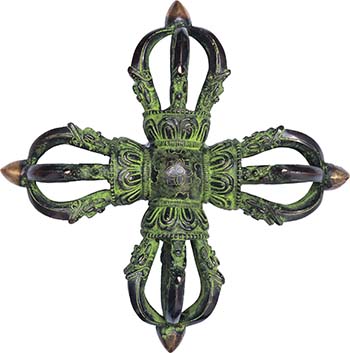
“Ah . . . perhaps you should get a tattoo of a double dorje or some other sacred symbol.  In a sense, it would be a constant reminder of the spiritual nature that dwells in physical matter.”

Or

“Maybe I’ll paint my face blue and dye my hair orange.”

“Hmmm . . . I wonder if you were a Druid in a past life.  Do you feel a particular attraction to oak trees?”

Aargh!  So it’s possible that this guy was deeply emotionally scarred by all of that loving kindness and unconditional acceptance from his parents.  If only they’d yelled at him or told him he was an idiot occasionally!  

Still, he does have a bit of a point about the notion of karma.

It’s perfectly understandable that people get a little riled up over the idea of crappy things happening to them because of what they may have done in a past life.  After all, most of us have absolutely no memory of our past lives and so it feels like we’re being punished for something that someone else did.  

Suppose I was Attila the Hun in a past life and in a fit of Barbarian Rage I whipped out my scimitar and beheaded a turtle.  Then 200 lifetimes later –   as Dan Adair –  I’m in a traffic accident and I get whiplash BECAUSE I decapitated that turtle.  That seems a little . . . unjust.  I mean, I’m NOT Attila in any sort of a meaningful sense, so why should I get sent to the principal’s office because Attila was a dick?

And then, to make it even worse, when I’m sitting there in my cervical collar reflecting on exactly HOW unjust it all is, an acquaintance says, “Oh, well, that’s karma.”  As my younger friend would put it:  “Fuck you.”

Now, there’s a particularly odious Christian doctrine called, “predestination.”  It holds that some people are born with the unchangeable destiny that they’re going to heaven when they die. Other people are born with the unchangeable destiny that they’re going straight to hell when they die.  It doesn’t matter what we do or how we behave, our ultimate destiny has already been decided at the moment of birth.

It’s like God is up there in the Kosmic Kitchen baking up human Souls and, as he pulls each one out of the Soul Muffin Pan, he tosses them into separate baskets marked, “Heaven,” and, “Hell.”

“Okay, heaven, heaven, heaven – whoops, you’re fucked – hell, heaven, fucked again, heaven . . .”  Like the beggars in the Five of Pentacles, we’re out in the cold and we’re going to stay there.

Theologians came up with a perfectly logical reason for this totally insane doctrine.  The idea is that God is all powerful and all knowing.  So if God knows everything, then that must mean that he knows everything that happened in the past, the present, AND the future!  And if God already knows what’s going to happen in the future, then he must already know who’s going to heaven and who’s going to hell.  Shazam!  There you are – it’s already determined.

That’s the kind of weird, Left-Brain, cuckoo for coco puffs vibe that a lot of people get off of the notion of karma.  It seems to be some sort of an inexorable process that was put into motion a long time before we came along and there’s not a damned thing we can do about it.  We’re either in the Heaven Basket or we’re in the Oh, You’re So Fucked Basket.  Like it’s something that happens TO us for no particular reason.

Of course, the important point that most of us miss is that karma isn’t happening to us, we’re happening to karma.  It’s a totally dynamic process and it’s something that we can change every single day simply by the ways that we behave right now.

The most simplistic way to think of it is as a sort of a bank account.  Rather than being born into a You’re-Going-to-Hell Basket or a You’re-Going-to-Heaven Basket, we’re born with a certain amount of Karmic Kash that we earned (or didn’t earn) in past lives.  The Dalai Lama will probably be reborn with several savings accounts, a really huge checking account, many certificates of deposit and a great coin collection.  Attila the Turtle Beheader, on the other hand, will be reborn with 50 cents in the bank and a lot of overdue bills.

The thing is, though, that the way that we’re born isn’t our destiny.  The way that we behave is our destiny.  Attila, for instance, might start a refuge for homeless turtles.  Every single time that he saves a turtle and gives it a meaningful life – KA -CHING – that’s another deposit in his Karma Account.  The Dalai Lama, on the other hand, might decide to support Eric Trump for President and – ZAP – that’s a major withdrawal from his Karmic Account.

As David Michie said in, “Buddhism for Busy People,” 

In what is one of the most outstandingly ingenious aspects of Buddhist teachings, we come to realize that our own selfish interests lie in being altruistic . . .months, years or decades of being generous for selfish reasons begin to have a predictable effect . . .what starts out as a contrived and self-conscious change of attitude and behavior results in a genuine metamorphosis.

In other words, we don’t have to start out as Mother Theresa or an Awakened Master.  We can start out as perfectly normal, selfish, self-centered human beings who are being kind to other beings because we DON’T want to end up wearing a cervical collar.  When we pick up a turtle that’s in the middle of the road and leave it safely on the other side, we can be doing it for the completely selfish reason of wanting to fill up our Karmic Account.

As we continue those little acts of kindness they gradually transform us.  They become acts of loving/kindness, where we’re actually noticing and caring about the welfare of the people and beings around us.  The translation of the word, “karma,” is, “action,” and that’s the key.  Our actions change us, even if they originate in selfishness.

And that’s how Attila the Hun becomes the Dalai Lama.  Pretty simple.

The Chariot, Choices, and Man in the Moon Epaulettes

Choosing new lives after devastating loss.

I’ve always loved the way that the guy is dressed in The Chariot Tarot card.    I mean, what a spiffy outfit!  He’s got a crown with a star on it, his very own scepter, and he’s rocking a sort of a skirt with all of the signs of the zodiac on it.  And the pièce de résistance is those wonderful Man in the Moon epaulettes. I mean, this is a guy that, if we saw him walking down the street, we’d definitely be impressed with how put together he is.   Not to mention his bold sartorial choices.

Of course, there’s a major wink in this card.  When we look at the two sphinxes that are pulling the chariot he stands in, we realize that (a) they’re sitting down; (b) they’re facing in opposite directions; and (c) there are no harnesses or reins attached to them.  In other words, the Charioteer, despite his glorious finery, is going nowhere any time soon.

The reason he’s not cruising is a matter of choice, and I don’t mean that he’s chosen not to move.  He’s psychically paralyzed.  The black and white sphinxes represent duality. The second that duality comes into the picture, we’ve got choices to make.  Should I go right or left?  Should I get this job or that job?  Should I get married or stay single?  Should I follow the Yellow Brick Road or just hang here with the Munchkins?

When we suddenly have too many choices, we can become frozen in place, like the classic deer in the headlights.  Which is ironic, because for so much of our lives we bitch about NOT having any choices.  We’re stuck in a dead end job.  Or we can’t leave a toxic relationship because we’re worried about the kids.  Or we’re living in a town we hate but we don’t have the money to move.

If only . . . if only . . . we had a choice.  Things would be different.  Life would be good.

Now, when our lives suddenly blow up – and I mean really blow up – we may not have much left.  If we go through a devastating divorce or our partner dies or we lose all of our money, we’re left standing there with nothing.  The one thing we DO have left is choices.  

It sounds paradoxical, because when we, “lose,” everything, we feel powerless.  We feel as if all of our usual, reliable resources have been stripped away from us and we have nothing left to work with.  Oddly, though, we find out that we have much more to work with than we did before we lost everything, and that’s because we suddenly have choices.  As Kristofferson said, “Freedom’s just another word for nothing left to lose.”  When we lose everything, we can actually be free, perhaps for the first time in our lives.

The Chariot is a wonderful metaphor for how we traverse our lives in ordinary times.  We may not actually be going anywhere, we may have no sense of direction, we may feel that our lives lack any real meaning, but by god we’re well dressed.  Before we step out into the world every day, we make sure our crowns are on straight, our zodiac skirts are clean and pressed, and we have a firm grasp on our scepters.  We may be, “leading lives of quiet desperation,” on the inside, but we see to it that our outsides are impeccable.

We’re standing there in our glorious, glittery chariots that we call our lives and – BOOM – we get fired or we come home and find our wife/husband shtupping our best friend or we get run over by an out of control ice cream truck.  Suddenly we’re lying there in the ditch with our crown all bent to hell, our scepter broken in two and our epaulettes torn off.

And, of course, we’re filled with immense grief for all that we’ve lost.

One of the first things that happens in the grief process is that we try to pretend that everything is normal.  Nora McInerny talks about that in one of her videos on grief. In a period of just a few months, her father died, her husband died and she had a miscarriage.  When friends and family would ask how she was doing, her constant refrain was, “I’m fine.  I’m alright.  I’m perfectly fine,” though she was shattered inside.

So basically, our first impulse is to pick ourselves up out of the ditch, dust off our zodiac skirts, glue our scepters together and put our bent crowns on our heads.  We’re fine.  Perfectly fine.

That works for some of us, after a fashion.  If we get our outsides together, then we can reassure ourselves that our insides must be okay, too.  Hey, I’m going to work, I’m paying my bills, I eat meals . . . sort of . . . so I must be okay.  Our friends and family will shine that back at us, too, because they really, really don’t want to deal with us NOT being okay.  Right around the six month mark after a death they’ll start to be worried and say something like, “Look, isn’t it time you start to get over this?  Maybe get out and meet someone?  You know . . . get on with your life?”

For many of us, though, that doesn’t work.  We know that the crown is never going to fit on our heads again, the goddamned scepter won’t stay glued together and our Man in the Moon epaulettes are in shreds.

At first blush, that can feel incredibly overwhelming, because there’s a realization that so much of what we used to call our lives was total bullshit.   If everything that we thought was so solid, so dependable, so . . . normal . . . can be taken away in a flash, then it wasn’t worth much to begin with, was it?

Then we enter into another phase of the grieving that can be just as painful as the first, shocking, phase, which is, “what do I do now?”  How do I put my life back together in such a way that it can’t be exploded into pieces by the next shit storm that blows through?  We have to make choices.

That secondary phase can be agonizingly slow and filled with crushing anxiety.  Like the Chariot, we can end up frozen in place for months, perhaps years. Just the realization that we made SO many wrong choices in our previous, pre-disaster lives, can render us terrified of making any choices now.  How do I not screw this up again?

The ironic thing is that eventually it turns out that even the idea of making new choices is bullshit.  There’s a new self that begins to emerge spontaneously and, much like the birth process, it shouldn’t forced and it can’t be stopped.  The new self is kinder, more compassionate, more loving, more patient, more authentic.  And a lot less concerned with how our crowns fit.

It was there all along, just waiting for the right circumstances to be born.  

The Buddhists talk about it in terms of, “original nature.”  They say that we each have an incredibly beautiful gem inside of us that’s covered with common rock.  As we chip away at the rock, we gradually reveal the jewel that is our real selves.  Sometimes it may take decades of patient meditation and practicing loving/kindness to reveal it.  Sometimes it just takes getting run over by an ice cream truck.

Christmas Candy, the Meaning of Giving, and Tibetan Meditation Centers

Making our lives into gifts.

Here in the United States we’re just finishing up the annual emotional and commercial orgy of Christmas, also known as, “the season of giving.”  It started me thinking about the nature of giving and, oddly, a Tibetan meditation center I toured over 20 years ago.

Our guide was a woman who lived there with the improbable name of, “Candy.”  I’m guessing that trying to explain the intricacies of Buddhist philosophy to a group of tourists in Bermuda shorts was not the highlight of her day, but she was pleasant, kind, and patient.  One of the concepts that she put in a nutshell for us was the idea of accumulating merit.

“We get up in the morning with the idea of helping other sentient beings and, if we do that, it earns us karmic merit.  And then, instead of clinging to that merit for ourselves, we dedicate it to the good of other sentient beings.  Which accumulates more merit, which we dedicate to the good of other sentient beings.”

I glanced around at the people I was with and their faces were frozen in expressions that pretty much conveyed, “I don’t know what in the fuck you’re talking about, but you seem relatively harmless.”  To me, though, it was a major revelation.  In just those few sentences, I understood the concept of giving with absolutely no expectations of getting anything back.  It’s been something I’ve gone back to again and again over the last two decades.  A lasting treasure.

Now, here’s the thing:  I feel absolutely sure that Candy had no idea that she was making a major impact in another person’s life and thoughts.  We spent maybe 30 minutes with her and I’ve never seen her again, but I still remember that moment like it happened yesterday.  It was a gift, and the gift was her just living her life and telling her truth.

We tend to think of giving as being something that’s transactional and we can see that idea illustrated in the Six of Cups.  The little boy is giving a gift of love (symbolized by the Cup) to the little girl.  Implicit in that image is the next step in the transaction, where the little girl is going to say, “Oh, hey!  What a nice cup!  Thanks so much for thinking of me.”

And then we feel good because we’ve made someone we care about feel good and we feel good about ourselves because, after all, we were thoughtful enough to give something nice to someone we care about.  When we put all of the commercialism and forced jolliness aside, that’s part of the sweetness of Christmas – it’s a chance to give something to others and tell them we love them.

Most of us feel pretty disconnected with that in our general, everyday lives, though.  We may get up in the morning with the intentions of being, “good,” people.  We’re loving with our life partners, we don’t snap at the cashier in the grocery store, we smile at our co-workers and try to work hard at our jobs.  As near as I can tell, right around 90% of us are good people, in the sense that we make some effort to not be shit heads and to be decent to our fellow humans.

Still, a lot of us are afflicted with a sense of meaninglessness.  We feel like we’re slow walking through life in a sort of a daze and we’re not really making any difference.  It’s like we’re born, we eat a lot of t.v. dinners, and then we die and we wonder if anything we’ve done actually matters.

That’s where synchronicity and a leap of faith comes in.  That’s where giving with no sense of attachment to the results comes in.

Each one of us is absolutely unique.  There’s never been anyone exactly like us before and there will never be anyone exactly like us again.  To the extent that we celebrate that uniqueness and share our own individual truths in our lives, we become a walking, talking, breathing gift to the world.

But we almost HAVE to detach that gift from results.  If we make our giving transactional – which is to say, someone saying, “Thank you for being you,”  – we’re setting ourselves up for a lot of disappointment.  The fact of the matter is that most people don’t even see us, in any sort of a meaningful way.  Like us, they’re hustling and bustling through life, trying to pay their bills, hoping they’ve got some clean socks, trying to figure out what in the hell they can cook for their kids that isn’t a t.v. dinner.

And if they do notice us, the odds are that they’re seeing us through so many perceptual filters that they don’t see who we really are.  As the old Indian adage goes, “When a pickpocket looks at a saint, all he sees is pockets.”  

So, we have to make a little leap of faith that we ARE being seen without knowing that we are.  And that we ARE making a difference in other people’s lives and in the world, without any proof that it’s so.  Sometimes it may be like Candy at the meditation center, where words we speak become seeds that grow in other people’s lives.  Sometimes it may be as simple as smiling at a person we pass on the street, never knowing that they were depressed and suicidal until they saw our smile.

We can see that in another card, the Ace of Cups.  The cup represents love flowing into the world, but, unlike the Six of Cups, it’s not attached to anything.  It’s not something we have to earn.  It’s not dependent on being thanked or being noticed or appreciated.  It’s just there in the world and it makes life better by its very presence.

When we finally get it that we’re giving to the world around us and making a difference just by being us to the fullest extent that we can, then we shift into having meaning in our lives because we ARE making a difference.  We may not see it.  Perhaps no one will ever tell us.  Maybe it will take twenty years for that good to ripen in someone else’s life, but we DO matter.  Every single day.

My e-book, “Just the Tarot,” is still available on Amazon for less than the price of a meaningless t.v. dinner and it’s twice as nutritious!

The Magician, Apples and Bears and Cat’s Eye’s Marbles

The role of paying attention in magic.

Not too long ago a friend asked me, “Well, what IS magic, anyway?”  And it’s hard to explain, you see, because magic is all about bears and apples and cats eye marbles.

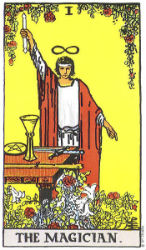
We encounter images like The Magician Tarot Card or Hollywood depictions of wizards and witches and we think that magic is very mysterious and as rare as a mustache on a frog.  It’s certainly nothing that those of us who are ordinary mortals will encounter, unless we trip over a  bottle with a genie in it.

Not true.  Not true . . . magic is everywhere.  We just don’t pay enough attention to see it.

I live in the mountains of Northern California and one of the things that comes along with mountains is bears.  Yes, large, furry, fearsome, 500 pound ursine critters with giant claws and paws and huge, scary teeth.

But it’s not so bad.  For the most part, bears mind their own business and humans mind theirs and seldom the twain shall meet.  You might occasionally step out on your back porch at night and say, “Oh, shit, it’s a bear.”  No problems.  The bear stares at you, you stare at the bear, you slowly step back into your house, close the door and repeat, “Oh, shit, it’s a bear.”

I don’t doubt that the bear is probably standing in the yard thinking, “Oh, shit, it’s a human.”

The one time that bears can become problematic is in the Autumn when they need to fatten up before they hibernate.  During that brief period of time, they will destroy anything that lies between them and food.  If you have a shed with trash cans in it, they will rip the roof off to get to the garbage.  They will eat goats and sheep if you leave them lying around at night.  They’ve been known to tear the doors off of cars because the owner left a bag of dog kibbles inside.  And they love, love, LOVE apples, which coincidentally ripen at exactly the same time that the bears get hungry.

When my partner, Carol, and I first moved to the mountains we purchased an old ranch style house.  It was built in 1950 and several generations of several families had lived in the house before us.  The deserted tree houses and forgotten toys lying in the weeds were testaments to the fact that many children had lived in that house and romped around on the surrounding property.

One of the things we were most excited about was that we had our very own apple grove on the hill behind the house.  There were about a dozen, gnarled old trees and we were thrilled when they burst into beautiful white and pink blossoms during our first Spring there.  The aroma of the blossoms was like something out of heaven. Fat, black and yellow bumble bees buzzed and droned from blossom to blossom and life was mellow.

As the summer progressed and the apples began to form and grow, we fantasized about harvesting them in the Autumn.  We knew we’d make apple pies and apple fritters and apple butter.  Perhaps we’d buy a small wine press and make apple cider or bottle apple vinegar.  Maybe we’d fill the bathtub with apple sauce and just squish around in it.

Oh, we were feeling very organic!  We were living in the country and we had a huge crop of apples coming ripe on our little farm.  Which actually began to worry me a bit, as I strolled through the grove, counting the apples.  I realized that, even on those few trees, there were hundreds of apples.  Maybe thousands.  It slowly began to dawn in the recesses of my mind that maybe thousands and thousands of apples coming ripe at the same time might not be such a swell idea.  What in the holy hell were we going to DO with all of them?

It was right about then that I first heard about the bears.  

One of our new neighbors dropped by unexpectedly and I was standing in the yard with him pretending that I liked it when neighbors dropped by unexpectedly.  He was chewing on a match stick, eyeing the apples trees critically and he said, “Best keep all of them apples picked up when they fall or you’ll draw every bear in the county.”

Gulp.  “Bears?  We’ve got . . . bears?”

“Oh, yeah,” he replied.  “The goddamned county is full of goddamned bears.  Better not go out at night without a gun or they could tear you apart.  Of course, they’re not near as bad as the mountain lions.  The goddamned mountain lions like to jump out of a tree, bite your head and crush it like a goddamned egg.  Goddamned, son of a bitch bears and mountain lions.  Best keep those goddamned apples picked up or you’ll be goddamned sorry.”

All of which leads up to the fact that I could not, in fact, keep the goddamned apples picked up despite frantic, manic efforts.  Apples fell like rain and covered the ground.  They fell into the rain gutters on the house.  They fell into pots full of flowers.  They fell on my head and shoulders as I rushed through the apple grove with a rake and wheel barrow.  They were everywhere.  Whoever said that an apple doesn’t fall far from the tree never had a goddamned apple tree.

Now, I only mention this because of the cat’s eye marble.

As it turned out, the neighbor was right about the apples and the bears.  There came the inevitable night when the dogs were howling and there was much huffing and puffing and the sounds of branching snapping in the apple grove.  When I ventured out the next morning, several of the trees had been thoroughly trashed.  The goddamned bear, not content to eat the goddamned apples that were on the ground, had ripped down dozens of branches and they lay broken and scattered around the grove.  

As I stood there, muttering to myself and examining the humongous mounds of bear shit, there was a loud cracking noise to my immediate right.  One of the larger branches had been broken nearly in two when the bear scaled the tree and it suddenly sagged almost to the ground.

And there, partially embedded in the wood at the point where the branch joined the tree, was a single cat’s eye marble.

I reached over and easily pulled it loose from the tree branch.  As I stood there staring at the marble in my hand, I felt a shiver run up my spine and the hair on my neck stood on end.  I realized that at some time, many, many years ago, a child stood by that very tree.  Perhaps it was getting dark and her mother called her in from playing.  Perhaps she was leaving a gift for the fairies.  For whatever reason, she had carefully balanced a marble at the convergence of the tree and branch and then forgotten about it.

Through the years, the tree grew and grew and the branch gradually enveloped the marble, holding it there safe inside of the tree.  Until I happened to be standing exactly next to the tree at the exact moment that the tree branch broke and revealed its treasure.

I felt as if the ghost of a small child was standing right there next to me, handing me that cat’s eye marble and saying, “Look what I’ve got, Mister.”

And that’s magic.

The odds against that happening are staggering.  It’s impossible.  Can’t happen. 

But it did.

The thing about it is that I didn’t cast a spell or wave a wand at the tree or ask the elementals to perform a magical feat.  It just happened and I was paying attention, so I saw it.

Maybe it was the ghost of that long ago child, but more likely it was the Universe laughing and saying, “Look what I’ve got, Mister.  Can you see?  Are you paying attention?”

Magic is out there.  It happens all of the time.  We just have to learn how to see it and when the Universe asks us to play with it, gather up our marbles and go.

*.  *.  *

PLEASE REMEMBER THAT MY E-BOOK, “JUST THE TAROT,” IS AVAILABLE ON AMAZON FOR LESS THAN THE PRICE OF WHOLE BAG FULL OF MARBLES.  YOU SHOULD BUY A COPY – IT’S MAGICAL!

Time Travelers, Blackberry Salmons, and Babies in Sunbeams

Religious concepts of time and the destruction of mindfulness.

I love Eckhart Tolle’s statement that, “it’s never not now.”  

It’s totally true, but we really have to bend our minds a lot to get into that space.  It’s not too difficult intellectually, because we can look at it rationally and realize that there really is no past (except in our heads) and there really is no future (except in our heads.)  I mean, it’s not like there’s some Past Land, like a Disney adventure ride, that we can go visit.  IT DOESN’T EXIST. Ditto with the Future, because all that it really consists of is our projections of what we think will probably happen.  Maybe.  Could be.

Despite that, we humans spend a MASSIVE amount of our lives Time Traveling to the future or the past and very little time in the Now.  Put another way, we use a lot of our mental space living in something that doesn’t even exist and, as a result of that, we spend very little time existing in the space that actually does exist.  We’re so bad at living in the Now that we actually have to take mindfulness classes to learn how to do it.

So how in the hell did this sorry state of affairs come to be?  We should find the person responsible for this and give him a good thrashing.

Oddly, the answer seems to be that it was our old buddy, Organized Religion, that did it.  In the Tarot, organized religion is represented by The Hierophant and The Hierophant has rules and regulations that we’re all supposed to bend our knees to.  One of his Big Rules is about time and it says, “There isn’t enough of it.”

Now, probably the original way that humans experienced time was sort of like this: 

There was just a big NOW, with no concept of the past or the future.  We just sat there in the bliss of the present moment soaking it all in.  Or it might have been a little bit more like this, where one NOW moment just led into the next NOW moment. No concept of past or future, just NOW.

That’s much the way that babies seem to experience time.  They can lie there for hours staring at a sunbeam and not get worked up at all about what the sunbeams are going to look like tomorrow or worry about what the sunbeams were like yesterday.

At a certain point in our evolution, our experience of time probably shifted more into the model we see with the Wiccan Wheel of Time.  

We started to notice the cycles of the Moon and the passing of the seasons.  There would have been some recognition of certain times of the year but not a great deal of worry about it.  The Native Americans of the Northwest expressed it in terms of activities.  “This is the time when we gather berries.  This is the time we catch salmon.  This is the time when we plant seeds.”  And so on.

Still, there was none of the huge anxiety that we seem to feel about time today.  Tribal people didn’t sit around their camp fires filling in dates on a calendar or trying to figure out how to, “use their time more productively.”  They just did what they needed to do when it was the right time of the year to do it.  “Hey, I’ll bet some fried salmon would go great with these blackberries!  We should probably stack up a little fire wood while we’re at it because it’s going to get cold sometime soon.”

Unfortunately, while the Native Americans were sitting around having fish fries and enjoying their blackberry cobblers, humans in the Middle East were coming up with an entirely different concept of time, which historians refer to as the, “inclined plane,” model.  The reasoning behind this model of time ran very much like this:

  1. – If time exists, then there must have been a BEGINNING of time, because . . . you know . . . there just must have been.
  2. – And if someone, “started,” time, then it must have been someone who was OUTSIDE of time and that would be someone who was eternal and that would be God.
  1.  -And if there was a start to time, then there must also be a stop to time, which is when the world ends and God will do that, too, so I think we should call it The End Times.

Okay, so it wasn’t the best piece of human thinking that we’ve ever seen, but they didn’t have Google in those days so they couldn’t really look things up.  It also represents a HUGE shift in human perception and one that we’re still suffering from today.  All of a sudden, time looks like this:

So time has suddenly become a quantity, rather than a quality. It begins and it ends.  We can measure it, we can put it on calendars, we can plan it, we can carry it around on the daily planners of our phones. Shazam! – we have the concepts of the past and the future, of yesterdays and tomorrows.  We see this notion of time-as-a-quantity deeply ingrained in our languages.

I need to SPEND some time on that.

I’m not sure I want to INVEST that much time in it.

Time’s a WASTING.

This should be a real time SAVER.

I need to ORGANIZE my time.

We’re RUNNING OUT of time.

I’ll PAY you for your time.

When we look at all of those statements, the basic message is that THERE ISN’T ENOUGH TIME, goddamnit!  Which, of course, is ridiculous, because there’s all the time in the world.  Literally.

We’ve been so totally hypnotized by the religious concept of time that we  can’t imagine a world without it.  We’ve devolved from that perfect bliss of a baby tripping out on the sunbeams into beings who are missing our own lives because we’re constantly living in the past or in the future.  The only cure for it seems to be to re-train our brains back into living in the NOW through mindfulness meditations and living mindfully.

I mean, you know, if we can schedule the time for that.  I’ll have to look at my calendar . . .

Just a reminder that there is ALWAYS time to read my ebook, Just the Tarot, and it’s still available, dirt cheap, on Amazon

Atheist Tarot Readers, Defective Jesus, and Finding a New God-Person

The pragmatism of polytheism.

I have a friend who is an atheist Tarot card reader and it tickles me no end.  I like to rag on her a bit and ask her, “Who do you think is answering your questions when you do a reading?  Maybe atheist angels or agnostic spirit guides?”  

Which generally earns me a dirty look or a shrug.  She reads Tarot cards.  She’s an atheist.  It’s not up for discussion.

Now, she’s kind of caught between a rock and a hard place.  The rock is that she was reading Tarot cards for many years before she became an atheist, so she knows that they actually work.  When you sit down with a deck of cards and do a reading, you get answers and the answers are generally (not always) right on.

The hard place is that she went through a series of very painful life experiences that led her to conclude that there’s no God and that religion is nothing more than superstitious nonsense.  That conclusion wasn’t arrived at in a frivolous manner because she was genuinely suffering in her life, she prayed for help, and nothing much happened.

It’s a pretty simple equation, right?  We’re told that there’s some sort of a God-person out there, that he loves us, and that if we’re in trouble he’ll come zooming in and rescue us.  So, if we do our part by (a) getting in trouble and (b) praying for help and the God-person doesn’t do his part by (c) zooming in and rescuing us, then it’s logical to conclude that the God-person either doesn’t exist or else he’s pretty useless.

I’m actually very sympathetic with my friend, the atheist Tarot reader, because I had a similar experience when I was in my mid-forties.  My father had just killed himself, I lost my job and had to declare bankruptcy, my house was repossessed, and my mother developed Alzheimer’s Disease.

All of this happened within a one year span of time.  My life went from being perfectly normal to being a total shit-burger in the wink of an eye.  I was so chewed up by life that I had to look up to see the bottom and if it weren’t for bad luck, “I wouldn’t have had no luck at all.”  Life had chewed me up, spit me out, and then stomped on me with hob-nail boots to be sure I’d stay on the ground.

I was living in Texas at the time and there’s a fundamentalist christian under every rock and behind every cactus in Texas.  It was probably inevitable, then, that one of them said, “Dan, you just need to get down on your knees and pray to Jesus for help.”  And I did.  I was raised up in the catholic church, so the concept of praying to Jesus wasn’t exactly foreign to me and I thought, “Well, shit . . . what do I have to lose?”  Nothing.

So I commenced praying and I prayed and prayed and prayed and asked Jesus to help me in my misery and travails and – SHAZAM! – nothing happened.  No heavenly hosts of angels appeared, Jesus didn’t invite me for a walk in the garden and no one anointed my fevered brow with soothing oils.  I continued to be royally fucked.

But, unlike my friend, the atheist Tarot reader, I didn’t throw my hands in the air and declare that God is dead and it’s just a cold, hard universe.  Instead, I analyzed my situation and thought, “Well, I’m in trouble, I prayed to the God-person to come zooming in and help me, and nothing happened.  Obviously, I have a defective God-person.  He’s not working, so I’ll just send him back.  I need to find a God-person who can get the job done.”

I did a lot of research on Gods and Goddesses and finally settled on Hecate’, the Goddess of the Cross Roads.  She seemed like a good fit because I was definitely at a cross roads in my life and I needed to know which way to turn.  I prayed and prayed and prayed and asked Hecate’ to help me in my misery and travails and – SHAZAM! – something happened.

In fact, quite a bit happened, just like magic.  I met a woman on line, fell in love with her, moved to California and we lived together for 19 years.  My life went from being an absolute shit-burger to being wonder-full in the wink of an eye.

Now, I’m not writing all of this as some sort of an anti-Jesus screed or to praise the wonders of Hecate’.  I know a few christians who swear up and down that Jesus answers their prayers and they seem like nice, honest people.  Maybe they got a Jesus model that wasn’t defective and he sort of works if they don’t take too close a look at him.  Maybe Jesus was just a bad fit for me – could be that he doesn’t like my haircut or tie dyed shirts.  I don’t know.  I just know he didn’t work.

Which leads me back to my friend, the atheist Tarot reader.  Like me, she tried praying to her God-person and nothing happened, nothing got better.  She quite logically realized he was a defective model and sent him back.  Fortunately, she was still able to hang on to her Tarot cards and say, “These DO work, so I’m not sending them back.”

The point being that we have a sort of a pragmatic, mostly unspoken, contract with our God-persons.  It’s something along the lines of, “Okay, God-person, we’ll pray to you and we’ll build all of these very grandiose temple-houses for you to live in and we’ll pay the salaries of your priest-persons.  You, on the other hand, will help us, console us, give us guidance, and zoom in to help us when we’re in trouble.”

Unfortunately, humans have a long history of making excuses for their God-persons.  In many instances, it’s as if the God-person is on vacation when we’re in trouble, or perhaps he has Attention Deficit Disorder and it just slips his mind that we’re hanging off the edge of a cliff holding on to a single branch.  In the worst instances, the God-person seems to behave like some sort of a deranged sadist who LIKES wrecking people’s lives and we just pray that maybe he won’t notice us while he’s in a bad mood.

In those instances, it’s perfectly acceptable to just say, “Okay, God-person – I held up my end of the bargain and you didn’t hold up yours.  It’s been sweet, but I think we both know this isn’t working out.”

And it’s also perfectly acceptable to find another God-person.  Just because this relationship is ending, it doesn’t mean that we can’t have another relationship.  There’s no reason to accept the christian line that there’s only ONE God-person and that we mustn’t ever be unfaithful to him, even when he’s being unfaithful to us.  What a narcissist!

It’s actually a great big universe out there and there are plenty of God-persons to choose from.  If we’re stone-cold poor, for instance, we might want to talk to Lakshmi, the Goddess of Abundance.  If we’re facing insurmountable obstacles, Ganesh specializes in removing them.  If we’re in need of healing, talk to Tara.  If we have no love in your lives, pray to Quan Yin.

I think that you’ll find that most God-persons are actually quite nice entities.  For the most part, they seem to have healthy boundaries.  They don’t follow you around and spy on what you’re doing.  They don’t have temper fits and throw you out of the garden just because you ate an apple.  They seem to have a lot of unconditional love and won’t ask you to sacrifice your first born son.  And they actually work.

My e-book, “Just the Tarot,” a practical guide to reading Tarot cards, is still available on Amazon for less than you’d pay for a small order of jalapeño poppers and will last a lot longer.

The Rules of Synchronicity Number Two: Lighten the Fuck Up and Walk on Some Water

Playfulness as a key to synchronicity.

In my previous post, The Rules of Synchronicity, Having Sex with Pizzas, and Becoming More Flow-ish, I began to lay out some basic rules for increasing synchronicity in our lives.  We then use that synchronicity to get into The Flow State and life becomes a lot easier.

  Rule number one, of course, is to ask for synchronicity.  It’s like knocking on a door – if you don’t knock, no one will answer.

Rule number two is . . . play.

Just play.  As in, don’t take ourselves so seriously.  Lighten the fuck up.  Mellow out.  Have some fun.

Now, to many people, that’s going to sound counter-intuitive.  After all, we’re asking the Universe for guidance in our lives!  And that’s serious stuff, by golly, and we should act very solemn about it.  Maybe dress all in black and look pained and tragic.  Or maybe even fall down on our knees and sob about it.

Not.

There is a, “Whatever-It-Is,” out there in the Universe that answers our questions and gives us guidance when we ask.  Call it god, call it the faery folk, call it angels, call it whatever you like.  It’s there and it engages with us when we engage with it.

Now, the Whatever-It-Is has some basic characteristics, just like a person.  In fact, it might be easier to think of Whatever-It-Is as a person or even a friend.  One of it’s characteristics is that it’s playful.  It likes to engage with people who have a sense of humor and a light heart.  It’s not that Whatever-It-Is WON’T engage with us if we’re all serious and dejected and depressed.  It would just rather engage with someone who’s a little more fun.

Using the analogy of a friend again, we all have friends who are in a dark, depressed place.  Everyone goes in and out of the light and some people stay in the darkness a little longer than others.  If we have a friend like that, we don’t turn our backs on him.  If she needs to have a cup of coffee and just unload about how miserable her life is, we’ll do that.  We’re willing to pat his shoulder and say, “There, there . . . it will all work out.”

On the other hand, if we see that particular friend coming toward us a block away, we might cross the street and peer into a shop window until he passes by.  We’re compassionate, but we’re not masochistic.  We’re there to help, but we don’t seek out the darkness they’re living in.

Put another way, we’re all attracted to people who are positive, humorous, and light hearted.  Their positive energy gives us a good energetic charge and, hopefully, we give them one as well.

In very much the same way, Whatever-It-Is is much more likely to engage with us when we’re living in a fun, humorous, positive space.  It has a light, playful energy and so it’s much more compatible with OUR energy when we’re light and playful.

This is, of course, completely contrary to what we’ve been raised to believe.  Traditionally, people have sought out a connection with Whatever-It-Is in churches.  And what do we know about going to church?  It’s very, very, very serious.  And solemn.  And pretty damned uncomfortable.  No giggling allowed, thank you very much.  

Catholics even have a tradition of smacking themselves in their chests with their fists and saying, “Mea culpa, mea culpa, mea MAXIMA culpa.”  That translates as, “I am guilty, I am guilty, I am SO FUCKING guilty.”

Would you like to have a conversation like that with a friend?  Of course not.  So why do we assume that Whatever-It-Is wants to have that conversation with us?  The ironic thing is that we’ve been taught that, in order to talk with Whatever-It-Is, we have to get into a really dark, serious emotional space and this is totally non-productive.  It just makes it that much harder for the positive energy and guidance to flow to us, because our vibration is incompatible.

Another problem that many of us – especially those of us who were raised as christians – encounter is that we’ve been taught from the get-go that GOD IS NOT OUR FRIEND!  The word, “god,” is just the term that most Westerners use to describe Whatever-It-Is.  It’s the something out there that we talk to when we need guidance and help, which we call, “praying,”  and when it answers us we call that, “miracles.”  

Unfortunately, we’ve also been taught that this god person pretty much doesn’t like anything that makes us happy.  That includes masturbation, sex, lying around being lazy, eating too much, and getting high.  He’s making a list and he’s checking it twice and he’s going to find out if we’re naughty or nice.  And if we’re naughty, we’re going straight to hell. Forever.  Period.

In other words, god doesn’t have much of a sense of humor.  In fact, you can flip through the entire bible and hardly find one single instance where god appeared to be having any fun or told a joke or did a dance.  The one exception I can think of was when Jesus decided to walk on the water just to freak out the local fishermen, but that’s a different story.

So, once again, this is a mind-set that we need to TOTALLY get out of.  Whatever-It-Is (call it god if you want to) LIKES for us to have fun.  Whatever-It-Is LIKES people who have sex and lie around in a hammock on a sunny day and tell jokes and dance.  Who wouldn’t?

Just to recap where we’re at in this discussion at this point:

  1. – We’re much happier, more fulfilled, and content when we’re living in the state of consciousness that we call, “The Flow.”
  2. – That state of consciousness always occurs coincident with synchronicity, so if we can increase our synchronicity, we increase the time we spend in The Flow.
  3. – Synchronicity means having contact with, asking questions of, and getting guidance from the spiritual source that some people call god/goddess or the faery folk or angels or spirit guides or even Whatever-It-Is.
  4. – The first step in achieving synchronicity is to actually, consciously ask for guidance and then watch for answers.
  5. – The answers will come a lot easier if we stay in a happy, light, positive vibration and remember that Whatever-It-Is is a benevolent friend who likes to have fun.

I’ll be posting some more about synchronicity in the near future, but for now just remember that the way to enlightenment is to lighten the fuck up.  We can do that!

Remember that my e-book, Just the Tarot, is available on Amazon for much less than what you’d pay for a box of chocolates and you’ll know EXACTLY what you’re getting.

The Rules of Synchronicity, Having Sex with Pizzas, and Becoming More Flow-ish

Basic rules for increasing synchronicity in your life and getting in the Flow.

We’re all familiar with that state of being that we call, “being in the Zone,” or, “being in the Flow.” Both artists and athletes talk about the special state of consciousness where their work becomes completely focussed, everything they want to accomplish unfolds effortlessly and the perception of time seems to be suspended. When we’re in the Flow, life becomes a magical mystery tour and feels like a perfect fit instead of a struggle.

There are dozens of books out there on the subject of the Flow, but my favorite is Charlene Belitz groundbreaking book The Power of Flow. She noted that when we’re in the Flow state, we have a marked increase in synchronistic events and she thought, “Hmmmm . . . if synchronicity goes along with the Flow state like cheese dip goes with Doritos . . . then that means that when one occurs, the other occurs, too. So . . . if we can increase synchronicity, maybe we can increase being in the Flow.”

And it works. I tried it. When I trigger extra synchronicity in my life, then my life begins to hum along much more smoothly and I feel happier, more content, and easier in my spirit. I may not be in the Flow constantly, but I’m sure as hell a lot more Flow-ish and that feels pretty good.

When we boil down synchronicity and then hang it on the line to dry, it basically just means that the universe is having a conversation with us. Carl Jung defined it as, “a meaningful convergence of interior and exterior events,” which is really just a formal way of saying that the universe is noticing what we’re thinking and interacting with our thoughts.

The classic example is when we’re sitting there thinking about our Great Aunt Petunia Lilac Huckleberry, whom we haven’t spoken to in 25 years, the phone rings and – Shazam! – it’s Aunt Petunia and she has something really important to tell us. Now, we can dissect that and analyze it and pick it apart a million ways to Sunday, but there are really only three things we need to focus on here: (1) We thought of Aunt Petunia; (2) Aunt Petunia called us; and (3) it was meaningful.

That sort of thing happens to all of us on what seems to be a completely random basis. Since it’s random – in other words, we’re not consciously causing it to happen – we just call it a coincidence. We shrug our shoulders and say, “Well, that was damned weird,” and just forget about it.

On the other hand, when we recognize that it’s really a thing – that we can make things like that happen – then it becomes a force in our lives. We start experiencing synchronicity a lot more because we’re asking for it to happen. And as we experience more synchronicity, then we find ourselves more and more in the Flow and life becomes a LOT easier.

There are some simple rules involved with causing more synchronicity to appear in our lives. I’ve stumbled across some of them as I’ve explored the subject and want to share them in a few ongoing posts, so I’ll start with this one.

SYNCHRONICITY RULE NUMBER ONE: START THE CONVERSATION

The first rule is to realize that there is something out there talking with us, having meaningful conversations, and giving us answers when we need them. BUT . . . whatever it is, it doesn’t usually start the conversation. We need to reach out to whatever it is first, and then it replies to us.

Human beings have realized that there was something out there talking with us for most of our existence and we’ve tried to fill in the blanks about who or what it is. Some people perceive the something out there as angels and spirit guides. Some people perceive it as Fairies. Some people see it as Jesus answering their prayers. Some people think of it in impersonal terms, like the Tao.

It doesn’t matter! We don’t have to figure out exactly what it is that’s talking back to us in order to have the conversation. If you feel more comfortable calling it Jesus, that’s fine. If you prefer Spirit Guides, that’s fine, too. If you just want to call it, “Hey, you,” then go for it. The main thing is to just realize that it’s there, it has answers for you, and it’s waiting for you to ask for them.

So, suppose you have a new boyfriend and he seems to be just perfect. He’s charming, good looking, he’s well read, fun to be with, has lots of money to throw around, and you think he may be The One. BUT . . . as the relationship develops you discover that the only way that he can have sex is to slather himself in tomato paste and cover his body with slices of pepperoni. Unless he’s dressed up as a pizza, he’s completely impotent in bed and you’re highly conflicted about this because you don’t much care for pizza and you certainly don’t want to eat it every night. It’s a conundrum and you need some guidance about your choices in the matter.

So what do you do? You just stop and say, “Hey, you, (or Jesus or Fairies or Tao) what should I do about this? I think I love the guy, but shtupping Italian food just really doesn’t turn me on.” And then you take a walk or go to work or throw all of your tomato covered bed sheets in the washer and wait for an answer.

And the answer will come. It may be something as dramatic as the local Round Table Pizza burning to the ground or it may be as subtle as finding a can of tomato paste that’s been run over by a truck, but the answer will come. Once we ask the question, the universe will always find a way to let us know what we need to do.

Which leads us to Rule Number One (a):

DON’T BE AN ASKHOLE

Have you ever had a friend who was constantly asking for your advice but never took it? They come to you with one problem after another, ask what they should do, and then manufacture endless reasons for why they can’t possibly do what you suggested.

They’re basically being askholes. They’re not really interested in solutions, they’re just interested in the drama of their problems. We may occasionally lose our tempers and blow up at those people but more often we just fade away. We start avoiding them as much as we can and, if they corner us, we just nod and say, “Uh, huh. Golly. How ‘bout that? Gee whiz.”

We’ve learned that they’re never going to follow our advice and so we stop giving it. The Universe (or Jesus or Fairies or the Tao or Hey You) is very much like that. If we ask for help with something, it will always respond with an answer. But . . . if we continually ignore the advice, then Hey You will start avoiding us and ignoring our questions because it knows we don’t really want an answer.

So, in the example above, the Universe might suggest that you leave the guy, or it might suggest that you sprinkle him with Parmesan cheese before you have sex, or it might suggest that you ask him to dress up like a grilled cheese sandwich instead of a pizza and see how THAT goes. Whatever form the advice comes in, we need to act on it. If we don’t, the advice will just stop coming. If we do, then the advice will increase, synchronicity will increase, and we’ll find ourselves more and more in the Flow.

I’ll be offering some more insights on how to increase synchronicity in the next few posts. In the meantime, ask and ye shall receive. Askhole and ye shall not.

Remember that my ebook, Just the Tarot, is still available on Amazon for less than the price of a single slice of pizza and MUCH less than a grilled cheese sandwich with tomato soup. You should buy a copy.