The Ten of Pentacles, Grandma Moses, and Rocking Getting Older

A closer look at the new paradigm of aging and how we can combat our own internalized ageism.

One thing that’s been apparent watching the demonstrations against the Trump regime is that there are a LOT of gray hairs in those crowds.  What in the hell are all of those old people doing out there demonstrating?  Aren’t old people supposed to sit at home in their rocking chairs with cats in their laps?

Well, what if everything we’ve been told about aging is wrong?

OLD IS THE NEW YOUNG?

Think of some of the standard images and words that come up when we discuss older people.  Words like:

Doddering;

Absent minded;

Frail;

Diminished;

Weak;

Senile

There is a cultural perception of older people as being in a period of decline, fragility, and irrelevance.  It isn’t just our societal obsession with youth; it’s an active attack on aging itself.  Ironically, of course, it’s something we all do sooner or later (if we’re lucky) so it seems like a peculiar notion on the face of it. 

Thankfully, there’s a new paradigm emerging.  It’s an entirely different way of aging that embraces it as a time of expansion, reinvention, and wisdom-driven creativity.  Before we can do that, though, we need to be mindful of the old paradigm of aging.

THE DISEASE MINDSET

Western cultures tend to treat aging as if it’s a medical problem, rather than a perfectly natural transition.  Billions of dollars are being made every year by convincing us that there’s something terribly, terribly wrong with having white hair and a few wrinkles.

There’s really no way to describe it other than as an anti-aging industry.  On the one hand, big pharma is busy programming the elderly to believe that they can’t possibly survive without a medicine cabinet full of pills.  On the other hand, the cosmetics companies are selling boatloads of product to, “restore your lost youth and vitality.”

The over-all message to anyone past the age of 60 is, “be afraid, be very afraid, because you’re useless, ugly and doomed.  You have a terminal disease called, ‘aging.’”  

But what if we learn to see aging as a form of enhancement, rather than a decline?

LATE LIFE FLOURISHING

There’s actually a term for that which is, “the Grandma Moses Effect.”

Anna Mary Robertson Moses (AKA Grandma Moses) left home at the age of 12 to go to work as a domestic for a farmer and his wife.  For the next 65 years of her life, she had a pretty grueling existence.  She and her husband were itinerant farm workers, drifting from job to job and doing back breaking field work.  She bore 10 children, five of whom died and she lived on the edge of poverty for most of her adult years.

She took up painting at the age of 78 and only because arthritis was making it painful for her to do needlework.  She initially sold her paintings out of the window of a local pharmacy for 2 dollars a piece.  By the time that she died at the age of 101, her paintings were being sold for millions of dollars, Hollywood had made a movie about her life, and she’d received a medal of honor at the White House.  

All because she picked up a paintbrush when she was obviously too old.

Now, suppose she’d been alive in our time.  What messages might she have been receiving at the age of 78?  “Let’s face it, dear, your life is over.  You’ve got one foot in the grave. I hope that you’ve got medical insurance because it’s all downhill from here.  As a matter of fact, you’re at the bottom of the hill and a boulder is about to run over you.”

Grandma Moses was the first time that millions of Americans really got it on a visceral level that being older doesn’t equate to being the walking dead.  Being older can be a magical beginning, instead of a tragic end.

REJECTING THE STEREOTYPES

Margaret Nash talks about this in her book, “Rebellious Aging.”  One of the key takeaways from that book is that we have to actively reject the stereotypes of what our culture thinks older people should be like.

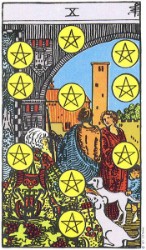
The Ten of Pentacles shows one of those stereotypes.  An old man sits quietly in a corner, wrapped in a shawl, while younger people engage with each other in the light.  There are dozens of other stereotypes in our culture, of course. Perhaps we should take up knitting or learn to play shuffleboard.  Maybe move into a nice retirement community where we don’t have to cook for ourselves anymore and we can scoot around in golf carts instead of actually walking.  Maybe join a book club or take a nice cruise with other old people.  The overall emphasis with these activities is that we should find something harmless to do while we’re waiting to die.

But suppose – horror of horrors – that we don’t die?  

Suppose that Grandma Moses had bought into the perspective that her life was over at the age of 78 and she just needed to sit down and wait to die?  That would have been 23 years of sitting there twiddling her thumbs, staring out the window, and asking people, “Am I dead, yet?”  Instead, the next 23 years were the richest and most fulfilling of her life.

THE AGE OF NEW AGING

There IS a new paradigm for aging emerging in our societies.  

 – Older people are staying creative, starting businesses, exploring spirituality, and reinventing themselves.

 – Longevity science and neuroscience show that the brain remains adaptable well into later life.  Neuroplasticity is showing that the idea that old dogs can’t learn new tricks is bullshit.  We still have lots of tricks up our sleeves.

 – And, as older people begin to behave differently, we begin to reject the stereotypes of how we’re supposed to be. The cultural narratives of aging are beginning to evolve.  We’re seeing much more positive portrayals of older people which in turn provide more positive role models for all of us.

 INTERNALIZED AGEISM

Probably the most important element in rebellious aging is rejecting our own internalized ageism.  That means taking the time to really examine how we feel about aging.

* How do we, personally, feel about, “old people?”

* Do we think our, “best years,” are over?

* Do we think, deep down, that young people are somehow, “better,” than old people?

* Are we rejecting our own sexuality because we think it’s inappropriate for older people to like sex?

* Are we constantly telling ourselves things like, “I’m too old for that?”

* Are we obsessing about our high school or college years instead of fully living in our present lives?

* Are we afraid to try new, creative endeavors because we just don’t have the time left to learn to play the piano or paint or sculpt?

* Are we obsessing over our health and expecting that we’re going to get sick, simply because we’re getting older?

If some, or all, of those things ring true for you, don’t feel bad about it.  That’s what we’ve been programmed to believe.  That doesn’t mean that we have to believe any of it any longer, though.  

RECLAIMING OUR POWER

We might think of this as learning to embrace our Inner Grandma Moses.  If we’re older, try to imagine that we’re actually going to live to be 101 years old, just like she did.  What do we want to do with all of that time?  If you’re 70, for instance, do you really want to spend the next 30 years bitching about your aching joints or would you rather roll a joint and listen to some music?  If you’re 80, do you want to spend the next 20 years sitting in a rocking chair or would rather dance to some rock and roll?

As other people have said, aging is inevitable but getting old isn’t.  Aging is a transition into wisdom, creativity, and new possibilities.  Celebrate it.

The Two of Pentacles, Multipotentialites, and Specializing in Being a Non-Specialist

How to distinguish creativity from attention deficit disorder.

Did you ever walk into a room and then have absolutely NO clue why you did it?  We stand there for a couple of seconds, asking ourselves, “What in the hell am I doing in here?  What did I want in this room?”  Blank. And then we remember that we were looking for our car keys or we wanted to make the bed or maybe there’s a book that we left somewhere and we need to find it.

That happens to everyone, of course, and older people even joke about it.  “I wouldn’t remember where my head was if it wasn’t screwed on.  Maybe I’m getting the OldTimers Disease.”

If it KEEPS happening, though, we may start to hear a little voice inside our mind that’s sounding an alarm.  “Hey, dude, maybe you are getting Alzheimer’s.  Or maybe you shouldn’t have taken all of those recreational drugs when you were a kid.  Or – oh, my god – maybe you’ve got a brain tumor!  Or maybe you’ve got ADHD!”

ADHD-ISH

The truth of the matter is that a lot of us are feeling ADHD-ish these days.  After all, attention deficits can also spring straight out of anxiety and depression and these aren’t the most tranquil of times, are they?  Even if we don’t have personal problems, the news networks and the internet are constantly blasting out the message that the sky is falling and we’re all going to die.  Climate change, pandemics, wildfires, dead celebrities, crazy politicians, oh, my!

Huge numbers of people are feeling distracted, nervous, upset, and having trouble concentrating.  There’s an epidemic of lost car keys and many of us aren’t just keeping to-do lists, we’re keeping lists of our to-do lists.  Try an internet search on, “how to get organized,” and you’ll see how very many us are bewildered, befuddled and befucked.  

AN ALTERNATE VIEW

Now, WAY BACK in the 2010s, Emilie Wapnick noticed that there were many, many people feeling this way.  It wasn’t just that they were having trouble with their attention spans or with getting organized.  Their entire lives felt unfocussed, as if they simply couldn’t decide what they should do next.  

She gave an incredibly influential TED talk called, “Why Some of Us Don’t Have One True Calling,”  and she introduced a radical idea.  Maybe, she suggested, we’re not really ding bats who keep getting distracted by shiny objects.  Maybe we’re actually just incredibly creative people who can’t and won’t be satisfied by a single pursuit. 

The term that she uses to describe people like that is, “multipotentialite.” As she outlines in her wonderful book, “How to Be Everything: A Guide for Those Who (Still) Don’t Know What They Want to Be When They Grow Up,” there are some of us who simply aren’t wired to be single-pursuit human beings.  We may be simultaneously (and passionately) pursuing vocations in art, writing, and auto repair, all the while researching a half a dozen other fields that we’re interested in.  In the past, such a person might have been admired and even lauded for their intellectual curiosity.  Today, they’re frequently labeled as being dysfunctional or misdiagnosed as having attention deficit disorder.

HENRY FORD’S DEMON BABY

Almost from its inception, the Industrial Revolution attempted to turn human beings into mere slaves who operated the machines in the factories.  The model wasn’t really perfected, though, until Henry Ford introduced his, “rolling assembly line,” in December of 1913.  Using that model, workers stand in one place as the product rolls by on a conveyor belt.  Each worker performs one job in assembling the product, and they do that one job over and over, hundreds of times a day. This ushered in the age of specialists.

There is no question that Henry Ford was a thoroughly evil man.  He was such a rotten person that Adolph Hitler mentioned him admiringly in Mein Kampf and kept a large portrait of Ford behind his desk.  Perhaps the worst thing that he did, though, was to champion the idea that a person should specialize in only one thing and do it over and over until his soul dies from sheer boredom.

NOT BELONGING IN THE AGE OF SPECIALIZATION

That idea of specializing in only one thing has it’s advantages, of course.  For instance, if we’re having a heart valve replaced it’s comforting to know that the surgeon has performed the same operation hundreds of time before.  Still, it can have devastating effects if it’s presented as the ONLY model of functioning in our society.

To be clear, multipotentialites don’t just like to pursue multiple interests at once:  it’s what they do.  It’s wired into their brains.  Telling a multipotentialite to specialize in just one area is like telling an introvert to go to more parties or telling a cat to fetch a stick and bark.

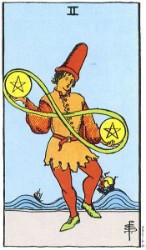
When we take that natural behavior, though – that need to pursue many different interests at once – and drop it into our linear, specialized society, it looks a lot like . . . guess what?  ADHD.  In a culture where concentrating on one task at a time is the behavior that’s rewarded and reinforced, the multipotentialite is frequently perceived as being highly dysfunctional.   Why can’t you concentrate?  Why don’t you ever get anything finished?  Why do you keep jumping from one thing to the next?  Those are questions that the multipotentialite will hear her entire life and it can leave her feeling inadequate, guilty, and shamed.  Like the figure in the Two of the Pentacles, life seems like a constant balancing act, rather than a fulfilling adventure.

STRATEGIZING FOR A HAPPY LIFE

If all of this is striking a chord with you, if you feel that you may be a multipotentialite, then rest assured, there are still ways to find happiness.  There are a few simple strategies that can make you feel like you’ve got super-powers instead of constantly feeling less than.

1. Embrace Your Identity and Fix Your Self-Image: Recognize that being a multipotentialite is a strength, not a flaw. Celebrate your curiosity and versatility instead of forcing yourself into a specialist mold.

2. Consciously Design a Portfolio Career: Instead of choosing one path, build a career that allows you to explore multiple interests. This could mean freelancing, consulting, or combining part-time roles.  If you’re an artist and a writer, for instance, you could do illustrations set off with poetry.

3. Set “Seasons” for Your Passions: Focus on specific interests for a set period, then rotate to another. This prevents burnout and keeps things fresh. This allows you to hyper-focus on a particular avocation, but use boredom as a signal for when it’s time to switch to another.

4. Create a “Renaissance Schedule”: Dedicate blocks of time to different pursuits. For example, Mondays for art, Tuesdays for coding, and so on. Structure helps manage your many passions without feeling scattered.

5. Prioritize Projects: Not every interest needs to become a lifelong commitment. Learn to distinguish between short-term fascinations and long-term passions.

6. Find Overlaps: Look for ways to combine your interests into unique projects. A multipotentialite superpower is the ability to innovate by connecting ideas from different fields.

If you’re interested in exploring more multipotentialite options for living, I’d really encourage you to visit Emilie’s website, “puttylike.   Creativity and curiosity are options that many people seem to have missed out on, so let’s take them to the max.

The Eight of Pentacles, Bras Burning Bright, and the Importance of Social Deviance

A look at the importance of personal and social deviance as illustrated by the war over brassieres.

Imagine a culture that was SO rigid that the people in it actually dictated what kind of underwear you had to put on in the morning.  Sounds pretty crazy, doesn’t it?

Still, that was exactly the situation that we had right here in the United States just 50 short years ago.  It’s a short tale and well worth looking at.

The modern brassiere was invented by Mary Phelps Jacob in 1910.  From that point on it was declared that, “decent,” women would wear bras and breasts would henceforth be encased in cotton cups when they were transported out in public view.

Now, in the late 1960’s, a growing group of women said, “I don’t wanna.”  It wasn’t that they were rigidly opposed to brassieres because, as any woman will tell you, bras can be comfy cosy in winter months and in cold climates.  Rather, they were making the radical assertion that any human being should have the right to decide whether they want to wear underwear on any given day.

Many people in our culture were shocked and appalled at the notion of unfettered breasts.  Women who went braless were actually arrested for, “public indecency,” in some Southern states.  “Decent,” women sneered at them and, “god-fearing,” men leered at them.

Still, the revolutionary bra warriors persisted and even went so far as to hold public bra burning to make their point.

By today, of course, no one cares if a woman wears a bra or not.  Generally speaking, bras go on in the winter time and come off in the summer time, which is perfectly sensible and the way it should have been all along.

The Great Bra Culture War is a perfect illustration of what sociologists refer to as, “tolerated social deviance.”  They actually have a very precise definition of deviance, which goes like this:

Deviance is a behavior, trait, or belief that departs from a social norm and generates a negative reaction in a particular group. In other words, it is behavior that does not conform to the norms of a particular culture or society.

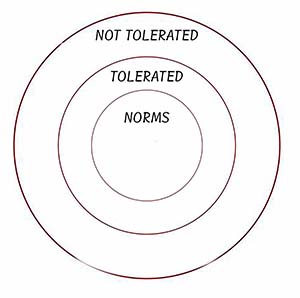
Tolerated social deviance is behavior that’s outside of the social norm, but not so far outside of it that it warrants severe punishment.  We can think of it as a series of concentric circles where the inner circle is the norm, the second circle is outside of the norm but it’s tolerated, and the outer circle is SO far outside of the norm that it will get you arrested.

In that model, during the first half of the 20th century not wearing a bra in public was in the outer circle and would result in a woman being shunned, slut-shamed, or arrested.  After the 1960s, not wearing a bra moved into the second circle of being outside the norm, but tolerated.  And by now, it’s moved into the inner circle of perfectly acceptable behavior, except in Mississippi.

The point of all of this is that freedom and creativity exist OUTSIDE of the norm.  That inner circle of social norms consists of people behaving in exactly the same way as everyone else.  The behavior is, “acceptable,” precisely because everyone else is doing it.

The world of the social norm is what Stuart Wilde was talking about when he referred to the Tick-Tock world.  As he pointed out in his book, “Affirmations: How to Expand Your Personal Power and Take Back Control of Your Life,” the Tick-Tock world involves getting up every day and doing the same things over and over and over because that’s what society expects of us and we don’t want anyone to think we’re being weird or unusual.  “I have to wear a bra because everyone else wears a bra and what would the neighbors think if I didn’t?”

To put it in terms of energy, it’s a closed system.  There’s nothing new or different flowing into it, because everyone is acting and thinking exactly the same way.  It’s like the guy in the Eight of Pentacles who’s just making the same product over and over again, but not creating anything new.

Deviance is thinking outside of that closed box.  Deviance is what allows fresh, different energy into the system.  Deviance is what makes us evolve.

We see this in cultures all across the world.  The most creative, vibrant cultures are the ones that tolerate the highest levels of diversity.  China and Russia, for instance, have extremely low tolerance for diversity and social deviance.  Are they producing any great literature?  Any amazing art?  Fabulous music?  Is anyone desperately trying to get into their countries?  Nope.

Put very simply, the best cultures are the cultures that maximize freedom and diversity.  Those are the cultures that are the most alive and evolving the fastest.

I’ve lived in both California and Texas.  I CHOOSE to live in California because California maximizes my opportunity to be just as different, weird, and unusual as I want to be.  California values social deviance and so I have a much greater opportunity to be my authentic self, to the best of my abilities.

It’s important to ponder all of this as we move into the new era of the Trump administration.  Are we going to continue to be a society that values  and encourages diversity or are we going to become a closed, intolerant  and stagnant energy system?

Make no mistake:  there ARE people out there who are so crazy that they want to tell us what kind of underwear we should put on in the morning.  They want to shrink those two outside circles into one boring inner circle where everyone looks and acts precisely like everyone else.  

Don’t let them do it.

Lucid Choices, The Four of Swords, and Living the Dream Life

Looking at our lives as lucid dreams.

Have you ever had a dream that seemed so real, so vivid and intense, that you were actually shocked when you woke up and realized it was just an illusion?

Sometimes they’re really GOOD dreams.  Perhaps we’re making incredible love with someone or maybe we’re floating through a starry, magical sky. Sometimes they’re really BAD dreams, where we’re being chased by monsters or night terrors.  Whether they’re good or bad, the one thing they have in common is that – at the moment that we’re having them – they seem absolutely, 100% real.

LIVING THE DREAM

There’s a strong case to be made for the idea that our so-called, “waking life,” is very much like a dream, as well.

In, “The Four Agreements,” that’s the term that Don Miguel Ruiz actually uses to describe our day to day existence:  a dream.  As we grow up, we’re programmed by our parents, our religions, and our societies to see the world in particular ways.  We don’t question those view points as they’re being installed in our little brains because we don’t have the ability to judge whether they’re true at that age.  By the time that we reach adulthood, we’re thoroughly convinced that the way that we see the world is the RIGHT way to see it, perhaps the ONLY way.  But those view points are just someone else’s dreams of how the world really is.

Buddhist and Hindu philosophies approach human life in much the same way:  life as we commonly experience it is an illusion, a dream that’s made up of our emotions, ideas, desires, and aversions.  We’re essentially sleep walkers who go through life laughing, crying, eating, procreating, raising families, working, and eventually dying, with no clue as to why we’re here or what it all means.  We just know that, like our dreams, it seems absolutely 100% real. 

WAKING UP

Occasionally, some of us will wake up just a little bit from the dream that we call our lives.  Usually it’s because our pleasant dreams have turned into a nightmare.  

One of our major dreams is, “I’m going to live happily ever after and nothing bad is going to happen to me.”  We’re taught that if we’re, “good,” people and we work hard and we’re responsible, everything is supposed to work out for us.  We’re going to fall madly in love with just the right person, have 2.5 beautiful children who will be extremely well adjusted, get a nice house, a new car, and all of the material toys. And we’ll live happily ever after.  Shit happens to, “bad,” people, not to us.

And then shit happens to us.

Perhaps we find our wife or husband in bed with someone else.  Perhaps we’re in a terrible auto accident.  Perhaps one of our beautiful children gets very, very sick.  Perhaps we get fired from our jobs and lose all of our material possessions.

It’s very much like suddenly waking up.  All of the things that seemed so rock solid and dependable in our lives turn out to be built on sand.  We may feel like life has betrayed us or the whole world has gone crazy.  Eventually, though, most of will go back to our dream worlds because the dream is so comfortable and waking up hurts.

LUCID DREAMING

There’s something that happens in some dreams where we’re dreaming but we suddenly become aware of the fact that it’s a dream.  We don’t wake up from the dream, but we exist within it, knowing that it’s a dream.  It’s called lucid dreaming and, if you’re not familiar with it you might enjoy reading, “Lucid Dreaming,” by Charlie Morley.

Now, one of the things that happens in lucid dreaming is that, to a large extent, we’re able to control the dream.  If we see a wall in front of us, we can consciously decide to simply grow wings and fly over it.  Or perhaps we can visualize a really beautiful woman or man and make love to them to our heart’s content.  

It’s a dream.  We know it’s a dream. But we can choose what happens in the dream.

LUCID LIVING

In his book, “Change of Heart,” Chagdud Tulku said that very few of us will ever be enlightened.  Most of us will continue to live in a dream state, perhaps for many incarnations.  BUT . . . we can choose whether we want to have a good dream or a bad dream.

Which sounds very much like lucid dreaming, doesn’t it?

When we have one of those life experiences where our day to day dream has turned into a nightmare, when we suddenly get a peek behind the curtain of what we thought was true, we have a choice.

Most people roll over and go right back to sleep, just as quickly as they can.

Some people decide to adopt a stance of total cynicism.  Life sucks.  People are rotten.  It’s all a lie.  These are the, “life is a bitch and then you die,” people.

But a few people will say, “Huh . . . it’s all just a dream.  But it’s an interesting dream.  I wonder if I can grow wings and fly over that wall?”

IT’S NOT ENLIGHTENMENT

One of the things that it’s important to remember is that just because we realize that life may be a dream, it doesn’t mean that we’re suddenly, “enlightened.”  Like the person in the 4 of Swords, we’re still solidly asleep, but now we know that we’re asleep.  Which is an improvement.

Unfortunately, as a brief stroll through the internet will teach us, there are many, many people out there who have decided that they must be gurus, spiritual adepts and geniuses just because they woke up a little bit.  Seeing through the illusions doesn’t mean that we’ve got an answer – it just means that we see the problem.

It’s a paradox, like lucid dreaming, where we’re asleep and awake at the same time.  If we keep meditating and keep working on our personal growth, we’ll wake up a little more and a little more and a little more.

In the meantime, we can choose to have good dreams.  We can have dreams that are full of love and healing and our dreams will make other people’s dreams a little better, too.

As Bob Dylan once said, “I’ll let you be in my dream if you’ll let me be in yours.”

Remember that my ebook, “Just the Tarot,” is available dirt cheap on Amazon. It’s not just a dream. Really. I think.

Thought-Forms, Astral Pornography, and The Ace of Wands

Are our thoughts actually energy forms?

A few years ago I was reading a fascinating book called, “You Are Not Your Brain,” and the authors made a statement that was positively shocking to me:  “To this day, scientists and psychologists cannot agree on exactly what a thought is.”

At first blush, that sounds completely ridiculous because we all know what thoughts are.  They’re . . . um . . . they’re like . . . these little things that jump up in our heads and live in our brains, right?  

There . . . I solved that one.  You’re welcome.

Seriously, though, there really isn’t a good working definition of what a thought actually is.  There’s a sort of reductionist explanation of how our nervous systems and brains produce thoughts.  We can hook someone up to a brain monitor and see which parts of their brains light up with activity when they’re thinking about a particular subject.  Perhaps their fear center – the amygdala – lights up because they’re thinking of something really scary.  Or their prefrontal cortex – the thinking brain – lights up because they’re doing some heavy problem solving.  

That doesn’t really do anything but describe the process of making the idea, though.  It doesn’t tell us what the finished product is.  That theory – that the brain makes ideas – exists cheek by jowl with the stimulus/response model where something in our environment makes us think certain things.  Perhaps we see a picture of Donald Trump and we think, “Ohhh, scary clown,” which makes us think of circuses which makes us think of Stephen King horror novels about murderous clowns which makes us think about our overdue library book.

That concept seems to be counter-intuitive when we think about . . . well . . . intuition.  When we have  intuitions or  flashes of insight, it feels as if they’ve popped right up in our brains without anything else making them happen.  When someone asked Einstein how he invented the theory of relativity he said, “Oh, it just dropped in while I was playing the piano.”

For centuries, human beings viewed some types of ideas in just that way:  as something that came into our minds from an outside source.  That’s why the word, “inspire,” means to have something breathed into you.  The notion was that something out there – perhaps the Universe or the Gods or the fairies – inserted the idea into your mind.

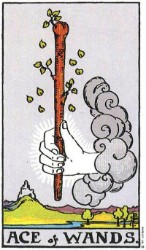
That’s what’s portrayed in the Tarot card, The Ace of Wands.  Wands represent ideas and this is an idea or thought coming into the world in its purest form of mental energy.  It’s, “divinely inspired.”

That STILL doesn’t tell us exactly what an idea IS, though.  It’s just talking about it’s source, rather than it’s contents.

Now, the Theosophists and Victorian occultists had very specific ideas of exactly what an idea is.  They viewed ideas as thought-forms, which is to say, individual little packets of energy produced by our brains and emotions and auric fields.  And – important point – they felt that they were independent of the human being once they were produced.

We’ve all seen those cartoons where there’s a person having a thought that appears as a bubble with text in it, hovering over the character’s head.  That’s a convenient way to visualize what the Theosophists were talking about.  Every time that we have a thought, it’s like our bio-field – our brains, emotional energies, energy bodies – are extruding a little, tiny thought-form bubbles that exists outside of us.

Most of the bubbles don’t last very long because they don’t contain much energy.  Let’s face it, many of us are NOT thinking about the theory of relativity while we play the piano.  Instead, we’re having really profound thoughts like, “Where’d I put my car keys?  Need a cup of coffee.  Gotta walk the dog.  Did I do the laundry?”   So these are little bubbles that appear for a moment, pop, and disappear.

When the thought forms are really heavily charged with energy, though, they stick around.  How do they get charged?  Well, through emotions and through repetition.

Suppose you just went to bed with someone and you had a super-duper, unbelievable, I-think-my-ears-just-fell-off orgasm at the exact moment that you thought, “I love you.”  That, “I love you,” thought is super-charged with energy and it will last.  Ditto, if you’ve been badly shocked or frightened by something.  The more intense the emotion, the more of an energetic charge the thought-form has and the longer it will exist.

We can also charge the thought-forms with energy by thinking of them over and over and over.  On a positive note, we can see that happen when someone thinks of their lover constantly, as we tend to do in the early stages of falling in love.  The obsessive thinking keeps adding energy to that same, “I love you,” thought-form and makes it’s last.  On a negative note, we can see the same pattern with chronic anxiety and depression.  Constantly thinking of things that frighten us or make us sad just increases the charge in the thought-forms and so the depression will linger long after the original cause.

Two of the early Theosophists, Annie Besant and Charles Leadbeater, published a book called, “Thought Forms.” It had illustrations of the forms as they emerged from people’s auras, as seen by psychic mediums.  Here’s one of a peaceful thought:

And here’s one of an angry thought.

I would have liked to have seen one of a horny thought – sort of astral pornography, I guess – but the Victorians didn’t roll that way.

So is all of this true?  Maybe.  It certainly forms the basis for much of what we call visualization and manifestation, as well as the concepts of either cursing or blessing someone.  I’ll be writing more about that in the immediate future but for the time being it’s a fun concept to play with.  What if our thoughts are actual things that exist in our personal energy space and exert an influence on us and those around us?  How can we change the negative thought-forms and increase the positive-forms?  Can we pick up someone else’s thought-forms, much like a virus?

Before you dismiss the idea out of hand, remember what we started off with here: the most preeminent psychologists and scientists in the world have absolutely no idea what a thought is.  The theory of thought-forms is just as good – and maybe better – than most of their theories.

Remember that my e-book, “Just the Tarot,” is still available – dirt cheap! – on Amazon. In fact, I’m sending thought-forms at you right now. You should buy this book . . . you should buy this book . . . you should buy this book . . .

The Five of Wands, Louise Hay, and Becoming the Grown Up Who Lives in Our Heads.

A look at childhood programming and using affirmations.

If I were to say, “Your thoughts are total bullshit,” you’d probably feel highly insulted.  On the other hand, if I were to say, “My thoughts are total bullshit,”  you might agree with me or you might tell me that’s not true and wonder where I got such a terrible self-image.

But if I were to say, “A lot of OUR thoughts, as human beings, are total bullshit,” that’s a more fertile ground for discussion simply because it depersonalizes it and takes us out of a fight-or-flight reaction.  We don’t have to defend anything or run away from being criticized.

In, “You Can Heal Your Life,” Louise Hay made the point that, at their base, our thoughts really mean nothing at all.  They’re just words that we string together and they don’t take on any meaning by themselves.  We have to ASSIGN meaning to them.  We have to say, “I believe these thoughts are true.”

And, oddly, our beliefs are nothing more than thoughts that we’ve repeated over and over and over until we believe that they’re true.  When we take a little closer look at those thoughts we can understand exactly why so many of them really are bullshit.

First of all, a lot of our thoughts were, “installed,” in our little brains when we were far, far too young to make any rational judgements about their validity.  By the time that we reach late adolescence most of us have been thoroughly programmed with unexamined thoughts that we believe to be true.  The richest source of the programming is our families, of course, but we get a hefty dose of it from our teachers and peers, as well.  Some of those thoughts might be things like:

I’m no good at math.

I can’t dance.

I’m a terrible athlete.

I’m not very good looking.

I’m too fat or too skinny or too tall or too short.

I don’t fit in.

Nobody likes me.

Or the thoughts might be something like:

Democrats are communists.

Republicans are fascists.

Rich people are heartless.

People who don’t practice my religion are evil.

Black people are scary or white people are arrogant honkies.

Immigrants are too lazy to work AND they’re going to steal my job.

These are all just words, strung together to make thoughts, which were repeated over and over when we were young until we came to believe that they must be true.

The truth of these beliefs were totally unexamined when we were kids because we didn’t have the mental capacity to evaluate them.  If our parents or teachers told us they were true, well then – hey –  they must be true because that’s what the grownups said. For the most part, though, they remain unexamined when we’re adults, which is the second reason that many or our thoughts are total bullshit.

Most of our thoughts are subliminal, which literally means, “below the light.”  In this case, we mean, “below the light of consciousness.”  We just think them, without even being aware of the fact that we’re thinking them.  That’s the infamous, “stream of consciousness,” or, “monkey mind,” that engages about 20 seconds after we wake up in the morning.  It’s just a ceaseless chatter that runs along by itself and contains – buried in its content – all of that programming that we got as kids.  It sounds like this:

Gotta get the coffee going, godamn it’s cold, I wonder if I have enough gas in the car, should have balanced the checkbook but I’m no good at math, gotta get the kids up and make breakfast, can’t believe the price of eggs, it’s the rich Republicans driving the prices up, nobody cares about working people, if only I had a better job but I’m not smart enough to get a better job, where are my socks . . .”

The unexamined thoughts that were programmed into us when we were kids are running over and over again, all the time, and remain unexamined.  And, yes, thoughts that are repeated over and over become beliefs and, like the people in the Five of Wands, we’ll fight to the death to defend our beliefs.

Which is the third reason that most of our thoughts are bullshit.  We’re totally ego involved with them.  Most of us, most of the time, completely identify with that subliminal thought stream.  We experience it as, “These are MY thoughts in MY mind, therefore, they’re a part of me.”  It never occurs to us that they’re not really our thoughts.  They’re our parent’s thoughts and our teacher’s thoughts and maybe even the thoughts of that bully who tortured us at recess in the third grade.

Affirmations, as Louise Hay points out, are a simple way to step out of that thought stream and start changing our beliefs by changing our thoughts.  Let’s face it:  most of don’t have the time to just sit there all day and watch our thoughts.  “Ah HA!  There’s another negative thought from my childhood programming!  Take THAT, negative thought!”

What we can do, though, is to become a little more conscious of our thought streams.  Even when we’re working or driving to the store or taking a shower, we can watch the mind chattering away and consciously think, “Okay, that’s a pretty negative thought,  And it’s probably not MY thought; it’s just something my mind was taught when I was a kid.”

When we begin to dis-identify with that constant stream of thoughts, we immediately lose the need to defend them.  After all, they’re not really my thoughts, so why should I care about them?  And then we can begin to replace all of that subliminal programming with programming that we consciously choose.

Just pick a positive thought – any positive thought – and repeat it 3 or 400 times a day.  Does that seem like a lot?  Well, how many times a day do we say something negative to ourselves with that childhood programming?  Hundreds of times, right?

If that sounds like a sort of a forced, Pollyanna Positivity it’s because it is. We are quite literally pushing our thoughts in a new direction and it can feel completely unnatural to begin with.  But that’s the whole point:  there’s nothing, “natural,” about our unhappy beliefs, either.  They were just thoughts that were repeated again and again, often by the miserably unhappy adults who raised us.  That’s all that happy beliefs are, too – thoughts that are repeated again and again until they become beliefs.  And we get to be the adults who are repeating them, which is pretty cool.

Small Town America, the Chat ‘N’ Chew Cafe’, and the Five of Wands.

A look at why small town Americans overwhelmingly support Donald Trump.

When we look at the electoral map of the United States, we can’t help but notice that there is a veritable sea of Red States that stretches from one coast to the other.  When we look a little closer at that sea, we notice that it’s actually composed of millions of tiny, little towns in thousands of tiny, little counties.  This is rock solid Trump country and – since Trump is a Master Salesman – it might behoove us to look at exactly what it is that he’s selling to these folks.

In a word, it’s, “nostalgia.”  Nostalgia for a simpler, cleaner, more understandable way of life.  You know . . . like we all had in the 1950s.

Now, I passed through a fair number of those little towns as I was growing up and, in many ways, they were all remarkably similar.

1 – They all had a local cafe’/hamburger joint with a cute name like, “The Chat ’N’ Chew,” where folks gathered for Sunday brunch or morning coffee.

2 -They all had one barber shop and one beauty salon.

3 -They all had a local high school and the Friday night football game at that high school was the most important event of the week.

4 -The high school football team was always called, “The Fightin’ ___________, “ (fill in the blank according to the local animal mascot, although I never encountered, “The Fighting’ Oysters.”)

5 -They all had some version of a local swimming hole where the younger kids frolicked and the older kids might go skinny dipping on a dare.

6 -They all had a, “lovers lane,” which was usually a small road on a hill or bluff where the high school kids went to explore their sexualities and lose their virginities.

7 – Except in the South, they all had one or two, “Negro,” families whose children might be allowed to attend the local schools, but were de facto segregated in every other way.

8 – They all had one token, “queer,” who was usually a single, older male who owned the local antique shop, cared for his aging mother, and was known to be, “a little light in the loafers, if ya know what I mean.”

9 – They were all convinced that their little town was somehow unique, different, and better than all of the other little towns and they usually had a billboard right outside of the town to tell you just exactly that.

I mention all of this, not to make fun of or denigrate those towns, but to point out that THEY WERE REALLY REAL.  Millions of Americans were born in and grew up those places and lived extremely happy lives in them.  

And then they left.

A big factor in their leaving is that Small Town America doesn’t have many ways to make a living.  Unless your Daddy owned a farm or your Mama owned The Chat ’N’ Chew, you were pretty well screwed in finding a job.  Another reason, of course, is that young people naturally want to get out and explore the world, to see what lies beyond that billboard on the edge of town.

There are many other millions of us who never had those small town experiences.  We can legitimately point out that while they were living their Ozzie and Harriet/white picket fences/1950s lives, Black people were still being lynched in the South.  Latinos were walled into barrios.  Gay folks were routinely beaten and sometimes killed.  Middle class women were quietly losing their minds and becoming addicted to Valium in record numbers.

That’s not to say that those small towns were hot beds of racism and homophobia.  For most of the people who lived there, those simply weren’t issues that they dealt with.  Except for that local antique dealer, there weren’t any queers and the few Black folks who lived there weren’t a problem because they kept their heads down and kept to themselves.

The end result is that we have millions of Americans who look back on their lives in Small Town, USA, as a golden, magical time.  These are the folks who spend thousands of dollars to travel back to high school reunions and reminisce over, “that year when the football team was the district champion.”

You also see these folks on the local community pages on FaceBook.   They chime in with comments like, “Hey, I lived in Thimble Town in the 1960s.  Does anybody else remember the milk shakes at Stegner’s 5 and dime?”  Or, “Whatever happened to Mrs. Peachtree?  She was my favorite teacher.”

That’s exactly what Trump is selling to that sea of Red Counties and Towns: nostalgia for a time that they viewed as simpler and easier, where everything, “made sense.”  It isn’t just the people who are still living there, it’s also the millions of people who USED to live there.

And so we’ve ended up with an America that’s essentially divided into two different cultures:  the rural folks, who remember a time when their lives were so much better; and the urban and coastal dwellers who view that life as largely incomprehensible, if not a down right lie.  Much like the Five of Wands, we’ve got a whole bunch of people swinging sticks at each other but never quite connecting.

The ironic thing, of course, is that the man who’s selling that nostalgic vision to the rural folks has never gone camping or hiking, never gone fishing or hunting, never owned a dog, lived most of his life in a penthouse in New York City, and wouldn’t be caught dead in a pair of blue jeans.

All of which doesn’t matter to his supporters in the least. A good salesman doesn’t just sell a product.  He sells an illusion.  And there is no better illusionist in the world than Donald J. Trump.

Being a Misfit, Being Heard, and the Five of Pentacles

The pain of never being understood and how to use it for growth.

About a year and a half ago, I took the Myers-Briggs Type Indicator (MBTI) personality test and discovered that I belong to a group called the, “INFJ.”  INFJs are essentially introverted intuitives and are as rare as hair on a frog.  Only 1% of the population are INFJs and less than 1/2 of 1% of the population are INFJ males.

Americans love to think of themselves as being special and unique, of course, so a small cottage industry has arisen around being an INFJ.  Claiming to be an INFJ has become sort of a short hand to tell other people how incredibly evolved and spiritual and sensitive you are. 

There are a kazillion videos and books pointing out how FABULOUSLY wonderful INFJs are and you can even buy INFJ tee shirts and bumper stickers just in case some mere mortals missed the bulletin.

I, on the other hand, looked at the description of the personality type and thought, “Oh, I am SO fucked.”

One of the strongest human drives is the need to be heard and acknowledged.  To have the feeling that other human beings – or even ONE human being – truly hears what we’re saying and understands what we’re feeling and thinking.

American couples spend millions of dollars every year going to therapists to learn how to communicate and to listen to each other.  In other words, how to be heard by our partners.

Many of us derive a great deal of pleasure from social media sites like FaceBook because we feel that someone out there is actually hearing us and acknowledging our existence.

Thic Nhat Hahn and other Buddhist masters have stressed the importance of deep and compassionate listening.  Hearing what the other person is really saying rather than composing a clever response while they’re speaking.

Actually being heard for who we are seems to heal the human heart.

While Americans may worship the concept of being, “unique,” they don’t really see the flip side of it, which is that the more different you are, the less likely it is that other people will actually understand you.  Some people might look at the INFJ personality configuration and think, “Oh, boy, I’m SO special.”  What they’re not seeing is that 99% of the people in the world don’t see the world the same way that the INFJ sees it and probably never will.

And that can break your heart. That can drive you to end it.

There are, of course, many other ways besides being an INFJ that will cause a person to not, “fit in.”  I was born into an Army family and military brats are renowned for feeling like perpetual outsiders in the civilian community.  It might be caused by belonging to a racial or ethnic minority, or having a disability, or being gay or trans, or not fitting the cultural standards of being physically attractive.  Janis Ian expressed that so poignantly in her song, “At Seventeen”,:

I learned the truth at seventeen 

That love was meant for beauty queens 

And high school girls with clear-skinned smiles 

Who married young and then retired . . .

High School, perhaps above all else, teaches us the cruel realities of not fitting in.  

Oddly, not fitting in – being a misfit –  can eventually quit breaking our hearts and act as a springboard to spiritual growth.  That only happens, though, when we finally surrender and just give up.  

What happens to a person who truly doesn’t fit in when they try to fit in?  Essentially, they deny their own reality and desperately attempt to, “blend in.”  They try to become what they think other people will like.  They hollow themselves out more and more in the quest to have someone, even one person, understand them and love them for who they really are.

The paradox, of course, is that they’re trying to trick someone into loving them for who they are by being who they aren’t, so even if they snag a friend or a lover or a partner, they’re still not really being seen or loved.

Eventually, if we keep that up, we come to feel like the beggars in the Five of Pentacles, always on the outside in the cold while the, “normal,” people are inside the church receiving all of the blessings that seem to be their birthrights.

There’s something incredibly liberating, though, when we finally admit to ourselves that we don’t fit in and never will.  When we finally admit that we’re never going to be one of the beautiful, golden people who seem to wear their lives like a tailored glove.

No, it doesn’t mean that we’ll finally be heard or acknowledged by other people.  In fact, the more we become our authentic selves, the more likely it is that other people will not hear us.

But . . . we can finally hear our Selves.

The Five of Pentacles, Karma, and God’s Little Baskets of Muffins

Transforming ourselves through karmic selfishness.

I have a younger friend who HATES karma.

More specifically, he hates when he’s in the middle of an, “Oh poor me,” bitching session and someone shrugs her shoulders and says, “Well, that’s karma.”  

First of all, it interrupts the rhythm of his complaining and he has to go back and remember what he was so upset about.  

“What was I saying?  I know it was important . . . oh, I remember . . . life is meaningless and no one understands me . . .”

Secondly, it infuriates him because it suggests that the mess he finds himself in is somehow HIS fault and the whole point of his rap is that it’s everything and everyone else’s fault.  Which is just further proof that no one understands him.

This guy was raised by a Buddhist and that may have something to do with his constant irritation.  It’s developmentally important that teenagers be able to rebel against their parents.  The first way that we really begin to define who we are in the world is by making it clear that we aren’t our parents.  I imagine that it must be pretty damned difficult for a teenager to get any rebellion traction against a Buddhist parent.

“You know, Dad, sometimes I really hate you.”

“Well, son, all strong emotions will pass if we simply do a little deep breathing.  Remember, you’re the sky and your emotions are just clouds drifting by.”

Or

“I’ve been think about getting a tattoo.  What do you think about that?”

“Ah . . . perhaps you should get a tattoo of a double dorje or some other sacred symbol.  In a sense, it would be a constant reminder of the spiritual nature that dwells in physical matter.”

Or

“Maybe I’ll paint my face blue and dye my hair orange.”

“Hmmm . . . I wonder if you were a Druid in a past life.  Do you feel a particular attraction to oak trees?”

Aargh!  So it’s possible that this guy was deeply emotionally scarred by all of that loving kindness and unconditional acceptance from his parents.  If only they’d yelled at him or told him he was an idiot occasionally!  

Still, he does have a bit of a point about the notion of karma.

It’s perfectly understandable that people get a little riled up over the idea of crappy things happening to them because of what they may have done in a past life.  After all, most of us have absolutely no memory of our past lives and so it feels like we’re being punished for something that someone else did.  

Suppose I was Attila the Hun in a past life and in a fit of Barbarian Rage I whipped out my scimitar and beheaded a turtle.  Then 200 lifetimes later –   as Dan Adair –  I’m in a traffic accident and I get whiplash BECAUSE I decapitated that turtle.  That seems a little . . . unjust.  I mean, I’m NOT Attila in any sort of a meaningful sense, so why should I get sent to the principal’s office because Attila was a dick?

And then, to make it even worse, when I’m sitting there in my cervical collar reflecting on exactly HOW unjust it all is, an acquaintance says, “Oh, well, that’s karma.”  As my younger friend would put it:  “Fuck you.”

Now, there’s a particularly odious Christian doctrine called, “predestination.”  It holds that some people are born with the unchangeable destiny that they’re going to heaven when they die. Other people are born with the unchangeable destiny that they’re going straight to hell when they die.  It doesn’t matter what we do or how we behave, our ultimate destiny has already been decided at the moment of birth.

It’s like God is up there in the Kosmic Kitchen baking up human Souls and, as he pulls each one out of the Soul Muffin Pan, he tosses them into separate baskets marked, “Heaven,” and, “Hell.”

“Okay, heaven, heaven, heaven – whoops, you’re fucked – hell, heaven, fucked again, heaven . . .”  Like the beggars in the Five of Pentacles, we’re out in the cold and we’re going to stay there.

Theologians came up with a perfectly logical reason for this totally insane doctrine.  The idea is that God is all powerful and all knowing.  So if God knows everything, then that must mean that he knows everything that happened in the past, the present, AND the future!  And if God already knows what’s going to happen in the future, then he must already know who’s going to heaven and who’s going to hell.  Shazam!  There you are – it’s already determined.

That’s the kind of weird, Left-Brain, cuckoo for coco puffs vibe that a lot of people get off of the notion of karma.  It seems to be some sort of an inexorable process that was put into motion a long time before we came along and there’s not a damned thing we can do about it.  We’re either in the Heaven Basket or we’re in the Oh, You’re So Fucked Basket.  Like it’s something that happens TO us for no particular reason.

Of course, the important point that most of us miss is that karma isn’t happening to us, we’re happening to karma.  It’s a totally dynamic process and it’s something that we can change every single day simply by the ways that we behave right now.

The most simplistic way to think of it is as a sort of a bank account.  Rather than being born into a You’re-Going-to-Hell Basket or a You’re-Going-to-Heaven Basket, we’re born with a certain amount of Karmic Kash that we earned (or didn’t earn) in past lives.  The Dalai Lama will probably be reborn with several savings accounts, a really huge checking account, many certificates of deposit and a great coin collection.  Attila the Turtle Beheader, on the other hand, will be reborn with 50 cents in the bank and a lot of overdue bills.

The thing is, though, that the way that we’re born isn’t our destiny.  The way that we behave is our destiny.  Attila, for instance, might start a refuge for homeless turtles.  Every single time that he saves a turtle and gives it a meaningful life – KA -CHING – that’s another deposit in his Karma Account.  The Dalai Lama, on the other hand, might decide to support Eric Trump for President and – ZAP – that’s a major withdrawal from his Karmic Account.

As David Michie said in, “Buddhism for Busy People,” 

In what is one of the most outstandingly ingenious aspects of Buddhist teachings, we come to realize that our own selfish interests lie in being altruistic . . .months, years or decades of being generous for selfish reasons begin to have a predictable effect . . .what starts out as a contrived and self-conscious change of attitude and behavior results in a genuine metamorphosis.

In other words, we don’t have to start out as Mother Theresa or an Awakened Master.  We can start out as perfectly normal, selfish, self-centered human beings who are being kind to other beings because we DON’T want to end up wearing a cervical collar.  When we pick up a turtle that’s in the middle of the road and leave it safely on the other side, we can be doing it for the completely selfish reason of wanting to fill up our Karmic Account.

As we continue those little acts of kindness they gradually transform us.  They become acts of loving/kindness, where we’re actually noticing and caring about the welfare of the people and beings around us.  The translation of the word, “karma,” is, “action,” and that’s the key.  Our actions change us, even if they originate in selfishness.

And that’s how Attila the Hun becomes the Dalai Lama.  Pretty simple.

The Rules of Synchronicity, Having Sex with Pizzas, and Becoming More Flow-ish

Basic rules for increasing synchronicity in your life and getting in the Flow.

We’re all familiar with that state of being that we call, “being in the Zone,” or, “being in the Flow.” Both artists and athletes talk about the special state of consciousness where their work becomes completely focussed, everything they want to accomplish unfolds effortlessly and the perception of time seems to be suspended. When we’re in the Flow, life becomes a magical mystery tour and feels like a perfect fit instead of a struggle.

There are dozens of books out there on the subject of the Flow, but my favorite is Charlene Belitz groundbreaking book The Power of Flow. She noted that when we’re in the Flow state, we have a marked increase in synchronistic events and she thought, “Hmmmm . . . if synchronicity goes along with the Flow state like cheese dip goes with Doritos . . . then that means that when one occurs, the other occurs, too. So . . . if we can increase synchronicity, maybe we can increase being in the Flow.”

And it works. I tried it. When I trigger extra synchronicity in my life, then my life begins to hum along much more smoothly and I feel happier, more content, and easier in my spirit. I may not be in the Flow constantly, but I’m sure as hell a lot more Flow-ish and that feels pretty good.

When we boil down synchronicity and then hang it on the line to dry, it basically just means that the universe is having a conversation with us. Carl Jung defined it as, “a meaningful convergence of interior and exterior events,” which is really just a formal way of saying that the universe is noticing what we’re thinking and interacting with our thoughts.

The classic example is when we’re sitting there thinking about our Great Aunt Petunia Lilac Huckleberry, whom we haven’t spoken to in 25 years, the phone rings and – Shazam! – it’s Aunt Petunia and she has something really important to tell us. Now, we can dissect that and analyze it and pick it apart a million ways to Sunday, but there are really only three things we need to focus on here: (1) We thought of Aunt Petunia; (2) Aunt Petunia called us; and (3) it was meaningful.

That sort of thing happens to all of us on what seems to be a completely random basis. Since it’s random – in other words, we’re not consciously causing it to happen – we just call it a coincidence. We shrug our shoulders and say, “Well, that was damned weird,” and just forget about it.

On the other hand, when we recognize that it’s really a thing – that we can make things like that happen – then it becomes a force in our lives. We start experiencing synchronicity a lot more because we’re asking for it to happen. And as we experience more synchronicity, then we find ourselves more and more in the Flow and life becomes a LOT easier.

There are some simple rules involved with causing more synchronicity to appear in our lives. I’ve stumbled across some of them as I’ve explored the subject and want to share them in a few ongoing posts, so I’ll start with this one.

SYNCHRONICITY RULE NUMBER ONE: START THE CONVERSATION

The first rule is to realize that there is something out there talking with us, having meaningful conversations, and giving us answers when we need them. BUT . . . whatever it is, it doesn’t usually start the conversation. We need to reach out to whatever it is first, and then it replies to us.

Human beings have realized that there was something out there talking with us for most of our existence and we’ve tried to fill in the blanks about who or what it is. Some people perceive the something out there as angels and spirit guides. Some people perceive it as Fairies. Some people see it as Jesus answering their prayers. Some people think of it in impersonal terms, like the Tao.

It doesn’t matter! We don’t have to figure out exactly what it is that’s talking back to us in order to have the conversation. If you feel more comfortable calling it Jesus, that’s fine. If you prefer Spirit Guides, that’s fine, too. If you just want to call it, “Hey, you,” then go for it. The main thing is to just realize that it’s there, it has answers for you, and it’s waiting for you to ask for them.

So, suppose you have a new boyfriend and he seems to be just perfect. He’s charming, good looking, he’s well read, fun to be with, has lots of money to throw around, and you think he may be The One. BUT . . . as the relationship develops you discover that the only way that he can have sex is to slather himself in tomato paste and cover his body with slices of pepperoni. Unless he’s dressed up as a pizza, he’s completely impotent in bed and you’re highly conflicted about this because you don’t much care for pizza and you certainly don’t want to eat it every night. It’s a conundrum and you need some guidance about your choices in the matter.

So what do you do? You just stop and say, “Hey, you, (or Jesus or Fairies or Tao) what should I do about this? I think I love the guy, but shtupping Italian food just really doesn’t turn me on.” And then you take a walk or go to work or throw all of your tomato covered bed sheets in the washer and wait for an answer.

And the answer will come. It may be something as dramatic as the local Round Table Pizza burning to the ground or it may be as subtle as finding a can of tomato paste that’s been run over by a truck, but the answer will come. Once we ask the question, the universe will always find a way to let us know what we need to do.

Which leads us to Rule Number One (a):

DON’T BE AN ASKHOLE

Have you ever had a friend who was constantly asking for your advice but never took it? They come to you with one problem after another, ask what they should do, and then manufacture endless reasons for why they can’t possibly do what you suggested.

They’re basically being askholes. They’re not really interested in solutions, they’re just interested in the drama of their problems. We may occasionally lose our tempers and blow up at those people but more often we just fade away. We start avoiding them as much as we can and, if they corner us, we just nod and say, “Uh, huh. Golly. How ‘bout that? Gee whiz.”

We’ve learned that they’re never going to follow our advice and so we stop giving it. The Universe (or Jesus or Fairies or the Tao or Hey You) is very much like that. If we ask for help with something, it will always respond with an answer. But . . . if we continually ignore the advice, then Hey You will start avoiding us and ignoring our questions because it knows we don’t really want an answer.

So, in the example above, the Universe might suggest that you leave the guy, or it might suggest that you sprinkle him with Parmesan cheese before you have sex, or it might suggest that you ask him to dress up like a grilled cheese sandwich instead of a pizza and see how THAT goes. Whatever form the advice comes in, we need to act on it. If we don’t, the advice will just stop coming. If we do, then the advice will increase, synchronicity will increase, and we’ll find ourselves more and more in the Flow.

I’ll be offering some more insights on how to increase synchronicity in the next few posts. In the meantime, ask and ye shall receive. Askhole and ye shall not.

Remember that my ebook, Just the Tarot, is still available on Amazon for less than the price of a single slice of pizza and MUCH less than a grilled cheese sandwich with tomato soup. You should buy a copy.