The Rules of Synchronicity, Having Sex with Pizzas, and Becoming More Flow-ish

Basic rules for increasing synchronicity in your life and getting in the Flow.

We’re all familiar with that state of being that we call, “being in the Zone,” or, “being in the Flow.” Both artists and athletes talk about the special state of consciousness where their work becomes completely focussed, everything they want to accomplish unfolds effortlessly and the perception of time seems to be suspended. When we’re in the Flow, life becomes a magical mystery tour and feels like a perfect fit instead of a struggle.

There are dozens of books out there on the subject of the Flow, but my favorite is Charlene Belitz groundbreaking book The Power of Flow. She noted that when we’re in the Flow state, we have a marked increase in synchronistic events and she thought, “Hmmmm . . . if synchronicity goes along with the Flow state like cheese dip goes with Doritos . . . then that means that when one occurs, the other occurs, too. So . . . if we can increase synchronicity, maybe we can increase being in the Flow.”

And it works. I tried it. When I trigger extra synchronicity in my life, then my life begins to hum along much more smoothly and I feel happier, more content, and easier in my spirit. I may not be in the Flow constantly, but I’m sure as hell a lot more Flow-ish and that feels pretty good.

When we boil down synchronicity and then hang it on the line to dry, it basically just means that the universe is having a conversation with us. Carl Jung defined it as, “a meaningful convergence of interior and exterior events,” which is really just a formal way of saying that the universe is noticing what we’re thinking and interacting with our thoughts.

The classic example is when we’re sitting there thinking about our Great Aunt Petunia Lilac Huckleberry, whom we haven’t spoken to in 25 years, the phone rings and – Shazam! – it’s Aunt Petunia and she has something really important to tell us. Now, we can dissect that and analyze it and pick it apart a million ways to Sunday, but there are really only three things we need to focus on here: (1) We thought of Aunt Petunia; (2) Aunt Petunia called us; and (3) it was meaningful.

That sort of thing happens to all of us on what seems to be a completely random basis. Since it’s random – in other words, we’re not consciously causing it to happen – we just call it a coincidence. We shrug our shoulders and say, “Well, that was damned weird,” and just forget about it.

On the other hand, when we recognize that it’s really a thing – that we can make things like that happen – then it becomes a force in our lives. We start experiencing synchronicity a lot more because we’re asking for it to happen. And as we experience more synchronicity, then we find ourselves more and more in the Flow and life becomes a LOT easier.

There are some simple rules involved with causing more synchronicity to appear in our lives. I’ve stumbled across some of them as I’ve explored the subject and want to share them in a few ongoing posts, so I’ll start with this one.

SYNCHRONICITY RULE NUMBER ONE: START THE CONVERSATION

The first rule is to realize that there is something out there talking with us, having meaningful conversations, and giving us answers when we need them. BUT . . . whatever it is, it doesn’t usually start the conversation. We need to reach out to whatever it is first, and then it replies to us.

Human beings have realized that there was something out there talking with us for most of our existence and we’ve tried to fill in the blanks about who or what it is. Some people perceive the something out there as angels and spirit guides. Some people perceive it as Fairies. Some people see it as Jesus answering their prayers. Some people think of it in impersonal terms, like the Tao.

It doesn’t matter! We don’t have to figure out exactly what it is that’s talking back to us in order to have the conversation. If you feel more comfortable calling it Jesus, that’s fine. If you prefer Spirit Guides, that’s fine, too. If you just want to call it, “Hey, you,” then go for it. The main thing is to just realize that it’s there, it has answers for you, and it’s waiting for you to ask for them.

So, suppose you have a new boyfriend and he seems to be just perfect. He’s charming, good looking, he’s well read, fun to be with, has lots of money to throw around, and you think he may be The One. BUT . . . as the relationship develops you discover that the only way that he can have sex is to slather himself in tomato paste and cover his body with slices of pepperoni. Unless he’s dressed up as a pizza, he’s completely impotent in bed and you’re highly conflicted about this because you don’t much care for pizza and you certainly don’t want to eat it every night. It’s a conundrum and you need some guidance about your choices in the matter.

So what do you do? You just stop and say, “Hey, you, (or Jesus or Fairies or Tao) what should I do about this? I think I love the guy, but shtupping Italian food just really doesn’t turn me on.” And then you take a walk or go to work or throw all of your tomato covered bed sheets in the washer and wait for an answer.

And the answer will come. It may be something as dramatic as the local Round Table Pizza burning to the ground or it may be as subtle as finding a can of tomato paste that’s been run over by a truck, but the answer will come. Once we ask the question, the universe will always find a way to let us know what we need to do.

Which leads us to Rule Number One (a):

DON’T BE AN ASKHOLE

Have you ever had a friend who was constantly asking for your advice but never took it? They come to you with one problem after another, ask what they should do, and then manufacture endless reasons for why they can’t possibly do what you suggested.

They’re basically being askholes. They’re not really interested in solutions, they’re just interested in the drama of their problems. We may occasionally lose our tempers and blow up at those people but more often we just fade away. We start avoiding them as much as we can and, if they corner us, we just nod and say, “Uh, huh. Golly. How ‘bout that? Gee whiz.”

We’ve learned that they’re never going to follow our advice and so we stop giving it. The Universe (or Jesus or Fairies or the Tao or Hey You) is very much like that. If we ask for help with something, it will always respond with an answer. But . . . if we continually ignore the advice, then Hey You will start avoiding us and ignoring our questions because it knows we don’t really want an answer.

So, in the example above, the Universe might suggest that you leave the guy, or it might suggest that you sprinkle him with Parmesan cheese before you have sex, or it might suggest that you ask him to dress up like a grilled cheese sandwich instead of a pizza and see how THAT goes. Whatever form the advice comes in, we need to act on it. If we don’t, the advice will just stop coming. If we do, then the advice will increase, synchronicity will increase, and we’ll find ourselves more and more in the Flow.

I’ll be offering some more insights on how to increase synchronicity in the next few posts. In the meantime, ask and ye shall receive. Askhole and ye shall not.

Remember that my ebook, Just the Tarot, is still available on Amazon for less than the price of a single slice of pizza and MUCH less than a grilled cheese sandwich with tomato soup. You should buy a copy.

Cheatin’ Horndogs, Vibrators in the Refrigerator, and Tarot Cards that Indicate Infidelity

Tarot cards that indicate infidelity in a relationship.

“She just started liking cheating songs,
And what’s bothering me,
I don’t know if it’s the cheating she likes,
Or just the melody.” – John Anderson

If you read Tarot cards for other people, you’ll find that one of the major topics that those people want to know about is love and romance.

Is she the right one for me?
Does he feel the same about me that I feel about him?
Should I ask her out?
Should we move in together?
Are we meant to get married?
Will this relationship last?

And, of course, with love and romance there are frequently questions about fidelity and cheating. Most marriages and relationships are, “monogamous,” which is derived from the Greek, meaning, “keep your dick in your pants,” (except when you’re with me.) A very large part of the marital and partnership contract is that when we fall in love we’ll be sexually and emotionally exclusive to that one other person.

Just the Tarot by Dan Adair – a kindle ebook available on Amazon

Having sex with or becoming emotionally attached to a third party is seen as a major violation of that contract and is grounds for terminating it. And there are major penalties that go along with that violation, such as being locked out of your house in your bathrobe, or having your partner pour maple syrup all over your best clothes just before she throws them out into the front yard. And many times, it’s not even REAL maple syrup, it’s that cheap, artificially flavored crap like Mrs. Butterworths.

Quite naturally, then, people who are cheating on their partners will go to great lengths to conceal it. And, quite naturally, the partner who’s being cheated on will somehow know, on a very deep, almost psychic level, that their mates are being unfaithful. There may be extremely subtle, subliminal clues, such as your husband having a giant hickey on his neck, or finding a pair of jockey shorts under the pillow when you wear boxer shorts. Or perhaps coming home early from work and seeing a naked man running out your back door, or finding a strange vibrator in the refrigerator next to the carton of eggs.

Those are the kinds of subdued, low key signals that will often make a person stop and ponder if there’s something more going on in their marriage than meets the eye. Still, their partners will tend to deny it. The vibrator in the refrigerator must have accidentally fallen into the grocery bag at the supermarket and really belongs to someone else. The naked man running out the backdoor was the plumber, who was sleepwalking, and was completely shocked when he awakened without clothes while he was working on the dripping faucet in the bathroom. The hickey on your husband’s neck was the result of a near tragic vacuum cleaner accident at work. The jockey shorts under the pillow were meant to be a present and now you’ve gone and ruined the surprise.

Even though these are all perfectly rational, reasonable explanations, there may still be lingering suspicions and so your client will want to consult the Tarot cards to determine the truth. Here are a few cards that may indicate that the questioner’s partner is what is clinically referred to as a, “cheatin’ horndog.”

THE LOVERS REVERSED

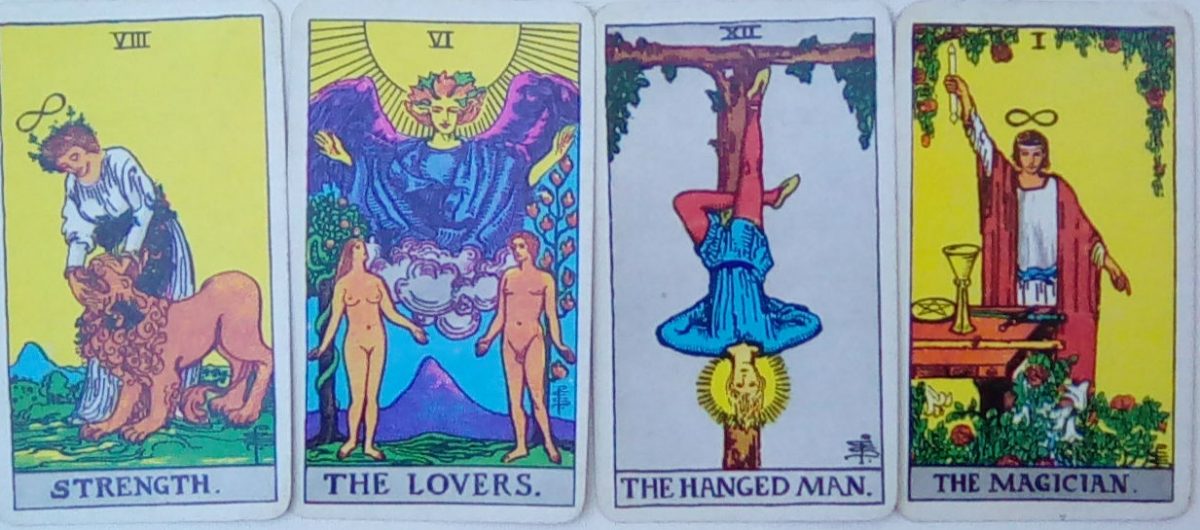
The Lovers is obviously THE romantic relationship card in the Tarot deck. It shows that period of time when you’re first together with your romantic partner and the whole world seems magical and glowing. It’s just the two of you, in your shining little garden. Just you and the angels and . . . um . . . that pesky snake climbing up the tree. When it’s reversed, the party’s over, baby. You’ve been thrown out of the garden and it’s time to deal with reality.

THE DEVIL (UPRIGHT OR REVERSED)

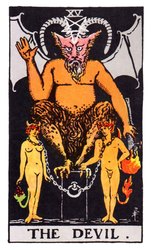
The Devil card shows the same two figures from The Lovers card, only things don’t seem to be as peachy anymore. For one thing, instead of an angel hovering over them, there’s a great big horny kind of a goat/bat demon thingie. They’re chained to a black stone or altar and they have tails which are on fire. (Having your tail burst into flames is another one of those subtle signs that there may be something wrong.) The Devil card can mean a lot of rotten things, such as addictions, super negativity, etc, etc,, but in this context – cheatin’ horndogs – it probably indicates a sexual affair that’s going on and it probably indicates that it’s a pretty heavy duty affair that may have strong elements of BDSM. I mean, horny goats, chains and flaming tails? Really?

THE TOWER (UPRIGHT OR REVERSED)

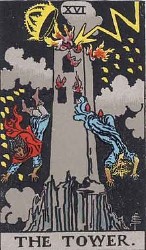
The Tower, as you might guess, is NOT a positive card. It usually indicates a freaking disaster that’s happening right in the middle of our happy little lives. The flash of the lightning bolts indicates that it’s sudden and shocking. It tends to destroy our lives right down to the foundation and then we’ve got to start rebuilding them, piece by piece. Having this show up in a reading about fidelity would indicate the sudden knowledge that your partner has been unfaithful and the relationship has been completely destroyed by that lack of fidelity.

FIVE OF WANDS

The Five of Wands may show up in a relationship where there’s a LOT of emotional turmoil. In the South, they talk about, “fight and fuck,” relationships. These are relationships where the two people involved have huge fights with much screaming and throwing of plates, and then they reconcile and have make-up sex that’s incredibly good. There are spoken phrases in there like, “Oh, baby, I’m so sorry,” and, “I promise this will never happen again, ‘cause you’re the dumplings in my chicken soup, honey buns.” Yes, I know honey buns and chicken soup are a disgusting combination, but you get the idea. There’s cheating going on, but they’ll probably reconcile and spend the next week in bed.


QUEEN OF WANDS REVERSED

The Queen of Wands has a lot of good characteristics and, among them, is fidelity. If she shows up reversed, there’s a very good chance that someone isn’t practicing that virtue.

ACE OF CUPS REVERSED

The Ace of Cups shows pure, unadulterated love pouring into the world. It tends to appear when someone is just starting off on a new romantic relationship and their hearts are full of love. When it’s reversed, there’s a good chance that their love got adulterated by a cheatin’, adulterating horndog.

THREE OF CUPS REVERSED

Obviously, this is very much of a party hardy card. When it’s upright, it’s healthy, joyous and free partying. When it’s reversed and shows up in this kind of a reading it can indicate that the joy is leaving or that your partner is partying with someone else.

TEN OF CUPS REVERSED

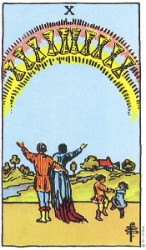
Among other things, the Ten of Cups is the Happy Family card. When it’s reversed it can be a sign that the happy family is breaking up, particularly if it’s a family with children involved.

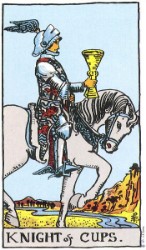
KNIGHT OF CUPS REVERSED

The Knight of Cups is riding out on a sincere quest for love. Reversed, it indicates that the love wasn’t found.

THREE OF SWORDS

LOL – well . . . yeah . . . that one’s pretty obvious. Stabbed right in the heart.

SEVEN OF SWORDS

The Seven of Swords is all about sneaking around and stealing someone else’s power. This is the kind of person who has an affair right in front of everyone’s eyes and somehow gets away with it. This card also shows up frequently when you’re involved with a malignant narcissist who’s just using you for their own ego gratification.

TWO OF PENTACLES

The Two of Pentacles may show up in a reading like this to indicate someone who’s trying to juggle two different love affairs and keep both of them going.

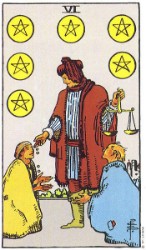
SIX OF PENTACLES

This may indicate a lover who’s not really giving with a whole, loving heart. Love is being measured out very carefully.

Those are just a few of the red flags that may show up if your questioner wants to know if his or her partner is running around.

Remember to be very careful with these types of readings. Many people are in a great deal of denial when relationships are falling apart and really, really DON’T want you to tell them what you see in the reading. What they want is for you to tell them that they were wrong and that the vibrator in the refrigerator is really just a whipped cream dispenser. If you’re doing a reading for your best friend and you tell her that her husband is playing hide-the-sausage with his secretary, she may not be pleased with you. At all.

And, of course, it’s always possible that the questioner’s partner might NOT be a cheatin’ horn dog. He could just be a rat faced dingleberry, which is an entirely different kettle of fish. In either case, approach this topic with caution. Practice using phrases such as:

It seems that all may not be as it appears.
There’s a certain murkiness here.
There appears to be a fork in the road of life.

Avoid using phrases such as:

I think he’s dipping his wick with your best friend.
She’s a real bottom feeder and believe me, I MEAN bottom.
You should have listened to your mother. By the way, does your mother still have that spare room?

The Seven of Swords, Vampires in Pink Bow Ties, and Malignant Narcissists

Malignant Narcissists as the source of monster legends.

Have you ever been worked over by a malignant narcissist?

Perhaps an incredibly charming person appeared in your life and he or she seemed to absolutely worship you.  You were told to an almost embarrassing extent how perfect you were, how beautiful, how intelligent, how sexy.  You fell in love, let down all of your guards and boundaries, and within a year that same person was constantly devaluing your opinions and your self worth and telling you that you just weren’t quite good enough.  You were too fat or too skinny or not very bright or not very well informed or your hair was too long or too short or you weren’t very satisfying in bed.

Or perhaps it was a family member, someone you’d always been fond of and trusted, but you find that they’re actually tearing you down and belittling you to other family members when you’re not there.

Or perhaps it’s a co-worker that you liked and opened up to about your personal life when you had a couple of drinks too many on a Friday night.  On Monday morning you’re shocked to discover that your drinking buddy has shared your personal, “secrets,” not only with all of your co-workers but with your boss, as well.  

There’s a common reaction from anyone who’s been chopped up and spit out by a malignant narcissist and that reaction is bewilderment.

“How could I have been so stupid?”

“Why didn’t I see this coming?”

“But . . . I thought he loved me . . .”

“She totally got under my radar.”

For whatever scant comfort it may provide, you’re in extremely good company.  Some of the smartest, most empathetic, highly evolved people in the world have been taken to the emotional cleaners by malignant narcissists.  It’s what they do and they’re experts at it.  It has NOTHING to do with how intelligent you are, how attractive you are, or how evolved you are.  To a malignant narcissist, you’re just a tasty snack.

The Seven of Swords is a perfect image of a malignant narcissist.  He’s stealing someone else’s power, as represented by the swords slung over his shoulder.  The flaps on the tent are closed, showing that the person he’s stealing from is totally unaware of what he’s doing.  And even the guard posted outside of the tent – representing our conscious mind – seems to not register what’s going on.

If we type, “malignant narcissist,” into a search engine, we’ll get a huge number of results.  There are literally thousands of articles and videos discussing what they do to other people, how they do it, and why they’re malignant narcissists to begin with.  Really, it’s kind of astounding when we realize that they only comprise 5% of the population.  To put it one way, they seem to have an over-sized footprint.  To put it another way, they’ve fucked with an AWFUL lot of us.

Although the term, “malignant narcissist,” is fairly new, there’s nothing new about this personality type.  In the past, they’ve been referred to as sociopaths, psychopaths, monomaniacs, and, “utterly without a conscience.”

And my favorite term for them:  monsters.

There is something positively inhuman about malignant narcissists.  They seem to have absolutely no sense of empathy or compassion.  They have no conscience and remorse.  And, far from being intelligent in the sense that most of us might use the term, their intelligence is more on the level of a vicious animal, a predator hunting down its prey.

We don’t even have to bend reality too much to see the malignant narcissist as the probable source of all of the, “monster,” legends that human cultures have promulgated.  Vampires, for instance, were seen as beings with no souls, no compassion, who fed on their victims and destroyed them in the process.  That’s a pretty good description of a malignant narcissist.

Of course, one of the things that folklore tells us about vampires is that they didn’t have any reflection in a mirror, which would drive a malignant narcissist nuts. They like to see how beautiful they are.  It might have been the reason that vampires were always on the prowl for fresh victims:  not just for fresh blood, but for more feedback.

“So . . . before I bite into your jugular vein and drain all of the life out of you, let me ask you one question.  How do I look in this outfit?”

“Wha . . . wha . . . WHAT?”

“This outfit.  How do I look?  The tuxedo and the string tie.  Too much?  Does it make me look pale?  I can’t see myself in the mirror, you know, and I’m just dying to know what you think of it.”

“Well . . . I mean . . . it is a little stark, I guess.  Just black and white is kind of . . . I don’t know . . . a little visually boring.  It could maybe use a touch of color.”

“Ah HA!  Precisely what I was thinking!  Just a dash of something a little brighter.  A red cummerbund, perhaps, or even a pink bow tie.”

“No, no, I wouldn’t go with pink.  Pink just isn’t . . . you.  Red would be fine.  Red would match your eyes and it’s more of a statement of who you really are.  You know:  the whole blood thing.  You could probably even get away with a deep magenta, but no pink.”

“Ah, thank you, thank you.  This conversation has been really invaluable to me.  Now, just one more thing before I kill you.  How do you like this hairstyle?  I’ve been thinking less hair gel and more curls . . .”

We can extend the vampire metaphor even further.  Like vampires, malignant narcissists just . . . won’t . . . stay . . . fucking . . . DEAD.  When we finally get enough of them and tell them to get lost, they just keep coming back for another drink of our blood.  It really does feel like we’d have to drive a stake through their hearts, cut their heads off, and stuff their mouths full of garlic cloves to finally make them shut up and leave us the fuck alone.

And, of course, malignant narcissists can’t stand the light of day.  When they’re finally fully exposed for what they are, they crumble into dust.  It becomes totally apparent that there’s no human substance to them, that there’s nothing there but sharp teeth and a giant ego.

One final thing that they have in common with vampires is that they count on us to make that one flawed decision that leads us to our own destruction, which is to get involved with them in the first place.  We all know that scene in the old Dracula movies where the Intrepid Traveller is standing in front of the horrible creepy castle.  There’s blood dripping down the walls, bats are flying in and out of the windows, wolves are howling in the distance and the Traveller looks at all of that and says, “By golly, I think I’ll knock on the door and see if anyone’s at home.”

The entire theater audience is mentally shrieking, “No, no, don’t get in there, stupid!  He’ll bite your throat!  Stay at the Motel 8 instead.  I know the rooms are tiny, but there are good locks and they have those little coffee machines.”

The same thing happens with malignant narcissists.  If we don’t go through their door, we don’t get our throats bitten and have the life force drained out of us.  It may well be that most of us will never be smart enough to deal with malignant narcissists effectively.  They are, after all, apex predators.  

What we can do, though, is to learn to recognize them.  If someone shows up in our lives and they’re so charming that it’s hard to believe – don’t believe it.  If someone is love-bombing us WAY too early in the relationship, ask ourselves why they’re doing it.  If it feels like love at first sight, take a good, hard second look.  

And take a good hard look at their histories.  One of the things I’ve noticed about malignant narcissists is that they have virtually NO social media presence.  Which is odd, when we think about it, because narcissists love, love, love to talk about themselves.  Malignant narcissists, on the other hand, are terrified of people they’ve exploited blowing their cover so they have no desire to leave a record on social media.  If you knew how many ex-lovers they’d left in bloody tatters, you’d run like hell in the opposite direction.

Finally, if you’ve been victimized by a malignant narcissist even once, or if you had parents who were narcissists, I’d HIGHLY recommend watching Dr. Ramani’s series of videos on YouTube.  

David Carradine, The Higher Self, and Holes Which Don’t Exist

A brief exploration of the meaning of life as illustrated by a Chinese instruction manual.

A few years ago I was assembling a shelf that had been manufactured in China and trying to decode the instructions manual for putting it together.  There were the usual directives – “insert screws A into holes B” – and I was following them quite efficiently when I read a line that stopped me dead in my tracks:

“DO NOT PUT THE BOLT WHICH IS NOT SUPPLIED INTO THE HOLE WHICH DOES NOT EXIST.”

I stared at that sentence for several moments and realized that I had to stop and think about it because it just sounded so . . . profound.  Particularly since it had come from China which, as we all know, is a Land of Mystery which is virtually overrun with Wise Sages who utter Profound Things pretty much all of the time.

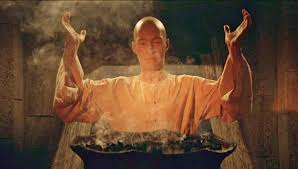
Had a Taoist Priest somehow infiltrated the Chinese shelf factory and quietly scattered deep truths in all of the instruction manuals?  I immediately visualized Master Po, the Shaolin priest on the old Kung Fu television series, looking at young David Carradine and saying, “When you can place the bolt which is not supplied into the hole which does not exist, then it will be time for you to go, Grasshopper.”

Sadly, as much as I turned the phrase over and over in my mind, I was unable to glean any universal wisdom from it.  It could be that I just haven’t reached the level of clarity and insight that will allow me to penetrate to its true meaning.  Or it might have been a typo.

In either case, the memory always makes me think about instruction manuals and the fact that all human beings come into the world supplied with them.

One of the most discomfiting experiences in life is to suddenly pop into a little higher realm of thought and wonder, “What in the holy FUCK am I doing here?”  That can also be expressed as, “What’s the meaning of life?”  Or, “Does life HAVE any meaning?  Or even, “What’s it all about, Alfie?”

All human beings yearn for meaning in one form or another.  We want to feel that we’ve somehow made a difference, that we’ve learned something, that we’ve touched other people’s hearts and spirits in our strange little trips through the Earth School.  When we actually stop and ask ourselves if our lives really mean anything, it can feel like we’re waking up on a train that’s hurtling along in the dark of night, we have NO idea how we got on the train, we don’t know where the train’s going, we don’t seem to have any ID cards in our wallets and, for some peculiar reason, we can’t quite remember who we are.

Life without a sense of meaning reduces us to feeling, as Alan Watts put it, as if we’re some sort of strange living tubes that suck in food at one end and excrete it at the other for no apparent purpose until we die.

Of course, one answer to that is to become Existentialists.  We can proclaim that life has NO meaning other than that which we personally give it and that we somehow find our meaning by embracing our meaninglessness.  That way we can go from the position of, “I don’t have a fucking clue,” to the position of, “I don’t have a fucking clue and isn’t it amazing of me to admit it?”

I mean, it’s not much of a position to take in life, but at least it’s a position.  Plus, if you’re an Existentialist, you get to be tragically hip, dress in a lot of dark clothes and frequently gaze off into the distance as if you’re in deep thought, when you’re really just thinking about what to eat for lunch.

There’s an alternative position, though, which some of the Eastern religions take and which has sort of filtered its way into the New Age/New Thoughts movements.  And that’s that we know precisely why we’re here but we’ve just forgotten.

I know, I know . . . it sounds a little far fetched.  How could we possibly forget what our purpose in life is?  Well, we forget where we put our car keys all of the time and they’re a lot easier to keep track of.

Think of it this way:  we’re hanging around out in the universe in between incarnations and we think, “Hey, you know what?  I think I’m going to incarnate on Earth!  That could be fun!  And I have this particular lesson that I need to learn and Earth might just be the perfect place to learn it.”

So before we reincarnate, we run through our pre-incarnation check list so that we can maximize our chances of learning what we need to learn.  “Let’s see . . . do I want to be born into a rich family or a poor family?  What race do I want to be?  What country do I want to be born into?  Should my parents be good people or assholes?  Do I want a penis or a vagina?  Decisions, decisions, decisions . . .”  

Then, when we’ve got everything figured out, we wait for the next opportunity to jump into a body.  “Oh, boy, here comes that sperm cell and it looks like it’s going to get to the egg and it’s getting closer and it’s crossing the finish line and – YES! – the next incarnation mission has successfully launched!  That’s one small step for man and one giant step for . . .”  

Well, you get the idea.  If all goes well and we make it through the next nine months of gestation – SHAZAM! – here we are on planet Earth, a human being, all ready to learn our lessons and fulfill our purpose for being here.  

Only, somewhere along the line, we forgot what our purpose was.

How embarrassing.  Don’t tell anyone.

Fortunately (or not, depending on our perspective), there are a lot of distractions here on planet Earth and we go on a lot of mini-missions.  We start with things like, “I wanna get fed and I want my diapers changed.”  Then, as we get older, we concentrate on things like, “I want to get laid and I want to get OUT of this goddamned high school.”  And then we move on to, “I want a partner.  I want a house.  I want a car.  I want a new computer.  I want a better job.”

It all gets very complex but, still, every once in a while, that little voice pops up and asks, “Does this mean anything?  Is this really what I’m supposed to be doing?”

It’s a terrifying question but it’s even more terrifying when we feel like there’s an answer but we can’t quite put our finger on it.

Which is where a spiritual practice comes in.

Most spiritual practitioners will tell us that that part of us, the one who said, “Hey, I think I want to incarnate on Earth and hang out there for a while,” is still with us, right here, right now, just waiting for us to ask it what in the hell we’re doing here.  You know . . . if we can pause long enough from eating and having sex and shopping on Amazon.

Some religions call it a, “Soul,” which I don’t much care for because the christian fundamentalists have pretty much yucked that up.  Other practices might refer to it as our, “Higher Self,” or our Spirit.  

People who meditate a lot will tell us that when we sit long enough watching our thoughts we become aware of the fact that there is another, “us,” sitting and watching and THAT’S the Higher Self.  Not our bodies, not our emotions, not our thoughts, but another, “us,” who is profoundly wise and deeply connected with our purpose for being here.

People who blast off on an acid trip or take a lot of magic mushrooms will frequently encounter that Higher Self and maybe zip around the astral plane with it.  Shamans who go on Spirit Quests are looking to have a little conversation with their Souls.  Even brain researchers like Jeffrey M. Schwartz posit the existence of a, “Wise Counselor,” who’s here to guide us and floats above our everyday lives.

The point is that the Wise Counselor, the Higher Self, the Spirit . . . that’s who’s got our instruction manuals.  That’s the part of us who knows why in the hell we’re here and what we’re supposed to be doing.  That’s the part of us who can tell us how to put the bolt which is not supplied into the hole which doesn’t exist.

So it becomes vitally important that we engage with that part of our being.  That we actively seek answers through whatever means will get us into communication with our Higher Selves.  For some of us that might mean meditation.  For others, ecstatic dance or yoga.  For others, psychedelics.  There is ALWAYS a gate for each one of us that leads us back to our Higher Selves.  We just have to look for it.

Once we find it, once we accomplish our purpose here in Earth school, once we learn how to put the bolt which is not supplied into the hole which doesn’t exist, then it will be time for us to go.

Grasshopper.

The Five of Cups and the Dark and Magical Path to Happiness.

Happiness as a choice, rather than just a state of being.

The Five of Cups shows a person who is in deep grief.  He’s lost something vital in his life and he’s mourning it on the deepest, most profound  level.  In the system of the Tarot, Cups represent emotions and he sees three of his cups lying on the ground, tipped over, and spilling out their emotions.  He’s literally hypnotized and immobilized by his sadness.

A sub-theme of this card is that he is also NOT focusing on the two remaining cups, which are upright and full.  He is so concentrated on what he’s lost that he’s not perceiving that he still has something left to be grateful for.

Happiness is one of those things in life that we seldom contemplate until we lose it.  Most humans are born happy.  Sure, there are the inevitable times when babies get, “fussy,” or decide to stay awake screaming their little heads off all night, but most young critters are happy, playful and content.  It doesn’t matter if we’re talking about human babies, puppies, kittens, or deer, the young are pretty much happy, pretty much most of the time.

So in many ways, happiness is a birthright of most living beings.  It’s also frequently a matter of inertia – objects in motion tend to stay in motion and happy people tend to stay happy.  We don’t even think about it until it disappears – we’re just pretty much happy, pretty much most of the time.  In the words of the old blues song, “You don’t miss your water ‘til your well runs dry.”

We’re told that into each life a little shit must fall, and, sure enough, we all suffer a certain amount of loss and grief.  We all have loved ones who die or become very ill, we get fired from jobs, we go through separations and divorces, and we occasionally get into car wrecks or fall down and break something that we’d rather not have broken. 

Thankfully, for most of us, those losses come in fairly measured doses and we have enough support built into our lives to recover and return to our natural state of happiness.  But there are also those of us who get absolutely hammered by loss and grief.  Who don’t just experience the death of loved ones, but the tragic death of loved ones.  Who don’t just go through a divorce but go through a devastating divorce, lose their homes, lose their jobs, and find themselves out on the street with nothing but the lint in the pockets of their overcoats.  Who not only lose their happiness, but lose it for a LONG time.  

Oddly, those are the people who probably appreciate happiness the most, because they’re the people who were forced to live without it.  They’re the people who had to fight to regain it, often alone, frightened, and hopeless.  To my mind, they’re some of the real heroes in life, the spiritual warriors who made it back from the dark side, from the brink of madness and suicide.

If you’ve ever gone through that kind of a loss, you’ll know what I mean.  If you’ve suffered a major nervous breakdown, or battled with alcoholism and addiction, or lived with crippling depression, you know what it’s like to be so down that you can’t even see up anymore.  Life becomes a meaningless, seemingly endless, series of days and nights filled with darkness, sadness, and extreme anxiety.  You don’t really know why you go on living, but you do, putting one foot in front of the other and slogging along toward nothing.

Now, some of us don’t make it back from that journey into darkness.  Some of us get swept over the precipice into oblivion.  Suicide is the 12th leading cause of death in the United States.  In 2020 there were 1.2 million suicide attempts in the country and nearly 46,000 successful suicides.  Those are, of course, only the suicides we know about because many of them are concealed.

For those of us who do make it back, happiness becomes a desperate quest and a practice.  We realize at some point that if we’re going to stay alive we somehow have to find a way to recapture happiness and build it back into our lives.  For some of us, that means finding a really good therapist to help us unravel all of the emotional knots and heal the psychic wounds.  For others, the gateway to happiness is the doorway to an Alcoholics Anonymous meeting hall.  Perhaps happiness arrives in the form of a prescription for Prozac or a spiritual reawakening or even a psilocybin mushroom. 

Happiness doesn’t arrive all at once, neatly bound in wrapping paper and ribbons.  It’s something that we carefully build back into our lives, one trembling step at a time.  We may need to learn how to control our thoughts that obsessively lead us back to melancholy view points.  We may need to learn how to control our emotions and just do some deep belly breathing and meditation when we feel overwhelmed with sadness.  We may need to sit down with a therapist and do some serious exploration of why our paths crumbled under our feet.

Happiness at that point is transformed from a natural occurrence into a set of skills that we practice in our daily lives.

For me, one of the major breakthroughs was my therapist teaching me that we can be happy whenever we want to be.  We can sit down, meditate on something that makes us happy, and we will feel happy, even if just for a few moments.  If we string together enough of those meditations, we have a happy day.  If we string together enough of those days, we have a happy life.  It’s a skill.  It’s a practice.

The other day I was listening to this delightful video from author Mary Pipher about her book, “Women Rowing North.”  

The book is primarily about women and about aging, but it also has a lot of good information on happiness.  One of the things she said that really jumped out at me is that happiness is an existential choice.

There’s a deeply profound lesson in there because happiness can’t be a choice until we’ve lost it and then we’ve finally learned how to regain it.

When happiness is just our natural state of being, we’re on spiritual cruise control.  When we’re pretty much happy, pretty much most of the time, like puppies and kittens and babies,  we’re not choosing happiness – we just ARE happy.  And happiness is frequently perceived as something that’s outside of us, that happens to us, rather than something we create.  We meet the right partner, we stumble into a good job, we have a nice summer, we get laid, we see a funny movie.  It’s all a sort of a pleasant parade of sweet events that we have absolutely no control over.

When we lose our happiness – really and truly lose it for an extended period of time – and we learn how to recreate it in our lives, then it becomes something that we can control.  It becomes a product of practicing certain skill sets like meditating, staying in positive thinking, avoiding negative situations and people, and performing all of the little mental and emotional hygiene tasks that are required to stay in a state of happiness.  We’re trying to stay in a state of happiness because we KNOW that we’ll die if we don’t.

There’s a step beyond that, though, which is what Mary Pipher is talking about.  When we practice happiness long enough, there comes a wonderful day when we realize that we CHOOSE to be happy.  At that point, happiness isn’t just a survival mechanism, it isn’t just a way to avoid the darkness.  It’s an active, conscious embrace of the Light.  Happiness isn’t just a way to get along, it becomes our primary value and our choice and we know that we’ll never live without it again.

It’s a huge gift in life.  We only find it at the end of some very dark paths, but when we reach that point we realize that the journey has been a magical quest that led us to our own inner light.

The Four of Pentacles, Elon Musk, and the Buddha in High Top Sneakers

An exploration of materialism as a source of joy.

I recently bought a pair of Keds High Top Sneakers and I got a major spiritual insight out of them.  That may sound a little weird but Robert Pirsig in, “Zen and the Art of Motorcycle Maintenance,” said that the Buddha could reside as easily on a computer chip as on a lotus.  So I see no reason that the Buddha couldn’t wear Keds High Tops.

I actually have a long history with Keds High Top Sneakers.  More accurately, I have a long NON history with them.  When I was a kid I desperately wanted a pair of them.  I thought that, without a doubt, they were the coolest sneakers in the entire world, and I was especially enamored of the circular white rubber sticker on the ankle that said, “KEDS.”  I knew that if I could get my feet into those sneakers all of my problems would be solved and I would live happily ever after, forevermore.

So, of course, my parents wouldn’t buy them for me, because that’s what parents do when you’re a little kid.  They stomp all over your sneaker dreams and leave you as a damaged human being who will grow up to be maladjusted and unable to cope with the modern world or ever form a meaningful relationship.  And all because they wouldn’t buy you a lousy pair of Keds High Tops.  Tragic, really.

I don’t know why I had to get this old before it finally occurred to me that I could buy my OWN Keds HIgh Top Sneakers.  Talk about self-love!  Talk about nurturing my Inner Child!  What a brilliant idea:  I could buy my own Keds!

And so I did.

The moment of Spiritual Keds Insight came when I opened the package at home and found myself feeling pure, unadulterated . . . fun.  It was just a LOT of fun pulling the little paper wads out of the toes, lacing them up, pulling them on and walking around the house admiring my feet.  My new KEDS HIGHTOP feet!

And that’s when I solved a basic conundrum I’ve been dealing with about  affirmations, visualization, and all of the various courses and videos out there that teach us, “how to have the life and abundance that we’ve always dreamed of having.”

I realized that I’d been feeling guilty about having material possessions that make me happy.  I’m in good company in experiencing that guilt because a lot of us – particularly those of us who were raised in Christian families – have been taught that material possessions are really, really bad.  Jesus rapped on that subject several times and said that it was easier for a camel to get through the eye of a needle than for a rich man to get into heaven.  He didn’t choose to expand the thought and tell us whether it’s easier for a camel to get into heaven than for a rich man to get through the eye of a needle, but I would certainly think so, all things being equal.  Nonetheless, it was clear that he had a mighty poor opinion of rich people and all of their toys.

One result of that early programming about material possessions (they are bad and you won’t get into heaven) is that I have trouble really embracing the New Thought teachings about abundance.  I definitely believe in visualization and in affirmations because I’ve seen them work in my own life.  Still, when the speakers get to the inevitable part where they talk about abundance, I veer off course.  Their talks usually go something like:

“Just a few short years ago I was so poor that I couldn’t even afford to have a penis.  I was so far down I had to look up to see a snake’s belly.  I was so poverty stricken that all I could afford to eat was dirt.  Why, I remember going into coffee shops and asking for a cup of hot water because it was free and then, when they weren’t looking, I’d mix some dirt into the water and pour ketchup on it so I could have some dirt soup.  But then one day when I was sitting in the local park –  because that’s the only place I had to sleep – I was chewing on some dirt and licking dew off of the leaves of a tree to wash it down and I suddenly understood . . . EVERYTHING!  And that’s when I developed my Amazing New Method of visualizing.  Now I have a private jet, 12 sports cars, 6 mansions, 8 girlfriends and, yes, friends, I’ve even grown a penis.  A big one.  And if you buy my new book you can have all of that, too!”

I’m good with that, right up until the point where they mention the jet, sports cars and mansions and then I think, “Bad . . . you won’t get into heaven.”  Because, you know, materialism is shallow and not really spiritual or evolved and people become obsessed with making money and turn into Donald Trump and Elon Musk, even though we kind of have to halfway forgive Elon because what chance did he have with a name like that? 

There’s even a Tarot card for it:  The Four of Pentacles.

It shows a man sitting on his little stool, clutching a coin to his chest, with another coin sitting on his head.  It’s not so much that he owns his money as that it owns him.  It’s sitting on him as much as he’s sitting on it. You can take one look at him and tell he’s not getting through the eye of a needle, much less into heaven.

Now, one of the most misquoted passages from the Bible is, “Money is the root of all evil.”  The actual passage says that THE LOVE OF MONEY is the root of all evil.  And that’s what my new sneakers taught me:  it’s not about the material possessions, it’s about the ATTACHMENT to them.

Buddhists talk a lot about attachment.  When we attach to material possessions (or even lovers)  we automatically start to think of them as, “ours.”  As extensions of ourselves, as part of our egos.  We feel more important because we have, “stuff,” and the more stuff we get, the more important we feel.  Then we start looking around at other people and comparing our stuff to their stuff.  If we’ve got more stuff than them, or more expensive stuff, then we must be better than them.  If they’ve got more or better stuff, then we become jealous of them and maybe even grow to hate them or dream about them losing all of their stuff so that we’ll be more important.

That’s the point where we’ve stopped seeing ourselves or others as humans and substituted material possessions for a measurement of worth.  Yes, that’s bad and, no,  we won’t get through the eye of a camel anymore, not even a rich camel.

But there’s a sort of a, “pre-attachment,” point with material possessions where they’re just a lot of fun, and fun is good in the same way that happy is good.  That’s what my Keds sneakers taught me.

If we give a new toy to a normal, very young child, the kid is going to be just as happy as a little clam in diapers.  She’ll play with it and stick it in her mouth and drool on it and carry it around for days.  And laugh a lot.  It’s a wonderful, fun thing to watch and there’s no downside.

Within a very short period of development, though, we begin to see a change in the way that some children receive new toys.  Especially in homes where there are too many children and not enough love, we see kids start to attach to their toys.  This is MY toy, it’s not yours.  They don’t want to share it with the other children and may begin to hide and even hoard their toys.  They may go into absolute screaming fits if one of the other kids tries to play with their . . . stuff.  Basically, even at that very young age, they’ve learned to substitute material possession for self worth and love.

The trick, then, is to re-learn the joy of a new toy without attaching to it.  There is absolutely NOTHING wrong with enjoying material possessions.  Hell, it’s probably hard wired into our nervous systems.  

I can thoroughly enjoy my Keds High Tops without at all thinking that my High Tops are better than your loafers.  I don’t have to run out and buy 20 more pairs of High Tops so that I’ll have a lot more of them than you.  I don’t need to put my High Tops in a safety deposit box.  I don’t have to get all tragically existential because, yes, someday my High Tops will wear out, so what’s the point of life anyway???

I can just enjoy them and I can do that with any other material possession that I want.  There’s nothing innately evil, wrong, or unspiritual about Keds High Tops.  They’re fun and fun is good, in the same way that happy is good, and happy is very good indeed.

At the end of the day, we’re here in the Earth School and the Earth School is chock full of fun toys, so we can just take pleasure in them, share them, and even love them for exactly what they are: toys.  Life is good and no one named us Elon Musk, so there is much to be grateful for.

The Ace of Cups, Love Without a Pronoun, and Purple Thongs in the Back Seat of the Mercedes

A look at love as existing independently from people.

In the esoteric system of the Tarot, Cups represent emotions and the Ace of Cups represents pure love.  This is a card of love-as-an-energy, pouring into the world out of thin air, magically filling our lives with wonder and ecstasy. The love isn’t, “attached,” to anything, it’s just there, existing by itself.

Love-as-an-energy is a notion that’s foreign to most Westerners, so it takes a little bit of work to wrap our heads around it.  We can see a similar notion in Reiki energy healing. The Reiki practitioner directs healing energy (which we could call, “love”) to the person or situation that is sick.  BUT . . . and this is a subtle and important distinction . . . the practitioner doesn’t tell the energy what to do.  She just sends the energy and the energy solves the problems.

Huh?  What in the hell does that mean?

Well, suppose we’ve got a friend who’s got kidney problems, or at least that’s what the doctor told him.  So we sit down and light our white candles and incense and we try to visualize as much healing and love flowing toward our friend’s kidneys as we possibly can.  Only the doctor our friend saw was distracted that morning because his mistress had left her purple thong in the back seat of his Mercedes and his wife found it and now his wife and his children aren’t speaking to him and his mistress wants her thong back and his life has just turned into a shit burger.  So he accidentally grabs the wrong chart and diagnoses a kidney problem when our friend actually has exhausted adrenals.

There we are, then, sending tons of healing energy to our friend’s kidneys when his kidneys are perfectly fine and it’s his adrenals that need a little TLC.  Instead of helping, we’re accidentally short circuiting the healing process because we decided what the problem is and we were wrong.  

The Reiki practitioner, on the other hand, just sets the intention of sending the healing energy to his friend but lets the energy figure out what the real problem is and what really needs to be healed.  In other words, he views the energy of love and healing as something that exists independently of the healer and something that has its own intelligence, an intelligence that’s far greater than ours.  You send it, but you don’t direct it.

All of which seems completely weird to most of us, because we view love as coming out of SOMEONE.  We view love as always being attached to a pronoun.  I love YOU.  YOU love me.  SHE loves him.  We view it as something that people generate themselves and bestow on others, not something that flows THROUGH us, but isn’t really ours.  Even when we talk about divine love, we view it as a very personal transaction where God or the Goddess or the Angels or the Guides are personally sending us love because, you know, we’re really nice people and why wouldn’t they?  We don’t just want the love, we want the hug that goes with it.

Ram Dass expressed a lot of the same ideas when he talked about love and relationships.  What happens when we fall in love?  We’re tritty-trotting down The Great Road of Life when we suddenly see another human being and, for whatever reason, something inside of us says, “YUM!!!  I want some of that.”  So, penises get hard, vaginas get moist, we leap into the nearest bed at the first opportunity and make love like bunnies until we fall over in an intertwined heap of sweat and hormones.  Big, silly grins for everyone.  Yay!

There’s a lot going on beneath the surface, of course.  Our brains are pumping out oxytocin and we feel high as a kite because, “we’re in love.”  That very feeling and all of those pleasure hormones predispose us to view the other person favorably and as someone who’s wonderful and magical and the source of that amazing feeling of being in love.  Many times we’re totally puzzled because our friends see our love object as a schlub with a bad haircut, instead of the Amazing Wizard of Love and Happiness that we perceive, and so we begin to cut our friends out of our lives and our lover becomes the SOLE source of love in our existence.

What happens when our lovers die or we break up because we caught them playing hide the sausage with the neighbor’s teenage daughter?  Grief happens.  Deep, devastating, profound grief.

Ram Dass looked at that whole process and said, “Yup, that’s what happens,” but he put an interesting twist on it.  He said that it isn’t the loss of the person that we’re grieving, it’s the loss of love.  The person was just a vehicle in human form that GOT us to the love that we craved and we thought he or she was the source.  Put another way, we mistook the car for the destination.  

That’s basically seeing love-as-an-energy.  It isn’t an energy that comes FROM our lovers, it’s an energy that flows THROUGH them.

None of that denigrates or diminishes the wonderful process that we call, “falling in love.”  Falling in love seems to be one of the ways that nature has hard wired us to reach that state of love that heals us and makes us whole.  It’s a good thing.

What it DOES do, though, is to remove a lot of the negative qualities that too frequently go along with that process.  When we realize that love is out there, that it exists independently of other people, then falling in love loses its addictive and dependent nature.  We don’t view the other person as the source of love, we view them as a portal in our lives – sometimes temporary and sometimes lasting – through which the love flows.  We don’t depend on them for our source of love, like a junkie depends on his dealer for heroin.

If the other person goes away, that’s okay, because the love remains and we can tap into it any time that we want to, just by opening our hearts to that energy.  In a very real sense, we become the source of our own love, because we’re the ones who are making the conscious decision to stay open to that amazing energy, no matter what happens or who comes and goes in our lives.

And then we’re living in love, instead of falling in love.

It’s a good thing.

Introverts, Extroverts, Neon Nose Rings and Being True to Our Selves

The difficulty of being seen and heard as an authentic person.

There’s an interesting – and somewhat paradoxical – psychological principle which is that THE MORE WE BECOME OURSELVES, THE LESS LIKELY WE ARE TO BE UNDERSTOOD BY OTHER PEOPLE.  That may sound a little grim, but there’s a lot of truth in it.

By way of an example, I’m a male.  In a very basic sense, I have NO idea what it’s like to be a female.  I can empathize with females, I can understand their political, emotional and social issues, I can be a strong supporter of feminism.  But I can’t understand, on a primal level, what it’s like to be a female.  There’s a whole slew of experiences in there – growing breasts, having your first period, prom dates, motherhood, etc. – that just aren’t a part of my being-in-the-world or my personal history.

I can take that up a notch and say that I’m an American male.  So I would definitely NOT understand what it’s like to be an Indonesian female.  Or I could say that I’m an older American male, so I would really, really not understand what it’s like to be a young Indonesian female.

The more different we are, the less we understand each other.

There’s also a very natural human drive called individuation, where we want to become separate, unique individuals.  We see it most clearly in adolescents.  For the first ten years of their lives they’ve been nothing more than extensions of their parents and their families.  Suddenly, as puberty approaches, they want to dress differently, act differently, and explore new ways of thinking.  They are compelled to differentiate themselves from their parents and if that means they get a neon nose ring to prove they’re different, so be it.

Although it’s less obvious, that drive to be, “different,” continues into adult life.  In the United States, we mainly express it through our adult toys and our clothing.  We talk about someone making a unique, “fashion statement,” or we’ve got a friend who drives around in a rare, restored 59 Chevy, or we raise Venus Flytraps .  We take a lot of pride in our uniqueness and tend to denigrate being, “a part of the herd.”.

For some people, though, that drive to be different, to fully express themselves as unique individuals, can have a downside to it as well. The reason for that is that we also have an equally strong drive TO BE HEARD, not just to be seen.  To be understood.  To have meaningful conversations and interactions with other human beings who really get what we’re feeling and thinking.

As Michael P.Nichols put it in, “The Lost Art of Listening,”

“Few aspects of human experience are as powerful as the yearning to be understood. When we think someone listens, we believe we are taken seriously, that our ideas and feelings are acknowledged, and that we have something to share.”

That transaction of communicating and being understood and validated assumes that we have some common ground with the other person.  The more that we have in common with the other person, the more quickly and easily they’ll understand what we’re saying.  If the only language I speak is English and the only language you speak is Spanish, we’re not going to do much meaningful communicating.  If you’re from New York City and I live in a small town in the mountains, we are NOT going to rock and roll.

It’s really a simple ratio:  the more we’re alike, the more easily we’ll communicate.  The more that we’re different, the more difficult it is to communicate.

So what happens if you’re not just different, but radically different from most people?  So different that you share very little common ground?

Here’s an example from the Jungian personality types.  We know that some people are introverts and some people are extroverts.  The more introverted we are, the less likely we are to understand how extroverts see the world, and vice versa.  Then take that up a notch by looking at an introverted personality type called the INFJ.  Only one percent of the people in the world share that personality type.  Take it up another notch by looking at males who have the INFJ personality type.  Only 0.5 percent of the people in the world share that person’s personality.  

That means that if you are a male INFJ personality type, over 99% percent of the people you meet will NOT understand how you process and view the world.  That’s not a lot of common ground.  That’s not even a pebble.

Or suppose you’ve taken a radical spiritual route such as we see in the Tarot card, The Hermit.  You’ve intentionally withdrawn yourself from the world and consciously sought another path like meditation or extreme solitude. After a few years of that kind of a lifestyle, there isn’t just a minor rift between your vision of the world and the way the average person sees it, there’s a giant, fucking chasm.

The more different you are, the less people will understand you.

Now, experts tell us that there’s a sort of an arc in that process that eventually leads people who are very different back to understanding that, on a spiritual level, we’re all the same.  Marsha Sinetar in her book, “Ordinary People as Monks and Mystics,” says that pursuing your true authentic self will inevitably lead to greater compassion and empathy with other people.  People who are largely detached from society eventually reattach on a much deeper level.

But . . . until that happens, until we reach that point of reattachment, it can be a very painful ride.  There can be the realization that people we really care about just don’t understand us.  The feeling that we don’t fit in, not anywhere.  There can be a terrible hunger to have just one person meet us on common ground.  There can be a severe sense of loneliness, isolation, and, yes, not being heard, a despairing feeling that we will never have a real friend or lover.

Put another way, being true to yourself is not for the faint hearted.  If the average person moves into an isolated cabin in the woods with no phone, no neighbors and no social media, he’ll go nuts in very short order.    Being true to yourself and your unique perceptions of the world can feel very much like living in that isolated cabin, even in the middle of a very busy city.

It requires a strong ego structure.  It requires the ability to enjoy emotional solitude, rather than seeing it as a curse.  It takes a lot of resiliency.  More than anything, though, it takes an ability to ferociously believe in ourselves.  Not to criticize others or try to force them to share our visions, but to say, “I am me.  I have a right to be here.  I have a right to be my own unique expression in the world.  I hope that someday you’ll be able to see me.  I hope that someday you’ll be able to hear me.  But the most important thing is that I can see me and I can hear me.”

Judgments, The Dalai Lama, and Putting Your Hat on the Table

How our belief systems affect our lives.

There’s an old saying that the reason our parents can push our buttons is that they installed the control panel. And there is so much truth in that.

I was watching a presentation from Mike Dooley the other day and he was talking about the importance of our belief systems. For those of you who aren’t familiar with Dooley’s work, he’s a strong advocate of the idea that, “thoughts become things,” and teaches visualization and manifestation techniques. His take on belief systems is that they act as, “regulators,” for what we allow ourselves to think, and since thoughts become things, our beliefs determine what we’re going to think and, therefore, what’s going to manifest in our lives. Our beliefs determine the Judgments that we make about life, which determine the course that our life takes.

For instance, if we have a strong, unconscious belief that we’re unattractive it’s very unlikely that we’ll be able to visualize ourselves with a good, loving partner. We can’t even THINK of that happening, and so it doesn’t. If we have a strongly held belief that rich people are evil, we’re not going to be able to attract money into our lives because we don’t want to see ourselves as evil.

Those are belief systems on a personal level. There are also what we might call, “meta belief systems,” that operate on a more elevated basis. These are systems like religions and politics and they interact with our personal belief systems. Most people in the United States are Christians and an inherent element in that religion is that people are, “sinners,” that life is suffering, and that there’s a loony tunes god in charge who might just throw you into a pit of eternal flames because you masturbated last night.

We can contrast that world view with this statement from the Dalai Lama: “I believe that the purpose of life is to be happy. From the moment of birth, every human being wants happiness and does not want suffering. . . From the very core of our being, we simply desire contentment. I don’t know whether the universe, with its countless galaxies, stars and planets, has a deeper meaning or not, but at the very least, it is clear that we humans who live on this earth face the task of making a happy life for ourselves.

If we believe in the so-called Law of Attraction – the idea that we draw into our lives people and events that are a match with our energy, emotions, and ideas – then we can see where these two belief systems would have massive implications in our personal lives. If we accept the classic Christian view that people are basically evil and life is shit because we got, “thrown out of the garden,” what are we going to attract into our lives? Evil people and shitty experiences. If we listen to the Dalai Lama and believe that the purpose of life is to be happy, we’ll automatically seek out happy people and create positive experiences in our lives.

All of this operates on an unconscious level, of course. If you were to ask the average Christian if she believes that people are rotten and life is meant to be suffering, she would very likely say no. But that’s exactly what we were taught in Sunday schools and church services when we were forming our views of life and were too young to make realistic assessments. All of those buttons – guilt, sin, life hurts – were installed on our control panels and they’re just waiting to be pushed.

Don Miguel Ruiz talks a lot about this in The Four Agreements. As he put it, most of our belief systems are just, “dreams,” illusions passed down from one generation to the next or forced onto us by our society and they remain largely unexamined. Democrats (or Republicans) are evil. People are no damned good. America loves peace (even though we sell more weapons than any other country in the world.) Monogamy works (even though about half of the people who try it get divorced.) Liberals are socialists. Conservatives are fascists. God’s a male. There is no God. We all have tons and tons of opinions and viewpoints that we live by, that we design our lives around, and, for the most part, we haven’t thought about them very much.

I once read about a woman who went into an absolute fury every time that her husband would put his cap on the kitchen table. When he questioned her about it, the only thing she could say was, “It’s just wrong.” She realized that her mother had taught her that lesson, so she asked her mother why it was wrong. Her mother’s response was that her mother had taught her that it was a terrible offense. She finally worked her way back to her great grandmother who started laughing and said, “Oh, lord, child, when I was young everyone had head lice. That’s why it was wrong to put your hat on the table.”

So three generations of her family had passed down a very strong belief and reaction about a simple behavior like putting a hat on a table. And none of them, until her, had ever questioned the belief or wondered what was behind it.

The sad part of this is that so many of our beliefs and judgements are just like that: totally unconscious ways of judging the world and ourselves that were passed down to us by people who weren’t thinking about them and accepted by us without thinking about them.

That’s also the good news.

Once we accept the idea that a lot of our most cherished beliefs – if not most of them – are constructed on total bullshit, then we can just get rid of them. It sounds like a really radical idea when we first encounter it but why not? Why not just get rid of beliefs that limit us and restrict us, and adopt beliefs that serve us better and allow us to expand our lives?

For instance, the belief that I’ll NEVER have enough money, shuts me down and keeps me frozen in place. The belief that the Universe is filled with abundance and I deserve my share opens me up to expanding and receiving. The belief that I have a RIGHT to be angry keeps me upset and repels positive people. The belief that I have a RIGHT to be a loving person attracts positive, loving people into my life and reinforces the idea that I’m lovable.

The Tibetan Buddhist teacher Chagdud Tulku Rinpoche said that most of us will never become enlightened in this life and that we’ll continue to live in the dream of illusion. But he also said that we CAN decide whether we want to have a good dream or a bad dream. And the road to a good dream starts with our beliefs about that dream.

Trauma, The Tower, and The Shit Happens Factor

The causes of trauma and how to deal with it.

Philosophers and religious leaders have long been fascinated with what we might call the, “shit happens,” factor in life.  Perhaps it’s because of our human tendency toward binary thinking, but most creeds will fall into one of two categories:  life is good and the universe is benevolent and loving; or life is hard and the universe is cold, capricious, and/or meaningless.  The more spiritual religions tend toward the first view that life is good and the more primitive religions tend toward the view that life is hard.

If we look at it objectively, life is pretty good, pretty much most of the time.  Unless we have the severe misfortune of living in a war zone or a climate disaster, most of us don’t have something terrible happening to us, right around 98% of the time.  Most of us aren’t starving to death, suffering from a terrible disease, or in a constant series of car wrecks.  To the extent that we’re unhappy or dissatisfied, it’s because of our own view of the world and not because something exterior is wrong.

It’s fairly easy, then, to build a case for the idea that life is good and the universe is benevolent and loving.  Food is good, drink is good, sex is good, friends are good, creative fulfillment is good.  Butterflies are good, birds are good, crystals and candles and incense and vibrators are good.  There are a LOT of things about life that are good, and very few things that are bad.

Most of the time.  But shit happens.  Sometimes, really SERIOUS shit happens.

We can be walking along, singing a song, happy and free, when suddenly a speeding ice cream truck jumps the curb, runs over us and we’re in the hospital for months.  And while we’re there, we lose our job, our house and car are repossessed, and our partner runs off to Tierra del Fuego with a tattoo artist.

That kind of an experience is exemplified in The Tower card.  It’s the kind of an experience where everything in our lives is absolutely blasted into dust and we’re left standing there, psychically naked and bleeding, realizing that everything we believed in, everything we took to be solid and dependable, was nothing more than an illusion.

There’s a word for what happens to us internally when we go through that kind of experience:  trauma.  Gabor Mate’, who is one of the leading experts on trauma, says that trauma is a perfectly normal reaction to a completely abnormal event.  

There are several components to trauma that have to be unpacked.  First of all, it’s not a mild or everyday experience.  We tend to overuse the word and talk about how a scary movie was traumatizing or it was traumatizing to spend Thanksgiving with relatives we don’t like.  That’s not it.  Trauma is caused by events that completely overwhelm the individual’s resources and leave her feeling absolutely powerless.  These are things like rape, beatings, war, abandonment or abuse as a child, the death of a partner.  These are HUGE events in a person’s life.

Another element in trauma is a sort of a psychic frozenness, a process where the person gets stuck in the traumatic experience.  A very important point here is that deep suffering does not necessarily equal trauma.  In the Tarot card, The Hanged Man, we see someone who has gone through very deep suffering but has come out on the other side with profound emotional and spiritual growth.  He didn’t get stuck in the pain, he grew from it.

Put another way, he had the emotional and spiritual tools that were necessary to deal with the pain, therefore he wasn’t overwhelmed by it, therefore he wasn’t traumatized.

If we look at it on a purely physiological level, there’s a defined sequence of events that takes place in our brains when we’re confronted by a dangerous event.

1 – The amygdala (the so-called, “lizard brain”) starts the fight or flight reaction.  We’re flooded with stress hormones, our hearts race, our hands shake. We either attack what’s threatening us or we run away from it.  Either way, we resolve the danger.

2 – The amygdala shuts down the fight or flight reaction and our bodies and brains return to a normal state.

3 – The hippocampus, which is the part of our brains that controls memory, basically says, “Whew, glad that’s over,” and files it away as a completed event.

4 – Just in case that sequence doesn’t happen, the prefrontal cortex, which is like the CEO of our brains, says, “HEY!  It’s over.  Settle down, kids.”

We know from functional brain scans that this normal sequence doesn’t take place in trauma.  The amygdala starts the fight or flight reaction but it never ends it.  The hippocampus never properly files away the experience as being over and so we keep re-experiencing the traumatic event in the form of flashbacks and anxiety triggers.  And the prefrontal cortex shows markedly diminished activity so it never says, “Hey, there’s nothing out there to threaten you.”

That’s why a combat veteran may end up cowering in a corner from hearing fireworks on the 4th of July.  That’s why a rape victim may go into a full blown panic attack when she sees a harmless stranger in a parking garage.  That’s why so many trauma victims become alcoholics and drug addicts in an attempt to numb what they’re feeling.  Because, in a very real sense, it’s NOT over for them.  They’re still living in active fight or flight mode, they’ve never been able to digest the event as a memory, and they’re not able to intervene rationally and say, “There’s no danger.”

So what can we do about all of that?  What can we do to draw ourselves out of the disaster of The Tower card and into the spiritual wisdom of The Hanged Man?

First and foremost, a good therapist can be invaluable.  Remember, the trauma happened because the person felt overwhelmed and didn’t have the resources to deal with it.  A good therapist can start to fill up our emotional and spiritual tool boxes and give us those resources that we didn’t have when we were overwhelmed.  We can learn to reframe the experience, to intervene with compulsive anxiety patterns, to stop in the middle of a panic attack and really tell ourselves, “There is NOTHING wrong.  Breathe deeply.  Relax.”

There are a couple of simple techniques we can use at home, as well.  Harvard Medical School and Dr. Dawson Church have both demonstrated that EFT Tapping sessions can dramatically reduce the presence of the stress hormone cortisol and calm the activity of the amygdala.  Tapping basically takes us out of the endless loop of the fight or flight reaction and begins to turn the traumatic event into a neutral memory.  There are resources for tapping all over the internet but a good place to start is with Rick Ortner, who’s done so much to disseminate the technique.

Another simple technique is mindfulness meditation.  Like tapping, mindfulness meditation reduces cortisol and calms the amygdala’s fight or flight response.  Even more dramatically, though, after only 8 weeks of practicing mindfulness meditation, the amygdala actually shrinks and the prefrontal cortex grows.  Literally, anxiety and fear are physically shrinking while rational thought is growing.  Again, there are resources all over the internet for practicing mindfulness, but here’s a nice guided meditation from Great Meditations to get you started.

Most of us who are on a spiritual path prefer to think that life is basically good and that the universe has an underlying energy of love and creativity.  Nonetheless, shit happens.  To all of us, sooner or later.  We don’t have to make it a continuing feature of our lives, though.  We can move out of painful experiences stronger, wiser, and more evolved than when they occurred and get back to enjoying butterflies and birds, crystals and incense, good friends and vibrators.  L’chaim!