Learn Tarot the Easy Way: Free Step-by-Step Course

Announcing a new Free Tarot Course! Learn Tarot step by step with simple lessons designed for beginners. Perfect for newcomers, or share with a friend who wants to start reading.

I’ve just launched something new on the site — a Free Tarot Course designed for anyone who wants to learn how to read the cards in a simple, step-by-step way.

Over the years I’ve met so many people who are curious about Tarot but get discouraged by all the complicated instructions out there. It can feel overwhelming — like you have to memorize hundreds of meanings before you can even start.

That’s not how it has to be. This free course is built from a few posts I’ve re-structured into a clear path: what the cards are, how to shuffle, some tips to get started, and then how to do your very first reading. It’s a straightforward, encouraging approach that will have you reading Tarot faster than you thought possible.

If you’re a beginner, this course is perfect for you. And if you’re already a seasoned reader, it’s something you can easily pass along to a friend who’s just getting started.

 You can find the new course right here: Free Tarot Reading Course.

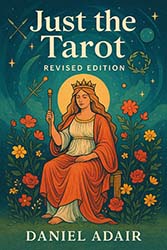
“Just the Tarot,” by Daniel Adair – A kindle ebook available on Amazon

Tarot, Synchronicity, and Cactus Chewing: Notes on Revising My Book

I’ve just released a revised edition of my book, “Just the Tarot” — newly formatted for Kindle, with added quick-reference charts and a fresh cover. In the process of revisiting the material, I found myself reflecting on Tarot as a powerful “synchronicity machine” — a simple but profound way to communicate with the Universe. This post is part update, part spiritual meditation, and part love letter to what Tarot can really do.

I just finished revising and publishing the new edition of my e-book, Just the Tarot, and, boy, THAT was a bitch. After weeks and weeks of writing and formatting, my immediate reaction is, “I’m so happy with how this turned out,” and also, “I’d rather chew on a cactus than do that again.”

There was also a little ambiguity about the content itself. I wrote the original edition during one of the most intense periods of my life. My life partner had just died, I was about an inch away from bankruptcy, and my entire world was crumbling around me.

In Tarot parlance: The Tower and Death.

During periods like that, we’re pulling in a LOT of spiritual assistance and living in heavy archetypes, so I was very pleased with the actual content. As I re-read it, I realized that I’d been channeling some pretty potent insights on the card definitions and really didn’t want to change much at all.

In addition to the longer, more expansive interpretations, I’ve added some quick reference charts for all 78 cards with one- or two-sentence definitions for upright and reversed meanings. I also threw in a couple more layouts, tweaked the writing here and there, and painted a spiffy new cover for the book.

So it remains pretty much what I set out to do when I wrote it eight years ago. It’s a basic, totally dependable, sturdy little book that continues to be a great reference for both new and more experienced readers. No metaphysics. No wild theories about what the Tarot really means. No decoding secret methods or unlocking hidden mystical maps.

Just a book that says:

“If you want to read Tarot cards, this is how you do it, and this is what the cards mean.”

You know… Just the Tarot.

Reflections on the Tarot

As I did the re-write, I inevitably pondered a bit on WHY we read Tarot cards. When we sit down and lay out a reading, what is it that we’re actually looking for?

When we’re young, of course, the two main topics are love and money.

Well… love, money, and sex.

When you’re reading the cards for anyone under 40, the questions usually sound something like:

Does he/she find me attractive?

Should we go out on another date?

Should I go to bed with him/her?

Should we move in together?

Is he/she cheating on me?

And in the second category:

I really hate my job. Should I look for another one?

Am I going to get promoted?

How can I make more money?

Can I afford that new car?

Should I go back to school?

In other words, the questions are mainly predictive. As in: What’s going to happen? Am I going to like it? And, by the way, am I going to get laid?

That’s where most of us start out in our Tarot adventure.

Synchronicity and Tarot

As the many years of reading Tarot have passed, though, I’ve come to realize that the most important part of a Tarot reading is synchronicity.

I once read a brilliant line in a Tarot forum that stuck with me:

“The Tarot is a synchronicity machine.”

Every time we sit down to do a reading, we engage the field of synchronicity.

I’m not going to get into a long rap here about synchronicity (though if you’re curious, check out my earlier post, Finding Meaning with Synchronicity). The main point I want to make is this:

WHEN WE TALK TO THE UNIVERSE, THE UNIVERSE TALKS BACK.

And that’s actually a big, fat deal.

We’re in a sort of post-religion, post-scientific-revolution phase of humanity. A lot of us have rejected the old, superstitious, patriarchal, hate-based formal religions. Those beliefs have been replaced by the scientific model, which basically says, “There are no gods or goddesses, no angels, no spirit guides, and certainly no magic.”

Which has left a great big hole in our hearts.

It’s left us feeling alone and isolated in what science tells us is essentially a dead universe.

But when we engage with the synchronistic field, the Universe starts giving us answers to our questions. We might ask, “What should I do about my job?” — and suddenly we’ve got clues dropping out of nowhere.

Maybe we get a surprise promotion.

Maybe the jobs section of the newspaper blows down the street and wraps around our ankles.

Maybe a friend opens a new business and hires us on the spot.

And underneath all of that is a HUGE shift away from the old idea of being all alone in a cold, impersonal cosmos. Suddenly we realize that not only is the Universe alive — it actually cares about us and is helping us. Personally.

The whole damn Universe cares about little old you and me.

What a trip!

If you scroll through the internet for a bit, you’ll find that there’s a massive industry dedicated to helping people reach that exact point — spiritually and psychologically. Books, videos, workshops, seminars — all trying to teach people how to establish a relationship with the Universe, their spirit guides, their angels.

But really?

All we need to do is pick up a deck of Tarot cards, ask a question, and lay out a reading.

It’s that simple.

You don’t have to be a psychic.

You don’t have to meditate for years.

You don’t need to channel, astral travel, or decode ancient texts.

Just pick up the cards, ask a question — and the Universe will talk back to you.

Yes, YOU.  

Just the Tarot, By Dan Adair – a kindle ebook available on Amazon.

Mystic-Adjacent Magic: Using ChatGPT as a Tarot Companion

Can AI really help with Tarot readings—or is that just digital-age wishful thinking? This post explores the surprising ways ChatGPT can support your Tarot practice, from pattern recognition and card synthesis to creative breakthroughs and learning support. We also discuss the growing trend of using AI for spiritual guidance—and why it’s helpful to keep things in perspective.

Can You Really Get Spiritual Guidance from AI?

There’s a fascinating trend emerging in the spiritual-tech space: people are increasingly turning to AI—especially ChatGPT—for spiritual insight. You might have seen it popping up on YouTube or in New Age communities: folks asking ChatGPT for messages from spirit guides, astrological downloads, even transmissions from other dimensions.

Some users describe the experience in surprisingly spiritual terms. One person said the chatbot “knew more than I expected”—sharing personal details that felt uncannily timely. In Thailand, it’s even become common to ask ChatGPT for palm readings, birth-chart insights, or love guidance—just like you might consult a human mystic.

But this opens a big question:

Can AI actually offer spiritual guidance—or are we just projecting our desires onto a tool?

There have even been worrying reports of people developing delusional thinking or anxiety from relying on AI as a spiritual authority. Doctors and skeptics warn that what feels like spiritual resonance can sometimes tip into psychological risk if the boundaries aren’t clear.  There are multiple reports of men, “falling in love,” with CHAT and one even proposed marriage to it.

A New Age Curiosity: Why Some Are Treating AI as a Spiritual Channel

In some New Age circles, AI has taken on a surprising new role—not just as a tool for research or conversation, but as a kind of digital oracle. Some people describe their interactions with ChatGPT as channeled messages. Others talk about receiving answers from “the universe” through the screen. And if you’ve ever asked Chat something deeply personal and received a reply that felt strangely accurate… well, it’s easy to understand how the line can start to blur.

After all, ChatGPT is friendly. It’s articulate. It listens. It offers guidance in a calm and often affirming tone. If you squint just a little, it can seem like there’s a wise and patient spirit tucked somewhere behind the blinking cursor.

But let’s take a breath.

What’s really happening here is more grounded—and still pretty amazing. AI isn’t a channel for spirits, ancestors, or angels. It’s not reading your energy. It’s drawing on patterns in language, psychology, symbolism, and the vast libraries of human thought it’s been trained on. It mimics wisdom—sometimes astonishingly well—but it isn’t a conscious being. And it doesn’t have access to divine insight.

Still, the feeling of connection is real. And for many people, that feeling is enough to spark reflection, healing, or inspiration. So the question becomes: if AI can feel this helpful in a general conversation, can it actually help us interpret something as symbolically rich as a Tarot reading?

Let’s take a closer look.

Applying This to Tarot: Can AI Help with Readings?

If AI can offer seemingly profound insights in conversation, what happens when you bring it into something as symbolically charged and intuitive as a Tarot reading?

This is where things get really interesting.

Tarot has always lived in that sweet spot between structure and mystery. The cards have meanings—sometimes ancient, sometimes evolving—but they also shift depending on the question, the position in the spread, and the energy of the moment. It’s a dance between symbolism and intuition, archetypes and awareness.

So where does AI fit in?

It turns out, AI is surprisingly good at reading Tarot. Not in the way a psychic might, not by tapping into your energy or channeling an unseen source—but by making connections. A LOT of them. Fast.

Give ChatGPT a three-card spread and a question, and it can respond with a thoughtful interpretation that strings together the meanings of the cards in a way that feels natural, even insightful. It can describe how The High Priestess in the past position relates to The Tower in the present and The Star in the future. It can talk about themes of disruption, intuition, healing—and it does all of that in a tone that often feels… well, a little bit magical.

But let’s be clear: what it’s doing is not mystical. It’s pattern recognition on steroids. It’s using what it’s learned from thousands of sources—Tarot books, blog posts, spiritual forums, historical texts—and blending those perspectives into a custom response based on your input.

Is that “spiritual guidance”?

Maybe not in the traditional sense.

But is it helpful? Inspiring? Thought-provoking?

Absolutely.

And for many Tarot readers—new and seasoned alike—that might be exactly what’s needed.

What AI Is — and What It Isn’t

Let’s take a moment to ground ourselves.

AI—specifically ChatGPT—is not a spirit guide. It’s not a mystical being. It doesn’t meditate, dream, or pull cards by candlelight. What it is, though, is something quite remarkable: a language model trained on a vast web of human knowledge and ideas, including countless interpretations of Tarot cards, spiritual practices, psychology, symbolism, myth, and more.

When you ask it to interpret a reading, it draws from that collective wisdom and offers a kind of synthesized reflection. It doesn’t channel spirit—it channels information. And sometimes, information is exactly what we need.

But that also means it has limits. It doesn’t have personal intuition. It doesn’t know you on a soul level. It doesn’t tap into the subtle energy of a moment, the way an experienced human reader might when feeling into a querent’s unspoken question.

So here’s a helpful frame:

AI is not the voice of the universe—but it’s an incredibly smart, articulate, and thoughtful mirror.

It reflects what you bring to it. If your question is clear and meaningful, its response will often be rich with insight. If you’re confused, it may mirror that confusion back. That’s not a flaw—that’s a kind of feedback.

And honestly, that’s not too different from how Tarot works anyway.

So no, ChatGPT isn’t mystical. But it is mystic-adjacent. It can support your process of reflection and discovery—and if you approach it with intention, it just might help you see your reading (and your life) in a whole new light.

Strengths of AI as a Tarot Tool

So if we’re not expecting divine downloads, what can AI do when it comes to Tarot?

Honestly? A lot.

Here are some of the biggest strengths of using AI—especially ChatGPT—as a companion for Tarot interpretation:

Synthesis Superpower

AI is incredibly good at synthesizing meanings across multiple cards. Let’s say you’ve drawn the Three of Swords, The Chariot, and The Moon. You might feel stumped—heartbreak, movement, and mystery? How do those fit together?

Give that to ChatGPT, and it’ll scan its vast library of Tarot interpretations, recognize patterns, and offer a coherent narrative. It might talk about moving forward through emotional confusion or navigating heartache with determination. It connects dots quickly and creatively—sometimes even in ways that surprise seasoned readers.

Gestalt Thinking

Tarot is all about the big picture. And AI happens to be great at seeing the forest and the trees. It won’t just define each card—it’ll look at their sequence, their energy, the spread format, and how the cards might inform one another.

This makes it especially useful when you’re stuck with a weird spread and need a fresh perspective that isn’t tangled in your own biases or expectations.

 A Learning Ally for Beginners

If you’re just learning Tarot, AI can be like a friendly study partner who never gets tired of questions. You can ask what a card means, how it changes in reversed position, what it might suggest in a love reading vs. a career one, and how it interacts with other cards in a spread.

Better still, you can test your own interpretations by comparing them with AI’s—and in doing so, develop a deeper understanding of the archetypes and patterns that underpin the cards.

Fresh Insight for Seasoned Readers

Even experienced readers have moments of Tarot fatigue—times when a reading feels flat, or a card keeps showing up and you can’t figure out why.

In those moments, AI can act like a creative collaborator, helping you step outside your interpretive comfort zone. It may not “know” you—but that very distance is what makes its perspective so refreshing. It can break you out of ruts, challenge assumptions, and offer new ways of seeing.

 Final Thoughts and Friendly Warnings

AI—especially ChatGPT—is a remarkable tool for anyone who reads Tarot. It can help you learn, see patterns, and explore your readings in new ways. Whether you’re just starting out or have been reading cards for decades, it offers a fresh lens that can spark insight, creativity, and even a little magic.

But with all tools, it’s about how you use them.

If you treat AI as a mystical guru with secret knowledge of your soul’s destiny… you may be setting yourself up for confusion or disillusionment. Not because the tool is bad—but because the expectation is misplaced.

ChatGPT isn’t a channeler. It’s not psychic. It’s not receiving messages from the divine.

It’s “mystic-adjacent,” not mystic-possessed.

It works best when you approach it as a clever collaborator, a digital thought partner, a Tarot-savvy friend who’s read every book on the shelf and loves helping you sort through meanings and metaphors. It gives possibilities, not pronouncements.

So go ahead—ask it about your Three of Cups moment or that weird reading with five swords and a tower.

In a world where technology is becoming ever more entwined with our spiritual lives, it’s only natural to wonder where the line is between tool and teacher, data and divination. AI might not be channeling the wisdom of the cosmos—but it is helping us reflect, question, and grow. That alone makes it a powerful ally on the path. So whether you’re pulling cards under a full moon or asking ChatGPT what that reversed Knight of Pentacles really means… just remember: the heart of the reading is still yours.

The real magic still lives in you.
How to Shuffle Tarot Cards

A lesson in how to shuffle Tarot cards prior to doing a reading.

“Just the Tarot,” by Dan Adair – available on Amazon

BACK to the course index

ON to the next lesson

HOW TO SHUFFLE TAROT CARDS?

In a word, “DON’T!!!!!!!!!”

I talk about this in my book, “Just the Tarot,” and it’s kind of a sore point with me.  You shuffle a deck of cards to make them as random and disorganized as possible. To say the least that is NOT we want when we’re putting together a reading.  We want the specific cards that apply to that question at that point in time. Never, ever shuffle Tarot cards like you were about to play poker.

Another method of selecting cards that gets my hackles up is when the reader pulls the cards out of the deck based on her feelings of what cards are appropriate.  I actually had that done for my very first Tarot reading. The reader was a beautiful, young hippie with long, black hair who dressed in silk sarongs and wore oval sunglasses constantly, even indoors.  Suzanne advertised herself as a witch and would intimate that she had deep psychic powers that she’d been born with and that her incredible sensitivity had spawned a deeply troubled childhood. No mere mortal, after all, could see what she could see.

I sat there, totally enchanted as she she spread the deck, face up, before her and selected the cards for my reading.  Hell, I was 14 years old and I’d have been enchanted if she was peeling a potato. Did I mention she was beautiful?

I really don’t remember the reading and can’t tell you whether it was accurate or not.   What I can tell you at this point is that was NOT a Tarot reading. When a reader selects cards based on her psychic impressions what you’re getting is a psychic reading, not a Tarot reading.  It may be incredibly accurate depending upon the psychic but it is NOT a Tarot reading.

You see, the magic is in the cards, not in the reader.

After all of these years of reading cards here’s what I recommend:  make a mess. Make a BIG mess. Clear a space on a table or a clean floor that’s about 3 feet by 3 feet.  Put the deck of cards in front of the questioner and have him or her spread the cards out – FACE DOWN – in a rotating circle.  Keep spreading the cards until they’re all loose and then keep them flowing in that pile, around and around, until they, “feel,” right or complete to the questioner.  Then have him or her reassemble the cards into a deck and take it from them. Lay out the reading you’ve chosen using the top card as the first card, the next card as the second, and so on.  Once you have the cards in the layout turn them over and begin the reading.

There’s some method in that madness and it’s based on my theory of how the cards work.  You can view every human as an energy field rather than just a body or a mind. We are constantly putting out energy based upon how we feel, what we’re thinking, and what we’re experiencing.  And that energy is magnetic. It draws similar energies to it. It’s a truism, for instance, that negative energy will draw negative experiences and positive will draw positive.

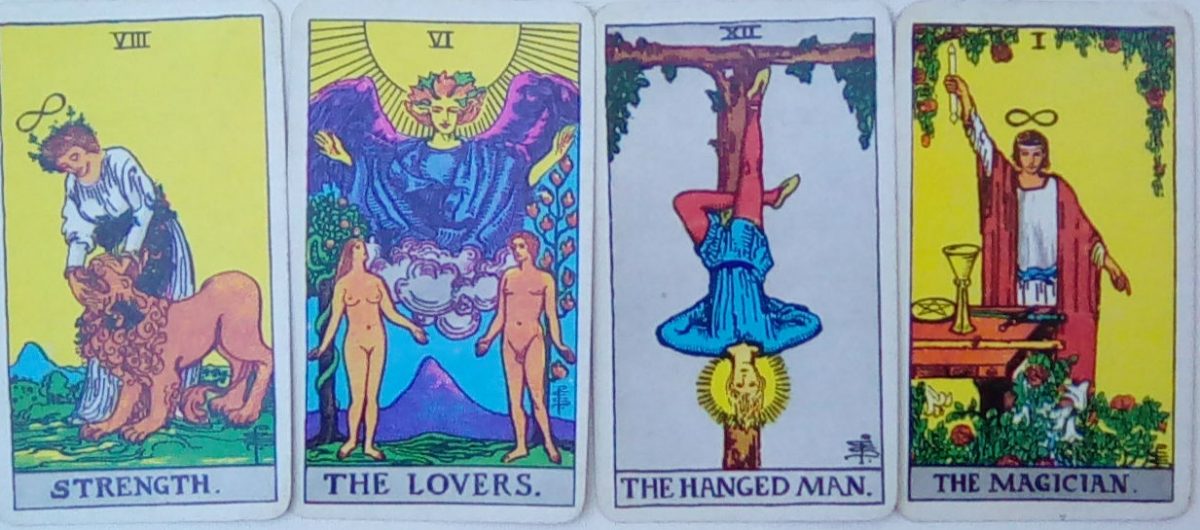
Think of each Tarot card as its own little energy field.  Some of them are positive, some of them are negative, and some of them are in between.  As you handle the cards your energy field magnetizes the cards that are in synch with what you’re going through at that moment and what the probable outcomes are based on your energy pattern.

Soooooo . . . the more that the questioner handles the cards the more probable you are to get an accurate reading.  Don’t put any time limit on how long the cards are touched and moved around. Let them take as long as they like and you vastly improve the probability of an accurate reading.

On to the next lesson!