I’ve just released a revised edition of my book, “Just the Tarot” — newly formatted for Kindle, with added quick-reference charts and a fresh cover. In the process of revisiting the material, I found myself reflecting on Tarot as a powerful “synchronicity machine” — a simple but profound way to communicate with the Universe. This post is part update, part spiritual meditation, and part love letter to what Tarot can really do.
I just finished revising and publishing the new edition of my e-book, Just the Tarot, and, boy, THAT was a bitch. After weeks and weeks of writing and formatting, my immediate reaction is, “I’m so happy with how this turned out,” and also, “I’d rather chew on a cactus than do that again.”
There was also a little ambiguity about the content itself. I wrote the original edition during one of the most intense periods of my life. My life partner had just died, I was about an inch away from bankruptcy, and my entire world was crumbling around me.
In Tarot parlance: The Tower and Death.
During periods like that, we’re pulling in a LOT of spiritual assistance and living in heavy archetypes, so I was very pleased with the actual content. As I re-read it, I realized that I’d been channeling some pretty potent insights on the card definitions and really didn’t want to change much at all.
In addition to the longer, more expansive interpretations, I’ve added some quick reference charts for all 78 cards with one- or two-sentence definitions for upright and reversed meanings. I also threw in a couple more layouts, tweaked the writing here and there, and painted a spiffy new cover for the book.
So it remains pretty much what I set out to do when I wrote it eight years ago. It’s a basic, totally dependable, sturdy little book that continues to be a great reference for both new and more experienced readers. No metaphysics. No wild theories about what the Tarot really means. No decoding secret methods or unlocking hidden mystical maps.
Just a book that says:
“If you want to read Tarot cards, this is how you do it, and this is what the cards mean.”
You know… Just the Tarot.
Reflections on the Tarot
As I did the re-write, I inevitably pondered a bit on WHY we read Tarot cards. When we sit down and lay out a reading, what is it that we’re actually looking for?
When we’re young, of course, the two main topics are love and money.
Well… love, money, and sex.
When you’re reading the cards for anyone under 40, the questions usually sound something like:
• Does he/she find me attractive?
• Should we go out on another date?
• Should I go to bed with him/her?
• Should we move in together?
• Is he/she cheating on me?
And in the second category:
• I really hate my job. Should I look for another one?
• Am I going to get promoted?
• How can I make more money?
• Can I afford that new car?
• Should I go back to school?
In other words, the questions are mainly predictive. As in: What’s going to happen? Am I going to like it? And, by the way, am I going to get laid?
That’s where most of us start out in our Tarot adventure.
Synchronicity and Tarot
As the many years of reading Tarot have passed, though, I’ve come to realize that the most important part of a Tarot reading is synchronicity.
I once read a brilliant line in a Tarot forum that stuck with me:
“The Tarot is a synchronicity machine.”
Every time we sit down to do a reading, we engage the field of synchronicity.
I’m not going to get into a long rap here about synchronicity (though if you’re curious, check out my earlier post, Finding Meaning with Synchronicity). The main point I want to make is this:
WHEN WE TALK TO THE UNIVERSE, THE UNIVERSE TALKS BACK.
And that’s actually a big, fat deal.
We’re in a sort of post-religion, post-scientific-revolution phase of humanity. A lot of us have rejected the old, superstitious, patriarchal, hate-based formal religions. Those beliefs have been replaced by the scientific model, which basically says, “There are no gods or goddesses, no angels, no spirit guides, and certainly no magic.”
Which has left a great big hole in our hearts.
It’s left us feeling alone and isolated in what science tells us is essentially a dead universe.
But when we engage with the synchronistic field, the Universe starts giving us answers to our questions. We might ask, “What should I do about my job?” — and suddenly we’ve got clues dropping out of nowhere.
Maybe we get a surprise promotion.
Maybe the jobs section of the newspaper blows down the street and wraps around our ankles.
Maybe a friend opens a new business and hires us on the spot.
And underneath all of that is a HUGE shift away from the old idea of being all alone in a cold, impersonal cosmos. Suddenly we realize that not only is the Universe alive — it actually cares about us and is helping us. Personally.
The whole damn Universe cares about little old you and me.
What a trip!
If you scroll through the internet for a bit, you’ll find that there’s a massive industry dedicated to helping people reach that exact point — spiritually and psychologically. Books, videos, workshops, seminars — all trying to teach people how to establish a relationship with the Universe, their spirit guides, their angels.
But really?
All we need to do is pick up a deck of Tarot cards, ask a question, and lay out a reading.
It’s that simple.
You don’t have to be a psychic.
You don’t have to meditate for years.
You don’t need to channel, astral travel, or decode ancient texts.
Just pick up the cards, ask a question — and the Universe will talk back to you.
Yes, YOU.
Just the Tarot, By Dan Adair – a kindle ebook available on Amazon.
When you’re overwhelmed by choices but none of them inspire you, the 7 of Cups offers deep insight into emotional flatness, spiritual paralysis, and the fog of indecision. This post explores what it means to feel stuck not from a lack of options, but from a disconnection from desire — and how gentle, imperfect movement can reawaken synchronicity, clarity, and personal magic. With insights from tarot, spiritual practice, and the idea that every choice is a spell, this is a compassionate guide for anyone feeling adrift in a sea of possibility.
We all know what it feels like to be stuck in a situation that offers no way out — a dead-end job, a draining relationship, a town or routine that feels too small for who we are. In those moments, the lack of options is the problem, and we ache for even one open door.
But there’s another kind of stuckness, quieter and harder to name. It happens when you look at your life and see too many doors — job possibilities, creative paths, lifestyle shifts, spiritual practices, places you could move to, people you could become — and yet none of them stir your heart. It’s not that you don’t have options. It’s that nothing feels real enough to move toward. Every possibility feels equally vague, equally weightless. You scroll through them in your mind like a streaming menu of “meh.”
That’s where the 7 of Cups comes in — a card that doesn’t warn of limitation, but of overabundance without embodiment. When we’re caught in that state, the problem isn’t a lack of imagination. It’s that we’ve lost our connection to desire, motivation, or meaning. And that kind of emotional flatness can leave us just as frozen as having no choices at all.
In this post, I want to explore that space of spiritual paralysis — what it really means, why it happens, and how we might begin to move forward again, even when nothing calls to us.
The 7 of Cups – Castles in the Sky
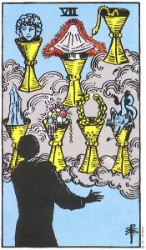
In the classic Rider-Waite tarot deck, the 7 of Cups shows a figure standing before a cloud filled with seven golden cups. Each cup holds something different — a castle, a laurel wreath, a snake, a dragon, a veiled figure, jewels, and even a head. These images float in the sky like a surreal dream, untouchable and unresolved. Some of the items represent temptation or danger. Others represent success, beauty, or mystery. Together, they evoke a kind of psychic overload: too many choices, too many desires, too many unknowns.
This card is often read as a symbol of fantasy, illusion, or indecision — a time when your head is in the clouds and your feet aren’t on the ground. You may be imagining all the things you could do, be, or have, but none of it is actually manifesting. The possibilities feel “up in the air” — compelling, maybe even glamorous, but disconnected from real life.
But the 7 of Cups doesn’t just speak to confusion. It speaks to the pain of disconnection from clarity, purpose, and desire. You might be a visionary, a dreamer, or someone with a deep well of creative imagination. And yet you feel suspended in a kind of fog — no longer trapped, but adrift.
This is the paradox: you can have a wealth of potential and still feel empty. You can imagine endless paths and still feel like you’re going nowhere.
Defining the Emotional Problem
Let’s be clear about something: this isn’t laziness. It’s not procrastination, and it’s not fear of commitment — at least, not in the way people usually frame those things.
What we’re really talking about here is a kind of emotional flatness — a sense that, no matter how many options are available, none of them feel alive. Nothing moves you. You’re not overwhelmed by too many passions; you’re stalled because nothing seems to matter. And when well-meaning people tell you to “follow your bliss” or “just pick something you’re passionate about,” you want to scream — because the truth is, you don’t feel passionate about anything.
This is a deeply misunderstood kind of stuckness. On the surface, it might look like you’re being indecisive or flaky. Underneath, there’s often a more painful story: burnout, disappointment, grief, disillusionment, even trauma. You may have spent years surviving rather than living. You may have pursued dreams in the past that led nowhere. Or you may simply be exhausted — mentally, emotionally, spiritually — and unable to summon the spark that used to drive you.
When this kind of numbness settles in, imagination alone won’t fix it. Vision boards and journaling prompts can feel like cruel jokes when you’re not connected to any real sense of desire. You become a ghost in your own life, haunting the possibility of change without feeling motivated to pursue it.
That’s where the 7 of Cups becomes not just a warning about illusion, but a mirror for a very human experience: the ache of possibility without passion.
Why We Get Frozen: The Paradox of Too Many Options
At first glance, having lots of options seems like a good thing — a sign of freedom, creativity, expansion. But if you’re not grounded in what you actually want or need, too many options can feel like a kind of psychic noise. Instead of liberating you, they overwhelm your system. Nothing feels real, and everything feels like a distraction.
This is the hidden danger of the 7 of Cups: abundance without anchoring.
You might bounce from idea to idea — start a new project, research a new career path, flirt with the idea of moving somewhere else — but none of it takes root. Each choice is hypothetical, weightless, floating just out of reach like the cups in the card. Without an emotional connection to any of them, they begin to blur together until doing nothing feels like the only viable option.
This paralysis often leads to guilt or self-blame: Why can’t I commit? Why don’t I care more? But the deeper issue isn’t about making a bad choice. It’s about the fear that no choice will lead anywhere meaningful.
And that fear can become self-fulfilling. We stop moving because we don’t feel inspired. But inspiration often follows movement — not the other way around. If we wait to feel perfectly clear before taking action, we can stay stuck for years.
The 7 of Cups teaches us that too much floating — too much dreaming without doing — eventually collapses into disconnection. The way out isn’t to find the perfect choice. It’s to ground ourselves in imperfect motion.
The Turn: A Way Out — “Three Least Sucky Choices”
So what do you do when everything feels empty? When every option seems flat, pointless, or too far away to matter?
Spiritual teacher Mike Dooley offers a surprisingly helpful piece of advice:
If all your choices suck, pick the three least sucky ones — and start moving.
It sounds irreverent, even a little cynical. But it’s actually a lifeline disguised as a joke.
Dooley isn’t saying you should build your life around mediocrity. He’s pointing to a truth that’s both practical and mystical: the universe can’t help you until you start moving. When you’re standing still, waiting for a lightning bolt of clarity, you’re not sending any clear signals. You’re broadcasting static.
But when you take even one step — toward something, anything — the whole energetic field around you begins to shift. Possibilities you couldn’t see before start to appear. A “meh” project might lead you to a person who lights you up. A half-hearted attempt at self-care might reawaken something long asleep. A seemingly random decision might become the breadcrumb trail that leads you home.
It’s not about pretending your choices feel great. It’s about trusting that momentum creates meaning, not the other way around.
And sometimes, choosing the “least sucky” option is the boldest move you can make — because it’s a choice made not from fantasy, but from faith.
The Role of Synchronicity
Synchronicity is the universe’s way of saying, “I see you.” It’s that perfect book showing up just when you need it, that person calling when you were thinking about them, that quiet nudge that leads you to an unexpected breakthrough. But synchronicity doesn’t happen in a vacuum. It happens when we’re in motion.
That’s the secret: the universe doesn’t respond to fantasy, it responds to engagement. It’s like a dance partner waiting for you to take the first step. As long as you’re frozen, the dance doesn’t begin.
You don’t need to be confident. You don’t need to be inspired. You just need to move — to start walking down the path of those three “least sucky” choices, trusting that better ones may be waiting just beyond the next curve.
This is how clarity often works. It’s not a neon sign pointing to your destiny. It’s more like a fog slowly lifting as you walk through it. You don’t get to see the whole map. You get to see the next few steps — and only after you take them.
And as you move, something begins to awaken. You start to feel little sparks again — a flicker of interest here, a glimpse of meaning there. What once felt flat starts to feel possible. New paths begin to emerge, and those dreamlike cups that once floated far above your head start to descend, one by one, into your hands.
Magical Reframing: Choice as a Spell
Here’s a radical way to reframe this moment of stuckness:
Every choice is a spell.
Not a perfect choice. Not a destined choice. Just… a choice. Made with intention. Infused with energy. Cast like a stone into the unknown.
In magic, we don’t wait until we feel certain. We gather what we have — some herbs, a candle, a whisper of desire — and we act. We claim. We declare. And the ritual itself becomes the spark that transforms the ordinary into the sacred.
In the same way, when you make a choice — even a small, imperfect one — you send a ripple out into the unseen. You say, “I’m willing to engage. I’m willing to participate in the mystery of my own life.” That willingness alone shifts the vibration.
This is where the 7 of Cups becomes not a warning, but an initiation.
It says: You are standing before a cloud of dreams. You may not know which one is right. But your power lies not in the picking — it lies in the choosing.
By choosing, you collapse the infinite into the actual. You call energy down from the clouds and into the body of your life.
That is magic.
From Fog to Flow
The 7 of Cups reminds us that too many possibilities can be just as paralyzing as none at all — especially when we’re cut off from desire, drained of motivation, or unsure whether anything really matters. But emotional flatness is not a failure. It’s a signal. A season. A sacred pause.
And the way through it is not to wait for perfect clarity, or for passion to descend from the heavens. The way through is to begin — gently, imperfectly, even skeptically.
Pick the three least sucky choices. Make one small move. Cast one little spell. Not because you know where it leads, but because motion creates magic. Choice calls energy into form. The fog doesn’t lift before we move — it lifts because we move.
As you walk, the air clears. The heart flickers back to life. The cups begin to settle, and one of them — maybe one you never expected — begins to shine a little brighter than the rest.
And in that moment, you remember:
You’re not lost.
You’re just in the in-between.
And you are, in fact, already on your way.
The Alchemy of the Mind: Transforming Your Life With the 7 Principles of the Kybalion, by Dan Adair

 Just the Tarot