The Wheel of Fortune and Flowing with these Strange Rhythms

This post explores the deeper meaning of The Wheel of Fortune Tarot card and its connection to the Kybalion’s Principle of Rhythm. Life’s ups and downs are not random but part of a greater pattern that ultimately arcs toward the positive. Discover how to maintain perspective, rise above collective fear, and navigate dark times with love, compassion, and inner strength.

Let’s face it: we’re all a little exhausted from the constant insanity in the world right now. Whether you’re right, left, or middle-of-the-bird, it can feel like we’re adrift in a sea of chaos. When it goes on long enough, we start to lose our perspective and wonder if things will ever be “normal” again.

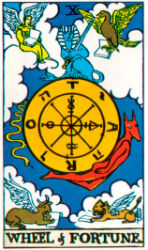
The message of The Wheel of Fortune is that everything passes and everything changes. The people who are at the top of the wheel right now will eventually be cast down, and the people who are at the bottom will eventually be elevated again.

Life is always cyclical — and this, too, shall pass.

The Principle of Rhythm

As I discussed in my book about The Kybalion, Western Occultism calls this The Principle of Rhythm. Here in Earth School, everything is rhythmic, and we only have to open our eyes to see it.

The tides come in and then go out.

The Moon waxes and then wanes.

Life explodes into the richness of spring and then recedes into the cold bleakness of winter.

Even great nations expand and then ultimately diminish into shadows of what they once were.

Everything rises and falls — and then rises again.

The same principle applies to human beings and all our affairs. We may have a string of incredibly good luck and then a period where we can’t buy a break. We may feel joyously happy for a while and then deeply depressed and anxious before we find our way back to happiness. We may fall deeply in love with someone and then end up despising them.

The Pendulum

The Kybalion envisions this process as the pendulum of a clock. It swings to the left, and then it swings to the right. And as the Principle of Rhythm states: “The swing to the left is always equal to the swing to the right.”

Modern science recognizes this in Newton’s Third Law of Motion: “Every action has an equal and opposite reaction.”

When we think about human life, we can see it in terms of alternating energies. We may go through incredibly negative periods — full of stress, sadness, and anxiety — only to be followed by times of great happiness, when everything seems to go our way.

We may have moments where we’re counting quarters to buy groceries, followed by periods of real abundance when the cash flows in like a river.

The collective energy of politics follows the same law – a hard swing to the right is inevitably followed by a hard swing to the left. Hatred is eventually replaced by compassion.

But It’s Not a Closed System

If that was all there was to the rhythms of life, it would be a pretty depressing scenario. It would feel like: “Okay, things are going well right now, but I can’t really enjoy it because it’s all going to turn to shit again.”

If life were nothing but good/bad/good/bad — ad infinitum — it would be the spiritual equivalent of one step forward and one step back. We’d be living, but not progressing. Stuck in an endless cycle of growth and degeneration. A closed system where nothing ever really improves.

The good news is that, as The Kybalion puts it, “nature favors the positive.” Positive energy will always overcome negative energy. Love will always be stronger than hate. Compassion will always conquer cruelty.

Put another way: yes, as long as we’re in Earth School, the pendulum will appear to move equally in both directions. The truth, though, is that it’s always arcing just a little more toward the positive — whether we can see it or not.

So What Should We Do Right Now?

We are, right now, in dark times. As Asha Nayaswami says in this wonderful video, there is demonstrable evil in the world, and some humans are acting out their darkest impulses.

So how do we deal with that? What should we do right now?

The advice of The Kybalion is to “rise above it.” We can’t control the Principle of Rhythm or the turns of the Wheel of Fortune. Those are built into the fabric of Earth School. We don’t have to be swung by the pendulum, though. We can rise above it spiritually.

What we can control is our reaction to it. We can make a conscious effort not to be swept along in the collective energies of hatred, fear, and anger. We can maintain our own little bubbles of love and compassion and keep putting out as much positive energy as we can.

As Nayaswami says, that doesn’t mean we become spiritual doormats. It doesn’t mean we avoid confronting evil when we encounter it. It means we confront it with truth, with as much gentleness and understanding as we can muster, and that we refuse to join it in any way, shape, or form.

Perspective

Above all, it means maintaining perspective. Keep your eyes on the horizon, not just on the dirt road full of potholes. Remember that the pendulum will swing back in the opposite direction.

When it does, life will not only be positive again — it will be more positive. People will learn from these experiences, and they’ll use that knowledge to build a better world.

We just have to be patient… and wait for the wheel to turn.

“Just the Tarot,” by Dan Adair – a kindle ebook available on Amazon.

Dreaming Big vs. Building Bridges

Why don’t manifestation techniques work for everyone? This post explores the pitfalls of one-size-fits-all manifesting advice, including why “dreaming big” may backfire for some people — and how “bridge affirmations” and quiet repetition can be just as powerful. Learn how to tailor your visualization style to your own emotional wiring, and find a manifestation method that actually fits you.

Ace of Pentacles – A Tarot affirmations poster available at Synergy Studio.

Why some manifestation advice doesn’t work — and what to do instead

One of the sillier ideas floating around in the world of visualizing and manifesting is the notion that “one size fits all.”

The way this usually goes is that a manifesting guru announces they’ve been studying this stuff for decades, and they’ve refined all of that knowledge into THE ONE TRUE METHOD that will make us rich, famous, and sexually irresistible.

A variation on that is the guru was visited by beings from another dimension who gave them the real lowdown. A variation of that is that the guru is now channeling spirit guides, divine beings, angels, or ancient Atlanteans who have imparted secret knowledge for the good of all mankind.

Now, I happen to be a huge fan of manifesting, visualization, and affirmations. But there are a couple of big fallacies baked into these presentations.

 Fallacy #1: One method works for everyone

If any one guru truly had the one method that worked for everyone, we’d all have signed up for that seminar by now. We’d all be millionaires. And we’d be so busy in bed we’d have to replace our mattresses every three months.

And… um… there still seem to be a lot of us who aren’t millionaires. Have you noticed?

I know that the last time I looked at my bank balance, I was shocked — shocked, mind you — to discover I still wasn’t rich.

Maybe you’ve had a similar experience.

Fallacy #2: Any method works for you

This is the one I want to dig into today: the idea that any particular method is going to work for everyone who uses it.

It’s understandable that the gurus would push that narrative. After all, the more seminars, books, and videos they sell, the more fully they manifest their vision of wealth. If they came right out and said, “You know… this might work for some of you but not all of you,” their book sales would definitely decline.

But the truth is: we’re all different, and we need to find the method that fits us best.

Dreaming Big vs. Building Bridges

One helpful concept from the psychology side of affirmations is the idea of “bridge affirmations,” also known as “ladder affirmations.”

Here’s the basic idea:

Your visualizations need to at least resemble your current reality enough that your brain doesn’t reject them outright. If you’re living under a bridge, eating beans out of a can, and you’ve just lost your can opener, it’s going to be really hard to visualize yourself living in a mansion with a butler serving you caviar.

A more realistic visualization might be:

• You have a brand new can opener

• That can opener lives in a drawer

• That drawer lives in a kitchen

• That kitchen lives in a cozy little apartment you can afford

Bit by bit, you’re bridging the gap between your present and your vision.

I won’t get too deep into the science here, but our brains have a filtering system called the reticular activating system (RAS). It decides what information to notice based on what we already believe is possible.

So if you try to visualize something your brain sees as ridiculous, the RAS stands behind you whispering: “Uh, uh. Not happening.”

“I’m a wildly wealthy kazillionaire!”

No, you’re not.

“I attract money like a magnet!”

Then why can’t you pay your bills?

“I’m irresistible to the opposite sex!”

So why don’t you ever HAVE sex?

Now, it’s possible that you are one of those super-manifesters the gurus talk about — the kind who visualizes a million dollars falling from the sky and then has to wear a helmet for protection from the cash downpour.

But if you’re not? That’s okay.

You may just be a bridge manifester, not a straight-to-the-moon manifester.

Sometimes your subconscious doesn’t need the big dream — it just needs the next step.

“Feel It Big!” Doesn’t Work for Everyone

Another favorite bit of advice from the manifestation gurus is: You have to really FEEL it.

Like, really really.

Don’t just visualize the million dollars — visualize all the wonderful stuff you’re going to buy with it.

Visualize how damn happy you’re going to be.

Do a happy dance.

Flap your arms.

Howl at the moon.

Shake your booty and cackle because you’re rich, rich, RICH, I tell you!

The idea is that emotion supercharges visualization — the more passion you inject, the faster it manifests.

But what if you’re just… not a very emotional person?

Maybe you’re a trauma survivor.

Maybe you’re neurodivergent.

Maybe you’re just a pragmatic flatliner who feels fine but doesn’t emote like a Broadway actor.

Does that mean you’re out of luck when it comes to manifestation?

Absolutely not.

Some of us don’t feel our way to manifestation — we focus our way.

That’s where repetitive affirmations come in.

What we’re trying to do is impress the visualization on the subconscious mind so that it starts working on it behind the scenes.

Yes, a giant burst of emotional energy can plant the seed deep.

But so can steady repetition — even without fireworks.

Write:

“I am attracting abundance into my life.”

Twenty or thirty times every morning.

Or listen to gentle affirmation recordings while you go about your day.

The subconscious doesn’t need drama. It just needs consistency.

Find Your Flavor

So if you’re not rich, famous, and ravishing just yet — relax.

Maybe you don’t need to “dream bigger.”

Maybe you just need to cross the next bridge.

By all means, try the big, bold, wildly emotional manifesting techniques. If that works for you — congratulations! (And maybe lend me a hundred grand while you’re at it.)

But if it doesn’t work?

Don’t give up.

Just try a different route.

Build bridges.

Use repetitions.

Focus instead of forcing.

As Ram Dass said:

“Ultimately, we’re our own gurus.”

And nobody knows you better than you.

“Just the Tarot,” by Dan Adair.  A kindle ebook available on Amazon.

Learning to Live Without Joy

Many people feel disconnected, numb, or unable to access joy—especially after childhood trauma. This post explores emotional flatness, toxic positivity, and why realness may matter more than happiness.

Did you get ACED when you were a kid?

ACE stands for Adverse Childhood Experience, and the odds are fairly high that you experienced one. ACEs include things like emotional abuse, neglect, parental mental illness, substance abuse, and divorce or separation of the parents.

We tend to think of those kinds of negative experiences as relatively rare. Maybe we got the hell beaten out of us by a crazed, drunk parent—but most people didn’t, right?

After all, just look at how happy everyone else seems.

But according to the CDC-Kaiser ACEs Study, 61% of adults across 25 states reported experiencing at least one ACE. And nearly 1 in 6 (16.7%) reported four or more.

The truth is, a sizable portion of the population is living with the long-term effects of unresolved trauma—including dissociation, emotional blunting, chronic anxiety, and difficulty accessing joy.

The Cultural Pressure to Be Happy

One of the strongest side effects of long-term trauma is the belief that, “Man, I must really be fucked up, because I’m just not happy. Everyone else is happy, but I’m a train wreck. In fact, I’m not even a train wreck, I’m completely off of the tracks.”

That belief is especially potent if you’re American.

American culture—especially through media and marketing—places enormous value on positivity, confidence, and personal success. Like the figures in the Three of Cups, we’re all supposed to be dancing with joy, smiling through life, bubbling over with gratitude. The message is:

“You should be happy, empowered, and in control of your life at all times.”

And if you’re not?

Then something must be seriously wrong with you.

This pressure to appear happy, even when we’re not, creates:

Emotional dissonance: A split between what we feel and what we think we should feel.

Shame about feeling bad: A second layer of suffering on top of the original pain.

Social masking: We say we’re “fine” or “happy” because it’s expected—and we believe others are genuinely feeling that way (even when they aren’t).

Antidepressants and the Emotional Economy

A recent Gallup poll reported that a whopping 78% of Americans say they feel satisfied or very satisfied with their lives. The poll even bemoaned the fact that the “happiness index” was down by two points.

Meanwhile, the U.S. is among the highest consumers of antidepressants in the world.

Some people take them for serious clinical issues—but many of us take them simply to cope with lives that feel emotionally flat or chronically overwhelming.

Years ago, psychologists discovered that one of the most useless surveys in the world was asking teenage boys if they’d had sex. The overwhelming majority said, “yes, of course I have,” —even though many of them didn’t have the slightest clue how to unfasten a bra, let alone what to do next. They thought they were supposed to be having sex, because they assumed all the other boys were doing it—even though they weren’t.

In much the same way, Americans seem to be lying to pollsters about how happy we are, because we think we’re supposed to be happy.

After all, everyone else is smiling.

Even if they’re not.

We’re taking pills to create artificial happiness because we think we should be happy, even when we’re not.

Living With “Flat” Emotions

What if, instead of constantly trying to fix our feelings, we first learned to live with them?

Assuming there’s no organic brain issue involved, there’s always a reason that we’re not happy.

As Gabor Maté points out, when we suffer trauma that we can neither fight nor flee from, we dissociate. We leave our bodies. We stop feeling.

Not feeling becomes a survival mechanism—a way of coping with pain that would otherwise overwhelm and break us.

If you’re among the 61% who’ve had at least one ACE, you’ve probably experienced dissociation and emotional flatness.

If you’re in the 16% who had four or more ACEs, emotional flatness may be how you live most of the time. It’s not that we don’t want to be happy—we just don’t know how.

And that, in itself, can be traumatic, because we’ve been programmed to believe that we should be happy—even when we can’t feel it.

But we can reframe that.

Rather than chasing a happiness ideal that may not be accessible—especially after trauma—it’s possible to:

• Honor emotional flatness as a survival adaptation.

• Shift the goal from happiness to authenticity.

• Value calmness, neutrality, or quiet presence as valid emotional states.

• Find meaning not in chasing joy, but in living gently and truthfully with what is.

This doesn’t mean giving up on healing, but healing might not look like “feeling great all the time.”

It might look more like “being okay with feeling whatever I feel.”

A New Emotional Ethic: Realness Over Happiness

Ideally, we need a massive cultural shift—from:

“I must feel good in order to be okay”

to:

“I’m okay because I’m allowing myself to feel what’s true for me.”

But… yeah. Don’t hold your breath on that one.

What is possible—what’s powerful—is to make that shift within ourselves.

If you’ve had the hell beaten out of you, either physically or emotionally, as a child or as an adult, it’s okay to feel sad.

It’s okay to feel numb.

It’s not just okay—it’s rational.

That doesn’t mean we want to live there forever.

That doesn’t mean we resign ourselves to an existence without joy. But maybe healing begins when we stop pretending. When we stop performing. When we let ourselves feel—or not feel—exactly where we are.

In this new ethic:

• Sadness is not a problem.

• Numbness is a messenger.

• Joy, when it comes, is a gift—not a requirement.

Back in the 1960s the Transactional Psychology movement came up with the catch phrase:  “I’m Okay, You’re Okay.”

To which Elisabeth Kubler-Ross replied:  “I’m Not Okay, You’re Not Okay.  And That’s Okay.”

The first step in the path seems to be honestly saying, “This is who I am.  This is where I’m at. I hurt when I feel and so I try not to feel. And for right now, that’s okay.”

The Alchemy of the Mind: Transforming Your Life With the Seven Principles of the Kybalion

Harnessing the Power of Mentalism: How the Magician Card Can Help You Manifest Your Desires

Discover how the Magician tarot card and the Principle of Mentalism from The Kybalion can help you manifest your desires by aligning thought and intention.

Have you ever tried to manifest something—a job, a relationship, a more abundant life—only to feel like nothing’s happening?  

As you probably know, there are hundreds of manifestation methods and techniques out there, each of them 100% guaranteed to bring us happiness, wealth, and a great sex life.  So why are so many of us still stumbling along, sad, poor, and . . . well . . . un-laid?

Here’s the truth: manifestation isn’t just about saying the right words, finding the right method or doing the right ritual. It begins with our minds. According to the ancient Hermetic wisdom of The Kybalion, “The All is Mind”—meaning that everything in the universe begins in thought. This is known as the Principle of Mentalism, and it’s the foundation of all true manifestation work.

Why Manifestation Often Fails (And How Mentalism Can Help)

Here are the most common reasons why manifestation doesn’t work :

• We’re trying to manifest from a place of fear or lack.  We’re so wrapped up in what we don’t have, that that’s all we can think about.  And whatever we think about is exactly what we’re going to get.

• Our conscious desire doesn’t match our unconscious beliefs.  If we’re convinced subconsciously that we don’t deserve love, we won’t find love.  If we’re convinced that we don’t deserve abundance, we’ll stay poor.

• Our thoughts and emotions are scattered or unfocused.  And undoing that is a learning process.  Especially if we’re already afraid or anxious, learning to calm down and focus on what we want, instead of what we don’t want, can feel like a real challenge.

Mentalism helps by bringing it all back to the source: our minds.  When our thoughts are aligned, our emotions follow—and so does our reality. Manifestation becomes less about “getting stuff” and more about changing who we are inside.

The Principle of Mentalism and Visualizing

The Principle of Mentalism is the first of the seven Hermetic principles outlined in The Kybalion.  A summary of it is the axiom:

“The All is Mind; the Universe is Mental.”

This means that the universe itself is a mental creation.  While that’s a fascinating metaphysical discussion for another day, what we want to focus in on right now is, “Why in the hell aren’t my visualizations working?”

 When we bring this axiom down to the level of our daily lives, it means: Everything begins as a thought. 

Put another way, every single thought we have is creating our personal reality – the fabric of our lives –  whether we’re aware of it or not.

When it comes to manifestation, Mentalism teaches that:

We are not separate from the creative power of the universe. That can be a hard one for us to wrap our heads around.  We aren’t just creations of the Universe – we’re also creating the Universe because we are conscious beings with free will. We’re a part of the Universe making itself.  We’re a part of that same source energy that created the stars.  We are incredibly powerful – we just don’t realize it.

Our thoughts are not passive—they are active forces shaping our experience. As Mike Dooley likes to put it, “Thoughts become things.”  Every single thought that we have has the potential to manifest in the physical world.  

To change our outer world, we must first change our inner world. If our thoughts become things that create our lives, then it only makes sense that the first thing we need to do is to take control of our thoughts.  We have to create what we want to manifest in our outer lives in our inner lives.  That means that we need to quit being victims of our thoughts and learn to direct them.  They’re working for us, not the other way around.

Which brings us to The Magician.

The Magician Card: Your Inner Creator

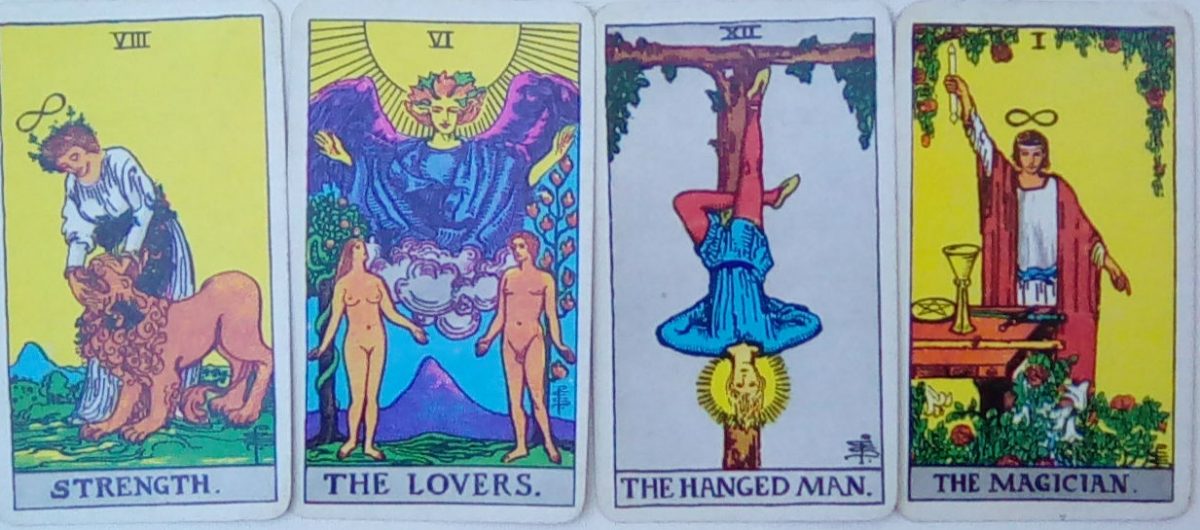
In the Rider-Waite tarot deck, The Magician stands at a table with the four tools of the Minor Arcana before him: a cup, a wand, a sword, and a pentacle. Above his head floats the infinity symbol. One hand points to the sky; the other points to the earth.

This is a card full of meaning for the manifestation process:

Infinity symbol: We have unlimited potential. Our minds are conduits for universal energy.  This is what we were just talking about: we are not separate from the creative power of the Universe.  We are a part of that power and that makes us much, much more powerful than we realize.

One hand up, one hand down: As above, so below—our inner world shapes our outer one.  This is another way of saying that our thoughts aren’t passive – they’re active agents creating our lives right now.  Whatever we create in our inner lives will manifest in our outer lives.

Tools on the table: We have everything we need to manifest—thought (swords), emotion (cups), action (wands), and material resources (pentacles).  We don’t need to borrow someone else’s methods for manifesting because we already have the magic in our own lives. 

The Magician is the living embodiment of the Principle of Mentalism. He reminds us that we are not a victim of circumstance—we are the creators of our experience by using our mental powers.

A Simple 4-Step Magician-Inspired Manifestation Practice

 Here’s a simple practice that brings together these lessons from the The Magician and the Principle of Mentalism.

Step 1: Clarify Your Desire

Get crystal clear.  Let me say that again:  GET CRYSTAL CLEAR!  What exactly do you want? Let’s face it – as human beings we are fully capable of wanting two things that contradict each other at the same time.  For instance, if you want a full time lover but you also want a lot of time to yourself, you need to sort that out.  Which one do you really want, because you probably can’t have both and if you ask for both they’ll cancel each other out and you’ll get nothing.

Write it down in a present-tense, emotionally charged sentence. For example:

 “I am joyfully attracting a lover and friend who is filling my life with meaning.”

Step 2: Align Your Mind

Close your eyes and visualize your desire as if it’s already happening.

Feel the emotion of it. Say your intention out loud.  In this example, you could imagine that you’re spending the day with your lover, having a wonderful time, and planning for a sensual evening together.

Step 3: Act with Intention

Now take a small action that reflects your inner belief.

It could be creating a vision board, applying for an opportunity, or simply saying “no” to something that no longer fits.  In this case, it could be writing out 20 affirmations that say, “I am loved and treasured by my partner.”

Step 4: Meditate on the Image of The Magician Card for a Few Moments

Do this while you’re visualizing your goal. This helps us to remember the lessons here:  everything begins with our thoughts;  we have unlimited potential that we’re using to create our dreams; everything that we need to create our dreams is contained within us.

It also goes a step further and helps us to connect with that archetypal energy of The Magician.  It’s a symbol that pulls power into our visualization and engages the Universe in helping to create our desires.

Final Thoughts: You Are the Magician

You don’t have to “become” powerful—you already are.

The Principle of Mentalism and The Magician card both remind you: your reality is a reflection of your consciousness.

Want to change the outside? Start on the inside.

Start with your thoughts.

Start with your intention.

Start with you.

Want to Go Deeper?

If this topic speaks to you, I invite you to check out my new ebook:

“The Alchemy of the Mind: Transforming Your Life With the 7 Principles of The Kybalion.”

In it, I explore how each Hermetic principle can help you reshape your beliefs, emotions, and daily experience. It’s part philosophy, part practical guide—and 100% dedicated to your growth.

Your Turn

Have you used The Magician card in your manifestation work?

What has Mentalism taught you about the power of thought?

Drop a comment below—I’d love to hear your experience.

Lucid Choices, The Four of Swords, and Living the Dream Life

Looking at our lives as lucid dreams.

Have you ever had a dream that seemed so real, so vivid and intense, that you were actually shocked when you woke up and realized it was just an illusion?

Sometimes they’re really GOOD dreams.  Perhaps we’re making incredible love with someone or maybe we’re floating through a starry, magical sky. Sometimes they’re really BAD dreams, where we’re being chased by monsters or night terrors.  Whether they’re good or bad, the one thing they have in common is that – at the moment that we’re having them – they seem absolutely, 100% real.

LIVING THE DREAM

There’s a strong case to be made for the idea that our so-called, “waking life,” is very much like a dream, as well.

In, “The Four Agreements,” that’s the term that Don Miguel Ruiz actually uses to describe our day to day existence:  a dream.  As we grow up, we’re programmed by our parents, our religions, and our societies to see the world in particular ways.  We don’t question those view points as they’re being installed in our little brains because we don’t have the ability to judge whether they’re true at that age.  By the time that we reach adulthood, we’re thoroughly convinced that the way that we see the world is the RIGHT way to see it, perhaps the ONLY way.  But those view points are just someone else’s dreams of how the world really is.

Buddhist and Hindu philosophies approach human life in much the same way:  life as we commonly experience it is an illusion, a dream that’s made up of our emotions, ideas, desires, and aversions.  We’re essentially sleep walkers who go through life laughing, crying, eating, procreating, raising families, working, and eventually dying, with no clue as to why we’re here or what it all means.  We just know that, like our dreams, it seems absolutely 100% real. 

WAKING UP

Occasionally, some of us will wake up just a little bit from the dream that we call our lives.  Usually it’s because our pleasant dreams have turned into a nightmare.  

One of our major dreams is, “I’m going to live happily ever after and nothing bad is going to happen to me.”  We’re taught that if we’re, “good,” people and we work hard and we’re responsible, everything is supposed to work out for us.  We’re going to fall madly in love with just the right person, have 2.5 beautiful children who will be extremely well adjusted, get a nice house, a new car, and all of the material toys. And we’ll live happily ever after.  Shit happens to, “bad,” people, not to us.

And then shit happens to us.

Perhaps we find our wife or husband in bed with someone else.  Perhaps we’re in a terrible auto accident.  Perhaps one of our beautiful children gets very, very sick.  Perhaps we get fired from our jobs and lose all of our material possessions.

It’s very much like suddenly waking up.  All of the things that seemed so rock solid and dependable in our lives turn out to be built on sand.  We may feel like life has betrayed us or the whole world has gone crazy.  Eventually, though, most of will go back to our dream worlds because the dream is so comfortable and waking up hurts.

LUCID DREAMING

There’s something that happens in some dreams where we’re dreaming but we suddenly become aware of the fact that it’s a dream.  We don’t wake up from the dream, but we exist within it, knowing that it’s a dream.  It’s called lucid dreaming and, if you’re not familiar with it you might enjoy reading, “Lucid Dreaming,” by Charlie Morley.

Now, one of the things that happens in lucid dreaming is that, to a large extent, we’re able to control the dream.  If we see a wall in front of us, we can consciously decide to simply grow wings and fly over it.  Or perhaps we can visualize a really beautiful woman or man and make love to them to our heart’s content.  

It’s a dream.  We know it’s a dream. But we can choose what happens in the dream.

LUCID LIVING

In his book, “Change of Heart,” Chagdud Tulku said that very few of us will ever be enlightened.  Most of us will continue to live in a dream state, perhaps for many incarnations.  BUT . . . we can choose whether we want to have a good dream or a bad dream.

Which sounds very much like lucid dreaming, doesn’t it?

When we have one of those life experiences where our day to day dream has turned into a nightmare, when we suddenly get a peek behind the curtain of what we thought was true, we have a choice.

Most people roll over and go right back to sleep, just as quickly as they can.

Some people decide to adopt a stance of total cynicism.  Life sucks.  People are rotten.  It’s all a lie.  These are the, “life is a bitch and then you die,” people.

But a few people will say, “Huh . . . it’s all just a dream.  But it’s an interesting dream.  I wonder if I can grow wings and fly over that wall?”

IT’S NOT ENLIGHTENMENT

One of the things that it’s important to remember is that just because we realize that life may be a dream, it doesn’t mean that we’re suddenly, “enlightened.”  Like the person in the 4 of Swords, we’re still solidly asleep, but now we know that we’re asleep.  Which is an improvement.

Unfortunately, as a brief stroll through the internet will teach us, there are many, many people out there who have decided that they must be gurus, spiritual adepts and geniuses just because they woke up a little bit.  Seeing through the illusions doesn’t mean that we’ve got an answer – it just means that we see the problem.

It’s a paradox, like lucid dreaming, where we’re asleep and awake at the same time.  If we keep meditating and keep working on our personal growth, we’ll wake up a little more and a little more and a little more.

In the meantime, we can choose to have good dreams.  We can have dreams that are full of love and healing and our dreams will make other people’s dreams a little better, too.

As Bob Dylan once said, “I’ll let you be in my dream if you’ll let me be in yours.”

Remember that my ebook, “Just the Tarot,” is available dirt cheap on Amazon. It’s not just a dream. Really. I think.

The Five of Wands, Louise Hay, and Becoming the Grown Up Who Lives in Our Heads.

A look at childhood programming and using affirmations.

If I were to say, “Your thoughts are total bullshit,” you’d probably feel highly insulted.  On the other hand, if I were to say, “My thoughts are total bullshit,”  you might agree with me or you might tell me that’s not true and wonder where I got such a terrible self-image.

But if I were to say, “A lot of OUR thoughts, as human beings, are total bullshit,” that’s a more fertile ground for discussion simply because it depersonalizes it and takes us out of a fight-or-flight reaction.  We don’t have to defend anything or run away from being criticized.

In, “You Can Heal Your Life,” Louise Hay made the point that, at their base, our thoughts really mean nothing at all.  They’re just words that we string together and they don’t take on any meaning by themselves.  We have to ASSIGN meaning to them.  We have to say, “I believe these thoughts are true.”

And, oddly, our beliefs are nothing more than thoughts that we’ve repeated over and over and over until we believe that they’re true.  When we take a little closer look at those thoughts we can understand exactly why so many of them really are bullshit.

First of all, a lot of our thoughts were, “installed,” in our little brains when we were far, far too young to make any rational judgements about their validity.  By the time that we reach late adolescence most of us have been thoroughly programmed with unexamined thoughts that we believe to be true.  The richest source of the programming is our families, of course, but we get a hefty dose of it from our teachers and peers, as well.  Some of those thoughts might be things like:

I’m no good at math.

I can’t dance.

I’m a terrible athlete.

I’m not very good looking.

I’m too fat or too skinny or too tall or too short.

I don’t fit in.

Nobody likes me.

Or the thoughts might be something like:

Democrats are communists.

Republicans are fascists.

Rich people are heartless.

People who don’t practice my religion are evil.

Black people are scary or white people are arrogant honkies.

Immigrants are too lazy to work AND they’re going to steal my job.

These are all just words, strung together to make thoughts, which were repeated over and over when we were young until we came to believe that they must be true.

The truth of these beliefs were totally unexamined when we were kids because we didn’t have the mental capacity to evaluate them.  If our parents or teachers told us they were true, well then – hey –  they must be true because that’s what the grownups said. For the most part, though, they remain unexamined when we’re adults, which is the second reason that many or our thoughts are total bullshit.

Most of our thoughts are subliminal, which literally means, “below the light.”  In this case, we mean, “below the light of consciousness.”  We just think them, without even being aware of the fact that we’re thinking them.  That’s the infamous, “stream of consciousness,” or, “monkey mind,” that engages about 20 seconds after we wake up in the morning.  It’s just a ceaseless chatter that runs along by itself and contains – buried in its content – all of that programming that we got as kids.  It sounds like this:

Gotta get the coffee going, godamn it’s cold, I wonder if I have enough gas in the car, should have balanced the checkbook but I’m no good at math, gotta get the kids up and make breakfast, can’t believe the price of eggs, it’s the rich Republicans driving the prices up, nobody cares about working people, if only I had a better job but I’m not smart enough to get a better job, where are my socks . . .”

The unexamined thoughts that were programmed into us when we were kids are running over and over again, all the time, and remain unexamined.  And, yes, thoughts that are repeated over and over become beliefs and, like the people in the Five of Wands, we’ll fight to the death to defend our beliefs.

Which is the third reason that most of our thoughts are bullshit.  We’re totally ego involved with them.  Most of us, most of the time, completely identify with that subliminal thought stream.  We experience it as, “These are MY thoughts in MY mind, therefore, they’re a part of me.”  It never occurs to us that they’re not really our thoughts.  They’re our parent’s thoughts and our teacher’s thoughts and maybe even the thoughts of that bully who tortured us at recess in the third grade.

Affirmations, as Louise Hay points out, are a simple way to step out of that thought stream and start changing our beliefs by changing our thoughts.  Let’s face it:  most of don’t have the time to just sit there all day and watch our thoughts.  “Ah HA!  There’s another negative thought from my childhood programming!  Take THAT, negative thought!”

What we can do, though, is to become a little more conscious of our thought streams.  Even when we’re working or driving to the store or taking a shower, we can watch the mind chattering away and consciously think, “Okay, that’s a pretty negative thought,  And it’s probably not MY thought; it’s just something my mind was taught when I was a kid.”

When we begin to dis-identify with that constant stream of thoughts, we immediately lose the need to defend them.  After all, they’re not really my thoughts, so why should I care about them?  And then we can begin to replace all of that subliminal programming with programming that we consciously choose.

Just pick a positive thought – any positive thought – and repeat it 3 or 400 times a day.  Does that seem like a lot?  Well, how many times a day do we say something negative to ourselves with that childhood programming?  Hundreds of times, right?

If that sounds like a sort of a forced, Pollyanna Positivity it’s because it is. We are quite literally pushing our thoughts in a new direction and it can feel completely unnatural to begin with.  But that’s the whole point:  there’s nothing, “natural,” about our unhappy beliefs, either.  They were just thoughts that were repeated again and again, often by the miserably unhappy adults who raised us.  That’s all that happy beliefs are, too – thoughts that are repeated again and again until they become beliefs.  And we get to be the adults who are repeating them, which is pretty cool.

The Judgement Card – Lay It Down and Shut the Door

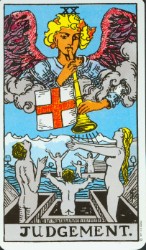
To my mind, Judgement is a lot creepier looking card than the Death card.  Coffins bobbing around in the sea while gray corpses pop out of them like zombies.  Of course, the Angel with the Trumpet hovers overhead calling them back to life and that’s nice but it’s still a disturbing card on the face of it.

Despite that, it’s still a hopeful card because it’s the card of endings and where there are endings there can be beginnings.  Judgement isn’t just about endings, though; it’s about the end of long cycles that occur in our lives. Often it shows up in our readings as a sign that we can finally lay our burdens down.

We all have seasons and cycles in our lives, though we frequently fail to recognize them as distinct and separate chapters.  Some of the more obvious cycles are birth through adolescence, puberty through adulthood, perhaps going to college or doing a hitch in the military after high school.  Our children growing up and moving out on their own. These are all periods of time that stand apart in our memories and experiences as being unique times in our lives.

And Judgement is about the ends of these cycles.  It’s about the personal judgements that we make about these periods of time, what they meant to us, and how we performed in dealing with them.

To use another common example, think of marriage or partnership as a cycle in our lives.  We meet someone, we fall in love, we decide that he or she is the person with whom we want to spend our lives.  The relationship may last for many years or just a few. Sooner or later, though, whether as a result of, “until death do us part,” or a divorce/separation, that bonding with another, that cycle of our lives, will be over.

And when it’s over, we have to make a judgement about it.  How did I do? Could I have done more? Could I have loved more or shown more feelings or compassion?

A divorce is probably a pretty good example of that process.  Unless you accidentally married a psychopath or an angel, the odds are that BOTH parties contributed to the divorce.  Both parties might have tried to be a little more caring or supportive or understanding or sensual or whatever the missing ingredients were that caused it all to fall apart.

Even if you’re actually an incredibly good, loving person you may have contributed to the divorce just by marrying an asshole to begin with.  The question is, “What did I do in this cycle that was good, bad, or indifferent?”

So Judgement is about the ends of these cycles in our lives and about the judgements we have to make when the cycles end.  And they’re not judgements about the other party or circumstances – they’re judgements about ourselves and our own behaviors.  With those judgements come – hopefully – growth. It can be something as simple as, “I’m a really good, loving person so why do I keep getting involved with assholes?”  Or as complex as, “I was really abused as a child so how do I learn how to really love and trust people?” The judgements are always geared toward being and doing better.

The second element in Judgement, though, is laying that burden down and starting a new phase and that’s where many of us trip ourselves up.  We need to be able to firmly close the door on that chapter of our lives and say, “That’s over. Time to move on.”

Taking the time to make thorough judgements about ourselves and about our behavior is the key to doing that.  We don’t just leave a marriage or experience a death or fight our ways through serious illnesses and then go on with life as as the Walking Wounded.  We take a good long look at ourselves and we thoroughly decide, “I did the best I could.”

Or, “I could have done better.”

Or, “I need to work on being a better person/listener/partner/lover and here’s how I’m going to do that.”

And, once we can honestly say to ourselves that we’ve learned the lessons we were supposed to learn, we forgive (or congratulate) ourselves and MOVE ON.  We don’t whip ourselves over not doing enough or continue to live in the past. We shut the door firmly and step out into our new world.

It’s over.

And it’s beginning.

Just the Tarot, by Dan Adair – a kindle ebook available on Amazon