THE EMPRESS AND THE ART OF FLUNKING OUT OF EARTH SCHOOL

A playful look at the New Age paradox of being “perfect souls” who still come to “Earth School” to learn lessons. The post explores both views and suggests that real growth comes not from suffering, but from joy, play, and becoming more fully ourselves.

There’s a rather large pothole in New Age philosophy that I keep tripping over. Let’s call it The Earth School Fallacy — the strange contradiction between “We are perfect divine beings” and “We’re here to learn lessons because… well, we’re NOT perfect divine beings.”

Somehow, we manage to carry both of those ideas around in our heads and not notice that they don’t quite fit together.

“Just the Tarot,” available on Amazon

THE EARTH SCHOOL MODEL

You’ve heard this one. If you’ve been on a spiritual path longer than a week, you’ve probably used this one.

Earth, we’re told, is a sort of cosmic classroom we incarnate into repeatedly. Each lifetime is a syllabus of Very Important Lessons, and with each incarnation we supposedly level up until we become Spiritually Perfect.

In this model, we actually choose our life challenges before we’re born.

Have a temper? Great! Let’s incarnate into a family whose daily activities include pushing all of your buttons like they’re competing for a prize. Assuming we don’t murder each other we eventually learn enough humility and patience and – SHAZAM –  we transform into Mahatma Gandhi.

Have an obsession with sex? Wonderful! Let’s incarnate into a world filled with gorgeous, eager, naked partners who—

Okay, that one never happens. But you get the drift.

Pass your lessons and you move up a grade.

Fail your lessons and you come back as a cockroach or a MAGA supporter and start over in Spiritual First Grade, eating glue and making macaroni art.

In Tarot Talk, Gaia’s classroom often looks like the Five of Wands — a bunch of souls flailing around wildly until one of us finally figures out what the sticks are for.

THE ANGEL WITHIN

Now we arrive at the second New Age idea — the one that directly contradicts the first.

This is the belief that we’re already spiritually perfect, but we’ve forgotten that fact. Our task isn’t to improve ourselves… it’s to remember that we don’t need improving.

Buddhists describe it as our original nature: a perfect jewel hidden under a crust of plain gray rock. Chip away the rock and — surprise! — you’ve been luminous the whole time.

Joni Mitchell phrased it better than all the gurus combined:

“We are stardust, we are golden,

and we’ve got to get back to the garden.”

In this view, we are pure, radiant beings from Source Energy who come to Earth, promptly forget who we are, and then spend the rest of our lives meditating, journaling, and buying inspirational calendars in an attempt to remember.

Put another way:

We’ve got a sleeping angel inside us, and the angel really needs to get its butt out of bed.

THE CONTRADICTION

Here’s the uncomfortable question no one asks:

If we’re already perfect, why would we CHOOSE to forget that and struggle?

It’s like becoming a master at algebra, then signing up for a lobotomy just so you can relearn quadratic equations from scratch.

Imagine your higher self sitting in another dimension saying,

“I’m a being of luminous perfection. You know what sounds fun? Forgetting everything and getting pissed off at the traffic while I drive to a boring, meaningless job that I hate.”

Something about that doesn’t quite compute.

EARTH SCHOOL AND THE WORK ETHIC PROBLEM

The Earth School model borrows heavily from Christian theology, a worldview in which:

• Humans are inherently sinful.

• Life is full of temptations that make us more sinful.

• If we behave ourselves and avoid having sex with the neighbor’s spouse, we get to go somewhere nice after we die.

In this model, Earth is basically the rough school on the dangerous side of town, with a curriculum of suffering, discipline, and fear.

Just keep your head down, work hard, and eventually—good news!—you’ll die.

THE VEDANTA SOLUTION (AKA: THE EMPRESS APPROACH)

Vedanta, from the Hindu tradition, on the other hand, leans toward Joni Mitchell’s interpretation. It suggests that:

• We are already perfect.

• Life is not meant to be hard.

• We’re not here to learn painful lessons.

• We’re here to experience, enjoy, and expand.

If the Vedanta version of Earth School has a model, it’s not the stern monk or stressed-out student — it’s The Empress.

Empress Poster available on Etsy

She’s not here to ace the test. She’s here to savor the banquet.

Play, creativity, pleasure, beauty — these are not distractions from the spiritual path.

They are the spiritual path.

That’s a really hard concept for Westerners to wrap our heads around.  We’re taught from the moment that we’re born that life is a series of assignments that we’re supposed to complete and that the next assignment will be better than the last.  That’s really the way that our whole society is set up.  We go to kindergarten so that we can go to grade school so that we can go to high school so that we can go to college or trade school so that we can get jobs so that we can get promotions so that we can retire comfortably and have enough money to pay for our funerals.

If we do all of that, we’ve been, “successful.”  If we don’t, our lives have been meaningless.

When someone tells us that the whole purpose of Earth School might actually be recess, it feels slightly insane.

LIVING SOMEWHERE IN THE MIDDLE

We can argue both sides.

If you lean toward Earth School, you can point to all the suffering and struggle that seem baked into our reality. As the English philosopher Thomas Hobbes famously put it, human life often appears “nasty, brutish, and short.”

But if you look again, you’ll also see breathtaking amounts of love, generosity, joy, and compassion.

So what’s the truth?

Probably something in the middle.

No, we’re not perfect angelic beings slumming on Earth…

but we can be.

Maybe life isn’t about learning painful lessons, and maybe it’s not about effortless perfection either.

Maybe it’s simply about becoming more yourself, more awake, more playful, more alive.

And oddly enough, the way we get there isn’t through suffering…

it’s through joy. It’s through learning how to play.

We don’t have to wait until we die to graduate.

We can do that right now — as soon as we remember that recess was always the point.

The Hierophant Card, Spirituality, and That Time That Ram Dass Got Conned

In this candid exploration of The Hierophant Tarot card, I unpack both the light and shadow sides of spiritual authority. From my own rocky history with organized religion to cautionary tales of gurus gone wrong, this post looks at how The Hierophant can represent both guidance and manipulation. Learn how to spot the difference between a true spiritual teacher and a false one, and why, in the end, your own connection to the Sacred should always be at the center.

The Hierophant Card from the Waite Tarot Deck

I’ve always had a hostile feeling toward The Hierophant card. I was raised in the old, Latin, fundamentalist Catholic Church, and like many a recovering Catholic, the mere sight of a priest, pope, or prelate is enough to make me start hissing and spitting.

The image of the Hierophant sitting on his golden throne while tonsured followers bow before him is a perfect example of what I don’t like about organized religion. It’s not the Sacred Divine that’s central to the image—it’s the priest. The priest is the intermediary you have to go through to get to the Sacred.

This setup isn’t limited to Catholicism, of course. We find it in all religions. There are countless priests, rabbis, pastors, vicars, imams, and gurus who claim to hold the Key to the Kingdom—and you’ve got to drop them a little sugar before they’ll let you see it.

Religion Versus Spirituality

“I’m more spiritual than religious.”

We’ve all heard that one—so often, in fact, it’s become almost a cliché in New Age circles. In very simple terms, religions claim to hold knowledge from God/dess—usually in the form of a book or oral teachings—and you have to pay someone (priest, rabbi, guru, etc.) to interpret it for you.

Spirituality, on the other hand, involves direct knowledge of the Sacred through personal meditation, taking psychedelic drugs, or having some other form of mystical insight. You don’t need to pay anyone to interpret it because you’re the one having the experience.

In Tarot terms, that’s the polarity between The High Priestess and The Hierophant: The High Priestess represents direct spiritual experience, while The Hierophant represents organized religion.

The Good and the Bad Faces of The Hierophant

I recently had a discussion with another Tarot reader who seemed mildly shocked by my open hostility to The Hierophant. I could have jumped right in with thousands of examples: pedophile priests, pastors who are sleeping with members of their flocks, imams and rabbis calling for each other’s destruction.

Organized religion makes that all too easy, right? There really are a lot of creepy critters living under that rock.

But I held off and listened to her. Her point was that The Hierophant can also represent the spiritual teacher who is genuinely a spiritual teacher. Examples might include yoga teachers, meditation guides, or instructors at temples and spiritual retreats.

And yes, I suppose that includes priests and pastors who sincerely try to teach compassion, love, and charity.

There are plenty of people who don’t know how to even begin their spiritual journey, much less reach the destination. For them, spiritual “instructors” can be a vital step on the ladder.

Still… be very, very careful.

The Guru Who Got Conned by a Guru

I’ve long been a fan of Ram Dass. Maybe it’s because he was a fellow Aries and I understood him on that level. Maybe it was his gentle, self-deprecating humor. Maybe it was because about 80% of what he said was solid truth.

If I were to name a “good” spiritual instructor, he’d be near the top of my list.

Despite all of that, he wrote an astounding article in a 1976 edition of Yoga Journal outlining how he had been thoroughly and totally conned by another guru named Joya.  

This was years after receiving his own spiritual transmission from his original guru in India. Despite that grounding, he stumbled right into Joya’s web. Within months, he was having sex with her, convinced she was channeling Indian goddesses, and buying her gold bracelets and rings to “protect her energy.”

He bought it—hook, line, and sinker.

Add to that the drunken sexual abuses of Chögyam Trungpa, the murders and kidnappings that evolved out of the Hari Krishna movement, and, of course, the horrors of the Bhagwan Rajneesh compound in Oregon, and you begin to get the picture.

Even the “good” face of The Hierophant can turn bad. No one following these leaders woke up and thought, “Hey, I’d really like to find a guru who’s going to rip me off, sexually abuse me, and get me involved in criminal activities.”

Who’s in the Center?

We can actually learn a lot just by looking at The Hierophant card.

A. The pope figure is in the center. If the spiritual teaching you’re receiving revolves around a particular person—if that person’s existence is central to the teaching—you’ve got a false teacher.

B. The figure is being worshipped. Unless your teacher can levitate six feet into the air and float around the room, don’t buy the idea that there’s something “divine” about them. Even then, check for wires. Real teachers may have siddhis—extraordinary spiritual powers—but they don’t flaunt them, expect worship, or claim to be gods or goddesses.

C. The figure sits on a throne wearing a golden crown. There’s a reason people contrast the spiritual with the material. Real spiritual teachers don’t hoard treasures. As the old country song asked, “Would Jesus wear a Rolex?”

Um… no. He wouldn’t.

Teachers Are Stepping Stones

If you’re involved in a religious practice—whether Tibetan Buddhism or American Christianity—and you feel it’s making you a better person, more power to you.

But remember: we are meant to evolve beyond teachers. We absorb what we need from them and then move on to the next plateau. Organized religion can be a stepping stone at the start of the journey, but it’s not the destination.

And no… I still don’t like The Hierophant.

“Just the Tarot,”  by Dan Adair, a kindle ebook available on Amazon.

Shine Your Light: The Star Card, Shame, and the Courage to Be Seen

This post explores the deeper meaning of The Star card in the Tarot and reflects on why so many of us struggle to shine our light in the world. Drawing on the work of Brené Brown, Tibetan Buddhism, and real-life dynamics like shame and codependency, I look at the messages—both cultural and personal—that lead us to dim our brilliance. The Star invites us to pour our gifts into the world, not for recognition, but because it’s who we truly are. This is a reflection on healing, self-worth, and the sacred courage it takes to be seen.• shine your light

This image is from one of my new Tarot Affirmation posters, now available on my Etsy art site. I really love how it turned out—but even more than that, I love the message it carries: Shine Your Light.

And yet, for so many of us, that’s easier said than done.

Instead of shining, we hide. Instead of pouring ourselves out like starlight, we dim, shrink, withdraw. Why is it so hard to be radiant in a world that so desperately needs our brilliance?

The Culture of Shame and the Fear of Being Seen

In one of her powerful TED Talks, Brené Brown speaks about the culture of shame we all live in. Even if you didn’t grow up in a dysfunctional family (and statistically, about 60% of us did), we’re still marinated in a society that constantly criticizes, compares, and belittles.

Maybe you brought home a report card with a B, and your parent asked, “Why didn’t you get an A?”

Maybe you’re in a job where meeting your performance goals doesn’t bring a sense of completion—it just earns you a fresh, even more demanding set.

Maybe you’ve internalized the billions of dollars spent by the beauty industry telling you that your face, your body, your age, or your hair simply aren’t good enough.

On social media, the message is constant: unless you’re being validated with likes and followers, you’re invisible.

Advertising tells you your house isn’t elegant enough, your car’s too old, your wardrobe outdated.

Even spirituality isn’t immune. We whisper to ourselves: I should be better. I should care more. I should meditate more. Pray more. Try harder.

Let’s face it: in this world, it’s all too easy to believe that we should be ashamed of simply being ourselves.

As Brown puts it, shame drives two powerful tapes in our heads:

1. You’re never good enough, and

2. Who do you think you are?

And because those tapes run deep, we begin to engineer our own smallness. We shrink ourselves to stay invisible—because visibility feels like a threat. We dim our light so no one will see just how “inadequate” we believe we are. And in doing so, we fail to shine.

Codependency and Dimming Our Own Lights

Sometimes, the reason we hide isn’t culture—it’s relationships.

Too many of us are caught in dynamics where one partner shines while the other fades into the background. It might be dressed up in the language of care or sacrifice, but the effect is the same: one person takes center stage, while the other erases themselves.

It could be a relationship with a narcissist, where one partner is expected to provide constant praise, attention, and emotional caretaking.

It could be a more obvious kind of abuse, where failing to meet someone else’s needs results in punishment, blame, or even violence.

It might even look noble—like staying small to “support” someone who is ill, unstable, or in need. But the underlying belief is this: there isn’t enough light to go around.

And so, we dim ourselves to make the other person shine.

We play down our accomplishments. We pretend we’re not that talented. We take the backseat in our own story. And we tell ourselves it’s virtuous.

But it’s not noble to disappear. It’s not compassionate to go dark.

We were meant to shine.

The Star Card and the Sacred Act of Sharing

The Star card in the Tarot is a card of healing—but it’s not just personal healing. It’s about reconnecting with the world by letting your own light flow into it.

In Tibetan Buddhism, there’s a teaching that each of us carries a radiant jewel inside. It may be buried under layers of dust or encased in stone, but it’s there—glimmering with our true nature. And our task in life is to uncover that jewel and offer it to the world.

That’s what the woman in The Star card is doing. She kneels beside the stream and pours out her water—not hoarding, not holding back. She gives freely to the land and to the flow of life itself.

She’s not asking for praise. She’s not trying to be impressive.

She’s just being who she is: a vessel of light.

And so are you.

You don’t shine for applause.

You don’t shine to prove anything.

You shine because it’s your nature.

And this world is thirsty for that kind of offering.

A Final Thought

You are not just a person. You are a sacred gift.

You are a hidden jewel.

You are starlight in human form.

Let yourself shine.

“Just the Tarot,” by Dan Adair – a kindle ebook available on Amazon

Love, Therapy, Ram Dass, and God in Drag

A look at the sources of love.

I’ve been reading a book called, “Getting the Love You Want,” by a psychotherapist named Harville Hendrix.  The theme of the book is basically, “We all fall in love, a lot of us fall out of love, and here’s how to fix that.”  He’s a smart guy, did some excellent analysis, and I’d probably recommend the book.

But he never did get into that basic question of, “What IS love?”

Now, there’s been an awful lot of brain and biochemistry research over the last 20 years.  What the scientists have determined is that when we magically meet, “the right person,”  giant sparks fly out of both our genitals and our subconscious minds, then our brains start pumping huge amounts of endorphins, and – SHAZAM! – we’re in love.

That’s what we could call the, “reductionist,” approach to love.  What we call love is ultimately reduced to brain and body chemicals that cause us to feel wonderful.  From that point of view, love is nothing more than a biochemical reaction – probably based on the need for the species to procreate – that we dress up with a lot of romantic notions, boxes of candy, and Hallmark cards.

It’s a classic case of the whole being more than the sum of the parts, though.  Love isn’t just hormones.

Love is an energy.  When we have it in our lives, we don’t just feel better, our lives actually work better.  Its presence seems to trigger huge amounts of synchronicity and serendipity, we suddenly have solutions to most of the problems that we encounter, and we’re harmonious with the Tao, the Universal Flow.  When we don’t have it, life can feel like a meaningless slog through knee deep mud.

So the obvious course of action seems to be that we should all run right out, throw a net over someone, and fall in love with them.  Unfortunately, as Hendrix pointed out, right around 50% of us fall out of love, which is extremely painful, and we’re right back where we started, only we hurt a little more than we did before and we’re a lot more cynical.  Then we go back out, find another person to fall in love with, and rinse and repeat. 

 As much as Americans revere the idea of finding our Soul Mates, most of us are actually serial monogamists, who find one Soul Mate after another after another until one of them finally sticks.

I got a BIG clue on all of this a few years ago when I was listening to a Ram Dass talk after my partner had died.  He said that the reason that we feel so devastated after a death, a divorce, or a break up is that we mistake the person for the love.  The person is the vehicle that gets us to the love, not the love itself.  Since we have so totally identified the love with the person, though, when they go away it feels as if all of the love has gone away.

As near as I’ve been able to figure out, there are basically three sources of love.  There’s the love we derive from our relationships with other people.  There’s self-love, which so many of us struggle to achieve.  And then there’s the love that flows out of our spiritual connection with Source Energy, the god-head, the Tao, the Flow.

The trick is to understand that all three of the different forms are actually the same energy, the Source Energy, dressed up in different costumes.

Human beings are hardwired to receive love from other human beings.  And that’s a very good thing, indeed.  It’s like a built in on-ramp to Source Energy and it should be an effortless, natural process.  Unfortunately, the second that we enter the world, a lot of other ingredients get added to that process.  We start out with pure love and then we throw in crazy parents, cultural expectations, dysfunctional partners, etc., etc., etc, until the love becomes a shit show.  

Then we find ourselves sitting in a therapist’s office, asking, “What happened?  All I wanted was for someone to love me.  What happened?”  If we’re blessed with a really good therapist, we can start to untangle those knots and sort it all out.  “Okay, this part of the shit show came from your depressed mother and this part of the shit show came from high school and this part of the shit came from your ex-husband.”  As we identify and subtract more and more of the added ingredients that doomed our relationships, we move closer to that model of pure love that we were born with.

Where our culture lets us down, though, is in not identifying the actual origin of that energy that we call, “love.”  When we finally realize that the love is flowing OUT of Source and THROUGH our partners, then we can wake up and realize, “Huh . . .the love is always there and it’s abundant.  I can find it through my partners, but I can find it in a lot of other ways, too.  I can actually love myself.  I can meditate on Source.  I can connect with that energy in a zillion different ways.”

That’s not to put down romantic love in any way.  Romantic love is a grand sort of a feeling and it’s probably the fastest way for us, as a species, to reach that love energy.  BUT . . . it’s not the origin of the energy.

Perhaps the best solution is something else that Ram Dass suggested:  “Treat everyone you meet as if they were God in drag.”  When we start looking at the people we love as little bits of that God/Goddess/Love energy shining out at us through their human forms, then we can honor them, honor the process, and honor the love.

The Secret, The Law of Attraction, and Game Show Gods

A look at manifesting what we think we want when the Universe has different ideas.

Once upon a time, when I was in my mid-forties, I found myself standing beside a wild, rushing stream in Northern California.  It was a chilly Autumn day and the forest was a wonderful mix of giant redwoods, twisting madrones, and towering, ancient oaks.

I was alone that day and the feeling of magic seemed to positively vibrate through the air.  I came to a rocky promontory where the stream poured over a limestone outcropping and dropped twenty feet into a crystal clear pool.  I thought that if there was any place in the world where the Fairie Folk would be likely to hide their enchanted treasures, it would be in that mystical glade.  And so I asked them, “Fairies, show me your gold!”

Seemingly out of nowhere, there was a powerful blast of wind in the tree tops and thousands and thousands of golden leaves fluttered to the forest floor.

I learned two valuable lessons that day.  First of all, don’t get uppity with the Fairies, particularly on their home turf.  Secondly, Fairies may have an entirely different idea of what’s really valuable than humans do.  I suspect that they may find a shower of golden leaves far more precious than a lump of yellow rock.

I was cogitating about all of that today because I just discovered that the movie, “The Secret,” is now available for free on YouTube.  If you haven’t seen it, it’s all about how we can have absolutely anything that we want in life, if we really, really understand the Law of Attraction.  It has a sort of a breathless, Dan Brown meets Norman Vincent Peale feeling to it, but it was a groundbreaking film at the time of its release and it’s been a positive force in many people’s lives.

The thing about the Law of Attraction is that it definitely works.  Sometimes.  And sometimes it doesn’t.  For most of us, it works just enough for us to scratch our heads and think, “There’s something going on here and I want to know what it is.”

There is  a general principle that if we think positive thoughts, more positive events and people will enter into our lives.  If we become more loving, then we’ll start to encounter more loving people.  If we’re grateful for the abundance that we have right now, then more abundance will flow into our lives.  On the other hand, if we’re constantly depressed and anxious, then the Universe will flow things into our lives to get anxious and depressed about.  If we’re constantly cynical and negative, we’ll attract cynical and negative people.

So, yes, “like attracts like,” and the energy we’re putting out will attract energy just like it.  The problem seems to be that the Universe may have very different ideas than we do about what we’re looking for.

I have a friend who was completely jazzed when, “The Secret,” came out.  She literally watched it several dozen times and took reams of notes so that she could get The Method of Manifesting down perfectly.  She made vision boards and spent many hours visualizing and writing out affirmations and she was so relentlessly positive that it was irritating to be around her.

Shortly after that, her husband lost his job, their house was repossessed and they had to live in a travel trailer parked at a camping site in the forest.

Quite understandably, she threw up her hands, pronounced it all, “New Age bullshit,” and even went so far as to become a dedicated atheist.  So what went wrong there?

Most Americans approach spirituality and religion as if it were a television game show.  For most of us, those are issues we don’t much think about right up until we get our asses caught in a crack.  We float right along through life, mostly happy, mostly decent to other people, mostly content with our new cars, new computers, new lovers.  

And then – KABLAM!!! – something awful happens.  We learn that we have some terrible illness or our life partners leave us or we get fired from our jobs and our houses get repossessed.  That’s the point where a lot of us get POWERFULLY religious and we suddenly remember that there’s a God-person who’s supposed to fix everything that’s bad.

We might call that particular God-person the, “Let’s Make a Deal God.”  As in, “Let’s make a deal, God.  If you’ll just get me out of this mess, I PROMISE I’ll never be bad again.  I’ll be a lot better person, God, and . . . and . . . I’ll start going to church and I’ll adopt a puppy and . . . I’ll be good, God.  Just PLEASE get me out of this!”

Now, here’s the thing:  the God-person (or the Fairies or the Angels or the Universe or Jesus or whatever our particular religious configuration is) does answer our prayers, just not necessarily in a way that makes any sense to us at the time it happens.  Like the Fairies on that Autumn day, the Higher Powers out there may have a very different idea about what constitutes gold in our lives than we do.  And so, we don’t get exactly what we wanted.

When that happens, we tend to carry the Let’s Make a Deal scenario even further and get really pissed off at the God-person for not holding up his end of the deal.  “Look, I wanted the shiny new Jeep that was behind Door Number Three and you gave me the crappy toaster oven that was behind Door Number Two.  Well, just forget that part about me adopting a puppy, God.  In fact, I just won’t believe in you anymore.  Neener, neener, neener!”

Many people approach visualization, manifestation, and the law of attraction in exactly the same way.  They think that if they can just find THE method that will make it all work right, they’ll suddenly own a mansion, a sports car, a private jet and they’ll get laid every single night and perhaps every morning, too.

Let’s face it, though:  if there was ONE method that worked EVERY SINGLE TIME for EVERY SINGLE PERSON, we’d all be millionaires and we’d be so tired from having great sex that we could barely crawl out of bed.  Hell, our butlers would have to serve us our meals in bed, only there wouldn’t BE any butlers because they’d all be millionaires, too.

What a conundrum!

It’s very possible that there’s a guardian angel standing at our shoulders saying, “Yes, dear, I know that you wanted the shiny new Jeep but you really can’t afford the payments or the insurance and you don’t know how to drive a stick shift.  On the other hand, we could put some bread in the toaster oven and, look:  I brought butter and raspberry jam and Red Zinger tea.”

Or perhaps my friend’s guardian angel was saying, “Yes, dear, I know that you wanted a pot full of Krugerands to appear in your living room, but maybe what you really need is to stop sitting in front of a t.v. watching a movie 30 times in a row and have a little adventure.  Life is short. Here’s a nice travel trailer and there’s a beautiful forest. Go.”

Einstein said, “Either everything is a miracle or nothing is a miracle.”  It can be really hard to wrap our heads around the idea that we’re getting precisely what we need, when we need it, even if it’s not exactly what we wanted.  The key seems to be to realize that miracles are constantly unfolding in our lives, but they tend to unfold slowly and in their own peculiar ways.

Just be patient, wait for the magic to work it out, don’t try to make toast with a Jeep, and don’t get uppity with the Fairies.

Remember that my ebook, “Just the Tarot,” is available on Amazon for less than a jar of raspberry jam. 

The Five of Pentacles, Karma, and God’s Little Baskets of Muffins

Transforming ourselves through karmic selfishness.

I have a younger friend who HATES karma.

More specifically, he hates when he’s in the middle of an, “Oh poor me,” bitching session and someone shrugs her shoulders and says, “Well, that’s karma.”  

First of all, it interrupts the rhythm of his complaining and he has to go back and remember what he was so upset about.  

“What was I saying?  I know it was important . . . oh, I remember . . . life is meaningless and no one understands me . . .”

Secondly, it infuriates him because it suggests that the mess he finds himself in is somehow HIS fault and the whole point of his rap is that it’s everything and everyone else’s fault.  Which is just further proof that no one understands him.

This guy was raised by a Buddhist and that may have something to do with his constant irritation.  It’s developmentally important that teenagers be able to rebel against their parents.  The first way that we really begin to define who we are in the world is by making it clear that we aren’t our parents.  I imagine that it must be pretty damned difficult for a teenager to get any rebellion traction against a Buddhist parent.

“You know, Dad, sometimes I really hate you.”

“Well, son, all strong emotions will pass if we simply do a little deep breathing.  Remember, you’re the sky and your emotions are just clouds drifting by.”

Or

“I’ve been think about getting a tattoo.  What do you think about that?”

“Ah . . . perhaps you should get a tattoo of a double dorje or some other sacred symbol.  In a sense, it would be a constant reminder of the spiritual nature that dwells in physical matter.”

Or

“Maybe I’ll paint my face blue and dye my hair orange.”

“Hmmm . . . I wonder if you were a Druid in a past life.  Do you feel a particular attraction to oak trees?”

Aargh!  So it’s possible that this guy was deeply emotionally scarred by all of that loving kindness and unconditional acceptance from his parents.  If only they’d yelled at him or told him he was an idiot occasionally!  

Still, he does have a bit of a point about the notion of karma.

It’s perfectly understandable that people get a little riled up over the idea of crappy things happening to them because of what they may have done in a past life.  After all, most of us have absolutely no memory of our past lives and so it feels like we’re being punished for something that someone else did.  

Suppose I was Attila the Hun in a past life and in a fit of Barbarian Rage I whipped out my scimitar and beheaded a turtle.  Then 200 lifetimes later –   as Dan Adair –  I’m in a traffic accident and I get whiplash BECAUSE I decapitated that turtle.  That seems a little . . . unjust.  I mean, I’m NOT Attila in any sort of a meaningful sense, so why should I get sent to the principal’s office because Attila was a dick?

And then, to make it even worse, when I’m sitting there in my cervical collar reflecting on exactly HOW unjust it all is, an acquaintance says, “Oh, well, that’s karma.”  As my younger friend would put it:  “Fuck you.”

Now, there’s a particularly odious Christian doctrine called, “predestination.”  It holds that some people are born with the unchangeable destiny that they’re going to heaven when they die. Other people are born with the unchangeable destiny that they’re going straight to hell when they die.  It doesn’t matter what we do or how we behave, our ultimate destiny has already been decided at the moment of birth.

It’s like God is up there in the Kosmic Kitchen baking up human Souls and, as he pulls each one out of the Soul Muffin Pan, he tosses them into separate baskets marked, “Heaven,” and, “Hell.”

“Okay, heaven, heaven, heaven – whoops, you’re fucked – hell, heaven, fucked again, heaven . . .”  Like the beggars in the Five of Pentacles, we’re out in the cold and we’re going to stay there.

Theologians came up with a perfectly logical reason for this totally insane doctrine.  The idea is that God is all powerful and all knowing.  So if God knows everything, then that must mean that he knows everything that happened in the past, the present, AND the future!  And if God already knows what’s going to happen in the future, then he must already know who’s going to heaven and who’s going to hell.  Shazam!  There you are – it’s already determined.

That’s the kind of weird, Left-Brain, cuckoo for coco puffs vibe that a lot of people get off of the notion of karma.  It seems to be some sort of an inexorable process that was put into motion a long time before we came along and there’s not a damned thing we can do about it.  We’re either in the Heaven Basket or we’re in the Oh, You’re So Fucked Basket.  Like it’s something that happens TO us for no particular reason.

Of course, the important point that most of us miss is that karma isn’t happening to us, we’re happening to karma.  It’s a totally dynamic process and it’s something that we can change every single day simply by the ways that we behave right now.

The most simplistic way to think of it is as a sort of a bank account.  Rather than being born into a You’re-Going-to-Hell Basket or a You’re-Going-to-Heaven Basket, we’re born with a certain amount of Karmic Kash that we earned (or didn’t earn) in past lives.  The Dalai Lama will probably be reborn with several savings accounts, a really huge checking account, many certificates of deposit and a great coin collection.  Attila the Turtle Beheader, on the other hand, will be reborn with 50 cents in the bank and a lot of overdue bills.

The thing is, though, that the way that we’re born isn’t our destiny.  The way that we behave is our destiny.  Attila, for instance, might start a refuge for homeless turtles.  Every single time that he saves a turtle and gives it a meaningful life – KA -CHING – that’s another deposit in his Karma Account.  The Dalai Lama, on the other hand, might decide to support Eric Trump for President and – ZAP – that’s a major withdrawal from his Karmic Account.

As David Michie said in, “Buddhism for Busy People,” 

In what is one of the most outstandingly ingenious aspects of Buddhist teachings, we come to realize that our own selfish interests lie in being altruistic . . .months, years or decades of being generous for selfish reasons begin to have a predictable effect . . .what starts out as a contrived and self-conscious change of attitude and behavior results in a genuine metamorphosis.

In other words, we don’t have to start out as Mother Theresa or an Awakened Master.  We can start out as perfectly normal, selfish, self-centered human beings who are being kind to other beings because we DON’T want to end up wearing a cervical collar.  When we pick up a turtle that’s in the middle of the road and leave it safely on the other side, we can be doing it for the completely selfish reason of wanting to fill up our Karmic Account.

As we continue those little acts of kindness they gradually transform us.  They become acts of loving/kindness, where we’re actually noticing and caring about the welfare of the people and beings around us.  The translation of the word, “karma,” is, “action,” and that’s the key.  Our actions change us, even if they originate in selfishness.

And that’s how Attila the Hun becomes the Dalai Lama.  Pretty simple.

The Rules of Synchronicity Number Two: Lighten the Fuck Up and Walk on Some Water

Playfulness as a key to synchronicity.

In my previous post, The Rules of Synchronicity, Having Sex with Pizzas, and Becoming More Flow-ish, I began to lay out some basic rules for increasing synchronicity in our lives.  We then use that synchronicity to get into The Flow State and life becomes a lot easier.

  Rule number one, of course, is to ask for synchronicity.  It’s like knocking on a door – if you don’t knock, no one will answer.

Rule number two is . . . play.

Just play.  As in, don’t take ourselves so seriously.  Lighten the fuck up.  Mellow out.  Have some fun.

Now, to many people, that’s going to sound counter-intuitive.  After all, we’re asking the Universe for guidance in our lives!  And that’s serious stuff, by golly, and we should act very solemn about it.  Maybe dress all in black and look pained and tragic.  Or maybe even fall down on our knees and sob about it.

Not.

There is a, “Whatever-It-Is,” out there in the Universe that answers our questions and gives us guidance when we ask.  Call it god, call it the faery folk, call it angels, call it whatever you like.  It’s there and it engages with us when we engage with it.

Now, the Whatever-It-Is has some basic characteristics, just like a person.  In fact, it might be easier to think of Whatever-It-Is as a person or even a friend.  One of it’s characteristics is that it’s playful.  It likes to engage with people who have a sense of humor and a light heart.  It’s not that Whatever-It-Is WON’T engage with us if we’re all serious and dejected and depressed.  It would just rather engage with someone who’s a little more fun.

Using the analogy of a friend again, we all have friends who are in a dark, depressed place.  Everyone goes in and out of the light and some people stay in the darkness a little longer than others.  If we have a friend like that, we don’t turn our backs on him.  If she needs to have a cup of coffee and just unload about how miserable her life is, we’ll do that.  We’re willing to pat his shoulder and say, “There, there . . . it will all work out.”

On the other hand, if we see that particular friend coming toward us a block away, we might cross the street and peer into a shop window until he passes by.  We’re compassionate, but we’re not masochistic.  We’re there to help, but we don’t seek out the darkness they’re living in.

Put another way, we’re all attracted to people who are positive, humorous, and light hearted.  Their positive energy gives us a good energetic charge and, hopefully, we give them one as well.

In very much the same way, Whatever-It-Is is much more likely to engage with us when we’re living in a fun, humorous, positive space.  It has a light, playful energy and so it’s much more compatible with OUR energy when we’re light and playful.

This is, of course, completely contrary to what we’ve been raised to believe.  Traditionally, people have sought out a connection with Whatever-It-Is in churches.  And what do we know about going to church?  It’s very, very, very serious.  And solemn.  And pretty damned uncomfortable.  No giggling allowed, thank you very much.  

Catholics even have a tradition of smacking themselves in their chests with their fists and saying, “Mea culpa, mea culpa, mea MAXIMA culpa.”  That translates as, “I am guilty, I am guilty, I am SO FUCKING guilty.”

Would you like to have a conversation like that with a friend?  Of course not.  So why do we assume that Whatever-It-Is wants to have that conversation with us?  The ironic thing is that we’ve been taught that, in order to talk with Whatever-It-Is, we have to get into a really dark, serious emotional space and this is totally non-productive.  It just makes it that much harder for the positive energy and guidance to flow to us, because our vibration is incompatible.

Another problem that many of us – especially those of us who were raised as christians – encounter is that we’ve been taught from the get-go that GOD IS NOT OUR FRIEND!  The word, “god,” is just the term that most Westerners use to describe Whatever-It-Is.  It’s the something out there that we talk to when we need guidance and help, which we call, “praying,”  and when it answers us we call that, “miracles.”  

Unfortunately, we’ve also been taught that this god person pretty much doesn’t like anything that makes us happy.  That includes masturbation, sex, lying around being lazy, eating too much, and getting high.  He’s making a list and he’s checking it twice and he’s going to find out if we’re naughty or nice.  And if we’re naughty, we’re going straight to hell. Forever.  Period.

In other words, god doesn’t have much of a sense of humor.  In fact, you can flip through the entire bible and hardly find one single instance where god appeared to be having any fun or told a joke or did a dance.  The one exception I can think of was when Jesus decided to walk on the water just to freak out the local fishermen, but that’s a different story.

So, once again, this is a mind-set that we need to TOTALLY get out of.  Whatever-It-Is (call it god if you want to) LIKES for us to have fun.  Whatever-It-Is LIKES people who have sex and lie around in a hammock on a sunny day and tell jokes and dance.  Who wouldn’t?

Just to recap where we’re at in this discussion at this point:

  1. – We’re much happier, more fulfilled, and content when we’re living in the state of consciousness that we call, “The Flow.”
  2. – That state of consciousness always occurs coincident with synchronicity, so if we can increase our synchronicity, we increase the time we spend in The Flow.
  3. – Synchronicity means having contact with, asking questions of, and getting guidance from the spiritual source that some people call god/goddess or the faery folk or angels or spirit guides or even Whatever-It-Is.
  4. – The first step in achieving synchronicity is to actually, consciously ask for guidance and then watch for answers.
  5. – The answers will come a lot easier if we stay in a happy, light, positive vibration and remember that Whatever-It-Is is a benevolent friend who likes to have fun.

I’ll be posting some more about synchronicity in the near future, but for now just remember that the way to enlightenment is to lighten the fuck up.  We can do that!

Remember that my e-book, Just the Tarot, is available on Amazon for much less than what you’d pay for a box of chocolates and you’ll know EXACTLY what you’re getting.

Eating Pancakes with Jesus, Having Lunch with Lucifer and Looking Inward with the Three of Pentacles

A contrast in Christian and Buddhist views of human nature and spirituality.

Are we on the outside looking in or on the inside looking out?

Do we think that heaven or redemption or satori or enlightenment or whatever we want to call it, is, “out there somewhere,” or do we think it’s inside of us, waiting to be uncovered?

Which direction are we gazing? Inside or out? It’s a fundamental, crucial question in terms of how we approach life and our personal spirituality.

In Western Christianity, there’s no question that the focus is very much outward.  Heaven, redemption, blessings are seen as things that exist but they’re not an innate part of us. Christian theology goes something like this:  

“God made you in his self-image but something kind of went wrong.  God is perfect, but you aren’t.  In fact, you’re really, really flawed.  In fact, let’s be honest here, you’re a real piece of  shit.   You like to fornicate and steal and lie to people and, um, eat bacon and shrimp.  You’re pretty much hopeless, unless you change your ways.  If you change your ways, you can eat pancakes with Jesus in heaven, and they use REAL maple syrup, not that Mrs. Butterworth’s crap.  On the other hand, if you DON’T change your ways, well, God is going to have to toss you into a flaming pit where you’ll burn in agony forever.  Because he loves you.”

Now, the salient point in all of that is that THERE IS NO GOOD INSIDE OF US.  Whatever blessings or grace may exist, they exist, “out there,” in God, and it’s only by overcoming our basic, sinful nature that we can have any hope of finding happiness and salvation.

It’s only by becoming, “not us,” that we can get God’s approval and get into that pancake breakfast with Jesus.  That sets us up for a lot of spiritual and psychological tension because, basically, everything we really like to do as human beings is a sin and sends us toward having snacks with Satan, instead of breakfast with Jesus.  Everything from sex, enjoying our possessions, loving a good meal, having a nice lazy day, eating shell fish or pork, even masturbating are ALL deadly sins.

What causes us to commit all of our sins?  Why, our bodies, of course!  It isn’t really ME that wants to get into bed with Mary Jo and fuck like bunnies, it’s my body.  It isn’t really me that wants a BLT, it’s my body.  More specifically, it’s my DAMNED body.  If it weren’t for my body, I could be, like, I dunno . . .  Mother Teresa . . . or maybe Mahatma Gandhi, except he wasn’t a Christian so he went straight to hell, of course. 

The end result of that is that we end up hating even our own bodies because the body is the source of all of those terrible impulses that cause us to sin.  That’s why Medieval christians developed wonderful traditions like whipping themselves and self-crucifixion.  The terrible, sinful body had to be literally beaten into submission so that it wouldn’t make them sin, or they’d end up having lunch with Lucifer or brunch with Beelzebub (also known as, “Beelzebubba,” if you live in Texas.)

It’s interesting and even a little startling to our Western minds, to compare that Christian model of spirituality with the Buddhist model.  Tibetan Buddhists speak of basic human nature in terms of a precious jewel or crystal that is covered with plain rock. Our job, our spiritual quest, is to uncover that beautiful jewel by chipping away at the rock, one little piece at a time.  By meditating, practicing mindfulness, and building loving/kindness into our lives, we gradually reveal more and more of the jewel, our true nature.  As Chagdud Tulku Rinpoche’ put it:

“Enlightenment is not anything new or something we create or bring into existence. It is simply discovering within us what is already there. It is the full realization of our intrinsic nature. 

In sharp contrast to Christian theology, we aren’t terribly flawed,”sinful,” beings.  Instead, we are beings that are incredibly beautiful, holy, and wonder-filled.  We just haven’t uncovered that part of our nature, that precious jewel, yet.

Our redemption isn’t, “out there,” it’s not something we’re going to find in heaven or a book.  It’s very much, “in here.”  It’s something that we find by looking inward, toward our true nature, by meditating, consciousness, and increasing the love in our hearts.

This isn’t to say that Buddhists don’t have their Greatest Hits list of, “sins.”  They condemn anger, judging others, envy, greed, etc.  But, they don’t condemn them in terms of their being a part of our basic nature.  Rather, they’re considered sort of side trips that lead us away from our basic goal of enlightenment.  They’re distractions, rather than definitions of who we really are.

There’s actually a major Buddhist doctrine called, “Precious Human Birth,” which not only says that we’re NOT terrible, sinful creatures, it says that if we were born human, we hit the fucking jackpot.  Only human beings are able to consciously contemplate life, make ethical decisions, and improve our spiritual state of being.  When we consider all of the trillions of other beings on our planet who were incarnated as insects and animals, being humans puts us in a very, very, VERY small minority.  We lucked out.

It’s a major shift in thinking for most of us who were raised in the West.  Our bodies aren’t sources of primal, evil urges; they are precious vessels that contain an ineffable beauty just waiting to be brought to the light.  They are a gift beyond comprehension.  Heaven and salvation aren’t up in the sky or hiding in a holy book – they’re in our hearts.

And if heaven is in our hearts, we are sacred.  Umm . . . really? Hmmm . . .  Are you sure?

The Three of Pentacles is a pretty good illustration of the two choices we can make.  The stone mason stands on a stool, mallet in hand, ready to carve.  Beside him there is a monk and a fool holding a plan.  The monk represents a religious creed, a looking outward to others for answers to our spiritual quest.  The fool represents our basic human nature, that surge of playful, happy spiritual energy that occurs when we gaze within and joyfully embrace what already exists in our hearts and souls.

We just have to understand that everything that we want to be, we already are.

Entropy, Coyote, The Tower Card, and That God Person

A brief exploration of why god didn’t make shit happen.

I have a lot of friends who are atheists.  While I disagree with them (leaning more toward polytheism myself), I can’t blame them for feeling that way.  When humans talk about god they tend to get plumb ridiculous.

It isn’t hard to imagine where the idea of god originated.  We can visualize one of our very ancient ancestors standing beside a tree scratching his crotch when – KABLAM!!! – a giant bolt of lightning hits the tree and blows it into a million smoldering pieces.  Being a thinking primate, our ancestors’ initial reaction was probably deeply profound.  Something along the lines of, “HOLY SHIT!  WHAT IN THE HELL WAS THAT???”

A little later, he probably tried to reason out exactly that question:  “What in the hell was that?”  He would have noticed, of course, that whatever IT was, IT had come from the sky.  From up there, somewhere.  Therefore, he would have arrived at his initial conclusion:  there MUST be a, “somewhere,” up there.  There must be some place up in the sky that the lightning monster came from.  Just for ease of discussion, he thought, let’s call it, “heaven.”

So did the lightning monster fall out of heaven?  Did it slip over the edge and tumble down to earth?  No, he’d reason;  upon consideration it was much more like it was THROWN from the heaven place because it hit really hard.  As he turned this over in his brain cells, it would dawn upon him that if it had been thrown, then there must be someone up there in the heaven place who threw it.  And when we throw something at someone, it’s usually because we’re pissed off.  Therefore, the heaven person must have been pissed off at me, he thought, and he threw a lightning monster at me, but he missed me and hit the tree.  Poor tree.

So just in the space of a few hours, he’d worked out that there was a place in the sky called heaven, that someone lived in it, and that he had a very bad temper that caused him to throw things at people he was pissed off with.  And he decided that, just for ease of discussion, he’d call that heaven person, “god.”

Now, of course, the next step would be to figure out why god was pissed off and, logically, it must have had something to do with what our ancestor had been doing when the god person threw the lightning monster at him.  And when he thought back on it, he realized that he’d been scratching his crotch.  “Aha!” he thought.  “The heaven person must not like crotches because . . . um . . . we use them for sex!  That must be it!’

And just like that, he’d invented the concept of sin.

So we can see that our incredibly wise ancestor was able to come up with the notions of heaven, god, and sin, and deduce all of that from the presence of a lightning bolt that hit a tree.  Brilliant, really.

There were a few flaws in his reasoning about god that would come back to haunt us.  First of all, the god person seems to be a bit on the irrational side.  Why wouldn’t he like crotches?  They’re perfectly nice human apparatuses that make us feel really good, so what’s his problem with them?  Especially as the idea that the god person actually MADE us evolved, it seemed more and more problematic that he wouldn’t like our genitals.  If he didn’t like them that much, why didn’t he just make us with something else between our legs, like, I don’t know, a flower or an extra foot or something?

Second, we can see that god has a really bad temper.  A really, really bad temper.  If he didn’t like what we were doing, he could have just sent a nice angel with a handwritten note that said, “Hey, that’s really irritating, so knock it off.”  But, no, he has to blow up a tree.

Third, we see that this god person is very strongly associated with bad things happening.  If a tree blows up or there’s an earthquake or a flood or a tsunami, it’s because god is PISSED.  It’s a punishment, presumably because we’ve been playing with our genitals again.

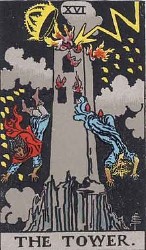
We can see that idea pretty clearly illustrated in the Tarot card called The Tower.  Most of the Tower-Being-Hit-By-Lightning myths have to do with punishment for human hubris.  Those idiots were trying to build a tower so high that it would reach to the heaven place and the god person got pissed and blew up the tower, just to show them that HE owned the heaven place and not them.

There’s actually a conundrum hidden in The Tower card that theologians have wrestled with for centuries.  If god loves us, and god’s all powerful, why does all of this bad stuff keep happening to us?  I mean, if he can control everything, why doesn’t he just make good stuff happen to us?  Why is there cancer and fires and floods and why do terrible, terrible things happen to people?

The traditional answer goes right back to the idea that god is an extreme control freak with a really bad temper.  He WANTS for good stuff to happen to us, but we keep doing the wrong things and so he HAS to make bad stuff happen to us.  Because we’re crotch scratching sinners, doncha know?

Native Americans had a slight shift in that perspective that makes a major difference in how we view the world.  They noticed that there is a factor in the universe which physicists would later label as, “entropy.”  The definition for entropy is, “a lack of order or predictability; gradual decline into disorder.”  Another way of putting it is that any organized system will start to disintegrate.

On a practical level, that means that just as soon as we get things arranged to our satisfaction, they start to fall apart.  It’s like when we clean our houses and then a week later they’re a mess again.  Entropy snuck up and bit us in the ass.

Native Americans built that into their theology and we might call it, “the shit happens,” principle.  Yes, there are loving, benevolent gods who want our lives to go perfectly well and want us to be happy.  But sometimes shit happens.  And when it does, it’s because of the Trickster Gods, like Coyote and Raven.  The benevolent gods are busy weaving a beautiful tapestry of life, but the trickster gods are over there in the corner unraveling it as fast as they can.  They’re entropy and they’re making the system disintegrate.

On the one hand, this allows us to have loving, caring gods.  On the other hand, it explains why shit happens.  In this scenario, the lightning bolt that hit the tree our ancestor was standing next to would have been sent by Raven or Coyote.  And they would have been laughing their asses off when they watched him jump.

That turn in their theology was actually a very important step.  First of all, it acknowledges that shit happens.  Second, it says that shit happens, JUST BECAUSE.  It doesn’t necessarily have a damned thing to do with us or whether we’ve sinned or we’re scratching our crotches again.  It just happens because entropy is a part of the fabric of the Universe.  Coyote or Raven are always there, turning our orderly, sensible worlds upside down, JUST BECAUSE.  So it gets rid of the concept of sin and we don’t have to feel guilty about our genitals anymore.

Most importantly, though, it gets rid of the nutso, bipolar, control freak, mean bastard that we’ve had running heaven.  It’s not OUR fault that shit happens, but we also don’t have to invent a crazy god to explain it.  No more vengeful patriarch who’s just itching to throw us into eternal flames.  No more voyeuristic stalker who’s counting how many times we masturbate so he can punish us for it.    No more crazed Jehovah demanding that Abraham shove a knife into his son’s chest to prove how much he loves god.  

And, all in all, the heaven place is  much nicer without him.

Dan Adair is the author of, “Just the Tarot,” available on Amazon.com at a very reasonable price.

Tarot Readings, Archetypes, and God-Fearing Southern Women

I recently heard a very nice woman describe herself as, “a good, God-fearing Christian.”  And it really gave me a bad case of the creepy-crawlies because it’s such a death blow to any true spirituality.

I spent a substantial portion of my life in the Southern United States, so expressions like that aren’t anything particularly new to me.  Many people in the South are not only God-fearing but they also have a lot of things, “put the fear of God,” in them. God, for them, is a pretty scary dude.

I didn’t really think much about those sayings until recently, when my life took a drastic turn toward the worst and I had to reassemble the jigsaw puzzle that my incarnation had become.  When confronted with the death of a loved one and the financial disaster that ensued, I began a spiritual quest of sorts, trying to put some meaning back into a life that had become dangerously Meaning-Less.

The Tarot was a big part of that quest.  In reading after reading it provided a basic framework for understanding where I was in life and where I wanted to go.  It was my touchstone through the darkest times l’ve lived through.

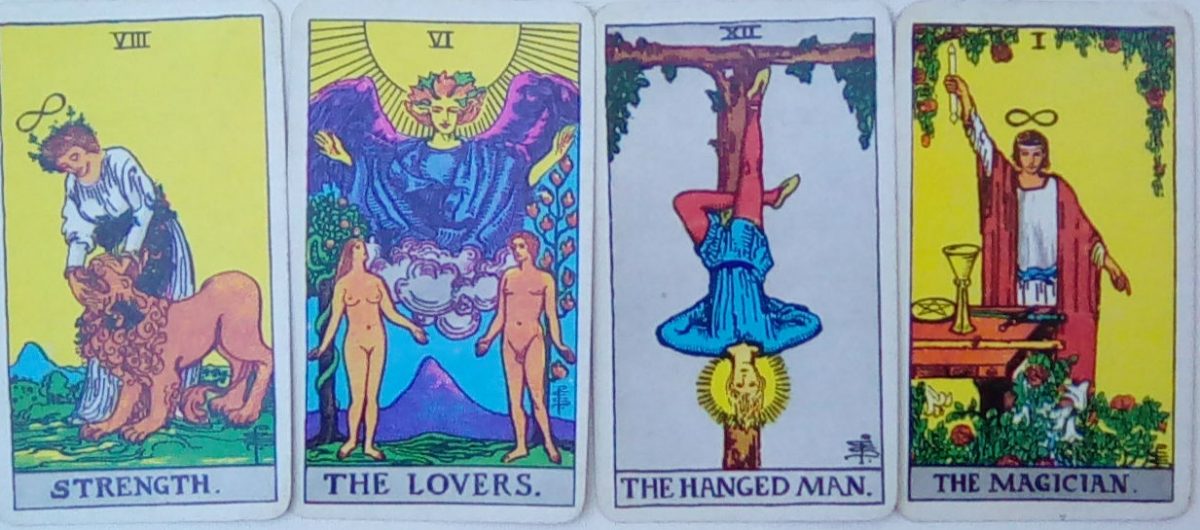
One of the most profound lessons it taught me was, “don’t be afraid.”  The readings were . . . well . . . readings. It was like, “Okay, THIS is happening in your life and THAT’S happening in your life, and in order to move forward you need to do THIS and then THAT.”  Or, to put it in more concrete terms, “Okay, the Death Card is in your life right now and so is The Tower, so you need to channel The Hermit and retreat and heal and then you’ll get the spiritual lessons of The Hanged Man.”

It was a road map, really.  Or, perhaps more accurately, a sort of a spiritual GPS system that kept telling me, “Okay, now turn right and go 12 miles more . . .”  And I learned to see that everything that was happening to me was a necessary step on the road.

I learned to trust.  To trust in the process of life and in the Universe as a loving, benevolent energy that was always there and always supporting me.

That’s a necessary pre-condition for any serious spiritual quest.  You have to believe, deep in your heart and mind, that you are ultimately safe and that you are moving toward something or someone that loves you.  Otherwise, why would you do it? Why would you deliberately seek out something that could harm you?  Something that’s scary?

Let’s look at the way that we, as Westerners, usually view the whole God thing, whether consciously or not.  We see the universe as a sort of a triangle or pyramid. God sits at the very top of the pyramid and everything – all the energy and forms in the universe – flow downward from him/her to us, who live very close to the bottom of the pyramid.

In most mystical traditions and many non-western religions, God is seen as a sort of pure, loving energy that flows down to us, but becomes more diffused and faint as it enters the physical realm where we exist.  The quest for the holy grail, then, becomes a quest to bring ourselves more in alignment with that pure, loving energy and to expand its presence in our lives.  

We may use a variety of means to get there – meditation, psychedelics, yoga, loving/kindness, etc. – but there is a basic belief that the underlying energy in the universe is love.  That it nourishes us and completes us and comforts and guides us through the dark times in our lives. Conscious contact with that energy heals us.

But . . . then we have the Judeo/Christian/Islamic model of the universe.  It’s still a pyramid with God sitting at the top, but God is a sort of a psychotic, abusive, completely unpredictable father.  And not only does love flow down, but a LOT of punishing, sadistic shit also flows down. This God is, a “jealous God,” a, “fearful God,” a God who claims to love you but is perfectly willing to pitch you into eternally burning flames if you even question what he tells you to do.

This is a God who blows up cities because there are gay people living in them.  Who tells Abraham to tie his son down to a stone altar and thrust a dagger into the child’s heart.  Who destroys Job’s family and his bnlife over a casual bet with the Devil.

This is one sick puppy.

There is no, “God Card,” in the Tarot.  We don’t think about it but it really is a curious omission.  The Major Arcana contains nearly all of the archetypes that blow through our lives:  death, love, luck, rebirth, judgement. But no God. And God IS kind of a major archetype, right?

Historians tell us that the first Tarot decks emerged in the 15th century, a time when Europe was absolutely obsessed with and dominated by the Christian God-Model.  The scary, crazy dude who you kind of hoped wouldn’t notice you and do something awful to you. That may be the very simple reason that the creators of the Tarot decided to just leave the God-Model out of the deck:  because a malevolent, harmful God is a complete short circuit to the spiritual quest.

If there’s no belief that you’re moving toward love and healing, why would you go there?  And if your God is a foul tempered narcissist who is off of his medications, why would you think there’s any genuine love flowing out of that?

The model of God emerging out of the Middle Eastern religions – the angry, hateful, capricious, male god of war – has been an absolute spiritual disaster for the Western world.  We have been deeply wounded by it and we need to KNOW that and begin to consciously heal our hearts and minds. And the way to do that is to move toward love.  

Always.