Empath Ethics 101: Don’t Help?

Why respecting emotional boundaries is essential for empaths—and how not helping can sometimes be the most loving choice.

The High Priestess – Intuition

If you’re an empath, you’ve probably been in this situation: you’re having a perfectly normal conversation with someone, but your intuition is screaming that something’s wrong. You sense they’re deeply hurting. Their emotional shields are up, their energy has pulled inward — but underneath it all, you can feel the pain.

The first instinct of an empath is to say, “Hey, what’s wrong? What can I do to help?” Especially if it’s someone we love, we want to reach out and offer comfort.

But sometimes, that’s exactly the wrong thing to do.

It’s Not Intrusive… to Us

The first thing to understand is: we’re not being deliberately intrusive. We channel other people’s emotions as naturally as breathing. When we’re in a one-on-one conversation with someone we care about, we pick up on their energetic patterns — even if they’re trying to hide them. It’s not something we try to do. We just do.

But to someone who isn’t an empath, that does feel intrusive. It can feel like we’re reading their private diary without permission.

Expecting an empath not to process someone else’s energy is like telling someone not to notice faces or colors. It’s simply how we experience the world. But we have to remember: “normal” people don’t operate this way, and many feel invaded or exposed when we reflect their hidden emotions back to them.

Language as a Boundary

For most people, language functions as an energetic boundary. Let’s say we’re sitting with someone and sense something is wrong. The conversation might go like this:

“How are you today?”

“I’m fine, thank you.”

“So everything’s good with you?”

“Yes, it is.”

That’s the moment we need to stop. We’ve given them a verbal cue that we’re open to listening. They’ve responded by clearly saying they don’t want to talk about it.

That doesn’t mean our intuition is wrong. We can trust what we’re sensing. But they’ve drawn a boundary with language — and emotionally healthy people honor boundaries.

Don’t Get Loopy

For empaths — especially intuitive types like INFJs and INFPs — this can trigger a kind of informational loop. Our intuition says something’s wrong, but the person says everything’s fine. It feels disorienting — like being told the sky is green and the grass is blue.

This can easily lead to obsessive thinking. We replay conversations, analyze patterns, try to intuit what they won’t say. When we can’t resolve it, we go over it again and again.

It becomes a loop — rearranging the same puzzle pieces, but still not seeing the picture. It’s a huge drain on time and energy.

The truth is: if they want to tell us what’s wrong, they will. If they don’t, it’s not our business.

Give Them the Gift of Space

Sometimes, the greatest gift we can offer someone we love is space.

Yes, we may know — deeply, clearly — that they’re hurting. And we want to help. But we must also respect the context of our relationship.

If you’re a therapist and they’ve asked for support — of course, help them.

If you’re giving a Tarot or psychic reading and they’re open — of course, help.

But outside those contexts, no matter how close we feel to someone, it’s always up to them to invite us in. If they don’t, we honor that. We don’t push. We don’t intrude.

Yes, It’s Confusing

Yes — this can feel confusing as hell to empaths.

In many ways, we’re always intimate with those we love. We feel their emotions. We know how they’re doing even when they’re not physically present. Sometimes it feels like their pain is our pain.

But we must remember: feeling something doesn’t mean we need to act on it.

If someone we care about is struggling, and they don’t ask for help, we let them be. We can still support them energetically — by holding space, sending love, offering healing from a distance.

But anything more? That’s up to them.

The Hermit, Introverted Intuitives, and Letting Our Lights Shine

How intuitives emerge from a Hermit Phase.

As an INFJ personality type, I’ve always felt a particular affinity for The Hermit card.    After all, going into Hermit mode is one of the primary defense mechanisms of intuitives and introverts.   When we feel overwhelmed or hurt, we pull up the drawbridge, slam the gate shut, and self-isolate until we heal.  Sometimes that takes a few weeks and sometimes it can turn into years.

I’ve recently begun focusing on another part of The Hermit card, though, which is the lamp that he’s holding aloft.  He isn’t just hiding out anymore – he’s illuminating a path for others to follow.

 INTUITIVES DON’T LEAD

Doing that is NOT something that highly intuitive or empathetic people are inclined to do, for a couple of reasons.  First – and most obvious – is the fact that most intuitives are also introverts.  We’re not the sort of people who want to have a great deal to do with other people, much less try to lead them anywhere. 

In a very real sense, that’s more of the path of the extrovert.  Extroverts love, love, LOVE to charge out into society, organize everything, and tell other people what they should be doing and when they should be doing it. Which is fine, because someone has to put together the Christmas parties, right?  Better them than us.

INTUITIVES AND SELF-IMAGE

Another reason that intuitives seldom assert themselves as, “leaders,” is that many of us have really rotten self-images.  We feel as if we don’t fit in, as if we’re the original square peg in a round hole.  

Some of that flows out of the fact that society is, once again, pretty much designed by extroverts.  Starting in elementary school, we’re told that daydreaming and wanting to be by ourselves is, “bad.”  How many of us received the dreaded report card that said, “Doesn’t play well with other children?”  Yikes.  

That continues into adult life, of course.  Just look at the modern work spaces, with cubicles piled on top of each other and no sense of privacy or personal space.  They’re extrovert heaven and introvert hell and if we don’t like them there must be something wrong with us.  It turns out we don’t play well with other adults, either.

INTUITIVES AND DYSFUNCTIONAL FAMILIES

There’s a further reason for intuitive introverts having terrible self-images, which is – guess what? – our families.  When I first started digging into intuitive personality types I was astounded at the number of people who reported that they had come from dysfunctional families.  And by, “dysfunctional,” I mean families where one or both parents had serious mental issues, addiction issues, or abuse issues.  

Frequently, a part and parcel of being a terrible parent is blaming the child for your bad parenting skills.  A classic example is a parent who gets drunk, beats the hell out of the kid, and then says, “You made me do that.  If you were a better child, I wouldn’t have to beat you.”  The end result is that the kid is convinced that he or she isn’t a, “good,” person and that they’re somehow to blame for the abuse.  We go into life with the basic premise that we’re flawed and unloveable.

INTUITIVES AND COGNITIVE INTELLIGENCE

So, all of these factors (and more) lead the introverted intuitive to feel that she’s in no position to lead anyone, anywhere.  After all, we’re odd balls and we’re just not quite good enough.  But is that borne out by facts?  Consider these statistics from Susan Storm’s article in PsychologyJunkie:

Of all of the personality types, INFJs have the second highest grades in high school.

INFJs have the highest first semester grades in college and some of the highest undergraduate grades.

INFJs are among the most persistent personality types in actually finishing college.

INFJs tend to score well above average in standardized IQ tests.

INFPs and INFJs read more than any other personality types.  While the average American reads 12 books per year, INFJs average 67 books per year.

INTUITIVES AND EMOTIONAL INTELLIGENCE

While some introverted intuitives are full blown empaths, ALL of them are highly empathetic.  And by empathetic, I mean that they can, “read,” another person’s emotions so deeply and so quickly that they may appear to be psychic.  

When you meet an introverted intuitive, they are instantly scanning your body language, your eyes, your facial expressions, the tone of your voice and even the clothes that you chose to wear that day.  All of this happens so rapidly that the intuitive may not even be aware that he’s doing it.  What’s more, intuitives frequently feel that everyone else must have that same level of perception, simply because it feels so natural to them.  But, no, most people don’t do that.

As Eileen McKusick, author of Tuning the Human Biofield put it, “It’s like having an antenna that goes a little higher than everyone else’s.  We pick up information that normal people don’t.”

COMING OUT OF THE HERMIT PHASE

What usually pulls introverted intuitives out of their Hermit phase is a desire to help other people.  That can manifest as personally as wanting to help a friend who’s gone through a divorce or as broadly as wanting to make some contribution to humanity as whole.  Intuitives are, after all, highly empathetic, which means that we really DO feel other people’s pain, almost as if it were our own.  

In order to help, though, we have to get rid of that old, “I’m not good enough,” self-image.  When we combine our intellectual intelligence with our emotional intelligence, we are actually extraordinarily capable of helping others heal.

It’s estimated that up to 52% of the population may fall into the introvert section of the personality types.  BUT . . . introverted intuitives are a very tiny slice of that.  Only 1 to 2% of the world population are INFJs and only 4.4% are INFPs.  We have unique gifts and unique perspectives.  We just need the self confidence to go along with those gifts. To let our lights shine on other people’s darkened paths.

Animal Companions, Heart Chakras, and Learning to Love

Our pets abilities to heal our Souls.

“I’ve known several Zen Masters and they were all cats.” – Eckhart Tolle

The image in The Fool tarot card shows a person dancing with joy at the edge of a cliff.  It’s meant to portray a Soul that’s so fully in the Flow that, even if she were to dance off of the cliff into thin air, she wouldn’t fall.  It’s a beautiful card, but we seldom take much note of the little dog that dances right along with The Fool.

In her book, “Animal Soul Contracts: Sacred Agreements for Shared Evolution”, Tammy Billups addresses the idea that animals come into our lives for specific reasons and they’re often instrumental in helping us to recover and evolve.  As she puts it, we have a Soul Contract with our animals.  We heal them and they heal us.

She tells the story of a man who was living alone when a stray dog suddenly showed up on his doorstep.  He took the dog in and they formed a strong, loving bond. The one problem was that the dog developed terrible separation anxiety and suffered greatly whenever his new owner had to leave the house.

He finally contacted Ms. Billups in the hope that she could work with the dog and help it to feel more secure.  In the course of treating the dog, though, the man had a sudden epiphany:  every relationship he’d ever had ended up with his lover walking away from him.  He had severe abandonment issues of his own and so he’d attracted an abandoned dog.  He started therapy and, as he learned to deal with his own fears of abandonment, the dog healed from its separation anxieties.

She posits that animals – and particularly that class of animals that we refer to as our, “pets,” – have a very deep and ancient Soul connection with human beings.  They not only mirror who we are, as the dog did with the young man, but they also point us toward a better way of existing in the world.

One thing that they provide to us abundantly is pure, unconditional love.  Getting that kind of love as an infant is vital to the development of a healthy, well adjusted human being.  Sadly, though, we have a lot of people in our world who were beaten more than they were hugged as children.  We emerge as adults who are convinced that (a) we can’t be loved; (b) somehow it’s our fault, rather than the fault of our crazy parents; and (c) it’s never safe to reach out to other people for love.

And then a puppy or a kitten shows up in our lives and loves us unconditionally.  The dog or the cat doesn’t give a flip about how smart we are or how we dress or how much money we have or any of the other parameters we may find in human relationships.  They just love us, totally and unconditionally, for who we are.  And, yeah, we learn that lesson on a deep Soul level:  it’s safe to love and to receive love.  They fill that hole in our hearts that’s been there since we were babies.

Another example that Ms. Billups gives is that highly empathetic people (and particularly empaths) will tend to attract highly empathetic animals.  We run into that sometimes with an animal that literally seems to be peering straight into our Souls when it looks at us.  There’s a sort of a tickle in our energy systems and a voice that says, “This dog somehow understands exactly who I am and what I’m feeling.”

The common bond is that both animals and empathetic people are primarily, “feelers,” rather than just thinkers.  We exist on that energy level of emotions and almost instantly perceive the hidden vibrations in another being.  And the, “training,” that we receive from that kind of an animal is to learn to keep our own vibrations as loving and kind as possible because they’re feeling them just as much as we are.

Which brings me to the part of Ms. Billups discussion that really blew me away, which is emotional support animals.

We’ve seen a fairly substantial increase in the presence of emotional support animals as a result of the wars in Iraq and Afghanistan.  Many of the troops were returning home with severe PTSD and social anxiety.  Psychologists found that pairing them with animals – usually dogs – helped to soothe their nervous systems and allowed them to interact more peacefully in social settings.

It makes sense, even on a superficial level.  If we’re feeling extreme anxiety, the presence of a calm, loving animal would obviously settle us down.  Ms. Billups takes that a step further, though.

She says that some animals, especially emotional support animals, are able to hold what she calls a, “transformational healing presence.”  In other words, it isn’t just their presence as a trusted companion that’s calming down the person’s nervous system.  Rather, these are animals that are SO evolved that they’re able radiate calmness, serenity and love out of their very core.

We can actually see that with our own eyes.  The next time that you encounter someone with a support dog in a store, stop and look at the people around you.  Most of them will suddenly slow down, smile, and begin to radiate calmness of their own.  It isn’t just because they think the dog is cute, either.  Rather, they’re walking into that energy field of a healing presence that the dog is holding and it transforms them.

There’s a lesson in there for humans, as well.  It takes work – sometimes a lot of work – but we can become that same sort of a transformational healing presence in the world.  Through therapy, affirmations, meditation, and working with our heart chakras, we can nurture a core energy that’s calm, loving, and compassionate.

We don’t need to develop a philosophy or a method around that.  We don’t need to become gurus or convince anyone that they should behave in this way or that way.  All that we need to do is to build the love in our hearts and radiate it out into the world.

One of the neat things about that is, like the support dog in the store, we can step out of all of that judgment about who’s going to receive the love.  The dog isn’t standing there thinking, “Oh, that one’s a Republican – no love for him.”  Or, “Uh, oh, it’s a liberal, shut down the love.”  It’s there for anyone who wants to receive it, no questions asked.  And if someone doesn’t want to receive it, the dog doesn’t get upset or neurotic about it – she just keeps shining that light.

So I’m going to start paying a lot more attention to the animals in my life and begin actively looking for the messages that they’re bringing me.  Perhaps I’ll put my cat in my lap the next time I meditate and see if she has anything she’d like to add.  I’m guessing she does.

Empaths, Elections, and Staying True to Our Own Energy

Building effective boundaries for empaths.

If you’re an empath and you’ve been feeling kind of sick to your stomach lately, believe me – you’re not alone.  Many of us have experienced the recent election in the United States as something that makes us want to curl up in a ball under a blanket for the next four years.

It’s important for us to explore how this is affecting us from a bioenergetic perspective, though, and not just from a political or emotional perspective.  What is all of this DOING to our energy and our energy fields?

What’s one of the first words that come to mind when we contemplate being an empath?  Boundaries, right?  Boundaries, boundaries, BOUNDARIES!  

Empaths have extremely porous personal boundaries and very leaky energetic boundaries.  In a way, that’s what makes us empaths.  “Normal,” people have fairly strong boundaries and a strong sense of, “I’m over here and you’re over there and we’re two separate beings.”  For a normie, what another person is feeling stays inside of the other person, unless the other person decides to share it.  For an empath, other people’s feelings are constantly flooding into us. It’s very easy for us to merge with those feelings and mistake them for our own.

That’s one of the reasons that many empaths become codependent.  We merge so totally (and so easily) with other people’s emotions that we mistake them for our own.  If someone we’re close to is having emotional or mental problems, we think that we have to manage their drama because it feels like it’s our own. We end up taking care of their lives instead of our own.

So one of the first steps to becoming a healthy empath is to learn to identify our own energy and separate it out from other people’s energies.  We learn this at an early age and many of us become socially avoidant as a result.  We realize that if we’re around people who are angry, depressed, or violent, that we just soak all of that in and it fucks us up.  One strategy we use to deal with that is to just avoid people in general: many empaths become radical introverts.  Which works, but it’s not the BEST strategy, right?  We really can’t cover our heads with the blankets for the next four years.

Can we?  Um . . . no.  I guess not.

We have to learn to separate our energy fields in better ways.

The human energy system is really quite simple to visualize.  As Alla Svirinskaya says in her book, “Own Your Energy – Develop Immunity to Toxic Energy and Preserve Your Authentic Life Force,”  we can think of it as the physical body or core, which is surrounded by a couple of other energetic layers or bodies which are the emotional body and the mental body.  Those other bodies are usually seen as egg shaped, so we end up with a picture of it that looks like this:

For a normie, those extra layers act as a wall to keep out other people’s energy. They filter out negative energies so that they never reach the core of the physical body. For an empath, though, they act as a bridge.  Instead of blocking us off from the emotional identity of people who aren’t us, they allow it to flow right into our personal energy fields which frequently overwhelms us, leaving us confused and injured.

Most empaths are dealing with those dynamics on a daily basis.  What we forget, though, is that our personal energy fields exist inside of larger energy fields.  Any time that you put a group of people together, their personal energy fields are going to merge to some extent and generate a group energy field that’s composed of the collective emotions of all of those people. And we live within those other energy fields.

In a very real sense, we could talk about the vibrations of a particular town or a county or a state.  Those vibrations are the collective energies of the people who live in those places.  Texas, for instance, has a very different vibration than California. And, yes, countries have a collective energy field, too, which is brings us back to the topic at hand:  dealing with this election.

About 72 million Americans got together and voted for a candidate who oozes hatred and anger out of every pore of his orange skin.  THAT is the collective energy that we’re dealing with right now and THAT is what’s making us feel sick.  Put simply, there’s a whole lot of hatred and anger out there in the collective energy field and it’s seeping in to our personal energy fields.  As empaths, we are especially vulnerable to this.

So what can we do about it? Well, we need to remember that the key to being a healthy empath is to be able to distinguish OUR energy from OTHER’S energy.  We need strong boundaries and we need that sense of, “this energy belongs to me and that energy doesn’t.”

Empaths are (for the most part) kind, loving, compassionate people.  That just goes with the territory.  When you really and truly understand another human being on the deepest level, it’s very difficult to stay angry with them.  Or to hate them.  Or to judge them too harshly.

Hatred, anger and judgements are NOT our energies and that’s why they make us sick.

A good strategy for us, then, is to be very conscious of those energies existing inside our personal fields. If we start to feel really, really, REALLY pissed off at the Trumpsters, we can stop and say, “This is NOT my energy.  This is their energy.  I won’t own it.”

Another strategy is to do what Chagdud Tulku called, “antidoting.”  The antidote for hatred is love and the antidote for anger is compassion.  I’m not suggesting that we turn ourselves into human doormats for the Trumpsters.  Rather, we’re just embracing our own nature.  By embracing our own nature, by being as compassionate, kind, and caring as we can, we automatically separate OUR energy from THEIR energy and – surprise, surprise! – we’ve got boundaries.  Suddenly, they’re over there and we’re over here and we don’t have to live in their hatred or let it blend into our energy.

Shazam!

EMPATHS, EARTHING, AND MEDITATING CODEPENDENTS

Staying grounded as an empath.

So I just received my Amazing Hooga Earthing Mat from the very nice UPS driver and I should be incredibly spiritual after just a few days of using it.  

The basic theory behind them is that our energy systems get in a kerfuffle because we’re exposed to negative people, places, and things and, when we walk barefoot on the Earth, it restores our systems to their natural, harmonious balance.  Earthing Mats simulate that very same energy and get our auras all fluffy and pretty again.

I decided to get one because I’ve recently become aware of the fact that it is of tantamount importance for empaths to stay thoroughly grounded.  If we don’t, we start to dissolve like a piece of salt in the rain.  Earthing is a dandy way to avoid that.

EMPATHS AND EMPATHY

Being an empath is sort of hard to describe to a, “normal,” person.  First of all, of course, being an empath is not equivalent to being empathetic, although most empaths are highly empathetic.  An empathetic person might sympathize with another individual to a point where they can imagine what the other person is feeling and thinking.  Empaths actually experience what the other person is feeling in real time.

Empaths are also not psychics, although most psychics are empaths.  A psychic will focus on another person, “read,” their energy, their emotions and their thoughts, and then weave all of that into a coherent meaning, much like telling a story.  Empaths, on the other hand, are simply bombarded with information about the other person without really knowing what it all means.  We automatically glean far more details about the other person’s energetic and emotional state than what’s on the surface, but we don’t necessarily know how to put it all together.

To make it even more confusing, there isn’t just one type of empath.  There are empaths who actually hear what other people are thinking.  Other empaths feel other people’s emotions as they occur.  Some are telemetric empaths who, “get a reading,” merely by touching a piece of clothing or jewelry that someone else has owned.  A few empaths are highly attuned to the feelings of animals, but won’t pick up anything from other human beings.  Precognitive empaths may get very strong insights about what’s going to happen to a person in the future.

EMPATHS AND EGO STRUCTURE

One thing that all empaths have in common is a relatively weak ego structure.  It makes perfect sense, when we think about it.  Our ego is our sense of who we are, and the first part of knowing who we are is knowing that you’re over there and I’m over here.  Your, “you,” starts with your skin and all of your emotions, energy, and thoughts reside inside of your skin and all of mine reside in mine.  The only way that another human could possibly know what we’re thinking is if we tell them.

Which is very much not true for empaths.  For an empath, what’s going on in the other person’s mind is also going on in our minds, simultaneously with what WE’RE thinking.

All of which can make for a very confusing state of affairs, because we’re never quite sure which part of the conversation is ours and which part is yours.  For an un-grounded empath, there really ARE no significant boundaries or borders.  

There’s an old Spanish expression which goes, “Mi casa, su casa,” or, “My house is your house.”  Now change that to, “My brain is your brain,” and you get an idea of how truly weird it can be for an empath to hold a simple conversation.  Most empaths have to sit quietly after a meaningful exchange and decode exactly what thoughts came from which person.

EMPATHS AND CODEPENDENCY

One of the ways that the weak ego structure of empaths shows up is in codependent behavior.  Codependents tend to revolve around other people, much like the moon revolves around the earth.  Sometimes that’s a result of having been raised in an alcoholic or abusive family.  Sometimes it’s because we have a particular personality type.  And sometimes it’s because we’re empaths who haven’t learned to separate ourselves from other people.  

What happens with empaths is that we become enmeshed in the other person’s energy, in their thoughts, emotions, and their life patterns.  Since empaths already have a weakened sense of boundaries, they can easily dissolve into a more dominant person’s energy system.  In essence, they become overwhelmed and end up as bit players in someone else’s movie, instead of starring in their own.  They not only feel the other person’s emotions, they become the other person’s emotions.

EMPATHS AND MEDITATION

Empaths also need to be very careful about the type of meditation they practice.  

Many types of meditation are geared toward weakening the ego structure.  We’re basically trying to get past that chattering mind stream that prevents us from truly relaxing into deep meditation.  Those techniques involve what’s referred to as a, “bare awareness,” method, where we might focus on our breath or a mantra, or a candle flame, until the chattering mind calms down and recedes into the background.

BUT . . . studies have increasingly shown that meditation is highly correlated with PSI or psychic abilities.  If we tritty trot off to a meditation center for a two week retreat, we’re probably going to be more psychic coming out of it than we were going in.  For a normal person, that involves a significant decrease in ego control and, “becoming one,” with the universe and our fellow humans.

An empath, though, is already wide open and our challenge lies in shutting down some of that in-flow of information.  Deep meditation can destroy whatever barriers we’ve managed to erect and leave us completely adrift in other people’s energies.

Mindfulness meditation seems to be the, “go to,” method for empaths.  It’s a constant reminder to stay in our own bodies in the present moment and to separate from all of the drama out there.

THE EIGHT OF WANDS

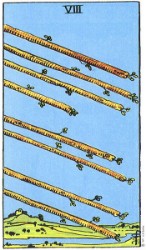
Being an empath can feel very much like the Eight of Wands looks.  Wands represent ideas and this card shows inspired ideas raining down from heaven.  For an empath, though, the ideas may be far from inspired and not at all our own.  

If everyone we met was in a perfect, loving place, being an empath could be pure heaven.  We’d just walk around grinning while all of those good vibes poured straight into us. Unfortunately, that’s far from the current state of affairs and a tremendous amount of what we absorb is toxic.

The answers for empaths seem to be strengthening ego structure, not weakening it.  Building boundaries and borders, not letting them down.  And, above all, staying grounded.  Which we can begin to do by planting our tootsies firmly on the Amazing Hooga Earthing Mat.

THE DEVIL CARD AND THE CONUNDRUM OF EVIL PEOPLE IN THE WORLD

An exploration of the notion of evil as it applies to anti-social personality disorders.

There are some people who seem to be just . . . evil.

It feels kind of icky, just making that statement.  It seems like stepping into that whole judeo-christian tar-pit of demon possession and punishing, crazy gods and hell fire and damnation and sinners.  We can see that idea illustrated pretty well in The Devil tarot card.  Two nude people are chained to a black altar while a gigantic, scary demon bat/goat sort of a thing hovers over them.  Yikes!  They done been possessed by the devil!!!

Evil in that context seems like a very medieval, primitive sort of a concept.  Something that you expect to hear coming out of the mouths of fundamentalist religious people who aren’t very spiritually evolved.

Still . . .there are some people who seem functionally evil.

Many of us have had the ill-fortune to encounter a few psychopaths or sociopaths or malignant narcissists.  Usually – if we’re normal people – they take us completely by surprise.  Many of them are extremely adept at concealing their inner natures, but they basically have NO EMPATHY.  No sense of compassion.  No kindness.  No love living inside of them.  Not even a little sprout.

It’s a shock, when we realize that.  That these are people who appear to be perfectly normal on the outside (in fact, in the case of narcissists, they may be very attractive on the outside) but have nothing but a dead, arid desert in their hearts.  What’s worse, many of them aren’t content with just being morally and ethically dead, they actually delight in causing harm to others.  Sociopaths may be content to live and let live (as long as you don’t cross them) but malignant narcissists and psychopaths go out of their way to fuck people up.  They don’t see other people as humans – they see them as prey.

It can still be difficult to get from that behavior to the concept of evil.  We tend to view, “evil,” in terms of moral wrongness and choice.  In other words, if we see a clear choice between loving kind behavior on the one hand and cruel, malicious behavior on the other and we choose to be cruel and malicious, then that’s evil.  The evil lies in perceiving the distinction between the two behaviors and choosing the one that causes harm.

Psychopaths, sociopaths, and narcissists don’t seem to have that sense of choice.  It’s not that they’re choosing to be evil rather than being kind, they simply have no concept of kindness.  What’s more, they view that lack of a sense of compassion as a strength.  They view normal people who have a conscience and try to be kind as weak and they go out of their ways to exploit that weakness.

So, in a classic sense of ethics, we can’t really see them as being evil, because they don’t have that capacity to choose between being a good human being and being a fucked up human being.  They’re just fucked up.  Period.

We may embrace the medical/psychiatric model and try to make excuses for them.  We look at them from a normal person’s point of view and think, “How awful it must be to live in a world of no love and no kindness.  Something horrifically traumatic must have happened to them to make them that terrible.”

Well, yes and no.  Sociopaths, for instance, have brains that are measurably, physically different from those of normal people.  They appear to have been born that way.  Not all people who are born with that brain structure become sociopaths, however.  It seems that something has to happen in their environment to trigger the brain into becoming sociopathic.  It’s like they’re hardwired that way at birth, but someone or something has to throw the switch to activate the wiring.

Psychologists and researchers are still arguing about exactly what it is that throws the switch.  It could be emotional trauma, physical trauma, horrible parents, malnutrition, all of the above or – in some cases – none of the above.  A lot of sociopaths were born into wealthy, loving families. Somehow, though, they end up with NO feelings of compassion or empathy, with a total lack of the characteristics that make us fully human.

It’s important to note, though, that THEY DON’T FEEL THAT WAY.  At all.  They’re quite happy with the way they exist in the world and think the rest of us are fools.  They don’t see themselves as lacking in basic human characteristics, they see us as weaklings.  

It’s also important to note that there are apparently no, “cures,” for these disorders.  There’s no way to magically change them into, “normal,” human beings.  If you dig around on the internet you’ll find some theorizing that talk therapy may be effective in treating malignant narcissism, but when you ask actual therapists about that, they just shake their heads.

There is some evidence that the number of sociopaths and narcissists among us is actually increasing, but there are arguments against that.  It could be that our methodology for detecting them has just gotten better.  It could be that they’re just more visible because of our new world of social media.  

In any case, there’s no question that they’ve always been among us.  In fact, Austrian philosopher Karl Popper argued that what we call, “history,” is largely the record of the psychopaths of our species.  We study people like Hitler, Napolean, and Genghis Khan, people who caused immense pain and suffering in the world and just didn’t care, but we ignore all of the millions of kind, loving souls who were trying to just get through life.

 Although they are very much a minority, almost a tiny fraction of the population, they have an oversized effect on the people around them.  Because of them, we tend to question the goodness of human nature.  We see the world as a dangerous place and fail to see all of the love and compassion that exists in the majority of human beings.

Even worse, they frequently succeed in dragging us down to their level.  Anyone who’s been worked over by a malignant narcissist will tell you that you emerge from that experience with a lot less trust of other people and  with a constant question of whether the next person you become involved with will be a real human being or another monster in disguise.

So . . . we end up having to recognize that there ARE people living among us who have no empathy, no compassion, no sense of ethics, no internal moral compass, and who cause a great deal of suffering for other human beings.

We can’t really call them, “evil,” in the ethical sense of their choosing to be rotten human beings.  And we can’t really use the medical model and say that they’re, “sick,” because many of them live normal, productive lives and appear to be quite happy, making everyone around them miserable.  And, thankfully, we’re evolving out of that primitive model of thinking that they’re possessed by demons or they’re servants of the devil.

But there they are, walking among us like human question marks. How can you be a human being and exist in that space?  If you DO exist in that space, are you still fully human?  It’s truly a conundrum that currently has no solution.  Until there IS a solution, they can at least serve as a contrast for the rest of us.  We can look at them and realize, “That’s what I DON’T want to be.”

Dan Adair is the author of, “Just the Tarot,” available on Amazon.com at a very reasonable price.

The Empress, Conservative Cavemen, and Getting Back to Our Magical Garden

Recovering a sense of physical safety in the world.

I’ve posted in before about the importance of recovering a sense of spiritual safety and of recovering a sense of safety about our own subconscious minds.  Today I’d like to share a little about recovering a sense of physical safety.

What if I were to tell you that 99% of people are perfectly safe 99% of the time?

Does that sound a little weird and uncomfortable to you?  It certainly did to me, when I first stumbled over the idea.  After all, we KNOW that the world is a terribly dangerous place.  Just look at all of the earthquakes and floods and tsunamis and GIGANTIC FUCKING ICEBERGS that are dropping off of the polar caps like fleas!  Not to mention the wars and famine and terrorists and horrible car accidents and planes full of terrorists flying into towers full of innocent people.

Yikes!

In fact, double yikes or even yikes to the fourth power, which is a pretty big YIKES!

But . . . stop and think about it for a few minutes.  How long has it been since you were smack in the middle of a 7.5 earthquake?  Or a massive flood?  Or you got swept away by a tsunami?  Or had an iceberg collide with the ocean liner you were on?

The astounding truth of the matter is that – by far and away – MOST of us get up in the morning, drive to work or take care of our homes, raise our children, plan for our retirements, take vacations, go about our lives and . . . NOTHING BAD HAPPENS.  Nothing.  We’re perfectly safe 99% of the time.

So why do we all have this creepy feeling of impending doom, of something horrible that’s going to happen to us right around the corner?  And why does it matter?

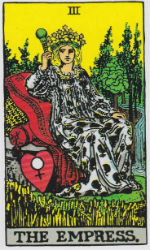
The Empress card in the Tarot shows someone who is absolutely, perfectly at ease in her world.  She reclines gracefully on her beautiful couch, surrounded by natural abundance.  Her head is crowned with stars and she grasps a scepter of power, but holds it very casually.  Her legs are slightly parted, as if she might welcome a little company on her couch, and her face radiates a quiet, peace.  She is the Goddess in Paradise.  

That is EXACTLY the vibration that we should have in our world, here on the beautiful Earth Mother.  We have evolved here over hundreds of thousands of years and this is our home.  In the words of the Desiderata:

“You are a child of the universe no less than the trees and the stars; you have a right to be here.”

We might find a clue as to why so many of us don’t feel safe in our Magical Earth Home hiding in our brain structure.  The limbic system of our brain is set up to trigger massive amounts of stress hormones when our fight or flight reaction is activated.  Nick Ortner,in his book The Tapping Solution: A Revolutionary System for Stress-Free Living, posits what he calls a, “negative brain bias.”  His thinking is that our ancestors who were the most frightened were also the ones who were most likely to survive.  To use his example, the caveman who thought the rustling in the bushes might be a tiger was more likely to live than the one who assumed it was a harmless squirrel.  And so, the more frightened, constantly freaked-out cavemen and cavewomen would have been the most likely to pass on their genes and – shazam! – we all have, “Holy crap is that a tiger in the bushes?” reactions built into our brains, even if we’re actually surrounded by harmless squirrels.

Maybe.  Maybe not.

Psychological studies suggest that conservatives have a negative brain bias, but liberals do not.  In a nutshell, if you show a bunch of pictures of gardens to both conservatives and liberals, conservatives will pick out the creepy spiders and snakes in the pictures and liberals will pick out the pretty butterflies and flowers.  In other words, conservative cavemen were the ones who heard tigers in the bushes and liberal cavemen were the ones who heard squirrels.

And, if Ortner’s hypothesis were true, all of the liberals should have been eaten by tigers, but there are still a bunch of us around watching the butterflies and smelling the flowers.

Which suggests that a negativity bias really isn’t built into our brains.  It was acquired.  Where did it come from, then?

A lot of it comes from social programming, of course.  It has long been a part of Judeo-Christian philosophy that the Earth was, “given to man,” by God and we’re supposed to control it and everything in it.  We have to, “conquer mother-nature,” in order to survive and build more hamburger stands and condos and parking lots and Walmart Super Stores.  God wants us to.  When you view nature as something to be conquered, then nature – earth itself – becomes an enemy, rather than our Mother and home.

Then there’s politics.  Think of what we’ve been hearing from our politicians for the last four years.  BE AFRAID!  Be very, very, very, very afraid of Mexicans and Knee-Grows, and Arabs and Jews and Chinese and lesbians and socialists and feminists and communists and . . . well . . . pretty much anyone who looks or sounds or thinks differently than we do.  Every single one of them wants to Destroy Our Way of Life, rape our daughter, and steal our dog.

A certain amount of the fear comes from the globalization of information.  We see things on the internet and our televisions that we would have been totally unaware of a short evolutionary time ago.  If there are riots in Portland, train crashes in Pakistan, or bombings in Yemen, we are aware of that now.  It’s all become a part of our daily lives.  The work that’s being done with mirror neurons suggests that human beings are highly empathetic.  If we see other people in pain or distress, we internalize that pain as our own, and we are being exposed to a LOT more people in pain than has ever been normal for the human race.

All of these factors – plus a lot more than could be covered in a blog post – have combined to create a massive illusion, a sort of a group hypnosis, where the world is perceived as a horribly dangerous place that could kill us at any moment.  And, really, it’s not.  

99% of the time, it’s perfectly safe for 99% of us.

Hopefully we can begin to stop the insanity and start EXPANDING that safety and peace to as many other humans as we can.  Stop the wars, feed the hungry, eliminate corruption and greed, declare AS A SPECIES that racism and religious fanaticism will no longer be tolerated.  

But first we need to recover that sense of safety in our own hearts and heads.  We need to return to our home in the magical garden and become The Empress again.

Disclaimer: “As an Amazon Associate I earn from qualifying purchases.”

Psychic Empathy, Boundary Violations, and Deep Sadness

I have struggled with being a psychic empath for most of my adult life and probably a good portion of my childhood.  I don’t much discuss it with other people because most people can’t comprehend the sensations that psychic empaths deal with on a daily basis.  There’s just no point in it.

Now, just to be clear, most of the ideas that people have about psychic empaths are garbage.  There’s a Hollywood image of someone, “picking up,” crystal clear messages out of the ether, making astonishing predictions about the future, or having amazing insights about other people’s thoughts.  The truth of the matter is that living with those, “gifts,” frequently feels like pure chaos. 

INSIDE AND OUTSIDE

As near as I can tell, most people have a very clearly defined sense of inside versus outside, both in terms of their bodies and their emotions.  In other words, they have an innate sense of, “I’m in here, and you’re over there.”

To a large extent, that sense of differentiation doesn’t exist for psychic empaths.  We can, “feel,” other people’s energy, their moods, their emotions, their private thoughts just as if they were expressing them out loud.  Sometimes – especially with people we love or have some other strong bond with – we can feel their energy from a very great distance.  We somehow know when people we care about are upset, depressed, or in trouble.  We also know when they’re happy, joyful.

That’s not unheard of, even for normal people.  Many people have had the experience of thinking of someone that they haven’t heard from for years, when suddenly the phone rings and it’s that person.  It happens.  Now try to imagine if it happened to you every single day.  At a certain point, the psychic empath will begin to feel like a sponge, like we don’t know which energy is ours and which energy belongs to other people.  It can be very confusing:  why am I suddenly terribly depressed?  Is it me or is it that someone else’s energy?

EMPATHS VERSUS PSYCHIC EMPATHS

Claiming to be an, “empath,” has gotten to be kind of trendy.  There are articles about it all over the internet and I guess it’s a way of saying, “Hey, I’m a really sensitive, caring person.”  Which is cool.  We LIKE sensitive caring people.  But there is a major difference between empaths and psychic empaths.  It all exists on a spectrum, so imagine a straight line with different points on it.

A ———-B———C———D

At point A you find people with NO empathy at all:  sociopaths, narcissists, psychopaths.  At point B, you find, “normal,” people with some empathy but clearly defined and sometimes rigid boundaries between themselves and other people.  At point C, you’d find emotional empaths, who are people who can STRONGLY (and emotionally) identify with other people’s feelings.  At point D, you’d find psychic empaths who actually experience other people’s emotional energy as being mixed in with their own, frequently on an involuntary basis.

And, “involuntary,” is the salient word.  Contrary to the fictionalized image of the psychic, most psychics don’t intentionally, consciously, “tune into,” other people’s emotions and thoughts.  It’s just something that happens as a part of our innate make up.  It’s what we do, whether we like it or not.

BEING PSYCHIC VERSUS BEING HYPER-VIGILANT

People who grew up in highly abusive households, people who have suffered spousal abuse, people who have been in combat, and people who have extremely high stress jobs tend to become hyper-vigilant.  What that means is that they are in a nearly constant, “fight or flight,” reaction.  They have become so habituated to living in a dangerous environment that they are constantly, “scanning,” for any signs of threats.  They are in a constant reactive mode. 

Hyper-vigilance – that scanning for danger – can occur at such an amazingly rapid rate that it almost appears to be psychic.  People who are hyper-vigilant are taking in and processing cues from their environment at a speed that’s nearly incomprehensible to a, “normal,” person.  That’s how they survived in surroundings that were fraught with danger, by being extremely sensitive to the slightest nuances of what’s going on around them.

The difference between being hyper-vigilant behavior and psychic behavior may actually look blurry to an outsider.  Hyper-vigilant behavior, though, is learned, adaptive, behavior and psychic behavior is something that you’re born with.  The difference can get even blurrier because people who are psychic will frequently become hyper-vigilant as a result of being so open to other people’s energy.

BOUNDARIES:  BEING VIOLATED AND VIOLATING

If you do a quick survey of articles on the internet about empaths you’ll find that boundaries are a big issue.  Most of the articles and books out there are oriented toward helping empaths have stronger personal boundaries.  If you’re highly empathic – much less psychically empathic – keeping your energy and your emotions separated from other people’s energies and emotions can be a huge challenge.

I’ve recently become aware of a different aspect of that, though, which is that, “normal,” people frequently feel that their boundaries are being violated by psychic empaths.  And I don’t really know why it hadn’t occurred to me before.

To a large extent, all I can do is to describe it from my side of the experience.  When I sit down across from someone, I feel almost bombarded with energetic and emotional impressions.  I’m not just listening to their words and reading their body language and facial expressions, I’m processing – frequently on a subconscious level – a whole array of vibrations that they’re emanating.

While I’m doing that, it can be difficult to keep what I’m picking up on a psychic level separate from what the person is telling me verbally.  And inadvertently responding to the unspoken psychic content can make the other person feel personally violated.

Let me give you an example.  Suppose a psychic empath is sitting down having a nice chat with a stranger about the weather.  Unbeknownst to the empath, the person they’re chatting with has been having a lot of emotional issues with a romantic relationship she’s involved in.  So the conversation might go something like:

“Nice weather we’re having.”

“Yes, but they say it might rain.”

“You never can tell this time of the year.”

“Yeah, the weatherman always seems to get it wrong.  What’s up with your boyfriend yelling at you?”

And, NO, the stranger is NOT going to say, “Oh, gee, you must be psychic!”  They’re going to say, “That’s personal and it’s none of your damned business.” And then they’re going to feel creeped out.

The point is that the psychic empath wasn’t trying to intrude.  He wasn’t meaning to pick up on something that’s a deeply private issue to the other person – it just happens.  Psychics pick it up and it pops out of our mouths. And, yes, it can feel very much like a boundary violation to the person who just got, “read.”  (Interestingly, I’ve only been able to find one article that addresses this issue.  It’s called, “Hey, Don’t Read My Mind,” though it might as well be called, “Don’t Read My Mind, Goddamnit!”)

BEING PSYCHIC AND BEING ALIENATED

I realized as I was writing this post that I was feeling an immense sense of sadness.  There are virtually no people out there that psychic empaths can talk to about these issues.  It’s paradoxical:  being highly empathetic almost always leads to a sense of being highly alienated.  The longer you live, the more aware you become of the fact that you are fundamentally different from the majority of people you will encounter in life.  The more that you authentically honor your own nature – the very way that you were born – the less you feel that you will ever belong.

I’m not offering this little post in the hope that most people will understand what I’m trying to say.  Rather, I’m putting it out there for other people who are dealing with the same experiences and feel that no one understands.

You are not alone.
Introverts, Extroverts, and Becoming a Cookie

My life partner used to say, “I’m my own cookie.”

What she meant by that was that she was the source of her own valuation.  She didn’t need someone to say, “You’ve been a good little girl, so here’s a cookie.”  She could decide on her own that she was a good person AND she could make her own rewards rather than depending on someone else for them.  

Above and beyond all of that – she was her own reward.  Just being herself and being with herself was reward enough.  She was her own cookie.  That’s a hell of a life skill if you can figure out how to do it.

It can also be a really vital life skill if you’re an introvert.  The more introverted we are, the less likely it is that we’re going to get our cookies from someone else.  If we don’t want to starve to death, we’d better figure out how to do some baking.

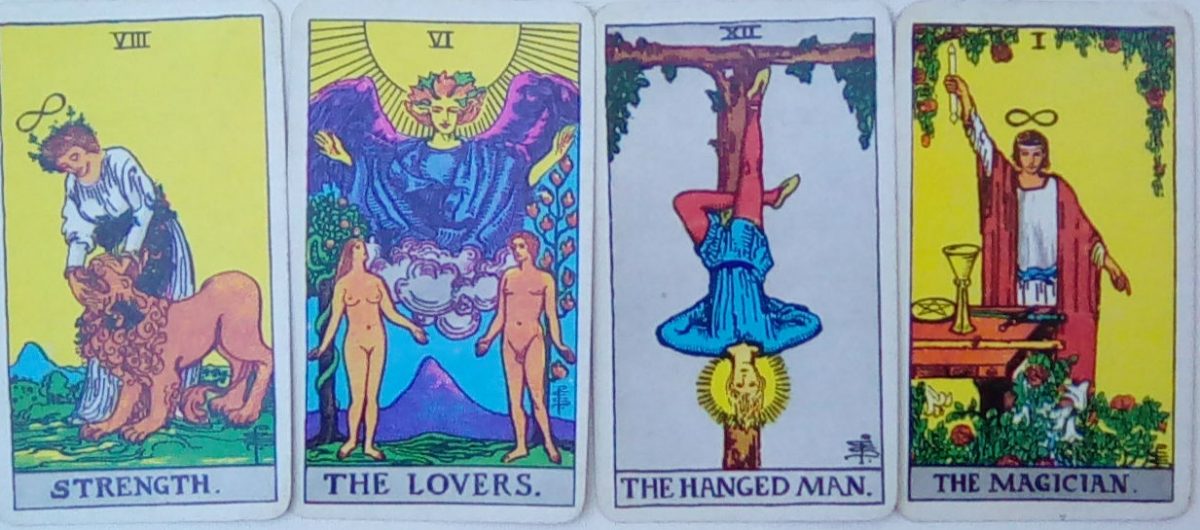
If you’re reading this, there’s actually a pretty good chance that you’re an introvert.  It’s a pretty simple equation:  people who do Tarot reading are usually empaths.  Empaths are usually introverts.  

When we do a Tarot reading (or any other type of psychic reading) for other people, it’s not about us.  It’s about the life and the experiences and the dilemmas of the person we’re reading.  If we’re going to be effective at that, we have to be able to empathize, to actually put ourselves in their space, and say, “Okay, you’re going through THIS and that makes you feel like you want to do THAT, but perhaps you should consider doing THIS instead.”  If you’re a good reader, you have to be able to suspend your own judgments and really get into the life and vibrations of the other person, to really see it from their perspective.  And that’s called, “empathy,” right?  That’s literally being an empath.

Doctor Judith Orloff, author of, “The Empath’s Survival Guide: Life Strategies for Sensitive People,” flat out states, “An empath can be an introvert or an extrovert, though most are introverts.”  So, if you’re a Tarot reader, you may be one of those wonderful extroverts who likes to dress up like a gypsy and do readings at Renaissance Fairs.  But the odds are that you aren’t.  The odds are that you’re an introvert and you hate crowds and feel intensely uncomfortable when you’re forced to be around too many people.

Which brings us back to baking our own cookies.

Our society is extrovert-driven.  We’re taught from the moment we come into this world that there’s something wonderfully right about being an extrovert and something terribly wrong with being an introvert.  Think of the terms we use to describe extroverts:  

  • He’s the life of the party.
  • She took center stage.
  • They were vibrant and bubbly.

Now think of the terms we use to describe introverts:

  • She’s a shrinking violet.
  • He’s a wall flower.
  • They faded into the background.

As we grow up, introverts are literally shamed just for being who we are, just for the way we were born.  Brene’ Brown, author of, “The Gifts of Imperfection,” says that our society has an epidemic of shame and that our school systems are 90% shame based.  A lot of that shame is aimed at children who are introverts.

  • She’s too quiet.
  • He doesn’t  play well with the other children.
  • She seems to be in her own little world.

In other words we’re taught that everything an introvert is – quiet, socially withdrawn, introspective, etc. – is NOT NORMAL and is a cause for alarm and a sign of neurosis.

Perhaps one of the most prevalent – and most damaging – myths in our society is that introverts are sort of socially backwards (not to say, “socially stupid”) and that they just don’t know HOW to fit in.  That’s why they spend so much time alone – they don’t have any choice.

Actually, the evidence indicates quite the opposite.  Researchers at Yale University asked over a thousand people to predict how the average, normal person would think, feel, and behave in different situations.  The correct answers were based on data they had already gathered about how the average, normal person actually DID react in those situations.

And do you know who scored some of the highest points on the test?  Introverts.  Introverts were able to predict with a high degree of accuracy exactly how, “normal,” people think, react, and behave. Introverts, far from being socially inept, can be highly tuned into and aware of social norms and behavior, even more tuned into what’s going on around them than extroverts.

So if we’re introverts, the start of baking our own cookies, the start of being our own rewards, is to firmly, thoroughly, once and for all, get rid of all of the BULLSHIT that we’ve been taught about ourselves since we were kids.  We are not socially inept, we are not painfully shy, we are not dull and uninteresting.  In fact, we can be a damned sight more interesting than the social butterflies who are getting all of society’s cookies.

But a more important step is to rethink what the terms, “introvert,” and, “extrovert,” actually mean, once we jettison all of the cultural prejudices.  Anna Lemind, author of, “The Power of Misfits: How to Find Your Place in a World You Don’t Fit In,” has a very simple answer for that:  energy systems.

Extroverts recharge their energy systems through large amounts of social contact.

Introverts recharge their energy systems through having a lot of time to themselves.

Period.

Extroverts aren’t any better than introverts and introverts aren’t any better than extroverts.  We’re just different.

The salient point here, though, is that if you’re really and truly an introvert, AND you buy society’s bullshit that you somehow have to be an extrovert to fit in, to get your cookie, you’re going to end up physically exhausted and spiritually depleted. Trying to be around a lot of people sucks you dry. No cookies for you.  Sorry.

As introverts, we really and truly ARE our own cookies.  We draw our energy from ourselves, not from others.  We ARE our own rewards and that’s just how our energy systems work.  The good news is that, much more than extroverts, we get to choose the ingredients that go into our cookies.  Chocolate chips?  Yes!  Sprinkles?  Definitely.  Whole wheat flour?  Ummmm . . . no.

After all, it’s my cookie.