THE EMPRESS AND THE ART OF FLUNKING OUT OF EARTH SCHOOL

A playful look at the New Age paradox of being “perfect souls” who still come to “Earth School” to learn lessons. The post explores both views and suggests that real growth comes not from suffering, but from joy, play, and becoming more fully ourselves.

There’s a rather large pothole in New Age philosophy that I keep tripping over. Let’s call it The Earth School Fallacy — the strange contradiction between “We are perfect divine beings” and “We’re here to learn lessons because… well, we’re NOT perfect divine beings.”

Somehow, we manage to carry both of those ideas around in our heads and not notice that they don’t quite fit together.

“Just the Tarot,” available on Amazon

THE EARTH SCHOOL MODEL

You’ve heard this one. If you’ve been on a spiritual path longer than a week, you’ve probably used this one.

Earth, we’re told, is a sort of cosmic classroom we incarnate into repeatedly. Each lifetime is a syllabus of Very Important Lessons, and with each incarnation we supposedly level up until we become Spiritually Perfect.

In this model, we actually choose our life challenges before we’re born.

Have a temper? Great! Let’s incarnate into a family whose daily activities include pushing all of your buttons like they’re competing for a prize. Assuming we don’t murder each other we eventually learn enough humility and patience and – SHAZAM –  we transform into Mahatma Gandhi.

Have an obsession with sex? Wonderful! Let’s incarnate into a world filled with gorgeous, eager, naked partners who—

Okay, that one never happens. But you get the drift.

Pass your lessons and you move up a grade.

Fail your lessons and you come back as a cockroach or a MAGA supporter and start over in Spiritual First Grade, eating glue and making macaroni art.

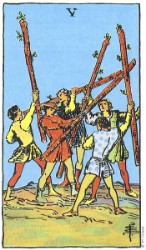
In Tarot Talk, Gaia’s classroom often looks like the Five of Wands — a bunch of souls flailing around wildly until one of us finally figures out what the sticks are for.
THE ANGEL WITHIN

Now we arrive at the second New Age idea — the one that directly contradicts the first.

This is the belief that we’re already spiritually perfect, but we’ve forgotten that fact. Our task isn’t to improve ourselves… it’s to remember that we don’t need improving.

Buddhists describe it as our original nature: a perfect jewel hidden under a crust of plain gray rock. Chip away the rock and — surprise! — you’ve been luminous the whole time.

Joni Mitchell phrased it better than all the gurus combined:

“We are stardust, we are golden,

and we’ve got to get back to the garden.”

In this view, we are pure, radiant beings from Source Energy who come to Earth, promptly forget who we are, and then spend the rest of our lives meditating, journaling, and buying inspirational calendars in an attempt to remember.

Put another way:

We’ve got a sleeping angel inside us, and the angel really needs to get its butt out of bed.

THE CONTRADICTION

Here’s the uncomfortable question no one asks:

If we’re already perfect, why would we CHOOSE to forget that and struggle?

It’s like becoming a master at algebra, then signing up for a lobotomy just so you can relearn quadratic equations from scratch.

Imagine your higher self sitting in another dimension saying,

“I’m a being of luminous perfection. You know what sounds fun? Forgetting everything and getting pissed off at the traffic while I drive to a boring, meaningless job that I hate.”

Something about that doesn’t quite compute.

EARTH SCHOOL AND THE WORK ETHIC PROBLEM

The Earth School model borrows heavily from Christian theology, a worldview in which:

• Humans are inherently sinful.

• Life is full of temptations that make us more sinful.

• If we behave ourselves and avoid having sex with the neighbor’s spouse, we get to go somewhere nice after we die.

In this model, Earth is basically the rough school on the dangerous side of town, with a curriculum of suffering, discipline, and fear.

Just keep your head down, work hard, and eventually—good news!—you’ll die.

THE VEDANTA SOLUTION (AKA: THE EMPRESS APPROACH)

Vedanta, from the Hindu tradition, on the other hand, leans toward Joni Mitchell’s interpretation. It suggests that:

• We are already perfect.

• Life is not meant to be hard.

• We’re not here to learn painful lessons.

• We’re here to experience, enjoy, and expand.

If the Vedanta version of Earth School has a model, it’s not the stern monk or stressed-out student — it’s The Empress.

Empress Poster available on Etsy

She’s not here to ace the test. She’s here to savor the banquet.

Play, creativity, pleasure, beauty — these are not distractions from the spiritual path.

They are the spiritual path.

That’s a really hard concept for Westerners to wrap our heads around.  We’re taught from the moment that we’re born that life is a series of assignments that we’re supposed to complete and that the next assignment will be better than the last.  That’s really the way that our whole society is set up.  We go to kindergarten so that we can go to grade school so that we can go to high school so that we can go to college or trade school so that we can get jobs so that we can get promotions so that we can retire comfortably and have enough money to pay for our funerals.

If we do all of that, we’ve been, “successful.”  If we don’t, our lives have been meaningless.

When someone tells us that the whole purpose of Earth School might actually be recess, it feels slightly insane.

LIVING SOMEWHERE IN THE MIDDLE

We can argue both sides.

If you lean toward Earth School, you can point to all the suffering and struggle that seem baked into our reality. As the English philosopher Thomas Hobbes famously put it, human life often appears “nasty, brutish, and short.”

But if you look again, you’ll also see breathtaking amounts of love, generosity, joy, and compassion.

So what’s the truth?

Probably something in the middle.

No, we’re not perfect angelic beings slumming on Earth…

but we can be.

Maybe life isn’t about learning painful lessons, and maybe it’s not about effortless perfection either.

Maybe it’s simply about becoming more yourself, more awake, more playful, more alive.

And oddly enough, the way we get there isn’t through suffering…

it’s through joy. It’s through learning how to play.

We don’t have to wait until we die to graduate.

We can do that right now — as soon as we remember that recess was always the point.

Taking Religion Out of the Tarot – A Look at the Real Tarot Deck

For centuries, Christianity condemned Tarot as witchcraft — yet hidden Christian symbols helped the cards survive the Inquisition. This post uncovers how those overlays disguised the deck’s true archetypal roots.

“Are Tarot cards evil?”

That’s one of the most common Google searches on the Tarot and I assume it comes from people who were raised as, “good Christian folks.”  After all, for centuries Christianity has railed against the Tarot.  Preachers and pastors are still screaming that the cards are the gateways to the Devil and dangerous tools of shadowy occultists.

One of the weird things about that is the Tarot actually contains a strong Christian thread that was intentionally stitched into the deck as camouflage.  It’s chock full of angels and not so subtle allusions to the Bible.  Without them, the Tarot would never have survived the Inquisition.

So let’s take a little closer look at how the Church’s iron grip shaped the early Tarot, what Christian symbols were embedded to disguise it, and what the cards may have actually looked like before that clever cover was sewn in.

TAROT WAS BORN IN DANGEROUS TIMES

The first historical references to the Tarot are in Europe in the 1450s.  Right in the middle of one of history’s most brutal religious crackdowns:  the Inquisition.  It’s hard for us to imagine it today, but ANY sort of fortune telling or divination could mean an automatic death sentence.

The Bible was explicit in its warnings. Leviticus 19:31 commands: “Do not turn to mediums or necromancers; do not seek them out, and so make yourselves unclean by them.”

We may casually lay out a reading today, curious as to what the cards can tell us.  To the Church, though, there was nothing casual about it.  It was witchcraft.  And witchcraft meant torture, trials, and being put to a horrible death.

The death toll from the Inquisition is still debated.  Some historians estimate the death toll from the Catholic Church’s witch hunts as, “low” as 30,000 victims.  Others, like Leonard Shlain in, “The Alphabet Versus the Goddess” place the number as high as 10 million.

Whatever the numbers actually were, the climate of terror was real, daily, and all pervasive.  So how did the Tarot survive?

HOW THE TAROT HID IN PLAIN SIGHT

The disguise of what the Tarot actually is was quite brilliant.

First, the makers announced that it was a card game, plain and simple.  Nothing to see here.   It’s just poker, only with archetypes.

 And then they wove Christian symbols directly into the deck.

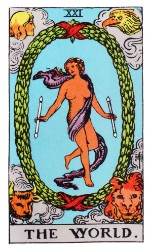
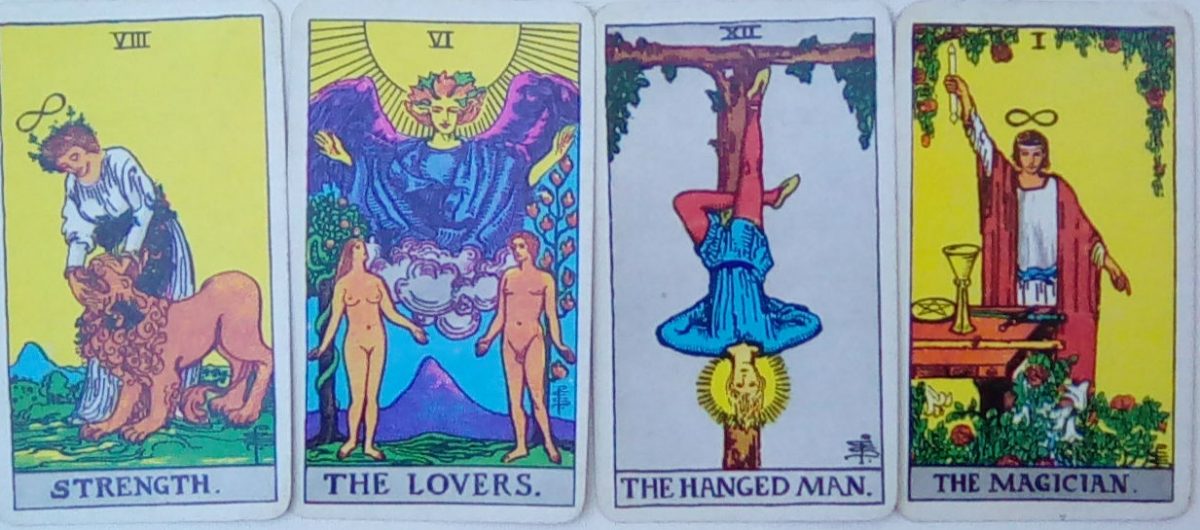
Take The World card.  It’s four corner symbols – lion, ox, eagle, and angel – aren’t just random.  They’re the traditional symbols of the four evangelists:  Matthew, Mark, Luke, and John.

Even more striking are the Four Cardinal Virtues, lifted straight out of Catholic theology:

Justice

Temperance

Fortitude (Strength)

Prudence

By embedding these virtues, the creators of the deck could claim that the Tarot promoted Christian morality rather than undermining it.  It was a survival tactic:  “See – these aren’t pagan symbols.  Ripping up a Tarot deck is just like ripping up a Bible.”

Prudence eventually vanished from the deck (see my previous post, “Dear Prudence – The Mysterious Case of the Missing Tarot Card”), but the other three virtues remain mainstays of the Major Arcana to this day.

WHAT DID THE ORIGINAL DECK LOOK LIKE?

So what happens if we get rid of the Christian overlays, the cards that don’t really belong in the deck?

What remains are the raw archetypes.  Timeless figures like The Fool, The Magician, The Lovers, The Devil, The Wheel of Fortune and Death.  Those cards pulse with universal energies that transcend any single religion.

A question that arises naturally out of this is:  if we’re getting rid of the Virtue cards, why not get rid of The Hierophant, too?  After all, it was originally known as, “The Pope,” and what could be more Catholic than that?  The answer is The Hierophant is nothing but The High Priest in disguise and is the partner card to The High Priestess in the same way that the Emperor is linked to The Empress.

Beneath the Christian veneer lies a much older symbolic system, one that might have looked very different if it hadn’t been forced to wear this mask.

WHERE DID THE TAROT REALLY COME FROM?

Contrary to many modern assumptions, the Tarot did NOT evolve out of Christianity.  

Instead, it seems to have appeared fully formed in the mid-1400s, as though it had been carried forward from some older source.  What that source was – Ancient Egypt or an even older, lost esoteric tradition – remains a mystery.

What’s clear is this:  the Christian layer was camouflage, not origin.  It was a survival strategy, not a birthing.

SEEING THE REAL DECK

The, ‘Christian Themes’ in the Tarot were never a part of the original deck.  They were just part of a clever disguise to get past the censors of the Inquisition.

When we peel back that layer, what we find is a universal language of archetypes.  The Fool, Magician, Death, The Star – these are symbols that speak to something much deeper than mere religious dogma.

And so the question remains:  when we lay the cards out today, are we seeing the archetypes themselves?  Or the clever veil that once kept them alive?

“Just the Tarot” by Daniel Adair – a kindle ebook available on amazon.

The Hierophant, the Tangerine Blob, and the Moral Collapse of American Christianity

A look at the role of cognitive dissonance in American Christian voters.

One of the larger puzzles of the recent elections in the U.S. is the huge number of people who are self-professed Christians but voted for Trump.  Not to belabor the point, but Jesus was pretty much of a peace, love, and forgiveness dude and the Tangerine Blob is all about hatred, anger, and vengeance.

So how could they possibly reconcile being followers of Jesus with voting for the Malevolent Cheeto?  Hmmm . . .

It’s important to note that American Christianity (and Christianity in general) has always sort of run on two different tracks at the same time. As Dee Brown delineated in his classic book, “Bury My Heart At Wounded Knee,”  Christianity was a driving force behind the genocide that White settlers committed against Native Americans.  The peculiar notion of, “the White man’s burden,” dictated that all people of color MUST be forced to adopt Christianity or be exterminated.

And, of course, the resurgence of the Ku Klux Klan in the 1920s had massive support among the White Protestant churches of the South.  There’s a reason that the Kluxers burn crosses at their rallies.

We’ve regularly had this strange dissonance between the Christianity that purports to be a creed of peace and humility and the Christianity that feels more like a violent Spiritual Imperialism.  It’s like someone saying, “You have to believe in our God of love or we’ll kill you.”

It may be that, “dissonance,” is precisely the word to describe what happened with American Christians and this election.  In psychology, “cognitive dissonance,” is the term that’s used to describe the state where an individual holds two different sets of beliefs that contradict each other, or where their behavior is completely at odds with their values.  

Think of it like a good, family man who professes to love his wife and children but is constantly sneaking off to have liaisons with hookers.  Or a feminist woman who’s strongly attracted to primitive, abusive males.  What happens is that the differences between their self images and their behaviors cause a huge amount of psychic tension and eventually something’s got to give.  Either they change their behaviors or they change their beliefs and that eliminates the dissonance and relieves the tension.

If we start to think of American Christianity in terms of that same sort of a moral and behavioral dissonance, then all of this begins to make sense. The Hierophant card represents the formal teachings of a religion or creed, as opposed to actual spirituality.  It’s what the church tells us that we ought to believe and how we ought to behave.  It’s not necessarily who we truly are.

Jesus, of course, taught that we ought to love each other, we ought to forgive each other, we should help the powerless and the ill, that violence is wrong, and that rich people can’t get into heaven.  Americans, on the other hand, have always been at war more than we’ve been at peace, we love violence in our movies and our sports, we sell more weapons of destruction than any other country in the world, and we worship money and the people who have money.

If you’re a Christian, that’s cognitive dissonance.

Now, it would be inaccurate and melodramatic to describe Trump as, “the Anti-Christ.”  At the end of the day, he’s just one more puffed up wanna-be dictator strutting his stuff on the world stage.  It would be highly accurate, though, to describe him as, “the Anti-Jesus.”  Nearly all of his behaviors and beliefs – the anger, the hatred, the vanity, the vengeance, the gross materialism – are in direct opposition to everything that Jesus taught.

If we stick with our model of cognitive dissonance, Christians voting for Trump would be like the good family man leaving his wife and running off with a hooker.  Or the feminist woman getting married to a man who’s a sexist pig.  Rather than changing their behaviors, they changed their beliefs.

Put another way, the election of Donald Trump can be seen as a substantial shift away from what American Christians claimed to be and toward who they really are.  In fully embracing their Shadow of anger, xenophobia, sexism, and violence, they’ve relieved the psychic tension of that cognitive dissonance.  They feel a whole lot better, even if the rest of us are freaking out.

So it’s really not shocking at all.  That very dark side of Christianity has always been there, operating in the background.  What’s interesting, from a purely sociological point of view, is what American Christianity will become now that they’ve thoroughly expunged Jesus from the equation.  Without the doctrines of peace, love, and brotherhood, what’s left?

In her brilliant book, “The Power Worshippers – Inside the Dangerous Rise of Religious Nationalism,” Katherine Stewart argues that what’s left is essentially a political movement rather than a church.  She traces a nationwide network of religious fundamentalists, ultra-conservative oligarchs, and autocratic preachers who are determined to undermine democracy and impose their world view on the rest of us.  Their world view is that White males should be the ruling class in our society, that women should be subservient breeding stock, and that our constitutional democracy should be replaced with an Old Testament religious theocracy.

Will that movement be able to sustain itself in the long run?  Perhaps.  What’s clear at this moment, though, is that if it’s going to be defeated there will have to be a transformation of the basic values of many Americans.  Unfortunately, the normal vehicle for ethical change in America has always been the Christian church, which apparently isn’t very Christian anymore.  We shall see . . .

“Just the Tarot,” available dirt cheap on Amazon. As a member of the Amazon affiliate program I may receive a very small, itty bitty, tiny remuneration when you click through one of my links and make a purchase.

Atheist Tarot Readers, Defective Jesus, and Finding a New God-Person

The pragmatism of polytheism.

I have a friend who is an atheist Tarot card reader and it tickles me no end.  I like to rag on her a bit and ask her, “Who do you think is answering your questions when you do a reading?  Maybe atheist angels or agnostic spirit guides?”  

Which generally earns me a dirty look or a shrug.  She reads Tarot cards.  She’s an atheist.  It’s not up for discussion.

Now, she’s kind of caught between a rock and a hard place.  The rock is that she was reading Tarot cards for many years before she became an atheist, so she knows that they actually work.  When you sit down with a deck of cards and do a reading, you get answers and the answers are generally (not always) right on.

The hard place is that she went through a series of very painful life experiences that led her to conclude that there’s no God and that religion is nothing more than superstitious nonsense.  That conclusion wasn’t arrived at in a frivolous manner because she was genuinely suffering in her life, she prayed for help, and nothing much happened.

It’s a pretty simple equation, right?  We’re told that there’s some sort of a God-person out there, that he loves us, and that if we’re in trouble he’ll come zooming in and rescue us.  So, if we do our part by (a) getting in trouble and (b) praying for help and the God-person doesn’t do his part by (c) zooming in and rescuing us, then it’s logical to conclude that the God-person either doesn’t exist or else he’s pretty useless.

I’m actually very sympathetic with my friend, the atheist Tarot reader, because I had a similar experience when I was in my mid-forties.  My father had just killed himself, I lost my job and had to declare bankruptcy, my house was repossessed, and my mother developed Alzheimer’s Disease.

All of this happened within a one year span of time.  My life went from being perfectly normal to being a total shit-burger in the wink of an eye.  I was so chewed up by life that I had to look up to see the bottom and if it weren’t for bad luck, “I wouldn’t have had no luck at all.”  Life had chewed me up, spit me out, and then stomped on me with hob-nail boots to be sure I’d stay on the ground.

I was living in Texas at the time and there’s a fundamentalist christian under every rock and behind every cactus in Texas.  It was probably inevitable, then, that one of them said, “Dan, you just need to get down on your knees and pray to Jesus for help.”  And I did.  I was raised up in the catholic church, so the concept of praying to Jesus wasn’t exactly foreign to me and I thought, “Well, shit . . . what do I have to lose?”  Nothing.

So I commenced praying and I prayed and prayed and prayed and asked Jesus to help me in my misery and travails and – SHAZAM! – nothing happened.  No heavenly hosts of angels appeared, Jesus didn’t invite me for a walk in the garden and no one anointed my fevered brow with soothing oils.  I continued to be royally fucked.

But, unlike my friend, the atheist Tarot reader, I didn’t throw my hands in the air and declare that God is dead and it’s just a cold, hard universe.  Instead, I analyzed my situation and thought, “Well, I’m in trouble, I prayed to the God-person to come zooming in and help me, and nothing happened.  Obviously, I have a defective God-person.  He’s not working, so I’ll just send him back.  I need to find a God-person who can get the job done.”

I did a lot of research on Gods and Goddesses and finally settled on Hecate’, the Goddess of the Cross Roads.  She seemed like a good fit because I was definitely at a cross roads in my life and I needed to know which way to turn.  I prayed and prayed and prayed and asked Hecate’ to help me in my misery and travails and – SHAZAM! – something happened.

In fact, quite a bit happened, just like magic.  I met a woman on line, fell in love with her, moved to California and we lived together for 19 years.  My life went from being an absolute shit-burger to being wonder-full in the wink of an eye.

Now, I’m not writing all of this as some sort of an anti-Jesus screed or to praise the wonders of Hecate’.  I know a few christians who swear up and down that Jesus answers their prayers and they seem like nice, honest people.  Maybe they got a Jesus model that wasn’t defective and he sort of works if they don’t take too close a look at him.  Maybe Jesus was just a bad fit for me – could be that he doesn’t like my haircut or tie dyed shirts.  I don’t know.  I just know he didn’t work.

Which leads me back to my friend, the atheist Tarot reader.  Like me, she tried praying to her God-person and nothing happened, nothing got better.  She quite logically realized he was a defective model and sent him back.  Fortunately, she was still able to hang on to her Tarot cards and say, “These DO work, so I’m not sending them back.”

The point being that we have a sort of a pragmatic, mostly unspoken, contract with our God-persons.  It’s something along the lines of, “Okay, God-person, we’ll pray to you and we’ll build all of these very grandiose temple-houses for you to live in and we’ll pay the salaries of your priest-persons.  You, on the other hand, will help us, console us, give us guidance, and zoom in to help us when we’re in trouble.”

Unfortunately, humans have a long history of making excuses for their God-persons.  In many instances, it’s as if the God-person is on vacation when we’re in trouble, or perhaps he has Attention Deficit Disorder and it just slips his mind that we’re hanging off the edge of a cliff holding on to a single branch.  In the worst instances, the God-person seems to behave like some sort of a deranged sadist who LIKES wrecking people’s lives and we just pray that maybe he won’t notice us while he’s in a bad mood.

In those instances, it’s perfectly acceptable to just say, “Okay, God-person – I held up my end of the bargain and you didn’t hold up yours.  It’s been sweet, but I think we both know this isn’t working out.”

And it’s also perfectly acceptable to find another God-person.  Just because this relationship is ending, it doesn’t mean that we can’t have another relationship.  There’s no reason to accept the christian line that there’s only ONE God-person and that we mustn’t ever be unfaithful to him, even when he’s being unfaithful to us.  What a narcissist!

It’s actually a great big universe out there and there are plenty of God-persons to choose from.  If we’re stone-cold poor, for instance, we might want to talk to Lakshmi, the Goddess of Abundance.  If we’re facing insurmountable obstacles, Ganesh specializes in removing them.  If we’re in need of healing, talk to Tara.  If we have no love in your lives, pray to Quan Yin.

I think that you’ll find that most God-persons are actually quite nice entities.  For the most part, they seem to have healthy boundaries.  They don’t follow you around and spy on what you’re doing.  They don’t have temper fits and throw you out of the garden just because you ate an apple.  They seem to have a lot of unconditional love and won’t ask you to sacrifice your first born son.  And they actually work.

My e-book, “Just the Tarot,” a practical guide to reading Tarot cards, is still available on Amazon for less than you’d pay for a small order of jalapeño poppers and will last a lot longer.

The Hitchhiker’s Guide to the Dark Ages, The Hierophant Card, and Eschewing Sheep

The Bible as an anachronistic guide for living.

The Bible was really the original Hitchhiker’s Guide to the Galaxy, at least for a big chunk of Western history.

In The Hitchhiker’s Guide to the Galaxy, Douglas Adams invented a sort of a tourist’s guide book that could be used while visiting various sections of  outer space.   No matter what bizarre planet or dystopian nebula a traveler might be visiting, she could simply consult the Guide to Galaxy to determine what in the hell was going on.

Now imagine, if you will, a world in which the inhabitants were so thoroughly stupid and ill-informed that they thought that the planets they saw in the night sky must be living creatures because, after all, they moved around instead of standing still.  Inhabitants who believed that their own planet was, in fact, flat as a board, and that you might fall off of the edge of it if you sailed your ship too far in any given direction.   People who believed that if a man had a wet dream it was because his, “vital fluids,” were being drained by a succubus.  People who believed that witches had secret teats that they used to nurse black cats.

To use the scientific nomenclature, people who were just as dumb as a bag of rocks.

For such people, life would seem very puzzling and, indeed, very frightening.  They were constantly surrounded by threats and mysteries.  Where does lightning come from?  Do demons live in trees?  Why do we sneeze?  What’s a clitoris and where do you find one?  Well . . . never mind that last one . . .  that’s still going on.

Fortunately, when confronted by this bizarre, evil, scary world, they had a book they could turn to for guidance on nearly any subject.  And not just any book.  This book was written by . . . God.  And, since God actually MADE the bizarre, evil, scary world, he’d be the one who’d have the answers about what in the hell was going on, wouldn’t he?  All of that secret God-knowledge was contained in The Christian Hitchhiker’s Guide to the Dark Ages, also known as the Bible.

Unfortunately, there were very few copies of the Bible in existence, they were enormous,  and those few copies were mainly kept locked away in castles and monasteries.  To make matters worse, even if the common folks were somehow able to get hold of a copy of the Bible, they didn’t know how to read it because . . . you know . . . ddumb as a bag of rocks.  All that they could do was to sit there and hold the Bible and try to guess what it might actually say, which didn’t work out too well.

And so they invented a special class of people who actually COULD read and actually HAD copies of the Bible and they called them, “priests,”  and sometimes, “monks.”  We see one such person in the Tarot card, The Hierophant.

The arrangement that the common people had with the priests was really quite simple.  When they – the common folks – were confronted with a problem or a conundrum in life, they would go to the priest and give him money, or some eggs, or perhaps a goat. Maybe an eggplant.  In return, the priest would bring out an enormous copy of the Bible, flip it open, read a bit, and then tell the common folks what God had to say about how to solve their problems.

We can imagine that this exchange might have gone something like this:

“Yes, hello Father Flanagan.  Top of the morning to you.  We’re here because our well has dried up and if there’s no water we don’t know how the village will come down with giardia this summer.  We can’t decide if we should dig a little deeper or maybe just start a new well, so if you could look in your giant book and tell us what the God person says, we’d appreciate it.  By the way, here’s an eggplant.”

The priest, for his part, would mutter a few incantations, heave open the big, fat book to a random section, and trace a few lines of the Holy Scripture with his finger.

“Ah, here it is, my children.  The Lord saith, “Thou shalt not curse the deaf, nor put a stumbling block before the blind,.”  Leviticus 19:14.

“Oh.  Um . . . begging your pardon, your holiness, but what does that mean?”

“It means, don’t trip blind people.”

“Ah . . . yes . . . and that’s very good advice, Father.  I personally try to avoid tripping blind people as much as possible.  Anyone here who trips blind people?”

The common people glance around at each other, shaking their heads.

“Nope, none of us trip blind people.  Well, there was Fred, but that was years ago.  Still, your honorableness, that doesn’t hardly tell us whether to dig a new well.  Could we maybe give it another try?  Here’s another eggplant.”

“Oh, very well.  Let’s see . . . um . . . “You must not lie carnally with any animal, thus defiling yourself with it; a woman must not stand before an animal to mate with it.”  Leviticus 18:23

“Uh, what does THAT mean?”

“It means don’t have sex with your sheep.”

“Eeeeeewww!  Gross!  Jesus.  I’ll have a hard time getting THAT out of my head.  Anyone here sheep fuckers?  No?  Even Fred?  No?  Sigh . . . now, about that well, your priestliness.”

And so on and so on, until the priest had all of the people’s eggplants and the people had, verily, nothing but a dry well to spit in.  

The problem, of course, was that The Hitchhiker’s Guide to the Dark Ages, aka The Bible, wasn’t really designed for the Dark Ages, it was designed for the Stone Ages.  While knowledge such as how to kill a giant with a slingshot or how to plug up the Nile River with frogs might have been interesting, it hardly solved the more complex problems of the Dark Ages.  People of the Dark Ages were facing more technologically intricate matters, like how to fight dragons or what charcoal worked best when burning heretics at the stake.

The Bible simply didn’t have the answers, no matter how many eggplants they threw at it.

Now, in the very same sense, it’s entirely possible that the Bible doesn’t contain the answers to the questions we’re facing today.

How do we fight a worldwide pandemic?  And the Bible says . . . nothing about that subject.

How do we stop this horrific gun violence?  Nothing.

Should abortion be legal?  Nothing.

Why is Donald Trump orange?  Nothing.

Is Marjorie Taylor Green an alien life form?  Nothing.

Why have we been cursed with the Kardashians?  Nothing

It may very well be that the Bible isn’t just a very, very, very old book that lost a lot in the translation.  It may be that the Bible is totally irrelevant to most of what we call daily life.  That may be why the number of people who self-identify as christians has fallen from 90% in the 1950s to a mere 64% today.

It’s difficult to deal with fundamentalist christians.  They’re still waving The Hitchhiker’s Guide to the Dark Ages in the air and screaming that the earth is flat and we might fall off of the edges.  Nonetheless, it may be time to look for a different paradigm and different answers.

At least we’ll get to keep our eggplants.

If you enjoyed this post, please remember that my book, JUST THE TAROT, is available on Amazon for much less than the cost of a Bible and doesn’t contain one single word about sheep.

Happy Buddhists, Christian Apple Munchers and Garden Gnomes in Tutus

Why Buddhism is actually a happy religion.

The Dalai Lama giggles a lot.  Have you ever noticed that?  On a certain level, he seems to find life to be absolutely hilarious.  For instance, there’s this wonderful interview that Barbara Walters did with him and, toward the end of the video, he absolutely cracks up about the fact that Eskimos kiss each other by rubbing noses.

It seems a little strange because Buddhism has a reputation for being a very dark, solemn sort of a religion.  That reputation probably flows out of the Buddha’s admonition that, “life is suffering,” which is not exactly what he said, but it’s the way that it’s frequently translated.  So we have this religious doctrine that seems to say that life is suffering, yet we see Buddhists like the Dalai Lama and Thic Nhat Hahn who not only seem to be happy, they seem to be really, really, REALLY happy.

What’s up with that?

The tarot card, The Hierophant, is all about formal doctrine, rather than first hand experience.  Religion, rather than spirituality.  It represents what religions SAY they are, rather than the way that they’re actually practiced on a daily basis by their followers.  Oddly, there’s a curious optimism that permeates Buddhism once we get past the doctrines and get into the actual experience of, “living Buddhism.”  

Although I’m sure that the Buddha wouldn’t dig my doing this because it involves a lot of judgment,  one of the best ways to illustrate that optimism  is by contrasting it with the dominant Western religion, Christianity.  In particular, how do the two religions actually VIEW human beings?

Christianity starts out with the basic premise that humans are miserable, flawed sinners.  According to Christian doctrine, we’re actually born that way, which doctrine is referred to as, “original sin.”  Now, it’s kind of hard to get a grasp on what original sin really means, but when you wrestle it to the ground it seems to mean that every single one of us was born with, “the stain of Adam,” on our souls.  Which goes back to Adam and Eve getting thrown out of the Garden of Eden because that bitch Eve just HAD to have an apple

I know, right?  It’s kind of hard to figure the reasoning.  Still, it appears to say that because our great, great, great, great, great grandmother to the hundredth power munched on an apple, we’re all born sinners and destined to go straight to hell if we don’t find redemption.  That’s also, by the way, the reason that women have been, “cursed,” with having periods every month.

I’m not making this shit up.  

So, according to Christianity, at the core of every human being there’s a rotten, sinful, apple muncher and we come into the world that way.  That’s why you’ve got to get babies baptized right away, because babies are basically pure evil, as we all know.

The Buddhist viewpoint is very much the opposite.  Buddhists believe that at the core of every human being is absolute perfection.  We just don’t know it.  Tibetan Buddhist Master, Chagdud Tulku Rinpoche, described this by saying that we all have a beautiful jewel at the center of our hearts which is covered over by common rock.  Our job is to slowly chip away at the rock that’s covering our jewel so that more and more of it is exposed as we go through our lives. Yes, life is suffering, but it’s suffering because we remain ignorant of our true nature, which is bliss and joy.

To put all of that in a nutshell, Christianity says that we should pretty much hate ourselves and Buddhism says that we should pretty much love ourselves.  It shouldn’t be a major news flash to anyone that hating yourself feels really, really bad and loving yourself feels really, really good.

Which may be why the Pope doesn’t do a lot of giggling.

There’s another major implication here, which is that Chrisitanity views, “salvation,” as coming from an outside source and Buddhism sees it as very much of an inside job.  Christianity says that we are SO fucked up and miserable and down in the dirt that we literally have no chance of saving ourselves.  We just have to pray and hope that Jesus is going to ride in on his white horse and whack us with his redemption wand and THEN we get to go to heaven.

Buddhists believe that our salvation, our Buddha nature, is already inside of us, so ANYONE can become a Buddha.  That means you, me, our Aunt Gertrude, or even the weird guy down the block who collects garden gnomes and dresses them in tutus. And we don’t get there by some outside deity or force, “forgiving us,” we get there by sitting our asses down on the meditation cushion and by practicing love and compassion in our daily lives.

Which is a lot of work and a lot of responsibility but it’s also tremendously liberating.  It’s looking at ourselves and realizing that if we’re not happy it’s because we didn’t do the work.  We may have talked the talk but we didn’t walk the walk.  We didn’t uncover that jewel inside of us.  It’s TOTALLY up to us.

Wow!

Another probable reason that the Dalai Lama giggles a lot is that Buddhists believe that we are all connected.  I don’t mean that in some generalized sense of, “our common humanity,”  or, “our shared heritage,”  or the Christian sense that we’re all, “born in sin.”  No, I mean, really, genuinely, energetically connected to each other, just like there’s some invisible thread that runs from me to you and from you to another person and so on and on.  Whatever we’re feeling and experiencing emotionally and spiritually is going out into a sort of a giant, collective web of consciousness and affects not just us, but everyone else, as well.

Think of it this way:  if we’re going out grocery shopping and we’re in a really high vibrations, zippety doo dah sort of a mood, some of that positive energy is going to spark off of us to everyone we encounter, from the kid stacking tomatoes at the vegetable section to the cashier who checks us out.  On the other hand, if we’re in a really sour bah humbug fuck you mood, some of that negative energy will be transferred to other people as well.  We leave everyone we meet either feeling a little better or a little worse.

Now take that same phenomenon of energy transfer and magnify it to influencing every person on the entire planet.  That doesn’t mean that if we wake up in a rotten mood trains will crash and someone’s flower garden will die.  But it does mean that everything we’re feeling is radiating out to everyone else, even if it’s one little drip at a time.  The way that the Buddha put it was:

“Goodness, like rain in a bucket, gathers one drop at a time.

Evil, like rain in a bucket, gathers one drop at a time.”

So, if you’re a really highly evolved, spiritually aware person and you KNOW that everything you’re feeling is affecting everyone else, what are you going to do?  Are you going to sit around your house feeling like crap and radiating out bad vibes?  Or are you going to try to stay in as high and loving a place as possible, as much of the time as possible, and send out good vibes?

Obviously, you’re going to try to stay as happy as possible.  And if you stay as happy as possible, for a long enough period of time, you’ll probably start to giggle.

Eating Pancakes with Jesus, Having Lunch with Lucifer and Looking Inward with the Three of Pentacles

A contrast in Christian and Buddhist views of human nature and spirituality.

Are we on the outside looking in or on the inside looking out?

Do we think that heaven or redemption or satori or enlightenment or whatever we want to call it, is, “out there somewhere,” or do we think it’s inside of us, waiting to be uncovered?

Which direction are we gazing? Inside or out? It’s a fundamental, crucial question in terms of how we approach life and our personal spirituality.

In Western Christianity, there’s no question that the focus is very much outward.  Heaven, redemption, blessings are seen as things that exist but they’re not an innate part of us. Christian theology goes something like this:  

“God made you in his self-image but something kind of went wrong.  God is perfect, but you aren’t.  In fact, you’re really, really flawed.  In fact, let’s be honest here, you’re a real piece of  shit.   You like to fornicate and steal and lie to people and, um, eat bacon and shrimp.  You’re pretty much hopeless, unless you change your ways.  If you change your ways, you can eat pancakes with Jesus in heaven, and they use REAL maple syrup, not that Mrs. Butterworth’s crap.  On the other hand, if you DON’T change your ways, well, God is going to have to toss you into a flaming pit where you’ll burn in agony forever.  Because he loves you.”

Now, the salient point in all of that is that THERE IS NO GOOD INSIDE OF US.  Whatever blessings or grace may exist, they exist, “out there,” in God, and it’s only by overcoming our basic, sinful nature that we can have any hope of finding happiness and salvation.

It’s only by becoming, “not us,” that we can get God’s approval and get into that pancake breakfast with Jesus.  That sets us up for a lot of spiritual and psychological tension because, basically, everything we really like to do as human beings is a sin and sends us toward having snacks with Satan, instead of breakfast with Jesus.  Everything from sex, enjoying our possessions, loving a good meal, having a nice lazy day, eating shell fish or pork, even masturbating are ALL deadly sins.

What causes us to commit all of our sins?  Why, our bodies, of course!  It isn’t really ME that wants to get into bed with Mary Jo and fuck like bunnies, it’s my body.  It isn’t really me that wants a BLT, it’s my body.  More specifically, it’s my DAMNED body.  If it weren’t for my body, I could be, like, I dunno . . .  Mother Teresa . . . or maybe Mahatma Gandhi, except he wasn’t a Christian so he went straight to hell, of course. 

The end result of that is that we end up hating even our own bodies because the body is the source of all of those terrible impulses that cause us to sin.  That’s why Medieval christians developed wonderful traditions like whipping themselves and self-crucifixion.  The terrible, sinful body had to be literally beaten into submission so that it wouldn’t make them sin, or they’d end up having lunch with Lucifer or brunch with Beelzebub (also known as, “Beelzebubba,” if you live in Texas.)

It’s interesting and even a little startling to our Western minds, to compare that Christian model of spirituality with the Buddhist model.  Tibetan Buddhists speak of basic human nature in terms of a precious jewel or crystal that is covered with plain rock. Our job, our spiritual quest, is to uncover that beautiful jewel by chipping away at the rock, one little piece at a time.  By meditating, practicing mindfulness, and building loving/kindness into our lives, we gradually reveal more and more of the jewel, our true nature.  As Chagdud Tulku Rinpoche’ put it:

“Enlightenment is not anything new or something we create or bring into existence. It is simply discovering within us what is already there. It is the full realization of our intrinsic nature. 

In sharp contrast to Christian theology, we aren’t terribly flawed,”sinful,” beings.  Instead, we are beings that are incredibly beautiful, holy, and wonder-filled.  We just haven’t uncovered that part of our nature, that precious jewel, yet.

Our redemption isn’t, “out there,” it’s not something we’re going to find in heaven or a book.  It’s very much, “in here.”  It’s something that we find by looking inward, toward our true nature, by meditating, consciousness, and increasing the love in our hearts.

This isn’t to say that Buddhists don’t have their Greatest Hits list of, “sins.”  They condemn anger, judging others, envy, greed, etc.  But, they don’t condemn them in terms of their being a part of our basic nature.  Rather, they’re considered sort of side trips that lead us away from our basic goal of enlightenment.  They’re distractions, rather than definitions of who we really are.

There’s actually a major Buddhist doctrine called, “Precious Human Birth,” which not only says that we’re NOT terrible, sinful creatures, it says that if we were born human, we hit the fucking jackpot.  Only human beings are able to consciously contemplate life, make ethical decisions, and improve our spiritual state of being.  When we consider all of the trillions of other beings on our planet who were incarnated as insects and animals, being humans puts us in a very, very, VERY small minority.  We lucked out.

It’s a major shift in thinking for most of us who were raised in the West.  Our bodies aren’t sources of primal, evil urges; they are precious vessels that contain an ineffable beauty just waiting to be brought to the light.  They are a gift beyond comprehension.  Heaven and salvation aren’t up in the sky or hiding in a holy book – they’re in our hearts.

And if heaven is in our hearts, we are sacred.  Umm . . . really? Hmmm . . .  Are you sure?

The Three of Pentacles is a pretty good illustration of the two choices we can make.  The stone mason stands on a stool, mallet in hand, ready to carve.  Beside him there is a monk and a fool holding a plan.  The monk represents a religious creed, a looking outward to others for answers to our spiritual quest.  The fool represents our basic human nature, that surge of playful, happy spiritual energy that occurs when we gaze within and joyfully embrace what already exists in our hearts and souls.

We just have to understand that everything that we want to be, we already are.

Judgments, The Dalai Lama, and Putting Your Hat on the Table

How our belief systems affect our lives.

There’s an old saying that the reason our parents can push our buttons is that they installed the control panel. And there is so much truth in that.

I was watching a presentation from Mike Dooley the other day and he was talking about the importance of our belief systems. For those of you who aren’t familiar with Dooley’s work, he’s a strong advocate of the idea that, “thoughts become things,” and teaches visualization and manifestation techniques. His take on belief systems is that they act as, “regulators,” for what we allow ourselves to think, and since thoughts become things, our beliefs determine what we’re going to think and, therefore, what’s going to manifest in our lives. Our beliefs determine the Judgments that we make about life, which determine the course that our life takes.

For instance, if we have a strong, unconscious belief that we’re unattractive it’s very unlikely that we’ll be able to visualize ourselves with a good, loving partner. We can’t even THINK of that happening, and so it doesn’t. If we have a strongly held belief that rich people are evil, we’re not going to be able to attract money into our lives because we don’t want to see ourselves as evil.

Those are belief systems on a personal level. There are also what we might call, “meta belief systems,” that operate on a more elevated basis. These are systems like religions and politics and they interact with our personal belief systems. Most people in the United States are Christians and an inherent element in that religion is that people are, “sinners,” that life is suffering, and that there’s a loony tunes god in charge who might just throw you into a pit of eternal flames because you masturbated last night.

We can contrast that world view with this statement from the Dalai Lama: “I believe that the purpose of life is to be happy. From the moment of birth, every human being wants happiness and does not want suffering. . . From the very core of our being, we simply desire contentment. I don’t know whether the universe, with its countless galaxies, stars and planets, has a deeper meaning or not, but at the very least, it is clear that we humans who live on this earth face the task of making a happy life for ourselves.

If we believe in the so-called Law of Attraction – the idea that we draw into our lives people and events that are a match with our energy, emotions, and ideas – then we can see where these two belief systems would have massive implications in our personal lives. If we accept the classic Christian view that people are basically evil and life is shit because we got, “thrown out of the garden,” what are we going to attract into our lives? Evil people and shitty experiences. If we listen to the Dalai Lama and believe that the purpose of life is to be happy, we’ll automatically seek out happy people and create positive experiences in our lives.

All of this operates on an unconscious level, of course. If you were to ask the average Christian if she believes that people are rotten and life is meant to be suffering, she would very likely say no. But that’s exactly what we were taught in Sunday schools and church services when we were forming our views of life and were too young to make realistic assessments. All of those buttons – guilt, sin, life hurts – were installed on our control panels and they’re just waiting to be pushed.

Don Miguel Ruiz talks a lot about this in The Four Agreements. As he put it, most of our belief systems are just, “dreams,” illusions passed down from one generation to the next or forced onto us by our society and they remain largely unexamined. Democrats (or Republicans) are evil. People are no damned good. America loves peace (even though we sell more weapons than any other country in the world.) Monogamy works (even though about half of the people who try it get divorced.) Liberals are socialists. Conservatives are fascists. God’s a male. There is no God. We all have tons and tons of opinions and viewpoints that we live by, that we design our lives around, and, for the most part, we haven’t thought about them very much.

I once read about a woman who went into an absolute fury every time that her husband would put his cap on the kitchen table. When he questioned her about it, the only thing she could say was, “It’s just wrong.” She realized that her mother had taught her that lesson, so she asked her mother why it was wrong. Her mother’s response was that her mother had taught her that it was a terrible offense. She finally worked her way back to her great grandmother who started laughing and said, “Oh, lord, child, when I was young everyone had head lice. That’s why it was wrong to put your hat on the table.”

So three generations of her family had passed down a very strong belief and reaction about a simple behavior like putting a hat on a table. And none of them, until her, had ever questioned the belief or wondered what was behind it.

The sad part of this is that so many of our beliefs and judgements are just like that: totally unconscious ways of judging the world and ourselves that were passed down to us by people who weren’t thinking about them and accepted by us without thinking about them.

That’s also the good news.

Once we accept the idea that a lot of our most cherished beliefs – if not most of them – are constructed on total bullshit, then we can just get rid of them. It sounds like a really radical idea when we first encounter it but why not? Why not just get rid of beliefs that limit us and restrict us, and adopt beliefs that serve us better and allow us to expand our lives?

For instance, the belief that I’ll NEVER have enough money, shuts me down and keeps me frozen in place. The belief that the Universe is filled with abundance and I deserve my share opens me up to expanding and receiving. The belief that I have a RIGHT to be angry keeps me upset and repels positive people. The belief that I have a RIGHT to be a loving person attracts positive, loving people into my life and reinforces the idea that I’m lovable.

The Tibetan Buddhist teacher Chagdud Tulku Rinpoche said that most of us will never become enlightened in this life and that we’ll continue to live in the dream of illusion. But he also said that we CAN decide whether we want to have a good dream or a bad dream. And the road to a good dream starts with our beliefs about that dream.

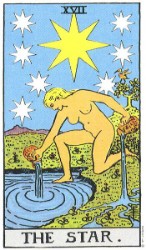
The Star, Fairies, Cat’s Milk, and Roe V. Wade

Our ancient ancestors believed that some stars were alive.  They looked at the night skies and observed that some of the stars, which we now call planets, moved around in the sky.  Since things which are alive move, it was perfectly reasonable – given the extent of their knowledge at the time –  to conclude that these moving stars were actual living beings and give them names like Mars, Jupiter, or Venus.  They couldn’t prove they were alive but this unprovable metaphysical belief was accepted by most of humanity throughout most of our history.  Some people still think that stars and planets are alive and have their own souls, which is a perfectly fine, harmless metaphysical belief.

All metaphysical beliefs are created equal.

If that sounds a little abstruse, allow me to explain.  All metaphysical beliefs – ALL OF THEM – are by their nature unprovable using physical means.  Metaphysical beliefs deal with the invisible world of souls, spirits, gods, demons, elves, fairies.  These are not physical entities and, therefore, cannot be quantified in the physical world.

I may believe very strongly in the existence of the Soul – and I do – but I can’t prove its existence.  I can’t take a picture of it, I can’t weigh it, I can’t pull it out of a paper bag and say, “See?  Here it is.  Told you it existed, didn’t I?”

I also believe in elves, fairies, ghosts and gods and goddesses in the plural.  If you’re a materialistic atheist, you might look at me and say, “You know, you’re a little touched in the head.  You’re saying that you believe in invisible things that no one can actually prove exist.”  

That would be quite a reasonable statement from a materialist atheist, and it would be equally reasonable for me to say, “So what?  What business is it of yours, what I believe in?  If I believe in fairies, it’s not hurting you in the least, is it?  It’s not like my fairies are stealing your cat’s milk or anything.”

Keep in mind, though, that this scenario is valid for ALL metaphysical beliefs, not just fairies and elves and ghosts.  It applies equally to Jesus, Jehovah, Allah, Ganesh, and Tara.  All of these are beliefs in invisible beings whose existence can’t be proved (or disproved) any more than hob-goblins and imps.  

All metaphysical beliefs are created equal.  And equally unprovable.  

As long as they don’t hurt anyone else, there’s really no problem with them.  For millions of people, they’re actually sources of great comfort.  They help us to feel that we’re not alone in a vast, cold universe and that there’s some meaning and purpose to our existence.  They help us to face death and tragedy with faith and courage.  There’s much to be said for them, but they are ALL equally unprovable.

Where we start to run into a little trouble with them is when we decide that OUR unprovable metaphysical beliefs are better than THEIR unprovable metaphysical beliefs.  To a certain extent that’s just human nature and doesn’t cause any great harm.  If I say, “My Goddess is better than your Jesus, neener, neener, neener!” you may find that obnoxious and annoying, but it doesn’t really harm you in any way.

Where we run into REAL trouble is when we decide that OUR unprovable metaphysical beliefs are better than THEIR unprovable metaphysical beliefs, THEREFORE they have an obligation to adopt our unprovable beliefs and abandon their own.

By way of an example, if I believe in fairies, this belief isn’t harming you at all (assuming my fairies aren’t stealing your cat’s milk.)  On the other hand, if I go up on a mountain top to meditate and I come back down with the Ten Fairy Commandments and DEMAND, on penalty of death, that everyone follow the Fairy Commandments, then I’ve made a very serious step into a spiritual dictatorship.  If I decide that the faces of fairies are sacred and that it’s a sin to portray them in paintings and drawings, and that it’s okay for me to kill anyone who does that, I’m a psychopath who should be locked up.

Because, you see, they’re all unprovable metaphysical beliefs.

We laugh at the idea of the fairies issuing Ten Commandments, or them behaving like Allah and saying their faces can’t be depicted.  We might not laugh at the idea of a fairy who was crucified, killed, and then walked out of his tomb, but we’d at least find the story goddamned peculiar.

Now, all of these stories and cultural myths about unprovable beliefs are, as I said, relatively harmless, right up to the point where we insist that other people have to share our belief in them.  In forcing other people to act according to our beliefs, we violate their freedom and their personal choice.

There’s a matter of degree in that, of course, and it’s based on how much the other person’s beliefs are actually harming us and interfering in our lives.  I have atheist friends, for instance, who become quite irate over the fact that United States coins bear the slogan, “In God We Trust.”  For the most part, we shrug that off because it really doesn’t harm us in any way, therefore it’s not important.  On the other hand, if they were to put Jesus or Allah on the quarter dollars, we’d be pissed.  That’s crossing a line where someone is trying to impose their unprovable metaphysical beliefs on our daily lives and that violates our freedom and personal choice.  It’s going from a generic, multi-purpose god-we-trust to a specific, “In THIS god we trust.”

All of which brings us to the overturning of Roe V. Wade.

Now, there’s been a lot of political posturing and folderol wrapped around that decision by the Not Very Supreme Court.  There are people writing about constitutional, “originalism,” and states rights and decentralizing our government to return power to the voters.  All of which is bullshit.

The real issue here is exemplified by the anti-abortion protesters holding up signs that say, “Abortion Is Murder.”  

We all know what murder is:  it’s the killing of another human being.  If you walk up and shoot me in the head, that’s murder.  If I fly into a rage and run over you with an ice cream truck, that’s murder (even if it’s a slightly more interesting form of murder.)  There’s no debate or ambiguity in our minds about exactly what constitutes murder.  No, the question revolves around exactly what constitutes a human being.

On the face of it, the answer to that seems simple. I’m a human, you’re a human, all of those bipedal critters at the mall are humans.  We tend to define humanness in terms of walking around, talking, being conscious, and being able to interact with the world.  There are certain physical, cognitive, and emotional qualities which, when taken together, we call a human being.

There are basic qualities that we all recognize as a being that’s human and we don’t pretend that something which doesn’t have those qualities IS human.  While we may know that every sperm cell is a POTENTIAL human being, we don’t view them as actually BEING humans and prosecute men for mass murder when they masturbate.  We may know that every egg that a woman produces is a POTENTIAL human being, but we don’t hold a funeral when she has her period.

Roe V. Wade was the simple recognition of the fact that when a sperm cell penetrates an egg, it remains a POTENTIAL human being.  At the point of impregnation and well through a large part of the pregnancy, the fetus has NO characteristics that constitute what we think of as a human being.  Pregnancy is a continuum in which the fetus becomes more and more human but is not, in fact, a human being at the inception of the pregnancy.  And if there’s no human, there can’t be any murder.  There can’t be any violation of human rights because there isn’t a human being there until late into the second trimester.  

What’s glitching up our national conversation on this is the unprovable metaphysical belief that there is an entity called, “the soul,” combined with the unprovable metaphysical belief that this invisible entity enters into the egg at the exact second that the sperm cell does and – shazam! – we have a full human being. 

If – and only if – we all mutually accept those unprovable metaphysical beliefs is it legitimate for the courts to abolish abortion.  Since most of us DON’T accept those metaphysical beliefs, what’s happening is that a minority’s religious views are being imposed on the majority without their consent.  Which is a theocracy, not a democracy.

I’m not meaning to denigrate or mock christian beliefs.  If they want to believe that the Soul zips into an egg the second a sperm cell enters it, that doesn’t hurt me a bit.  As long as it doesn’t steal my cat’s milk, their christian soul is welcome to do whatever it fancies. 

What does hurt me, though, is when those unprovable beliefs are imposed on me as a government policy.  Because, let’s face it, the christians do NOT have a good track record in being a part of governments.  These are the same fine folks who brought us the Inquisition.  These are the same folks who raped and pillaged and murdered their way through South America in the name of Jesus.  These are the same folks who enslaved millions of innocent Africans because the Bible said that slavery was alright.  These are the same folks who sat silently in their golden churches while Hitler murdered most of the European Jews.

We have no reason to believe that christian fanatics will respect other people’s beliefs or even their lives.  And we have many reasons to believe that they won’t, so we need to stop this, now, before it gets worse.  And that is NOT an unprovable metaphysical belief.  That’s history.

Spring Equinox, the Four of Wands, and the Spiritual Joy of Chocolate Covered Bunnies

Exploring the lost – and found – joy of spirituality.

I haven’t celebrated easter in a very long time.  I’m not a christian, so I don’t feel any particular connection there.  I was also reared as a catholic, so there may actually still be a little subconscious hostility left over as a result of recovering from that heritage.  

This year, though, I decided that I was really going to celebrate the Spring Equinox.  I won’t belabor the fact that the christian churches never met a pagan holiday that they didn’t steal or co-opt, and that easter is obviously a take-over of the celebration of Spring.  We all know that.  What I hadn’t really consciously flashed on, though, was that I was letting the christian holiday interfere with MY holiday in more ways than one.

It’s been a bitch of a year and a bitch of a winter, not just for me but for the entire world.  There’s been a lot of death, a lot of depression, a lot of darkness and craziness and it’s gone on for a very long time.  So when the first golden daffodil started popping open this year, I could feel in my very bones that I wanted to celebrate.  I wanted to embrace that light with everything I had.

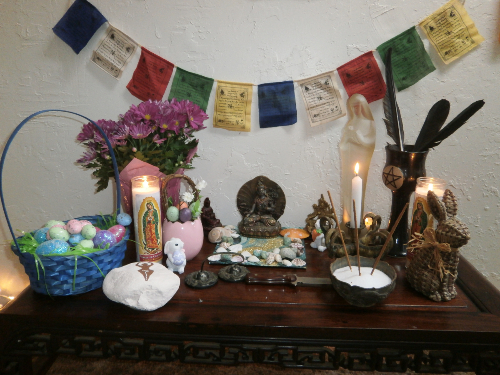
I decided to build a Spring Equinox altar.  That, along with incense and candles, is one of the few positive things about growing up catholic.  I’ll build an altar anywhere, anytime, at the drop of a freaking hat.  And then I’ll stick candles on it and get some incense burning, by Goddess.

I spent hours cruising through our local stores, purchasing the, “ingredients,” for my little shrine to Spring.  As usual, Dollar General was a treasure trove for low priced holiday decorations.  I bought glittery eggs and plaster bunny rabbits for fertility symbols.  Candles and chrysanthemums and sea shells.  Virgin of Guadalupe’ votives to represent the Goddess. And more bunnies. I went home and dug out my crystals and my pentagrams and my chalice and athame’, and began assembling the altar.

About half way through the process I realized that I was having a hell of a good time.  I actually found myself laughing out loud as I arranged the items on an old coffee table and rearranged them and rearranged them again.  I put my statues of Tara and Quan Yin in the center of the table, strung white christmas lights around the shrine, lit incense, and laughed some more.

It was fun!

And it really hit me like a hammer:  organized religions didn’t just steal our holidays, they stole our fun.  They took every single pagan holiday, turned it something dark and solemn and serious, and systematically tried to wring every bit of joy and laughter out of it.

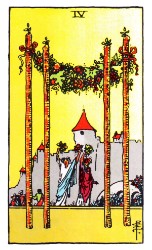
Easter is a prime example of that.  The pagan celebrations of Spring had a HUGE amount of fun attached to them.  Much like the Four of Wands, there was dancing, drinking, revelry and the people who were doing the celebrating didn’t just eat chocolate bunnies, they fucked like bunnies.  A LOT.

And then along came organized religion.  Suddenly the celebration of Spring was all about death.  All about a very kind – and perhaps fictional – man being tortured, crucified and killed.  And, yes, I know that christians like to say that easter is all about re-birth, all about christ rising from the tomb, but it’s really not.  It’s about death.  

It’s like they took my beautiful, golden daffodil and threw a bucket of blood on it.

There’s been that same strange dance between pagan joy and organized religion for centuries and I’d have to say that – all in all – we pagans are winning.  Organized religion took over the mid-winter festival and declared that it was the birthday of Jesus, a very solemn occasion, doncha know?  We countered with christmas trees and presents and twinkling lights.  Organized religion took over our festival celebrating the end of the season of light and declared that it was, “All Souls Day.”  We came right back and said, “Nope, it’s Halloween – break out the masks and candy!”

They said, “Easter,” and we replied, “Chocolate Bunnies!”

The point is that you can’t repress the joy of true spirituality.  William James pointed that out in The Varieties of Religious Experience a long time ago.  The hallmarks of someone who has had a true spiritual experience are joy, compassion and love.  

To put it another way, if we’re not having some FUN with our religions, we’re not connecting with any sort of spirituality AT ALL.  If we’re afraid to laugh in church, we’re in the wrong church.

So this year I’m starting again.  Like my little Spring Equinox altar, I’m assembling the, “ingredients,” of my spirituality.  They will include feathers and crystals and bells and, yes, some chocolate bunnies. And I may rearrange them and then rearrange them again, but I’ll be laughing while I do it.

Wishing you a joy-FULL Spring Equinox and BIG smiles.