Angels, Spirit Guides, and the Tarot

We seldom see the Tarot referred to as, “a Spirit Guide.”  Which is weird.

There are many, many online courses about contacting your angels and spirit guides.  Thousands of videos online telling you how to do it and/or how to maximize your contact with your spiritual helpers.  Dozens and dozens of books on the subject.

So . . . it’s pretty widely accepted that (a) there are benevolent, loving beings out there who want to help us; and (b) we can learn how to be in touch with them.  But, curiously, the Tarot isn’t usually included in those discussions.

A part of that, of course, may stem from the fundamentalist christians horror of all things occult.  We’ve seen the ghost hunter shows on television where a couple of little girls are playing with a Ouija board and two minutes later thousands of creepy demons and ghosts are whizzing out of the kitchen cabinets.  Tarot decks have been painted with the same brush for decades despite the fact that the images in them are chock full of angels. (See my previous post, “The Angels of the Tarot.”)

Another element is that most people who read the Tarot don’t really THINK of it as a means of getting in touch with our angels or spirit guides.  We just think of it as, “Asking the Tarot for advice.” Of course, that begs the question of who or what is giving the advice. Is an inanimate deck of cards somehow capable of cogitating about our problems and giving us the best insight and solutions?  

In one of the better online courses about contacting your spirit guides and angels, Roslyn Light suggests journaling as a means for receiving messages from them.  There are some people among us who are able to be in direct contact with higher beings and see them and hear them. Others may receive guidance through synchronicities and so-called coincidences that occur in their lives.  A book falling out of a shelf and opening to a certain page with a pertinent message, for instance. For others answers and solutions may appear in the writing they do in their journals.

And, for some of us, the very best way to get in touch with our guides may be the Tarot.  Which makes a lot of sense when you actually think about it. It’s said that beings from the higher planes communicate with us in symbols and images rather than verbally.  There is probably no other source on earth that is richer in images and symbols than a deck of Tarot cards. In other words, it speaks their language.

Indeed, it seems entirely possible that this is exactly what the Tarot was designed to do.  It may well be a tool conceived by minds far greater than ours to allow us to have direct communication with the higher spiritual realms and the beings who dwell there.

And all we have to do is ask.

The Fool – Alone but not Lonely

In the first (or the last, depending on your perspective) card of the Major Arcana we see The Fool starting off on his Spiritual Quest, a dog barking at his feet, his eyes turned toward the heavens.

And he’s very much alone.  But maybe not lonely.

What starts us on a Spiritual Quest?  It’s certainly not because things are going swimmingly.  Sometimes it just a chronic, nagging feeling that something in our lives is just not quite right.  Sometimes it’s a sudden flash of insight that’s like the first rolling stone that starts an avalanche.

Frequently it’s some life event that knocks us ass over teakettle and forces us to look at the fact that our assumptions and beliefs have been wrong all along.  That what we took for granted isn’t worth a bag of spit. The death of a loved one. The suicide of a coworker. Surviving a crash or a deadly disease.

Even then, many people will embrace what might be called “a pseudo-quest,” or perhaps, “an aborted quest.”    Shocked and shaken right down to their toes by some near catastrophe they respond by pulling the covers over their heads and crawling into the safe, warm womb of organized religions.  Like the men kneeling in front of the pope in The Hierophant card they look to others for spiritual truth rather than seeking it in their own hearts.

The person on a true Spiritual Quest is there because he or she HAS to be.  The choices of pretense, dull lassitude, and being a comfortable member of the herd no longer exist for them.  They have a burning desire to know – or at least seek – the truth and that desire can’t be ignored.

And, yes,  that can feel lonely at times.

For one thing most people aren’t really very interested in looking at the verities of Spiritual life.  The next time that you’re at a family gathering just casually mention that everyone in the room is going to die sooner or later if you don’t believe me.  You may not be invited back and, if you are, I guarantee no one will want to sit next to you at Thanksgiving Dinner. People actually seek out toys, money, meaningless sex, and anything else they can think of to AVOID talking about death and they don’t appreciate it when someone puts the subject right up in their faces.

A second factor, though, is that your Spiritual truths are YOUR Spiritual truths and not necessarily anyone else’s.  As you tread your way down the path of The Fool you will discover certain things that you know in your heart are true but the people around you, even your loved ones, may think that you’re out of your mind.  Or very much a Fool.

I remember when I first realized that visualization actually causes the things we visualize to manifest in our lives.  And I don’t mean just reading about it or acknowledging it as an abstract idea. I mean actually sitting my butt down, doing the visualizations and having them actually manifest.

I was blown away.  “This,” I thought, “is magic.  Real, honest to goddess, freaking magic!”

And that realization was followed by a whole series of other realizations.  If my thoughts and emotions can cause things to manifest in my life, then my life is . . . a manifestation of my thoughts and emotions.

Which means that I made this mess.  Not my parents, not my environment, not my culture, not random circumstances.  This thing I call my life is . . . ME. My thoughts. My emotions.

Which means that I’m responsible for it.  It’s my karma that I made. BUT . . . it also means I can change it.  And, man, that’s not just magic . . . that’s freedom!

It was a major turning in The Fool’s Path and I was tremendously excited about it.  The people I tried to share it with . . . not so much. My New Agey friends sort of yawned and said things like, “Oh, yeah, I think I read something like that a long time ago in Ram Dass.  Or was it, ‘A Course in Miracles?’ Maybe it was, ‘Codependent No More . . .”

My more conventional friends either edged slowly away or their mouths hung open for a moment before they changed the subject.

I realized eventually that it was MY Spiritual truth.  It was a result of my Tarot readings and my studies and my meditations and it fit perfectly at that exact moment in MY life.  The fact that other people didn’t understand it or know it or really, really dig it in their own hearts didn’t matter. What mattered was that I had found one of my truths.

And there’s a Spiritual truth in that realization, too.  Just because you’re alone in your beliefs doesn’t mean you have to feel lonely.  In all likelihood the people around you don’t share or understand your truths because they haven’t done the work that you have or they just don’t care.  That doesn’t diminish what you know by one little bit. Every truth that you find along the path is a jewel to be treasured and uncovers a little bit more of who you really are.

The Star Tarot Card – Ishtar, The Dalai Lama, and the Re-Emergence of The Goddess

Just who is the mysterious woman in the Tarot card, “The Star?”  She’s one of what I call, “the astronomical cards,” that are grouped together at the end of the Major Arcana:  The Star, The Moon, The Sun, and The World.

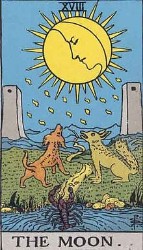
For some reason it seems easier to relate to the other three cards today.  Perhaps it’s because they are so intimately interwoven with our daily existence.  We live on and with Mother Earth/The World. The Sun makes us happy and marks out our seasons.  The Moon controls the tides and is strongly connected with women’s fertility and men’s insanity.  

But what about The Star?  What comes to mind? Anything?  Not much?

The first known examples of the Tarot emerged 1500-ish.  We know that most of the natural philosophers (they didn’t have scientists, yet) were still using the Greco-Roman model of the universe at that time.  The Earth, of course, was the Center of the Universe because we are SO important. Then extending all around the Earth there was a great circle of a sphere which contained space and the moon and the sun.

The latest, most up-to-date thinking at that time was that stars were actually holes in the sphere that surrounded us and that the light they radiated was heaven shining through the holes.  Which is why heaven is, “up there,” even today.

BUT . . . there were also stars that moved around.  We call them planets now days but the thinking back then was that if they moved around, then, by golly, they must be alive because that’s what living things do and that’s what dead things don’t.

Now, it’s interesting because the Greeks (and their intellectual suck ups the Romans) decided that if there were magical, celestial beings whizzing around in space then most of them must have penises.  Yes, I know . . . there’s poor lonely Venus and she’s a female, but every other, “living star,” was a male. Jupiter, Mars, Saturn, Mercury, Pluto . . . not a vagina in the whole lot of them.

The rest of the world took an entirely different approach, however.  In most cultures there was no doubt that if stars were living beings they were definitely females.  And that’s what showed up in the Tarot, which we are told was a product of medieval Europe and which was still going by Greco-Roman thinking.  A woman. Odd, isn’t it?

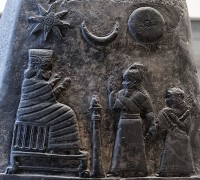
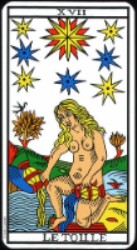
In, “The Alphabet Versus The Goddess,”  Leonard Shlain makes a very strong case that all early civilizations were Goddess-based cultures.  And we can posit that Star Goddesses played a prominent role. The Sumerian/Babylonian Star Goddess Ishtar is portrayed here as her symbol, an eight pointed star:


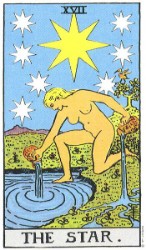
And here we have an early Tarot deck version of The Star, with . . . ahem . . . an eight pointed star hovering over the Star Woman.


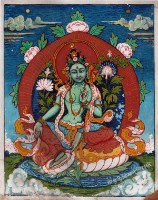
Or take the example of Tara, the Hindu Goddess who crossed over into Tibet.  She is portrayed with seven eyes – two in her hands, two in her feet, and three in her head – because she sees all of our suffering .


When the Buddhists arrived in Tibet they announced that Tara was actually the feminine counterpart of the bodhisattva (“buddha-to-be”) Avalokiteshvara and came into existence from a tear of Avalokiteshvara, which fell to the ground and formed a lake.

Right.  Another example of a man giving birth to a woman.  We know that happens all of the time.

Tara is thought to be the oldest still worshipped Goddess in existence and she was in Tibet a LONG time before Buddhism arrived.  Tara actually means, “Star,” so we can guess that Tibetan society was originally a matriarchal culture centered around the worship of a Star Goddess.

If you want a clincher for that, the term, “Dalai Lama,” literally translates as, “High (or exalted) Mother.”  If the original Dalai Lama didn’t have breasts it would have been a damned peculiar title.

When a Tibetan Buddhist wants to talk about compassion and pure, unadulterated love, they use the the example of the love that flows between a mother and a child.  Several of them that I’ve run across – such as Tulku Thondup who wrote, “Boundless Healing: Meditation Exercises to Enlighten the Mind and Heal the Body,” – expressed frustration in trying to convey that concept to Westerners because we tend to have such screwed up relationships with our parents.  Mother EQUALS love in their culture, if not in ours.

So we can perhaps begin to cobble together a picture of who the Star Woman actually is.  She is a Goddess. A mother. Unconditional love. Compassion. Always there, gently shining down to guide and protect us.  The blessing of feminine energy.

And perhaps, as the Goddess archetype continues to re-emerge in the world, that image and that feeling will once again seem as normal to us as The Sun, The Moon, and The World.

Let’s hope so.

The Death Card – Signs, Symbols and Candles Burning Bright

“Mortality is not kind, and do not let anyone tell you it is; if there is such a thing as wisdom, and I have serious doubts about its presence in my own life, it lies in the acceptance of the human condition and perhaps the knowledge that those who have passed on are still with us, out there in the mist, showing us the way, sometimes uttering a word of caution from the shadows, sometimes visiting us in our sleep, as bright as a candle burning in a basement with no windows.”

James Lee Burke – “Robicheaux”

I love that sentence, not just for the incredible poetry of Southern writing, but especially for the last part:  “as bright as a candle burning in a basement with no windows.”

If someone you loved intensely dies you know that feeling of being in a basement too well.  Suddenly they’re . . . gone. All of their magic, all of their thoughts, their words, their touches and glances, have disappeared forever.

No matter what your spiritual beliefs may be – and I personally believe very strongly in an afterlife – the physical body, the material presence of the person you loved is gone.

There is, I think, a natural reaching out which most of us do after a death.  Trying to somehow contact the other person, to imagine them and how they are. Are they confused and disoriented?  Are they blissful and satisfied? Are they finally out of the pain that they were in and experiencing peace? There’s just that burning need to touch them, to feel their spirit one more time.

Religious people will tell you that they’re in heaven having pancakes with Jesus and, by golly, they have REAL maple syrup in heaven, not Mrs. Butterworth’s.  Spiritual people will tell you that they’re on, “the other side,” and dancing on rainbows or cruising through the astral plane. Psychic mediums may be able to give you very detailed descriptions like, “She’s in the garden and she’s wearing a white lace dress and your dog Skipper who died twenty years ago is there with her.”

And it’s all very comforting and sweet, all of those well intentioned words and Hallmark cards, but what we really want is to be able to see our loved ones for ourselves.  Instead, it’s like we’re, “in a basement with no windows.” We can’t see up and we can’t see out. We can’t see them.

If you actually talk to people who are grieving a death you’ll find an amazing number of them HAVE felt or seen some sort of a contact from their loved ones.  Maybe a pair of earrings suddenly appear on a bedside table, or a long lost note from them falls out of a book, or the lights flicker on and off whenever the dead come to mind.  There are signs and signals from them and, yet, we can’t quite get through to them. No matter much we miss or desire that contact we just can’t touch them.

It feels, of course, like a great big Cosmic Door has been slammed shut.  We’re on one side and they’re on the other. We may hear a faint murmur of their voices but we can’t get past the door.

Oddly, though, Death can be the start of a journey that will take you to much greater heights than you could have ever imagined.  Getting through that goddamned door can become a Quest.

The Sioux tribes believe that people who are grieving over Death are closer to Spirit World than normal humans.  That the veil between the two worlds is thinner for them, that the Spirits hear them more clearly, and that their prayers have greater powers. Certainly deep grief feels that way.  It’s as if you exist in a world apart from ordinary life and you see and feel things that others who are aren’t grieving can’t see and feel.

In other words, people who are close to Death – either their own or a loved one – are existing in a Sacred Space.  There is no other time when we are more likely to ask the right questions and get the right answers than when we are in the presence of Death.

Death leaves clues and symbols for us that point to a higher, Spiritual realm. What we do with them is up to us.  We don’t have to understand them at first, we just need to acknowledge that they’re real.  Yes, those earrings DID appear out of nowhere. Yes, it IS odd that a note from my husband fell out of a book just as I was thinking of him.  Yes, the lights DO flicker on and off for no reason when I talk about my dead child.

And, yes, it’s entirely possible that our departed loved ones are still here, “as bright as a candle burning in a basement with no windows.”

The Hermit: “For What Does It Profit a Man to Gain the Whole World But Lose His Soul?”

I am fortunate enough to live in one of the most beautiful places in the United States, the Trinity Alps of far Northern California.  There are gorgeous rivers and streams and lakes, mountains, two national forests, a plethora of eagles, hawks, ravens, bears, trout, and salmon.  And there are only 13,000 people living in the entire county so you can still actually spend hours walking in the woods or sitting by a river by yourself.

We have thousands of tourists come through every summer and a sizable minority of them are just plain miserable.  It’s either too hot or it’s too cold, there aren’t enough cashiers in the grocery store, the ATM wasn’t working, the water in the river is too cold to swim in, it’s too quiet, it’s boring, the internet isn’t fast enough, etc., etc., etc.

It’s kind of sad.  These people have spent thousands of dollars to go to a beautiful, tranquil place to get away from their problems for a few weeks and it turns out that the main problem they have is . . . them.  They’re just not happy people. And they brought themselves with them.

Like the old cliche’ says, “No matter where you go, there you are.”

The Hermit is about a period of withdrawal from the world.  About getting out of the stream of time and events for a while so that you can either figure out or remember who you really are.  But, as we can surmise from the unhappy tourists in Trinity County, there’s a little more involved with that than just running away from home.

A researcher named Marsha Sinetar wrote a fascinating book on the subject called, “Ordinary People As Monks and Mystics, Lifestyles For Self-Discovery.”  She put ads in several papers across the country seeking out people who had chosen to withdraw from everyday life and based the book on her interviews with them.

Several things become obvious as you read through the book.  The first is that these people experienced a massive reordering of what they considered to be valuable (also known as, “their values.”)  At some point in their lives they simply decided that the new car, the big house, the fancy computers, the pay raise at the job, and yes, even the marriage to the, “perfect spouse,” and 2.5, “perfect children,” were all bullshit.  All of the things that we might ordinarily consider important and satisfying and fun had become unimportant distractions to them.

What BECAME important to them were, oddly, the things that used to be part of the human birthright but which many of us have lost in modern life.  Time alone. Time to think. Time to meditate. Being in nature. Reading. Silence. Contemplation.

And – again, oddly – claiming  these simple things which used to be free to every human being actually, “cost,”  them a fair amount. Most of them had to walk away from the high paying jobs and start doing part time jobs and learn to live on less money and with fewer possessions.  They walked away from the social status and from the concept that they were, “important people,” as defined by others and walked toward the concept of being, “important people,” as defined by their own hearts.  

Some of them became alienated from their families who refused to accept their new lifestyles.  “Why are you living out in the woods with a dog instead of finding a good husband and having kids?  What’s wrong with you?”

These are mainly seen as sacrifices by people on the outside looking in, though.  To the participants in the study they were very small sacrifices to make for having the luxuries of time and solitude.  

“Time, not money, seemed to be the element most coveted for their new life. . . they didn’t have to be financially secure, they just had to FEEL secure . . .”

And that was one of the biggest takeaways for me from this book.  Modern life, as most of us know it, is a thief. It steals our TIME and in doing so it steals our ability to think about who we are and why we’re here.  In exchange it gives us, “things,” – toys, computers, cars, houses, money – and then it hypnotizes us into thinking that those things are actually us, actually the life that it just stole from us.  

The Hermit is about throwing away the trinkets and finding the gold.  Taking back your time and your Self and your Soul.

Getting Real – The Hanged Man

An exploration of the loss of false identity and the need to create an authentic self as exemplified in The Hanged Man tarot card.

I said in my original definition of The Hanged Man that having this archetype blow through your life is a lot like getting hit in the face with a two by four.  It involves an experience that is so painful, so truly devastating that you have to totally reevaluate how you relate to life and the souls around you.  

In other words, you have to have a new framework for your existence.  

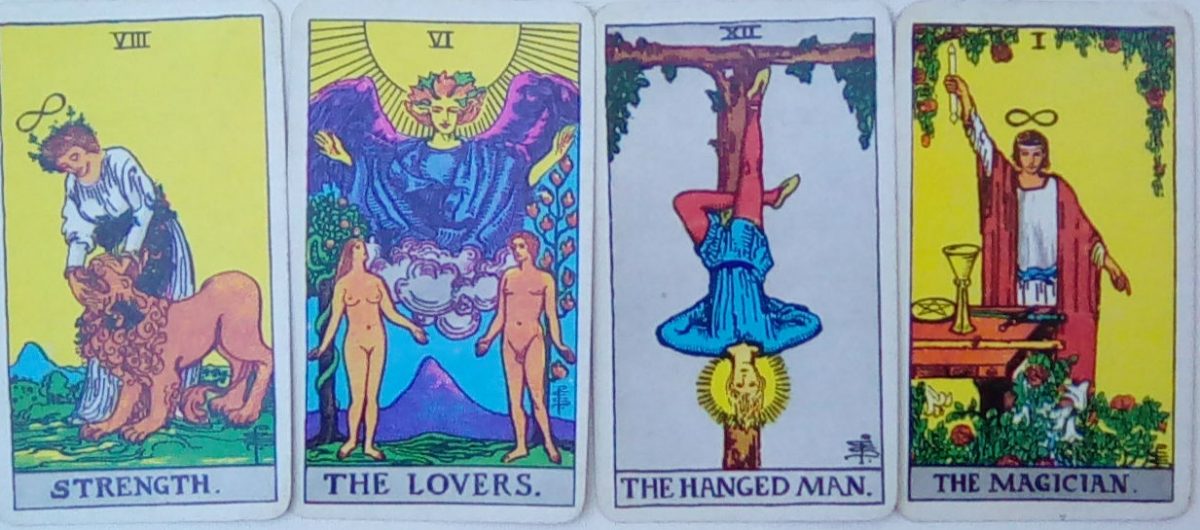
We tend to focus on the central figure of The Hanged Man – the individual hanging from one foot with his hands tied behind him – and not see the background of the picture which includes the frame from which he is hanging.  The frame, though, is every bit as important as the person.

A.E. Waite chose to design the frame in a shape which is very much like a cross and evocative of Jesus, but that’s not how the frame was shown in the older cards.  It normally consisted of two living trees, one on each side, with a beam laid across their tops. It wasn’t a cross and had zippity doo dah to do with Jesus.

We can, perhaps, get a better grasp of what the inventors of the Tarot were getting at if we look at The Hanged Man from the old Marseille deck.


The name is Le Pendu, the hanging one.  It’s related to a slew of our modern words such as pendant, pendulum, dependent, and depend.  The commonality is that they all describe something that hangs from something else.

We all have a central point that our worlds (as we perceive them) hang from.  You might call it your, “identity.” Or perhaps your, “social fabric.” It’s made up of a myriad of factors that, blended together, make up the way that we see the world and our places in it.

“I’m a conservative hispanic catholic from New Mexico.”

OR

“I’m a liberal jew from Marin County.”

OR

“I’m an african american wiccan from Alabama.”

There are literally millions upon millions of variations, with each of us picking out and identifying with the things that make us feel unique and influence the way we perceive the world and our lives.  “This is who I am.”

The Hanged Man has had a forced realization that everything he believed in, everything he thought of as, “myself,” was an illusion.  Maybe it was a divorce that caused him to see that. Maybe it was the death of a child. Maybe it was an illness. Whatever it was he KNOWS that his previous life wasn’t real.

No, you aren’t your sports car because that can be taken away from you.

And you aren’t your house.

Or your brand new computer.

Or your family.

Or your religion.

Or even the color of your skin because, in case you haven’t noticed, you’re not taking that with you when you leave this beautiful world.

The Hanged Man has had that kind of a shocking realization.  That none of it’s really REAL. Everything he dePENDED on can vanish in the blink of an eye.  Everything he hung his identity from was an illusion. He’ll never see the world in the same way again.

And now he has to put himself back together, only this time in a way that IS real and that can’t be taken away from him.  He needs to reclaim his soul.

When you look at the trees in the old Marseille card it’s obvious that the branches have  been cut off. Everything that was once his life has been pruned away. BUT . . . the tips of the branches also look very much like buds in the Spring.  Full of life and ready to grow again.

Here’s how Eckhart Tole put it in The Power of Now: A Guide to Spiritual Enlightenment:

“Ego is no more than identification with form, which primarily means thought forms . . . What a liberation to realize that, ‘the voice in my head,’ is not who I am.  Who am I then? The one who sees that.”

That’s the Hanged Man.

Just the Tarot by Dan Adair – a kindle ebook available on Amazon

Disclaimer: “As an Amazon Associate I earn from qualifying purchases.”

Strength as a Force

Practicing love as a conscious force in the physical world.

The Strength card is almost a parable in a picture.  A beautiful woman crowned with flowers gently closes the mouth of a ferocious lion.  The symbol of eternity floats over her head, reminding us that this is no ordinary strength that she embodies.

We all have different images and ideas that come to mind when we use the word, “strength.”    For many of us the image may be similar to the one depicted in the Swiss Tarot.


Here there is no gentle woman, but a muscled, ferocious man throwing the lion to the ground.  No doubt he ripped it’s head off and wore it for a top hat to remind every one of how butch he was.

That’s definitely NOT the concept of Strength that the Waite Tarot is trying to convey, nor is it in keeping with the images from the oldest Tarot decks.  This type of Strength has nothing to do with brute force and much more to do with love.

And that can be very hard for many of us to wrap our heads around:  love as Strength.

But even stranger is the concept of love as a Force, as it’s portrayed in the Marseille deck La Force.


Therapist and self-help author Gay Hendricks gives this advice in Conscious Living: Finding Joy in the Real World:  “If you really want to change something love and accept it just the way it is.”  And that implies something quite a bit stronger than just the surface of the statement.  It implies that love can physically change things.

If you’re confronted with a bully, love him and he’ll change.

If you’re having hard times financially, love it and it will change.

If you’re having marriage problems, love it and it will change.

This isn’t just a matter of, “mere,” attitude adjustment, either.  It’s not learning how to feel better about something that stinks. It ACTUALLY changes things when you love them.

Which means that love is a force.  Or to put it another way, love is an energy.  It’s something that you can feel and something that can be projected into your world to make things better for you.

You can also approach that concept by examining some other emotional energies like hate or anger or pain.  If you walk into a room where there’s just been a really angry argument you can feel it. The anger is palpable even after the people who argued are gone.  If you meet a really negative person your first reaction is, “Boy, does HE have bad vibes.” If you walk into a slaughter house or a county jail the energy can literally make you sick to your stomach.

On the other hand, if you walk into a meditation center you immediately feel calmed and soothed by the energy that’s being generated there.

I got a wonderful tip from family therapist and counselor Jil Chipman:  “You can be happy any time that you choose to be.”

If we practice mindfulness then emotions can become a choice rather than random forces that batter us around.  We can sit and think about things that make us happy and literally become happy people at that moment. And there’s an energy and vibration that goes with happiness that we emanate when we are in that state.

In the same sense, if we think of things that we love we become loving people at that moment and there is an energy and a vibration that we emanate when we are in that state.

We are literally generating an energy which we call love and it’s literally a physical force that can change things for the better.  And that’s Strength.

Disclaimer: “As an Amazon Associate I earn from qualifying purchases.”

The Chariot Card and Getting Some Direction in Your Life.

Choosing your goals by defining what you aren’t. Using the subtractive method to define your core values.

I have to admit that I read Tarot cards for years before I flashed on the fact that there are no reins attached to the sphinxes in The Chariot.  As I said in my basic definition, this is a very deceptive card on its’ surface.  The charioteer looks like he’s totally in control of the situation but, upon closer examination, there’s no sign of control at all.  The sphinxes are black and white, representing opposing forces, and they’re sitting on their butts, not moving forward. And they’re not harnessed to The Chariot. The charioteer might as well be a lawn ornament for all of the real action that’s involved.

What The Chariot is really all about is figuring out what your goals are going to be.  And, since this is a card of the Major Arcana, it’s not about figuring out what your minor goals are going to be.  It’s not about what you want to do next week or next month or even next year. It’s about figuring out what you want to do with your life.

Put it this way:   goals, desires, life purpose are what puts harnesses on the sphinxes and puts the reins in the charioteers hands.  Your goals are what motivate you, what cause you to go forward and evolve instead of just sitting in place. You have to know where you want to go before you can start your journey.

And, like The Chariot, that can be deceptive on the surface.  Most of us hustle and bustle through life being good at what we do.  We do a good job for our employers, we’re good parents, we’re good sons and daughters and friends.  And, as long as we’re, “doing good,” we figure that’s enough. We fill our busy schedules up with so many details that we don’t even have time to think.  We don’t question why we’re here. We’re here to work hard and buy IPhones, right?

We usually don’t contemplate if that’s really all that there is until, unfortunately, we encounter a tragedy or a catastrophe.  The death of a life partner or our parents or children, a terrible divorce, losing all of our possessions and going bankrupt. And then we get hit smack between the eyes with those very troubling questions.  Why am I here? What am I supposed to be doing? Is this all there is to life? Is there some purpose to all of this that I’m supposed to fulfill?

And then there’s a big surprise.  Those are REALLY HARD QUESTIONS!!!  You can go through a lot of fortune cookies and not find the answers, believe me.  

One way to get started is The Subtractive Method.  If you can’t quite figure out who you are and what you’re supposed to be doing, then figure out what you aren’t and what you’re not supposed to be doing.

There’s a Feng Shui exercise where you walk into a room and you just feel its’ energy.  You try to sense what’s harmonious in the room and what isn’t. If there’s something that feels like it doesn’t fit with the energy of the room and your personal energy field, then you subtract it.  And you keep subtracting until the energy feels right. For example:

“Hmmmm . . . this is my meditation room.  I have my statue of the Buddha and my painting of Red Tara.  There’s my altar bowl with the incense in it. Altar, meditation pillow, check. The quartz crystals on the window sill feel good.  And . . . um . . . that giant stuffed giraffe with purple polka dots that my boyfriend gave me. That’s wrong. That’s definitely wrong.  I’ll subtract that . . .”

And you can do the same thing with your life.  Remove what’s NOT you until what IS you starts to emerge.

Here’s a neat trick that life coach Tambre Leighn suggests in her course on dealing with the grief process:

A – get a pen and paper and write out one word listings of things that are important to you.  These might be things like love, serenity, happiness, music, art, friendship, etc.

B – go back and write a brief sentence for each word describing what they actually mean to you.

C – arrange them in order of importance, most important to least important.

So now you have a list that you can call your, “core values.”  These are the things that are most valuable to you in life, therefore they are clues as to why you’re here and where you should be going.

Keep the list handy.  When you’re faced with decisions like, “Do I really want this job?” or, “Am I really interested in this person?” take a look at your list.  Is the job or the person really compatible with your values? If quiet and serenity is important to you do you want to get involved with a guy who’s a party animal?  If peace of mind is important to you, do you want a high pressure job with a lot of extra demands?

As you continue to eliminate or subtract people and situations that are incompatible with your values the real you will start to emerge.  You will start to instinctively move toward energy that’s compatible with your higher purpose and you’ll be on your way.


The Lovers and The Devil – That Old Black Magic Called Love

Discussing the distinction between romantic love, as represented by The Lovers Tarot card and emotional enslavement, as represented by the The Devil Tarot card.


Falling in love always seems like a magical experience.

You see someone across the room at a party and suddenly a giant, sizzling fireball shoots directly from your second chakra into theirs, or vice verse, and you involuntarily shout, “Zounds!”

Well, you’d shout, “zounds,” if you were at a party in the Middle Ages.  Today it would more probably be, “holy shit!” or, “wow!” or, “OMG . . . WTF?”

The point is that it’s often sudden, totally unexpected, and irresistable.  It’s like an outside force has taken over your conscious brain and turned you into a stuttering, romantic, totally bedazzled, HAPPY fool.

The scholars tell us that the notion of romantic love first appeared in the Middle Ages (zounds!).  Presumably before that, “Romeo, wherefore art thou?” was more a matter of, “Me, Tarzan, you Jane, let’s . . . ahem . . . reproduce.”

That doesn’t seem likely, though.  Solomon had some pretty steamy stuff going on 900 years before Jesus appeared and even talked about how much he enjoyed, “eating my honeycomb,” on his wedding night.  Must have been a very sweet woman.

Despite it being a wonderful, magical experience, there have always been a certain number of men who find it problematic.  One assumes they feel it’s not manly to be turned into a gibbering idiot by another person and that someone must have put a damned spell on them to make them feel all gooey inside.  The word, “glamour,” is directly descended from the word, “glimmer,” which means to cast a spell on someone. We speak of beautiful women as being, “enchanting,” and an enchantment is, of course, a spell.  And look at this version of The Lovers from an old Swiss Tarot deck:


Yep, that’s still Cupid shooting his arrow but there’s also a nasty old hag of a witch cackling away on the side.  She obviously just slipped him some Love Potion #9 and he doesn’t know if it’s day or night.

So we’ve pretty much got the picture on falling in love.  It’s overpowering. It’s magical. It seems to be beyond our rational control.  The Waite Tarot takes that a step further and shows it as a holy, sacred experience, guarded by an angel.  An experience as innocent and fresh as the Garden of Eden.

But wait. ( Or maybe I should say, “But Waite.” ) What’s that snake doing in that apple tree on the left hand side of the card?  Who invited him to the party?

Which brings us to The Devil card.


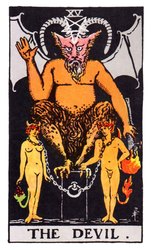
It’s the same naked couple but they’ve got an entirely different angel hovering over them.  And they’ve sprouted horns and tails and the guy’s tail is on fire. Typical male – only thinking of one thing, right?

Now, The Devil card can have a lot of meanings.  Materialism with NO spirituality. Violent sex. Black magic.  Just plain evil. But in this context, let’s look at it as the opposite of romantic love.

Say it’s fifteen years after the couple fell in love.  They’ve got three kids and a mortgage they can’t afford.  The wife just caught the husband playing hide-the-sausage with the baby sitter but doesn’t feel like she can leave him because of the kids.  And she is SO not interested in going to bed with him again. Ever.

They’re still the same couple and they’re still together, but their love has been transformed into a chain that binds them together in emotional slavery.

If you’ve ever been in a loveless marriage, or even knew someone who was, then you know that it shares some of the characteristics of romantic love.  It’s overpowering. It seems to come out of nowhere. It turns normally rational people into gibbering fools. But eventually, it makes you dead inside.

And I would guess that there is a further message in this couple appearing in The Devil card.  Living in a loveless union with another human being isn’t just wrong, it’s evil. It robs both of the partners of the love that they deserve, the love that makes us grow and blossom into full human beings.  It defeats the purpose of our being here on the earth plane, which is surely to learn love and compassion.

Here’s to love!

For more information about the Tarot, check out my ebook Just the Tarot – only 3 bucks on Amazon.com.

The High Priestess and Growing Your Intuition

A discussion of intuition as a function of the right hemisphere of the brain making sudden contact with the left hemisphere and The High Priestess as a representation of that mid-brain connection.

The High Priestess represents our connection with what some people call, “deep mind.”  She is our – frequently unconscious – connection with the higher realms of spirit and magic.  She is the exact point where the truth travels through the creative, feminine right brain and emerges in consciousness in the linear, masculine left brain as a flash of, “intuition.”

It all sounds very complicated but it’s not.  It’s actually hardwired into our system but we’ve taught ourselves to ignore it.  Our language, however, is replete with phrases describing it.

“I had a hunch . . .”

“I just had a feeling . . .”

“Something told me . . .”

“I just knew . . .”

What all of that describes is suddenly reaching a firm, undoubtable conclusion without any preceding rational thought.  And, yes, it seems magical for exactly that reason: it seems to burst out of nowhere.

Another way that it manifests is as a, “sixth sense.”

If you’re hiking in the woods and a predator is watching you, you somehow, “know,” it and the hairs on the back of your neck stand on end.  Combat soldiers describe the same feelings just before the enemy starts shooting at them.

A classic example is thinking of someone you haven’t seen in years and the phone suddenly rings and it’s them.

A silly example is that if a man is walking behind a woman and stares at her butt she will always know that someone is staring at her butt.  I don’t know how women do that, but it’s true.

Now, to a rationalist all of that is impossible.  You can’t, “sense,” that a mountain lion is watching you or that a guy is staring at your butt or that an old friend is about to call.  But we still do. It happens and we all KNOW that it happens.

So, two thoughts on, “intuition,” that we should probably keep in mind.  First of all, we live in a society that denigrates it and treats it as if it’s irrational.  It’s not irrational, it’s NON rational, or perhaps META rational. It has nothing to do with the left brain, logical, linear thinking process that the western world worships.  It, “arrives,” out of thin air, like a telegram from an angel. But it’s also not a metaphysical belief.

It’s important to be clear about metaphysical beliefs.  I’ve known christian fundamentalists who believed that Jesus is right there at their sides 24/7 to solve each and every problem that they’ll ever have.  And that this beautiful world of ours is positively dripping with devils and demons who have nothing better to do than make people have, “impure thoughts,”  about their neighbor’s wives.

I think fundamentalists are total fruit cakes but, hey, they’re welcome to believe whatever they want.

I believe in ghosts and spirit guides and totem animals and the Goddess, and I’m sure the christian fundamentalists think I’m a total fruit cake.

The point with either set of beliefs is that they are metaphysical and totally unprovable one way or the other.  They are NOT demonstrable facts. They are beliefs.

Intuition, on the other hand, operates daily in the physical world.   There are millions of reported incidents of it and anyone who says it’s not real is either in denial or an idiot.

Second, we can all do it.  And we can get better at it.  That’s important.

We tend to think that some people are psychic and some people aren’t.  Some people can read Tarot cards and some people can’t. Some people can achieve enlightenment and some people never will.

It’s not true.  It’s just a function of time and effort.  I guarantee you that if you sit down every day and concentrate on your brow chakra for 15 minutes you WILL start to see some magical, astral scenes.  If you read Tarot cards over a period of time you WILL become more psychic.

It’s exactly the same deal with intuition.  It’s something that you were born with and it’s just a matter of practicing.  Start paying a little more attention to your feelings. Start asking the universe (or your angels or your spirit guides or your totem animals) for answers when you’re puzzled about something.  And the answers will appear. Just like magic.

You are The High Priestess.  You just forgot.