The Death Card, Spaghetti and Ghosts

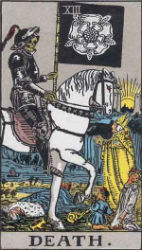
The Death card is one of those scary Tarot cards that no one wants to see in their reading.  As one British writer put it, “This card usually sends the wind up people . . .”  

Death . . . eeeew!  Creepy.

We should talk about that . . .

I’ve attended a weekly bereavement support group since my life partner died.  We get together once a week – on Zoom, since Covid happened – discuss the grief process, check in with each other, and offer emotional support to members who are hurting.  At one of the meetings a new member whose husband had died a few weeks earlier asked, rather hesitantly, “Um . . . have any of you had any experiences with . . . like . . . ghosts?”

Every hand in the room went up.

Every single one of us had experienced strange messages or pictures of our loved ones inexplicably falling off of shelves or lights that flickered on and off when we mentioned the names of the people who had died or books that we hadn’t taken off of the shelf lying on the floor opened to passages that comforted us.  

Every single one of us.

And here’s an odd thing about that:  even though a LOT of people have these experiences, “normal people,” (and by, “normal,” I mean people who aren’t in the grief process) don’t want to hear about them.  Oh,they try to reassure the person who’s grieving that their dead person isn’t, somehow, dead. They’re well armed with the standard, trite phrases.

“I’m sure he’s right there with you.”

“She’s looking down on you from heaven.”

“You have a new guardian angel watching out for you now.”

Still, they really don’t want to hear about how the dead person is RIGHT THERE in your living room turning lights on and off and leaving books out for you to peruse.  Because, you know, that’s kind of spooky.  

And, yes, spooks ARE spooky.  When you’re cooking spaghetti and you get a flash of someone who’s dead sitting at the kitchen table, it does tend to pucker your pasta.  But it happens all the time.  Ask anyone in any grief group.  

So why don’t people want to talk about it?

Well, there’s probably a primal fear of the dead that’s hard wired into our bodies and minds.  The horror story genre is built straight out of that energy and authors like Stephen King know exactly how to evoke it and make the hair on our necks stand up.  

And, of course, there’s all of the religious crap that our culture embraces:  dead people are supposed to be in heaven eating pancakes with Jesus or they’re supposed to be in hell roasting marshmallows with Satan,  but they are NOT supposed to be reclining in their favorite barcalounger playing with the cat.

There’s also a certain amount of it that flows out of good old fashioned denial.  The more we focus on death, the more we have to acknowledge that someday we, too, are going to be dead and, by golly, that’s just plain depressing, doncha think?  We even have a word for people who want to talk about death, “too much,”:  morbid.  According to the Cambridge dictionary, that’s, “too interested in unpleasant subjects, esp. Death.”

(LOL – if you’re going to die – and you are – how can you be, “too,” interested in that?)

And there’s the strong atheist/empiricist current that flows through our culture.  If a phenomenon can’t be plopped onto a scale, weighed, dissected, and held with our hands, it doesn’t really exist, and you can’t weigh a ghost.  By that standard, or course, rainbows and emotions don’t exist, either.

I think, though, that there’s a further element involved here and that’s the day to day implications of ghosts.

A huge amount of human culture is built around this simple question:  what happens to us when we die?  HUGE.  All of our religions are really premised on that one idea: something happens to us after we die.  What is it?  Is it good?  Is it bad?  Is it horrible? How can we massage that outcome from this side?  How many Hail Mary’s do I have to say to end up in heaven instead of hell?  How much incense do I have to burn and how many incantations do I have to chant to have better karma?  

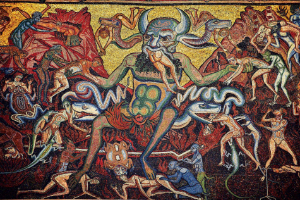
European art and  culture in the Middle Ages were almost entirely devoted to those questions.

Morbid, right?

Ghosts, in a very real sense, are where the rubber meets the road in religions and spirituality.  They are the interface between this world and whatever happens to us when we die.  They are a constantly repeated phenomenon that has occurred throughout all of human history.  The story of Jesus appearing to his disciples after he was crucified is, essentially, a ghost story, right?

If we really accept the fact that ghosts and ghostly phenomena do exist – and millions of perfectly rational people attest to that existence – then it shifts a lot of our thinking and our sense of being in this world.  

If the person we love HASN’T ceased to exist, if they are somehow still here in some other form, then grief doesn’t make a lot of sense, does it?  It’s more like a dear friend deciding that they’re going to move to Europe.  It might make us sad.  We might miss them terribly.  But we don’t have to throw ourselves on the ground, sob, and rip our clothing.  They’re still here, but they’re over-there/here, instead of here/here.

And, what exactly does, “here,” mean?  If someone’s dead, they’re supposed to be WAY, “over there.”  You know . . . in heaven or hell or zooming around the astral plane on a portable golden throne.  But if they’re sitting in your kitchen watching you cook spaghetti or they’re in the barcalounger playing with the cat, then they’re, “here.”  But they’re also, “there,” because . . . um . . . they’re dead.  Maybe the truth is closer to what some Native American tribes believe and the dead aren’t gone at all – they’re still walking around with us in another dimension that we just can’t see.

I don’t know the answers.  But I know it’s a conversation that we ought to be having and we ought to be having it outside of the confines of bereavement support groups and pastors offices.  If Uncle Bob is dead but he’s hanging out in the den watching television, that’s important.  Maybe instead of throwing white sage and holy water at him and telling him to, “go to the light,” we ought to just say, “Hey, Bob – what’s up?”

Maybe he’ll tell us.  

The Ten of Swords, the Death Card, Child Abuse and Forgiveness

It’s hard to put an exact figure on it because child abuse tends to operate in the darkness, but most statistics indicate that about one in five people were abused as children. That abuse can, of course, be a broad spectrum of behaviors from physical abuse to emotional and social abuse to sexual abuse, or a combination of all of those. And therapists will take different approaches in treating those abuses, depending upon the type and severity.

We can simplify that by just lumping it all under one word: trauma. Victims of child abuse suffered severe trauma at a point in their lives when they were totally ill-equipped to process it intellectually or psychologically. Child abuse is normally committed by those who are closest to us – our parents, siblings, uncles, teachers, priests, pastors – and so it involves a deep betrayal of the most basic sense of trust. It leaves its victims with an enduring, often unconscious, feeling that the world is NOT a safe place and that we can never feel secure or at peace, even in our own homes. To use a current phrase, we suffer from Post Traumatic Stress Disorder, just like people who have been in combat for extended periods of time.

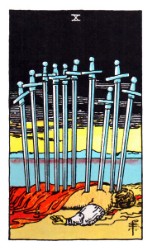
Eventually, that lack of trust in life, that basic inability to ever really relax into safety, will cause us to build impenetrable walls that destroy the quality of life. We are so wounded that we just can’t let other people all the way into our lives because they might hurt us, too. Very much like the figure in the Ten of Swords, the battle is over and we lost. And how could we not? We were just children when the battle took place.

We may seek help through therapy or spiritual resources in an attempt to remove the toxins, to tear down the walls of distrust and fear. If we’re blessed with a really good therapist or a wonderful teacher, we may actually make progress with our issues and begin to engage in life in a more open, loving way. We still feel wounded, though, pierced with countless swords of pain when we recall what happened to us as children.

And then an odd thing happens somewhere along the journey: our abusers die. Abusers, like everyone else, are ultimately mortal and they age and die like everyone else.

When that happens it can be a very odd time in our lives. There may initially be a real feeling of catharsis, a sort of a joyful crying out into the world: “I’m still here and you’re not, you son of a bitch.” Or there may be a total numbness and lack of grief. After all, they taught us the value of learning to feel nothing again and again and again while they beat us. Later, if we go into therapy, there may be a deep regret: “Why didn’t I confront him when he was still alive? Why didn’t I ever ask her why she couldn’t love me?”

At the end of the day, though, they’re dead. As the coroner in Wizard of Oz put it, “She isn’t simply merely dead, she’s really most sincerely dead.”

Or is she?

The terrible truth of the matter is that, for most of us, they go on living in our own heads and hearts long, long after they’re physically dead. There are constant inner dialogues with them, sometimes dozens a day, that we carry on as if they were right there in the room with us, instead of lying in a grave. There are the critical, shaming voices that intrude on our every activity.

“That was stupid.”

“Can’t you do anything right?”

“Well, THAT was typical. You screwed up again.”

Many times these inner critics have become so natural to us, so much a part of our existences, that we don’t even realize that they aren’t us. They’re the disembodied voices of our dead abusers.

So how do we ever get rid of them? How do we ever get to a point where we can say, “You know what? You’re dead. Go away now?” The answer for me came in the form of forgiveness, but not forgiveness in the normal sense of the word. At least not the way I’d ever thought about it.

At first, the idea of forgiving your abusers feels grotesque, even outrageous. “Wait a minute . . . I was a little tiny, helpless kid and this person beat me (fucked me, fondled me, burned me, shamed me – fill in the blank with your particular form of abuse.) Why in hell should I forgive them? Just because they’re dead?”

Well, there are two reasons and, oddly, neither one of them has a thing to do with the abuser.

First of all, yes, they’re dead. Yes, in a physical sense, they really ARE most sincerely dead. Whatever they are now, they aren’t any longer the specific person who abused us.

And that means that, as Louise Hay pointed out, all that they are right now is thought constructs in our heads. That’s it: they are literally just our memories now and they have no existence beyond that. When that really hit me, when I finally GOT that, my first thought was, “Wow! I’m CHOOSING to live with my abusers. All they are is my thoughts and I’m in charge of my thoughts. This is a choice to continue the abuse.”

And once I got that, I realized that if I continued to keep those thought patterns alive, it was a CONSCIOUS choice to live with abuse.

That’s where forgiveness comes in. Louise Haye also pointed out that forgiveness is, ultimately, an act that takes place in our own minds. We don’t tend to think of it that way. We tend to think of it as always involving another person and it usually has a lot of drama attached. It goes something like this:

“I forgive you for the fact that – even though I was deeply in love with you, had your three children, and was a good and faithful wife who adored you with all of her heart – you just couldn’t keep your dick in your pants and you screwed my best friend. That slut.”

In other words, we’re SAYING that we’re forgiving the other person, but we’re really not. What we’re really doing is pointing out what a total piece of shit the other person is and saying that we’ll live with that, as long as they feel good and guilty about what they did wrong. It’s a power thing disguised as a kindness thing.

Real forgiveness, though, is truly letting it go, not choosing to live in it, and that’s why it’s so important in healing the wounds of abuse. It means recognizing that we’re keeping the abusers alive in our own minds, acknowledging what they did to us and honoring ourselves as survivors, and then just . . . letting them go . . . for once and for all . . . back into Universe. “If hating you means I’m keeping you alive, then I can let go of that hatred. I forgive you, I bless you, I release you.” And in doing that, we’re really blessing ourselves. We’re really releasing ourselves from the prisons they built in our minds.

You can invent your own rituals for doing that. I like to use Nick Ortner’s Meridian Tapping with three rounds of what they did to me and three rounds of letting them go. You might prefer to build a Day of the Dead Altar with their picture on it. Talk to the picture, tell them what they did and how it felt, and then throw the picture away.

Light a candle, meditate on the abuser and then release him or her as you blow out the flame.

Do a Buddhist Sur Ceremony and release them with love and compassion.

They don’t exist anymore. We’re free.

The Lovers, The Goddess, and The Monogamy Model

Did you ever have a good friend just disappear on you when they became romantically involved with someone?  You know:  a friend you loved to hang out with, a person who was your go-to buddy for a cup of coffee or a drink, the first person you’d call when something really good (or really bad) happened to you?

And then they fall in love and suddenly you can’t reach them.  You ask if they’d like to have a cup of coffee and they reply, “I don’t know;  I’ll have to see what WE’RE doing.”  On the one hand, you’re happy for them to be in love, but on the other hand, you really kind of feel like you just got dumped.

The bottom line on it is that romantic love, as we currently practice it, tends to be very exclusionary.  We’re a decidedly monogamist society, so 99% of the time falling in love involves two people, period.  And, yes, there is a strong expectation that those two people will devote the majority of their loving and caring to each other and not to people who are outside of the relationship.  It’s very much as if your former best friend is saying, “Well, yeah, I loved you but that was what I was doing until I could find someone to fall IN love with and now I’m busy.  Bye!”

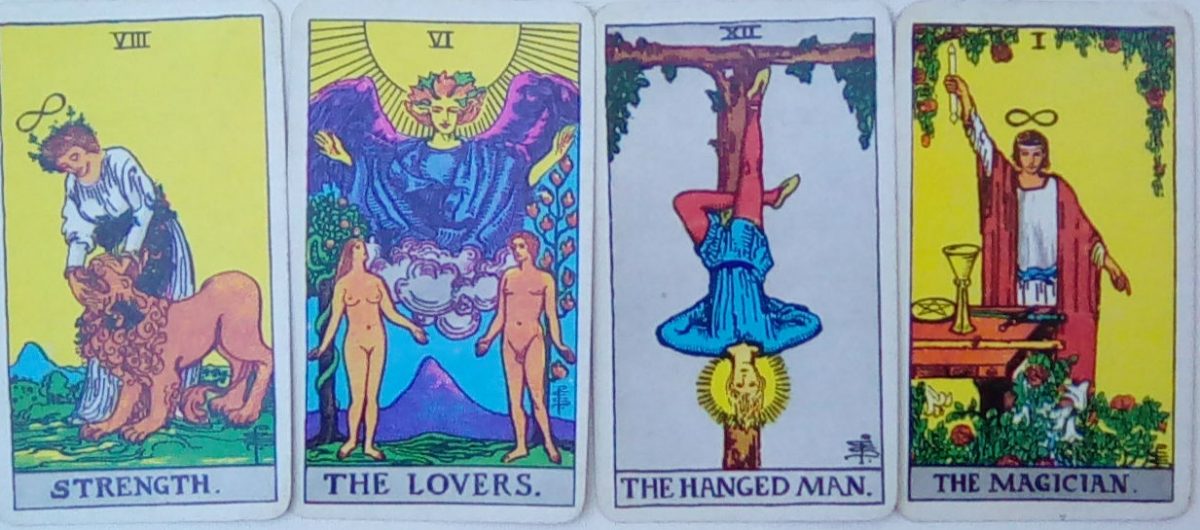
The Lovers tarot card beautifully illustrates the romantic model of love that the Victorians positively adored.  A man and a woman stand beside each other, nude, but not touching, not even making eye contact, while an angel hovers overhead, its wings spread protectively over the couple.  The message is loud and clear:  romantic love is holy and ethereal and, yes, we have bodies, but REAL love is about those heavenly emotions and not about . . . you know . . . S-E-X.

And, yes, it’s about two people and two people only.  You don’t see any best friends hanging out in this card.

Thic Nhat Hanh says that true love, as opposed to our normal idea of romantic love, includes four elements:  (1) loving/kindness which is the ability to offer happiness to the other person; (2) the energy of compassion, which removes suffering from you and the other person; (3) joy in loving; and (4) inclusiveness, which is removing the barriers between you and the other person.  BUT – and this is the kicker with our western concept of love – if it’s really true love then those energies will continue to expand, particularly the energy of inclusiveness. 

 In our romantic love model we draw a circle around ourselves and our partners and say, “Okay, we’re in love – go away.”  In this alternate model, romantic love becomes a spiritual practice that expands to include, rather than exclude, others. In other words, if it’s real love it grows your circle, it doesn’t contract it.

Which leads to a very sensitive and perhaps painful question:  Is monogamy really a healthy model for growing love in our lives?  

Unfortunately, the very question comes packed with a lot of poisonous images.  We think of the middle aged man cheating on his wife with the babysitter.  Or unhappy housewives having miserable affairs with the next door neighbor.  Or swingers, who basically just want to fuck anything that moves, proclaiming that they have, “an open marriage.”

In other words, there’s a large, built in, “Yuck,” factor when we try to visualize a model of love that doesn’t involve exclusive monogamy.  All of those images, though, are operating WITHIN the framework of a monogamist society.  Screwing around on your wife or husband is yucky because it involves lying, cheating, and deeply hurting people who love you, trust you, and expect that you’re going to be, “faithful.”   Sexual swingers probably have inordinately high sex drives and are non-monogamous by nature.  They just get yucky when they try to disguise their true nature within the framework of a traditional marriage.

It may help to think about this issue if we can actually step back a bit and ask ourselves, “Is monogamy natural?  Is this the natural state of human love or is this something that’s been imposed by society over many thousands of years?”

As Leonard Schlain points out in, “The Alphabet Versus the Goddess,”  the evidence is strong that most human societies were originally matriarchal.  And there are actually a few truly matriarchal societies left in the world.  So where do they stand on the issue of monogamy?  

The Mosuo women are China’s last surviving matriarchy.  They don’t marry.  The women choose and change partners as they wish, whenever they wish.

The Minangkabau people practice marriage to a limited extent but the women and children live in their own houses and the men live elsewhere.  

In the Khasi society, a matrilineal and matrilocal culture in the northeastern part of India, monogamy is the norm but women are free to divorce and remarry as frequently as they want to, with no social or economic consequences.

So, if the most ancient form of human society was the matriarchy, and if the current surviving matriarchies are examples of how those societies functioned, then we can conclude that monogamy is NOT a, “natural,” human norm.

Even more fascinating is the fact that these are WOMEN who are rejecting the monogamist model.  Remember, a large element of the argument for monogamy is that women, especially when they’re pregnant, are weak, helpless, and badly in need of male protection.  Apparently these societies think otherwise.

Is monogamy simply an artificial social construct that was foisted on humans by patriarchal societies that viewed women as property, as, “belonging,” to men?  And, as the Goddess archetype reemerges in the world, will we see a breakdown of the monogamistic model?

There may be signs of that, especially among older people.  Sociologists have already noted a new form of family structure they call, “living apart together,”  in which people who describe themselves as being in love still choose to maintain separate households.  Women in these relationships are very much maintaining their own individual identities rather than merging into a shared identity.

It’s fascinating to think of what new forms of romantic relationships may emerge in the coming few years.  Communes?  Group marriages?  Matriarchies?  The Lovers card may need to be a lot larger before it’s all over.

The Chariot Card, Setting Intentions, and Magical Stepping Stones

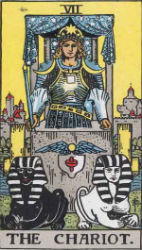
As I’ve said in previous posts, the most astounding thing about the Chariot card is something that we usually don’t even notice. The Charioteer has no reins and the Sphinxes have no harnesses. In fact, the Sphinxes are sitting on their asses, pointed in different directions.


And it IS astounding that we don’t notice that . . . but not really. The Charioteer is, after all, one hell of an impressive looking guy. Tall, handsome, big shoulders, noble face. I hate him. (Whoops, who said that?) Seriously, if you just encountered the Charioteer casually you’d assume that this is someone who has it all together. He has incredible, beautiful armor, moons on his shoulders, a magical crown, a glowing square over his heart chakra, and a hell of a ride.


But, ultimately, he has no direction and, therefore, he has no real power.
And that may be why he’s dressed up in his finest duds: so that we don’t notice that there’s really nothing there.


Eckhart Tolle talks about this a lot. The ego loves things. New I Phones, new cars, designer clothes, new houses. The reason is that the ego identifies itself with things. The more things it’s got and the more expensive they are, the bigger and more powerful the ego feels. That isn’t just a new computer – that new computer is a part of and an extension of ME. And the more things I’ve got, the more ME there is, right?


Of course, it’s all a shell game, a little illusion that we sell to ourselves and others to distract from the fact that most of us tend to be pretty hollow shells. Drop us in the middle of a forest with nothing but the clothes on our backs and what do we have? Drop death or disaster on us, something that truly takes away all of our things, all of our ego extensions, and what do we have?


That’s the question. That’s what the Charioteer has to begin to find out. How to become something more than a flashy appearance. And the beginning of finding out is called, “Intention.”


Buddhists have a lot to say about intention, and particularly Right Intention. The intention to practice harmlessness, to at least do no harm if you can’t actually do some good. The intention to practice loving/kindness, to remember that all sentient beings deserve our compassion and empathy. But those are steps on the path, and first we need to see the path itself. Where does Intention come into our lives?


It can be as simple as a realization like, “Oh, I am SO fucked up.”
Or feeling sad and alone and miserable and being tired of feeling that way.
Or being an alcoholic or an addict and being sick and tired of being sick and tired.


It’s whatever makes you stop and think, “I don’t want to be here anymore.” I don’t want to live like this anymore. And, of course, “I don’t want to be here anymore,” leads to, “So, where DO I want to be?” And that leads to, “I want to be over THERE.” I want to be happy. Or I want to be more spiritual. Or I want to feel more evolved. Or I want to be more helpful and loving to the people around me.


Once we’ve got that, once we understand that we don’t want to live in that painful space anymore and we’ve got a vision of a better space that we’d like to be in, then we have a goal. And once we have a goal, then we’ve got a direction to move in, and then we’ve got steps that we can take.


“I want to be a more spiritual person. What can I do about that? (1) Pick up a copy of that book on angels I’ve been wanting to read. (2) Actually sit my ass down and meditate in the morning. (3) Promise myself that I am NOT going to get pissed off at that ditz who sits next to me at work and I’m going to try to respond with loving kindness, instead. (4) Try to post something on FaceBook that’s a little inspiring instead of bitching about the quarantine . . .”


The second that we actually set an intention, that we actually say, “I want to go from Point A to Point B because Point A pretty much sucks,” then the stepping stones along that path magically appear. Then the Charioteer has some reins and the Sphinxes are harnessed and we’re MOVING somewhere.


Stay home. Stay safe. Be blessed.

The Fool, The Buddha, and the Corona Virus

Some Tarot interpretations say that the bag or satchel that dangles from the end of the pole on The Fool card is his karma. That he is a new born soul dancing into life and the memories of his experiences and actions – both good and bad – are carried with him into his next incarnation in that little bag.

And that’s a good question for all of us as we face this very profound experience of a world wide pandemic: What will we carry with us when it’s finally over?

Shit happens. We all know that. A lot of the time we experience life less as the Captains of our Fates and more as the silver ball in an old fashioned pin ball machine. We aren’t thinking, we aren’t planning, we aren’t really conscious of what’s happening to us or why. We just keep hitting and being hit by those paddles, bouncing around from one place to the next until a bright, neon sign lights up and says, “GAME OVER.”

And then we’re dead.

Did it make any sense? Did our journey through all of the joys and pains, the triumphs and shit sandwiches actually MEAN anything? Or was it just a random series of events that left us bruised and battered and ultimately puzzled over why it all happened?

A large component in that equation is consciousness. Actually being aware of what’s happening to you right now, right this moment and actively SEEKING for meaning.

Let me give you an example from personal experience. My life partner, Carol, died a couple of years ago and eventually I joined a bereavement support group, also known as a Grief Group. Basically, it’s a small group of people who have lost a loved one and we sit down together once a week and talk about that experience. In other words, we’re trying to find some meaning, some understanding of what we’ve gone through and where we go from here.

One of the most positive things I’ve carried out of that group is the realization of how very much alike we all are in the face of something that is as monumentally dreadful as death. It doesn’t matter if you’re an 81 year old great grandmother or a 25 year old newly wed; death is experienced in much the same way. There are periods of shock, then numbing, then panic and horrible anxiety, overwhelming sadness, and the feeling of being totally lost in the world. There can be great nobility and growth in that process if you can somehow stay connected to your feelings and look for answers. What does it mean? Why did they die? Why am I still here? What am I supposed to do with my life now?

And, sadly, there are other people who experience very little growth and get no spiritual or emotional insights from the process. They throw themselves into a flurry of social activities right after the funeral and, when they have to be home, they turn the t.v. up as loud as it can go and stay on the phone as much as they can. They spend as little time as possible in that Sacred Silence that follows death and they think as little as possible about what it means. In a phrase, “they move on,” from the grieving period as fast as they can. If they’ve lost a husband or a wife, they remarry or re-partner within a year, as if their loved one was an interchangeable part rather than a precious human soul who intermingled with their life stream.

In other words, they don’t carry anything out of it.

Perhaps that’s a form of basic, animal wisdom. As the Buddha said, all sentient beings seek to be happy and to avoid suffering, so there’s nothing unusual about not wanting to hurt. But he also said that suffering is inevitable. No matter how much we might wish otherwise, we each have our portion of pain and how we deal with that suffering – IF we deal with that suffering – that moment in time is the anvil on which we forge our karma. It isn’t just what we go through – it’s how we consciously integrate what we go through. Did we learn anything from the experience? Did we grow and evolve as human beings? Did our compassion and ability to love others increase or diminish? Did we make what happened to us MEAN something in our lives?

So . . . here we sit in the midst of a major historical event. And none of want to be in it. I haven’t met one single person who has said, “Damn, this is exciting! I’m so glad I’m here to see this happen!” But, we’re still here, like it or not. A lot of people are going to die before this all over. Many more will lose people they love with all of their hearts and souls. There’s going to be suffering and we know that.

Right now, millions of us are locked away in our houses and apartments, waiting for the storm to blow through, hoping we won’t be one of the people who are swept out into eternity by this goddamned virus. I guarantee you that many of us are spending this time with the television turned up as loud as it will go, constantly on the phone, constantly on the internet, constantly trying to be too busy to think or feel. They can’t wait to, “move on,” and, “get back to normal.”

In other words, they won’t carry anything out of it.

Right now, we are ALL fools dancing on the edge of a cliff. We can take the time to sit down and meditate, to read, to journal, to REALLY talk with people we love, or . . . we can turn up the volume on the t.v. If there’s one thing we should all know right now it’s that life is precious, time is precious. We can fill that little bag The Fool carries with some new found wisdom, compassion, and meaning. We can actually ask what all of this means, why we’re here, and what we’re supposed to do next.

Or not.

Tarot Readings, Archetypes, and God-Fearing Southern Women

I recently heard a very nice woman describe herself as, “a good, God-fearing Christian.”  And it really gave me a bad case of the creepy-crawlies because it’s such a death blow to any true spirituality.

I spent a substantial portion of my life in the Southern United States, so expressions like that aren’t anything particularly new to me.  Many people in the South are not only God-fearing but they also have a lot of things, “put the fear of God,” in them. God, for them, is a pretty scary dude.

I didn’t really think much about those sayings until recently, when my life took a drastic turn toward the worst and I had to reassemble the jigsaw puzzle that my incarnation had become.  When confronted with the death of a loved one and the financial disaster that ensued, I began a spiritual quest of sorts, trying to put some meaning back into a life that had become dangerously Meaning-Less.

The Tarot was a big part of that quest.  In reading after reading it provided a basic framework for understanding where I was in life and where I wanted to go.  It was my touchstone through the darkest times l’ve lived through.

One of the most profound lessons it taught me was, “don’t be afraid.”  The readings were . . . well . . . readings. It was like, “Okay, THIS is happening in your life and THAT’S happening in your life, and in order to move forward you need to do THIS and then THAT.”  Or, to put it in more concrete terms, “Okay, the Death Card is in your life right now and so is The Tower, so you need to channel The Hermit and retreat and heal and then you’ll get the spiritual lessons of The Hanged Man.”

It was a road map, really.  Or, perhaps more accurately, a sort of a spiritual GPS system that kept telling me, “Okay, now turn right and go 12 miles more . . .”  And I learned to see that everything that was happening to me was a necessary step on the road.

I learned to trust.  To trust in the process of life and in the Universe as a loving, benevolent energy that was always there and always supporting me.

That’s a necessary pre-condition for any serious spiritual quest.  You have to believe, deep in your heart and mind, that you are ultimately safe and that you are moving toward something or someone that loves you.  Otherwise, why would you do it? Why would you deliberately seek out something that could harm you?  Something that’s scary?

Let’s look at the way that we, as Westerners, usually view the whole God thing, whether consciously or not.  We see the universe as a sort of a triangle or pyramid. God sits at the very top of the pyramid and everything – all the energy and forms in the universe – flow downward from him/her to us, who live very close to the bottom of the pyramid.

In most mystical traditions and many non-western religions, God is seen as a sort of pure, loving energy that flows down to us, but becomes more diffused and faint as it enters the physical realm where we exist.  The quest for the holy grail, then, becomes a quest to bring ourselves more in alignment with that pure, loving energy and to expand its presence in our lives.  

We may use a variety of means to get there – meditation, psychedelics, yoga, loving/kindness, etc. – but there is a basic belief that the underlying energy in the universe is love.  That it nourishes us and completes us and comforts and guides us through the dark times in our lives. Conscious contact with that energy heals us.

But . . . then we have the Judeo/Christian/Islamic model of the universe.  It’s still a pyramid with God sitting at the top, but God is a sort of a psychotic, abusive, completely unpredictable father.  And not only does love flow down, but a LOT of punishing, sadistic shit also flows down. This God is, a “jealous God,” a, “fearful God,” a God who claims to love you but is perfectly willing to pitch you into eternally burning flames if you even question what he tells you to do.

This is a God who blows up cities because there are gay people living in them.  Who tells Abraham to tie his son down to a stone altar and thrust a dagger into the child’s heart.  Who destroys Job’s family and his bnlife over a casual bet with the Devil.

This is one sick puppy.

There is no, “God Card,” in the Tarot.  We don’t think about it but it really is a curious omission.  The Major Arcana contains nearly all of the archetypes that blow through our lives:  death, love, luck, rebirth, judgement. But no God. And God IS kind of a major archetype, right?

Historians tell us that the first Tarot decks emerged in the 15th century, a time when Europe was absolutely obsessed with and dominated by the Christian God-Model.  The scary, crazy dude who you kind of hoped wouldn’t notice you and do something awful to you. That may be the very simple reason that the creators of the Tarot decided to just leave the God-Model out of the deck:  because a malevolent, harmful God is a complete short circuit to the spiritual quest.

If there’s no belief that you’re moving toward love and healing, why would you go there?  And if your God is a foul tempered narcissist who is off of his medications, why would you think there’s any genuine love flowing out of that?

The model of God emerging out of the Middle Eastern religions – the angry, hateful, capricious, male god of war – has been an absolute spiritual disaster for the Western world.  We have been deeply wounded by it and we need to KNOW that and begin to consciously heal our hearts and minds. And the way to do that is to move toward love.  

Always.

Valentine’s Day, The Lovers Tarot Card, Ram Dass, and Snakes in a Tree.

Uh, oh . . . Valentine’s Day is just around the corner.  The Lovers tarot card could almost be an emblem for it. 

 The Waite tarot deck portrays it as a pretty little scene from the Garden of Eden:  a nude man and woman are posed in the foreground while an angel with flaming wings floats protectively overhead.  Their love is pristine and pure and heavenly. Don’t look at the snake climbing up the tree.

I said, DON’T LOOK.  They’re in love. No snakes, goddamnit.

Well, okay.  Probably we can get a better picture from an earlier Tarot deck.

In the Swiss deck, we see a couple who are actually touching each other.  An old hag of a witch has obviously just whomped them with a love spell and – just in case that’s not enough – an angel is about to shoot a Love Arrow right THROUGH that girls head.  

They’re thunderbolted and flabbergasted, glimmered and glamored.  They’re in Love, L-U-V!

And it’s wonderful and it’s fabulous and it’s the best thing in the world.  But . . . what IS it, exactly? What is it that makes our brains pump out floods of endorphins, walk around with silly grins on our faces, and talk about our partners to a point where our friends want to strangle us?

A reductionist would tell you that it’s just chemicals in the body.  Hormones. Random encounters in the process of looking for a mate that somehow become permanent relationships.  Ultimately it’s all driven by the need to fuck and reproduce and then we . . . sort of . . . get fond of each other after we’ve had our orgasms and THAT, by golly, is love.

Ram Dass spoke of it quite differently.  He said that sometimes another person is the key that unlocks us and we’re the key that unlocks them and we exist in love.  That the other person is the vehicle for us to get to love.  And, when the other person dies or leaves, it feels like all of the juice, all of the magic, all of the love has gone out of our lives.

Think about that:  the vehicle that gets us to love.

One of the more interesting meditation exercises we can do is to just sit with the feeling of love.  Open our heart chakras and let ourselves relax into love. It may be that when we start that kind of meditation we need something to refer to in order to start the flow of love.  Perhaps we think of a person we love deeply or a place that brings us great peace or even a dog or a cat or a horse. The thought of the beloved starts the flow of loving energy. The beloved is the vehicle that takes us to love.

As we continue to practice that meditation, though, the need for an outside reference, for a thought, memory, or person to take us to that place of love lessens.  Our heart chakras become stronger and clearer and more open and we find that we can enter into loving feelings spontaneously.

We can just exist in, just float in, a sea of love.  And it feels SO good. At that point we’ve gone from needing something outside of us to, “cause,” love to just being love.

Here’s another way to look at it:  the Buddhists teach us that clinging and desire bring suffering.  We feel miserable and we tell ourselves, “If I just had that ___________ (fill in the blank with new car, new computer, iphone, house, dress, shoes, degree, etc.) then I’d be really happy.”  

And so we torture ourselves with what we don’t have, that thing that will finally make us happy, and the more we lust after it, the more miserable it’s absence makes us feel.  Maybe we get two jobs so we can afford it. Maybe we eat rice and beans for a year so we can scrimp and save and FINALLY we can buy the thing that will make us happy.

And it does!  For a while. But it’s a total sugar rush and after a very short period of time we don’t feel so happy anymore.

And then we start thinking about the NEXT one thing that will finally make us happy and we feel miserable because we don’t have it.

That’s really the basis of capitalist society and advertising:  convincing us that there is some THING outside of us that’s going to make us happy.  And, by golly, when that happiness wears off, we’ve got some other neat stuff to sell you that will make you REALLY happy.  For a while.

Or . . . we can just short circuit all of that process and say, “I’m happy.”  We really can. Like the love meditation, we can start out just thinking about things or places or people that make us happy.  We don’t have to buy them or worry about losing them because they’re our thoughts.

The trees make me happy, the clouds make me happy, my lover makes me happy, my vibrator makes me happy, a stream, or a river, or a lake, or the ocean . . . those thoughts make me happy.  And, as we continue that process, we can eventually move straight into BEING happy, without having to possess anything external to us to MAKE us happy. 

Walmart hates that, but it’s one of the most important lessons we can learn.  Happiness exists independent of things.

And it’s the same dynamic with love.  When our lover leaves us or dies we feel crushed because it feels like we’ve lost all of the magic of love.  But love exists independent of people. We’ve lost the vehicle that brought us to love, but we haven’t lost the love.  It’s always right there waiting for our hearts to open and return to it’s embrace.

And there’s no snake climbing up a tree.  Just love, L-U-V!

The Judgement Card – Lay It Down and Shut the Door

To my mind, Judgement is a lot creepier looking card than the Death card.  Coffins bobbing around in the sea while gray corpses pop out of them like zombies.  Of course, the Angel with the Trumpet hovers overhead calling them back to life and that’s nice but it’s still a disturbing card on the face of it.

Despite that, it’s still a hopeful card because it’s the card of endings and where there are endings there can be beginnings.  Judgement isn’t just about endings, though; it’s about the end of long cycles that occur in our lives. Often it shows up in our readings as a sign that we can finally lay our burdens down.

We all have seasons and cycles in our lives, though we frequently fail to recognize them as distinct and separate chapters.  Some of the more obvious cycles are birth through adolescence, puberty through adulthood, perhaps going to college or doing a hitch in the military after high school.  Our children growing up and moving out on their own. These are all periods of time that stand apart in our memories and experiences as being unique times in our lives.

And Judgement is about the ends of these cycles.  It’s about the personal judgements that we make about these periods of time, what they meant to us, and how we performed in dealing with them.

To use another common example, think of marriage or partnership as a cycle in our lives.  We meet someone, we fall in love, we decide that he or she is the person with whom we want to spend our lives.  The relationship may last for many years or just a few. Sooner or later, though, whether as a result of, “until death do us part,” or a divorce/separation, that bonding with another, that cycle of our lives, will be over.

And when it’s over, we have to make a judgement about it.  How did I do? Could I have done more? Could I have loved more or shown more feelings or compassion?

A divorce is probably a pretty good example of that process.  Unless you accidentally married a psychopath or an angel, the odds are that BOTH parties contributed to the divorce.  Both parties might have tried to be a little more caring or supportive or understanding or sensual or whatever the missing ingredients were that caused it all to fall apart.

Even if you’re actually an incredibly good, loving person you may have contributed to the divorce just by marrying an asshole to begin with.  The question is, “What did I do in this cycle that was good, bad, or indifferent?”

So Judgement is about the ends of these cycles in our lives and about the judgements we have to make when the cycles end.  And they’re not judgements about the other party or circumstances – they’re judgements about ourselves and our own behaviors.  With those judgements come – hopefully – growth. It can be something as simple as, “I’m a really good, loving person so why do I keep getting involved with assholes?”  Or as complex as, “I was really abused as a child so how do I learn how to really love and trust people?” The judgements are always geared toward being and doing better.

The second element in Judgement, though, is laying that burden down and starting a new phase and that’s where many of us trip ourselves up.  We need to be able to firmly close the door on that chapter of our lives and say, “That’s over. Time to move on.”

Taking the time to make thorough judgements about ourselves and about our behavior is the key to doing that.  We don’t just leave a marriage or experience a death or fight our ways through serious illnesses and then go on with life as as the Walking Wounded.  We take a good long look at ourselves and we thoroughly decide, “I did the best I could.”

Or, “I could have done better.”

Or, “I need to work on being a better person/listener/partner/lover and here’s how I’m going to do that.”

And, once we can honestly say to ourselves that we’ve learned the lessons we were supposed to learn, we forgive (or congratulate) ourselves and MOVE ON.  We don’t whip ourselves over not doing enough or continue to live in the past. We shut the door firmly and step out into our new world.

It’s over.

And it’s beginning.

Just the Tarot, by Dan Adair – a kindle ebook available on Amazon


The Hermit Card and Ho Ho Ho-ing Your Way Through the Holidays

I had one of those shocking moments recently where I suddenly realized that it’s almost Thanksgiving and I’m living alone.  And I had the requisite reaction to that for a few hours.

Oh, my god!

It’s almost Thanksgiving!

And I’m living alone!

Which means . . . I’m going to be alone on Thanksgiving!

Oh, NO . . .

The thought sat there in my gut for a few hours like some super-sized greasy hamburger and fries, making me mildly nauseated and regretful for having it.  And then I started tip toeing around the feelings and thinking, “Hmmm . . . that’s interesting.  Why is being alone on Thanksgiving such a terrible, terrible thing?”

In my original definition of The Hermit, I wrote:

This is a card of solitude and the individual is very much withdrawn from others around him.  This isn’t a bad sort of solitude, however, this is a solitude that involves spiritual growth and contemplation.

The point being that there are times in our lives when it’s totally appropriate and healthy to be alone.  In my case, my partner of 19 years died last year and this is a period of self-imposed solitude, meditation, and thought for me.  The silence really is golden and I wouldn’t have it any other way.

I’d say that there are a bunch of us in the same boat, but we’re not in the same boat.  We’re in our separate little boats drifting along on our own currents, but hopefully you take my meaning.  Perhaps, like me, they’ve had a partner die or maybe they’ve gone through a divorce or they have a job that requires them to work on the holidays.

For many of them, they are alone the majority of the time and THAT’S ALL RIGHT the majority of the time.  

So what is it about the holidays that makes us feel like it’s somehow NOT alright to be alone?

I think one of the keys lies in the word itself:  alone. We assign a lot of negative connotations to that word.  Alone is sad, pitiful, lost, desolate and, of course, lonely. We have to learn how to draw the venom out of the word and out of the concept.

Scott Cunningham wrote a lovely little light-weight book called, “Wicca For the Solitary Practitioner,” and I really dig that concept.  I am not alone; I am a solitary practitioner.  I make my own magic now.

Solitude does not equal loneliness.  Solitude many times equals healing and immense spiritual and emotional growth.  It’s something to be treasured, not dreaded. People who are, “alone,” are many times very, very happy, evolved beings.

Another key, of course, is societal expectations.  Thanksgiving is a time to sit down with members of your family – no matter how much you may loathe some of them – and eat very large quantities of dead birds.  We all know that and we’re programmed with that from the time we’re kids. You never saw a Norman Rockwell painting of Thanksgiving that featured one guy sitting by himself eating lasagna, right?


Just LOOK at those happy campers!  It’s Thanksgiving and they’re not alone.  And, boy, that dead bird looks just perfect!  No lasagna on THAT table.

And that’s the point:  it’s not being alone on the holidays that makes us feel bad, it’s the expectation that somehow we’re not supposed to be alone on the holidays and that if we are alone something is dreadfully wrong.  In other words, if you’re okay with living alone 363 days of the year but it makes you feel terrible on Thanksgiving and Christmas, it ain’t being alone that’s bumming you out – it’s Christmas and Thanksgiving.

So what do we do about that?  One solution that I see with some of my friends is to get very, very hostile toward Christmas and Thanksgiving.  “They’re artificial holidays. They’re so commercialized and materialistic. They’ve lost the original meanings. Etc., etc. etc.”

You know – sort of the modern day, “Bah, humbug,” solution.  If you don’t have at least one friend who’s a Bah Humbugger you must not spend much time on FaceBook.

But . . . somehow . . . that doesn’t feel quite right, either.  With all of their glitz, tinsel, and artificiality, I’ve had some really wonderful holidays with family and friends in the past.  I’m happy for my friends who are still in that groove and I don’t want to rain on anyone’s Macy’s Parade.

It’s just not me anymore. 

It seems to me that there are really only a couple of rational responses to the holidays when you’re a Solitary Practitioner.

  1. You can pretend that they just aren’t happening and that it’s just like any other day of the year.  That requires some Deeply Disciplined Denial, but you can pull it off if you live by yourself and insert ear plugs before you walk into a store.
  2. You can invent new rituals and traditions and OWN those days instead of letting them own you.

I’m not sure, yet, but I think I’m leaning toward the second solution.

Christian fundamentalists get in a royal snit when you say, “Happy Holidays,” instead of, “Merry Christmas.”  They forget – or ignore – that the original pronunciation of the term was, “Happy Holy Days.”

The celebrations of the harvest and abundance – what we call Thanksgiving – and lighting bright lights and candles on the darkest day of the year – what we call Christmas – have been Holy Days from time immemorial.  They’re built into our Souls and have nothing to do with Jesus, Pilgrims, America, or eating large,dead birds.

I can celebrate that as The Hermit as easily as I can in a crowd.  I just need some good lasagna recipes.

The Magician, The Devil, and the Habit of Evil


Have you ever had someone in your life who was truly evil?  I mean, beyond our usual descriptors of, “He’s an angry person.”  Or mean. Or disturbed. Or selfish. 

I mean, really, genuinely evil.  Someone who consciously inflicts as much pain as they can, knowing that it’s wrong.  It can leave you wondering about the world and about everything you believe in.

For most of history, human beings have been using a sort of, “argument from nature,” to excuse their worst behavior.  They point to the world of animals where fangs and claws seem to rule, and pronounce that it’s either kill or be killed, the strong survive and the weak die, and, since we’re animals, too, those rules apply to us, as well.  We HAVE to be cruel because it’s our nature.

Even leaving aside their totally disregarding all of the love and nurturing that we ALSO see in the animal world, it’s a bogus point of view.  They are deliberately ignoring the fact that good and evil are choices and that where no choice exists no concept of evil can exist.

We might feel pretty squeamish watching a cat torture a mouse but we don’t think that the cat is evil because of it.  We recognize that it’s the cat’s nature and instinct to hunt and kill and that the cat hasn’t made a conscious choice in the matter.  There’s no evil because there’s no choice between good and evil and where there’s no choice there can be no morality.

In The Fool card, we see pure energy entering into the world.  In The Magician card we see a human being directing that energy and choosing how it will be used.  He or she can use it for benefit or harm, for good or for evil, and that’s the point where morality is born.

To a certain extent, those of us who have embraced the New Age movement are guilty of being a little goody two-shoes about the existence of evil.  We try to live in the affirmation of love and caring and we try to NOT let negativity, malice, anger, and hatred into our lives or our consciousness.  But, as Louise Hay said, “If you are going to clean the house, you have to see the dirt.” Pretending the evil isn’t there doesn’t make it go away.

The good news is that there’s probably a LOT less evil in the world than some religions would have us believe.  If we recognize that true evil involves a conscious choice to hurt and cause suffering we can eliminate all of the animal world because they operate on instinct, not choice.  

Psychotics – even serial killers – can’t really be called evil in the pure sense because they can’t make rational choices.

Serious alcoholics and drug addicts can’t really be called evil – no matter how much damage they do – because they’re driven by their compulsions and disease.

Sociopaths and narcissists get us into an interesting – and scary – gray area.  Sociopaths actually recognize that other people make moral choices between good and evil but they have no internal moral compass themselves.  They recognize the concepts but they just don’t care about them.

Malignant narcissists also recognize that other people make moral choices but they think we’re stupid to do so.  They delight in manipulating people who have a sense of right and wrong and use those deceptions to enhance their own sense of being superior to everyone else.  “See how I charmed you and lied to you and you were too stupid to know the difference?”

And that’s a strange thing to wrap your head around.  If someone knows the difference between good and evil behavior on an intellectual level, but has no heart, no compassion, no empathy with others, are they actually capable of understanding the hurt and pain they’re inflicting?  And if they don’t really understand it, are they evil or just very flawed humans?

I dunno.

Sadly, it seems that a lot of the evil in the world and in ourselves is a matter of plain old habit and rationalization.

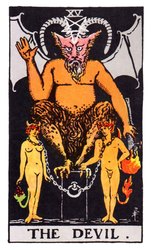
The Devil card is very dramatic.  We see two humans in chains with a literal Bat Out of Hell glowering above them.  The riff on this from fundamentalists christians would be that there is evil everywhere and if you’re not careful The Devil can reach out and SNATCH you up, just like that!

But – again – evil is not something that is external to us;  it’s an internal choice. In fact, it’s a series of choices. Despite the theme in horror films, no one is born evil.  We just get comfortable with it. We CHOOSE to act wrongly, to react with anger instead of compassion, to indulge our rage instead of finding our love, until choosing to be a curse in the world rather than a blessing is a habit.

So the people in The Devil card aren’t just wearing their chains.  They made them, one link at a time.

“Little by little a person becomes evil, as a water pot is filled by drops of water… Little by little a person becomes good, as a water pot is filled by drops of water.” – Buddha

Even Hitler was once someone’s beautiful baby boy.  Choose carefully.