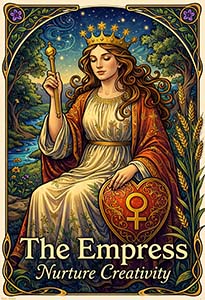
In my Empress affirmation poster, I paired her image with the words:
Nurture Creativity
This may be one of the most misunderstood instructions in the entire Tarot.
Because most of us have been trained to believe that creativity comes from effort. From discipline. From pushing harder. From sitting at the desk and refusing to get up until something happens.
That approach belongs to The Emperor.
The Empress operates differently.
She does not force growth.
She allows it.
She creates the conditions in which growth becomes inevitable.
Creativity Cannot Be Forced
Every creative person eventually encounters this paradox.
The harder you try to force creativity, the more it retreats.
You sit at your desk, determined to produce something brilliant. Hours pass. Nothing happens. Your mind feels like dry soil.
And then, days later—while taking a walk, washing dishes, or doing something completely unrelated—an idea appears effortlessly.
It arrives whole.
Not constructed, but received.
Albert Einstein understood this phenomenon. When asked how he discovered the theory of relativity, he didn’t describe grinding intellectual labor. He said simply:
“It just dropped in while I was playing the piano.”
He wasn’t forcing the insight.
He was allowing it.
This is Empress energy.
The Forgotten Value of Leisure
The philosopher Josef Pieper wrote a remarkable book titled Leisure as the Basis of Culture. In it, he argues that leisure is not the absence of productivity, but its foundation.
Leisure, in its true sense, is not laziness in the modern, pejorative sense. It is a state of receptive openness.
It is the willingness to stop forcing.
Pieper observed that culture itself—art, philosophy, music, science—arises not from frantic effort, but from spaces of inward stillness.
When we allow ourselves to be idle, something deeper begins to move.
The soil replenishes itself.
Modern society often treats leisure as wasteful. We are taught that our worth is tied to constant activity. But creativity obeys older, quieter laws.
Seeds do not grow faster because you stare at them.
They grow because the conditions are right.

Julia Cameron and the Act of Creative Nurturing
Julia Cameron’s The Artist’s Way remains one of the most practical and psychologically accurate guides to creativity ever written.
Her central insight is simple: creativity must be nurtured.
Not commanded.
She encourages practices like morning pages and artist dates—not to produce finished work, but to create space for the creative self to emerge naturally.
These practices are Empress practices.
They say to the creative mind:
You are safe here.
You are allowed to emerge in your own time.
And when that safety is present, creativity begins to flow again.
The Courage to Be “Lazy”
This is perhaps the most radical lesson of The Empress.
You must allow yourself to be, at times, unproductive.
Not because you are weak.
But because you are cultivating fertility.
What appears to be inactivity is often incubation.
Beneath the surface, ideas are forming. Connections are being made. Your subconscious is doing its work.
If you constantly demand output, you exhaust the system that produces it.
The Empress reminds us that rest is not the opposite of creation.
It is part of creation.
Nurture Creativity
The Empress does not shout. She does not command. She invites.
She reminds us that creativity is not a machine, but a living process.
It responds to kindness.
It responds to patience.
It responds to nourishment.
When you stop trying to force creativity and begin nurturing it instead, something remarkable happens.
Ideas begin to arrive again.
Quietly.
Effortlessly.
Like seeds finding their way toward the light.
So when The Empress appears in your readings—or quietly makes herself known in your life—it is not a signal to push harder. It is an invitation to soften. She asks you to step out of the mentality of force and into the rhythm of cultivation. To rest without guilt. To follow your curiosity. To trust that creativity, like all living things, emerges when it is nourished rather than commanded.
She reminds you that you are not a machine designed for constant output, but a garden capable of extraordinary growth. Your task is not to force the flowers to bloom, but to tend the soil and allow them to emerge in their own time.

 Just the Tarot