The Chariot Card and Getting Some Direction in Your Life.

Choosing your goals by defining what you aren’t. Using the subtractive method to define your core values.

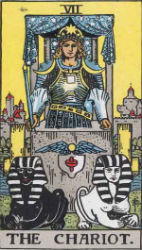
I have to admit that I read Tarot cards for years before I flashed on the fact that there are no reins attached to the sphinxes in The Chariot.  As I said in my basic definition, this is a very deceptive card on its’ surface.  The charioteer looks like he’s totally in control of the situation but, upon closer examination, there’s no sign of control at all.  The sphinxes are black and white, representing opposing forces, and they’re sitting on their butts, not moving forward. And they’re not harnessed to The Chariot. The charioteer might as well be a lawn ornament for all of the real action that’s involved.

What The Chariot is really all about is figuring out what your goals are going to be.  And, since this is a card of the Major Arcana, it’s not about figuring out what your minor goals are going to be.  It’s not about what you want to do next week or next month or even next year. It’s about figuring out what you want to do with your life.

Put it this way:   goals, desires, life purpose are what puts harnesses on the sphinxes and puts the reins in the charioteers hands.  Your goals are what motivate you, what cause you to go forward and evolve instead of just sitting in place. You have to know where you want to go before you can start your journey.

And, like The Chariot, that can be deceptive on the surface.  Most of us hustle and bustle through life being good at what we do.  We do a good job for our employers, we’re good parents, we’re good sons and daughters and friends.  And, as long as we’re, “doing good,” we figure that’s enough. We fill our busy schedules up with so many details that we don’t even have time to think.  We don’t question why we’re here. We’re here to work hard and buy IPhones, right?

We usually don’t contemplate if that’s really all that there is until, unfortunately, we encounter a tragedy or a catastrophe.  The death of a life partner or our parents or children, a terrible divorce, losing all of our possessions and going bankrupt. And then we get hit smack between the eyes with those very troubling questions.  Why am I here? What am I supposed to be doing? Is this all there is to life? Is there some purpose to all of this that I’m supposed to fulfill?

And then there’s a big surprise.  Those are REALLY HARD QUESTIONS!!!  You can go through a lot of fortune cookies and not find the answers, believe me.  

One way to get started is The Subtractive Method.  If you can’t quite figure out who you are and what you’re supposed to be doing, then figure out what you aren’t and what you’re not supposed to be doing.

There’s a Feng Shui exercise where you walk into a room and you just feel its’ energy.  You try to sense what’s harmonious in the room and what isn’t. If there’s something that feels like it doesn’t fit with the energy of the room and your personal energy field, then you subtract it.  And you keep subtracting until the energy feels right. For example:

“Hmmmm . . . this is my meditation room.  I have my statue of the Buddha and my painting of Red Tara.  There’s my altar bowl with the incense in it. Altar, meditation pillow, check. The quartz crystals on the window sill feel good.  And . . . um . . . that giant stuffed giraffe with purple polka dots that my boyfriend gave me. That’s wrong. That’s definitely wrong.  I’ll subtract that . . .”

And you can do the same thing with your life.  Remove what’s NOT you until what IS you starts to emerge.

Here’s a neat trick that life coach Tambre Leighn suggests in her course on dealing with the grief process:

A – get a pen and paper and write out one word listings of things that are important to you.  These might be things like love, serenity, happiness, music, art, friendship, etc.

B – go back and write a brief sentence for each word describing what they actually mean to you.

C – arrange them in order of importance, most important to least important.

So now you have a list that you can call your, “core values.”  These are the things that are most valuable to you in life, therefore they are clues as to why you’re here and where you should be going.

Keep the list handy.  When you’re faced with decisions like, “Do I really want this job?” or, “Am I really interested in this person?” take a look at your list.  Is the job or the person really compatible with your values? If quiet and serenity is important to you do you want to get involved with a guy who’s a party animal?  If peace of mind is important to you, do you want a high pressure job with a lot of extra demands?

As you continue to eliminate or subtract people and situations that are incompatible with your values the real you will start to emerge.  You will start to instinctively move toward energy that’s compatible with your higher purpose and you’ll be on your way.


The Lovers and The Devil – That Old Black Magic Called Love

Discussing the distinction between romantic love, as represented by The Lovers Tarot card and emotional enslavement, as represented by the The Devil Tarot card.


Falling in love always seems like a magical experience.

You see someone across the room at a party and suddenly a giant, sizzling fireball shoots directly from your second chakra into theirs, or vice verse, and you involuntarily shout, “Zounds!”

Well, you’d shout, “zounds,” if you were at a party in the Middle Ages.  Today it would more probably be, “holy shit!” or, “wow!” or, “OMG . . . WTF?”

The point is that it’s often sudden, totally unexpected, and irresistable.  It’s like an outside force has taken over your conscious brain and turned you into a stuttering, romantic, totally bedazzled, HAPPY fool.

The scholars tell us that the notion of romantic love first appeared in the Middle Ages (zounds!).  Presumably before that, “Romeo, wherefore art thou?” was more a matter of, “Me, Tarzan, you Jane, let’s . . . ahem . . . reproduce.”

That doesn’t seem likely, though.  Solomon had some pretty steamy stuff going on 900 years before Jesus appeared and even talked about how much he enjoyed, “eating my honeycomb,” on his wedding night.  Must have been a very sweet woman.

Despite it being a wonderful, magical experience, there have always been a certain number of men who find it problematic.  One assumes they feel it’s not manly to be turned into a gibbering idiot by another person and that someone must have put a damned spell on them to make them feel all gooey inside.  The word, “glamour,” is directly descended from the word, “glimmer,” which means to cast a spell on someone. We speak of beautiful women as being, “enchanting,” and an enchantment is, of course, a spell.  And look at this version of The Lovers from an old Swiss Tarot deck:


Yep, that’s still Cupid shooting his arrow but there’s also a nasty old hag of a witch cackling away on the side.  She obviously just slipped him some Love Potion #9 and he doesn’t know if it’s day or night.

So we’ve pretty much got the picture on falling in love.  It’s overpowering. It’s magical. It seems to be beyond our rational control.  The Waite Tarot takes that a step further and shows it as a holy, sacred experience, guarded by an angel.  An experience as innocent and fresh as the Garden of Eden.

But wait. ( Or maybe I should say, “But Waite.” ) What’s that snake doing in that apple tree on the left hand side of the card?  Who invited him to the party?

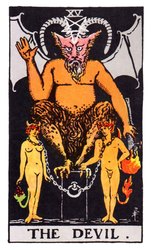
Which brings us to The Devil card.


It’s the same naked couple but they’ve got an entirely different angel hovering over them.  And they’ve sprouted horns and tails and the guy’s tail is on fire. Typical male – only thinking of one thing, right?

Now, The Devil card can have a lot of meanings.  Materialism with NO spirituality. Violent sex. Black magic.  Just plain evil. But in this context, let’s look at it as the opposite of romantic love.

Say it’s fifteen years after the couple fell in love.  They’ve got three kids and a mortgage they can’t afford.  The wife just caught the husband playing hide-the-sausage with the baby sitter but doesn’t feel like she can leave him because of the kids.  And she is SO not interested in going to bed with him again. Ever.

They’re still the same couple and they’re still together, but their love has been transformed into a chain that binds them together in emotional slavery.

If you’ve ever been in a loveless marriage, or even knew someone who was, then you know that it shares some of the characteristics of romantic love.  It’s overpowering. It seems to come out of nowhere. It turns normally rational people into gibbering fools. But eventually, it makes you dead inside.

And I would guess that there is a further message in this couple appearing in The Devil card.  Living in a loveless union with another human being isn’t just wrong, it’s evil. It robs both of the partners of the love that they deserve, the love that makes us grow and blossom into full human beings.  It defeats the purpose of our being here on the earth plane, which is surely to learn love and compassion.

Here’s to love!

For more information about the Tarot, check out my ebook Just the Tarot – only 3 bucks on Amazon.com.

Donald Trump, The Empress, and The Emperor

A juxtaposition of male and female energy patterns as exemplified in the Emperor and Empress Tarot cards.

I have to admit that I’m always a little puzzled when I run across one of those news columns discussing, “Donald Trump’s Toxic Brand of Masculinity.”  To me, a guy who gets daily manicures, has his dyed hair styled every morning, and bakes under a sun lamp until he turns orange isn’t masculine ANYTHING, toxic or otherwise.

But maybe I’m just being defensive on behalf of all of the sane men in the world.

Today IS the International Day of the Woman, though, so perhaps it’s a good time to talk about all of this.

The Emperor and The Empress, sharing the same exalted positions and residing side by side in the Tarot deck, are often – in fact usually – held up as examples of male and female energy in the world.  But let’s a take a step back from that. Let’s just consider them as examples of energy in the world. Different ways of being.

Ram Dass has a rap in Grist for the Mill: Awakening to Oneness that says you can consider people on a number of different levels.  You can look at their skins and see black and white and brown. Or you can look at their signs of the zodiac and see Aries and Scorpios and Capricorns.  Or you can approach it like a psychologist and see obsessive compulsives and narcissists and dependent personalities.

Or you can take it right down to the bedrock and see Souls.  Fellow travelers on this very strange journey through this beautiful world who just happen to be incarnate as a Taurus or a Leo in black or brown or pink skin and seem to have developed a little problem with OCD.

Or to put that another way, we are all multiple patterns of energy existing in the Earth Plane.

And two of those patterns of energy are male and female.

There are, obviously, very valid and real differences between the two patterns.  The human body responds quite differently to testosterone and estrogen. Males tend to have more muscle mass and extra cones in their eyes.  Women tend to have more fat cells and to visualize more in patterns than lines.

We can take those differences and we can celebrate them as we do when we recognize both the God and the Goddess.  The problems start to arise when we view those differences as being absolute and we turn them into stereotypes. “Real,” men are always muscular and silently strong.  “Real,” women are always soft and fluttery and vulnerable.

I’ve known women who were so physically powerful that they could have bounced me down the driveway like a basketball.  And I’ve known men who were nervous nellies residing in very frail bodies. You can take any stereotype of masculinity or femininity and find examples of it in both men and women.

Likewise, we know that we all have both testosterone and estrogen in our bodies.  We all have both, “male,” and, “female,” hemispheres in our brains. Some men retain massive amounts of fluids when the moon is full.  Some women are natural born weight lifters.

So masculinity and femininity are much more of a continuum than a dichotomy.  It’s a lot more gray than it is black and white.

From that perspective it’s much easier to drop the idea of looking at The Emperor and The Empress as masculine and feminine energy and just look at them as ways that energy can exist on the Earth Plane.


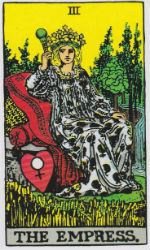
The Empress is relaxed.  Comfortable. At ease in her world.  She reclines on a velvet throne, legs slightly spread, wearing an unfettered, flowing robe and she is crowned with stars.  She holds a sceptre – her symbol of power – but she holds it loosely, almost as if she’s forgotten she has it. A lovely waterfall flows out of a verdant forest behind her and wheat – the symbol of nourishment – grows in front of her.  And . . . is that a box of chocolate leaning up against her throne?

The Empress is very, very powerful.  She is the power of life and fertility but it’s a gentle, unassuming power.  Most of all, she BELONGS in her world and she blesses it and it blesses her.

And now look at The Emperor.


Kind of a nasty faced old man who looks like he’s suffering from a severe case of hemorrhoids.  He sits on a hard, stone throne (ouch) and tightly grasps a vaguely Egyptian looking sceptre. His garments are tight, as well, and reveal that he is fully armored beneath them.  Mountains rise behind him, barren of any vegetation, and far, far below him a river flows at the base of the cliffs.

The Emperor is also very powerful, but he’s very different from the energy of The Empress.  It’s tempting to view him as the alpha-dog but he’s so obviously, painfully alone that you know he doesn’t even have a pack to run with.  The Empress exists IN her world, as a part of her world. The Emperor has, “conquered,” his world, destroying anyone and anything that got in his way.  He’s at the top of the heap but his heap is a pile of ashes.

Sadly, there are still many people in the world (and, yes, they’re mostly men) who choose to adopt the energy patterns of The Emperor rather than The Empress.  And we all pay a price for their choice.

/Disclaimer: “As an Amazon Associate I earn from qualifying purchases.”

Is There a Secret Path in the Tarot?


The answer to that is probably both, “yes,” and, “no.”

It would seem to me that it’s, “no,” if you’re looking for some clearly delineated path that involves going to point A, learning it’s lessons, then being prepared to move to point B because of what you learned at point A, then moving on to point C because of what you learned at point B, and so on.

In other words, starting at The Fool and learning it’s esoteric lessons which then enables you to understand the esoteric lessons involved in The Magician, which in turn gives you the knowledge to understand The High Priestess, etc.

Occultists have been chasing their own tails trying to find some sort of linear path in the Major Arcana at least since Victorian times.  Many of them linked the cards with systems of numerology or astrology. A.E. Waite was so determined to make them fit into his numerological scheme that  he actually switched the placement of the Strength and Justice cards so that they’d be in accordance with his theory.

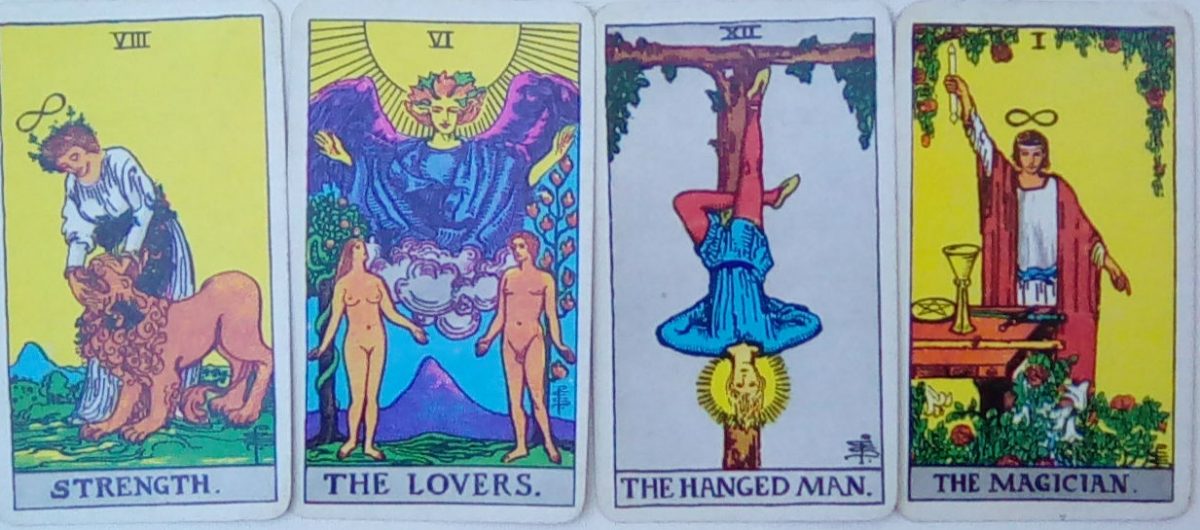
And it IS kind of tempting to try to see some sort of a pattern.  At the beginning or the Major Arcana it actually looks like some of the cards fit together.  The Magician and The High Priestess certainly might be male and female energy in magic. The Empress and the Emperor seem to go together, at least in name.  But then that goes to shit because The Hierophant certainly doesn’t fit with The Lovers or The Chariot with Strength.

The astronomical cards are sort of grouped together, with The Star, The Moon, and The Sun in sequence.  But then the Judgement card gets thrown in between them and The World, which messes that up.

And that’s the deal with the Major Arcana:  if you squint your eyes and turn your head sideways you can see all sorts of patterns in them.  I’ve seen books where they were divided into thirds with each third being a separate path. Or where one card was linked to the card that fell four places behind it.  All SORTS of wonderful, creative schemes that pretty much seem to lead nowhere.

So I don’t think we can say that there is a path in the Tarot, at least not in the sense that the classical occultists like Waite and Levi and Crowley would have loved.  But if there isn’t A PATH there are some definite trails which we could call Doctrines.

The Fool, for instance, contains the truth of being intoxicated with the spirit world.  The Magician embodies the occult maxim of, “as above, so below,” and reminds us that we create on the astral plane what comes to be in the material plane.  The Wheel of Fortune is a perfect diagram of karma operating in our lives. The World reminds of the truth of rebirth and reincarnation.

There are a lot of truths contained in the cards and, taken together, they point us to a different way of experiencing the world and a different way of living.  To make a path out of them, though, we have to connect the dots ourselves. Ultimately, the path is in us, not in the cards.

Three of Swords

The meaning of the Three of Swords in a Tarot reading, with definitions for both the upright and reversed positions.

There is a heart pierced by three swords and rain is falling from dark gray clouds in the background.  

Upright: On the most obvious level this may indicate a relationship which has failed because one of the parties is screwing around.  Someone’s heart is broken and there is deep grief, tears, confusion and a sense of profound betrayal. Trauma of any sort.

“Just the Tarot,” by Dan Adair – a kindle ebook available on Amazon

Reversed: The swords are falling out and the heart is beginning to heal.  This usually shows that period after a bad break up when a person is beginning to put the pieces of her life back together and starting to move on.  It is a card of recovery and coping with reality.

EXAMPLES:  That period after a break up, divorce, or even the death of a life mate, when your heart is so broken with grief that you can’t think straight, can’t sleep, and can’t eat.  Deep, profound grief.

Discovering that your lover has been going to bed with your best friend and lying to both of you.

Two of Swords

The meaning of the Two of Swords in a Tarot reading, including definitions for both the upright and reversed positions.

This card shows a robed and blind-folded figure, arms crossed, holding two swords in perfect balance.  A sea or lake in the background appears to be totally still, perhaps stagnant.

Upright: The main thing to note with this card is the stasis, the lack of motion and movement.  Even the sea is motionless. Swords are about power and aggression and in this case the power is frozen in place and any progress is stalemated.  Two opposing people, ideas, or forces are equally strong and nothing is moving or changing.

In a marriage or romantic relationship this could indicate two people who are locked into an emotional power struggle.  Neither party is willing to compromise or empathize with the others feelings. In fact, the blindfold on the figure indicates that they may not even be able to see or comprehend the other person’s feelings.  The relationship isn’t ending but neither is it growing or thriving. It’s become all about the power rather than love.

The quarter moon in the sky indicates that the stalemate may last about a lunar month before any changes can be expected.

“Just the Tarot,” by Dan Adair – available on Amazon

Reversed: Things are finally moving and changing.  In a relationship it may indicate that one party has decided to leave.

EXAMPLES:  Your friends who are constantly bitching at and about each other but are completely unwilling to consider ending the relationship.

Being locked into a business relationship with someone who refuses to listen to your ideas for improving the business.


Ace of Swords

The meaning of The Ace of Swords in a Tarot reading, including definitions for the upright and reversed positions.

The card show a ghostly hand grasping a sword.  The tip of the sword pierces a crown draped with laurels.  

Upright: This card represents power and action beginning to manifest in the Earth plane.  It may indicate the start of a new enterprise or the beginning of a very strong, power based sexual affair.  There is the suggestion of an excess of force, of pure, undirected physical strength. The crown hints at positions of authority held by fear and intimidation rather than by merit or morality.  This card is also linked to minor surgery and small cuts.

“Just the Tarot,” by Dan Adair – a kindle ebook available on Amazon

Reversed: This shows someone who is pushing too hard or coming on too strong.  It warns against over-reactions and loss of temper. If the Querant is entering a new business deal be warned that it may go very, very wrong.

EXAMPLES:  A new boss or supervisor who immediately starts reshaping things to his or her own model through intimidation and sheer force of personality.

A new lover who is way too dominant and controlling.

Seven of Wands

The meaning of the Seven of Wands in a Tarot reading, including definitions for upright and reversed positions.

A man stands on top of a rising or hillock, a staff held crosswise in his hands in a defensive position.  Six staves seems to wave in the air just beneath him and he wears an expression of concern and watchfulness.

UprightA card of battles and a constant state of conflict.  The key to note with this card is that – while under siege – the subject still holds the high ground and will probably triumph.  Tactically, it is important for the subject to remember that he or she is outnumbered and it’s best to deal with one problem or person at a time rather than attempt to take them all on at once.

“Just the Tarot,” by Dan Adair – available on Amazon

Reversed – There are just too many opponents or problems for the time being.  Disengage from conflict and deal with what you can or you must.

EXAMPLES:  A boss or supervisor who is under constant criticism from superiors and rebellion from employees.  The misery of having to constantly fight just to hold your position.

Sharing a house with roommates who are constantly criticizing you.


Six of Wands

The meaning of the Six of Wands in a tarot reading, including definitions for the upright and reversed positions.

A man rides a horse through a crowd.  He is robed in purple, wears a laurel crown and carries a stave which is topped with another crown of laurel.  Five people stand aside as he rides by, each one clutching a staff of their own.

Upright: A card of victory and success.  Of the multiple people battling in the five of wands, this person has emerged victorious and holds the dominant position.  The cloak he wears signifies authority and command and he is definitely in charge. The laurel crowns tell us that he has won legitimate honors and recognition.  This card can indicate victory in a legal battle or show that the subject’s ideas and view points have launched him or her into a position of authority. Promotions may be indicated.

“Just the Tarot,” by Dan Adair – a kindle ebook available on Amazon

Reversed:  Approach any conflict with extreme caution.  The subject is not in a position of strength and will lose if he engages in a fight.  Walk away and live to fight another day.

EXAMPLES: Winner.  Think of a person who has used her wits, skill, knowledge and persuasion to emerge as the head of the pack.

Winning an election.

Five of Wands

The meaning of the Five of Wands in a Tarot reading, including both upright and reversed positions and examples for each definition.

Five men, crowded together, hold wands aloft.  At first glance this appears to be five people engaged in a fight with staves, a scene right out of the old Robin Hood movies.  Upon closer examination, however, it’s apparent that they are holding the staves one handed rather than in a two handed fighting stance and don’t even seem to be looking at each other.  Indeed, the placement of the wands suggests that they are very close to constructing a pentacle with them.

Upright: Difficult negotiations, conflict, struggle, competing ideas fighting for ascendancy.  This is a shift from the previous cards because it shows a group effort, several people working on putting ideas or projects into effect and having strong differences of opinions.  They are literally trying to construct something new by joining their separate ideas together. There will be a tough period to get through but you can still expect a positive outcome at the end.

“Just the Tarot,” by Dan Adair – available on Amazon

Reversed:  Walk away from the negotiations, let passions calm down and try again later.  Emotions are getting in the way of ideas and this project isn’t going to work right now.

EXAMPLES:  A large committee or work group composed of people who have wildly different approaches to solving problems and very different ways of thinking.  

A commune where the members are working together but have very different philosophies about life.