Six of Swords

The meaning of the Six of Swords in a Tarot reading, including definitions for both the upright and reversed positions.

A woman and a child huddle in a boat surrounded by a cluster of upright swords.  Behind them a boatman propels the boat forward with a long pole.

Upright: This is a card of leaving troubles behind and moving toward better times.  A journey from rough waters to waters that are placid and calm. There is a definite element of escape, of fleeing in this card.  It springs naturally from the brutal power games of the Five of Swords. The subject of the card has had enough and is taking a leave from it all.  Note that the woman and the child are hooded and their heads are down, as if concealing their identity from the dangers they are leaving behind.

There is also an element of turning your power over to someone else, of letting a third party make decisions for you if that will get you to safety.  It is the man who is the motive force here, not the woman and child and he is transporting them to a safer place. On a mundane level this may indicate a journey across a body of water.

“Just the Tarot,” by Dan Adair – available on Amazon

Reversed: Difficulties in travel and travel arrangements.  Missed connections, lost tickets. It may indicate loss due to inattention or a failure to move rapidly.

EXAMPLES: An abused woman fleeing to a shelter for battered women, perhaps being escorted by the police.

Quitting a horrible job with no notice.

Three of Swords

The meaning of the Three of Swords in a Tarot reading, with definitions for both the upright and reversed positions.

There is a heart pierced by three swords and rain is falling from dark gray clouds in the background.  

Upright: On the most obvious level this may indicate a relationship which has failed because one of the parties is screwing around.  Someone’s heart is broken and there is deep grief, tears, confusion and a sense of profound betrayal. Trauma of any sort.

“Just the Tarot,” by Dan Adair – a kindle ebook available on Amazon

Reversed: The swords are falling out and the heart is beginning to heal.  This usually shows that period after a bad break up when a person is beginning to put the pieces of her life back together and starting to move on.  It is a card of recovery and coping with reality.

EXAMPLES:  That period after a break up, divorce, or even the death of a life mate, when your heart is so broken with grief that you can’t think straight, can’t sleep, and can’t eat.  Deep, profound grief.

Discovering that your lover has been going to bed with your best friend and lying to both of you.

Two of Swords

The meaning of the Two of Swords in a Tarot reading, including definitions for both the upright and reversed positions.

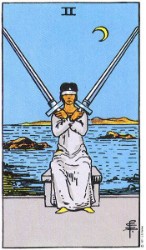
This card shows a robed and blind-folded figure, arms crossed, holding two swords in perfect balance.  A sea or lake in the background appears to be totally still, perhaps stagnant.

Upright: The main thing to note with this card is the stasis, the lack of motion and movement.  Even the sea is motionless. Swords are about power and aggression and in this case the power is frozen in place and any progress is stalemated.  Two opposing people, ideas, or forces are equally strong and nothing is moving or changing.

In a marriage or romantic relationship this could indicate two people who are locked into an emotional power struggle.  Neither party is willing to compromise or empathize with the others feelings. In fact, the blindfold on the figure indicates that they may not even be able to see or comprehend the other person’s feelings.  The relationship isn’t ending but neither is it growing or thriving. It’s become all about the power rather than love.

The quarter moon in the sky indicates that the stalemate may last about a lunar month before any changes can be expected.

“Just the Tarot,” by Dan Adair – available on Amazon

Reversed: Things are finally moving and changing.  In a relationship it may indicate that one party has decided to leave.

EXAMPLES:  Your friends who are constantly bitching at and about each other but are completely unwilling to consider ending the relationship.

Being locked into a business relationship with someone who refuses to listen to your ideas for improving the business.


Ten of Wands

The meaning of the Ten of Wands in a Tarot reading, including definitions for both the upright and reversed positions.

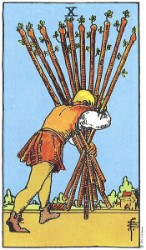
A man walks forward, bent over and carrying a bundle of ten staves.  His head is downward and tucked into the bundle. A villa and farmed land are in the distance.

Upright:Heavy burdens and overwhelming responsibilities.  The subject literally feels that he has the weight of the world on his back.  He’s staggering along, shouldering the burden, but he’s lost sight of his long term goals and any real meaning in his life.

“Just the Tarot,” by Dan Adair – a kindle ebook available on Amazon

Reversed:  The subject may be approaching a time when she can lay her burdens down but it may not be in a pleasant context.  Possible loss of a job, demotion, or simply giving up and walking away.

EXAMPLES:  The workaholic. Someone who is consumed by his job, not because he loves his work, but because he’s lost any sense of his true self and joy in life.

Taking care of family to the exclusion of taking care of yourself.

The Strength Card in the Tarot

The meaning of the Strength card in the Tarot, including definitions for the upright and reversed positions.

Strength

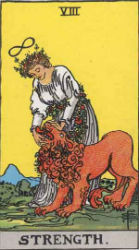
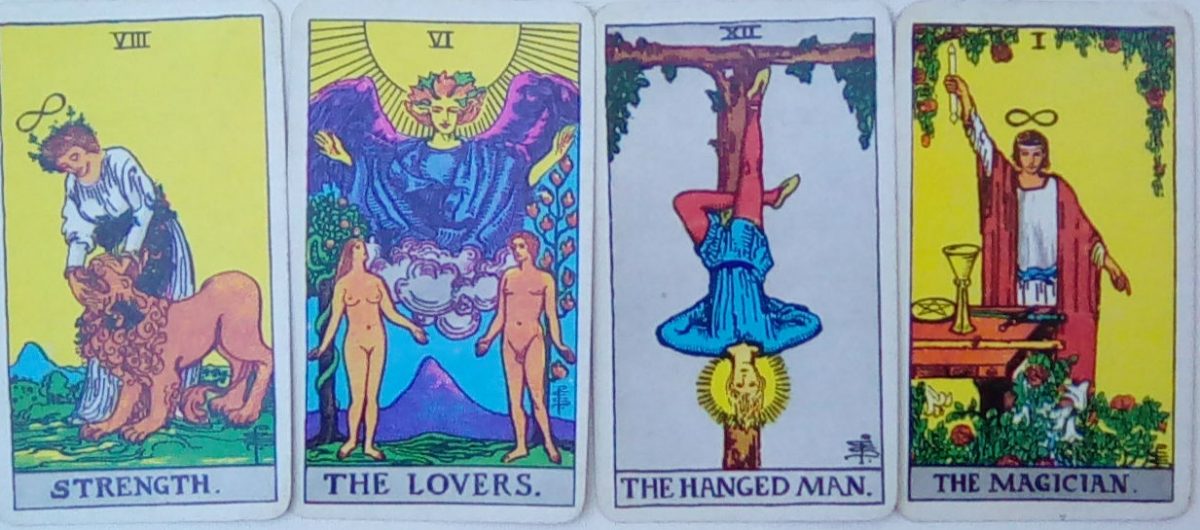
This is, obviously, first and foremost a card denoting strength.  It is, however, a quiet, gentle, enduring strength rather than a blustering, muscle flexing type of strength.  Note how gently the woman is closing the lion’s mouth. She almost appears to be petting it, rather than subduing it.

The lemniscate hovering above her head indicates that she is channeling the Higher Power and the realm of spirit.  This is very much the strength of the Goddess, loving and nurturing to all of her creatures and conquering with enduring love rather than brute force.

This card shows that the questioner will overcome challenges and be successful in the long term.  The key to this is quiet perseverance rather than an all out frontal assault on the problems. The urge to fight – represented by the lion – is overcome and supplanted by the loving strength of her higher nature.  So, too, the questioner should approach problems with loving kindness rather than aggression and will win out in the end.

On a simple physical level this card may show an individual who has been ill for some time but is slowly recovering and gaining strength.

REVERSED – A lack of strength and resolve.  The questioner may be overcome by foes and enemies because he or she isn’t strong enough to stand up to them.  If conflicts arise try to delay and retreat.

This may also show a person who is chronically ill or fatigued and is failing to get better.  A long term, serious illness.

If you have questions about this card or its meaning in one of your readings, please don’t hesitate to leave a comment.  I’ll get back to you as soon as I can.

A FEW MORE THOUGHTS ABOUT STRENGTH:

Strength has some of the most cliched definitions attached to it of any card in the Major Arcana.  It’s a woman closing a lion’s mouth. So the lion is an animal, right? And the woman is, well, a woman.  And, hey, she’s got the symbol for eternity floating over her head! So . . . um . . . it must be about using our higher nature to control our animal instincts, right?

And, of course, the second someone mentions, “animal instincts,” being the good little puritans we are, we immediately think of . . . you know . . . S-E-X.  And somehow this rather interesting portrayal of a woman quietly closing the mouth of a lion morphs into a morality play about being more spiritual and less sexual because, of course, sex and spirituality are opposites.  

It’s my belief that Strength is actually about a state of being called, “Ahimsa.”  For those of you who aren’t familiar with it Ahimsa is a phrase which basically means, “being harmless,”  or, “doing no harm.” It’s practiced in Hinduism, Buddhism, and Jainism and is mentioned prominently in the Yoga Sutras of Patanjali.  And, yes, it’s usually described as a practice but it’s also a state of being. It’s a state of projecting absolutely no harmful or aggressive vibrations at all.

Let me give you an example.  My life partner Carol had an old Persian cat who liked to lie out in the sunshine during the summer.  I glanced out the kitchen window one day and was astonished to see this large, white cat stretched out on the ground and completely surrounded by birds.  They were strolling around, pecking at the ground, grooming themselves, and literally within inches of one of their worst predators, a cat.

They had absolutely no fear of the cat because they somehow knew that the cat had absolutely no interest in harming them.  The cat was practicing kitty-ahimsa and the birds were responding in kind.

You find similar scenarios in the tales from India.  Ferocious tigers and snakes who become completely docile in the presence of a master practicing ahimsa.

Here’s what Swami Kriyananda said about it:  “Ahimsa, rightly understood, becomes the ultimate weapon;  it turns one’s enemy into one’s friend, thereby banishing the possibility of further conflict.”

You could call it the ultimate weapon, as he did, or the ultimate STRENGTH.

I told the story about the cat and the birds to a conservative friend of mine.  He sneered and said, “Well, it’s a good thing that cat has someone to feed it or it would starve to death.”

He didn’t get it.  The cat was fully capable of killing those birds in seconds but the cat chose not to.  Instead of spreading blood and gore all over the back yard the cat chose to enjoy the sunny day and, perhaps, the songs of the birds.  He projected peace and peace is what was projected back at him.

Violence, aggression, anger, fear, those are all ultimately choices that we make.  If we put out those vibrations the beings around us respond on the same vibrational level.  If we put out peace and harmlessness the beings around us respond with peace and harmlessness.

Ahimsa can be a difficult concept for Westerners to grasp.  We tend to think of strength as something we’re doing, some positive action, or at least the ability to endure something unpleasant.  Ahimsa, on the other hand, is not-doing. It’s a deliberate withdrawing from any actions that might cause harm, anger, or fear.  It seems totally paradoxical:  you are ARMING yourself with peace.  And thus you overcome violence.

This card calls for taking a good, deep look at what we mean when we use the word, “Strength.”  Is it aggression? Dominance? Walking over people who disagree with you? Or is it quite the opposite?
“Just the Tarot,” by Dan Adair – a kindle ebook available on Amazon

Pamela Colman Smith – The Real Genius Behind the Waite-Rider Tarot Deck

A look into the life of Pamela Colman-Smith, the pixie genius who designed the Waite Tarot Deck.

The most popular Tarot deck in the world is the The Rider Tarot Deck authored by A.E. Waite and published by the Rider Company.  The illustrations in the deck were done by Pamela Colman Smith and it’s been within recent memory that people have started referring to it as the Waite-Smith deck.  The standard description of it is that the illustrations were prepared by Pamela Colman Smith, “under the directions of A.E. Waite.”

It might be more accurate to say that the illustrations were prepared by her DESPITE the instructions of A.E. Waite.

Pamela_Colman_Smith_

PAMELA COLMAN SMITH

She’s one of the more fascinating people in the history of modern occultism.  She had a wonderful smile and was so tiny that she was nicknamed, “Pixie.” As she was growing up her family shuttled between London, Jamaica, and New York and she spent several years living in Kingston and absorbed much of the Jamaican culture.  Her mother was an artist and she, too, developed artistic talents at an early age and began attending the Pratt Art Institute in New York at the age of 15.

By the age of 21 both of her parents had died and she moved by herself to London where she supported herself working as an illustrator, author, and set designer for theatrical productions.  It was there that she met the poet William Butler Yeats who introduced her A.E. Waite, one of the founding member of the Hermetic Order of the Golden Dawn. Shortly thereafter Waite commissioned her to illustrate his Tarot deck and the rest is history.

But that’s where it really gets interesting.

There have been many, many people who have claimed that they were channeling some sort of a higher power that guided their creativity and, “co-created,” with them.  Painters, sculptors, writers who felt the presence of a greater power than themselves literally telling them what to paint, carve, or write. Some of them talk about spirit guides, others describe the guides as angels, a few might even think that god was talking to them.

It is my strong belief that this is exactly what happened to Pamela Smith when she created the Waite deck.

Consider this:  Smith created ALL 78 cards between April and October of 1909.  That means that for that 6 month period she was pumping out an average of 13 highly complex illustrations a month.  As an artist I can tell you that’s nearly impossible.

There is also strong evidence that Waite may have had fairly precise instructions about the Major Arcana but Smith pretty much invented the illustrations for the Minor Arcana herself, even using some of her close friends as models.  With the sheer volume of illustrations she produced and her admittedly short exposure to occultism, you have to think that those pictures were almost painting themselves.

And, finally, there is the evidence of the nature of A.E. Waite himself.  He was, to put it mildly, one incredibly boring old fart. Shortly after Smith produced the cards Waite published a book called The Pictorial Key to the Tarot (Dover Occult) Here’s just a bit of his definition for the card The Magician:

“With further reference to what I have called the sign of life and its’ connexion with the number 8, it may be remembered that Christian Gnosticism speaks of rebirth in Christ as a change, ‘unto the Ogdoad.’ “

And it gets a lot worse.  Can you imagine having a drink with that guy?

The Waite-Smith tarot deck is truly magical.  Every card is beautiful and tells its’ own unique story.  That magic definitely didn’t flow out of A.E. Waite. It flowed out of the eyes and soul of Pixie.  She was in the groove and some higher force was using her mind and her hands to bring those cards into being.  Aren’t we lucky that happened?


Disclaimer: “As an Amazon Associate I earn from qualifying purchases.”

“Just the Tarot,” by Dan Adair – available on Amazon

Doing Your First Tarot Reading – Start Small

An online lesson in how to do a Tarot reading including an example reading.

BACK to the Tarot Course index.

One of the things that I’d really recommend for your first reading is to start small.  If you look through the sites on the internet you’ll find some monstrous huge patterns for laying out the cards.  Lots and lots of details and sometimes dozens of cards. A beginner using one of those is sort of like deciding you’re going to write a computer program right after you figured out how to put a ringtone on your smartphone.  Start off with some smaller layouts and get a feel for the cards before you get too complex.

I actually prefer smaller reading layouts and I do at least one a week just to check in and get a little perspective on where I’m at and where I’m going.  Here’s a simple layout that takes just a little time to do but touches most of the important bases.

1 2 3 4

1 – Current conditions

2 – What needs to be done

3 – Factors working against the questioner

4 – The probable outcome

Now here’s an actual reading using this layout.  This was done for a woman who was in her fifties, professed to be deeply religious, but was not a very happy camper.

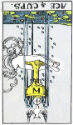
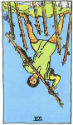
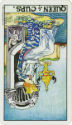
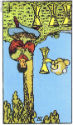
ace 7wands queenofcups 4cups

1 – Current conditions – Ace of Cups Reversed

2 – What needs to be done – 7 of Wands Reversed

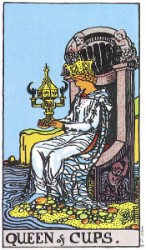
3 – Factors working against the questioner – Queen of Cups Reversed

4 – The probable outcome – 4 of Cups Reversed

Now, if you read my previous post – A Few Tips Before You Start Reading Tarot Cards – you’ll recognize a couple of factors immediately.  First, all of the cards are reversed. This means that the questioner is in a very subjective state of mind and is probably not dealing realistically with what’s going on.  Second, 3 out of 4 of the cards are cups, meaning that this reading is primarily about emotions.

If you’re using the definitions from my book, “Just the Tarot,” (available on Amazon.com as an ebook for less than the cost of a can of beer – just saying)  here’s what you find:

1 – Current conditions – Ace of Cups Reversed – It’s possible that the questioner thinks he or she is love but the other person views it as just a friendship.  Another possibility is that there has been true love but it’s fading away.

2 – What needs to be done – 7 of Wands Reversed – There are just too many opponents or problems for the time being.  Disengage from conflict and deal with what you can or you must.

3 – Factors working against the questioner – Queen of Cups Reversed – This may be a person who has a sour attitude toward love and affection.  Perhaps a very materialistic person who prizes possessions over true affection.

4 – The probable outcome – 4 of Cups Reversed – The individual is letting go of old relationships and is starting over.  Perhaps a new love interest or romance.

It doesn’t take long to conclude that this reading is about a romantic relationship and that something is rotten in a Scandinavian country.  The Ace of Cups upright shows that love is blossoming but when it’s reversed it shows that love is dying. The Queen of Cups reversed in the position of opposing factors shows us that one of the people in the relationship – perhaps the questioner or perhaps her partner – has got a pretty bad attitude happening about love and romance.  The 7 of Wands in the position of what needs to be done shows us that there are just too many problems in this relationship for it to have a good outcome. And the 4 of Cups reversed shows us that the questioner or her partner will probably come to that conclusion and just walk away and start over.

See how easy that was?  You lay out the cards, you look for a pattern, and you put the story together.  Now you try it . . .

“Just the Tarot,” by Dan Adair – a kindle ebook available on Amazon

Can You Learn to Read Tarot Cards?

A short lesson on how to begin reading Tarot cards, including advice for choosing a deck and getting started.

BACK to the course index

ON to the next lesson

Over the years that I’ve been reading Tarot cards I’ve had many people ask me if they could learn how to read the cards.  The answer, of course, is, “No.”

Just kidding.

The answer is an unreserved, “Oh, hell, yes.”

Anyone can learn to read Tarot cards.  There are really only three things you need:  a deck of Tarot cards, a good set of definitions and layouts, and a little time.

The deck you choose will probably depend on what sings to your subconscious.  You have a very wide choice already and it seems like some enterprising artists and writers are coming up with new designs almost every month.

If you’re a purist at heart you may want to consider a nicely done reproduction of The Marseille Deck.  This most closely resembles the original decks that were used in the 15th and 16th centuries. A word of caution:  the, ‘pips,” – cards ace through ten of the four major suits, AKA the Minor Arcana – do not have the intricate illustrations of themes and situations that we associate with modern Tarot cards.

A nice alternative is The Aquarian Tarot Deck.  These are beautifully illustrated with knock-your-socks off Art Deco pictures.  Not the deck I use, but absolutely elegant cards.

The most popular deck by far – and the one that I personally favor – is The Rider Waite Tarot Deck, Rider being the company that manufactures them and Waite being A.E. Waite, the person who authored them.  Thanks mainly to the amazing artist who did the illustrations – Pamela Coleman Smith – it’s definitely the most magical deck out there. There have been several variations in colors and inks through the years so you can find them in hues that range from fairly muted to near neon.

You can find nearly all of the decks that are available on Amazon.com if you want to browse through them and most decent occult shops or larger book stores will have a few on hand.  Something to be aware of when selecting cards is to be sure that they actually ARE Tarot cards. There are a ton of card decks that are used for fortune telling or intuition work that have nothing to do with the Tarot.  The Inner Child Cards and Totem Medicine Cards come to mind – both lovely decks but not the Tarot.

Finally, it is highly NOT recommended that you ever, ever purchase a used deck of Tarot cards.  They do tend to retain the vibrations of the original owner and you don’t want that popping up in your readings.

As far as finding a good set of definitions and card layouts, I personally recommend my book, “Just the Tarot,” as an Amazon Kindle ebook for only 3 bucks.  There are, of course, many, many other books available, as well as definitions and lessons on-line.

You can also, of course, browse through the books on amazon.com and compare the various reviews that the readers have left.   A strong caveat: if you’re thinking of buying, “The Pictorial Key to the Tarot,” by A.E. Waite, don’t bother. Ironically it’s one of the worst books on the subject that’s ever been written and it is MAJORLY boring to boot.

As far as the third element necessary for learning the Tarot – time – that’s up to you and your individual temperament.  Some people are really into taking classes and socializing and you can find online courses or, if you live in one of the hipper locations of the country, you can probably take personal classes.  If you’ve got a busy schedule like most of us do, try to do a reading or two a week. Write down the results and then go back to them at the end of the week and see how accurate the readings were.  As time passes you’ll start to get a personal feel for each card and begin to develop a talent for putting all of the cards in a layout into a story.

Have fun!

On to the next lesson!

“Just the Tarot,” by Dan Adair – available on Amazon