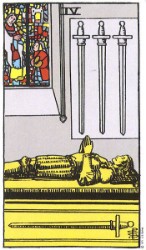
The Four of Swords: ReCreation

Recreating ourselves through rest. An exploration of the Four of Swords.

If you’re feeling stuck, exhausted, or strangely unmotivated right now, the Four of Swords may have a valuable message for you.

In the traditional Tarot, the Four of Swords depicts an armored knight lying in deep slumber. Three swords hang above him; one rests beneath him. It’s a card associated not just with rest, but with recovery. We often see it when someone has gone through a physically or emotionally traumatic experience and simply needs to become as quiet as possible in order to heal.

But there’s a subtler message here — one that goes beyond simple rest.

It’s about re-creation.

When we’re physically ill, we’re encouraged to sleep as much as possible. Why? Because the body heals in stillness. Damaged cells are repaired. Infections are fought. New, healthy tissue is created. We intuitively understand that the human body is self-healing — if we can just turn off the busy mind and get out of the way.

The same principle applies emotionally and spiritually.

When we’ve been wounded — by stress, burnout, loss, disappointment, or simply too much striving — our instinct is often to withdraw. To reduce contact. To go quiet. That instinct isn’t weakness. It’s wisdom.

That’s what I was emphasizing in my Tarot affirmation poster for the Four of Swords: sometimes the periods when we feel least productive are actually the periods of our greatest growth.
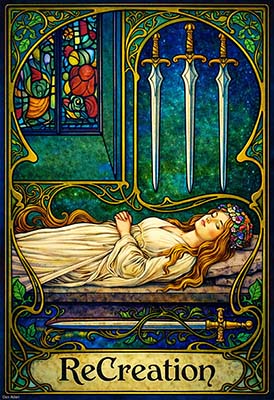
Tarot Affirmation Print available on Etsy.

The Cultural Problem

Part of the struggle comes from the culture we swim in.

From the time we’re children, we’re trained to work harder, move faster, achieve more. Rest is framed as a brief pit stop before we re-enter the race. Productivity is virtue. Exhaustion is normal.

So when we find ourselves demotivated or depleted, our first reaction is usually self-criticism.

“I don’t know what’s wrong with me.”

“I just can’t get it together.”

“I feel stuck.”

But what if nothing is wrong with you?

What if you’re not broken — you’re rebuilding?

What if your body, mind, and spirit are quietly saying, “You need time. You need stillness. You need space.”

The tragedy is that the more we fight that message, the longer the recovery takes. We override the natural healing cycle because we’re afraid of falling behind.

Nature Doesn’t Apologize for Rest

Look at Nature.

The Earth explodes into life in the Spring.

She flourishes in Summer.

She releases in Autumn.

She rests in Winter.

Do you imagine the Earth berating herself all Winter long? Does she panic and whisper, “I should be more productive”?

Of course not.

Rest is part of the cycle.

Contraction makes expansion possible.

Stillness prepares the ground for growth.

And yet, though we are children of the Earth, we rarely grant ourselves the same permission.

Reframing “Stuck”

When we hit a slack period — when progress stalls and energy feels low — we can frame it in one of two ways.

We can tell ourselves we’re lazy, depressed, failing, falling behind.

Or we can recognize that we’re in a season of restoration before the next expansion.

Because that is precisely what often happens.

When we release our grip — when we stop forcing clarity, stop chasing momentum, stop judging ourselves — something begins to recalibrate beneath the surface. Just as the body eliminates toxins during sleep, the psyche releases old narratives during rest.

We may not consciously see it happening. Our subconscious may be reorganizing itself in silence. Old wounds may be dissolving. A new identity may be forming.

The Four of Swords is not stagnation.

It is sacred pause.

It is integration.

It is ReCreation — not recreation as distraction, but re-creation as transformation.

And if we can trust that process, if we can stop fighting it, those quiet, stuck-feeling days may turn out to be the very foundation of our next, beautiful phase of growth.

Sometimes the most powerful thing we can do is lay down the sword — and let ourselves become new.


“Just the Tarot,” by Dan Adair – available on Amazon
The Four of Cups, The Five of Cups, and Finding Gratitude in Painful Times

There are a lot of people out there right now talking and writing about how to create abundance.  One of the things that they all agree upon is the need for gratitude as a part of the process of manifestation.  

Whether you’re working with angels and spirit guides or an agnostic trying to get the hang of the Law of Attraction, all of the teachers and financial gurus will tell you to start with a grateful heart.  If you’ve only got a few bucks in your pocket, be grateful for them before you try to manifest more. If you want to have stronger, more positive people in your life, start by telling the people who are already in your life how much you appreciate them.

But sometimes we get stuck and it’s really hard to pull up that attitude of gratitude.  It could be that we’ve had some sort of a terrible loss. It could be that our lives are going through one of those phases where everything just sucks and we finally have to say, “Jesus, why is this shit happening to me?”  Or it could be that it’s just one of those times when we need to feel sorry for ourselves a while.

Gratitude is an emotion, just like love, hatred and anger, so it’s appropriate that the two cards in the Tarot deck that deal with a lack of gratitude are in the suit of emotions – the Cups.

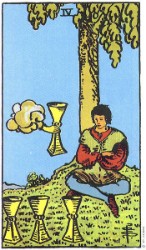
In the Four of Cups we see a man sitting on the ground, arms crossed in defensiveness or rejection, staring at three cups standing on the ground before him.  A fourth cup is appearing out of thin air but he doesn’t even see it. The Three of Cups is, of course, a card of celebration and happiness so we can conjecture that the cups he’s staring at represent the loss of some major source of happiness in his life.  Perhaps he’s broken up with a lover or he’s been fired from a job that he really liked. In any case, he’s so focused on the past that he’s not perceiving the new opportunity, the cup floating in the air.

Contrast that with the Five of Cups.  This is a card of MAJOR, life changing loss and deep, deep grief.  He’s dressed in the black cloak of mourning and the wine from the three cups is spilled upon the ground, gone forever.  And, again, he’s so focused on his loss that he can’t even see that he has two cups left which are quite full. An example might be a man or woman who can’t focus on their children because they are too deep in grief over a spouse who has died.  She has literally turned her back on happiness for the time being.

So, knowing that gratitude can be a major factor in manifesting an abundant, spiritually satisfying life, how do you even GET to it when all you can feel is a sense of loss?  Sometimes cognitive and spiritual reframing is the answer.

In the case of the Four of Cups – the loss of a relationship or a job – try to see that cup that’s hanging in the air.  Ask yourself WHY it happened. Is it clearing the way for a deeper relationship or a better job? What employment or relationship skills did you learn by going through this?  How is this going to make you a better or a stronger person in the future?

You can even take it to a deeper level of analysis if you like.  Is this some kind of a script from a childhood trauma that you’re playing over and over again?  Are you subconsciously manifesting lovers who will reject you or make you miserable? Are you seeking out jobs or bosses who won’t appreciate you?  Can you bring that to full consciousness and turn it around? Can you feel grateful for the growth?

In the case of the Five of Cups, it’s a much rougher road.  It’s hard to find anything positive about someone you love dying.  True, deep grief is devastating. It can actually make us physically ill and sometimes it drives us to a despair that’s so deep we can’t imagine it will ever end or we’ll ever smile again.

Yet, it can cause a major and ultimately beneficial shift in our perspectives.  If we are at all honest with ourselves it will drive us to real and permanent reevaluations of our lives.  It causes us to ask what in the hell it’s all about. Is there really life on the other side? Did my loved one survive in some form?  Are there spiritual beings? If she was taken and I was left behind, what am I supposed to be doing with my life now? Surely I have some life purpose that’s higher than watching television and eating junk food.

It’s like a ball of yarn that’s come completely unraveled and you have figure out how to roll it back up.  Or a jig saw puzzle where you have all of the pieces but you’ve lost the picture of the assembled puzzle. All you can do is start at the edges and try to put life back together in a way that makes sense.  Eventually, though, it adds a much greater depth and meaning to life.

Gradually, horribly slowly, we do begin to recover from grief if we choose to go on living.  And, yes, it gives us a sense of gratitude for life and for the love we experienced with the person we lost that’s more profound than we could have ever imagined.

Gratitude can always be discovered.  Sometimes we just have to look for it a little harder.