THE EMPRESS AND THE ART OF FLUNKING OUT OF EARTH SCHOOL

A playful look at the New Age paradox of being “perfect souls” who still come to “Earth School” to learn lessons. The post explores both views and suggests that real growth comes not from suffering, but from joy, play, and becoming more fully ourselves.

There’s a rather large pothole in New Age philosophy that I keep tripping over. Let’s call it The Earth School Fallacy — the strange contradiction between “We are perfect divine beings” and “We’re here to learn lessons because… well, we’re NOT perfect divine beings.”

Somehow, we manage to carry both of those ideas around in our heads and not notice that they don’t quite fit together.

“Just the Tarot,” available on Amazon

THE EARTH SCHOOL MODEL

You’ve heard this one. If you’ve been on a spiritual path longer than a week, you’ve probably used this one.

Earth, we’re told, is a sort of cosmic classroom we incarnate into repeatedly. Each lifetime is a syllabus of Very Important Lessons, and with each incarnation we supposedly level up until we become Spiritually Perfect.

In this model, we actually choose our life challenges before we’re born.

Have a temper? Great! Let’s incarnate into a family whose daily activities include pushing all of your buttons like they’re competing for a prize. Assuming we don’t murder each other we eventually learn enough humility and patience and – SHAZAM –  we transform into Mahatma Gandhi.

Have an obsession with sex? Wonderful! Let’s incarnate into a world filled with gorgeous, eager, naked partners who—

Okay, that one never happens. But you get the drift.

Pass your lessons and you move up a grade.

Fail your lessons and you come back as a cockroach or a MAGA supporter and start over in Spiritual First Grade, eating glue and making macaroni art.

In Tarot Talk, Gaia’s classroom often looks like the Five of Wands — a bunch of souls flailing around wildly until one of us finally figures out what the sticks are for.

THE ANGEL WITHIN

Now we arrive at the second New Age idea — the one that directly contradicts the first.

This is the belief that we’re already spiritually perfect, but we’ve forgotten that fact. Our task isn’t to improve ourselves… it’s to remember that we don’t need improving.

Buddhists describe it as our original nature: a perfect jewel hidden under a crust of plain gray rock. Chip away the rock and — surprise! — you’ve been luminous the whole time.

Joni Mitchell phrased it better than all the gurus combined:

“We are stardust, we are golden,

and we’ve got to get back to the garden.”

In this view, we are pure, radiant beings from Source Energy who come to Earth, promptly forget who we are, and then spend the rest of our lives meditating, journaling, and buying inspirational calendars in an attempt to remember.

Put another way:

We’ve got a sleeping angel inside us, and the angel really needs to get its butt out of bed.

THE CONTRADICTION

Here’s the uncomfortable question no one asks:

If we’re already perfect, why would we CHOOSE to forget that and struggle?

It’s like becoming a master at algebra, then signing up for a lobotomy just so you can relearn quadratic equations from scratch.

Imagine your higher self sitting in another dimension saying,

“I’m a being of luminous perfection. You know what sounds fun? Forgetting everything and getting pissed off at the traffic while I drive to a boring, meaningless job that I hate.”

Something about that doesn’t quite compute.

EARTH SCHOOL AND THE WORK ETHIC PROBLEM

The Earth School model borrows heavily from Christian theology, a worldview in which:

• Humans are inherently sinful.

• Life is full of temptations that make us more sinful.

• If we behave ourselves and avoid having sex with the neighbor’s spouse, we get to go somewhere nice after we die.

In this model, Earth is basically the rough school on the dangerous side of town, with a curriculum of suffering, discipline, and fear.

Just keep your head down, work hard, and eventually—good news!—you’ll die.

THE VEDANTA SOLUTION (AKA: THE EMPRESS APPROACH)

Vedanta, from the Hindu tradition, on the other hand, leans toward Joni Mitchell’s interpretation. It suggests that:

• We are already perfect.

• Life is not meant to be hard.

• We’re not here to learn painful lessons.

• We’re here to experience, enjoy, and expand.

If the Vedanta version of Earth School has a model, it’s not the stern monk or stressed-out student — it’s The Empress.

Empress Poster available on Etsy

She’s not here to ace the test. She’s here to savor the banquet.

Play, creativity, pleasure, beauty — these are not distractions from the spiritual path.

They are the spiritual path.

That’s a really hard concept for Westerners to wrap our heads around.  We’re taught from the moment that we’re born that life is a series of assignments that we’re supposed to complete and that the next assignment will be better than the last.  That’s really the way that our whole society is set up.  We go to kindergarten so that we can go to grade school so that we can go to high school so that we can go to college or trade school so that we can get jobs so that we can get promotions so that we can retire comfortably and have enough money to pay for our funerals.

If we do all of that, we’ve been, “successful.”  If we don’t, our lives have been meaningless.

When someone tells us that the whole purpose of Earth School might actually be recess, it feels slightly insane.

LIVING SOMEWHERE IN THE MIDDLE

We can argue both sides.

If you lean toward Earth School, you can point to all the suffering and struggle that seem baked into our reality. As the English philosopher Thomas Hobbes famously put it, human life often appears “nasty, brutish, and short.”

But if you look again, you’ll also see breathtaking amounts of love, generosity, joy, and compassion.

So what’s the truth?

Probably something in the middle.

No, we’re not perfect angelic beings slumming on Earth…

but we can be.

Maybe life isn’t about learning painful lessons, and maybe it’s not about effortless perfection either.

Maybe it’s simply about becoming more yourself, more awake, more playful, more alive.

And oddly enough, the way we get there isn’t through suffering…

it’s through joy. It’s through learning how to play.

We don’t have to wait until we die to graduate.

We can do that right now — as soon as we remember that recess was always the point.

What To Do When Our Lives Turn Into Crap – Wheel of Fortune Reversed

How to deal with it when you hit a period of bad luck

I recently got The Wheel of Fortune reversed in one of my personal readings and we all know where that’s at:  a period of bad luck coming.  Get ready, because things are NOT going to go the way that you want them to, at least not for a while.

And, since I’m an intuitive, I started thinking about exactly what, “luck,” is.  When we say we’re lucky or we’re unlucky, just what exactly are we talking about?

KARMA

Some of it can be karma, of course.  We’ve all met those people who seem to be blessed with nothing but good fortune.  They were born into families that loved and nurtured them, they were the beauty queens and football heroes in their high schools, and they went on to have wonderful careers, lots of money, and 2.5 semi-perfect children.  Into every life a little rain must fall, but they seem to live under giant umbrellas.

And then there are people who just can’t buy a fucking break.  No matter how hard they try, no matter how they struggle and strive, nothing goes right for them.  They’re always at the right place at the wrong time and money and love evade them like a bunny rabbit on speed.

Many of the people who are blessed with Hallmark Card lives have done little to deserve those lives, and many of the people who are cursed with disastrous existences have done little to deserve THAT fate.  

So all we can do is to shake our heads and say, “Well, it must be karma.  They must have been very, very good or very, very bad in a previous incarnation and now they’re getting what they deserve.”

Because if we DON’T say that, there’s no real justice or balance in it. Then life becomes this sort of an insane lottery where it’s all just a matter of . . . luck.

TIME AND TIDE

Another approach to dealing with bad luck is the Principle of Rhythm that’s discussed in books like The Kybalion.  The idea here is that there’s a natural rhythm to life where sometimes everything’s coming up rainbows and sometimes it all turns to shit.  

The way that the Kybalion explains it is that life is very much like the pendulum of a clock.  It swings first in one direction and then in the opposite direction and each swing is equal to the other.  We may have a period of great good fortune but it will be followed by a period of bad luck and vice versa.  

They reinforced that idea by looking at nature.  The moon waxes and then wanes.  The tides rise and then fall.  People are born, spring into maturity and then die.  Our emotions may be ecstatic one day and really depressed the next.  

There seems to be a natural rhythm where we swing from one extreme to the next on a regular basis but spend most of our time somewhere in the middle.

Of course, the problem with that theory is that it ends up being one-step-forward and one-step-back.  If our bad luck is always equal to our good luck, then we ain’t got no luck at all, brothers and sisters.

The way that they solved it was to say that life TENDS toward the positive.  That even if we have swings between good and bad luck, we have a little more good luck than bad.  So we’re actually making progress even if it feels like our feet are stuck in concrete.

And, yes, they turned to reincarnation to explain why some people have nothing but good luck and some people have nothing but bad luck.  Even if it seems like the clock’’s pendulum got permanently stuck on one side, it’s really just swinging very slowly because we can’t remember our past lives.

Okay . . .

WHO THE HELL KNOWS?

Humans have been trying to explain luck since the beginning of time.  There are a million different theories and formulas about it and they really just boil down to, “How do I get me some of that GOOD luck?”  Or, “How do I avoid that BAD ju-ju?”

A lot of the advice has involved figuring out ways to bribe the crazy gods that we’ve invented.  The Old Testament tells us to burn a fatted calf, because god likes a good barbecue.  The Taoist religions burn fake money because apparently that’s a way of making a deposit in their god’s bank accounts (yes, even gods need a little pocket change.). And, of course, many modern day Christians go to church every Sunday to sort of hedge their bets.  “Hey, Lord, I just put a twenty in the collection plate, and I could use a really lucky week.”

All we really know is that there seems to be something out there that we call, “luck.”  It’s some sort of a force or energy that brings good fortunes into the lives of some people. Its absence brings bad fortunes into the lives of others.  No matter how much we may want to, we can’t buy it or cajole it into our lives or pay a priest or pastor to make it go away when it turns bad.

SO WHAT DO WE DO?

So what do we do when we’re going through a patch of really bad luck?  When we flip over the card and it’s The Wheel of Fortune reversed?  

One solution is to just hunker down and ride it out.  Bad luck can feel like a huge storm that’s raging through our lives and we just need to get into the tornado shelter.  Try to turn off our emotions, grit our teeth, and wait for it to pass.

The Kybalion suggests trying to, “rise above it.”  In other words, there’s not a goddamned thing we can do about that clock pendulum swinging, but we can try to raise our vibrations to a point where it affects us less than it would otherwise.  Eventually the pendulum will swing back in the other direction.  If we stay calm, try to stay positive, and remember that this too shall pass, it will lessen the effects.

BEEN DOWN SO LONG IT LOOKS LIKE UP TO ME

Of course, if we ARE one of those people who seem to have been born under a bad moon, that’s a different kettle of fish.  If there’s been nothing but bad luck for a very long time, then we need to learn to adjust to that, too.

And the only solutions I can come up with there are to try a little harder than the Hallmark Card people and build in the fact that we’re not luck magnets.  We actually need to take the time to write the affirmations, do the visualizations, make the vision boards, and feng shui our houses until they shine like newly minted dimes.  Because it’s NOT going to come naturally to us.  

Maybe we were terrible people in a past life.  Maybe our clock pendulums broke when we were born.  Who knows?  What we do know is that we’ve got to put in a little more effort.  

Ultimately, good luck or bad luck, we make our own lives.

“Just the Tarot,” by Dan Adair – a kindle ebook available on Amazon

Love, Limerence, and The Ace of Cups? How to Heal Obsessive Attraction with Self-Generated Love

Ever fallen in love with someone you couldn’t have? Psychologists call it “limerence,” but spiritually it’s more than just a crush. This post explores the difference between obsessive attraction and true love, why we sometimes fall for the “wrong” people, and how to heal by generating love from within. Featuring insights from psychology, past-life theory, Ram Dass, and the Ace of Cups, it’s a guide to shifting from longing to self-created wholeness.

Ace of Cups – A Tarot affirmation poster available at Synergy Studio.

Did you ever fall in love with someone you shouldn’t have?  Someone who was unavailable, but you still felt intensely attracted to them?

Maybe it was your next door neighbor who was happily married.  Maybe it was a co-worker and you KNEW that a work place romance would be a disaster.  Hell, maybe it was your 8th grade teacher who was just SO perfect in every way.

GETTING CRUSHED

We used to call that, “getting a crush,” on someone.  We meet someone and we just know that we’re supposed to be together, even though everything else is saying, “No, you’re not.”

Psychologists – as psychologists tend to do – have invented a new term for it which is, “limerence.”  Here’s a definition:

Limerence is an involuntary, intense, romantic obsession characterized by intrusive thoughts and a longing for emotional reciprocation, often leading to emotional suffering due to unmet romantic needs.”

In other words, having a crush on someone you probably shouldn’t have a crush on.

IT’S ALL PERFECTLY NATURAL

Now, this has been going on ever since the world began and, of course, it’s caused a passel of trouble. Marriages end, people lose their jobs, reputations and careers are destroyed.  All in the name of love.

Which is puzzling, isn’t it?  Love is supposed to be this grand, wonderful adventure that lets us soar to new heights on the wings of the person we’re in love with.  So why is all of this so painful and frustrating?  

THE CALM, INNER VOICE

I had a teaching dream once about spirit guides and spiritual guidance.  I call them, “teaching dreams,” because they’re very lucid, very clear and they usually have to do with some issue that’s really bothering me.

The subject of this dream was, “How do I distinguish true spiritual guidance from my own desires and ego?”

And the answer was that spiritual guidance is never harsh, never critical, never ominous.  It’s always gentle, loving, and kind and leaves us feeling nurtured rather than criticized or beaten up.

The same principle applies to falling in love.  If it feels sweet and kind, it’s probably real love.  If it involves obsessive thinking, insecurity, self-doubt, or criticism . . . hey, it may be a hell of a crush, but it ain’t love.

WHY DOES IT HAPPEN?

Why do we fall in love with people who aren’t, “right,” for us?

Psychologists, philosophers and playwrights have been trying to figure that one out for hundreds of years and really haven’t made much progress.

My personal theory is that these are relationships that are, “out of time.”  And I don’t mean that in the sense of, “Whoops, we’re out of time.”

Rather, what I’m talking about is old relationships from previous incarnations that have been displaced in time.  The feelings are still there, but they’re no longer appropriate in their old form.

Perhaps we were married to someone or had a super, sizzling hot sexual affair with them two lifetimes ago.  Because of that intense attraction, we meet them again in this lifetime.

Only – guess what? – they’re married to someone else.  Or they’re our teacher or mentor.  Or perhaps we’re straight, but they’re the same sex that we are.

The feelings are just as intense.  The desire to be with them is just as strong.  But it just ain’t happening this go-round.

WHAT SHOULD WE DO?

Well . . . nothing, in most cases.  Just observe it and sit with it.  Realize that you love this person but that the love has to take a different form than romantic love.

We can feel it.  We can cherish it.  But we don’t have to act on it.  If there’s a huge internal conflict about getting romantically or sexually involved with someone, that’s not a very good way to start out, is it?

FILL YOUR HEART WITH LOVE

Ram Dass said that we frequently mistake other people as the source of love, rather than realizing that they’re just vehicles that get us to the love.

When we’re seriously crushing on someone we shouldn’t be crushing on, we feel that as a loss, as a deficit, as if we’ve got this Grand Canyon sized hole in our hearts that only they can fill.

Fortunately, we’ve got this wonderful part of our energy systems called, “the heart chakra.”    It can generate an infinite amount of love because love actually IS infinite.  

We can sit down at any time or place and just meditate on love, meditate on that chakra filling up with that sweet, kind essence that is love and the feeling of not being complete immediately goes away.

IT ISN’T THEM, IT’S US

We’ve been programmed into believing that love always flows out of someone else and into us.  That if someone, “out there,” doesn’t love us, we won’t get the love we need.

That’s really the source of the pain in limerence.  We’re convinced that without that other person’s love, we’re just going to be miserable and unfulfilled.  We can’t get to the love we want and so it hurts.

Not true.

We create our own love, in our own hearts.  We receive love when we open our heart centers and intentionally, consciously fill them up.

THE ACE OF CUPS

When we look at the Ace of Cups we can see this message very clearly.  The cup is our heart and the love isn’t flowing out of another person into the cup.  It’s flowing straight out of the Universe.  Love is everywhere.  It’s a Universal energy and we just need to open ourselves to receiving it.  If we occasionally receive it from another person, that’s great.

But if we don’t, that’s not a tragedy and it doesn’t need to be painful. The source of love is always in our own hearts.

“Just the Tarot,” by Dan Adair – A kindle ebook available on Amazon

Learning to Live Without Joy

Many people feel disconnected, numb, or unable to access joy—especially after childhood trauma. This post explores emotional flatness, toxic positivity, and why realness may matter more than happiness.

Did you get ACED when you were a kid?

ACE stands for Adverse Childhood Experience, and the odds are fairly high that you experienced one. ACEs include things like emotional abuse, neglect, parental mental illness, substance abuse, and divorce or separation of the parents.

We tend to think of those kinds of negative experiences as relatively rare. Maybe we got the hell beaten out of us by a crazed, drunk parent—but most people didn’t, right?

After all, just look at how happy everyone else seems.

But according to the CDC-Kaiser ACEs Study, 61% of adults across 25 states reported experiencing at least one ACE. And nearly 1 in 6 (16.7%) reported four or more.

The truth is, a sizable portion of the population is living with the long-term effects of unresolved trauma—including dissociation, emotional blunting, chronic anxiety, and difficulty accessing joy.

The Cultural Pressure to Be Happy

One of the strongest side effects of long-term trauma is the belief that, “Man, I must really be fucked up, because I’m just not happy. Everyone else is happy, but I’m a train wreck. In fact, I’m not even a train wreck, I’m completely off of the tracks.”

That belief is especially potent if you’re American.

American culture—especially through media and marketing—places enormous value on positivity, confidence, and personal success. Like the figures in the Three of Cups, we’re all supposed to be dancing with joy, smiling through life, bubbling over with gratitude. The message is:

“You should be happy, empowered, and in control of your life at all times.”

And if you’re not?

Then something must be seriously wrong with you.

This pressure to appear happy, even when we’re not, creates:

Emotional dissonance: A split between what we feel and what we think we should feel.

Shame about feeling bad: A second layer of suffering on top of the original pain.

Social masking: We say we’re “fine” or “happy” because it’s expected—and we believe others are genuinely feeling that way (even when they aren’t).

Antidepressants and the Emotional Economy

A recent Gallup poll reported that a whopping 78% of Americans say they feel satisfied or very satisfied with their lives. The poll even bemoaned the fact that the “happiness index” was down by two points.

Meanwhile, the U.S. is among the highest consumers of antidepressants in the world.

Some people take them for serious clinical issues—but many of us take them simply to cope with lives that feel emotionally flat or chronically overwhelming.

Years ago, psychologists discovered that one of the most useless surveys in the world was asking teenage boys if they’d had sex. The overwhelming majority said, “yes, of course I have,” —even though many of them didn’t have the slightest clue how to unfasten a bra, let alone what to do next. They thought they were supposed to be having sex, because they assumed all the other boys were doing it—even though they weren’t.

In much the same way, Americans seem to be lying to pollsters about how happy we are, because we think we’re supposed to be happy.

After all, everyone else is smiling.

Even if they’re not.

We’re taking pills to create artificial happiness because we think we should be happy, even when we’re not.

Living With “Flat” Emotions

What if, instead of constantly trying to fix our feelings, we first learned to live with them?

Assuming there’s no organic brain issue involved, there’s always a reason that we’re not happy.

As Gabor Maté points out, when we suffer trauma that we can neither fight nor flee from, we dissociate. We leave our bodies. We stop feeling.

Not feeling becomes a survival mechanism—a way of coping with pain that would otherwise overwhelm and break us.

If you’re among the 61% who’ve had at least one ACE, you’ve probably experienced dissociation and emotional flatness.

If you’re in the 16% who had four or more ACEs, emotional flatness may be how you live most of the time. It’s not that we don’t want to be happy—we just don’t know how.

And that, in itself, can be traumatic, because we’ve been programmed to believe that we should be happy—even when we can’t feel it.

But we can reframe that.

Rather than chasing a happiness ideal that may not be accessible—especially after trauma—it’s possible to:

• Honor emotional flatness as a survival adaptation.

• Shift the goal from happiness to authenticity.

• Value calmness, neutrality, or quiet presence as valid emotional states.

• Find meaning not in chasing joy, but in living gently and truthfully with what is.

This doesn’t mean giving up on healing, but healing might not look like “feeling great all the time.”

It might look more like “being okay with feeling whatever I feel.”

A New Emotional Ethic: Realness Over Happiness

Ideally, we need a massive cultural shift—from:

“I must feel good in order to be okay”

to:

“I’m okay because I’m allowing myself to feel what’s true for me.”

But… yeah. Don’t hold your breath on that one.

What is possible—what’s powerful—is to make that shift within ourselves.

If you’ve had the hell beaten out of you, either physically or emotionally, as a child or as an adult, it’s okay to feel sad.

It’s okay to feel numb.

It’s not just okay—it’s rational.

That doesn’t mean we want to live there forever.

That doesn’t mean we resign ourselves to an existence without joy. But maybe healing begins when we stop pretending. When we stop performing. When we let ourselves feel—or not feel—exactly where we are.

In this new ethic:

• Sadness is not a problem.

• Numbness is a messenger.

• Joy, when it comes, is a gift—not a requirement.

Back in the 1960s the Transactional Psychology movement came up with the catch phrase:  “I’m Okay, You’re Okay.”

To which Elisabeth Kubler-Ross replied:  “I’m Not Okay, You’re Not Okay.  And That’s Okay.”

The first step in the path seems to be honestly saying, “This is who I am.  This is where I’m at. I hurt when I feel and so I try not to feel. And for right now, that’s okay.”

The Alchemy of the Mind: Transforming Your Life With the Seven Principles of the Kybalion

Beyond Isolation: How Introverts Can Truly Recharge

A look at creating healing solitude.

If introverts had a battle flag, it would probably have The Hermit card printed on it.  We absolutely love to withdraw into our own cozy little shells and let the world turn without us participating in it.

So, we’ve finally canceled our plans, turned off our phone, and settled into solitude. But after hours of scrolling or zoning out, we still feel drained. What gives?

THE MYTH OF THE INTROVERT RECHARGE

Introverts often mistake social withdrawal for true recharging but miss the neurological component (acetylcholine release) that actually restores their energy.  Just sitting at home is not going to refresh or restore us, although that’s where we need to begin the process.

DOPAMINE VERSUS ACETYLCHOLINE

There are, of course, about a kazillion different chemicals and hormones doing a tango in our busy brains at any given time.  For purposes of this discussion, though, let’s focus in on just two of them, the neurotransmitters called dopamine and acetylcholine.  And let’s just call them, “happy juices,” because they make different people happy in different ways.

Our brains discharge dopamine when we’re exposed to a lot of social stimuli like loud music, parties, crowded shopping malls and lots of other people.  Extroverts actually have many more, “receptors,” for dopamine in their brains than introverts do, so they can soak up an ocean of it and it makes them really happy campers. They feel jazzed, excited, and alive.

Since introverts can’t absorb a lot of dopamine, it basically kicks our asses.  For us, it’s like drinking six cups of really strong Espresso – it makes us jittery, nervous, and quickly worn out.  It’s introvert poison.

Acetylcholine, on the other hand, gives our brains a mellow, quiet buzz.  It’s less like ecstatic dancing at a concert and more like snuggling into a warm bed with nice clean sheets.  It’s quiet and peaceful.  Introverts love it and it drives extroverts crazy with boredom.  It’s our happy juice.

THE ISOLATION TRAP

Now,  since too much dopamine makes us feel like crap, it’s perfectly natural to think that just getting away from situations that cause dopamine will make us feel ever so much better.  After all, if too much, “peopling,” is wearing us out, then non-peopling should recharge us.

So, we fill the moat around our introvert castles with alligators, pull up the drawbridges, and put up a big sign that says, “GO AWAY!”  Free at last!

Unfortunately, by that point, we’re frequently so worn out that we just sit there staring out the window, doom-scrolling on our computers for hours, or binge-watching NetFlix.  Those are what therapists call low-nourishment activities because they don’t do anything to feed our emotions or bodies.  And, specifically with introverts, they don’t feed us any acetylcholine to make our brains happy.

PLANNING FOR A BRAIN BOOST

A good question for introverts to ask when we’re planning for our recharge time is, “Will this activity leave me feeling nourished or merely distracted?” We know that there are specific, fairly low energy activities that refresh and recreate us by increasing acetylcholine production.

Reading and Deep Learning: Encourages relaxed but engaged attention.

Mindfulness Meditation or Breathwork: Activates the parasympathetic nervous system, reducing cortisol and boosting calm focus.

Creative Flow States: Writing, drawing, or music allow for contemplative immersion.

Nature Walks or Gentle Movement: Combines physical and sensory stimulation with mental quiet.

MINDFUL INTENTIONS

Another way of putting that is that we need to be intentional with our solitude.  We need to design an Acetylcholine-Rich Hermit Phase.  We can learn to structure our alone time for maximum benefit.

Conscious solitude planning: Schedule blocks for purposeful recharging activities instead of just avoiding people.

Minimize mindless distraction: Replace passive screen time with meaningful, immersive solo activities.

Create mini rituals: Tea-making, journaling, or slow stretching to ease into relaxation.

And, hell, if we’re not quite ready to jump into being Zen Master Introverts, we can combine some of those activities.  Maybe do some Tai Chi while we’re bing-watching Netflix.

REDEFINING OUR SOLITUDE

We’re all different, of course, and introverts tend to be really different.  For me, painting, writing, or meditating brings on that acetylcholine recharge.  For you, it may be gentle dance motions, working in your garden or reading a good book. For others it might be sitting in the sunshine sipping a cup of tea.

The point is that we all know what makes us feel good.  For an introvert it’s like a lover gently kissing the back of your neck or touching your cheek with her finger tips.  It’s sweet, it’s calm, it’s gentle, and it makes us feel better almost instantly.  Those are the activities that we want to build into our solitude.

Yes, we need to get away from other people on a regular basis, but simply being alone isn’t the answer.  Living in intentional, mindful, loving solitude is what makes us whole again.

The Hermit, Introverted Intuitives, and Letting Our Lights Shine

How intuitives emerge from a Hermit Phase.

As an INFJ personality type, I’ve always felt a particular affinity for The Hermit card.    After all, going into Hermit mode is one of the primary defense mechanisms of intuitives and introverts.   When we feel overwhelmed or hurt, we pull up the drawbridge, slam the gate shut, and self-isolate until we heal.  Sometimes that takes a few weeks and sometimes it can turn into years.

I’ve recently begun focusing on another part of The Hermit card, though, which is the lamp that he’s holding aloft.  He isn’t just hiding out anymore – he’s illuminating a path for others to follow.

 INTUITIVES DON’T LEAD

Doing that is NOT something that highly intuitive or empathetic people are inclined to do, for a couple of reasons.  First – and most obvious – is the fact that most intuitives are also introverts.  We’re not the sort of people who want to have a great deal to do with other people, much less try to lead them anywhere. 

In a very real sense, that’s more of the path of the extrovert.  Extroverts love, love, LOVE to charge out into society, organize everything, and tell other people what they should be doing and when they should be doing it. Which is fine, because someone has to put together the Christmas parties, right?  Better them than us.

INTUITIVES AND SELF-IMAGE

Another reason that intuitives seldom assert themselves as, “leaders,” is that many of us have really rotten self-images.  We feel as if we don’t fit in, as if we’re the original square peg in a round hole.  

Some of that flows out of the fact that society is, once again, pretty much designed by extroverts.  Starting in elementary school, we’re told that daydreaming and wanting to be by ourselves is, “bad.”  How many of us received the dreaded report card that said, “Doesn’t play well with other children?”  Yikes.  

That continues into adult life, of course.  Just look at the modern work spaces, with cubicles piled on top of each other and no sense of privacy or personal space.  They’re extrovert heaven and introvert hell and if we don’t like them there must be something wrong with us.  It turns out we don’t play well with other adults, either.

INTUITIVES AND DYSFUNCTIONAL FAMILIES

There’s a further reason for intuitive introverts having terrible self-images, which is – guess what? – our families.  When I first started digging into intuitive personality types I was astounded at the number of people who reported that they had come from dysfunctional families.  And by, “dysfunctional,” I mean families where one or both parents had serious mental issues, addiction issues, or abuse issues.  

Frequently, a part and parcel of being a terrible parent is blaming the child for your bad parenting skills.  A classic example is a parent who gets drunk, beats the hell out of the kid, and then says, “You made me do that.  If you were a better child, I wouldn’t have to beat you.”  The end result is that the kid is convinced that he or she isn’t a, “good,” person and that they’re somehow to blame for the abuse.  We go into life with the basic premise that we’re flawed and unloveable.

INTUITIVES AND COGNITIVE INTELLIGENCE

So, all of these factors (and more) lead the introverted intuitive to feel that she’s in no position to lead anyone, anywhere.  After all, we’re odd balls and we’re just not quite good enough.  But is that borne out by facts?  Consider these statistics from Susan Storm’s article in PsychologyJunkie:

Of all of the personality types, INFJs have the second highest grades in high school.

INFJs have the highest first semester grades in college and some of the highest undergraduate grades.

INFJs are among the most persistent personality types in actually finishing college.

INFJs tend to score well above average in standardized IQ tests.

INFPs and INFJs read more than any other personality types.  While the average American reads 12 books per year, INFJs average 67 books per year.

INTUITIVES AND EMOTIONAL INTELLIGENCE

While some introverted intuitives are full blown empaths, ALL of them are highly empathetic.  And by empathetic, I mean that they can, “read,” another person’s emotions so deeply and so quickly that they may appear to be psychic.  

When you meet an introverted intuitive, they are instantly scanning your body language, your eyes, your facial expressions, the tone of your voice and even the clothes that you chose to wear that day.  All of this happens so rapidly that the intuitive may not even be aware that he’s doing it.  What’s more, intuitives frequently feel that everyone else must have that same level of perception, simply because it feels so natural to them.  But, no, most people don’t do that.

As Eileen McKusick, author of Tuning the Human Biofield put it, “It’s like having an antenna that goes a little higher than everyone else’s.  We pick up information that normal people don’t.”

COMING OUT OF THE HERMIT PHASE

What usually pulls introverted intuitives out of their Hermit phase is a desire to help other people.  That can manifest as personally as wanting to help a friend who’s gone through a divorce or as broadly as wanting to make some contribution to humanity as whole.  Intuitives are, after all, highly empathetic, which means that we really DO feel other people’s pain, almost as if it were our own.  

In order to help, though, we have to get rid of that old, “I’m not good enough,” self-image.  When we combine our intellectual intelligence with our emotional intelligence, we are actually extraordinarily capable of helping others heal.

It’s estimated that up to 52% of the population may fall into the introvert section of the personality types.  BUT . . . introverted intuitives are a very tiny slice of that.  Only 1 to 2% of the world population are INFJs and only 4.4% are INFPs.  We have unique gifts and unique perspectives.  We just need the self confidence to go along with those gifts. To let our lights shine on other people’s darkened paths.

Karma, Having Sex with Republicans, and Being Kind to Yaks

Seeing karma as a way to change our past.

One of my favorite internet memes says, “Karma – It’s spelled K-A-R-M-A and it’s pronounced, ‘Ha, ha, fuck you.’”  

That’s a perfect explanation of our usual understanding of karma which is basically, “If you do some shit, you get some shit.”  If we do something terrible to another person, something terrible is going to happen to us. If we do something nice, something nice is going to happen to us.

OH, WELL, IT’S KARMA

Counter-intuitively, karma is also used an explanation for why bad things happen to good people.  We may have a friend who’s a wonderful person and goes through his life supporting and nurturing others, who’s full of love and gentleness and kindness.  And then something horrendous happens to him, like he falls of a cliff or discovers his wife is having sex with a Republican.

We simply can’t understand why such a good person would have such bad luck.  Certainly, he did nothing to deserve it and, according to the Law of Karma, all of his good behavior should have been rewarded with good things happening to him.

But . . . we’re told . . . perhaps he did something really, really terrible in a previous incarnation.  Maybe he pushed someone off of a cliff or maybe he had sex with a Republican.  Maybe he actually – shudder – enjoyed having sex with a Republican.

That allows us to restore some sense of cosmic balance and we say, “Oh, well, it’s just karma.”

IT AIN’T ME, BABE

We can certainly understand that concept when something bad happens to someone else, but it’s difficult to swallow when it happens to us.

Let’s face it, most of us are NOT the Dalai Lama and we have very little memory of our past lives.  We may accept the general idea that we’ve lived other lives, but we don’t actually remember being a Yak herder in Mongolia in 40 A.D. or a courtesan in Paris during World War I. 

From our current point of view, those people who we were in our past lives were literally someone else and not us.  

The idea that I broke my wrist today because some other guy kicked a Yak 2000 years ago seems entirely capricious and cruel and unjust.  It feels like . . . how shall I put this? . . . bullshit.

KARMA AND DETERMINISM

From that perspective, karma feels very much like determinism.  Determinism is the view that every single thing that happens to us is pre-determined from the moment of birth.  There really isn’t any free will or choice in life because our lives are a result of our genetics, our cultures, the families we’re born into, and the times we live in.

We can actually make a strong case for that.  Even in the United States, where we worship the idea of free will and choosing our own destinies, the statistics say it ain’t so.  If we’re born into a dirt poor family, we’ll probably die dirt poor.  If we’re born into great wealth, we’ll probably die rich.   If our parents were conservative Catholics, we’ll probably be conservative Catholics.  If our grandfather hated socialists for no particular reason, we’ll probably hate socialists for no particular reason.

We tell ourselves that we’re making choices about those issues, but for the most part we aren’t.  It was all programmed into us before we came down the birth canal.  Life is something that happens to us, not something that we create.

Karma can feel a lot the same way.  I, me, the person who I am right now, did NOT kick that Yak 2000 years ago, so why am I being punished for it?  It’s something that’s just happening to me, not something I can control or make any choices about.

BUT KARMA’S A CHOICE

Paradoxically, being the people who we are, right here, right now, is the good news about karma.  

Determinism basically says, “You’re fucked or you’re not fucked and there’s not one damned thing you can do about it.  You have NO choice in the matter.”  It’s all predetermined.

The Law of Karma, on the other hand, says that what we do right now is what really counts.  Far from saying that we have NO choice in the matter, karma is saying that we always have a choice.  And our choices are what determine our karma.

As David Michie said in, “Buddhism for Busy People,” 

“A lot of Western people wrongly think that karma equals fate or predestination.  They think it’s something you don’t have any power to change.  This is a misunderstanding.  It is we who create our own karma and we can change it in a powerful, dynamic way. We are creating hundreds, even thousands of such causes every day of our lives.”

Put another way, we are creating our own karma ALL THE TIME.  It’s not something from the past that just pops up to bite us in the ass every once in a while.  It’s not like The Wheel of Fortune, where we have good luck for a while and then bad luck, for no apparent reason.  It’s something we personally create by either being good people or being bad people.

THE PRESENT AS PROLOGUE TO THE PAST

Now, there’s a particularly fascinating doctrine in some schools of Buddhism that says that we can actually change our past karma by how we behave in our present lives.  

Suppose, for instance, that I was a really notorious Yak kicker in Mongolia in 40 A.D.  I didn’t just kick Yaks occasionally.  No, I was a mean, nasty, evil spirited son of a bitch who got up every single morning and kicked the hell out of as many Yaks as I could reach.

Fast forward 1985 years to my current life.  Suppose I start an, “adopt a Yak program,” and spend years rescuing and feeding homeless Yaks.  I learn to love Yaks and have great compassion for them.  Perhaps I even dress them in Yak finery for special occasions.

Under this particular doctrine, I wouldn’t JUST be creating good karma for my present self.  My good karma would go backwards through time and actually change the character and behavior of my previous self, the notorious Yak kicker. He might learn to love Yaks just as much as I do and my bad Yak karma would be erased.

IT’S NOT THAT WILD

If that sort of time traveling karma sounds a little too wild, just consider what most of us already believe about karma.

We believe that we have one Soul with many different historical identities and that what a previous identity does can travel through time to affect the life of our current identity.  So if all of these past identities are somehow in touch with our current identity, why wouldn’t our current identity be in touch with our past identities?  If they can affect us, it stands to reason that we can affect them.

KARMA AS AN ONGOING PROJECT

When we shift our perspective in that way, then karma becomes an on-going project.  We’re no longer victims of our past.  We’re actually re-creating our past through our current actions.

And if that isn’t free will and choice, I don’t know what is.

Being compassionate, decent people every day and right now is good for us and it’s good for the people around us.  And, ultimately, it’s good for the Yaks.  

Do it for the Yaks.

Just a reminder that my ebook, “Just the Tarot,” is available on Amazon for much less than a bag of Yak feed.

The Emperor, Robotic Cats, and Suicide Among Elderly Men

Examining the reasons for the high suicide rate among elderly males.

I was just reading an article about suicide in the elderly and the author – a certified therapist with a PhD, mind you – suggested that a good preventative might be a robotic cat or dog that we could talk to and sleep with.  That way, we wouldn’t be lonely and, if we weren’t lonely, we wouldn’t be offing ourselves at record numbers.

Now, if you weren’t already suicidal, the idea of having to get a little cat robot to be your best friend would surely drive you over the edge.  It’s such a radiant example of NOT understanding suicide in the elderly that it’s almost breathtaking.

Here, kitty kitty!  Oh, shit, her batteries are dead.  Might as well just kill myself.

The, “reasons,” for elder suicide are all over the place.  According to the experts, it’s because we’re lonely, or we’re socially isolated, or we’re sick, or we don’t have jobs anymore, or our spouses died, or we’re invisible in a youth-culture, or we never get touched by anyone.

My very favorite is that elderly people commit suicide because they’re . . . drumroll, please . . . depressed.  

You think?

After spending several days combing through articles and studies about why elderly people kill themselves, I came to two conclusions.  One – nobody really knows why.  Two – nobody is very motivated to find out.  From a purely dollars and cents perspective, it doesn’t make a lot of sense to social scientists to study elderly suicide because – hey! – old people are, you know, old.  Why spend a ton of money studying how to keep them alive when they’re supposed to die soon anyway?

They have pretty much pinned down the people at the highest risk. The person who is most likely to commit suicide in the United States is an elderly, white, male, introvert with a family history of suicide.

Males kill themselves four times more than females.  Apparently it’s one of our special skills, though it’s probably best to not note it on our resume’s.  No surprise, then, that those statistics would go across all of the age groups and extend into old age.

I can also understand the factor of the family history of suicide.  Perhaps that’s just a genetic predisposition to depression, but once you’ve seen suicide modeled in your own family, it’s hard to unsee it.

Introversion is a little harder to grasp, because it exists across such a broad spectrum and means so many different things to different people.  About 52% of the general population are introverts but most of them are obviously not suicidal.

Researchers have been quick to make the leap from introversion to loneliness and social isolation, though.  Under that model, introversion = social isolation, which = loneliness, which = depression which causes suicide.

Leaving aside the fact that those us with robotic cats are hardly lonely, other statistics would seem to refute this approach.  Elderly women actually report much higher levels of feeling socially isolated and much higher levels of feeling lonely than elderly men.  If there was causation from those factors, we’d expect to see the gender statistics reversed, with women killing themselves at four times the rate of men.

There’s another interesting difference we can discern when we look at a recent study from UCLA.  Dig this:

“What’s striking about our study is the conspicuous absence of standard psychiatric markers of suicidality across all age groups among a large number of males who die by suicide,” said Kaplan, a professor of social welfare at the UCLA Luskin School of Public Affairs. They found that 60% of victims had no documented mental health conditions.

In other words, the standard perception of suicide as being caused by long term mental illness simply isn’t born out.  Suicidal men aren’t crazy, they’re just suicidal.

So, if elderly men aren’t killing themselves because they’re more lonely, more isolated, crazier, or more introverted than everyone else, what’s causing it?

I suspect that a large part of it may lie in another part of the description, which is, “white male.”

Of all of the many groups in the United States, there is no group that is more likely to fully participate in the toxic masculine paradigm than the Caucasian male.  We have, simply by being born with white skin, more access to the education and financial resources that enable us to become completely enmeshed in the insane pursuit of money, power, and position.  We abandon our own authenticity in that lifelong pursuit.

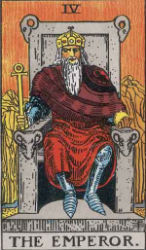
When we look at the Tarot card, The Emperor, we see the ultimate outcome of that paradigm.  Yes, he’s sitting on a throne and he’s powerful.  He’s also completely and totally alone, covered from head to toe in his armor.  Everything around him is a blasted, sterile wasteland. No friends.  No lovers.  No family.

He doesn’t even have a fucking robotic cat to sit on his lap.

When we talk about toxic masculinity, we mainly frame it in terms of the negative effects that it has on women who come into contact with it.  We tend to forget that it’s the men who are carrying all of those toxins around with us.  And it’s killing us.

Is it likely that white American males will begin to look at the female paradigm or perhaps people of color and try to figure out why we’re killing ourselves and they’re not?  Probably not.  On the other hand, artificial intelligence is improving by leaps and bounds.  It’s only a matter of time – hopefully a very short time – until we’ll all have robotic cats and dogs who can actually talk to us and help us deal with our emotional problems more realistically.

Here kitty kitty!  I have some brand new batteries for you, sweetheart.

I am very pleased to announce that my ebook, “Just the Tarot,” is now available FOR FREE on Amazon for anyone who has a Kindle Unlimited membership. The cheapest robotic cat that they offer is $113.00 so this is just one hell of a deal.

The Four of Pentacles, New Age Capitalists, and Buddha in an F-150 Pickup Truck

A look at the New Age fascination with money.

“I wanted to be able to help people financially.  If you have enough money, you can buy health.  A rich man can always find a woman.  If you have enough money, you can buy almost anything.” – Jerry Hicks

There is a very peculiar – and very strong – connection between the New Age/New Thought movement and good old American capitalism.

The Four of Pentacles shows a guy with his feet on money, holding money, and money on his mind, and that’s a LOT of the New Age movement and its leaders.

Mike Dooley, who is best known for his credo, “Thoughts become things,” was an international tax specialist for Price Waterhouse and his primary client was Saudi Freaking Arabia.

Prior to channeling Abraham, Esther Hicks was a business accountant and Jerry Hicks was THE leading Amway salesman in the United States.

Stuart Wilde made a fortune selling Mod clothing on Carnaby Street before he took up Taoism and made another fortune selling books about how spiritual it is to make a fortune.

Even the much beloved Ram Dass was born into a very wealthy family, never experienced a day of poverty or want, franchised his spirituality very successfully and died on his massive estate in Hawaii.

I have to admit that I was somewhat puzzled by the extreme emphasis on money and material possessions when I first stumbled into the New Age movement.  I started my spiritual journey as a young kid in a midwestern state, taking LARGE amounts of LSD, reading Tarot cards, and convinced that it really was the Dawning of the Age of Aquarius.

Racism, war and poverty would be eliminated.  We’d all live in peace and harmony and people would really and truly realize that love is all that matters.  Those were my dreams when I was a young man.

Duh.  I know.  It didn’t exactly turn out that way, did it?  Still, there was a nobility and a grandeur to the dreams that I think all young people should have. 

And so, when Mike Dooley talked about his dreams as a young man, I was a bit mystified.  “I wanted to make a million bucks, own my own private plane and travel internationally with a beautiful woman by my side.”

Or Stuart Wilde’s statement that, “Money doesn’t imply that rich people are spiritual but it does infer that poor people probably are not.”

Or the (I’m sure inadvertent but telling) juxtaposition in Jerry Hicks statement, “A rich man can always find a woman.  If you have enough money, you can buy almost anything.”

Esther and Jerry Hicks probably took the wedding of capitalism to spirituality further than anyone else.  Their basic position is that our desire for material goods – for the goodies in life – is what drives us into greater and greater spiritual growth.  In their view, we have a sort of an internal wish list that’s composed of things like boats, cars, money, houses. As we tell the Universe what we want, the Universe provides all of those things on the wish list.

BUT . . . as we fulfill one wish list, another list spontaneously arises and we want even more, which the Universe provides and then we want even more, and so on. 

Oddly, that very process is exactly what the Buddha described as the source of all suffering.  It’s the constant desire for more and more and more, without the realization that more is never enough to make us happy. One wish list will always be replaced by another.

What I eventually realized is that these people – despite being rampant, unapologetic capitalists – ARE spreading a lot of spirituality through the world, no matter how paradoxical that might sound. 

Here’s the thing:  American capitalism is the dominant force in the world right now.  And the lingua franca of capitalism is M-O-N-E-Y.  

Who are the people who are going to all of the seminars and retreats of the New Age gurus and buying all of the millions of books they produce every year?  They sure as hell aren’t Buddhist monks or old hippies.  

They’re business people.  Amway salesmen.  Used car dealers.  Advertising guys.  Executive secretaries and career women.  Their dreams aren’t about world peace or brotherhood; their dreams are composed of F-150 pick up trucks, big houses, ski boats, and, yes, all the women they can buy with their fabulous wealth.

The ironic thing about it is that as they’re attending the Let’s-All-Get-Rich rallies, they’re also getting a HUGE dose of spirituality.  What’s really behind the idea of visualization and manifestation is that the physical world is not at ALL what it looks like.  We really CAN manifest whatever we want, seemingly out of nothing.  Magic really DOES exist.  There IS huge abundance in the world and we can tap into it with the power of attraction.

These are exactly the same people who love to mock California woo-woos and think that psychics and sensitives are crack pots.  But there they are, hunkered down in their split level homes in Nebraska, Utah, and Kentucky, pasting together vision boards and writing out affirmations.

LOL – which is doing magic.  Plain and simple.  If you’re trying to make something appear out of nothing using the power of your mind, you’re casting a magic spell.  Surprise!

It’s all very bizarre and puzzling, but it’s an improvement.  It’s a definite improvement.