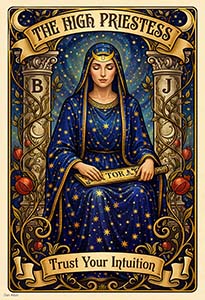
In my High Priestess affirmation poster, I chose the phrase:
“Trust Your Intuition.”
It sounds simple. Almost obvious.
And yet it’s one of the most misunderstood instructions in the entire Tarot.
We say things like:
“I have a feeling . . “
“I just have a hunch . . .”
“I’m getting bad vibes about this . . .”
All human beings have intuition — some more than others. Some people sneer at it as a primitive, pseudo-mystical leftover from a less scientific age. Others practically swim in it, using it as their primary guide through life.
Most of us fall somewhere in the middle.
We occasionally get flashes of clarity about which path to take and which to avoid. But most of the time we default to logic. We try to predict outcomes. We use our brains rather than our hearts.
And then sometimes — usually in hindsight — we think:
“Damn, I knew better . . .”
So it’s worth asking:
What is intuition… and what is it not?

It’s Not Fear
One of the biggest confusions we have is mixing intuition up with the limbic system — the ancient part of the brain responsible for fight-or-flight.
That system exists to keep us alive. It detects threat. It reacts instantly.
It was what warned our ancestors that something dangerous was hiding in the trees. We experience it today as:
- The hairs rising on the back of our neck
- A sudden jolt of anxiety
- The feeling that someone is watching us
That reaction can feel mysterious. But it isn’t mystical. It’s biological.
True intuition does not trigger fight-or-flight.
It doesn’t flood the body with adrenaline. It doesn’t tighten the chest.
Real intuition is calm.
It arrives quietly, with a sense of understanding. It clarifies rather than agitates. Instead of panic, it brings steadiness — a subtle reassurance that says:
“This is right – you’ll be okay.”
It’s Not Rapid-Fire Prediction
The brain is constantly predicting the future based on the past.
When we encounter a new situation, the mind instantly searches its archives for similar experiences. It matches patterns, runs comparisons, and projects possible outcomes — all in a fraction of a second.
We’re mostly unaware this is happening.
So when we say we “have a feeling” about someone, what we often have is a memory.
If we once had a terrible experience with a brunette woman wearing purple socks, we may feel wary of a new brunette wearing purple socks. We call that a vibe.
It isn’t.
Some people process these patterns so quickly that it seems magical. Certain personality types — INFJs and INFPs, for example — are especially skilled at rapid, intuitive-seeming synthesis.
But that process is still rooted in past data.
True intuition is different.
It is not logical.
It is not based on memory.
It may have absolutely nothing to do with what has happened before.
It is a clear message about the present moment — even when there’s no obvious reason you should understand what you understand.
It’s Not Fragmented
You may have met highly sensitive or empathic people whose lives are chaotic.
On the surface, that seems contradictory. If they absorb more information than most, shouldn’t they navigate life more easily?
Not necessarily.
When someone takes in too much external input without discernment, they can lose track of what belongs to them and what belongs to others.
If they’re near someone who is anxious, they become anxious. If they’re around anger, they internalize anger.
Soon they feel as if they’re having five contradictory “intuitions” at once.
But intuition does not contradict itself.
It does not conduct committee meetings in your head.
It does not present twelve equally compelling paths and demand that you choose one immediately.
True intuition is singular.
It points.
It does not debate.
Clear, Calm, and Quietly Joyful
Perhaps the greatest hallmark of genuine intuition is that it brings relief.
It removes doubt.
It dissolves mental noise.
It doesn’t shout. It doesn’t demand. It doesn’t come with fireworks.
It simply settles into you and says:
“Yes, this is it.”
And when it does, there is often a subtle happiness attached to it — not excitement, not mania — but a deep rightness.
That is the High Priestess.
She does not force reality.
She does not argue.
She does not panic.
She knows.
And when that knowing arrives within you, the work is not to question it endlessly — it is to honor it.
That is what “Trust Your Intuition” really means.
 Just the Tarot