Surviving the Season: A Light-Hearted Guide to Beating SAD Without Losing Your Mind

This post explores the realities of Seasonal Affective Disorder (SAD) with a humorous twist — why the winter blues hit so hard, how light deprivation messes with our brains, and what actually helps. From sunrise-mimicking light boxes to Vitamin D3 and CBT-SAD reframing techniques, this guide offers practical, affordable ways to lift your mood when the days get dark. Includes a free downloadable PDF of 15 winter affirmations to help rewire your thoughts and make the season feel gentler, brighter, and a whole lot more manageable.

Are you still suffering from the cosmic hangover known as the time change?

Maybe you can’t sleep at night but can barely keep your eyes open during the day. Maybe you’re stumbling through the month like a melancholy robot — mostly upright, mildly conscious, but deeply unimpressed with existence.

And isn’t it cruelly ironic that exactly when we’re all miserable from light deprivation, the government decides to turn the lights off an hour early?

Thanks, folks. Really helpful.

 Light and Happiness (a Love Story as Old as Humans)

Humans have a deep evolutionary connection with light — not metaphorical light, not spiritual light, not “good vibes” light — we’re talking about actual photons hitting your eyeballs. For centuries, nearly every culture has tried to cheer up the dark months by adding more light: bonfires, candles, lantern festivals, torches, flaming wheels, glowing turnips… you name it, someone set it on fire.

Even our pop songs know what’s up:

• You are the sunshine of my life.

• You light up my life.

• I’ve got sunshine on a cloudy day.

• Sunshine on my shoulders makes me happy.

But when there isn’t enough light?

We become depressed, anxious, sluggish, and mildly feral. We want to curl up under a quilt with a 40-pound bag of potato chips and hibernate until April.

In short:

Light = joy.

Dark = sadness.

This is not complicated.
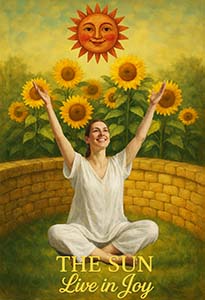
The Sun Tarot Affirmation Poster available on Etsy

 Seasonal Affective Disorder (SAD): The Winter Blues With a Capital B

The official psychological name for the winter blues is Seasonal Affective Disorder, or SAD — which is honestly too accurate. It ranges from “a little down” to “I may never be cheerful again and also don’t touch me.”

Depending on which study you read, SAD affects anywhere from 5% of Americans to 10 million people, with symptoms like:

• chronic sadness

• sleep pattern chaos

• irritability

• carb cravings

• emotional flatness

• hiding from society like a depressed woodland creature

If you’ve ever had it, you know what a total beast it can be. While everyone else is decking halls and singing carols, you’re sitting at home thinking:

“Crap… three more months of this.”

I’ve had SAD kick my ass more than once, so I was very happy to discover that it’s now the subject of its own therapeutic specialty:

CBT-SAD — Cognitive Behavioral Therapy for Seasonal Affective Disorder.

And it’s not as complicated as it sounds.

The Three Pillars of Beating SAD (According to CBT-SAD)

1. Increase Your Light

This one feels obvious:

If darkness is the problem, light is the solution.

But not just any light.

You need a blast of sunrise-level brightness first thing in the morning — something that tells your brain:

“Hello, it’s daytime, stop making melatonin.”

Enter: the mood-enhancing light box.

These used to be huge contraptions you practically had to strap to your head. Now they’re about the size of a tablet, reasonably priced, and honestly kind of pleasant.

Light boxes work because they:

• mimic sunrise

• raise serotonin

• lower melatonin

• reset your circadian rhythm

• tell your brain to get out of bed and stop being a raccoon

This is the one I use because it’s inexpensive and has great reviews:

2. Vitamin D3 (Your Winter Sunshine Backup Plan)

We naturally get Vitamin D from sunshine — so of course, in winter, our levels tank. Add the fact that we’re bundled head-to-toe like sentient laundry bags, and you’ve got the perfect recipe for deficiency.

Low Vitamin D contributes to:

• low serotonin

• flat dopamine

• brain fog

• irritability

• low energy

• general “I’m over this” mood

Supplementing D3 helps stabilize:

• serotonin

• dopamine

• inflammation

• sleep-wake cycles

• mood regulation

And best of all: it’s cheap.

You can grab it on Amazon or at the pharmacy.

3. Reframing the Way You Think About Winter

This is where the cognitive part comes in.

My sister once pointed out that constantly referring to winter as “the dark times” might not be the healthiest mindset. Fair enough.

If we’ve had rough winters in the past, we tend to brace for them like emotional storm preppers:

• “I hate winter.”

• “I dread those long dark months.”

• “Wake me up when it’s spring.”

These thoughts become self-fulfilling prophecies.

CBT-SAD teaches us to rewire those expectations and rewrite our inner scripts — not with toxic positivity, but with seasonal intelligence.

For example:

• Winter is not the enemy — winter is the exhale.

• Early nights are invitations to gentler evenings.

• Light is scarce now, so I become intentional with it.

• Winter is not a shutdown — it’s a recalibration.

These reframes help your brain reinterpret winter as:

• restorative

• quiet

• intentional

• gentle

• rhythmic

Instead of something to dread, it becomes something to work with.

I’ve included 15 winter reframes as a free downloadable PDF that you can get by clicking here:


Final Thoughts (and a Pep Talk)

If SAD is hitting you hard, it’s worth finding a good therapist who understands seasonal depression. But even without professional help, these three pillars can make a huge difference.

Hopefully, this little article gives you a few ideas about how to get the Bah Humbug out of your brain and bring some light back into your winter.

And remember:

Light returns. It always returns.

Thought-Forms, Astral Pornography, and The Ace of Wands

Are our thoughts actually energy forms?

A few years ago I was reading a fascinating book called, “You Are Not Your Brain,” and the authors made a statement that was positively shocking to me:  “To this day, scientists and psychologists cannot agree on exactly what a thought is.”

At first blush, that sounds completely ridiculous because we all know what thoughts are.  They’re . . . um . . . they’re like . . . these little things that jump up in our heads and live in our brains, right?  

There . . . I solved that one.  You’re welcome.

Seriously, though, there really isn’t a good working definition of what a thought actually is.  There’s a sort of reductionist explanation of how our nervous systems and brains produce thoughts.  We can hook someone up to a brain monitor and see which parts of their brains light up with activity when they’re thinking about a particular subject.  Perhaps their fear center – the amygdala – lights up because they’re thinking of something really scary.  Or their prefrontal cortex – the thinking brain – lights up because they’re doing some heavy problem solving.  

That doesn’t really do anything but describe the process of making the idea, though.  It doesn’t tell us what the finished product is.  That theory – that the brain makes ideas – exists cheek by jowl with the stimulus/response model where something in our environment makes us think certain things.  Perhaps we see a picture of Donald Trump and we think, “Ohhh, scary clown,” which makes us think of circuses which makes us think of Stephen King horror novels about murderous clowns which makes us think about our overdue library book.

That concept seems to be counter-intuitive when we think about . . . well . . . intuition.  When we have  intuitions or  flashes of insight, it feels as if they’ve popped right up in our brains without anything else making them happen.  When someone asked Einstein how he invented the theory of relativity he said, “Oh, it just dropped in while I was playing the piano.”

For centuries, human beings viewed some types of ideas in just that way:  as something that came into our minds from an outside source.  That’s why the word, “inspire,” means to have something breathed into you.  The notion was that something out there – perhaps the Universe or the Gods or the fairies – inserted the idea into your mind.

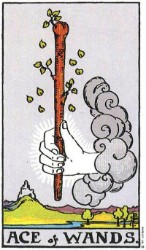
That’s what’s portrayed in the Tarot card, The Ace of Wands.  Wands represent ideas and this is an idea or thought coming into the world in its purest form of mental energy.  It’s, “divinely inspired.”

That STILL doesn’t tell us exactly what an idea IS, though.  It’s just talking about it’s source, rather than it’s contents.

Now, the Theosophists and Victorian occultists had very specific ideas of exactly what an idea is.  They viewed ideas as thought-forms, which is to say, individual little packets of energy produced by our brains and emotions and auric fields.  And – important point – they felt that they were independent of the human being once they were produced.

We’ve all seen those cartoons where there’s a person having a thought that appears as a bubble with text in it, hovering over the character’s head.  That’s a convenient way to visualize what the Theosophists were talking about.  Every time that we have a thought, it’s like our bio-field – our brains, emotional energies, energy bodies – are extruding a little, tiny thought-form bubbles that exists outside of us.

Most of the bubbles don’t last very long because they don’t contain much energy.  Let’s face it, many of us are NOT thinking about the theory of relativity while we play the piano.  Instead, we’re having really profound thoughts like, “Where’d I put my car keys?  Need a cup of coffee.  Gotta walk the dog.  Did I do the laundry?”   So these are little bubbles that appear for a moment, pop, and disappear.

When the thought forms are really heavily charged with energy, though, they stick around.  How do they get charged?  Well, through emotions and through repetition.

Suppose you just went to bed with someone and you had a super-duper, unbelievable, I-think-my-ears-just-fell-off orgasm at the exact moment that you thought, “I love you.”  That, “I love you,” thought is super-charged with energy and it will last.  Ditto, if you’ve been badly shocked or frightened by something.  The more intense the emotion, the more of an energetic charge the thought-form has and the longer it will exist.

We can also charge the thought-forms with energy by thinking of them over and over and over.  On a positive note, we can see that happen when someone thinks of their lover constantly, as we tend to do in the early stages of falling in love.  The obsessive thinking keeps adding energy to that same, “I love you,” thought-form and makes it’s last.  On a negative note, we can see the same pattern with chronic anxiety and depression.  Constantly thinking of things that frighten us or make us sad just increases the charge in the thought-forms and so the depression will linger long after the original cause.

Two of the early Theosophists, Annie Besant and Charles Leadbeater, published a book called, “Thought Forms.” It had illustrations of the forms as they emerged from people’s auras, as seen by psychic mediums.  Here’s one of a peaceful thought:

And here’s one of an angry thought.

I would have liked to have seen one of a horny thought – sort of astral pornography, I guess – but the Victorians didn’t roll that way.

So is all of this true?  Maybe.  It certainly forms the basis for much of what we call visualization and manifestation, as well as the concepts of either cursing or blessing someone.  I’ll be writing more about that in the immediate future but for the time being it’s a fun concept to play with.  What if our thoughts are actual things that exist in our personal energy space and exert an influence on us and those around us?  How can we change the negative thought-forms and increase the positive-forms?  Can we pick up someone else’s thought-forms, much like a virus?

Before you dismiss the idea out of hand, remember what we started off with here: the most preeminent psychologists and scientists in the world have absolutely no idea what a thought is.  The theory of thought-forms is just as good – and maybe better – than most of their theories.

Remember that my e-book, “Just the Tarot,” is still available – dirt cheap! – on Amazon. In fact, I’m sending thought-forms at you right now. You should buy this book . . . you should buy this book . . . you should buy this book . . .

The Emperor, Psilocybin, and Butterfly Warriors

A look at the role of psilocybin in erasing toxic masculinity.

And then there’s the amazing case of Mark Matzeldelaflor.

Mark was a Navy Seal.  In case you’re not familiar with that, the Seals and the Green Berets are the ultimate warriors.  Incredible athletes, highly disciplined and impeccably trained, they are considered the finest combat soldiers in the world.  

Mark was also a professional sniper in the Seals.  His job was to kill other human beings by shooting them with high powered rifles, as rapidly and effectively as possible, and he was very good at it.

After serving two tours in Iraq, he left the military and returned to the West Coast, where he became an emotional and spiritual shipwreck.  He drifted from one meaningless job to another, drank too much, suffered from horrible PTSD and sank into depression and suicidal ideation.

Then one day a buddy of his said, “Hey, man, why don’t you take some Magic Mushrooms with me”. And it all went away.  All of the trauma, all of the depression, the alcoholism, the PTSD – it vanished from his heart and brain like . . . well . . . magic.

Mark immediately started trying to use his new world view to help other veterans and started an organization called Guardian Grange.  The idea is to use the discipline and talents that they’ve acquired in the military but channel that into helping to save the earth.  And their first project is . . . a refuge for monarch butterflies.

Now, I’ve written quite a bit here about toxic male role models and I find this story so amazing from that perspective.  When we think of the classic toxic male, we tend to envision a guy who’s taken a few too many steroids, muscular, swaggering, fairly devoid of emotions, unable to admit any vulnerabilities, and a bully.

That kind of a guy becomes a sort of a silly cartoon when you put him up against the reality of a Navy Seal.  These are men who can run or swim for hours with no rest, survive in a jungle or desert with no food, and kill with no mercy or compunction.

So how does someone who is literally a stone cold killer suddenly become a Butterfly Warrior?  It’s fascinating to think about, isn’t it?

The normal cultural model for male/female behavior is based on hormones.  To put it in a nutshell, men are chock full of testosterone and that makes us aggressive, dominant, and violent.  Women are flooded with estrogen, and that makes them passive, nurturing, and weak.  That model was given a huge boost by Sigmund Freud, a man who wanted to fuck his own mother and thought the clitoris was utterly unimportant in female sexuality.

Despite it’s rather shaky logic and dubious proponents, that remains the model that most people operate out of:  we’re simply predetermined products of our hormones.  But what if we’re not?

Scientists are just now beginning to really dig into what psilocybin does to the human brain.  They know, for instance, that it has some sort of a strong interaction with serotonin and pleasure receptors, meaning that it makes us happier.  They know that it vastly increases the connectivity between different parts of the brain, so that parts of our brain that don’t usually, “talk to each other,” are suddenly communicating.  They know that it suppresses activity in other parts of the brain, such as the portion that maintains our sense of self and ego.

Still, there’s much more that we DON’T know about how Magic Mushrooms affect our brains than what we DO know.  Somehow it erases depression, anxiety, PTSD, and suicidal ideation.  And – I suspect – it may also erase toxic male role modeling.

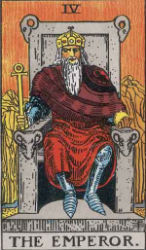
My symbol for the Male Archetype in our culture is The Emperor.  He’s strong, he’s heavily armored, he’s living in a barren environment, and he’s very much alone.  He rules, but he’s paid a heavy price for his crown.  He is, above all else, disconnected.

One of the best descriptions I’ve read of what psilocybin does to the human brain is that it’s just like a snow globe.  It picks up our brains, gives them a good shake, and a lot of our normal neural pathways are disrupted and fly off in totally new directions.  If you’re more into mechanistic models, it seems to instantly rewire our brain patterns.

Dig what Mark said in that interview:  “I just reconnected to nature and my past, where I was like a kid in the woods.”  That description is what we hear from many other people who have taken psilocybin:  an instant sense of reconnection with the earth and with meaning.

Now, there’s no suggestion that psilocybin caused a huge drop in Mark’s testosterone levels or that he suddenly became a eunuch and that’s what took away his aggression or his toxic male role modeling.  He simply instantly learned how to be a male in an entirely different way than what WE ARE TAUGHT that it means to be a male.

All of this is strongly indicative that, “manhood,” is much more in our heads than it is in our testicles.  Toxic masculinity may very well consist of a series of enculturated neural pathways that are so deeply burned into our brain tissue that they’re nearly impossible to overcome.  Unless someone picks up that snow globe and gives it a good shake.

We can’t expect that taking psilocybin will turn our culture around anytime soon.  For one thing, we’re taught from the cradle that some form or another of toxic masculinity is good, that this is the way that a real man behaves.  For another, there’s no money to be made by the pharma industries where psilocybin in concerned.  It’s out there and it’s relatively cheap, so why manufacture it?

Still, it’s a start.  If a man who was the most efficient killing machine the military can manufacture can suddenly turn into a warrior for butterflies that’s . . . a miracle.  

There’s hope.

Another way to almost instantly expand your consciousness is to buy my ebook, Just the Tarot, available dirt cheap on Amazon.

The Emperor, Robotic Cats, and Suicide Among Elderly Men

Examining the reasons for the high suicide rate among elderly males.

I was just reading an article about suicide in the elderly and the author – a certified therapist with a PhD, mind you – suggested that a good preventative might be a robotic cat or dog that we could talk to and sleep with.  That way, we wouldn’t be lonely and, if we weren’t lonely, we wouldn’t be offing ourselves at record numbers.

Now, if you weren’t already suicidal, the idea of having to get a little cat robot to be your best friend would surely drive you over the edge.  It’s such a radiant example of NOT understanding suicide in the elderly that it’s almost breathtaking.

Here, kitty kitty!  Oh, shit, her batteries are dead.  Might as well just kill myself.

The, “reasons,” for elder suicide are all over the place.  According to the experts, it’s because we’re lonely, or we’re socially isolated, or we’re sick, or we don’t have jobs anymore, or our spouses died, or we’re invisible in a youth-culture, or we never get touched by anyone.

My very favorite is that elderly people commit suicide because they’re . . . drumroll, please . . . depressed.  

You think?

After spending several days combing through articles and studies about why elderly people kill themselves, I came to two conclusions.  One – nobody really knows why.  Two – nobody is very motivated to find out.  From a purely dollars and cents perspective, it doesn’t make a lot of sense to social scientists to study elderly suicide because – hey! – old people are, you know, old.  Why spend a ton of money studying how to keep them alive when they’re supposed to die soon anyway?

They have pretty much pinned down the people at the highest risk. The person who is most likely to commit suicide in the United States is an elderly, white, male, introvert with a family history of suicide.

Males kill themselves four times more than females.  Apparently it’s one of our special skills, though it’s probably best to not note it on our resume’s.  No surprise, then, that those statistics would go across all of the age groups and extend into old age.

I can also understand the factor of the family history of suicide.  Perhaps that’s just a genetic predisposition to depression, but once you’ve seen suicide modeled in your own family, it’s hard to unsee it.

Introversion is a little harder to grasp, because it exists across such a broad spectrum and means so many different things to different people.  About 52% of the general population are introverts but most of them are obviously not suicidal.

Researchers have been quick to make the leap from introversion to loneliness and social isolation, though.  Under that model, introversion = social isolation, which = loneliness, which = depression which causes suicide.

Leaving aside the fact that those us with robotic cats are hardly lonely, other statistics would seem to refute this approach.  Elderly women actually report much higher levels of feeling socially isolated and much higher levels of feeling lonely than elderly men.  If there was causation from those factors, we’d expect to see the gender statistics reversed, with women killing themselves at four times the rate of men.

There’s another interesting difference we can discern when we look at a recent study from UCLA.  Dig this:

“What’s striking about our study is the conspicuous absence of standard psychiatric markers of suicidality across all age groups among a large number of males who die by suicide,” said Kaplan, a professor of social welfare at the UCLA Luskin School of Public Affairs. They found that 60% of victims had no documented mental health conditions.

In other words, the standard perception of suicide as being caused by long term mental illness simply isn’t born out.  Suicidal men aren’t crazy, they’re just suicidal.

So, if elderly men aren’t killing themselves because they’re more lonely, more isolated, crazier, or more introverted than everyone else, what’s causing it?

I suspect that a large part of it may lie in another part of the description, which is, “white male.”

Of all of the many groups in the United States, there is no group that is more likely to fully participate in the toxic masculine paradigm than the Caucasian male.  We have, simply by being born with white skin, more access to the education and financial resources that enable us to become completely enmeshed in the insane pursuit of money, power, and position.  We abandon our own authenticity in that lifelong pursuit.

When we look at the Tarot card, The Emperor, we see the ultimate outcome of that paradigm.  Yes, he’s sitting on a throne and he’s powerful.  He’s also completely and totally alone, covered from head to toe in his armor.  Everything around him is a blasted, sterile wasteland. No friends.  No lovers.  No family.

He doesn’t even have a fucking robotic cat to sit on his lap.

When we talk about toxic masculinity, we mainly frame it in terms of the negative effects that it has on women who come into contact with it.  We tend to forget that it’s the men who are carrying all of those toxins around with us.  And it’s killing us.

Is it likely that white American males will begin to look at the female paradigm or perhaps people of color and try to figure out why we’re killing ourselves and they’re not?  Probably not.  On the other hand, artificial intelligence is improving by leaps and bounds.  It’s only a matter of time – hopefully a very short time – until we’ll all have robotic cats and dogs who can actually talk to us and help us deal with our emotional problems more realistically.

Here kitty kitty!  I have some brand new batteries for you, sweetheart.

I am very pleased to announce that my ebook, “Just the Tarot,” is now available FOR FREE on Amazon for anyone who has a Kindle Unlimited membership. The cheapest robotic cat that they offer is $113.00 so this is just one hell of a deal.

The Pragmatism of Happiness, Colliding with Bubbles and The Five of Wands

The pragmatism of choosing to be happy.

Maybe we’re just meant to be happy.

That may sound a bit simplistic and silly on the face of it.  “Duh . . . who doesn’t want to be happy?”  Still, when we consider all of the hoops we jump through in order to NOT be happy, it’s kind of amazing.  Happiness, for many of us, always seems to be a future event rather than something we enjoy in the present moment.

  • I’ll be happy when I finally get out of high school.
  • I’ll be happy when I finally get laid.
  • I’ll be happy when I get a good job.
  • I’ll be happy when I get that new computer.
  • I’ll be happy when I get a new car.
  • I’ll be happy when I fall in love.
  • I’ll be happy when I get married.
  • I’ll be happy when I get divorced.
  • I’ll be happy when the kids are grown up and I have some time for myself.

And on and on and on.  That approach is valid, to a certain extent.  We do get some measure of happiness from all of these things and events, but it never seems to last.  It never seems like real happiness.  It’s like we’re microdosing instead of getting the whole pill.

One of the problems is that we always look at happiness as something that happens to us, rather than something we generate on our own.  We see this reflected in the way that we talk about the process.  “You make me happy.”  Or, “this made me sad.”  Or, “I couldn’t believe how happy that made me feel.”  

The way we verbalize it sounds like there are these bubbles floating around the universe that we occasionally have collisions with and it changes the way that we feel.  “Uh, oh, I just ran into a sad bubble, so I’m sad now.”  Or, “Oh, man, that happy bubble felt good.  Yay!”

Since we don’t control those sources of happiness, since they’re things that happen to us rather than by us, we never feel as if we control our own happiness.  Yes, we can try to maximize our lives so that we run into more happy bubbles than sad bubbles.  We can get rid of the negative people in our lives.  We can find jobs that don’t totally suck.  We can intentionally pick out books or videos that are uplifting, rather than depressing.  But that’s still giving that power of happiness away to exterior sources.  We’re still just trying to control the exterior sources rather than realize our own ability to be happy just because we want to be.

So a good first step in being happy is to just claim our own emotional states.  That means realizing that our happiness, sadness, joy, depression, anger, love, etc. are all things that we are generating ourselves.  They don’t come from outside of us – we’re making them up as we go along.  

Put another way, it’s not a simple stimulus/response interaction.  We don’t have to automatically respond to our life’s events in certain pre-programmed ways.  We can – and do – interpret them.  We just usually interpret them in a very unconscious way.  We’ve been taught that some events are supposed to make us sad and some events are supposed to make us happy and we never stop to question why.

For instance, marriage = happiness and divorce = sadness.  We accept that equation instantly, despite the fact that about half the marriages in our country are miserable experiences and divorce often feels like being let out of a prison.  As the bumper sticker says, “It is better to have loved and lost than to go on living with a psychopath.” 

Now, once we’ve gotten there, when we’re willing to accept that WE are making our own emotions happen rather than colliding with random happy or sad bubbles, then the next step is to actually ask ourselves why we’re choosing those emotions.  A good yardstick to use in that process is evaluating whether they’re actually doing anything for us.  Are they making our lives better?  Are they moving things forward?  Are they improving the quality of our lives?

By way of an example, I used to love, love, LOVE my self-righteous anger.  If I really, genuinely felt that I was right and someone else was wrong, I was willing to argue all night and fight to the death to defend my position and change the other person’s opinion.  I was angry because I had every right to be angry.  

In my defense, I don’t think I’m exactly alone in that process.  Social media groups often feel like the Five of Wands, where everyone is madly swinging their opinions at everyone else, all of us sure that we’ve got the real skinny on what’s true and what’s not.  Our current politics are even worse.

A peculiar thing happened to me, though, where I reached a point of realization that anger just didn’t work very well.  It was this sudden revelation that every single time I got angry, it made things worse instead of better.  Every single time.  Without fail, if I lost my temper I ended up with shit on my shoes and feeling like hell.  Far from changing anyone’s mind about the issue we were arguing over, it just convinced them that I was an angry asshole and there was no reason to listen to me.

And so I just gave it up.  Sure, I get irritated or impatient, just like any other human being, but I haven’t been angry in several years.  Not because I’m some kind of Mahatma Gandhi, but simply because it doesn’t work.  It’s like trying to use the wrong key to start your car.  If you know it’s not going to work, why would you do it?

In the same sense, sadness and depression are emotions that just don’t work very well for human beings.  They make life a lot harder, instead of a lot easier.  They freeze us in place and keep us from attaining our goals and feeling connections with life and joy.  

They are basically an unnatural act, in the true sense of that term.  When we look at young critters, what’s their primary activity?  Play.  Puppies, kittens, young humans, young apes, any young being gets up in the morning and plays until they’re so exhausted that they fall over.  And then they get up and do it again.  We’re born happy and we have to learn how to be unhappy.

Now, it’s true that into every life a little shit must fall.  We aren’t going to feel happy and positive when someone we love has just died or we’ve just gotten run over by a truck.  About 90% of the time, though, NOTHING IS WRONG.  That means that in about 90% of our lives, we can make that simple choice of how we’re going to feel:  happy or sad?  Can you imagine having a life that was 90% happy?  Sounds pretty good, doesn’t it?

It doesn’t have to be some bold, existential statement, either.  It doesn’t have to be some phony Pollyanna stance that everything in life is sweetness and light.  It can be a simple act of pragmatism.  Happiness makes us feel connected with life and our fellow beings.  We move forward toward our goals and opportunities for growth seem to appear out of nowhere.  Depression makes us miserable and we feel that we have no choices and no growth in life.

In a nutshell, depression doesn’t work very well.  Sadness doesn’t work very well.  We can give them up, just like a bad habit, because ultimately that’s all they are.  

The Five of Cups and the Dark and Magical Path to Happiness.

Happiness as a choice, rather than just a state of being.

The Five of Cups shows a person who is in deep grief.  He’s lost something vital in his life and he’s mourning it on the deepest, most profound  level.  In the system of the Tarot, Cups represent emotions and he sees three of his cups lying on the ground, tipped over, and spilling out their emotions.  He’s literally hypnotized and immobilized by his sadness.

A sub-theme of this card is that he is also NOT focusing on the two remaining cups, which are upright and full.  He is so concentrated on what he’s lost that he’s not perceiving that he still has something left to be grateful for.

Happiness is one of those things in life that we seldom contemplate until we lose it.  Most humans are born happy.  Sure, there are the inevitable times when babies get, “fussy,” or decide to stay awake screaming their little heads off all night, but most young critters are happy, playful and content.  It doesn’t matter if we’re talking about human babies, puppies, kittens, or deer, the young are pretty much happy, pretty much most of the time.

So in many ways, happiness is a birthright of most living beings.  It’s also frequently a matter of inertia – objects in motion tend to stay in motion and happy people tend to stay happy.  We don’t even think about it until it disappears – we’re just pretty much happy, pretty much most of the time.  In the words of the old blues song, “You don’t miss your water ‘til your well runs dry.”

We’re told that into each life a little shit must fall, and, sure enough, we all suffer a certain amount of loss and grief.  We all have loved ones who die or become very ill, we get fired from jobs, we go through separations and divorces, and we occasionally get into car wrecks or fall down and break something that we’d rather not have broken. 

Thankfully, for most of us, those losses come in fairly measured doses and we have enough support built into our lives to recover and return to our natural state of happiness.  But there are also those of us who get absolutely hammered by loss and grief.  Who don’t just experience the death of loved ones, but the tragic death of loved ones.  Who don’t just go through a divorce but go through a devastating divorce, lose their homes, lose their jobs, and find themselves out on the street with nothing but the lint in the pockets of their overcoats.  Who not only lose their happiness, but lose it for a LONG time.  

Oddly, those are the people who probably appreciate happiness the most, because they’re the people who were forced to live without it.  They’re the people who had to fight to regain it, often alone, frightened, and hopeless.  To my mind, they’re some of the real heroes in life, the spiritual warriors who made it back from the dark side, from the brink of madness and suicide.

If you’ve ever gone through that kind of a loss, you’ll know what I mean.  If you’ve suffered a major nervous breakdown, or battled with alcoholism and addiction, or lived with crippling depression, you know what it’s like to be so down that you can’t even see up anymore.  Life becomes a meaningless, seemingly endless, series of days and nights filled with darkness, sadness, and extreme anxiety.  You don’t really know why you go on living, but you do, putting one foot in front of the other and slogging along toward nothing.

Now, some of us don’t make it back from that journey into darkness.  Some of us get swept over the precipice into oblivion.  Suicide is the 12th leading cause of death in the United States.  In 2020 there were 1.2 million suicide attempts in the country and nearly 46,000 successful suicides.  Those are, of course, only the suicides we know about because many of them are concealed.

For those of us who do make it back, happiness becomes a desperate quest and a practice.  We realize at some point that if we’re going to stay alive we somehow have to find a way to recapture happiness and build it back into our lives.  For some of us, that means finding a really good therapist to help us unravel all of the emotional knots and heal the psychic wounds.  For others, the gateway to happiness is the doorway to an Alcoholics Anonymous meeting hall.  Perhaps happiness arrives in the form of a prescription for Prozac or a spiritual reawakening or even a psilocybin mushroom. 

Happiness doesn’t arrive all at once, neatly bound in wrapping paper and ribbons.  It’s something that we carefully build back into our lives, one trembling step at a time.  We may need to learn how to control our thoughts that obsessively lead us back to melancholy view points.  We may need to learn how to control our emotions and just do some deep belly breathing and meditation when we feel overwhelmed with sadness.  We may need to sit down with a therapist and do some serious exploration of why our paths crumbled under our feet.

Happiness at that point is transformed from a natural occurrence into a set of skills that we practice in our daily lives.

For me, one of the major breakthroughs was my therapist teaching me that we can be happy whenever we want to be.  We can sit down, meditate on something that makes us happy, and we will feel happy, even if just for a few moments.  If we string together enough of those meditations, we have a happy day.  If we string together enough of those days, we have a happy life.  It’s a skill.  It’s a practice.

The other day I was listening to this delightful video from author Mary Pipher about her book, “Women Rowing North.”  

The book is primarily about women and about aging, but it also has a lot of good information on happiness.  One of the things she said that really jumped out at me is that happiness is an existential choice.

There’s a deeply profound lesson in there because happiness can’t be a choice until we’ve lost it and then we’ve finally learned how to regain it.

When happiness is just our natural state of being, we’re on spiritual cruise control.  When we’re pretty much happy, pretty much most of the time, like puppies and kittens and babies,  we’re not choosing happiness – we just ARE happy.  And happiness is frequently perceived as something that’s outside of us, that happens to us, rather than something we create.  We meet the right partner, we stumble into a good job, we have a nice summer, we get laid, we see a funny movie.  It’s all a sort of a pleasant parade of sweet events that we have absolutely no control over.

When we lose our happiness – really and truly lose it for an extended period of time – and we learn how to recreate it in our lives, then it becomes something that we can control.  It becomes a product of practicing certain skill sets like meditating, staying in positive thinking, avoiding negative situations and people, and performing all of the little mental and emotional hygiene tasks that are required to stay in a state of happiness.  We’re trying to stay in a state of happiness because we KNOW that we’ll die if we don’t.

There’s a step beyond that, though, which is what Mary Pipher is talking about.  When we practice happiness long enough, there comes a wonderful day when we realize that we CHOOSE to be happy.  At that point, happiness isn’t just a survival mechanism, it isn’t just a way to avoid the darkness.  It’s an active, conscious embrace of the Light.  Happiness isn’t just a way to get along, it becomes our primary value and our choice and we know that we’ll never live without it again.

It’s a huge gift in life.  We only find it at the end of some very dark paths, but when we reach that point we realize that the journey has been a magical quest that led us to our own inner light.

Loneliness, the Five of Pentacles, and Robin Williams

Some mornings I wake up feeling six kinds of crazy and twenty kinds of lonely.

There’s an old song that Don Mclean wrote about Vincent Van Gogh that has the verse:

“Now, I understand, what you tried to say to me,

How you suffered for your sanity . . .”

And the truth is that there are a lot of us out here who, “suffer for our sanity.”  We live through dark times, alone times, times when we’re so depressed, so far down emotionally and spiritually and energetically, that the pistol to the head, the bottle of pills, the fifth of whiskey calls out to us like the sweet voices of the Sirens.  “Come here, baby;  let me wrap my gentle arms around you and we’ll just be so peaceful and sweet and the pain will stop.”

For the most part, most of us survive.  We don’t take that path that Vincent walked down, we cling to our lives and our dreams, and we keep trying, even though we feel six kinds of crazy and twenty kinds of lonely.  We don’t embrace the Siren’s gentle arms and drift off into forever.

Many of us become highly adept at hiding our pain in plain sight.  We’re the funny ones, the comedians, the people who are always laughing, many times at ourselves and the sense that our lives are ridiculous.  Remember when Robin Williams killed himself and so many people were shocked?  “What?  Robin Williams?  How can that be?  He was always kidding, always joking.  Why would he kill himself?”

Six kinds of lonely and twenty kinds of crazy.  That’s why he killed himself.  To those of us who live out here on the fringe, it was no surprise at all because we recognized him as one of us.  In his senior album at Redwood High School he was voted both, “the funniest,” graduate and the graduate, “who is most likely NOT to succeed.”  

That speaks volumes to those who can hear.  Yes, we like him, but, man, he is NOT one of us.

The Five of Pentacles has always struck that same chord for me.  The two beggars are, above all else, outsiders.  They struggle along in the snow storm, crippled, wrapped in rags, while behind them a joyous light shines through a church window.  One imagines the parishioners inside: fat, happy, warm, singing songs of praise to Jesus, not even aware of the people outside their window who are, “suffering for their sanity.”

They are NOT one of us.  They don’t belong.  They are Out Siders.  Literally.

If you’re six kinds of lonely and twenty kinds of crazy, that’s probably a big part of your reality.  You don’t belong.  You’re not part of the group.  You don’t fit, “in.”  That’s certainly been my experience.  I’m in my late sixties and I still feel as profoundly isolated as I did when I was a kid.

So how do we deal with that?  If we are really and truly the odd ducks, the square pegs that don’t fit in the round holes, the crazy outsiders who don’t have a place in the herd, how do we NOT stumble into the same endings as Robin and Vincent?

I think that a good beginning is to just HONOR our weirdness.  And I really mean, “honor,” it.  Robin Williams and VIncent Van Gogh were worth a million – no, two million – bank executives and lawyers and accountants and other very, very successful people.

Why?  Precisely because they WERE outsiders.  They saw the world differently and they held up a mirror or a canvas and they said, “Look!  Can you see it?  Can you see the way it looks to me? Can you see the starry night?  Can you see how funny and amazing all of this is?”

Being alone is HARD, man.  Many people have been touched by that, perhaps for the first time in their lives, during this pandemic.  Being physically alone, not being touched, not being hugged, and loved and cherished – it’s all hard.  But being alone for all of your life, feeling like you’re always on the outside of that church window looking in . . . that’s the hardest.  That’s twenty kinds of lonely, if you let it be.  That’s six kinds of crazy, if you let it be.

The Hermit is very much alone.  He stands aside from the rest of society but he also holds up a shining lamp in the darkness.  He honors who he is, and he realizes that his wisdom is a gift to the world.  Make no mistake about it, though:  he’s been lonely and he’s been crazy and he’s suffered for his sanity, but he won through in the end.  It’s just a path that some of us have to walk.

Shine on!