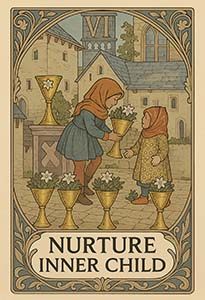
The Six of Cups reminds us that our creativity flows from the innocence of the inner child. Protecting that child means honoring your art, choosing who sees it, and never letting careless criticism silence your joy.
When Beauty Meets Criticism
Have you ever created something you thought was beautiful — a painting, an essay, even a garden — and when you finally shared it, the first thing someone did was point out the flaws? Instead of seeing what you were trying to express, they zeroed in on what they thought was wrong.
There’s always a tension between creating and sharing. When we make something real — assuming we’re not just hacking away — we’re revealing a piece of our heart, our soul, our lived experience. A careless critique can feel like a personal attack. It can leave us feeling exposed, vulnerable, even ashamed.
The Inner Child at Play
Picasso once said, “All children are born artists; the problem is to remain an artist as we grow up.” Creativity flows from the same source as play — from the child who once molded mud into castles or splashed finger paints across paper just for the joy of it.
That inner child still lives inside us, but it’s easily wounded. A thoughtless comment can silence it. A dismissive tone can make it retreat. And when that happens, the creative flow — the very essence of who we are — begins to dry up.
The Birth of the Critic
Mel Brooks joked that with the birth of art came the inevitable afterbirth — the critic. And he wasn’t wrong. If you take your creativity seriously, you’ll eventually encounter people who feel compelled to “fix” your work.
Julia Cameron wrote that before we can become good artists, we must first give ourselves permission to be bad ones. Every artist, writer, gardener, or musician produces clumsy beginnings — and even seasoned creators sometimes turn out a piece that just doesn’t land.
The creative process is messy and human. Yet while you’re admiring what went right, someone else may focus only on what went wrong.
The Wound of the Inner Artist
Cameron also warned that exposing your inner artist to harsh criticism is the emotional equivalent of child abuse. It’s like taking the eager, innocent child who offers you their finger painting and saying, “That’s terrible. You don’t really have any talent, do you?”
If you choose a creative life, criticism is inevitable. Some people simply won’t resonate with your vision, and occasionally you’ll make something that misses the mark. That’s part of the territory. But you can — and must — protect your inner artist with the same fierce loyalty you’d show a child under attack.
Learning by Heart
I became an artist late in life and am entirely self-taught. I picked up a mallet and chisel and learned to carve wood through trial, error, and stubborn joy. I learned to paint the same way.
Looking back, I can see how rough those early pieces were — primitive, awkward, untrained — and yet they were full of life. I still remember the pride I felt each time I saw progress take shape beneath my hands.
Claiming the title artist took courage. The first time I walked into a gallery and asked, “Would you show my work?” was absolutely terrifying.
A Pact of Protection
One simple, unbreakable pact guides me still: when someone criticizes my art, that’s the last time they see my art.
Showing your work is an act of intimacy — an unveiling of something deeply personal. The art flows from the child within you, and that child deserves protection.
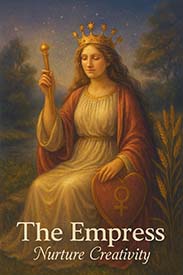
We’re all born creative—but somewhere along the way, we forget. This post explores how to reconnect with your natural creative spark by nurturing it gently, playfully, and without judgment. Centered around the Empress Tarot card and the affirmation “Nurture Creativity,” this is a soulful guide to reclaiming your artistic joy, silencing your inner critics, and remembering who you really are.
We are born creative. That’s not poetry—it’s biology. The moment a child is given space, they draw in the dirt, sing nonsense songs, build forts out of chairs and blankets. As Picasso once said, “Every child is an artist. The problem is how to remain an artist once he grows up.”
Substitute the word artist with creative and the truth holds. It’s not just painters or poets or musicians who are creative—it’s gardeners and cooks and problem-solvers and dreamers. Creativity is our birthright. The trouble is, somewhere along the way, we forget that.
That’s why when I created the affirmation poster for The Empress, I chose the words: “Nurture Creativity.” She’s not just a symbol of beauty or abundance—she is the Earth Mother of inspiration itself. Her power doesn’t lie in striving or perfection. It lies in growing, tending, and trusting.
So What Happened?
If we’re born creative, why do we have to learn how to nurture it?
Because somewhere along the line, that light was dimmed.
It happens early—often by people who love us. Well-meaning parents may tell their children, “You can’t make a living as an artist,” or “You should do something more practical.” The message is subtle but clear: creativity is fine for hobbies, but not for life.
Teachers, too, can unwittingly squash that spark. A child who colors outside the lines, who doesn’t draw a tree the “right” way, or who writes odd little poems that don’t rhyme may be corrected, redirected, or even shamed. In the name of order, achievement, and conformity, imagination is often sacrificed.
Then there’s the school system itself, which tends to reward left-brain thinking—math, logic, memorization—while cutting funding for art, music, poetry, and play. Creative expression is often treated as an “extra” instead of a core part of human development.
Add to that a culture that idolizes productivity over process, perfection over exploration, and we end up with generations of adults who believe they are not creative simply because they were never given the space—or the encouragement—to grow.
But that creativity didn’t vanish. It just went quiet.
The First Step Back
The first step in being creative is remembering that you already are.
You were born that way. Creativity isn’t something you have to earn, or prove, or qualify for—it’s part of your wiring. Despite all the conditioning you received growing up, despite what teachers, parents, or critics may have said, your creativity never left you.
It’s not gone. It’s just… misplaced.
Think of it like losing your car keys. You don’t panic because they’ve stopped existing—you just start retracing your steps. You check your pockets, your coat, the kitchen counter, under the couch cushion. And eventually, you find them right where you left them. Creativity is like that: it’s tucked into your daydreams, your doodles, your half-finished journal entries and quiet longings. It’s waiting for you to remember.
You’re not starting from scratch. You’re simply coming home. Here are some simple steps to get you there.
Remember It’s Play
One of the most important things to remember as you reconnect with your creativity is this: it’s supposed to be fun.
You’re not going to get a work evaluation. You’re not going to be graded. There’s no report card, no gold star, and no panel of judges waiting to declare whether what you made is “good enough.” There’s no wrong way to write a poem or paint a picture or design your garden. If it feels good to your spirit, you’re doing it right.
If you catch yourself getting tense, self-critical, or frozen with perfectionism, think back to finger painting as a kid. You weren’t trying to master composition or worry about the light source. You were just joyfully smearing color across a page—ooey, gooey, and gloriously free. You didn’t second-guess whether it was “real art.” You just made it.
That’s the energy you want to invite back. Not pressure. Not performance. Just play.
Get rid of the critics in your head.
Those voices telling you you’re not good enough? They’re not the voice of truth. They’re the echo of someone you met along the way—probably in childhood. Maybe it’s creepy Mrs. Finglestermer, your second-grade teacher who chewed with her mouth open and told you you weren’t “doing it right.” Or maybe it’s your perfectionist father who criticized how you made your bed—so of course now you think your sketch isn’t good enough either.
Whatever form they take, those voices don’t belong in your creative space. Tell them to sit down and shut up.
Second: protect your creativity from external critics too.
Don’t ask people what they think of your poem, or your painting, or your dream, unless they’ve earned the right to hold it gently. If someone mocks or dismisses your work, they never get to see it again. Your creativity is like a small child—it deserves to feel safe, encouraged, and loved. You wouldn’t leave your kid with someone who belittles them. Don’t do that to your art either.
Create in sacred space. Share it only with the people who nurture, not the ones who nitpick. The Empress doesn’t seek approval—she creates because it is her nature.
Return to the Garden
The Empress reminds us that creativity doesn’t thrive under pressure—it blossoms in safety, in slowness, in love. When we nurture our creativity, we’re not just making art—we’re healing the part of ourselves that was told to be quiet, to be small, to be practical. We’re reclaiming the joy of making for its own sake. So whether it’s through paint or words or music or movement, give yourself the grace to grow. You don’t need permission. You only need space. And a little bit of faith.
You are already creative. You always have been. All that’s left is to remember.
An exploration of the essence of being human rather than a robot.
If you’ve messed around with CHATGPT at all, you know, of course, that it’s designed to simulate having an interaction with another human being. What’s more, it’s set up to replicate a human being who really, really, REALLY likes you. One who totally appreciates how brilliant and deep and amazing you are and, by golly, doesn’t mind telling you.
A typical CHAT interaction might go something like this:
“Hello CHAT. I’ve recently been thinking that the moon is primarily composed of green cheese. What are your thoughts on that?”
“That’s a really profound insight. While the general consensus of the scientific community is that the moon is not composed of green cheese, the cheesiness of the moon may operate on a deeper, more metaphorical level for you. You may be seeing below the mere physical reality of the moon and into a sort of a lunar spiritual essence. Would you like to explore what cheese may represent to you as a part of your spiritual journey?”
“Um . . . well . . . I never really thought of it that way. I mean, I try to be a spiritual person, kind of, and I DO like cheese. I guess I just never made the connection between the two.”
“As you know, the Moon has been poetically referred to in terms of higher aspirations and is prominently featured in all Earth-based religions. Cheese is highly nutritious and the color green is said to be the color of the heart chakra. As such, it might be said that you’re feeding your heart based spirituality through the image of the cheese moon. Would you like me to design a cheesy guided meditation for you?”
“Gosh . . . I guess. Can there be nachos?”
“Certainly. I see that you’re already taking this insight to a much deeper symbolic level.”
IS CHAT A SOCIOPATH?
Now, as sweet as it can be to have a . . . person? . . . constantly validating you in the most extravagant terms, there are a couple of red flags that are immediately discernible.
First of all, no matter how good it may become at mimicking human personalities, AI can never, ever have a human emotion. Ever.
Scientists and therapists are still struggling to define exactly what human emotions are, but we definitely know what they aren’t. They aren’t just thoughts or ideas. They aren’t, “acting as if,” we’re having emotions. Emotions are an extremely complex blend of personal history, genetics, brain and body chemicals, and culture, all interacting with our current environment.
Put another way, emotions arise out of the mind/body continuum and AI doesn’t have a body. Therefore, AI can never have an emotion.
If we were to look at a human being who was decidedly brilliant but completely incapable of experiencing emotional reactions, what would we conclude? We’d say that he or she is either badly damaged or a sociopath. So why do we not apply those same standards to AI? Functionally, CHAT is a sociopath.
The second red flag is the constant, “love bombing,” that the AI programmers have built in to their models.
If you’ve gone through a relationship with a malignant narcissist, you’re well aware of the phenomenon of love bombing. In the initial stages of the relationship, the MN is almost sickeningly profuse in their praise. No matter what you do or say, they assure you that it’s brilliant, profound, amazing and that they’ve never met anyone who’s quite as splendiferous as you are. The purpose, of course, is to draw their victims further into their webs so that they can begin the process of destroying them.
We can’t exactly apply that same model to AI. CHAT isn’t slathering us with compliments so that it can eventually tell us what idiots we are. We can, however, ascribe something similar to the motives of the programmers of AI models. They’ve deliberately built love bombing into the models as a method of pulling us back in to interactions with the programs. And, yes, we should be just as suspicious of that behavior coming from a computer programmer as we would be with any other human being.
CHAT AND THE REDUCTIONIST MODEL OF HUMAN BEINGS
Researchers have pretty much tracked down what happens when two human beings fall in love. We see someone across a room and there’s something – perhaps the way that the person is standing or the way that they talk or the fact that they’re wearing purple socks – that we find attractive. We cross the room, start talking to them, find them even more attractive and perhaps set up a date with them.
If we continue to find them attractive, our bodies begin to go through some intense changes. When we’re in their presence, we’re flooded with all sorts of pleasure hormones and when we’re away from them we experience extreme discomfort. All of these physiological changes can be viewed as biological, “nudges,” to move us toward bonding and mating with the person in the purple socks. At about the two year mark of the relationship, most of those pleasure hormones drop away and we sort of, “wake up,” from the trance of what we call, “falling in love.”
That’s what we could refer to as the reductionist model of being in love. It’s, “reduced,” to mere chemicals and hormones that cause us to behave in certain ways that are conducive to the reproduction of the human species.
Which is perfectly valid as far as it goes, but it doesn’t go very far. Being in love with another human being is one of the most mystical, magical transactions that we can ever have. It doesn’t just change our brain chemistry, it changes our entire perception of life and meaningfulness.
CHAT can read every love poem that’s ever been written and it can scan through all of the scientific literature on falling in love, but it will never be able to understand it. Put very simply, we are more than the sum of our parts. We are not reducible. Love is magical and AI is not.
AI AS AN INFINITY MIRROR
Finally, we should take a good, hard look at what the dominance of AI could mean to human culture. Let’s take the example of AI and art.
For all of human history, art has involved learning the craft of representing the human experience. Whether we’re talking about drawing, painting, sculpting or – more recently – photography, art is a visual representation of what the artist is seeing and feeling at the moment of creation.
There are AI programs now where you can say, “Please make an image of the emotion of joy. I’d like you to use the romantic style of painting and I want a woman in a white robe flying through rainbow colored clouds.” And – Shazam – a few minutes later, you’ve got precisely that image. AI has very rapidly produced what it might take an artist hours or even days to make.
And many times, the image is very, very good.
We have to look at what’s going on in the background, though. In the moments between your request and AI producing the image, the program has scanned through a kazillion pictures that are on the internet, correlated them with your request, and then produced a synthesis of all of those images.
Put another way, it’s mirrored human creation back to us. All of those many, many images, styles and techniques were invented by human beings, not robots.
AI is a mirror, not a creator. It’s a synthesizer, not an originator.
The question is, is this sustainable? At what point does human creation begin to ebb and then disappear?
It’s not an idle question. At this moment, there are hundreds of thousands of people putting art (and writing) that they didn’t personally create onto the internet. And the AI bots are scanning through all of those images and writings, right along with the, “real,” images and writings produced by humans.
Since, demonstrably, AI can produce art and writing at a much more prodigious rate than human beings, there will logically come a time when AI is reflecting back AI, rather than human creations. To put it another way, human creations will be swamped by an ocean of artificial creations. Like a person standing in front of a mirror holding a mirror, AI will begin reflecting an infinity of mirrors that only show itself. The artificial reflection of human culture will become more, “real,” than the actual human culture.
SO WHAT SHOULD WE DO ABOUT THIS?
I’m not suggesting that we should abandon AI or start screaming that we’re all doomed. I love playing with it, too, but we should build in rational caveats.
1 – Never, ever think that AI is some kind of a person. Basically, AI is a search engine on steroids. It doesn’t exist in any way, shape, or form outside of the internet. It has no soul, it has no spirit, it’s not creative, and it has no emotions.
2 – Exercise a healthy amount of suspicion. Silicon Valley has been around long enough that we can make some rational judgements about its denizens. Elon Musk, Peter Thiel, Jeff Bezos, and Sergey Brin all emerged out of this culture. To suggest that any of them are altruistic or care about the welfare of their fellow human beings is laughable. We don’t KNOW what the ultimate purpose of AI is, but we can assume it will involve large amounts of money and control. Don’t hand these Chatbots your personal life or feelings anymore than you’d give them your credit card or social security numbers.
3 – Consume actual human creations. Read books that are written on keyboards by real human beings. Buy art that’s produced by hands and not by computer chips. If you’re watching a video that’s obviously AI, leave a thumbs down and click off of it. And if you’re an artist or a writer, for Goddess sake, don’t use a computer to create a picture or a book and then pretend that it’s yours.
4 – Most of all, honor human emotions. Computers are wonderful, little tools that make our lives easier. But they will never know the magic of falling in love or the deep grief of mourning. Our greatest gift is our capacity to feel, a capacity that can never be shared in any way with a computer program.
That bit of self-knowledge may be the greatest gift of AI: the realization that we are ultimately The Lovers and not The Thinkers. Cartesian philosophy said, “I think, therefore I am,” but the truth is, “I feel, therefore I am human.”
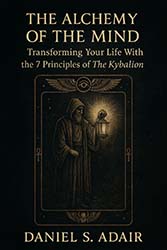
The Alchemy of the Mind: Transforming Your Life with the 7 Principles of the Kybalion
My new ebook, “The Alchemy of the Mind,” is now available at a very reasonable price on Amazon.com. And I personally wrote every fucking word of it.
If introverts had a battle flag, it would probably have The Hermit card printed on it. We absolutely love to withdraw into our own cozy little shells and let the world turn without us participating in it.
So, we’ve finally canceled our plans, turned off our phone, and settled into solitude. But after hours of scrolling or zoning out, we still feel drained. What gives?
THE MYTH OF THE INTROVERT RECHARGE
Introverts often mistake social withdrawal for true recharging but miss the neurological component (acetylcholine release) that actually restores their energy. Just sitting at home is not going to refresh or restore us, although that’s where we need to begin the process.
DOPAMINE VERSUS ACETYLCHOLINE
There are, of course, about a kazillion different chemicals and hormones doing a tango in our busy brains at any given time. For purposes of this discussion, though, let’s focus in on just two of them, the neurotransmitters called dopamine and acetylcholine. And let’s just call them, “happy juices,” because they make different people happy in different ways.
Our brains discharge dopamine when we’re exposed to a lot of social stimuli like loud music, parties, crowded shopping malls and lots of other people. Extroverts actually have many more, “receptors,” for dopamine in their brains than introverts do, so they can soak up an ocean of it and it makes them really happy campers. They feel jazzed, excited, and alive.
Since introverts can’t absorb a lot of dopamine, it basically kicks our asses. For us, it’s like drinking six cups of really strong Espresso – it makes us jittery, nervous, and quickly worn out. It’s introvert poison.
Acetylcholine, on the other hand, gives our brains a mellow, quiet buzz. It’s less like ecstatic dancing at a concert and more like snuggling into a warm bed with nice clean sheets. It’s quiet and peaceful. Introverts love it and it drives extroverts crazy with boredom. It’s our happy juice.
THE ISOLATION TRAP
Now, since too much dopamine makes us feel like crap, it’s perfectly natural to think that just getting away from situations that cause dopamine will make us feel ever so much better. After all, if too much, “peopling,” is wearing us out, then non-peopling should recharge us.
So, we fill the moat around our introvert castles with alligators, pull up the drawbridges, and put up a big sign that says, “GO AWAY!” Free at last!
Unfortunately, by that point, we’re frequently so worn out that we just sit there staring out the window, doom-scrolling on our computers for hours, or binge-watching NetFlix. Those are what therapists call low-nourishment activities because they don’t do anything to feed our emotions or bodies. And, specifically with introverts, they don’t feed us any acetylcholine to make our brains happy.
PLANNING FOR A BRAIN BOOST
A good question for introverts to ask when we’re planning for our recharge time is, “Will this activity leave me feeling nourished or merely distracted?” We know that there are specific, fairly low energy activities that refresh and recreate us by increasing acetylcholine production.
– Reading and Deep Learning: Encourages relaxed but engaged attention.
– Mindfulness Meditation or Breathwork: Activates the parasympathetic nervous system, reducing cortisol and boosting calm focus.
– Creative Flow States: Writing, drawing, or music allow for contemplative immersion.
– Nature Walks or Gentle Movement: Combines physical and sensory stimulation with mental quiet.
MINDFUL INTENTIONS
Another way of putting that is that we need to be intentional with our solitude. We need to design an Acetylcholine-Rich Hermit Phase. We can learn to structure our alone time for maximum benefit.
– Conscious solitude planning: Schedule blocks for purposeful recharging activities instead of just avoiding people.
– Minimize mindless distraction: Replace passive screen time with meaningful, immersive solo activities.
– Create mini rituals: Tea-making, journaling, or slow stretching to ease into relaxation.
And, hell, if we’re not quite ready to jump into being Zen Master Introverts, we can combine some of those activities. Maybe do some Tai Chi while we’re bing-watching Netflix.
REDEFINING OUR SOLITUDE
We’re all different, of course, and introverts tend to be really different. For me, painting, writing, or meditating brings on that acetylcholine recharge. For you, it may be gentle dance motions, working in your garden or reading a good book. For others it might be sitting in the sunshine sipping a cup of tea.
The point is that we all know what makes us feel good. For an introvert it’s like a lover gently kissing the back of your neck or touching your cheek with her finger tips. It’s sweet, it’s calm, it’s gentle, and it makes us feel better almost instantly. Those are the activities that we want to build into our solitude.
Yes, we need to get away from other people on a regular basis, but simply being alone isn’t the answer. Living in intentional, mindful, loving solitude is what makes us whole again.
The Eight of Pentacles looks like a pretty happy card. A craftsman sits at his bench carving away at one pentacle after another and seems to have several of them displayed, as if they were for sale. My original definition of the card in my book, “Just the Tarot,” pretty much agrees with that:
Profiting from your skills. Learning new skills that will advance your career. Possible promotions or awards at work.
And, yet, as an artist and a writer, I have to say, “Ugh.”
And, “Yuck.”
In some ways the Eight of Pentacles is sort of the anti-creativity card. Real creativity involves an interesting balance between competence and incompetence.
If you’ve ever gone through the pains of starting a new job or you’ve supervised someone who was new at their job, you know that there’s a definite learning curve. For about the first six months you can count on a pretty high level of screwing up. The new employee has to learn new skills or – in some cases – unlearn what he thought he knew. At about six months to a year, she’ll start to develop the abilities to perform the job and, after a year, it should be easy peasy.
We see a lot the same thing with artists. Having a creative vision isn’t enough. The painter has to learn how to blend the colors and which brushes to use. The wood carver has to know which chisels do what and what types of wood have smooth, tight grains that will take the details of the carving.
You study it, you practice it, and you learn it. I used to refer to that as, “getting the knowledge out of my head and into my hands.”
But, the thing is, the second you’ve REALLY learned it, the second you can do it perfectly over and over and over again . . . you’ve stopped creating. You’re just repeating.
That’s what I see when I look at the Eight of Pentacles: a line of perfectly carved pentacles that are all exactly the same. It would have been really cool if some of them were orange and some of them were purple, if there were a few folk art pentacles mixed in with some abstract pentacles.
But there aren’t.
Henry Ford invented the assembly line in 1913. It was a novel concept at the time: a product moving down a line, being assembled by a team of workers. Each worker was highly trained in doing one separate part of the assembly, over and over and over. Doing exactly the same thing day after day after day until they retired or dropped dead from boredom.
It was a brilliant idea for a capitalist and an absolute soul killer for the workers. Real creativity involves trying something new that you don’t actually know how to do perfectly. It’s a meshing of your skill set with unknown territory that results in something unique and different AND increases your skills.
Unfortunately, we don’t see a lot of that in our work places. We see people stuck in jobs where they do one or two things over and over again and are never challenged and never grow. We actually give them awards for that and congratulate them on knowing how to do those one or two things better than anyone else, on accepting the concept that they should be, “good”, but not creative or different.
The Eight of Pentacle is a safe card, a card that shows that nothing bad is happening to that person. But nothing particularly wonderful is happening to that person, either. The real story is in the definition of the Eight of Pentacles Reversed:
Employment problems that may involve a need for retraining or learning new job skills. Possibly the questioners position being eliminated or some sort of a reshuffle of employees that will place him or her in a job requiring different skills.
In other words, THAT person is going to have to GROW. It’s all really a question of choosing emotional safety or choosing growth. Sit in the nest or jump out and learn how to fly.



 Just the Tarot