Dreaming Big vs. Building Bridges

Why don’t manifestation techniques work for everyone? This post explores the pitfalls of one-size-fits-all manifesting advice, including why “dreaming big” may backfire for some people — and how “bridge affirmations” and quiet repetition can be just as powerful. Learn how to tailor your visualization style to your own emotional wiring, and find a manifestation method that actually fits you.

Ace of Pentacles – A Tarot affirmations poster available at Synergy Studio.

Why some manifestation advice doesn’t work — and what to do instead

One of the sillier ideas floating around in the world of visualizing and manifesting is the notion that “one size fits all.”

The way this usually goes is that a manifesting guru announces they’ve been studying this stuff for decades, and they’ve refined all of that knowledge into THE ONE TRUE METHOD that will make us rich, famous, and sexually irresistible.

A variation on that is the guru was visited by beings from another dimension who gave them the real lowdown. A variation of that is that the guru is now channeling spirit guides, divine beings, angels, or ancient Atlanteans who have imparted secret knowledge for the good of all mankind.

Now, I happen to be a huge fan of manifesting, visualization, and affirmations. But there are a couple of big fallacies baked into these presentations.

 Fallacy #1: One method works for everyone

If any one guru truly had the one method that worked for everyone, we’d all have signed up for that seminar by now. We’d all be millionaires. And we’d be so busy in bed we’d have to replace our mattresses every three months.

And… um… there still seem to be a lot of us who aren’t millionaires. Have you noticed?

I know that the last time I looked at my bank balance, I was shocked — shocked, mind you — to discover I still wasn’t rich.

Maybe you’ve had a similar experience.

Fallacy #2: Any method works for you

This is the one I want to dig into today: the idea that any particular method is going to work for everyone who uses it.

It’s understandable that the gurus would push that narrative. After all, the more seminars, books, and videos they sell, the more fully they manifest their vision of wealth. If they came right out and said, “You know… this might work for some of you but not all of you,” their book sales would definitely decline.

But the truth is: we’re all different, and we need to find the method that fits us best.

Dreaming Big vs. Building Bridges

One helpful concept from the psychology side of affirmations is the idea of “bridge affirmations,” also known as “ladder affirmations.”

Here’s the basic idea:

Your visualizations need to at least resemble your current reality enough that your brain doesn’t reject them outright. If you’re living under a bridge, eating beans out of a can, and you’ve just lost your can opener, it’s going to be really hard to visualize yourself living in a mansion with a butler serving you caviar.

A more realistic visualization might be:

• You have a brand new can opener

• That can opener lives in a drawer

• That drawer lives in a kitchen

• That kitchen lives in a cozy little apartment you can afford

Bit by bit, you’re bridging the gap between your present and your vision.

I won’t get too deep into the science here, but our brains have a filtering system called the reticular activating system (RAS). It decides what information to notice based on what we already believe is possible.

So if you try to visualize something your brain sees as ridiculous, the RAS stands behind you whispering: “Uh, uh. Not happening.”

“I’m a wildly wealthy kazillionaire!”

No, you’re not.

“I attract money like a magnet!”

Then why can’t you pay your bills?

“I’m irresistible to the opposite sex!”

So why don’t you ever HAVE sex?

Now, it’s possible that you are one of those super-manifesters the gurus talk about — the kind who visualizes a million dollars falling from the sky and then has to wear a helmet for protection from the cash downpour.

But if you’re not? That’s okay.

You may just be a bridge manifester, not a straight-to-the-moon manifester.

Sometimes your subconscious doesn’t need the big dream — it just needs the next step.

“Feel It Big!” Doesn’t Work for Everyone

Another favorite bit of advice from the manifestation gurus is: You have to really FEEL it.

Like, really really.

Don’t just visualize the million dollars — visualize all the wonderful stuff you’re going to buy with it.

Visualize how damn happy you’re going to be.

Do a happy dance.

Flap your arms.

Howl at the moon.

Shake your booty and cackle because you’re rich, rich, RICH, I tell you!

The idea is that emotion supercharges visualization — the more passion you inject, the faster it manifests.

But what if you’re just… not a very emotional person?

Maybe you’re a trauma survivor.

Maybe you’re neurodivergent.

Maybe you’re just a pragmatic flatliner who feels fine but doesn’t emote like a Broadway actor.

Does that mean you’re out of luck when it comes to manifestation?

Absolutely not.

Some of us don’t feel our way to manifestation — we focus our way.

That’s where repetitive affirmations come in.

What we’re trying to do is impress the visualization on the subconscious mind so that it starts working on it behind the scenes.

Yes, a giant burst of emotional energy can plant the seed deep.

But so can steady repetition — even without fireworks.

Write:

“I am attracting abundance into my life.”

Twenty or thirty times every morning.

Or listen to gentle affirmation recordings while you go about your day.

The subconscious doesn’t need drama. It just needs consistency.

Find Your Flavor

So if you’re not rich, famous, and ravishing just yet — relax.

Maybe you don’t need to “dream bigger.”

Maybe you just need to cross the next bridge.

By all means, try the big, bold, wildly emotional manifesting techniques. If that works for you — congratulations! (And maybe lend me a hundred grand while you’re at it.)

But if it doesn’t work?

Don’t give up.

Just try a different route.

Build bridges.

Use repetitions.

Focus instead of forcing.

As Ram Dass said:

“Ultimately, we’re our own gurus.”

And nobody knows you better than you.

“Just the Tarot,” by Dan Adair.  A kindle ebook available on Amazon.

Harnessing the Power of Mentalism: How the Magician Card Can Help You Manifest Your Desires

Discover how the Magician tarot card and the Principle of Mentalism from The Kybalion can help you manifest your desires by aligning thought and intention.

Have you ever tried to manifest something—a job, a relationship, a more abundant life—only to feel like nothing’s happening?  

As you probably know, there are hundreds of manifestation methods and techniques out there, each of them 100% guaranteed to bring us happiness, wealth, and a great sex life.  So why are so many of us still stumbling along, sad, poor, and . . . well . . . un-laid?

Here’s the truth: manifestation isn’t just about saying the right words, finding the right method or doing the right ritual. It begins with our minds. According to the ancient Hermetic wisdom of The Kybalion, “The All is Mind”—meaning that everything in the universe begins in thought. This is known as the Principle of Mentalism, and it’s the foundation of all true manifestation work.

Why Manifestation Often Fails (And How Mentalism Can Help)

Here are the most common reasons why manifestation doesn’t work :

• We’re trying to manifest from a place of fear or lack.  We’re so wrapped up in what we don’t have, that that’s all we can think about.  And whatever we think about is exactly what we’re going to get.

• Our conscious desire doesn’t match our unconscious beliefs.  If we’re convinced subconsciously that we don’t deserve love, we won’t find love.  If we’re convinced that we don’t deserve abundance, we’ll stay poor.

• Our thoughts and emotions are scattered or unfocused.  And undoing that is a learning process.  Especially if we’re already afraid or anxious, learning to calm down and focus on what we want, instead of what we don’t want, can feel like a real challenge.

Mentalism helps by bringing it all back to the source: our minds.  When our thoughts are aligned, our emotions follow—and so does our reality. Manifestation becomes less about “getting stuff” and more about changing who we are inside.

The Principle of Mentalism and Visualizing

The Principle of Mentalism is the first of the seven Hermetic principles outlined in The Kybalion.  A summary of it is the axiom:

“The All is Mind; the Universe is Mental.”

This means that the universe itself is a mental creation.  While that’s a fascinating metaphysical discussion for another day, what we want to focus in on right now is, “Why in the hell aren’t my visualizations working?”

 When we bring this axiom down to the level of our daily lives, it means: Everything begins as a thought. 

Put another way, every single thought we have is creating our personal reality – the fabric of our lives –  whether we’re aware of it or not.

When it comes to manifestation, Mentalism teaches that:

We are not separate from the creative power of the universe. That can be a hard one for us to wrap our heads around.  We aren’t just creations of the Universe – we’re also creating the Universe because we are conscious beings with free will. We’re a part of the Universe making itself.  We’re a part of that same source energy that created the stars.  We are incredibly powerful – we just don’t realize it.

Our thoughts are not passive—they are active forces shaping our experience. As Mike Dooley likes to put it, “Thoughts become things.”  Every single thought that we have has the potential to manifest in the physical world.  

To change our outer world, we must first change our inner world. If our thoughts become things that create our lives, then it only makes sense that the first thing we need to do is to take control of our thoughts.  We have to create what we want to manifest in our outer lives in our inner lives.  That means that we need to quit being victims of our thoughts and learn to direct them.  They’re working for us, not the other way around.

Which brings us to The Magician.

The Magician Card: Your Inner Creator

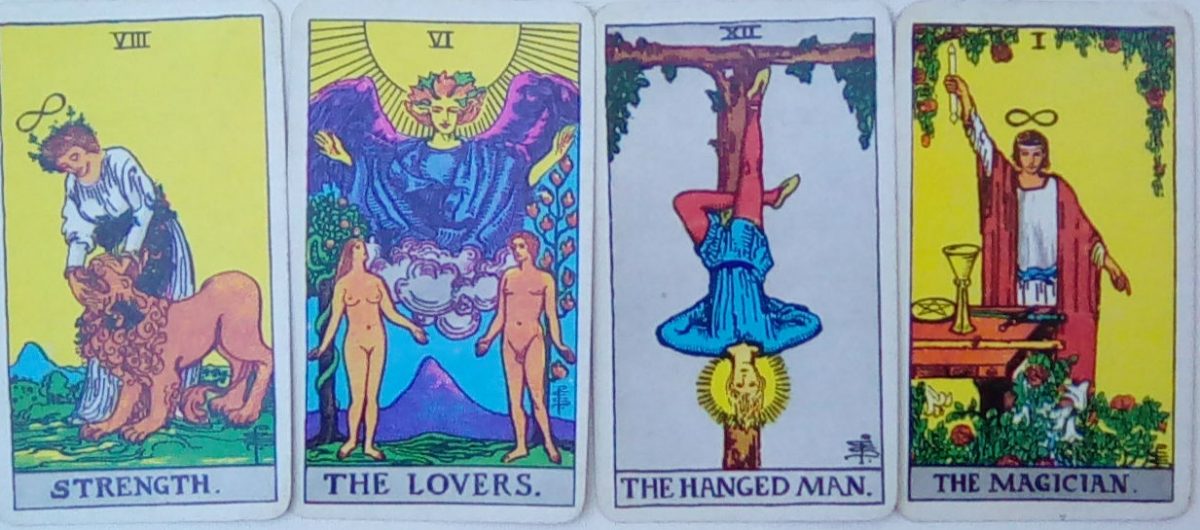
In the Rider-Waite tarot deck, The Magician stands at a table with the four tools of the Minor Arcana before him: a cup, a wand, a sword, and a pentacle. Above his head floats the infinity symbol. One hand points to the sky; the other points to the earth.

This is a card full of meaning for the manifestation process:

Infinity symbol: We have unlimited potential. Our minds are conduits for universal energy.  This is what we were just talking about: we are not separate from the creative power of the Universe.  We are a part of that power and that makes us much, much more powerful than we realize.

One hand up, one hand down: As above, so below—our inner world shapes our outer one.  This is another way of saying that our thoughts aren’t passive – they’re active agents creating our lives right now.  Whatever we create in our inner lives will manifest in our outer lives.

Tools on the table: We have everything we need to manifest—thought (swords), emotion (cups), action (wands), and material resources (pentacles).  We don’t need to borrow someone else’s methods for manifesting because we already have the magic in our own lives. 

The Magician is the living embodiment of the Principle of Mentalism. He reminds us that we are not a victim of circumstance—we are the creators of our experience by using our mental powers.

A Simple 4-Step Magician-Inspired Manifestation Practice

 Here’s a simple practice that brings together these lessons from the The Magician and the Principle of Mentalism.

Step 1: Clarify Your Desire

Get crystal clear.  Let me say that again:  GET CRYSTAL CLEAR!  What exactly do you want? Let’s face it – as human beings we are fully capable of wanting two things that contradict each other at the same time.  For instance, if you want a full time lover but you also want a lot of time to yourself, you need to sort that out.  Which one do you really want, because you probably can’t have both and if you ask for both they’ll cancel each other out and you’ll get nothing.

Write it down in a present-tense, emotionally charged sentence. For example:

 “I am joyfully attracting a lover and friend who is filling my life with meaning.”

Step 2: Align Your Mind

Close your eyes and visualize your desire as if it’s already happening.

Feel the emotion of it. Say your intention out loud.  In this example, you could imagine that you’re spending the day with your lover, having a wonderful time, and planning for a sensual evening together.

Step 3: Act with Intention

Now take a small action that reflects your inner belief.

It could be creating a vision board, applying for an opportunity, or simply saying “no” to something that no longer fits.  In this case, it could be writing out 20 affirmations that say, “I am loved and treasured by my partner.”

Step 4: Meditate on the Image of The Magician Card for a Few Moments

Do this while you’re visualizing your goal. This helps us to remember the lessons here:  everything begins with our thoughts;  we have unlimited potential that we’re using to create our dreams; everything that we need to create our dreams is contained within us.

It also goes a step further and helps us to connect with that archetypal energy of The Magician.  It’s a symbol that pulls power into our visualization and engages the Universe in helping to create our desires.

Final Thoughts: You Are the Magician

You don’t have to “become” powerful—you already are.

The Principle of Mentalism and The Magician card both remind you: your reality is a reflection of your consciousness.

Want to change the outside? Start on the inside.

Start with your thoughts.

Start with your intention.

Start with you.

Want to Go Deeper?

If this topic speaks to you, I invite you to check out my new ebook:

“The Alchemy of the Mind: Transforming Your Life With the 7 Principles of The Kybalion.”

In it, I explore how each Hermetic principle can help you reshape your beliefs, emotions, and daily experience. It’s part philosophy, part practical guide—and 100% dedicated to your growth.

Your Turn

Have you used The Magician card in your manifestation work?

What has Mentalism taught you about the power of thought?

Drop a comment below—I’d love to hear your experience.

The Five of Wands, Louise Hay, and Becoming the Grown Up Who Lives in Our Heads.

A look at childhood programming and using affirmations.

If I were to say, “Your thoughts are total bullshit,” you’d probably feel highly insulted.  On the other hand, if I were to say, “My thoughts are total bullshit,”  you might agree with me or you might tell me that’s not true and wonder where I got such a terrible self-image.

But if I were to say, “A lot of OUR thoughts, as human beings, are total bullshit,” that’s a more fertile ground for discussion simply because it depersonalizes it and takes us out of a fight-or-flight reaction.  We don’t have to defend anything or run away from being criticized.

In, “You Can Heal Your Life,” Louise Hay made the point that, at their base, our thoughts really mean nothing at all.  They’re just words that we string together and they don’t take on any meaning by themselves.  We have to ASSIGN meaning to them.  We have to say, “I believe these thoughts are true.”

And, oddly, our beliefs are nothing more than thoughts that we’ve repeated over and over and over until we believe that they’re true.  When we take a little closer look at those thoughts we can understand exactly why so many of them really are bullshit.

First of all, a lot of our thoughts were, “installed,” in our little brains when we were far, far too young to make any rational judgements about their validity.  By the time that we reach late adolescence most of us have been thoroughly programmed with unexamined thoughts that we believe to be true.  The richest source of the programming is our families, of course, but we get a hefty dose of it from our teachers and peers, as well.  Some of those thoughts might be things like:

I’m no good at math.

I can’t dance.

I’m a terrible athlete.

I’m not very good looking.

I’m too fat or too skinny or too tall or too short.

I don’t fit in.

Nobody likes me.

Or the thoughts might be something like:

Democrats are communists.

Republicans are fascists.

Rich people are heartless.

People who don’t practice my religion are evil.

Black people are scary or white people are arrogant honkies.

Immigrants are too lazy to work AND they’re going to steal my job.

These are all just words, strung together to make thoughts, which were repeated over and over when we were young until we came to believe that they must be true.

The truth of these beliefs were totally unexamined when we were kids because we didn’t have the mental capacity to evaluate them.  If our parents or teachers told us they were true, well then – hey –  they must be true because that’s what the grownups said. For the most part, though, they remain unexamined when we’re adults, which is the second reason that many or our thoughts are total bullshit.

Most of our thoughts are subliminal, which literally means, “below the light.”  In this case, we mean, “below the light of consciousness.”  We just think them, without even being aware of the fact that we’re thinking them.  That’s the infamous, “stream of consciousness,” or, “monkey mind,” that engages about 20 seconds after we wake up in the morning.  It’s just a ceaseless chatter that runs along by itself and contains – buried in its content – all of that programming that we got as kids.  It sounds like this:

Gotta get the coffee going, godamn it’s cold, I wonder if I have enough gas in the car, should have balanced the checkbook but I’m no good at math, gotta get the kids up and make breakfast, can’t believe the price of eggs, it’s the rich Republicans driving the prices up, nobody cares about working people, if only I had a better job but I’m not smart enough to get a better job, where are my socks . . .”

The unexamined thoughts that were programmed into us when we were kids are running over and over again, all the time, and remain unexamined.  And, yes, thoughts that are repeated over and over become beliefs and, like the people in the Five of Wands, we’ll fight to the death to defend our beliefs.

Which is the third reason that most of our thoughts are bullshit.  We’re totally ego involved with them.  Most of us, most of the time, completely identify with that subliminal thought stream.  We experience it as, “These are MY thoughts in MY mind, therefore, they’re a part of me.”  It never occurs to us that they’re not really our thoughts.  They’re our parent’s thoughts and our teacher’s thoughts and maybe even the thoughts of that bully who tortured us at recess in the third grade.

Affirmations, as Louise Hay points out, are a simple way to step out of that thought stream and start changing our beliefs by changing our thoughts.  Let’s face it:  most of don’t have the time to just sit there all day and watch our thoughts.  “Ah HA!  There’s another negative thought from my childhood programming!  Take THAT, negative thought!”

What we can do, though, is to become a little more conscious of our thought streams.  Even when we’re working or driving to the store or taking a shower, we can watch the mind chattering away and consciously think, “Okay, that’s a pretty negative thought,  And it’s probably not MY thought; it’s just something my mind was taught when I was a kid.”

When we begin to dis-identify with that constant stream of thoughts, we immediately lose the need to defend them.  After all, they’re not really my thoughts, so why should I care about them?  And then we can begin to replace all of that subliminal programming with programming that we consciously choose.

Just pick a positive thought – any positive thought – and repeat it 3 or 400 times a day.  Does that seem like a lot?  Well, how many times a day do we say something negative to ourselves with that childhood programming?  Hundreds of times, right?

If that sounds like a sort of a forced, Pollyanna Positivity it’s because it is. We are quite literally pushing our thoughts in a new direction and it can feel completely unnatural to begin with.  But that’s the whole point:  there’s nothing, “natural,” about our unhappy beliefs, either.  They were just thoughts that were repeated again and again, often by the miserably unhappy adults who raised us.  That’s all that happy beliefs are, too – thoughts that are repeated again and again until they become beliefs.  And we get to be the adults who are repeating them, which is pretty cool.

Judgments, The Dalai Lama, and Putting Your Hat on the Table

How our belief systems affect our lives.

There’s an old saying that the reason our parents can push our buttons is that they installed the control panel. And there is so much truth in that.

I was watching a presentation from Mike Dooley the other day and he was talking about the importance of our belief systems. For those of you who aren’t familiar with Dooley’s work, he’s a strong advocate of the idea that, “thoughts become things,” and teaches visualization and manifestation techniques. His take on belief systems is that they act as, “regulators,” for what we allow ourselves to think, and since thoughts become things, our beliefs determine what we’re going to think and, therefore, what’s going to manifest in our lives. Our beliefs determine the Judgments that we make about life, which determine the course that our life takes.

For instance, if we have a strong, unconscious belief that we’re unattractive it’s very unlikely that we’ll be able to visualize ourselves with a good, loving partner. We can’t even THINK of that happening, and so it doesn’t. If we have a strongly held belief that rich people are evil, we’re not going to be able to attract money into our lives because we don’t want to see ourselves as evil.

Those are belief systems on a personal level. There are also what we might call, “meta belief systems,” that operate on a more elevated basis. These are systems like religions and politics and they interact with our personal belief systems. Most people in the United States are Christians and an inherent element in that religion is that people are, “sinners,” that life is suffering, and that there’s a loony tunes god in charge who might just throw you into a pit of eternal flames because you masturbated last night.

We can contrast that world view with this statement from the Dalai Lama: “I believe that the purpose of life is to be happy. From the moment of birth, every human being wants happiness and does not want suffering. . . From the very core of our being, we simply desire contentment. I don’t know whether the universe, with its countless galaxies, stars and planets, has a deeper meaning or not, but at the very least, it is clear that we humans who live on this earth face the task of making a happy life for ourselves.

If we believe in the so-called Law of Attraction – the idea that we draw into our lives people and events that are a match with our energy, emotions, and ideas – then we can see where these two belief systems would have massive implications in our personal lives. If we accept the classic Christian view that people are basically evil and life is shit because we got, “thrown out of the garden,” what are we going to attract into our lives? Evil people and shitty experiences. If we listen to the Dalai Lama and believe that the purpose of life is to be happy, we’ll automatically seek out happy people and create positive experiences in our lives.

All of this operates on an unconscious level, of course. If you were to ask the average Christian if she believes that people are rotten and life is meant to be suffering, she would very likely say no. But that’s exactly what we were taught in Sunday schools and church services when we were forming our views of life and were too young to make realistic assessments. All of those buttons – guilt, sin, life hurts – were installed on our control panels and they’re just waiting to be pushed.

Don Miguel Ruiz talks a lot about this in The Four Agreements. As he put it, most of our belief systems are just, “dreams,” illusions passed down from one generation to the next or forced onto us by our society and they remain largely unexamined. Democrats (or Republicans) are evil. People are no damned good. America loves peace (even though we sell more weapons than any other country in the world.) Monogamy works (even though about half of the people who try it get divorced.) Liberals are socialists. Conservatives are fascists. God’s a male. There is no God. We all have tons and tons of opinions and viewpoints that we live by, that we design our lives around, and, for the most part, we haven’t thought about them very much.

I once read about a woman who went into an absolute fury every time that her husband would put his cap on the kitchen table. When he questioned her about it, the only thing she could say was, “It’s just wrong.” She realized that her mother had taught her that lesson, so she asked her mother why it was wrong. Her mother’s response was that her mother had taught her that it was a terrible offense. She finally worked her way back to her great grandmother who started laughing and said, “Oh, lord, child, when I was young everyone had head lice. That’s why it was wrong to put your hat on the table.”

So three generations of her family had passed down a very strong belief and reaction about a simple behavior like putting a hat on a table. And none of them, until her, had ever questioned the belief or wondered what was behind it.

The sad part of this is that so many of our beliefs and judgements are just like that: totally unconscious ways of judging the world and ourselves that were passed down to us by people who weren’t thinking about them and accepted by us without thinking about them.

That’s also the good news.

Once we accept the idea that a lot of our most cherished beliefs – if not most of them – are constructed on total bullshit, then we can just get rid of them. It sounds like a really radical idea when we first encounter it but why not? Why not just get rid of beliefs that limit us and restrict us, and adopt beliefs that serve us better and allow us to expand our lives?

For instance, the belief that I’ll NEVER have enough money, shuts me down and keeps me frozen in place. The belief that the Universe is filled with abundance and I deserve my share opens me up to expanding and receiving. The belief that I have a RIGHT to be angry keeps me upset and repels positive people. The belief that I have a RIGHT to be a loving person attracts positive, loving people into my life and reinforces the idea that I’m lovable.

The Tibetan Buddhist teacher Chagdud Tulku Rinpoche said that most of us will never become enlightened in this life and that we’ll continue to live in the dream of illusion. But he also said that we CAN decide whether we want to have a good dream or a bad dream. And the road to a good dream starts with our beliefs about that dream.

The World Card, Rebirth, and Designing Your Next Body


The World seems to be the only Tarot card that deals with birth, which is odd because you couldn’t find a more archetypal, universal experience than birth.  As I noted in my book, “Just the Tarot,” the wreath in The World card strongly resembles the shape of the birth canal and suggests a totally new beginning.

We all associate birth with that initial entry into the world, that first thrust through the placenta and into a whole new universe.  In reality, though, we’re being reborn constantly. It’s fairly well known that ALL of the cells in our bodies are completely replaced by new cells about every seven to ten years but many cells are constantly dying and being regenerated.  Red blood cells are replenished about every four months. White blood cells every few days. Fat cells, of course, last the longest. Wouldn’t you know it?

And here’s an interesting slant on all of that.  While the molecules in your body are busy whizzing around and making sure everything that’s supposed to stay inside doesn’t fall out and everything that’s supposed to come out doesn’t stay in, they’re also making these amazing substances called neuropeptides.

I don’t know about you but I totally suck at science and math and just a word like neuropeptides makes my brain freeze with anxiety.  Nonetheless, it’s important to know about them and here’s why.

Neuropeptides are the physical correspondents of our emotions.  They come and go together. Adrenaline is one of them. If you get a big spurt of adrenaline it totally triggers your fight or flight reaction.  Your heart races, your fists clench, your eyes dilate – you’re ready to kick some ass or run like a rabbit. Adrenaline doesn’t CAUSE the fight or flight reaction, they just always occur together.

Same deal with another neuropeptide, serotonin.  If you have a lot of serotonin in your system, you’re happy.  If you don’t have enough, you’re sad. Serotonin = happiness and happiness = serotonin.

The kicker is that our bodies manufacture neuropeptides to MATCH the emotions we’re feeling.  So, if you’re a very happy, positive person, then you’ll have a lot of serotonin being pumped out.  If you go through a sustained period of stress and unhappiness, then your serotonin levels drop like a rock in water and your adrenaline levels go up.

Kicker number two:  we have receptors for these neuropeptides in cells ALL OVER OUR BODIES, not just in our brains.  So if you’re pumping out massive amounts of serotonin, it’s attaching to molecules throughout your entire system and your body is basically happy.  Massive amounts of adrenaline and your body is basically stressed and unhappy.

Where it gets really interesting is when we consider that our emotions are actually dictating what types of molecules are going to make up our bodies AND we’re constantly replacing and replenishing those molecules.  We’re literally remaking our bodies all the time based on our emotional states. We are – right now – designing the types of bodies we’ll have in a couple of months when all of those cells get replaced with cells that match our current emotional state.

To put it another way, if you’re chronically negative and unhappy, your body is going to manufacture molecules that are negative and unhappy.  Serotonin = happiness and low serotonin = unhappiness. It can turn into an endless cycle of misery. Crappy emotional states CAUSE crappy body and brain chemistry which CAUSE more crappy emotional states and on and on.  

That’s where visualizations and affirmations come in.  When we do them, we’re interrupting that repetitive cycle.  When we do affirmations we’re rewiring the Deep Mind and telling it that we’re happy and successful people and – guess what – happy and successful people have oodles of serotonin.  When we visualize being happy and successful, we FEEL happy and successful and happy emotions MAKE serotonin appear.

It’s a very odd phenomenon.  We are literally giving birth to . . . ourselves . . . all the time.  And we have a choice as to what kind of a body and person we’re creating.  Happy thoughts = happy cells = happy thoughts. We choose our World every single day.

* If you’re interested in learning more about this, look up Dr. Candace Pert, who pioneered the research.

The High Priestess, Affirmations, and Writing Your Own Story

I realized many years ago that I was an absolute genius at manifestation . . . with one big problem.  My problem was that my genius was hitched to my unconscious programming instead of what I consciously wanted to create.”  Gay Hendricks, “Attracting Genuine Abundance,”  DailyOm

I grew up in one of those families from hell.  Alcoholic, abusive father, detached, depressive mother, a military family so we were constantly moving and never growing roots.  

And, as Melody Beattie said in, “Codependent No More,” one of the real curses of that is that you accept the insanity you’re living in as, “normal.”  Being beaten, screaming fights, drunks passed out on the floor – it’s all perfectly normal in YOUR household.  Doesn’t everyone live like that? Hell, you’re just a kid, how are you supposed to know the difference?

Someone once said that your parents always know how to push your buttons because they installed the control panel.  There’s a lot of truth in that – on a primal, cellular level no one knows you better than your parents. And, in addition to installing the control panel, they also installed the programming.

If you were raised in a less than benign household that programming can be pretty awful.  You probably grew up hearing things like:

“You’re a very, very bad girl.”

OR

“Why did you do something so stupid?”

OR

“I don’t like hitting you but you don’t leave me any choice.”

And your poor little subconscious, your subconscious that was too young and too trusting and too inexperienced to know any better just soaked that shit up and believed it, the same way that you believed that drunken, crazy parents were normal.  And – voila! – you end up as an adult who believes that he’s very, very bad, stupid, and deserves to be abused. After all, your parents told you so, didn’t they?

I was talking with a therapist about all of that subconscious, self-defeating programming and I asked if affirmations and visualizations were a way to sort of short circuit it.  She looked very thoughtful for a minute and said, “No, I think of them more as a way of writing your own story. Who do YOU want to be in your story? How do YOU want to live and feel in your story?”

That’s a wonderful distinction that we miss too often.  Affirmations and visualizations aren’t just ways of overcoming negative beliefs that we absorbed in the past.  They’re also ways of consciously creating what we want our futures to look and feel like.

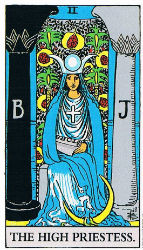
A great deal of The High Priestess is about the deep mind, the subconscious and unconscious part of our minds that holds both our creativity and our self-defeating beliefs.  Too often it’s like a one way door. Magic, symbols, dreams emerge from the Right, feminine, side of the brain, but we don’t consciously interact with it, we don’t, “input,” data, we just passively receive content.

When we dream or meditate that realm of magic that resides in the Right Brain flows into our lives.  When we visualize or do affirmations, we’re talking directly to the Right Brain. We’re dropping what we want our lives to be, what we want our stories to be, into our subconscious and then it performs the magic and makes it real.

In my original definition of The High Priestess, I wrote this about what happens when the card is reversed, when we’re ignoring that interactive process with our subconscious:

The creative, intuitive, feminine right side of the brain is being overpowered and held hostage by the logical, sequential, male left side of the brain.  Intuition and creativity are being ignored in favor of so-called rational thinking. There is a need here to reconnect with your primal self. Take the time for meditating, long hot baths, dancing, art.  Get back in touch with your creative energy.

We need to take the time to visualize, to affirm what we want in our lives, to have a nice, quiet talk with the High Priestess.   We need to take the time to write our own story or someone else will write it for us.

“Just the Tarot,” by Dan Adair, a book of basic Tarot definitions available on Amazon.com.