The Most Powerful Card in the Tarot – Getting Downright Foolish

An explanation of why The Fool is the most powerful card in the Tarot.

There’s an ongoing debate among Tarot aficionados about which card is THE strongest card in the deck.  The most prominent candidates are usually the first two cards of the Major Arcanum:  The Fool and The Magician.  I tend to lean toward The Fool, for reasons which I’ll explain, but the truth is that we need both of their energies in our personal and spiritual growth.  The Fool is pure potential, whereas The Magician is pure mastery.  Growth occurs when those two energies intersect.

LOOKING AT THE SYMBOLISM

In The Fool, we see a young, ambisexual person dancing along at the edge of a cliff.  He lightly holds a rose in one hand, and his meager possessions are contained in a satchel hanging from a pole that he carries over his shoulder.  A small dog joyously cavorts at his feet, despite the fact that The Fool appears to be about to walk straight off of the cliff.

If we had to select a couple of words to describe the image, they would probably be, “happy,” and, “unfocused.”  The person in the card seems to not have a care in the world.  He’s to telling us to stop and smell the roses, to trust in the present moment. The message is that if he walks off of the cliff, he’ll just keep strolling along on thin air.

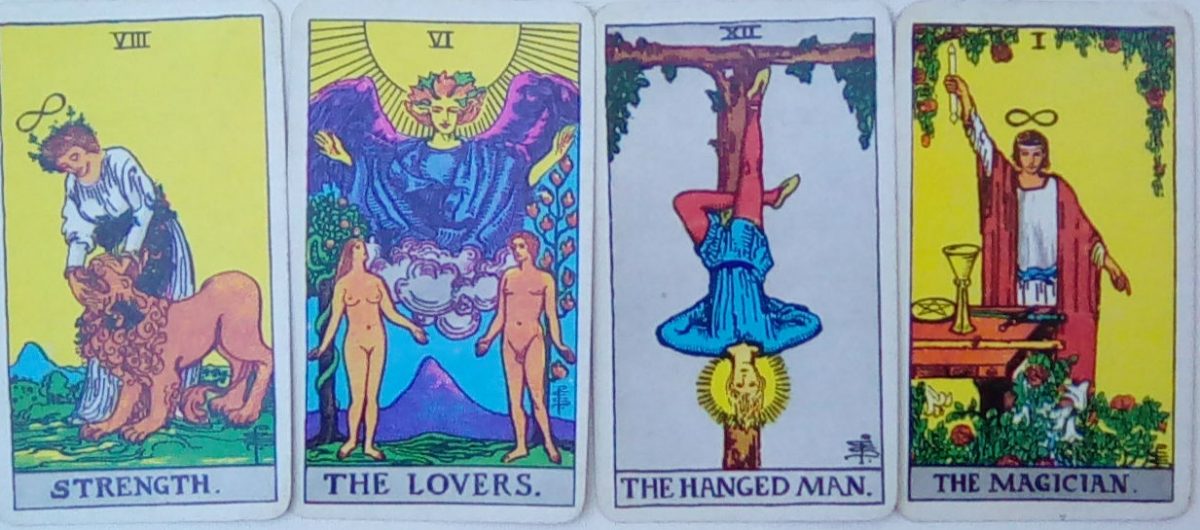
The Magician card, on the other hand, is an image of total concentration and focus.  He’s dressed in the formal robes of a ceremonial magician and looking very serious.  One hand, holding a wand with two points, is pointed toward the sky and the other is pointed at the ground.  His robe is belted with the ouroboros symbol of eternity, a snake eating it’s own tail, and that message is reinforced by the eternity symbol floating over his head.  The four symbols of earthly existence, the wand, pentacle, cup, and sword, lie on his altar.

“Just the Tarot” by Dan Adair – A complete set of definitions, layouts and instructions for reading Tarot cards.

The Magician is channeling the divine energy into the Earth Plane.  He’s using it to control the four elements and manifest his desires through the use of his will power.  If we had to select a couple of words to describe this image, they would be, “control,” and, “focus.”

THE MAGICIAN AS THE WESTERN PARADIGM OF POWER

The Magician is very much the Western paradigm of power.  We use phrases like, “He’s a take-charge sort of a guy,” or, “She’s always in control,” to describe this kind of power, and we tend to admire it.

The Magician is the type of a person who is very conscious of what she wants to accomplish, has a detailed plan for doing it, has the necessary skills to make it happen, and works the plan until she reaches her goals.

This is the type of linear, step-by-step thinking that Westerners have traditionally employed, and it can be very effective.  

It’s also very much an ego-based sort of a power.  It’s saying, “This is what I want and I’m going to use all of my abilities and will to make it manifest.”

THE FOOL AS THE EASTERN PARADIGM OF POWER

The Fool’s energy is much more in keeping with the Eastern paradigm of power.  It has more to do with aligning ourselves with a deeper, universal  power, rather than trying to run the whole show with our egos.

There’s a basic trust implicit in The Fool.  It’s a trust that, as the Desiderata put it, “whether or not it is clear to you, no doubt the universe is unfolding as it should.”  The idea is that there IS an underlying force in the Universe and that it’s a loving, compassionate force.  When we’re in alignment with that force, then we’re in The Flow, or the Tao, and our lives are much easier and happier because of it.  And, paradoxically, the more that we try to control that Flow, as the Magician does, the less in alignment we are and the harder life becomes.

VISUALIZING AND MANIFESTATION

We can see this sort of tension between The Magician energy and The Fool energy when we begin to delve into visualization and manifestation.  

Most of the books and seminars on the subject run pretty close to The Magician model of power. (A) We figure out what we want (the usual example being a million dollars.)  (B) We concentrate all of our will power on that goal by visualizing it, writing affirmations, and making vision boards.  (C) We cause that goal to manifest in our lives through repetition and the sheer power of our wills.  The Magician model is also very one-pointed and specific, as in, “I want a million bucks by September the first and I want it to be in unmarked hundred dollar bills.”

Of course, that frequently doesn’t work, as evidenced by the fact that most of us aren’t millionaires.  This is the point where many teachers will bring in the concept of The Fool energy.  The idea here is to relax, stay in the present moment, and quit telling the Universe how it’s supposed to behave.  Instead of setting a specific goal, right down to every detail, we set a general goal, but let the Universe work out the details.

Mike Dooley, in particular, works with this concept in many of his books like, “Manifesting Change.”  He refers to our trying to control all of the details (Magician energy) as, “the cursed hows.”  In other words, “I want a million bucks, Universe, and this is exactly HOW I want you to manifest it.”  The point that he’s making is that we may think we’re opening one door to financial abundance, but in reality we’re slamming shut a thousand other doors.  The Universe is infinite and it has an infinite number of ways of delivering what we want to manifest, unless we get too specific about how we want it done.

So, we bring in Fool energy.  We use a general statement like, “I’d like to manifest happiness and abundance in my life, Universe, and I’m sure you can work out the details.  After all, you make stars and solar systems, so this shouldn’t be much of a challenge for you.” And then we butt out and let it happen, while we stay happy and in the present moment.

CONSCIOUS AND SUBCONSCIOUS MINDS

The Kybalion – a discussion of Hermetic magic – talks about this dance between Magician energy and Fool energy in terms of the conscious and subconscious minds.

Our conscious mind is our everyday mind, which is the mind that we mostly identify with.  It’s ego based, logical, and linear and it’s very clever at performing mundane tasks.  It’s the mind that balances our budgets, pays the rent, buys groceries, and gets the kids to school on time.  We could call it Magician energy but it’s really just a tiny part of our larger mind.

The subconscious mind, on the other hand, comprises the majority of our minds.  Unlike the conscious mind, it never needs to sleep and it’s working 24/7, processing information, calculating what the future may look like and telling us when something’s wrong.

The most important thing about the subconscious mind, though, is that it’s our connection to the super-conscious mind, AKA the Universe.  Though that connection, it has almost infinite power to manifest anything that we truly desire.  That’s Fool energy.

Those two minds – conscious and subconscious – need to work together.  Although the subconscious mind is infinitely powerful, it just drifts without direction from the conscious mind.  Even worse, it can construct our reality based on the crap that flows through the internet, our televisions, our cultures and our religions, which may have very little to do with what we really want to manifest.

So we need to use that Magician energy – the conscious mind – to sort through our options and figure out where we want to actually go with our lives.  Do I want to be rich?  Do I want to be an artist?  Do I want more love in my life?  Once we determine what our overall goals and desires are, then we say, “Hey, subconscious mind/Universe – this is what I’d like to see happen.  Please get to work on that.”

THE FOOL DOES THE HEAVY LIFTING

Here’s the most important thing about all of that:  The Fool does the heavy lifting.  The SOLE PURPOSE of the conscious mind is to figure out where we want to go and turn it over to the subconscious mind/Universe.  

The conscious mind has a terrible time accepting that notion, because it’s ego based.  It wants to control every little detail of the manifestation process, and so it keeps snatching it back from the Universe and imposing more and more cursed hows on the process.  Every single time that we do that, we’re slamming doors shut instead of letting the subconscious mind open more doors.

And so, yes, in my opinion there can be no doubt that the most powerful card in the Tarot deck is The Fool.  It’s the primal energy that makes good things manifest in our lives.  The Magician can guide that energy but, by itself, it’s nothing but a control freak in a red robe.

Doing Justice to Our Beliefs With Byron Katie’s The Work

A look at how to change our core beliefs using the methods from Byron Katie’s, “The Work.”

The Justice card in the Tarot is, at its most basic level, about society judging us, but there are few harsher judgements than those which we make about ourselves.  And most of them are horribly unjust.

As Cynthia Kane points out in, “Talk to Yourself Like a Buddhist,”  we say things to ourselves that we would never, ever, in a million years, say to our friends and family.  When we really start listening to our inner dialogue, we may find little poisoned pellets like:

You’re so stupid.

I can’t believe that you fucked that up . . . again.

What in the hell is wrong with you?

Why can’t you ever get anything right?

Your problem is that you’re just lazy.

And on and on and on.  The more dysfunctional that our family of origin was, the more likely we are to have that harsh inner critic constantly deriding us.  Constantly telling us that we don’t measure up and we’re never quite good enough, no matter how hard we try.

Now, there’s a basic formula in New Age Thought that goes like this:

Our thoughts create our emotions.

Our emotions create our vibrations.

Our vibrations create our lives.

When we break that down, it just means that every single thought we have has an emotion attached to it, either positive or negative.  When we think of puppies or cookies, we feel good.  When we think of dentists and written tests, we feel bad.  Our feelings about those thoughts add up to create our overall vibration.  If we’re constantly thinking of things that make us sad or scared, we end up with negative vibrations.  If we’re constantly thinking of things that make us happy, we end up with positive vibrations.  And, eventually, our overall vibrations will draw similar vibrations into our lives.  If we have really negative vibrations, we’ll draw in negative people and failures.  If we have really positive vibrations, we’ll draw in positive people and abundance.

It’s really cool when we figure that out because it empowers us to make changes.  We can jump in at any one of those three points and start to transform our lives. Most of the self-help guides advocate one approach or another.  If we change our thoughts, we’ll change our emotions.  Or if we work on feeling happier about life, that will change our thoughts.  Or if we meditate on raising our vibrations, that will change what we attract.  Pull on any one of those three strings and our lives will start to change.

There’s one element that’s frequently left out of that equation, though, and that element is beliefs.  We can change our thoughts, our emotions, and our vibrations but if we don’t change our underlying beliefs, we’re not going to get anywhere.

The classic example of that is the person who wins the lottery and two years later he’s bankrupt.  Maybe he spent hundreds of hours visualizing getting that winning ticket and wrote out a kazillion affirmations and did vision boards and all of that helped him to win.  But he didn’t change that underlying belief, which was, “I’m poor,” so the money floated away.  It wasn’t a vibrational match for his basic beliefs about himself.

To put it in a nutshell, our beliefs create our thoughts which create our emotions which create our vibrations which create our lives.

Which begs the question, “What IS a belief?”  

A belief is nothing more than a thought that we repeat over and over until we think it’s true.  Sometime they ARE true, but frequently they aren’t.  If we want to know what our real beliefs are, all we have to do is to listen to that inner dialogue.  If we’re constantly degrading and belittling ourselves, then those are beliefs that we need to change before we can effect permanent changes in our lives.

So how do we change our basic, underlying beliefs?  We actually pull them out and look at them.

One of the most powerful tools for doing that is Byron Katie’s, “The Work.”  

To use The Work method, we take a, “work sheet,” (download one here) and focus on four areas:

1- What’s the belief that I need to change?

2- Is it true?

3 – What kind of a person would I be without that belief?

4 – What are some opposite turn arounds that I can substitute for that belief?

Here’s an example of a negative belief that a lot of us carry around:  “I’ll never have enough money.”

IS IT TRUE?  For most of us, it’s not true at all, at least for most of our lives. There are very few of us who have been homeless or starving.  That doesn’t mean that we haven’t gone through some bitchy, bad times.  There may very well have been times when paying our bills or even just buying groceries was a struggle.  Still, if we’re honest with ourselves, most of us, most of the time, manage to pull it together even through the occasional hard times.

Of course, one of the questions that we need to look at there is, “What do I mean by, ‘enough money.’ “  If we put together a vision board that’s covered with pictures of sports cars, McMansions, and private jets, we’ll probably feel like we don’t have, “enough.”  If we think in terms of food, clothing, shelter, a car that runs, and a job, though, we realize that we’ve usually had plenty.

WHO WOULD I BE WITHOUT THAT BELIEF?  Well, for one thing, we’d probably be a lot more grateful.  When we actually focus on the fact that we have always had enough money to eat, enough money for a warm place to live in the winter, enough money to pay our bills, then we can start to see how very lucky we’ve actually been.  

For another thing, we can start feeling a lot less anxious about the future.  If we’re able to look at our past and see that there’s always, somehow, been enough, then we can see that there’s absolutely no empirical evidence for the idea that we won’t have enough in the future.  It’s just a movie playing in our heads that’s based on a bad fantasy.

WHAT ARE SOME OPPOSITE TURN AROUNDS TO THIS BELIEF?  The obvious one, of course, is, “I always have enough money.”  Some others might be, “I manifest what I need as I go along,”  or “The Universe always provides for my needs.”

Once we’re able to flip that basic belief, then some miracles start to happen.  Our thoughts begin to be more positive (“I always have enough money.”). Since our thoughts have changed, our emotions start to change (“I really don’t have anything to worry about financially and I’m happy about that.”). Since our emotions have changed, our vibrations start to change (“I feel really secure, relaxed and positive about life.”).  And when our vibrations change, then we start to create the life that we always wanted.

It’s a really good and relatively simple method for changing our basic beliefs.  Of course, Byron Katie probably named it, “The Work,” for a reason, because it does take some work.  It’s not just a matter of sitting down and filling out a sheet of paper.  It’s actually taking the time to listen to our own thought stream, write down those negative beliefs, and then meditate on them as we fill out the sheets.

And changing negative beliefs is work on a whole different level, as well.  We tend to cling to beliefs about ourselves and the world around us simply because they’re comfortable and they’re what we’re used to.  When we adopt the very opposite of those beliefs, it can initially feel very strange and foreign.  The negatives will keep popping up in our thought streams for a while, but we now have the consciousness to stop and say, “Nope.  It’s not true, it doesn’t make me feel good, and it’s not who I am.”

Note: as a member of Amazon Associates, I may receive a tiny remuneration if you buy a product listed on this page. I am in no way associated with the authors of the books quoted.

Happiness, Capitalists, Yellow Rocks, and Radical Meditators

Most people who are on a Spiritual Path eventually come to hold beliefs which conservatives consider, “politically radical.”  It’s ironic, because most people who are on a Spiritual Path have very little interest in politics, except to casually observe it as another form of human insanity.

When I use the term, “radical,” I mean it in its original use from the latin word, “radix,” or root, as in, “the root of a plant.”  To get radical is to get at the very root of something, to get to the place that it all grows out of, so to speak.

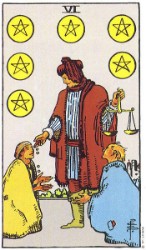
Let’s take the example of the Six of Pentacles.  It shows a richly dressed man, scattering coins to beggars, and holding a scale so that he can measure exactly what he’s giving away.

You couldn’t ask for a better representation of the, “scarcity,” view of life that’s at the root of our society.  There simply isn’t enough wealth to go around and some people have it and some people don’t.  Those who DO have it, should share it with those who don’t have it, but they need to be very, very careful about not giving too much away, because there’s never really enough.

In real time, we see that happening with the gazillionaires who live in penthouses, fly around in private jets, take vacations on yachts, and are DESPERATELY WORRIED that poor people might be getting too many food stamps.  Having enough to eat without working for it at minimum wage jobs is bad for their character, doncha know?  Makes them lazy and dependent.  Pass the champagne, darling . . .

As we move into a deeper level of spirituality, though, we begin to understand that there’s another model for looking at life, which is the, “abundance,” view.  The Universe and Mother Earth seem to be richly, almost insanely, abundant.  There are enough seeds in one tomato to plant an entire farm.  There are enough sperm cells in one tablespoon of semen to repopulate the world.  Women’s bodies produce far more eggs than they could ever bear as babies.  And, yes, we could produce enough food to feed every hungry person in the world.

And we begin to realize that the problem isn’t that there isn’t enough, the problem is that some people are spiritually sick and want far more than their share of the abundance.  Even worse, they want to be sure that other people have less than THEIR share, because they believe in their hearts that wealth is scarce and if they have more wealth, they’re better than other people.

Eckhart Tolle talks about this quite a bit in A New Earth: Awakening to Your Life’s Purpose (Oprah’s Book Club, Selection 61)  In a nutshell, the Ego always wants more STUFF, because the Ego believes that the more STUFF it has, the more important it is.  And, as a part of that contrast, if you’ve got less stuff than I have, then I’m just that much more important!  If I drive a BMW and you drive a Honda, I’m better than you.  If you have a two hundred dollar computer and mine cost five thousand, then I’m better than you.  If I live in a McMansion and you live in a trailer, then I’m better than you.

And so we get hypnotized into this weird dance of thinking that our STUFF makes us, “better people.”  But, as Tolle points out, it’s just a sugar rush, not real nutrition.  Yes, the new computer (or car or house or jewelry) makes us happy for a while, but then it doesn’t anymore.  So we have to buy more and more and more stuff to keep getting that rush, but somehow happiness keeps slipping away from us every time.  

If we keep walking down the Spiritual Path we realize that the STUFF doesn’t really make us happy, not for long.  As we continue to evolve, we start to get a glimpse of happiness WITHOUT the stuff.  Maybe that revelation comes to us in our meditations or our dreams or journals, but we begin to get just a glimmer that the material stuff really has very little to do with happiness.  We can actually BE HAPPY anytime that we want to and we don’t need a new computer to get there.

And that, my friends, is a RADICAL idea!  That goes right to the root of our whole economic system and way of life.  It short circuits the entire capitalist system which is based on consumers being convinced that they need to keep consuming STUFF in order to be happy.  If we quit buying all of that crap that doesn’t really make us happy, then the gazillionaires who are selling us all of that crap that doesn’t really make us happy are going to lose a lot of money.  

Dangerous, dangerous thinking!  LOL – it really is.  It’s why they killed Jesus.  “It is easier for a camel to pass through the eye of a needle than for a rich man to enter heaven.”  WHAT????  Kill that guy!  Quickly!

The point is that as we explore and grow spiritually, our values change and we become less and less in synch with society as whole.  We realize that, ultimately, what all of us want is love and happiness.  And we realize that love and happiness flow out of our hearts, not our possessions.  Possessions and materialism itself start to feel like a form of insanity, which it can easily become.

Consider the example of the genocide committed against Native Tribes in the United States.  We killed hundreds of thousands of Tribal Peoples in the Dakotas and Northern California because they were sitting on land that contained gold.

From their point of view, we were totally out of our minds because NO ONE HAD TOLD THEM THAT GOLD ISN’T JUST A ROCK.  Why kill someone over a rock?  Which, by the way, it IS just a rock.  You can’t eat it.  You can’t fertilize your fields with it.  You can’t make clothing out of it. Other than being pretty, gold is totally useless.

Except that somewhere, thousands of years ago, some asshole said, “I have this pretty yellow rock and you don’t, so I’m better than you.”  Since that original asshole, wars have been fought, untold numbers of people have been tortured and killed, and whole civilizations have been decimated, all because some people wanted to have ALL of the pretty, yellow rocks. 

 It really is monumentally nuts, when you think about it.

It’s my fervent hope that, as we move out of the ego-based scarcity model and into the new spiritual paradigm, we’ll see materialism begin to wither on the vine.  Contrary to their paranoia, that doesn’t mean we need to have a revolution and take all of the rich people’s stuff away from them. There’s plenty to go around and if their yellow rocks make them feel better, so be it.  

That’s abundance.

That’s radical.

Disclaimer: “As an Amazon Associate I earn from qualifying purchases.”