Time Travelers, Blackberry Salmons, and Babies in Sunbeams

Religious concepts of time and the destruction of mindfulness.

I love Eckhart Tolle’s statement that, “it’s never not now.”  

It’s totally true, but we really have to bend our minds a lot to get into that space.  It’s not too difficult intellectually, because we can look at it rationally and realize that there really is no past (except in our heads) and there really is no future (except in our heads.)  I mean, it’s not like there’s some Past Land, like a Disney adventure ride, that we can go visit.  IT DOESN’T EXIST. Ditto with the Future, because all that it really consists of is our projections of what we think will probably happen.  Maybe.  Could be.

Despite that, we humans spend a MASSIVE amount of our lives Time Traveling to the future or the past and very little time in the Now.  Put another way, we use a lot of our mental space living in something that doesn’t even exist and, as a result of that, we spend very little time existing in the space that actually does exist.  We’re so bad at living in the Now that we actually have to take mindfulness classes to learn how to do it.

So how in the hell did this sorry state of affairs come to be?  We should find the person responsible for this and give him a good thrashing.

Oddly, the answer seems to be that it was our old buddy, Organized Religion, that did it.  In the Tarot, organized religion is represented by The Hierophant and The Hierophant has rules and regulations that we’re all supposed to bend our knees to.  One of his Big Rules is about time and it says, “There isn’t enough of it.”

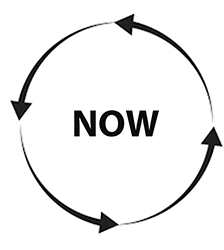
Now, probably the original way that humans experienced time was sort of like this: 

There was just a big NOW, with no concept of the past or the future.  We just sat there in the bliss of the present moment soaking it all in.  Or it might have been a little bit more like this, where one NOW moment just led into the next NOW moment. No concept of past or future, just NOW.

That’s much the way that babies seem to experience time.  They can lie there for hours staring at a sunbeam and not get worked up at all about what the sunbeams are going to look like tomorrow or worry about what the sunbeams were like yesterday.

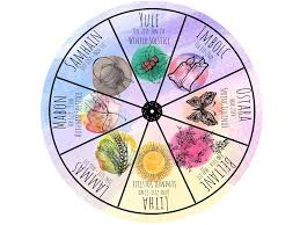
At a certain point in our evolution, our experience of time probably shifted more into the model we see with the Wiccan Wheel of Time.  

We started to notice the cycles of the Moon and the passing of the seasons.  There would have been some recognition of certain times of the year but not a great deal of worry about it.  The Native Americans of the Northwest expressed it in terms of activities.  “This is the time when we gather berries.  This is the time we catch salmon.  This is the time when we plant seeds.”  And so on.

Still, there was none of the huge anxiety that we seem to feel about time today.  Tribal people didn’t sit around their camp fires filling in dates on a calendar or trying to figure out how to, “use their time more productively.”  They just did what they needed to do when it was the right time of the year to do it.  “Hey, I’ll bet some fried salmon would go great with these blackberries!  We should probably stack up a little fire wood while we’re at it because it’s going to get cold sometime soon.”

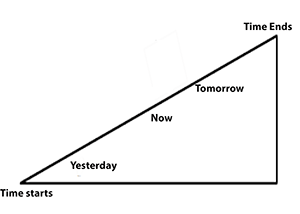
Unfortunately, while the Native Americans were sitting around having fish fries and enjoying their blackberry cobblers, humans in the Middle East were coming up with an entirely different concept of time, which historians refer to as the, “inclined plane,” model.  The reasoning behind this model of time ran very much like this:

  1. – If time exists, then there must have been a BEGINNING of time, because . . . you know . . . there just must have been.
  2. – And if someone, “started,” time, then it must have been someone who was OUTSIDE of time and that would be someone who was eternal and that would be God.
  1.  -And if there was a start to time, then there must also be a stop to time, which is when the world ends and God will do that, too, so I think we should call it The End Times.

Okay, so it wasn’t the best piece of human thinking that we’ve ever seen, but they didn’t have Google in those days so they couldn’t really look things up.  It also represents a HUGE shift in human perception and one that we’re still suffering from today.  All of a sudden, time looks like this:

So time has suddenly become a quantity, rather than a quality. It begins and it ends.  We can measure it, we can put it on calendars, we can plan it, we can carry it around on the daily planners of our phones. Shazam! – we have the concepts of the past and the future, of yesterdays and tomorrows.  We see this notion of time-as-a-quantity deeply ingrained in our languages.

I need to SPEND some time on that.

I’m not sure I want to INVEST that much time in it.

Time’s a WASTING.

This should be a real time SAVER.

I need to ORGANIZE my time.

We’re RUNNING OUT of time.

I’ll PAY you for your time.

When we look at all of those statements, the basic message is that THERE ISN’T ENOUGH TIME, goddamnit!  Which, of course, is ridiculous, because there’s all the time in the world.  Literally.

We’ve been so totally hypnotized by the religious concept of time that we  can’t imagine a world without it.  We’ve devolved from that perfect bliss of a baby tripping out on the sunbeams into beings who are missing our own lives because we’re constantly living in the past or in the future.  The only cure for it seems to be to re-train our brains back into living in the NOW through mindfulness meditations and living mindfully.

I mean, you know, if we can schedule the time for that.  I’ll have to look at my calendar . . .

Just a reminder that there is ALWAYS time to read my ebook, Just the Tarot, and it’s still available, dirt cheap, on Amazon

Atheist Tarot Readers, Defective Jesus, and Finding a New God-Person

The pragmatism of polytheism.

I have a friend who is an atheist Tarot card reader and it tickles me no end.  I like to rag on her a bit and ask her, “Who do you think is answering your questions when you do a reading?  Maybe atheist angels or agnostic spirit guides?”  

Which generally earns me a dirty look or a shrug.  She reads Tarot cards.  She’s an atheist.  It’s not up for discussion.

Now, she’s kind of caught between a rock and a hard place.  The rock is that she was reading Tarot cards for many years before she became an atheist, so she knows that they actually work.  When you sit down with a deck of cards and do a reading, you get answers and the answers are generally (not always) right on.

The hard place is that she went through a series of very painful life experiences that led her to conclude that there’s no God and that religion is nothing more than superstitious nonsense.  That conclusion wasn’t arrived at in a frivolous manner because she was genuinely suffering in her life, she prayed for help, and nothing much happened.

It’s a pretty simple equation, right?  We’re told that there’s some sort of a God-person out there, that he loves us, and that if we’re in trouble he’ll come zooming in and rescue us.  So, if we do our part by (a) getting in trouble and (b) praying for help and the God-person doesn’t do his part by (c) zooming in and rescuing us, then it’s logical to conclude that the God-person either doesn’t exist or else he’s pretty useless.

I’m actually very sympathetic with my friend, the atheist Tarot reader, because I had a similar experience when I was in my mid-forties.  My father had just killed himself, I lost my job and had to declare bankruptcy, my house was repossessed, and my mother developed Alzheimer’s Disease.

All of this happened within a one year span of time.  My life went from being perfectly normal to being a total shit-burger in the wink of an eye.  I was so chewed up by life that I had to look up to see the bottom and if it weren’t for bad luck, “I wouldn’t have had no luck at all.”  Life had chewed me up, spit me out, and then stomped on me with hob-nail boots to be sure I’d stay on the ground.

I was living in Texas at the time and there’s a fundamentalist christian under every rock and behind every cactus in Texas.  It was probably inevitable, then, that one of them said, “Dan, you just need to get down on your knees and pray to Jesus for help.”  And I did.  I was raised up in the catholic church, so the concept of praying to Jesus wasn’t exactly foreign to me and I thought, “Well, shit . . . what do I have to lose?”  Nothing.

So I commenced praying and I prayed and prayed and prayed and asked Jesus to help me in my misery and travails and – SHAZAM! – nothing happened.  No heavenly hosts of angels appeared, Jesus didn’t invite me for a walk in the garden and no one anointed my fevered brow with soothing oils.  I continued to be royally fucked.

But, unlike my friend, the atheist Tarot reader, I didn’t throw my hands in the air and declare that God is dead and it’s just a cold, hard universe.  Instead, I analyzed my situation and thought, “Well, I’m in trouble, I prayed to the God-person to come zooming in and help me, and nothing happened.  Obviously, I have a defective God-person.  He’s not working, so I’ll just send him back.  I need to find a God-person who can get the job done.”

I did a lot of research on Gods and Goddesses and finally settled on Hecate’, the Goddess of the Cross Roads.  She seemed like a good fit because I was definitely at a cross roads in my life and I needed to know which way to turn.  I prayed and prayed and prayed and asked Hecate’ to help me in my misery and travails and – SHAZAM! – something happened.

In fact, quite a bit happened, just like magic.  I met a woman on line, fell in love with her, moved to California and we lived together for 19 years.  My life went from being an absolute shit-burger to being wonder-full in the wink of an eye.

Now, I’m not writing all of this as some sort of an anti-Jesus screed or to praise the wonders of Hecate’.  I know a few christians who swear up and down that Jesus answers their prayers and they seem like nice, honest people.  Maybe they got a Jesus model that wasn’t defective and he sort of works if they don’t take too close a look at him.  Maybe Jesus was just a bad fit for me – could be that he doesn’t like my haircut or tie dyed shirts.  I don’t know.  I just know he didn’t work.

Which leads me back to my friend, the atheist Tarot reader.  Like me, she tried praying to her God-person and nothing happened, nothing got better.  She quite logically realized he was a defective model and sent him back.  Fortunately, she was still able to hang on to her Tarot cards and say, “These DO work, so I’m not sending them back.”

The point being that we have a sort of a pragmatic, mostly unspoken, contract with our God-persons.  It’s something along the lines of, “Okay, God-person, we’ll pray to you and we’ll build all of these very grandiose temple-houses for you to live in and we’ll pay the salaries of your priest-persons.  You, on the other hand, will help us, console us, give us guidance, and zoom in to help us when we’re in trouble.”

Unfortunately, humans have a long history of making excuses for their God-persons.  In many instances, it’s as if the God-person is on vacation when we’re in trouble, or perhaps he has Attention Deficit Disorder and it just slips his mind that we’re hanging off the edge of a cliff holding on to a single branch.  In the worst instances, the God-person seems to behave like some sort of a deranged sadist who LIKES wrecking people’s lives and we just pray that maybe he won’t notice us while he’s in a bad mood.

In those instances, it’s perfectly acceptable to just say, “Okay, God-person – I held up my end of the bargain and you didn’t hold up yours.  It’s been sweet, but I think we both know this isn’t working out.”

And it’s also perfectly acceptable to find another God-person.  Just because this relationship is ending, it doesn’t mean that we can’t have another relationship.  There’s no reason to accept the christian line that there’s only ONE God-person and that we mustn’t ever be unfaithful to him, even when he’s being unfaithful to us.  What a narcissist!

It’s actually a great big universe out there and there are plenty of God-persons to choose from.  If we’re stone-cold poor, for instance, we might want to talk to Lakshmi, the Goddess of Abundance.  If we’re facing insurmountable obstacles, Ganesh specializes in removing them.  If we’re in need of healing, talk to Tara.  If we have no love in your lives, pray to Quan Yin.

I think that you’ll find that most God-persons are actually quite nice entities.  For the most part, they seem to have healthy boundaries.  They don’t follow you around and spy on what you’re doing.  They don’t have temper fits and throw you out of the garden just because you ate an apple.  They seem to have a lot of unconditional love and won’t ask you to sacrifice your first born son.  And they actually work.

My e-book, “Just the Tarot,” a practical guide to reading Tarot cards, is still available on Amazon for less than you’d pay for a small order of jalapeño poppers and will last a lot longer.

The Rules of Synchronicity Number Two: Lighten the Fuck Up and Walk on Some Water

Playfulness as a key to synchronicity.

In my previous post, The Rules of Synchronicity, Having Sex with Pizzas, and Becoming More Flow-ish, I began to lay out some basic rules for increasing synchronicity in our lives.  We then use that synchronicity to get into The Flow State and life becomes a lot easier.

  Rule number one, of course, is to ask for synchronicity.  It’s like knocking on a door – if you don’t knock, no one will answer.

Rule number two is . . . play.

Just play.  As in, don’t take ourselves so seriously.  Lighten the fuck up.  Mellow out.  Have some fun.

Now, to many people, that’s going to sound counter-intuitive.  After all, we’re asking the Universe for guidance in our lives!  And that’s serious stuff, by golly, and we should act very solemn about it.  Maybe dress all in black and look pained and tragic.  Or maybe even fall down on our knees and sob about it.

Not.

There is a, “Whatever-It-Is,” out there in the Universe that answers our questions and gives us guidance when we ask.  Call it god, call it the faery folk, call it angels, call it whatever you like.  It’s there and it engages with us when we engage with it.

Now, the Whatever-It-Is has some basic characteristics, just like a person.  In fact, it might be easier to think of Whatever-It-Is as a person or even a friend.  One of it’s characteristics is that it’s playful.  It likes to engage with people who have a sense of humor and a light heart.  It’s not that Whatever-It-Is WON’T engage with us if we’re all serious and dejected and depressed.  It would just rather engage with someone who’s a little more fun.

Using the analogy of a friend again, we all have friends who are in a dark, depressed place.  Everyone goes in and out of the light and some people stay in the darkness a little longer than others.  If we have a friend like that, we don’t turn our backs on him.  If she needs to have a cup of coffee and just unload about how miserable her life is, we’ll do that.  We’re willing to pat his shoulder and say, “There, there . . . it will all work out.”

On the other hand, if we see that particular friend coming toward us a block away, we might cross the street and peer into a shop window until he passes by.  We’re compassionate, but we’re not masochistic.  We’re there to help, but we don’t seek out the darkness they’re living in.

Put another way, we’re all attracted to people who are positive, humorous, and light hearted.  Their positive energy gives us a good energetic charge and, hopefully, we give them one as well.

In very much the same way, Whatever-It-Is is much more likely to engage with us when we’re living in a fun, humorous, positive space.  It has a light, playful energy and so it’s much more compatible with OUR energy when we’re light and playful.

This is, of course, completely contrary to what we’ve been raised to believe.  Traditionally, people have sought out a connection with Whatever-It-Is in churches.  And what do we know about going to church?  It’s very, very, very serious.  And solemn.  And pretty damned uncomfortable.  No giggling allowed, thank you very much.  

Catholics even have a tradition of smacking themselves in their chests with their fists and saying, “Mea culpa, mea culpa, mea MAXIMA culpa.”  That translates as, “I am guilty, I am guilty, I am SO FUCKING guilty.”

Would you like to have a conversation like that with a friend?  Of course not.  So why do we assume that Whatever-It-Is wants to have that conversation with us?  The ironic thing is that we’ve been taught that, in order to talk with Whatever-It-Is, we have to get into a really dark, serious emotional space and this is totally non-productive.  It just makes it that much harder for the positive energy and guidance to flow to us, because our vibration is incompatible.

Another problem that many of us – especially those of us who were raised as christians – encounter is that we’ve been taught from the get-go that GOD IS NOT OUR FRIEND!  The word, “god,” is just the term that most Westerners use to describe Whatever-It-Is.  It’s the something out there that we talk to when we need guidance and help, which we call, “praying,”  and when it answers us we call that, “miracles.”  

Unfortunately, we’ve also been taught that this god person pretty much doesn’t like anything that makes us happy.  That includes masturbation, sex, lying around being lazy, eating too much, and getting high.  He’s making a list and he’s checking it twice and he’s going to find out if we’re naughty or nice.  And if we’re naughty, we’re going straight to hell. Forever.  Period.

In other words, god doesn’t have much of a sense of humor.  In fact, you can flip through the entire bible and hardly find one single instance where god appeared to be having any fun or told a joke or did a dance.  The one exception I can think of was when Jesus decided to walk on the water just to freak out the local fishermen, but that’s a different story.

So, once again, this is a mind-set that we need to TOTALLY get out of.  Whatever-It-Is (call it god if you want to) LIKES for us to have fun.  Whatever-It-Is LIKES people who have sex and lie around in a hammock on a sunny day and tell jokes and dance.  Who wouldn’t?

Just to recap where we’re at in this discussion at this point:

  1. – We’re much happier, more fulfilled, and content when we’re living in the state of consciousness that we call, “The Flow.”
  2. – That state of consciousness always occurs coincident with synchronicity, so if we can increase our synchronicity, we increase the time we spend in The Flow.
  3. – Synchronicity means having contact with, asking questions of, and getting guidance from the spiritual source that some people call god/goddess or the faery folk or angels or spirit guides or even Whatever-It-Is.
  4. – The first step in achieving synchronicity is to actually, consciously ask for guidance and then watch for answers.
  5. – The answers will come a lot easier if we stay in a happy, light, positive vibration and remember that Whatever-It-Is is a benevolent friend who likes to have fun.

I’ll be posting some more about synchronicity in the near future, but for now just remember that the way to enlightenment is to lighten the fuck up.  We can do that!

Remember that my e-book, Just the Tarot, is available on Amazon for much less than what you’d pay for a box of chocolates and you’ll know EXACTLY what you’re getting.

The Rules of Synchronicity, Having Sex with Pizzas, and Becoming More Flow-ish

Basic rules for increasing synchronicity in your life and getting in the Flow.

We’re all familiar with that state of being that we call, “being in the Zone,” or, “being in the Flow.” Both artists and athletes talk about the special state of consciousness where their work becomes completely focussed, everything they want to accomplish unfolds effortlessly and the perception of time seems to be suspended. When we’re in the Flow, life becomes a magical mystery tour and feels like a perfect fit instead of a struggle.

There are dozens of books out there on the subject of the Flow, but my favorite is Charlene Belitz groundbreaking book The Power of Flow. She noted that when we’re in the Flow state, we have a marked increase in synchronistic events and she thought, “Hmmmm . . . if synchronicity goes along with the Flow state like cheese dip goes with Doritos . . . then that means that when one occurs, the other occurs, too. So . . . if we can increase synchronicity, maybe we can increase being in the Flow.”

And it works. I tried it. When I trigger extra synchronicity in my life, then my life begins to hum along much more smoothly and I feel happier, more content, and easier in my spirit. I may not be in the Flow constantly, but I’m sure as hell a lot more Flow-ish and that feels pretty good.

When we boil down synchronicity and then hang it on the line to dry, it basically just means that the universe is having a conversation with us. Carl Jung defined it as, “a meaningful convergence of interior and exterior events,” which is really just a formal way of saying that the universe is noticing what we’re thinking and interacting with our thoughts.

The classic example is when we’re sitting there thinking about our Great Aunt Petunia Lilac Huckleberry, whom we haven’t spoken to in 25 years, the phone rings and – Shazam! – it’s Aunt Petunia and she has something really important to tell us. Now, we can dissect that and analyze it and pick it apart a million ways to Sunday, but there are really only three things we need to focus on here: (1) We thought of Aunt Petunia; (2) Aunt Petunia called us; and (3) it was meaningful.

That sort of thing happens to all of us on what seems to be a completely random basis. Since it’s random – in other words, we’re not consciously causing it to happen – we just call it a coincidence. We shrug our shoulders and say, “Well, that was damned weird,” and just forget about it.

On the other hand, when we recognize that it’s really a thing – that we can make things like that happen – then it becomes a force in our lives. We start experiencing synchronicity a lot more because we’re asking for it to happen. And as we experience more synchronicity, then we find ourselves more and more in the Flow and life becomes a LOT easier.

There are some simple rules involved with causing more synchronicity to appear in our lives. I’ve stumbled across some of them as I’ve explored the subject and want to share them in a few ongoing posts, so I’ll start with this one.

SYNCHRONICITY RULE NUMBER ONE: START THE CONVERSATION

The first rule is to realize that there is something out there talking with us, having meaningful conversations, and giving us answers when we need them. BUT . . . whatever it is, it doesn’t usually start the conversation. We need to reach out to whatever it is first, and then it replies to us.

Human beings have realized that there was something out there talking with us for most of our existence and we’ve tried to fill in the blanks about who or what it is. Some people perceive the something out there as angels and spirit guides. Some people perceive it as Fairies. Some people see it as Jesus answering their prayers. Some people think of it in impersonal terms, like the Tao.

It doesn’t matter! We don’t have to figure out exactly what it is that’s talking back to us in order to have the conversation. If you feel more comfortable calling it Jesus, that’s fine. If you prefer Spirit Guides, that’s fine, too. If you just want to call it, “Hey, you,” then go for it. The main thing is to just realize that it’s there, it has answers for you, and it’s waiting for you to ask for them.

So, suppose you have a new boyfriend and he seems to be just perfect. He’s charming, good looking, he’s well read, fun to be with, has lots of money to throw around, and you think he may be The One. BUT . . . as the relationship develops you discover that the only way that he can have sex is to slather himself in tomato paste and cover his body with slices of pepperoni. Unless he’s dressed up as a pizza, he’s completely impotent in bed and you’re highly conflicted about this because you don’t much care for pizza and you certainly don’t want to eat it every night. It’s a conundrum and you need some guidance about your choices in the matter.

So what do you do? You just stop and say, “Hey, you, (or Jesus or Fairies or Tao) what should I do about this? I think I love the guy, but shtupping Italian food just really doesn’t turn me on.” And then you take a walk or go to work or throw all of your tomato covered bed sheets in the washer and wait for an answer.

And the answer will come. It may be something as dramatic as the local Round Table Pizza burning to the ground or it may be as subtle as finding a can of tomato paste that’s been run over by a truck, but the answer will come. Once we ask the question, the universe will always find a way to let us know what we need to do.

Which leads us to Rule Number One (a):

DON’T BE AN ASKHOLE

Have you ever had a friend who was constantly asking for your advice but never took it? They come to you with one problem after another, ask what they should do, and then manufacture endless reasons for why they can’t possibly do what you suggested.

They’re basically being askholes. They’re not really interested in solutions, they’re just interested in the drama of their problems. We may occasionally lose our tempers and blow up at those people but more often we just fade away. We start avoiding them as much as we can and, if they corner us, we just nod and say, “Uh, huh. Golly. How ‘bout that? Gee whiz.”

We’ve learned that they’re never going to follow our advice and so we stop giving it. The Universe (or Jesus or Fairies or the Tao or Hey You) is very much like that. If we ask for help with something, it will always respond with an answer. But . . . if we continually ignore the advice, then Hey You will start avoiding us and ignoring our questions because it knows we don’t really want an answer.

So, in the example above, the Universe might suggest that you leave the guy, or it might suggest that you sprinkle him with Parmesan cheese before you have sex, or it might suggest that you ask him to dress up like a grilled cheese sandwich instead of a pizza and see how THAT goes. Whatever form the advice comes in, we need to act on it. If we don’t, the advice will just stop coming. If we do, then the advice will increase, synchronicity will increase, and we’ll find ourselves more and more in the Flow.

I’ll be offering some more insights on how to increase synchronicity in the next few posts. In the meantime, ask and ye shall receive. Askhole and ye shall not.

Remember that my ebook, Just the Tarot, is still available on Amazon for less than the price of a single slice of pizza and MUCH less than a grilled cheese sandwich with tomato soup. You should buy a copy.

The Sun, the Moon, Julius Caesar, and Why There’s No Such Thing as a Free Lunch

A brief look at the origin of the concept of time and its link to money, capitalism, and lunch.

Didja ever notice that we tend to discuss time in almost exactly the same way that we discuss money?

Consider some of these phrases:

  • We spend time.
  • We save time.
  • We waste time.
  • We invest time.
  • We say that we’re running out of time.
  • We tell people that we don’t have enough time.

And, of course, the one that really lets the cat out of the bag:  “Time is money.”  

In other words, we’ve made time into a commodity.  We assure ourselves that we don’t have enough of it, but we trade substantial portions of it to our employers in exchange for money, which then allows us to take vacations when we’ve stacked up enough moolah, because we, “need some time off.”

Now, there are moments in human history when we, as a species, have made such monumentally stupid decisions about something that they amount to an evolutionary wrong turn and scar us forever.  I discussed one such moment in my previous post, “Happiness, Capitalists, Yellow Rocks, and Radical Meditators.”

At some point in ancient human history, a person picked up a piece of gold and said, “I have a yellow rock and you don’t.”  The appropriate response would have been to say, “Dude, what good is it?  You can’t eat it and you can’t fuck it.  Get over yourself.”

But, instead, we said, “I want one, too.”  What followed was centuries of murder, pillaging, and decimating native cultures, all in the name of determining who had the most yellow rocks.

In much the same way, there was a point in human history when some idiot asked, “What time is it?”  We have to imagine that the person standing next to him replied, “It’s day time.  What are you blind?  The sun’s up there in the sky and you can see your hand in front of your face.  It’s day time.”

“No,  I mean, exactly what time of the day is it?”

“Who cares?  If it’s day time, we get up.  If it’s night time, we go to sleep.  Who cares what part of It’s-Get-Up-Time it is?”

“Well, if we don’t know precisely what time of It’s-Get-Up-Time it is, how are we supposed to know when to have lunch?”

“Oh . . . shit . . . I never thought of it that way.  That’s an important point.  I don’t want to miss lunch.”

“I know what!  Let’s build a sundial!  Then we’ll know exactly how much time we’ve got in each day and when to eat lunch.”

Thus was born the concept of time as a commodity.   Something that could be measured and therefore controlled.

This form of insanity became SO popular that by 46 BC Julius Caesar said, “You know, we’ve actually got too much time going on and we need to get it under control, so I invented . . . the calendar.  From now on, there are exactly 365 days in each year.  Well . . . I mean, except for every fourth year when there’s an extra day and we’ll just throw that one in during February so no one notices.”

It seemed as if we finally had time under full control and everyone knew exactly when to eat lunch, when suddenly, 1600 years later, in 1582, Pope Gregory said, “Actually, I’ve been thinking about it, and I think that there are  365.2425 days in the year instead of 365.25.”  And thus was born the Gregorian calendar, which we use to this very day.

Hurrah!

Now, let’s be honest.  If we had a friend or a relative who was terribly, terribly, TERRIBLY worried about whether there are 365.25 days in the year or 365.2425 days, we’d say, “You know, that guy’s plumb nuts.  He actually stays up at night worrying how long the year is.” 

Really, there are only two natural measures of time here on the Earth school. The first is the number of times that the Moon gets full.

And the second is how many Full Moons occur while we rotate around the Sun.

It gets light and then it gets dark and that’s night and day.  We have more dark in the winter and more light in the summer and those are the seasons.  The, “shortest,” day of the year is right around December the twenty first, so the, “new,” year starts right around December the twenty second.  Easy peasy.

We can see that more natural approach to time with the Indigenous Peoples of the Pacific Northwest.  They had one month that was called, “the time to catch salmon.”  Another month was, “the time to gather berries.”  Another month was, “the time to catch eels.”  My favorite was February, which was, “the time to do nothing,” (probably because of that pesky extra day that Julius Caesar discovered.)  They didn’t have any concept of weeks or months or hours in the day and were totally amazed at our obsession with watches and clocks and calendars.

So where DID this need to measure and control time come from?  We can get a very clear picture on that when we consider the origin of the word, “calendar.”  It was, “Kalendorium,” which was defined as, “A book in which the interest on loans (due on the first of the month) was recorded.  An account book.  A ledger.”

So the concept of time wasn’t invented to be sure that we all had lunch at the right time.  It was invented to be sure that we paid back our loans on time.  

Basically, the guys who had collected all of the yellow rocks said, “I’m going to loan you this yellow rock because all you have is copper rocks and you can’t even buy lunch with that.  BUT . . . in exchange for my giving you one of my yellow rocks, you have to pay me back TWO yellow rocks.  Unless, of course, you hold onto my yellow rock for longer than the period of the loan, and then you have to give me THREE yellow rocks.”

And thus was born capitalism.

It became more radical, of course, with the beginning of the industrial age when we saw the birth of the wage slave.  That’s when the people who had collected all of the yellow rocks REALLY dug in and took control of our time.

“Look here,” they said,  “I don’t have a lot of time because I’m busy counting all of my yellow rocks.  You, on the other hand, don’t have any yellow rocks but you have a lot of time, which, up until now, was free time.  Now, I’ll give you the dust in the bottom of my bag of yellow rocks in exchange for you using all of your time to work in my factory, and then you can afford to buy lunch.  I mean, if I decide to give you a lunch break.”

And thus was born the minimum wage.

 And that is how we came to lose our time.  Now we can’t afford to waste our time, because we have to spend our time, in order to invest our time because . . . well, we’re running out of time.

Time is money!

My ebook, “Just the Tarot,”  is still available on Amazon.com for less than you’d pay for three rolled tacos, even without guacamole’.  You really can’t afford to turn down a bargain like that.

Faeries and Angels and the Something Out There That Wants to Have a Chat

A closer look at synchronicity and the concept of a responsive universe.

There’s Something Out There.

 . . . And it’s watching you.

Cue in creepy horror story music.

LOL!  Not really.  More like cue in joyous, happy music.  But there IS Something Out There.  Something mysterious that we can occasionally feel but can’t quite focus on.  It flits by at the corner of our eyes but when we turn to look at it, it’s gone.

Here’s a fun experiment that anyone can try.  Think of a problem that you’ve got or a question that you need an answer to.  Really concentrate on it and then send it out into the universe and ask for an answer.

Then over the next week, watch for the answer.  You don’t have to get all serious about it (in fact, that may be the worst thing to do) but just remind yourself to look for the answer every time that you go out the door.  And it will appear.  It will probably be in symbolic form rather than a post-it note dropping out of the sky, but it will be there.  Perhaps a book will fall out of a shelf opened to a page that has the answer.  Maybe it will be a highway sign flashing a message on your way to work.  Maybe it will be a particular song that comes on the radio every time that you turn it on.  Perhaps a total stranger will walk up to you and say something that fits perfectly.  However it appears, if you ask the question and then diligently look for the answer, the answer will appear.

And that’s strange and wonderful and magical and marvelous and has some really interesting implications.

Now, our current term for that is, “synchronicity,” which was coined by Carl Jung.  Jung was one of the few honest scientists of his time and he noticed that weird shit happens and he actually wrote about it.  He noted weird things that  we’ve all experienced, like thinking of someone we haven’t seen in years when the telephone suddenly rings and it’s that very person calling.  One of his own examples was that he was treating a patient who was describing a dream she’d had about a scarab beetle when – shazam – a scarab beetle appeared on the outside of the window.

He looked at those occurrences, analyzed them thoroughly, and then concluded, “That’s weird. Really, really . . . weird.”

Unfortunately, when Jung talked to his fellow scientists about it and asked, “Have you noticed that weird shit happens?” they all said, “No.  We try very hard to not notice that.”  In other words, if they couldn’t explain it, they preferred to ignore it.

Jung’s very careful definition of synchronicity was, “a meaningful convergence of inner and outer events.”  Which is just another way of saying, “When you ask the universe a question, Something Out There answers you.”

There’s Something Out There.

A large part of the history of the human race has been trying to figure out just exactly WHAT or who the Something Out There is.  There have been a lot of interesting answers, too.  Human cultures have had hundreds and hundreds of gods and goddesses whom we have posited as, “the Something Out There,” that answers our questions and solves our problems.

We’ve gotten a bit lazy and unimaginative in modern times and we only seem to be able to come up with one god, but for most of our evolution we actually had specialized gods who answered specific questions.  If we were having problems with a lack of abundance in our lives, we might ask Lakshmi to give us answers for those questions.  Or if we were suffering through a drought, we might appeal to Oshun for rain.  Or if we were faced with insurmountable obstacles, we could turn to Ganesh and ask him to remove them.

All of the gods and goddesses are a recognition of the fact that there’s Something Out There that seems to listen to us and provide the answers that we need.  Some of the more spiritually, “evolved,” religions like Taoism posit that there’s a Something Out There but it’s not too terribly interested in our personal problems.  Rather, the Something Out There is a sort of an impersonal current that runs through the universe and we solve our problems by becoming more aligned with its energy.  The more we’re in harmony with that energy, the more likely we are to be happy and not have any problems that need answers.  We just have to get in the flow, but the flow doesn’t particularly care if we do that or not.

That’s never really been terribly satisfactory to the human spirit, though.  We seem to need to feel a personal connection, to know that the Something Out There actually sees us, hears us, and cares about us.  Despite the fact that Taoism as a philosophy may posit an impersonal universe, Taoism as a religion has plenty of gods and goddesses to talk with, not to mention swarms of ancestors we can consult on a daily basis.  Buddhism as a philosophy may be perfectly acceptable to atheists, but most Buddhists pray to Tara and have altars in their homes.

I love the approach that Brian Froud and Jessica MacBeth took in the Faeries’ Oracle Cards.  Not only is there a Something Out There, there are a LOT of somethings out there, in the form of Faeries, Gnomes, and Elementals who are perfectly willing to give us a wink and tell us when we’re going down the wrong paths.

In a very similar way, I have several friends who see and talk with angels and spirit guides on a regular basis.  To them, those are the Something Out There that answers when they ask a question.  Sonia Choquette has actually mapped out dozens of different types of angels and guides and elementals, each with different functions and different answers.

For as long as humans have existed, we’ve known that there was a Something Out There that is conscious, caring, and interacts with us to make our lives better.  And for just as long, we’ve been trying to fill in the blank about exactly who or what that Something Out There is.  

We don’t really need to do that, though.  We don’t have to be Spiritual Masters or be able to see the angels sitting on our couches.  If we have faeries living in our gardens and they want to appear to us and tell us their names, that’s great, but it’s not necessary.  We can just start with the knowledge that there’s Something Out There, which is magical enough for most of us, and go from there.

“Hey, Something Out There, I really like the person I’ve been dating and I’m wondering if we should move in together?”

“Hi, Something Out There, I’ve been offered a better job, but it means moving away from my family and I’m just not sure if I want to do that.  What do you think?”

“You know, Something Out There, I was wondering if I could really make a living as an artist, or am I just bullshitting myself?”

And the Something Out There will give us the answer and the answer will be right.

All we have to do is . . . Believe . . . Ask . . . and Listen.

Easy peasy.

Remember that my e-book, Just the Tarot, is available on Amazon and is less expensive than a bag of Doritos. If you buy one of those little jars of spinach dip to go along with the Doritos, my book is actually THREE TIMES LESS EXPENSIVE!!! Jesus, what a bargain!

The Hitchhiker’s Guide to the Dark Ages, The Hierophant Card, and Eschewing Sheep

The Bible as an anachronistic guide for living.

The Bible was really the original Hitchhiker’s Guide to the Galaxy, at least for a big chunk of Western history.

In The Hitchhiker’s Guide to the Galaxy, Douglas Adams invented a sort of a tourist’s guide book that could be used while visiting various sections of  outer space.   No matter what bizarre planet or dystopian nebula a traveler might be visiting, she could simply consult the Guide to Galaxy to determine what in the hell was going on.

Now imagine, if you will, a world in which the inhabitants were so thoroughly stupid and ill-informed that they thought that the planets they saw in the night sky must be living creatures because, after all, they moved around instead of standing still.  Inhabitants who believed that their own planet was, in fact, flat as a board, and that you might fall off of the edge of it if you sailed your ship too far in any given direction.   People who believed that if a man had a wet dream it was because his, “vital fluids,” were being drained by a succubus.  People who believed that witches had secret teats that they used to nurse black cats.

To use the scientific nomenclature, people who were just as dumb as a bag of rocks.

For such people, life would seem very puzzling and, indeed, very frightening.  They were constantly surrounded by threats and mysteries.  Where does lightning come from?  Do demons live in trees?  Why do we sneeze?  What’s a clitoris and where do you find one?  Well . . . never mind that last one . . .  that’s still going on.

Fortunately, when confronted by this bizarre, evil, scary world, they had a book they could turn to for guidance on nearly any subject.  And not just any book.  This book was written by . . . God.  And, since God actually MADE the bizarre, evil, scary world, he’d be the one who’d have the answers about what in the hell was going on, wouldn’t he?  All of that secret God-knowledge was contained in The Christian Hitchhiker’s Guide to the Dark Ages, also known as the Bible.

Unfortunately, there were very few copies of the Bible in existence, they were enormous,  and those few copies were mainly kept locked away in castles and monasteries.  To make matters worse, even if the common folks were somehow able to get hold of a copy of the Bible, they didn’t know how to read it because . . . you know . . . ddumb as a bag of rocks.  All that they could do was to sit there and hold the Bible and try to guess what it might actually say, which didn’t work out too well.

And so they invented a special class of people who actually COULD read and actually HAD copies of the Bible and they called them, “priests,”  and sometimes, “monks.”  We see one such person in the Tarot card, The Hierophant.

The arrangement that the common people had with the priests was really quite simple.  When they – the common folks – were confronted with a problem or a conundrum in life, they would go to the priest and give him money, or some eggs, or perhaps a goat. Maybe an eggplant.  In return, the priest would bring out an enormous copy of the Bible, flip it open, read a bit, and then tell the common folks what God had to say about how to solve their problems.

We can imagine that this exchange might have gone something like this:

“Yes, hello Father Flanagan.  Top of the morning to you.  We’re here because our well has dried up and if there’s no water we don’t know how the village will come down with giardia this summer.  We can’t decide if we should dig a little deeper or maybe just start a new well, so if you could look in your giant book and tell us what the God person says, we’d appreciate it.  By the way, here’s an eggplant.”

The priest, for his part, would mutter a few incantations, heave open the big, fat book to a random section, and trace a few lines of the Holy Scripture with his finger.

“Ah, here it is, my children.  The Lord saith, “Thou shalt not curse the deaf, nor put a stumbling block before the blind,.”  Leviticus 19:14.

“Oh.  Um . . . begging your pardon, your holiness, but what does that mean?”

“It means, don’t trip blind people.”

“Ah . . . yes . . . and that’s very good advice, Father.  I personally try to avoid tripping blind people as much as possible.  Anyone here who trips blind people?”

The common people glance around at each other, shaking their heads.

“Nope, none of us trip blind people.  Well, there was Fred, but that was years ago.  Still, your honorableness, that doesn’t hardly tell us whether to dig a new well.  Could we maybe give it another try?  Here’s another eggplant.”

“Oh, very well.  Let’s see . . . um . . . “You must not lie carnally with any animal, thus defiling yourself with it; a woman must not stand before an animal to mate with it.”  Leviticus 18:23

“Uh, what does THAT mean?”

“It means don’t have sex with your sheep.”

“Eeeeeewww!  Gross!  Jesus.  I’ll have a hard time getting THAT out of my head.  Anyone here sheep fuckers?  No?  Even Fred?  No?  Sigh . . . now, about that well, your priestliness.”

And so on and so on, until the priest had all of the people’s eggplants and the people had, verily, nothing but a dry well to spit in.  

The problem, of course, was that The Hitchhiker’s Guide to the Dark Ages, aka The Bible, wasn’t really designed for the Dark Ages, it was designed for the Stone Ages.  While knowledge such as how to kill a giant with a slingshot or how to plug up the Nile River with frogs might have been interesting, it hardly solved the more complex problems of the Dark Ages.  People of the Dark Ages were facing more technologically intricate matters, like how to fight dragons or what charcoal worked best when burning heretics at the stake.

The Bible simply didn’t have the answers, no matter how many eggplants they threw at it.

Now, in the very same sense, it’s entirely possible that the Bible doesn’t contain the answers to the questions we’re facing today.

How do we fight a worldwide pandemic?  And the Bible says . . . nothing about that subject.

How do we stop this horrific gun violence?  Nothing.

Should abortion be legal?  Nothing.

Why is Donald Trump orange?  Nothing.

Is Marjorie Taylor Green an alien life form?  Nothing.

Why have we been cursed with the Kardashians?  Nothing

It may very well be that the Bible isn’t just a very, very, very old book that lost a lot in the translation.  It may be that the Bible is totally irrelevant to most of what we call daily life.  That may be why the number of people who self-identify as christians has fallen from 90% in the 1950s to a mere 64% today.

It’s difficult to deal with fundamentalist christians.  They’re still waving The Hitchhiker’s Guide to the Dark Ages in the air and screaming that the earth is flat and we might fall off of the edges.  Nonetheless, it may be time to look for a different paradigm and different answers.

At least we’ll get to keep our eggplants.

If you enjoyed this post, please remember that my book, JUST THE TAROT, is available on Amazon for much less than the cost of a Bible and doesn’t contain one single word about sheep.

Cheatin’ Horndogs, Vibrators in the Refrigerator, and Tarot Cards that Indicate Infidelity

Tarot cards that indicate infidelity in a relationship.

“She just started liking cheating songs,
And what’s bothering me,
I don’t know if it’s the cheating she likes,
Or just the melody.” – John Anderson

If you read Tarot cards for other people, you’ll find that one of the major topics that those people want to know about is love and romance.

Is she the right one for me?
Does he feel the same about me that I feel about him?
Should I ask her out?
Should we move in together?
Are we meant to get married?
Will this relationship last?

And, of course, with love and romance there are frequently questions about fidelity and cheating. Most marriages and relationships are, “monogamous,” which is derived from the Greek, meaning, “keep your dick in your pants,” (except when you’re with me.) A very large part of the marital and partnership contract is that when we fall in love we’ll be sexually and emotionally exclusive to that one other person.

Just the Tarot by Dan Adair – a kindle ebook available on Amazon

Having sex with or becoming emotionally attached to a third party is seen as a major violation of that contract and is grounds for terminating it. And there are major penalties that go along with that violation, such as being locked out of your house in your bathrobe, or having your partner pour maple syrup all over your best clothes just before she throws them out into the front yard. And many times, it’s not even REAL maple syrup, it’s that cheap, artificially flavored crap like Mrs. Butterworths.

Quite naturally, then, people who are cheating on their partners will go to great lengths to conceal it. And, quite naturally, the partner who’s being cheated on will somehow know, on a very deep, almost psychic level, that their mates are being unfaithful. There may be extremely subtle, subliminal clues, such as your husband having a giant hickey on his neck, or finding a pair of jockey shorts under the pillow when you wear boxer shorts. Or perhaps coming home early from work and seeing a naked man running out your back door, or finding a strange vibrator in the refrigerator next to the carton of eggs.

Those are the kinds of subdued, low key signals that will often make a person stop and ponder if there’s something more going on in their marriage than meets the eye. Still, their partners will tend to deny it. The vibrator in the refrigerator must have accidentally fallen into the grocery bag at the supermarket and really belongs to someone else. The naked man running out the backdoor was the plumber, who was sleepwalking, and was completely shocked when he awakened without clothes while he was working on the dripping faucet in the bathroom. The hickey on your husband’s neck was the result of a near tragic vacuum cleaner accident at work. The jockey shorts under the pillow were meant to be a present and now you’ve gone and ruined the surprise.

Even though these are all perfectly rational, reasonable explanations, there may still be lingering suspicions and so your client will want to consult the Tarot cards to determine the truth. Here are a few cards that may indicate that the questioner’s partner is what is clinically referred to as a, “cheatin’ horndog.”

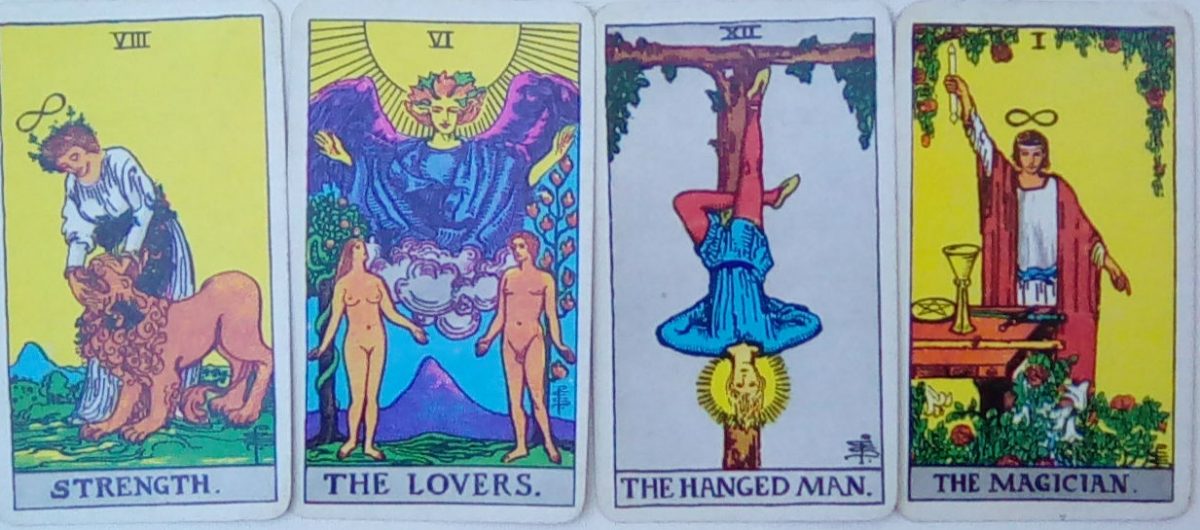
THE LOVERS REVERSED

The Lovers is obviously THE romantic relationship card in the Tarot deck. It shows that period of time when you’re first together with your romantic partner and the whole world seems magical and glowing. It’s just the two of you, in your shining little garden. Just you and the angels and . . . um . . . that pesky snake climbing up the tree. When it’s reversed, the party’s over, baby. You’ve been thrown out of the garden and it’s time to deal with reality.

THE DEVIL (UPRIGHT OR REVERSED)

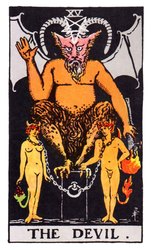
The Devil card shows the same two figures from The Lovers card, only things don’t seem to be as peachy anymore. For one thing, instead of an angel hovering over them, there’s a great big horny kind of a goat/bat demon thingie. They’re chained to a black stone or altar and they have tails which are on fire. (Having your tail burst into flames is another one of those subtle signs that there may be something wrong.) The Devil card can mean a lot of rotten things, such as addictions, super negativity, etc, etc,, but in this context – cheatin’ horndogs – it probably indicates a sexual affair that’s going on and it probably indicates that it’s a pretty heavy duty affair that may have strong elements of BDSM. I mean, horny goats, chains and flaming tails? Really?

THE TOWER (UPRIGHT OR REVERSED)

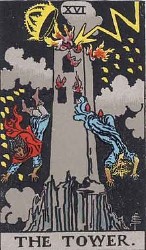
The Tower, as you might guess, is NOT a positive card. It usually indicates a freaking disaster that’s happening right in the middle of our happy little lives. The flash of the lightning bolts indicates that it’s sudden and shocking. It tends to destroy our lives right down to the foundation and then we’ve got to start rebuilding them, piece by piece. Having this show up in a reading about fidelity would indicate the sudden knowledge that your partner has been unfaithful and the relationship has been completely destroyed by that lack of fidelity.

FIVE OF WANDS

The Five of Wands may show up in a relationship where there’s a LOT of emotional turmoil. In the South, they talk about, “fight and fuck,” relationships. These are relationships where the two people involved have huge fights with much screaming and throwing of plates, and then they reconcile and have make-up sex that’s incredibly good. There are spoken phrases in there like, “Oh, baby, I’m so sorry,” and, “I promise this will never happen again, ‘cause you’re the dumplings in my chicken soup, honey buns.” Yes, I know honey buns and chicken soup are a disgusting combination, but you get the idea. There’s cheating going on, but they’ll probably reconcile and spend the next week in bed.


QUEEN OF WANDS REVERSED

The Queen of Wands has a lot of good characteristics and, among them, is fidelity. If she shows up reversed, there’s a very good chance that someone isn’t practicing that virtue.

ACE OF CUPS REVERSED

The Ace of Cups shows pure, unadulterated love pouring into the world. It tends to appear when someone is just starting off on a new romantic relationship and their hearts are full of love. When it’s reversed, there’s a good chance that their love got adulterated by a cheatin’, adulterating horndog.

THREE OF CUPS REVERSED

Obviously, this is very much of a party hardy card. When it’s upright, it’s healthy, joyous and free partying. When it’s reversed and shows up in this kind of a reading it can indicate that the joy is leaving or that your partner is partying with someone else.

TEN OF CUPS REVERSED

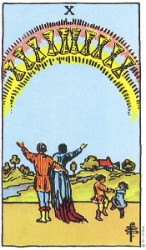
Among other things, the Ten of Cups is the Happy Family card. When it’s reversed it can be a sign that the happy family is breaking up, particularly if it’s a family with children involved.

KNIGHT OF CUPS REVERSED

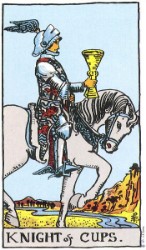
The Knight of Cups is riding out on a sincere quest for love. Reversed, it indicates that the love wasn’t found.

THREE OF SWORDS

LOL – well . . . yeah . . . that one’s pretty obvious. Stabbed right in the heart.

SEVEN OF SWORDS

The Seven of Swords is all about sneaking around and stealing someone else’s power. This is the kind of person who has an affair right in front of everyone’s eyes and somehow gets away with it. This card also shows up frequently when you’re involved with a malignant narcissist who’s just using you for their own ego gratification.

TWO OF PENTACLES

The Two of Pentacles may show up in a reading like this to indicate someone who’s trying to juggle two different love affairs and keep both of them going.

SIX OF PENTACLES

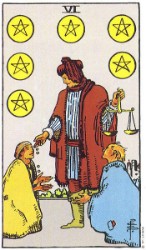
This may indicate a lover who’s not really giving with a whole, loving heart. Love is being measured out very carefully.

Those are just a few of the red flags that may show up if your questioner wants to know if his or her partner is running around.

Remember to be very careful with these types of readings. Many people are in a great deal of denial when relationships are falling apart and really, really DON’T want you to tell them what you see in the reading. What they want is for you to tell them that they were wrong and that the vibrator in the refrigerator is really just a whipped cream dispenser. If you’re doing a reading for your best friend and you tell her that her husband is playing hide-the-sausage with his secretary, she may not be pleased with you. At all.

And, of course, it’s always possible that the questioner’s partner might NOT be a cheatin’ horn dog. He could just be a rat faced dingleberry, which is an entirely different kettle of fish. In either case, approach this topic with caution. Practice using phrases such as:

It seems that all may not be as it appears.
There’s a certain murkiness here.
There appears to be a fork in the road of life.

Avoid using phrases such as:

I think he’s dipping his wick with your best friend.
She’s a real bottom feeder and believe me, I MEAN bottom.
You should have listened to your mother. By the way, does your mother still have that spare room?

The Pragmatism of Happiness, Colliding with Bubbles and The Five of Wands

The pragmatism of choosing to be happy.

Maybe we’re just meant to be happy.

That may sound a bit simplistic and silly on the face of it.  “Duh . . . who doesn’t want to be happy?”  Still, when we consider all of the hoops we jump through in order to NOT be happy, it’s kind of amazing.  Happiness, for many of us, always seems to be a future event rather than something we enjoy in the present moment.

  • I’ll be happy when I finally get out of high school.
  • I’ll be happy when I finally get laid.
  • I’ll be happy when I get a good job.
  • I’ll be happy when I get that new computer.
  • I’ll be happy when I get a new car.
  • I’ll be happy when I fall in love.
  • I’ll be happy when I get married.
  • I’ll be happy when I get divorced.
  • I’ll be happy when the kids are grown up and I have some time for myself.

And on and on and on.  That approach is valid, to a certain extent.  We do get some measure of happiness from all of these things and events, but it never seems to last.  It never seems like real happiness.  It’s like we’re microdosing instead of getting the whole pill.

One of the problems is that we always look at happiness as something that happens to us, rather than something we generate on our own.  We see this reflected in the way that we talk about the process.  “You make me happy.”  Or, “this made me sad.”  Or, “I couldn’t believe how happy that made me feel.”  

The way we verbalize it sounds like there are these bubbles floating around the universe that we occasionally have collisions with and it changes the way that we feel.  “Uh, oh, I just ran into a sad bubble, so I’m sad now.”  Or, “Oh, man, that happy bubble felt good.  Yay!”

Since we don’t control those sources of happiness, since they’re things that happen to us rather than by us, we never feel as if we control our own happiness.  Yes, we can try to maximize our lives so that we run into more happy bubbles than sad bubbles.  We can get rid of the negative people in our lives.  We can find jobs that don’t totally suck.  We can intentionally pick out books or videos that are uplifting, rather than depressing.  But that’s still giving that power of happiness away to exterior sources.  We’re still just trying to control the exterior sources rather than realize our own ability to be happy just because we want to be.

So a good first step in being happy is to just claim our own emotional states.  That means realizing that our happiness, sadness, joy, depression, anger, love, etc. are all things that we are generating ourselves.  They don’t come from outside of us – we’re making them up as we go along.  

Put another way, it’s not a simple stimulus/response interaction.  We don’t have to automatically respond to our life’s events in certain pre-programmed ways.  We can – and do – interpret them.  We just usually interpret them in a very unconscious way.  We’ve been taught that some events are supposed to make us sad and some events are supposed to make us happy and we never stop to question why.

For instance, marriage = happiness and divorce = sadness.  We accept that equation instantly, despite the fact that about half the marriages in our country are miserable experiences and divorce often feels like being let out of a prison.  As the bumper sticker says, “It is better to have loved and lost than to go on living with a psychopath.” 

Now, once we’ve gotten there, when we’re willing to accept that WE are making our own emotions happen rather than colliding with random happy or sad bubbles, then the next step is to actually ask ourselves why we’re choosing those emotions.  A good yardstick to use in that process is evaluating whether they’re actually doing anything for us.  Are they making our lives better?  Are they moving things forward?  Are they improving the quality of our lives?

By way of an example, I used to love, love, LOVE my self-righteous anger.  If I really, genuinely felt that I was right and someone else was wrong, I was willing to argue all night and fight to the death to defend my position and change the other person’s opinion.  I was angry because I had every right to be angry.  

In my defense, I don’t think I’m exactly alone in that process.  Social media groups often feel like the Five of Wands, where everyone is madly swinging their opinions at everyone else, all of us sure that we’ve got the real skinny on what’s true and what’s not.  Our current politics are even worse.

A peculiar thing happened to me, though, where I reached a point of realization that anger just didn’t work very well.  It was this sudden revelation that every single time I got angry, it made things worse instead of better.  Every single time.  Without fail, if I lost my temper I ended up with shit on my shoes and feeling like hell.  Far from changing anyone’s mind about the issue we were arguing over, it just convinced them that I was an angry asshole and there was no reason to listen to me.

And so I just gave it up.  Sure, I get irritated or impatient, just like any other human being, but I haven’t been angry in several years.  Not because I’m some kind of Mahatma Gandhi, but simply because it doesn’t work.  It’s like trying to use the wrong key to start your car.  If you know it’s not going to work, why would you do it?

In the same sense, sadness and depression are emotions that just don’t work very well for human beings.  They make life a lot harder, instead of a lot easier.  They freeze us in place and keep us from attaining our goals and feeling connections with life and joy.  

They are basically an unnatural act, in the true sense of that term.  When we look at young critters, what’s their primary activity?  Play.  Puppies, kittens, young humans, young apes, any young being gets up in the morning and plays until they’re so exhausted that they fall over.  And then they get up and do it again.  We’re born happy and we have to learn how to be unhappy.

Now, it’s true that into every life a little shit must fall.  We aren’t going to feel happy and positive when someone we love has just died or we’ve just gotten run over by a truck.  About 90% of the time, though, NOTHING IS WRONG.  That means that in about 90% of our lives, we can make that simple choice of how we’re going to feel:  happy or sad?  Can you imagine having a life that was 90% happy?  Sounds pretty good, doesn’t it?

It doesn’t have to be some bold, existential statement, either.  It doesn’t have to be some phony Pollyanna stance that everything in life is sweetness and light.  It can be a simple act of pragmatism.  Happiness makes us feel connected with life and our fellow beings.  We move forward toward our goals and opportunities for growth seem to appear out of nowhere.  Depression makes us miserable and we feel that we have no choices and no growth in life.

In a nutshell, depression doesn’t work very well.  Sadness doesn’t work very well.  We can give them up, just like a bad habit, because ultimately that’s all they are.  

The Seven of Swords, Vampires in Pink Bow Ties, and Malignant Narcissists

Malignant Narcissists as the source of monster legends.

Have you ever been worked over by a malignant narcissist?

Perhaps an incredibly charming person appeared in your life and he or she seemed to absolutely worship you.  You were told to an almost embarrassing extent how perfect you were, how beautiful, how intelligent, how sexy.  You fell in love, let down all of your guards and boundaries, and within a year that same person was constantly devaluing your opinions and your self worth and telling you that you just weren’t quite good enough.  You were too fat or too skinny or not very bright or not very well informed or your hair was too long or too short or you weren’t very satisfying in bed.

Or perhaps it was a family member, someone you’d always been fond of and trusted, but you find that they’re actually tearing you down and belittling you to other family members when you’re not there.

Or perhaps it’s a co-worker that you liked and opened up to about your personal life when you had a couple of drinks too many on a Friday night.  On Monday morning you’re shocked to discover that your drinking buddy has shared your personal, “secrets,” not only with all of your co-workers but with your boss, as well.  

There’s a common reaction from anyone who’s been chopped up and spit out by a malignant narcissist and that reaction is bewilderment.

“How could I have been so stupid?”

“Why didn’t I see this coming?”

“But . . . I thought he loved me . . .”

“She totally got under my radar.”

For whatever scant comfort it may provide, you’re in extremely good company.  Some of the smartest, most empathetic, highly evolved people in the world have been taken to the emotional cleaners by malignant narcissists.  It’s what they do and they’re experts at it.  It has NOTHING to do with how intelligent you are, how attractive you are, or how evolved you are.  To a malignant narcissist, you’re just a tasty snack.

The Seven of Swords is a perfect image of a malignant narcissist.  He’s stealing someone else’s power, as represented by the swords slung over his shoulder.  The flaps on the tent are closed, showing that the person he’s stealing from is totally unaware of what he’s doing.  And even the guard posted outside of the tent – representing our conscious mind – seems to not register what’s going on.

If we type, “malignant narcissist,” into a search engine, we’ll get a huge number of results.  There are literally thousands of articles and videos discussing what they do to other people, how they do it, and why they’re malignant narcissists to begin with.  Really, it’s kind of astounding when we realize that they only comprise 5% of the population.  To put it one way, they seem to have an over-sized footprint.  To put it another way, they’ve fucked with an AWFUL lot of us.

Although the term, “malignant narcissist,” is fairly new, there’s nothing new about this personality type.  In the past, they’ve been referred to as sociopaths, psychopaths, monomaniacs, and, “utterly without a conscience.”

And my favorite term for them:  monsters.

There is something positively inhuman about malignant narcissists.  They seem to have absolutely no sense of empathy or compassion.  They have no conscience and remorse.  And, far from being intelligent in the sense that most of us might use the term, their intelligence is more on the level of a vicious animal, a predator hunting down its prey.

We don’t even have to bend reality too much to see the malignant narcissist as the probable source of all of the, “monster,” legends that human cultures have promulgated.  Vampires, for instance, were seen as beings with no souls, no compassion, who fed on their victims and destroyed them in the process.  That’s a pretty good description of a malignant narcissist.

Of course, one of the things that folklore tells us about vampires is that they didn’t have any reflection in a mirror, which would drive a malignant narcissist nuts. They like to see how beautiful they are.  It might have been the reason that vampires were always on the prowl for fresh victims:  not just for fresh blood, but for more feedback.

“So . . . before I bite into your jugular vein and drain all of the life out of you, let me ask you one question.  How do I look in this outfit?”

“Wha . . . wha . . . WHAT?”

“This outfit.  How do I look?  The tuxedo and the string tie.  Too much?  Does it make me look pale?  I can’t see myself in the mirror, you know, and I’m just dying to know what you think of it.”

“Well . . . I mean . . . it is a little stark, I guess.  Just black and white is kind of . . . I don’t know . . . a little visually boring.  It could maybe use a touch of color.”

“Ah HA!  Precisely what I was thinking!  Just a dash of something a little brighter.  A red cummerbund, perhaps, or even a pink bow tie.”

“No, no, I wouldn’t go with pink.  Pink just isn’t . . . you.  Red would be fine.  Red would match your eyes and it’s more of a statement of who you really are.  You know:  the whole blood thing.  You could probably even get away with a deep magenta, but no pink.”

“Ah, thank you, thank you.  This conversation has been really invaluable to me.  Now, just one more thing before I kill you.  How do you like this hairstyle?  I’ve been thinking less hair gel and more curls . . .”

We can extend the vampire metaphor even further.  Like vampires, malignant narcissists just . . . won’t . . . stay . . . fucking . . . DEAD.  When we finally get enough of them and tell them to get lost, they just keep coming back for another drink of our blood.  It really does feel like we’d have to drive a stake through their hearts, cut their heads off, and stuff their mouths full of garlic cloves to finally make them shut up and leave us the fuck alone.

And, of course, malignant narcissists can’t stand the light of day.  When they’re finally fully exposed for what they are, they crumble into dust.  It becomes totally apparent that there’s no human substance to them, that there’s nothing there but sharp teeth and a giant ego.

One final thing that they have in common with vampires is that they count on us to make that one flawed decision that leads us to our own destruction, which is to get involved with them in the first place.  We all know that scene in the old Dracula movies where the Intrepid Traveller is standing in front of the horrible creepy castle.  There’s blood dripping down the walls, bats are flying in and out of the windows, wolves are howling in the distance and the Traveller looks at all of that and says, “By golly, I think I’ll knock on the door and see if anyone’s at home.”

The entire theater audience is mentally shrieking, “No, no, don’t get in there, stupid!  He’ll bite your throat!  Stay at the Motel 8 instead.  I know the rooms are tiny, but there are good locks and they have those little coffee machines.”

The same thing happens with malignant narcissists.  If we don’t go through their door, we don’t get our throats bitten and have the life force drained out of us.  It may well be that most of us will never be smart enough to deal with malignant narcissists effectively.  They are, after all, apex predators.  

What we can do, though, is to learn to recognize them.  If someone shows up in our lives and they’re so charming that it’s hard to believe – don’t believe it.  If someone is love-bombing us WAY too early in the relationship, ask ourselves why they’re doing it.  If it feels like love at first sight, take a good, hard second look.  

And take a good hard look at their histories.  One of the things I’ve noticed about malignant narcissists is that they have virtually NO social media presence.  Which is odd, when we think about it, because narcissists love, love, love to talk about themselves.  Malignant narcissists, on the other hand, are terrified of people they’ve exploited blowing their cover so they have no desire to leave a record on social media.  If you knew how many ex-lovers they’d left in bloody tatters, you’d run like hell in the opposite direction.

Finally, if you’ve been victimized by a malignant narcissist even once, or if you had parents who were narcissists, I’d HIGHLY recommend watching Dr. Ramani’s series of videos on YouTube.