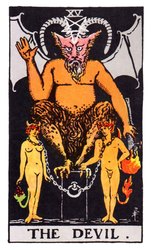
The Hierophant and the Gatekeepers

A discussion of the ways in which religious leaders act as gatekeepers to keep people from true spirituality.

In my book, “Just the Tarot,”  I wrote this about The Hierophant:

“In the earliest Tarot decks this card was simply labeled, “The Pope,” and that’s exactly what he represents:  established religions. In fact, the Hierophant represents religion as opposed to spirituality. This card is about dogma and priests and ministers interpreting spirituality for you, instead of you experiencing it directly.”

Despite – or perhaps because of – being reared in the old Catholic faith I’ve always had problems with organized religion.

That resistance to it has been increased by the never ending parade of pedophile priests and the evangelical preachers who want to fuck anything and everything.  Except their wives, of course.

Keep in mind that these, “frail reeds,” (as they like to describe themselves right after they get caught) CHOSE to stand up in front of their congregations and hold themselves out as the messengers of god.  Got a problem? NO problem: god’s got the answer. BUT . . . you have to go through me to get the answer because I’m god’s messenger.

In essence, they become the gatekeepers to the divine and they only let in the people they choose.  Alan Watts, the Zen/Beat philosopher of the 60s, pointed out in The Joyous Cosmology: Adventures in the Chemistry of Consciousness that this is a very calculated position.  If you go into 99% of the churches in the West you’ll see a pulpit that’s raised far above the seats of the congregants.  It’s a literal, physical telegram: I’m better than you and I’m closer to god than you.

It’s become somewhat of a cliche’ to talk about the difference between religion and spirituality (“I’m more spiritual than religious, man.”) but that’s it in a nutshell.  Highly religious people feel that you have to go through a third party (priest, preacher,rabbi,imam) to get to god and highly spiritual people feel that you can – and should – do it on your own.

Religiosity leads to spiritual and ethical laziness, both for the preachers and those who are being preached to.  

Religious leaders tend to think that they’ve got divine truth and spirituality in their books (bible, koran, etc.), sort of like a firefly trapped in a jar.    If you’re confronted with a moral dilemma, you don’t pray or meditate because you can just flip open your Book of Truth and find the answer.

Religious congregants don’t try to figure it out on their own, either.  They just go to their religious leader and ask what god says about it, the religious leader opens his book, reads a few paragraphs, and SHAZAM problem solved.

Unfortunately, spiritual truth dies when it’s confined to a book just as surely as a firefly dies when it’s confined to a jar.  And spirituality, the contact with the divine, atrophies when it goes unused, when we turn it over to someone else rather than doing it ourselves.

In short, you gotta walk the walk, not just talk the talk.  You don’t gain insight by putting someone else’s butt on a meditation pillow – it has to be yours.

The good thing about churches and mosques and synagogues is that they’re symbols of the deep seated yearning for unity with the divine that lives in the human heart.  The bad thing about them is that – for the most part – they don’t nurture and grow and encourage that yearning.

Disclaimer: “As an Amazon Associate I earn from qualifying purchases.”

The Magician and Channeling Down Energy

The Magician Tarot card and channeling spiritual energy into our lives.


The person in the Fool Tarot card is infused with pure cosmic energy and he’s dancing with the pure joy of it.

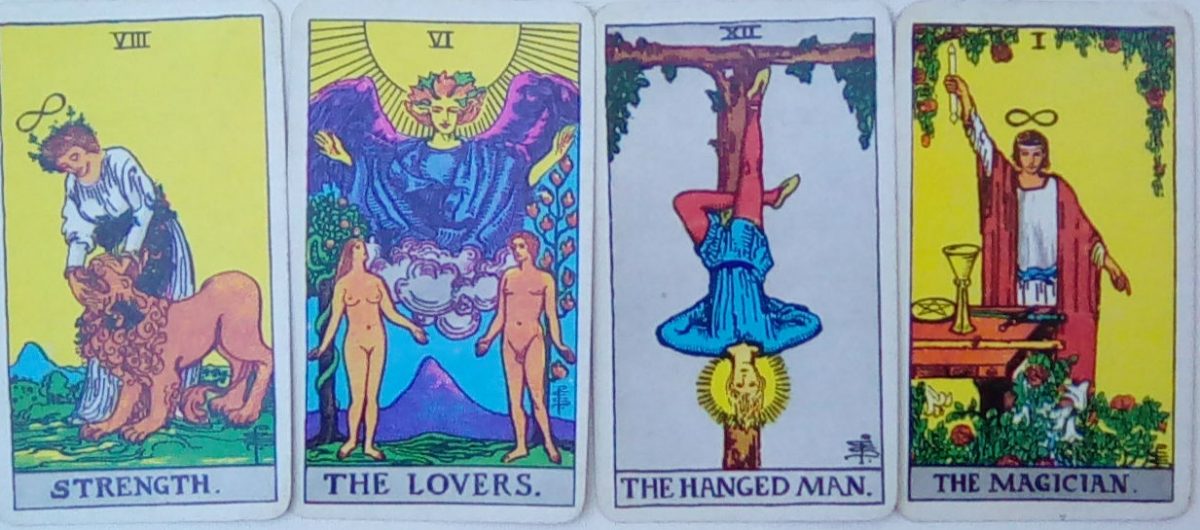
The Magician, on the other hand, is directing that energy.  We see him standing there in his robes, one hand pointed to the sky and the other pointed to the ground.  On his table are the four elements of the Tarot: wands, cups, swords, pentacles, also known as ideas, emotions, energy, and material.

He serves as a reminder that we are not alone.  We are not limited to our personal resources, our bodies and minds, as incarnate in this earth plane.  There are other realms of being and there is an infinite amount of energy available from those realms, energy far beyond what we think we possess.

And you can take a very, very, simplistic approach to that.  You don’t have to be a Master Occultist with secret knowledge of the Astral Planes and how to manifest that energy onto the Earth Plane.  You don’t have to go Full Wiccan and set up a Magic Circle with white candles at the quarters. You don’t have to be a Theosophist with intricate explanations of how the universe works.

Just start with three simple facts:

1 – you exist;

2 – there’s another realm of infinite energy;

3 – you’re connected to it.

No matter how beaten up or beaten down we may be, no matter how physically and spiritually exhausted we are, we have access to all of the energy we need any time we want it.

Don’t get hung up on names for the other realm.  Call it whatever you like – heaven, the astral plane, the angelic realms, foreverland . . . whatever.  I personally like the phrase, “Spirit World,” because it’s descriptive short hand without trying to put it in a box of faiths, creeds, or religions. But call it whatever rings true to you.

Don’t get hung up on methods for contacting it.  There are about a zillion religions and philosophies out there and they all claim to have the EXCLUSIVE method for getting in touch with Spirit World.  Bullshit. Try to think of it the way the Tibetan Buddhists describe it: at the level of our core being we are all beautiful, unique, crystals. The Light will shine through each of us in a different way.  For some, that light may be Reiki. For others, formal religions. For others, Wicca. Look around, experiment, and you’ll find what’s right for you.

In the meantime, there are simple, well established ways to get started with expanding your connections to the other realms.  Prayers work for some people. Meditation for others. Simply sitting quietly in nature and letting their hearts open works for others.  Dancing and shamanic drum circles may be your path.

Personally, I like meditation.  Rajinder Singh has an interesting book on meditating on the Third Eye (or brow chakra) called Inner and Outer Peace through Meditation and that can take you on a Magical Mystery Tour.

Or you might want to try meditations that are more heart centered.  Tara Brach has many, many FREE downloadable guided meditations here.

The path is always there, waiting for you, full of joy, love and energy.

Disclaimer: “As an Amazon Associate I earn from qualifying purchases.”

The Wheel of Fortune and the Gifts of Karma

This is about dealing with bad luck and painful times in our lives. It discusses the Tarot card called The Wheel of Fortune. It also discusses the Tibetan Buddhist concept of accumulating merit through conscious, mindful suffering.


You’re rolling along doing great, happy as a clam, your life full of blue skies and smiles and – BLAM – you get fired from your job.  Or your girlfriend leaves you. Or even worse, you get fired from your job and get terrible, terrible reviews on your exit interview and you know your resume’ will be screwed up for years.  Or . . . wait . . . your girlfriend leaves you for a lesbian who ALSO happens to be your supervisor and fires you and they BOTH give you terrible, terrible reviews on your exit interviews and you know your resume’, your ego and your libido will be screwed up for years.

We’ve all had those moments when life suddenly turns to shit with no warning and for no discernable reason.  It happens to everyone. A rabbi named Harold Kushner even wrote a book about it called, When Bad Things Happen to Good People that sold millions of copies.

Of course, you could also write a book called, “When Good Things Happen to Bad People,” but it probably wouldn’t sell as well.  Or you could write a book called, “When Good People Have Their Lives Turn into Shit Sandwiches and Then All of a Sudden Things Get Better For No Particular Reason.”

As the King of Siam said, “It’s a puzzlement.”

One of the reasons it’s puzzling for most of us is that we get that training from the time that we’re infants:  if you’re good, good things will happen to you. If you’re bad, no fruit cup for dessert and you stand in the corner.  It’s supposed to be a straight, cause and effect transaction that if you’re good you get rewarded, not kicked in the head.

But life is full of ups and downs, and The Wheel of Fortune is a perfect illustration of that.  At best our ill fortune can seem terribly random and at worst it can seem just plain perverse. A turn of some invisible wheel over which we have no control.


As I’ve gotten older I’ve come to take a lot of comfort in the concept of karma.  When a stranger decides he doesn’t like me and he’s going to make my life hell it makes more sense to me to think that I must have screwed with him in a past life than to think that he  just doesn’t like my nose or my aftershave.

And if you really embrace the concept it can actually help you to get through some horrific times.  “Yes, this is terribly painful and I’m going through some serious suffering. On the other hand, think of all of the bad karma I’m burning off.”

I remember the first time I had a serious discussion about karma.  I was taking a tour of a Tibetan Buddhist Meditation Center and the woman who was the tour guide and who lived there said:  “When we get up in the morning we try to live virtuously and if we do that we accumulate merit, which is good karma. And then we consciously dedicate that merit that we’ve earned to anyone who is suffering or in need.  Which is also a virtuous thing to do so we accumulate more merit by doing it and then we consciously dedicate THAT merit to others.”

To which I replied, “Huh?”

It took me a few years to get it but the key words there are, “consciously dedicate.”  

When we encounter the bad times in life – as we always do – live them consciously.  Endure them with grace and dignity. Be determined to learn and to grow spiritually from them.  Consciously dedicate those bad times to earning merit.

And when we’re having good times in life, consciously dedicate some of that extra energy and fortune to helping others who are having hard times.  

Conscious living makes The Wheel of Fortune make sense.

Disclaimer: “As an Amazon Associate I earn from qualifying purchases.”

Is There a Secret Path in the Tarot?


The answer to that is probably both, “yes,” and, “no.”

It would seem to me that it’s, “no,” if you’re looking for some clearly delineated path that involves going to point A, learning it’s lessons, then being prepared to move to point B because of what you learned at point A, then moving on to point C because of what you learned at point B, and so on.

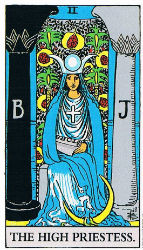
In other words, starting at The Fool and learning it’s esoteric lessons which then enables you to understand the esoteric lessons involved in The Magician, which in turn gives you the knowledge to understand The High Priestess, etc.

Occultists have been chasing their own tails trying to find some sort of linear path in the Major Arcana at least since Victorian times.  Many of them linked the cards with systems of numerology or astrology. A.E. Waite was so determined to make them fit into his numerological scheme that  he actually switched the placement of the Strength and Justice cards so that they’d be in accordance with his theory.

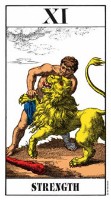
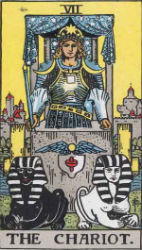
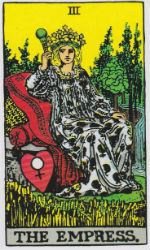
And it IS kind of tempting to try to see some sort of a pattern.  At the beginning or the Major Arcana it actually looks like some of the cards fit together.  The Magician and The High Priestess certainly might be male and female energy in magic. The Empress and the Emperor seem to go together, at least in name.  But then that goes to shit because The Hierophant certainly doesn’t fit with The Lovers or The Chariot with Strength.

The astronomical cards are sort of grouped together, with The Star, The Moon, and The Sun in sequence.  But then the Judgement card gets thrown in between them and The World, which messes that up.

And that’s the deal with the Major Arcana:  if you squint your eyes and turn your head sideways you can see all sorts of patterns in them.  I’ve seen books where they were divided into thirds with each third being a separate path. Or where one card was linked to the card that fell four places behind it.  All SORTS of wonderful, creative schemes that pretty much seem to lead nowhere.

So I don’t think we can say that there is a path in the Tarot, at least not in the sense that the classical occultists like Waite and Levi and Crowley would have loved.  But if there isn’t A PATH there are some definite trails which we could call Doctrines.

The Fool, for instance, contains the truth of being intoxicated with the spirit world.  The Magician embodies the occult maxim of, “as above, so below,” and reminds us that we create on the astral plane what comes to be in the material plane.  The Wheel of Fortune is a perfect diagram of karma operating in our lives. The World reminds of the truth of rebirth and reincarnation.

There are a lot of truths contained in the cards and, taken together, they point us to a different way of experiencing the world and a different way of living.  To make a path out of them, though, we have to connect the dots ourselves. Ultimately, the path is in us, not in the cards.

King of Pentacles

The meaning of the King of Pentacles in a Tarot reading with definitions for both upright and reversed positions.

A man wearing a crown sits on a heavily carved throne adorned with carvings of bulls heads.  He wears a flowing robe embroidered with grape vines and holds a globed scepter in his right hand.  His left hand holds a pentacle which rests upon his leg.

Upright: A very successful and probably fairly wealthy man with an abundance of good business sense.  This isn’t someone who’s striving for success – he’s already there. And, in keeping with the old cliche about how the rich get richer, he just keeps on making more money.

The bulls on the throne show that he has a strong sensual nature but probably also feels a need to dominate those around them.  The grapes indicate that, like his queen, he enjoys the finer things in life and expects nothing but the best.On a mundane level, look for a dark complected, heavy set or muscular man who is conservative and close to his family.  Solid but fairly boring.

Reversed:  A businessman who is capable of being vicious and very hard hearted who may be after the questioner in some sense.  Alternatively, a businessman who looks rock solid but may be totally undependable or secretly down on his luck.

EXAMPLES:  The CEO of a major company with a heavy stock portfolio.

The patriarch of a very successful family business.

“Just the Tarot,” by Dan Adair – a kindle ebook available on Amazon

Queen of Pentacles

The meaning of the Queen of Pentacles in a Tarot reading, with definitions for both the upright and reversed positions.

A crowned woman sits on a heavily carved throne adorned with goats and cherubs.  She is surrounded by a lush garden and gazes down at a pentacle which she holds in her lap.  A rabbit is hopping by in the lower corner of the card.

Upright: This is a very sensuous, materialistic woman.  Since this is the Queen of Pentacles, the suit of money and possessions, we know that both of those are very important to this woman.  Beyond that, though, there is an awareness of the fact that money really represents the good things in life that money can buy. This is a woman who enjoys – and expects – the finer things in life.  A nice car, a lovely home, a good income, and, yes, probably a very nice garden.

And with the goats on the throne and the rabbit at her feet we can interpret that there is a very strong element of sexuality to this woman.  Among the other fine things she expects and enjoys are good lovers and slow, delicious love making.

On a mundane level, look for a woman who possesses and excellent business sense and knows how to turn money into more money.

Reversed:  A tough, resilient business woman who is willing to get down in the ditches and fight it out hand to hand.  Very good with money but there is a hard, materialistic edge to her soul.

EXAMPLES:  A middle aged business woman who lives happily alone in a beautiful home and enjoys sharing her bed with the occasional lover.

A sensual, beautiful wife who EXPECTS to be supported in a luxurious manner because she’s damned well worth it.

Knight of Pentacles

The meaning of the Knight of Pentacles in a Tarot reading with definitions for both the upright and reversed positions.

A heavily armored man sits astride an immobile horse.  He holds a pentacle aloft in his gloved hand. Sprigs of greenery are attached to his helmet and to the mane of the horse.  A plowed field stretches out behind him.

Upright: A good money card, though hardly exciting or glamorous.  Unlike the Knight of Swords, this Knight isn’t going anywhere.  He sits still, solidly planted on his very solid looking horse. The plowed field represents the routine, day to day, hard work that’s necessary to bring projects to fruition.  This card shows a dependable, hard working individual who takes care of details and keeps money coming in.

On a mundane level, this may show the presence of a young, conservative individual in the questioners life.

Reversed:  Problems with money due to the disruption of the daily routine.  A young, conservative person who is causing problems in the questioners life.

EXAMPLES:  The single mother or father who reliably shows up for work every day, does the job with no drama or complaints, and put food on the table and shoes on the baby.

A college student who grinds his or her way through to a PhD by taking a few courses every year while working a full time job.

“Just the Tarot,” by Dan Adair – a kindle ebook available on Amazon

Page of Pentacles

The meaning of the Page of Pentacles in a Tarot Reading, including definitions for both the upright and reversed positions.

A young man in a fancy hat stands in a beautiful field and holds a single pentacle aloft with both hands.

Upright: Good news about business ventures is on the way.  Look for the possibility of a promotion or a raise.

There may be a young person present in the questioners life who is doing exceptionally well.  Perhaps graduating with honors or receiving a scholarship.

Reversed:  Financial news may be discouraging for a brief period of time.  The young person may be experiencing difficulties rather than honors.

EXAMPLES:  A fairly junior employee who is promoted for doing excellent work.

A young man or woman who totally nails the college entrance exams.

Ten of Pentacles

The meaning of the Ten of Pentacles in a Tarot reading, with definitions for both the upright and reversed positions.

An elderly, bearded man draped in a shawl sits and pets some dogs.  A man, a woman and a child stand just beyond him and the child reaches out to touch one of the dogs.  A tower and part of a castle complex are visible through an archway and ten pentacles are arranged in the pattern of the tree of life.

Upright: This is the end of the pentacle or money cycle and indicates good fortune and financial success.  There is a strong, multi-generational presence of family in the card so it may indicate a family owned business which has done very well.  The elderly man may point toward a happy, secure retirement.

Reversed:  Money is on the way.  It may be of the unexpected sort such as winning a lottery.  May point toward securing a good pension and medical benefits.

EXAMPLES:  A family owned store that is thriving and expanding.

Turning your business over to your children or grandchildren and entering a happy, well deserved retirement.

“Just the Tarot,” by Dan Adair – a kindle ebook available on Amazon

Nine of Pentacles

The meaning of the Nine of Pentacles in a Tarot reading, with definitions for both the upright and reversed positions.

A woman in a long, flowing robe stands in a garden surrounded by pentacles.  Her left hand is covered with a heavy leather glove and a bind folded hawk perches there.

Upright: A card of financial success with an emphasis on the home.  Perhaps redecorating or redesigning the questioners residence.  There is also an odd element of a lack of freedom here. Possibly someone who has compromised his or her desires for freedom in order to have security.  In any case the card is very positive in terms of money.

Reversed:  Bad news financially.  If the questioner is involved in some sort of money making project she should cut her losses and walk away.  Continued efforts along these lines can lead to financial ruin.

EXAMPLES:  The trophy wife who has oodles of cash and a brand new luxury car but is very much under the thumb of her husband.

A writer or artist who has given up his creative ambitions but is still doing very well financially.