Bundles of Sticks, Ajahn Brahm, and the Ten of Wands

Finding closure on experiences that don’t make any sense.

Should we carry our past with us or just throw it away?

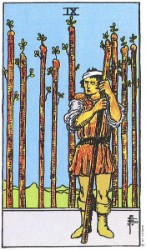
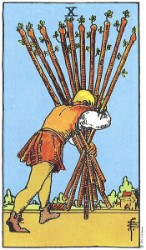
The Ten of Wands shows a person plodding along, carrying a large bundle of sticks.  The, “sticks,” are wands, the suit of the Tarot that represents ideas, so he’s actually carrying a massive number of ideas.  

If we take a little closer look at the card we notice a few odd things about it.  First, he’s not at all carrying the sticks the way that we’d expect.  If we pick up a big old honker of a load of sticks, we’d throw them over our shoulder, right?  Instead,  he’s carrying them in front of himself, with his head pressed into the bundle. 

Second, the sticks are all crossed up at the bottom and going in different directions at the top.  If someone asked us to lug a large pile of sticks across the yard, we’d probably throw a rope around them and tie them together, not carry them in a loose, unwieldy mess.

Third, he’s definitely not watching where he’s going.  His head is tilted down, as if he’s watching each step he’s taking, rather than keeping his eyes on his destination.

So just by looking at the face of the card, we can deduce quite a few things about it.  This guy is probably an intellectual, or at least someone who thinks a great deal, because he has many, many ideas that he’s carrying around.  His ideas don’t really, “fit,” together, and they’ve become quite a burden for him.  In fact, he’s so involved with carrying his ideas that he really has no idea where he’s going.  He’s so lost in his ideas that he has no perspective on his life.

The Australian Buddhist monk, Ajahn Brahm, tells a funny story about sticks.  When he was a novice monk he was strolling through the forest with his teacher, the head monk at the monastery where he was studying.  The master suddenly picked up a stick from the forest floor and asked, “How heavy is this stick, Ajahn Brahm?”  And then he threw it away and asked, “How heavy is it now?”

The point, of course, is that something is, “heavy,” only when we hold on to it.  It’s the act of PICKING IT UP AND CARRYING IT that makes it heavy.  We don’t look at a stick on the ground and say, “Oh, crap, that’s heavy.”  We only say it when we try to pick it up.  It’s our act of grasping something that makes it seem heavy, not the thing itself.

Human beings are natural storytellers.  We all reflexively try to make sense out of our lives and weave the events we experience into a coherent, sensible narrative.  We have an innate drive to try to make sense out of what happens to us and so we’re constantly reviewing our pasts and rearranging the puzzle pieces of our lives into some sort of a rational structure.

We don’t just say, “Well, I lost my fucking mind and decided to quit my job, leave my husband, and move to Montana to grow dental floss.  Just for no particular reason.”  Instead, we say, “After several years of marriage I felt a yearning for solitude and spiritual growth that could only be satisfied by disconnecting from social obligations that had become increasingly mundane.”  

That feels ever so much better.

We need to feel that it all makes sense, somehow.

From a Buddhist perspective, constantly trying to make sense out of our pasts is tantamount to picking up that stick.  It only becomes heavy, it only becomes a burden, when we grasp it and carry it around with us.  In fact, Ajahn Brahm actually recommends writing, “this is my past,” on a stick and throwing it as far away as we can.  Just let it go.  When we’re not carrying it, it’s not heavy.

Now, modern psychology has a different take on it.  Therapists tell us that it IS important to try to make sense out of what’s happened to us and to strive for a sense of meaningfulness in our lives.  Bottom lining it, that’s why we go to therapists:  because our lives aren’t making any sense and we need someone to help us sort it all out.

I suspect that for most of us, the truth lies somewhere in the middle.  If we wake up one morning and have no past, we may have suffered a psychotic break.  Or, in the case of people like Eckhart Tolle, perhaps we’ve had a massive revelation, a huge psychic shift that made us realize how absurd our previous thinking was.

For those of us who are neither psychotics nor enlightened spiritual masters, though, just tossing our pasts out the window isn’t an option.  It seems we can’t just NOT think about it.

Which brings us to that tired, but still valid, word:  closure.

We think of closure as having worked through a problem or a process in life until we’ve made sense of it, until it fits logically into our coherent narrative of what our lives mean.  If we go through a divorce, for instance, we may go to a therapist and try to figure out why it happened.  What was our role in the relationship breaking apart?  What was our spouses role?  What did we do wrong?  What did we do right?  What can we learn from it to make our future relationships better?  Eventually, when we’ve talked through all of those issues, we start to achieve closure and we’re ready to move on from it.  We haven’t necessarily thrown the stick away, but we’ve made it a hell of a lot lighter to carry.

There are other issues, though, that we can never seem to make any sense out of.

– If you were badly abused as a child, that doesn’t make any sense.  You didn’t do anything to deserve it and there’s no logical or emotional reason it should have happened to you.

-If you’re an open and loving person and you got chewed up and spit out by a malignant narcissist, that doesn’t make any sense.  You didn’t ask for it, you didn’t deserve it, and it shouldn’t have happened.

-If the new boss from hell fires you from your dream job because he’s a sexist or a sadist, that doesn’t make any sense.  You were a great employee, there’s no justice in it, and it shouldn’t have happened.

So there’s a kind of a subclass of experiences that we all have that we could call, “doesn’t make any sense,” experiences.  Those are the experiences that get really, “sticky.”  Those are the experiences that we pick up and carry with us.  We go over and over and over them, trying to figure them out, trying to make them somehow fit into our narratives, our story.  But they never do.

“Doesn’t make any sense,” experiences are the ones that are most likely to wound us spiritually and emotionally.  They keep us stuck.  They keep us wounded.  They keep us living in pain.

Oddly, though, they’re also the experiences that are easiest to let go of, if we think of them in the right way.  If we’ve honestly, sincerely, conscientiously tried to figure them out and we can’t do it, we can just say, “Well, fuck it.  This doesn’t make any sense.”  And then we can put that experience in a nice, “doesn’t make any sense,” box, tie a brightly colored, “doesn’t make any sense,” ribbon around it, and toss it in the nearest river.

Maybe we’re not enlightened or smart enough to throw all of our, “sticks,” away, but we can throw some of them away.  We can consciously choose which parts are valuable and which parts are worthless.  We can drop some of the burden and make it a little easier to move forward in our lives.  

And that’s a good start.

Lost Car Keys, Emotional Ladders and Being Ram Dass’s Illegitimate Child

Learning to climb our emotional ladders.

Did you ever have one of those morning meditations that was absolutely perfect?  Maybe you get up out of bed, light a candle on your altar, close your eyes, and the love and peace just FLOW into you as you sit there.  You feel compassion for all living beings and you feel oneness with the entire cosmos.  You feel that if you aren’t totally Buddha-like, you must at least be the illegitimate child that Ram Dass never acknowledged.  You are just SO high, SO spiritual, SO totally in the flow!

The feeling may continue as you take your shower, allowing the warm water to wash all the negativity from your aura.  And then again, as you eat your oatmeal, reminding yourself that you honor all living beings by not eating the flesh of animals.  You know you’ll have a perfect day at work.

And then . . . and then . . . you can’t find your car keys.  You go through the pockets of the clothes you wore the day before.  Check your night stand.  Look under the bed.  Scour your sock drawer.  Crawl around on the floor in case you dropped them.  Within the span of a few moments you’ve been transformed from Pema Chodron into a snarling, wild eyed beast.

“Where are you, you goddamned little jingly bastards?  Where in the fuck ARE you?”

Ironically, at the very height of your fury and hysteria, you locate the keys.  On your altar.

Sigh.  Another failed leap into enlightenment.

In their book, “Ask and It Is Given,”  Esther and Jerry Hicks make the point that sometimes it’s perfectly okay to feel angry.  In fact, sometimes getting really pissed off can be a sign that our mental health is improving.

It’s kind of a breath of fresh air in the New Age/New Thought movement.  We are constantly being told that we must stay positive and that, because of the Law of Attraction, being angry will do nothing but attract angry people and unpleasant events into our lives.  We find ourselves trying to censor our emotions, consistently trying to not feel what we’re feeling –  if what we’re feeling is anger –  and then feeling guilty when we can’t do it.

The Hicks look at it from a slightly different vantage point, which is that angry emotion is better than no emotion.  The basic premise is that our emotions are what motivate us, what keep us moving in life, what draw us toward love and make us run away from hatred.  Without emotions, we’re just stuck, dead in the water.

They say we live on a sort of a ladder of emotions, with apathy and depression at the bottom rungs of the ladder and love and joy at the top. In between joy and depression there are our other emotional states like irritation, feeling overwhelmed, pessimism, hopefulness, and so on.  As we climb the ladder and become more fully emotionally engaged with joy, we become more fully alive. When we descend the ladder into depression and apathy, we’re not really living, we’re just existing.  The ladder would look a lot like this:

JOY

POSITIVE EXPECTATION

OPTIMISM

HOPEFULNESS

PESSIMISM

IRRITATION

OVERWHELM

BLAME

ANGER

REVENGE 

RAGE

DEPRESSION

APATHY

I really like that idea of an emotional ladder because it allows me to be the mess that I frequently am and be honest with myself about where I’m at.  As the Hicks said in another book, it’s easy to program a GPS to take you from Phoenix to L.A. but first you have to know that you’re in Phoenix.  If we’re on the second to the top rung of the ladder – positive expectation – then it’s relatively easy to take that next step up to joy.  On the other hand, if we’re stuck WAY down the ladder in anger and we try to jump straight  up into joy, we’re probably going to fall off of the ladder and land on our asses.  It’s important to be honest with ourselves about where we really are on our emotional journey.  It saves us from broken asses.

And that leads into another neat concept which the Hicks came up with: the, “emotional set point.”  Basically, that’s just the rung of the emotional ladder that we live on most of the time.  We humans tend to be creatures of habit and so we pretty much maintain a consistent emotional state.  If we’re happy most of the time, we’ll stay happy most of the time.  If we’re sad most of the time, we’ll stay sad most of the time.  We may occasionally climb up and down a few rungs on the emotional ladder as life brings us good or bad events, but we tend to return to what feels like our, “natural,” state of being.

And there is a certain natural, genetic component involved in that.  According to The Harvard Health Blog, about half of the reason we may be happy or sad is based on the disposition we were born with.  So that person you know who’s always chirpy and perky and bright and annoyingly happy?  Yeah, that’s probably real.  They were likely just born that way.  And the friend who always seems a little sad may have just inherited it from his parents.  It’s their natural emotional set points.

The good news behind that, though, is that we can change our emotional set points.  Just because it feels, “natural,” to be in a certain emotional state doesn’t mean that we have to stay in that emotional state.

Suppose, for instance, that I’m a perfectionist.  I would want everything to go exactly according to plan and turn out just the way I’d envisioned it. 

What would flow out of that state of being would be a great deal of impatience with my co-workers and/or family members because they weren’t living up to the high standards that I set.  I might be constantly criticizing them, sniping at them, belittling their efforts and generally acting like an insufferable prick.

The cure for that could be to do loving-kindness meditations.  Starting to actively envision what other people are going through and building in empathy for the fact that they’re struggling with life the same way that I am.  As I continued to do that, my perfectionist expectations would drop away and I’d begin to see the people around me as fully dimensional human beings who deserve caring and patience.  I’m changing my emotional set point.

Or perhaps, like so many of us, we grew up in physically or emotionally abusive families.  Our, “go to,” response to stress in life might then be emotional flatness.  We learned very early in life that it’s easier to just turn off our emotions rather than feel the pain of the abuse.  

What flows out of that is becoming emotionally absent with our partners or children whenever there’s a problem.  Even worse, we abandon ourselves emotionally and fail to experience joy and deep love because we’re so shut down.

The cure for that could be to start doing, “happiness meditations.”  Just sit down once or twice a day and meditate on something that makes us happy, even if it’s a distant childhood memory of a beloved dog.  Start learning to live in that emotion again.  Stopping several times during the day and asking ourselves, “Am I happy right now?”  And, if we’re not, pull up that memory again until happiness becomes a habit.

The point is that it’s a practice, the same way that yoga or meditation are practices.  We don’t get where we want to go all at once.  If we come home and find our life partner shtupping our best friend, it’s okay to be angry.  In fact, it’s a hell of a lot better to be angry than it is to be depressed.  Anger can empower us but depression takes our power away.

As long as we’re feeling something, we’re still okay.  We’re still moving.  We’re still growing.  And, as the Hicks said, we can reach up for that next best emotion on the ladder. We can change our emotional set point.  It’s better to feel irritation than to feel overwhelmed.  It’s better to feel pessimism than to feel irritation.  It’s better to feel hopefulness than to feel irritation.  We can steadily, consciously move our emotional set point upward toward joy as long as we’re honest about what we’re feeling and we don’t shut ourselves down.

If we don’t feel it, we don’t heal it.  If we don’t heal it, we don’t grow.  And growing toward happiness is even better than knowing where your car keys are hiding.

Putin, Ukraine, Toxic Males, and The Emperor Card

Toxic-Male psychopathology in the invasion of Ukraine.

We’re at about the three week mark in the Russian invasion of Ukraine.  Anyone who’s a decent person has been shocked, appalled, and nauseated by what we’ve seen.  A quiet, peaceful country primarily known for its wheat and decorated Easter eggs is being bombed into dust.

For no apparent reason.

The horror of what we’re seeing on the news everyday is hard to grasp, but equally hard to grasp in the, “why,” of it.  Why would Russia suddenly launch a brutal military campaign – the likes of which we haven’t seen since the Nazis – against a neighbor who was absolutely no threat to its security?

I saw a talking head on one of the news shows tonight who asked, “Just how much of a psychopath is Vladimir Putin?”  It’s a revealing question because it points to the fact that we already knew Putin was a psychopath, we just didn’t know (and still don’t) how truly crazy he may be.

That truth points to another truth, which is that we’ve developed a remarkably high tolerance for psychopathology.  We put up with it.  We accept it.  It isn’t as if Putin hasn’t been doing dreadful things for decades.  He almost single handedly destroyed whatever small hope the Russian people had for freedom and democracy.  His political opponents end up poisoned, dead, or in prison.  He employed chemical warfare in Syria.

He’s a bad guy.  A crook.  A thug.  A criminal.  And he has been all of those things all of the time that he’s been in power.  Still, the world leaders kept inviting him to the dinner table.  Kept trading with Russia, inviting their teams to the Olympics, welcoming their tourists and investors, just as if Putin was somehow a normal, civilized leader.  It wasn’t until he decided to obliterate a modern society for no particular reason that we began to treat him like the psychopath that he is.

Just to define our terms before we go any further, what exactly do we mean when we say that someone is a psychopath?  According to Wikipedia, psychopathology is:

“characterized by persistent antisocial behavior, impaired empathy and remorse, and bold, disinhibited and egotistical traits.”

Put another way, a psychopath is a cold blooded, egotistical prick who causes a lot of suffering and really doesn’t give a shit about how many people he hurts.

I have argued previously in this blog that psychopathology is an inherent part of the Toxic-Male paradigm which our society too often embraces.  We see some of that exemplified in the Tarot card, The Emperor.  We can tell from his throne, scepter and title that he’s a powerful leader, a king of kings.  When we look a little more closely at the card, though, we see that he’s completely alone, armored, rigid, and surrounded by a blighted, sterile landscape.  His power is so toxic that not a tree or a flower can grow in his poisonous energy field. Still,  we focus on the power and not the devastation.  

Power that destroys everything around it for the sake of power is psychopathic.

Many of us actually admire and reward psychopathic behavior.  Consider this article from Forbes magazine in which they estimate that up to 12% of corporate CEOs may be psychopaths.  They are in those positions precisely because they are ruthless, have a total lack of empathy and will place corporate profit above the human suffering of their employees every time.

Remember when the CEO of the mortgage company Better.com fired over 900 employees at a goddamned Zoom meeting just before Christmas?  People across the country were shocked at the totally heartless, callous way that he’d behaved, but he wasn’t fired.  He took a month-long hiatus (translate:  he took Christmas vacation) and was back at work within a month.  He issued a tepid apology which was much more of an, “I’m sorry I got caught,” than it was an, “I’m sorry.”  He kept his job because the board of directors at Better.com wanted someone with psychopathic traits running their company.

We may shake our heads at the horrible behavior of Vladimir Putin but while we’re doing that we should take a very careful look at the behavior of Donald Trump. Persistent antisocial behavior?  Check.  Impaired empathy?  Check.  Total lack of remorse?  Check.  Bold, disinhibited and egotistical traits?  Check.  Can we really doubt that the primary difference between Putin and Trump is one of power?  Can we really doubt that Trump would have happily shut down a free press and had his opponents imprisoned if he could have gotten away with it?  Trump is a classic CEO psychopath.

And just about half of the population of the United States voted for him.  If you need any evidence that we have an increasing tolerance for psychopathic behavior, there it is.

When we look at written history, legends, and myths, it’s a safe bet that psychopaths have always been scattered throughout the human race.  Wherever we find suffering, cruelty, torture, war and rape, there we find psychopaths.  Is it fair, though, to tag this trait as a part of Toxic-Males?  After all, there are female psychopaths, too.

The answer to that question is a resounding, “yes.”  Psychopathology is toxic and it is very much a male behavior.  The ratio of male to female psychopaths may be as high as 20:1.  Virtually all serial killers have been males.  Mass shootings are overwhelmingly committed by males.  The prison population of violent offenders is heavily weighted toward males.

We can see the same evidence in human history.  Leonard Shlain, author of “The Alphabet Versus the Goddess: The Conflict Between Word and Image,” hypothesizes that most of the earliest human cultures were matriarchal, goddess based and peaceful.  It wasn’t until the emergence of patriarchal society that we began to see psychopath kings and leaders.  There is no historical record of females leading hordes of barbarians to murder, rape, and pillage.  Virtually all of the monsters in human form – Ghengis Khan, Hitler, Napolean, Pol Pot, to name just a few – have been males.

It might be tempting for us to simply shrug our shoulders and say, “Oh, well . . . they’ve always been a part of the human race.  What can we do about that?”  Unfortunately – or perhaps fortunately – the human race is at a crossroads and, as Eckhart Tolle has pointed out, we are in imminent danger of extinction if we don’t begin to evolve out of our current ways of thinking.  We now have weapons capable of destroying life on earth.  Millions – not thousands – of people were killed in wars and other armed conflicts during the 20th century and it’s not looking a hell of a lot better in this century.

To put it mildly, “Houston, we have a problem.”  A major component in that problem is Toxic-Male psychopathology.  By far and away, the majority of human beings – male and female – are NOT out there killing people and spreading terror.  It’s this tiny, tiny minority that’s threatening our very existence.  

So we must be rid of them.  One way or another, we MUST be rid of them.  We start that process with our own minds.  We start that process by recognizing that they are sick, depraved, deeply flawed human beings.  We stop, “admiring,” their so-called toughness and ruthlessness and realize that it’s really nothing more than a thin veneer over a sadistic personality.  We stop describing them as, “geniuses,” when they put their brutality on full display.  We stop voting for them when they run for office.  We stop promoting them to positions of leadership in businesses.  We stop acting as if it’s somehow okay or inevitable that mass shootings continue in our society or that our leaders are braggadocious bullies.

Above all else, we need to start holding up and supporting the model of emotionally healthy, nurturing, caring males.  Most men are not like these psychopaths – we know that.  Most men love their partners and their families and just want to live their lives in peace and harmony.  At the same time, though, as males we are constantly confronted with the stereotypes of what, “real,” men are like.  And those stereotypes look an awful lot like the psychopaths:  ruthless, emotionless, physically dominant, violent, and lacking in empathy.  That ideation of the, “alpha male,” is buried WAY deep down inside the collective psyches of both males and females.  We have to start digging it out, holding it up to the light of day, and rejecting it.

It really is a matter of our survival.

The Wheel of Fortune – Good Luck, Bad Luck, Flying Monkeys and Eckhart Tolle

A closer look at good luck and bad luck in The Wheel of Fortune

Luck.  It seems to be a universal concept, found in every human culture.  There are blues songs bemoaning the fact that, “if it wasn’t for bad luck, I wouldn’t have no luck at all.”  People talk about how their luck’s been so bad they’d have to look up to see the belly of a snake.  Then there are other people who seem to live enchanted lives, lives where one good thing after another happens to them for no apparent reason other than they’ve got really good luck.

The Wheel of Fortune Tarot card is obviously about luck, but the modern, Waite Deck depiction of it is really just about good luck.  It shows a wheel bedecked with Egyptian deities and surrounded by symbols of the four elements or, perhaps, the four apostles.  There’s nothing threatening or scary about this version of the card.

When we look at the old, Marseilles deck version of the card, though, we see a different story.  Instead of Egyptian deities, we see . . . um . . . monkey critters.  Wizard of Oz flying monkeys, one perched atop the wheel, wearing a crown and wielding a sword, one being carried upward on the wheel and one being cast down by the wheel.  This is really much more in keeping with that very primal perception of luck that we humans have always had about luck.  It’s something kind of creepy, magical, and outside of us, outside of our control.  We can never tell when a flying monkey might swoop down out of nowhere and carry us away in its nasty little talons

Humans are always trying to find a way to harness luck, to somehow bring it under our control.  There are dozens of gods of good luck that we’ve worshiped through history – Hotei, Fortuna, Lakshmi, etc. – hoping that they’ll bless us with strong luck.  Many people carry a rabbit’s foot or a lucky penny or have, “lucky socks,” or jeans that they favor.  A lot of obsessive compulsive behavior flows out of a ritualistic quest for luck.  OCDs may feel an urgent need to wipe the counter exactly seven times or wash their hands three times in order to avoid something catastrophic happening.  Most of us were taught the basics of avoiding bad luck as children.  Don’t step on a crack or you’ll break your mother’s back.  Don’t walk under a ladder.  Don’t break a mirror.  Oh, shit, it’s a black cat!

The older Tarot card shows both good luck and back luck – one monkey is rising on the Wheel of Fortune and one is descending.  The two phenomena seem to go together, to be attached, one rising from the other.  The second verse of the Tao Te Ching alludes to this when it says:

Once we know beauty, we know ugliness.

Once we know good, we know evil.

High and low, long and short—all these opposites support each other and can’t exist without one another.

That duality, that sense of opposites always going together, seems to apply to everything on the material plane, including luck.  Good luck seems to give way to bad luck and bad luck gives way to good luck, or that’s the way that we conceptualize it.

Eckhart Tolle suggests that, at least to some extent, it really is just about the way that we conceptualize it.  Many times, what we view as bad luck is just the end of a cycle.  Everything grows and then it diminishes and then it grows again.  We don’t view plants dying at the onset of winter as a tragedy, but we do view humans dying at the end of their incarnations as tragic.

Louise Hay has much the same view of the ends of relationships.  When we break up with someone or we get a divorce or our partners die, it feels like a horrible, painful tragedy.  It feels like bad luck.  She suggests viewing it instead as a sort of a graduation.  At the point the relationship ends, it means that we’ve learned everything we were supposed to learn from the dynamic of that relationship and it’s time to say, “thank you for the wisdom,” and move on.

The Law of Attraction people tell us that good luck and bad luck can actually be learned behaviors, patterns that we get into that, “attract,” more of the same.  If we can learn how to maintain a positive, healthy outlook on life, we tend to attract positive, healthy people and things into our lives.  In the same sense, if we see life as a terrible, crappy experience where we’ve got nothing but bad luck happening, that’s what we attract.  Even worse, we attract people with the same negative vibes and then we get to deal with their shit in addition to our own.  That can go a long way toward explaining why some people always seem to be lucky and some people seem to have a curse on them.

Pema Chodron said that life is all about being constantly thrown out of our nest. Constantly forced to give up our security and adapt to new experiences.  Quite a bit of what we call, “bad luck,” is that simple, elemental human experience of not wanting things to change.  We envision an idyllic, static existence where nothing new or challenging ever happens to us because change is scary.  Getting fired from our jobs, losing our partners, having to move out of our houses – these are all bad luck because they’re changes that we don’t want.

There are a couple of things worthy of noting about that, though.  The more that we resist change – the more that we say, “no,” to the end of a cycle –  the more dramatic that change is eventually going to be.  It’s almost like an explosive force that just keeps getting more and more powerful the longer we sit on it, until it eventually blows our existence into tiny, smoldering pieces.  A small change that we resist can easily grow into a catastrophe that we could have avoided.

The other thing to note is that good luck so often grows out of bad luck.  After we’ve had a period of seriously rotten luck, we frequently find our lives being showered with blessings of all sorts.  It could be that, as the Taoists assert, good luck is attached to bad luck and one inevitably gives rise to the other.  Or, as Tolle said, perhaps we’re just ending one cycle and plowing the dead weeds under the ground to make room for the new growth.

That can make a huge difference in how we experience those periods of, “bad luck.”  We can realize that The Wheel of Fortune is a wheel that’s constantly turning and that we’re never stuck in one place.  It just feels like it.  Being thrown out of the nest may feel incredibly uncomfortable emotionally.  It may be terrifying.  It may feel like horrible luck.  But it’s the only way we learn how to fly.

Dan Adair is the author of, “Just the Tarot,” available on Amazon.com at a very reasonable price.

The Lovers, The Devil, and Being Thrown Out of the Garden

Karmic relationships and how to leave them.

The Lovers Tarot card is a sort of a snapshot of a story we’re all familiar with:  Adam and Eve in the Garden of Eden.  The image is all the more poignant because we know the end of the story.  This picture was taken when the beautiful angel was hovering over them as a guardian and protector.  The very same angel would later cast them out of the garden because – horror of horrors – Eve munched on an apple and that pissed off their psychotic, bipolar god.

In many ways, this is a perfect metaphor for the process of, “falling in love.”  And falling out of love.

When we first meet that perfect someone and fall in love, our brains and bodies are absolutely saturated with pleasure hormones like oxytocin.  We become enchanted with the mere presence of our love object and the entire world seems to glow with a peculiar brightness and joy.  Basically, we’re high as a kite and we feel like we’re living in a beautiful garden.

That oxytocin high lasts about two years (coincidentally, about the same  time it takes to conceive a baby, gestate it, and get it on its feet) and then it just disappears.  Suddenly our brains go back to normal.  This is the, “reassessment period,” in a relationship where we take a good, hard look at our partners and decide if we really want to stay with them.  If, all in all, we feel satisfied and happy with them, we stay in the relationship.  If, after we come down from our oxytocin high, we discover that we’re living with a frog  rather than a prince, we leave.

In other words, we fall out of love.  We’ve been cast out of the enchanted garden.

I’ve been thinking about that process because of a subset of relationships that the amazing Sonia Choquette refers to as, “karmic relationships.”  In her videos, she explains that these are relationships that involve a sort of a, “Soul agreement,” with the other person.  The agreement is that we and the other partner are going to teach each other some serious lessons that will help us grow into our spiritual evolution.

And, “serious,” is the salient word there.  These tend to be very, very heavy relationships.

There’s an element of compulsion in them, for one thing.  We meet someone and suddenly feel a deep compulsion to be with them.  It may not even be someone we particularly like.  They may have values that are completely at odds with our own, or perhaps they’re physically or emotionally someone who is just not our type, not someone we would normally EVER be attracted to.

Yet, we are.  It’s a feeling like two magnets suddenly coming into alignment and pulling us toward each other with an irresistible force.

They also tend to be . . . uncomfortable . . . relationships.  In a romantic karmic relationship, we may feel a HUGE sexual attraction toward someone, but really, really NOT enjoy living with them.  Or we may feel a strong emotional attraction to them but have a terrible, terrible sex life.

In one way or another, it feels like a bad fit for us, because it is.  We’re not there to have a perfect relationship, we’re there to learn some heavy, hard lessons from being in each other’s lives.

That’s where it gets interesting because the timeline on a karmic relationship, the duration of it, is determined by when we learn those lessons and are ready to move on.  It may happen in six months or it may take decades.  In Sonia Choquette’s case, it took 31 years of marriage for her to get the lessons she needed to learn from her ex husband.

Which brings us to one of the most fascinating features of karmic relationships: leaving them.

When a karmic relationship is over, when we’ve finally learned the lessons we were supposed to learn, it becomes massively uncomfortable to stay in those relationships.  As Sonia said, the price we pay for overstaying in them is absolute emotional misery.  We really experience it as if we’re being spiritually expelled from them, as if we’re being thrown out of what we mistakenly thought was a garden but was actually full of weeds.  The same forces that compelled us to enter into the relationship are now compelling us to leave.  Lesson learned, relationship over.

If we ignore those compelling forces, if we insist on staying in the relationship even after the lessons from it have been learned, then we devolve into the couple from The Devil card.  This is the same couple of people from the The Lovers card, but now they’re living in misery and pain.  They’re chained to their karma, refusing to move on from the relationship and grow spiritually.

And, of course, if we examine The Devil card closely, we can see that the chains are very loose.  They could easily lift them over their heads and be free if they CHOSE freedom.  Instead, they cling to their misery.

Both Sonia Choquette and Louise Hay point to a very simple truth which our culture likes to deny:  relationships end.  And they end frequently.  When they d end, we can either choose to be miserable, choose to stay ensnared in the karma, or we can stop to absorb the lessons that we learned from the relationships.  We can either be bitter or we can bow gracefully toward our former partners and thank them for the lessons they helped us to learn.

And if we mutter under our breaths, “Thank you, you son of a bitch,” that’s alright, too.  We’re just humans and this is just a school.  We don’t have to get an A on our report cards every single time.

The Canyon of the Vaginas, The World Card, and the Loss of Male Magic

A friend gave me a book for Christmas called, “Ducks Flying Backward.”  It’s a wonderful collection of essays by Tom Robbins and the first entry is called, “The Canyon of the Vaginas.”  It’s about his quest to find a mysterious, obscure canyon in Nevada, the walls of which are covered with Native American petroglyph carvings of . . . well . . . vaginas.

Imagine that:  hundreds of Native shamans going to this one site over hundreds of years to carve depictions of vaginas!  And keep in mind, the Native petroglyphs weren’t casually done.  They were considered sacred symbols and it took considerable effort to incise them in the rock.

It started me musing on The World Tarot card.  It’s a card of rebirths, new beginnings and the successful gestation of projects.  It depicts a semi-nude woman emerging into the world with a magical wand held in each hand, a symbol not just of power but of balance.

The most interesting feature of the card, though, is probably the oval shape surrounding the woman.  Although it’s disguised as some sort of a wreath, it’s quite obviously symbolic of a vulva, complete with a clitoral bow perched at the top.  This card is really about the primal, archetypal, universal experience of birth.

Now, the Tarot also has a Death card and there’s nothing at all ambiguous about it.  It’s labeled, “DEATH,” and it has a grim reaper astride a black horse.  Why, then, would The World not have been labeled, “BIRTH?”  Or, if you wanted to extend that idea into our daily lives, “REBIRTH?”  Why disguise the vulva as a wreath?  If you wanted to depict the moment of birth, why not just do a painting of a baby emerging from a vagina?

The wreath is, of course, a symbol and, like all symbols, points toward a truth without actually expressing that truth in words.  As the Tao Te Ching says, “the word that can be spoken is not the eternal word.”  The moment that we try to express a symbol in words, we lose its essential truth, which is to say, the essence which is its truth.

Birth, in all of its forms – but particularly human birth – is one of the most deeply profound and mysterious events in human experience.  Science has, with its usual methodology, attempted to reduce that experience to the mere phenomenon of a sperm cell penetrating an egg, but no amount of reductionism can lessen the wonder of the process.  How do a few cells multiply into the complex, complicated, astounding beings we call, “humans?”  How do a sperm and an egg end up being a Buddha or a Mary Magdalene, an Einstein or a Marie Curie?

It’s a mystery.  Moreover, it’s a mystery which is contained primarily within the female body.  Yes, of course, men contribute sperm cells and the attached DNA but the process of actually creating a new human being is uniquely female.  And powerful. And magical.

If that process remains mysterious to us, with all of our instrumentation and ability to scan a fetus virtually from conception to birth, we can only guess what it must have felt like to our primitive ancestors.  It’s not hard to imagine a cave dweller gaping at a woman who had just given birth and exclaiming, “How in the hell did you DO that?”

Somehow in the course of our evolution women’s bodies became much more deeply connected to our universe than men’s bodies.  We see that plainly in the lunar cycles that cause oceans to rise and fall and women to menstruate whereas men feel . . . sort of uncomfortable . . . when the moon is full.

That’s not a subject for debate or sexual politics, it’s just a fact.  We’re at a point where our old buddy Science is beginning to document the very real differences between the state of a woman-being-in-the-world and a man-being-in-the-world.  For instance, we’re finding that women generally tend to have a much stronger connection between the two hemispheres of the brain than men and, therefore, a much deeper connection with intuition and symbolism.  (For more on that, see my post, “The High Priestess and the Hallway in Our Brains.”)

We can see these differences, we can observe them, but we still don’t fully comprehend them.  There’s still that very primitive sense that there’s something magical happening with the female spirit that’s NOT happening with the male spirit and it eludes us.  We could make a very strong case that the whole sorry history of patriarchy, treating women as property to be taken and enslaved and raped, and our current marriage laws spring straight out of that male desire to somehow capture that magic that males are missing in their own souls, even if by force.

The most visited painting in the Louvre right now is called, “The Origin of the World,” by Gustave Courbet.  It’s usually surrounded by crowds of tittering, semi-embarrassed Americans, gaping at the realistic portrayal of a woman’s genitals.  It might be tempting to brush this off as casual prurience, as prudes seizing a chance of peeking under a woman’s panties, but in it’s own way it’s become a sort of a shrine and the people have become pilgrims.  It’s not too hard a stretch to connect that painting with ancient Native Americans carving hundreds of vaginas into canyon walls.

The bottom line on it, I think, is that males have become so totally alienated from their own Divine Feminine that they have to project it outwards as a symbol.  They then worship it or attempt to capture it or – as in much of our pornography – degrade and devalue it.  As long as men continue to view the Feminine Principle in purely symbolic terms – a vagina rather than a spirit –  instead of fully integrating it into our consciousness, women will continue to be objectified as the unwilling, symbolic bearers of the magic that men have lost.

When we take a final look at The World card, we can note that the woman’s genitals are covered by a sort of a free-floating cloth.  The mystery remains concealed.  At least for now.

Old Souls, Young Souls and Reflections on the Death of Thich Nhat Hahn

Upon the death of Thich Nhat Hahn . . .

The great spiritual master, Thich Nhat Hanh, just died.  And the world took little note of his passing.  There was a brief note from the Dalai Lama. The United States State Department put out about a three paragraph memo recognizing him.  The Pope, as near I can tell, didn’t say a word.

I actually scanned through the pages of my FaceBook friends and found a total of three people who mentioned his death.  There were far more discussions of the death of a rock star named Meatloaf than there was of Thich Nhat Hanh.

Initially, I was fairly dismayed.  And saddened.  And a wee bit shocked.  I can’t tell you how many memes I’ve seen on FaceBook over the years that were quotations from Thich Nhat Hanh.  I’m sure you’ve seen them, too.  They’re usually posted with a picture of someone meditating or doing yoga or sitting blissfully under a tree.  I would guess that the number of them I’ve seen runs into the hundreds or possibly the thousands. 

 I found myself wondering – did all of those quotations actually mean anything to the people who posted them?  Did they read his books?  Did they watch his videos?  Did they in any way absorb anything that he said or believed?

I remembered a few months ago when Ram Dass passed over and there was very much the same reaction.  “Oh, yeah . . . I heard something about that.  Oh, well . . . he was pretty old, wasn’t he?”

Between the two of them, these people had a MASSIVE spiritual transmission.  They brought concepts and perspectives to the table that have helped millions – literally millions – of people across the world.  I don’t know what I expected at the news of their passing but it wasn’t, “Man, did you hear Meatloaf died?”

I know as I’m writing this that they’d both be laughing at the idea that their deaths were somehow important.  Both of them stressed throughout their decades of teachings that the whole, “my death matters,” rap is just an ego trip.  Ram Dass said that, “death is not an outrage,” it’s the most natural thing in the world.  Thich Nhat Hanh said that there is no death and no birth, just transitions of our forms.

Still, I think they were both exemplars of the fact that LIFE matters.  That the way we live our lives, that the amount of love and compassion and caring that we manifest matters very much.  In the middle of an ocean of pain and suffering and cruelty and despair, they continued to repeat that one simple, brave message:  love each other.

So . . . I  ponder over the fact that this beautiful human being, this compassionate, loving, deeply insightful man could pass away and it made such a tiny ripple on the consciousness of the world.

I think that the answer is probably that people have become accustomed to NOT having any sort of a spiritual practice, in the sense of consciously integrating spiritual values into their daily lives.  There’s a sort of a cliche’ in Texas about the good old boy Southern Baptist businessman who goes to church on Sundays and Wednesdays and screws people over the rest of the week.  When you ask him why he’d behave that way, the response is, “Well, that’s just binness (business).”

In other words, there’s a clear demarcation in his mind between spirituality – which happens on Sunday and Wednesday – and business, which happens on Monday, Tuesday, Thursday, Friday, and Saturday.  There’s a sort of a spirituality cubby hole in his existence that needs to be filled, but he manages to keep it very much in the background for most of his life.

I would guess that, for many people, posting, “spirituality memes,” on FaceBook operates in much the same way.  It’s a way of saying to others – and to ourselves – “Hey, I’m actually a deeply spiritual person.  See – I just posted a meme from Ram Dass or Thich Nhat Hanh or Pema Chodron.” And then our friends shine that right back at us and that fills that spirituality cubby hole.

Spirituality becomes a sort of a bon bon rather than a steady diet.  It’s something we post, not something we live.  It’s scratching an itch, rather than wondering why we’re itching to begin with.

I know that neither Ram Dass nor Thich Nhat Hanh would say, “Yeah, people are pretty much shallow assholes.”  I suspect they would say, “Yeah, there’s still a lot of work to do.  We need to get back on to our part of it.”

I’m finding a lot of comfort in a paradigm from the 1960s, which is that there are Old Souls and Young Souls.  If you’re an Old Soul, if you’ve been around the reincarnation cycle a few thousand times, then people like Thich Nhat Hanh resonate a lot more deeply in your heart than they might for a Young Soul.  This isn’t to say that being an Old Soul is somehow superior to or better than or wiser than a Young Soul.  It’s not an elitist trip.  It’s not a superiority trip.  It’s just being in a different place on the path.

The world seems to be awash in Young Souls right now and the best thing to do seems to be to constantly and consistently repeat that message from Ram Dass and Thich Nhat Hanh: love each other. 

Ironically, they’d both agree with the assessment of the Young Souls that their deaths didn’t really matter.  But their lives did.

Love each other.

Namaste’ Thich Nhat Hanh.  

The Fool, The Magician, and Laughing With the Angels.

Playfulness as a major force in the universe.

I was watching a Sonia Choquette video recently that was about getting in touch with our spirit guides and angels.  She made the point that the first step in that is to get in touch with our own spirits, because spirit talks to spirit.  And she also said that sometimes our spirits are NOT hanging out in our bodies.  The basic idea is that, if we are constantly depressed, angry, and fearful, then our spirits don’t really WANT to be in our bodies because our bodies are so toxic.  Who wants to hang out in a room full of anger and sadness?  Who wants to hang out in a body full of anger and sadness?

Huh . . .

The cure for that is – surprise – to be happy.  Laugh, play, be light.  Make our bodies and minds into places where our spirits want to be.

It started me thinking about two Tarot cards, The Fool and The Magician.  Not the cards from the Waite Tarot deck, which was designed in the early 20th century, but the original, older portrayals from the 14th and 15th centuries.   The portrayals in the Waite deck are stunningly beautiful, but, in some ways, are not at all consistent with the original meanings of the cards.

Here, for instance, we have the Waite version of The Fool.  He/she is a beautiful, elegant, sexually indeterminate youth who is dancing along the edge of a chasm while a little dog dances beside him.  The basic meaning of the card is someone who is so high on cosmic energy, so in tune with universal energies that if he dances off of the cliff, he’ll just keep on dancing on thin air.

Now compare that to The Fool from the old Marseille Tarot deck.  This Fool is kind of a scruffy looking dude wearing the actual clothing of a Fool from the medieval royal courts.  The dog has torn a hole in his britches and he’s not even watching where he’s going.  He’s wearing a funny hat and he has jingle bells hanging off his cloak.

Not exactly elegant, is he?

But he does remind us of the original Fool who would entertain the royal courts.  He had a very, very special status in those courts because he was the only one who was actually allowed to laugh at and make fun of the King.  He was considered sort of a mad idiot, someone who had either been cursed or blessed by the gods with a somewhat insane, totally irreverent sense of humor.  His purpose was to mock the pompous and remind the all-too-serious that life can be seen as a joke.

The same point of view was taken of what we remember in our language as, “the village idiot.”  We might think of him as someone who was perhaps mentally deficient or brain damaged.  To the villagers, however, he was seen as someone who had been touched by the finger of god, someone who was viewed as a blessing to the village and so should be fed and cared for, for free.  He was a treasure in large part because he made people laugh and get in touch with their love.

Again, look at The Magician from the Waite deck.  Once more, we see a thoroughly elegant, physically beautiful individual who is very much in charge of his magic.  This is a master of the occult, a Wise Being who channels magic from the astral realm into the physical plane.  

Contrast that with The Magician from the older decks.  This Magician looks a little clumsy.  He, too, is dressed in Fools clothing and isn’t paying attention to what he’s doing.  Displayed on the table before him is a cup and dice and coins, and other random items.  Far from being the magical symbols that we see in the Waite Magician card, these look like things he might have dug out of his pockets and we almost wonder if there might be a few balls of lint scattered in there.

The older Magician was not a master occultist.  The older magician was a street entertainer, much like the stage magicians that we see today.  He might not be sawing women in half or disappearing into a magical box, but he could still put on a hell of a show.  He could make the dice do what he wanted them to do and he probably wasn’t above taking a few pennies from people who couldn’t guess which cup the pea was under.

He was a flim-flam man.  An illusionist.  Someone who knew how to shuffle a deck of cards and astonish us by picking out the Ace of Spades every single time.

He was fun.

That’s what’s missing in the newer, Waite deck portrayals of these two cards.  The sense of fun.  The sense of goofiness.  The sense that life really isn’t supposed to be taken all that seriously and a lot of it is just plain silly. 

Here’s a radical proposition:  what if angels like to play?  What if angels actually have a rip roaring, hilarious sense of humor?  What if that’s the vibration that they actually exist on:  laughter and play?  So then think of the Western approach to prayer.  You know how we get all serious and somber and . . . church like . . . when we pray?  Prayer, after all, is a VERY SERIOUS business.  We all know that, because we’ve been in churches and people weren’t doing a hell of a lot of laughing.

But suppose . . . just suppose . . . that everytime we get all serious and somber, we automatically tune out our angels and guides?  Just like changing to a channel that they’re not broadcasting on.  They’re still there.  They’re still wanting to help us.  But we just tuned them out by completely losing our sense of humor.

It could be that laughter and play are underlying forces in the universe and when we’re playing, we’re in harmony with our true nature and our Higher Selves.  Think of little kids and puppies and kittens.  These are beings who have JUST transported in from the other side and what do they do all day?  They play.  They play and play and play until they fall over exhausted and then, when they wake up, they play some more.

Wouldn’t it be ironic if, by being SO serious about our spirituality, we were turning our backs on our spirituality?  Maybe we need to set up some playgrounds in our churches.  Maybe we need to find some pastors and priests and rabbis and mullahs who can tell a good joke.

Maybe we need to lighten the fuck up.

Laughter lights us up inside, sometimes like a warm, glowing candle and sometimes like fireworks, but it always brings light and lightness.  Laugh and get en-lightened.  Works for me.

Just the Tarot by Dan Adair, a kindle ebook available on Amazon

THE DEVIL CARD AND THE CONUNDRUM OF EVIL PEOPLE IN THE WORLD

An exploration of the notion of evil as it applies to anti-social personality disorders.

There are some people who seem to be just . . . evil.

It feels kind of icky, just making that statement.  It seems like stepping into that whole judeo-christian tar-pit of demon possession and punishing, crazy gods and hell fire and damnation and sinners.  We can see that idea illustrated pretty well in The Devil tarot card.  Two nude people are chained to a black altar while a gigantic, scary demon bat/goat sort of a thing hovers over them.  Yikes!  They done been possessed by the devil!!!

Evil in that context seems like a very medieval, primitive sort of a concept.  Something that you expect to hear coming out of the mouths of fundamentalist religious people who aren’t very spiritually evolved.

Still . . .there are some people who seem functionally evil.

Many of us have had the ill-fortune to encounter a few psychopaths or sociopaths or malignant narcissists.  Usually – if we’re normal people – they take us completely by surprise.  Many of them are extremely adept at concealing their inner natures, but they basically have NO EMPATHY.  No sense of compassion.  No kindness.  No love living inside of them.  Not even a little sprout.

It’s a shock, when we realize that.  That these are people who appear to be perfectly normal on the outside (in fact, in the case of narcissists, they may be very attractive on the outside) but have nothing but a dead, arid desert in their hearts.  What’s worse, many of them aren’t content with just being morally and ethically dead, they actually delight in causing harm to others.  Sociopaths may be content to live and let live (as long as you don’t cross them) but malignant narcissists and psychopaths go out of their way to fuck people up.  They don’t see other people as humans – they see them as prey.

It can still be difficult to get from that behavior to the concept of evil.  We tend to view, “evil,” in terms of moral wrongness and choice.  In other words, if we see a clear choice between loving kind behavior on the one hand and cruel, malicious behavior on the other and we choose to be cruel and malicious, then that’s evil.  The evil lies in perceiving the distinction between the two behaviors and choosing the one that causes harm.

Psychopaths, sociopaths, and narcissists don’t seem to have that sense of choice.  It’s not that they’re choosing to be evil rather than being kind, they simply have no concept of kindness.  What’s more, they view that lack of a sense of compassion as a strength.  They view normal people who have a conscience and try to be kind as weak and they go out of their ways to exploit that weakness.

So, in a classic sense of ethics, we can’t really see them as being evil, because they don’t have that capacity to choose between being a good human being and being a fucked up human being.  They’re just fucked up.  Period.

We may embrace the medical/psychiatric model and try to make excuses for them.  We look at them from a normal person’s point of view and think, “How awful it must be to live in a world of no love and no kindness.  Something horrifically traumatic must have happened to them to make them that terrible.”

Well, yes and no.  Sociopaths, for instance, have brains that are measurably, physically different from those of normal people.  They appear to have been born that way.  Not all people who are born with that brain structure become sociopaths, however.  It seems that something has to happen in their environment to trigger the brain into becoming sociopathic.  It’s like they’re hardwired that way at birth, but someone or something has to throw the switch to activate the wiring.

Psychologists and researchers are still arguing about exactly what it is that throws the switch.  It could be emotional trauma, physical trauma, horrible parents, malnutrition, all of the above or – in some cases – none of the above.  A lot of sociopaths were born into wealthy, loving families. Somehow, though, they end up with NO feelings of compassion or empathy, with a total lack of the characteristics that make us fully human.

It’s important to note, though, that THEY DON’T FEEL THAT WAY.  At all.  They’re quite happy with the way they exist in the world and think the rest of us are fools.  They don’t see themselves as lacking in basic human characteristics, they see us as weaklings.  

It’s also important to note that there are apparently no, “cures,” for these disorders.  There’s no way to magically change them into, “normal,” human beings.  If you dig around on the internet you’ll find some theorizing that talk therapy may be effective in treating malignant narcissism, but when you ask actual therapists about that, they just shake their heads.

There is some evidence that the number of sociopaths and narcissists among us is actually increasing, but there are arguments against that.  It could be that our methodology for detecting them has just gotten better.  It could be that they’re just more visible because of our new world of social media.  

In any case, there’s no question that they’ve always been among us.  In fact, Austrian philosopher Karl Popper argued that what we call, “history,” is largely the record of the psychopaths of our species.  We study people like Hitler, Napolean, and Genghis Khan, people who caused immense pain and suffering in the world and just didn’t care, but we ignore all of the millions of kind, loving souls who were trying to just get through life.

 Although they are very much a minority, almost a tiny fraction of the population, they have an oversized effect on the people around them.  Because of them, we tend to question the goodness of human nature.  We see the world as a dangerous place and fail to see all of the love and compassion that exists in the majority of human beings.

Even worse, they frequently succeed in dragging us down to their level.  Anyone who’s been worked over by a malignant narcissist will tell you that you emerge from that experience with a lot less trust of other people and  with a constant question of whether the next person you become involved with will be a real human being or another monster in disguise.

So . . . we end up having to recognize that there ARE people living among us who have no empathy, no compassion, no sense of ethics, no internal moral compass, and who cause a great deal of suffering for other human beings.

We can’t really call them, “evil,” in the ethical sense of their choosing to be rotten human beings.  And we can’t really use the medical model and say that they’re, “sick,” because many of them live normal, productive lives and appear to be quite happy, making everyone around them miserable.  And, thankfully, we’re evolving out of that primitive model of thinking that they’re possessed by demons or they’re servants of the devil.

But there they are, walking among us like human question marks. How can you be a human being and exist in that space?  If you DO exist in that space, are you still fully human?  It’s truly a conundrum that currently has no solution.  Until there IS a solution, they can at least serve as a contrast for the rest of us.  We can look at them and realize, “That’s what I DON’T want to be.”

Dan Adair is the author of, “Just the Tarot,” available on Amazon.com at a very reasonable price.

Entropy, Coyote, The Tower Card, and That God Person

A brief exploration of why god didn’t make shit happen.

I have a lot of friends who are atheists.  While I disagree with them (leaning more toward polytheism myself), I can’t blame them for feeling that way.  When humans talk about god they tend to get plumb ridiculous.

It isn’t hard to imagine where the idea of god originated.  We can visualize one of our very ancient ancestors standing beside a tree scratching his crotch when – KABLAM!!! – a giant bolt of lightning hits the tree and blows it into a million smoldering pieces.  Being a thinking primate, our ancestors’ initial reaction was probably deeply profound.  Something along the lines of, “HOLY SHIT!  WHAT IN THE HELL WAS THAT???”

A little later, he probably tried to reason out exactly that question:  “What in the hell was that?”  He would have noticed, of course, that whatever IT was, IT had come from the sky.  From up there, somewhere.  Therefore, he would have arrived at his initial conclusion:  there MUST be a, “somewhere,” up there.  There must be some place up in the sky that the lightning monster came from.  Just for ease of discussion, he thought, let’s call it, “heaven.”

So did the lightning monster fall out of heaven?  Did it slip over the edge and tumble down to earth?  No, he’d reason;  upon consideration it was much more like it was THROWN from the heaven place because it hit really hard.  As he turned this over in his brain cells, it would dawn upon him that if it had been thrown, then there must be someone up there in the heaven place who threw it.  And when we throw something at someone, it’s usually because we’re pissed off.  Therefore, the heaven person must have been pissed off at me, he thought, and he threw a lightning monster at me, but he missed me and hit the tree.  Poor tree.

So just in the space of a few hours, he’d worked out that there was a place in the sky called heaven, that someone lived in it, and that he had a very bad temper that caused him to throw things at people he was pissed off with.  And he decided that, just for ease of discussion, he’d call that heaven person, “god.”

Now, of course, the next step would be to figure out why god was pissed off and, logically, it must have had something to do with what our ancestor had been doing when the god person threw the lightning monster at him.  And when he thought back on it, he realized that he’d been scratching his crotch.  “Aha!” he thought.  “The heaven person must not like crotches because . . . um . . . we use them for sex!  That must be it!’

And just like that, he’d invented the concept of sin.

So we can see that our incredibly wise ancestor was able to come up with the notions of heaven, god, and sin, and deduce all of that from the presence of a lightning bolt that hit a tree.  Brilliant, really.

There were a few flaws in his reasoning about god that would come back to haunt us.  First of all, the god person seems to be a bit on the irrational side.  Why wouldn’t he like crotches?  They’re perfectly nice human apparatuses that make us feel really good, so what’s his problem with them?  Especially as the idea that the god person actually MADE us evolved, it seemed more and more problematic that he wouldn’t like our genitals.  If he didn’t like them that much, why didn’t he just make us with something else between our legs, like, I don’t know, a flower or an extra foot or something?

Second, we can see that god has a really bad temper.  A really, really bad temper.  If he didn’t like what we were doing, he could have just sent a nice angel with a handwritten note that said, “Hey, that’s really irritating, so knock it off.”  But, no, he has to blow up a tree.

Third, we see that this god person is very strongly associated with bad things happening.  If a tree blows up or there’s an earthquake or a flood or a tsunami, it’s because god is PISSED.  It’s a punishment, presumably because we’ve been playing with our genitals again.

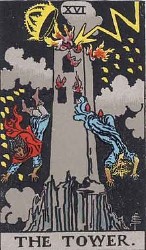
We can see that idea pretty clearly illustrated in the Tarot card called The Tower.  Most of the Tower-Being-Hit-By-Lightning myths have to do with punishment for human hubris.  Those idiots were trying to build a tower so high that it would reach to the heaven place and the god person got pissed and blew up the tower, just to show them that HE owned the heaven place and not them.

There’s actually a conundrum hidden in The Tower card that theologians have wrestled with for centuries.  If god loves us, and god’s all powerful, why does all of this bad stuff keep happening to us?  I mean, if he can control everything, why doesn’t he just make good stuff happen to us?  Why is there cancer and fires and floods and why do terrible, terrible things happen to people?

The traditional answer goes right back to the idea that god is an extreme control freak with a really bad temper.  He WANTS for good stuff to happen to us, but we keep doing the wrong things and so he HAS to make bad stuff happen to us.  Because we’re crotch scratching sinners, doncha know?

Native Americans had a slight shift in that perspective that makes a major difference in how we view the world.  They noticed that there is a factor in the universe which physicists would later label as, “entropy.”  The definition for entropy is, “a lack of order or predictability; gradual decline into disorder.”  Another way of putting it is that any organized system will start to disintegrate.

On a practical level, that means that just as soon as we get things arranged to our satisfaction, they start to fall apart.  It’s like when we clean our houses and then a week later they’re a mess again.  Entropy snuck up and bit us in the ass.

Native Americans built that into their theology and we might call it, “the shit happens,” principle.  Yes, there are loving, benevolent gods who want our lives to go perfectly well and want us to be happy.  But sometimes shit happens.  And when it does, it’s because of the Trickster Gods, like Coyote and Raven.  The benevolent gods are busy weaving a beautiful tapestry of life, but the trickster gods are over there in the corner unraveling it as fast as they can.  They’re entropy and they’re making the system disintegrate.

On the one hand, this allows us to have loving, caring gods.  On the other hand, it explains why shit happens.  In this scenario, the lightning bolt that hit the tree our ancestor was standing next to would have been sent by Raven or Coyote.  And they would have been laughing their asses off when they watched him jump.

That turn in their theology was actually a very important step.  First of all, it acknowledges that shit happens.  Second, it says that shit happens, JUST BECAUSE.  It doesn’t necessarily have a damned thing to do with us or whether we’ve sinned or we’re scratching our crotches again.  It just happens because entropy is a part of the fabric of the Universe.  Coyote or Raven are always there, turning our orderly, sensible worlds upside down, JUST BECAUSE.  So it gets rid of the concept of sin and we don’t have to feel guilty about our genitals anymore.

Most importantly, though, it gets rid of the nutso, bipolar, control freak, mean bastard that we’ve had running heaven.  It’s not OUR fault that shit happens, but we also don’t have to invent a crazy god to explain it.  No more vengeful patriarch who’s just itching to throw us into eternal flames.  No more voyeuristic stalker who’s counting how many times we masturbate so he can punish us for it.    No more crazed Jehovah demanding that Abraham shove a knife into his son’s chest to prove how much he loves god.  

And, all in all, the heaven place is  much nicer without him.

Dan Adair is the author of, “Just the Tarot,” available on Amazon.com at a very reasonable price.