Shine Your Light: The Star Card, Shame, and the Courage to Be Seen

This post explores the deeper meaning of The Star card in the Tarot and reflects on why so many of us struggle to shine our light in the world. Drawing on the work of Brené Brown, Tibetan Buddhism, and real-life dynamics like shame and codependency, I look at the messages—both cultural and personal—that lead us to dim our brilliance. The Star invites us to pour our gifts into the world, not for recognition, but because it’s who we truly are. This is a reflection on healing, self-worth, and the sacred courage it takes to be seen.• shine your light

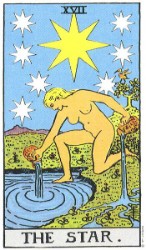
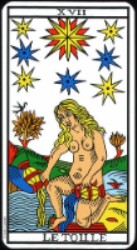
This image is from one of my new Tarot Affirmation posters, now available on my Etsy art site. I really love how it turned out—but even more than that, I love the message it carries: Shine Your Light.

And yet, for so many of us, that’s easier said than done.

Instead of shining, we hide. Instead of pouring ourselves out like starlight, we dim, shrink, withdraw. Why is it so hard to be radiant in a world that so desperately needs our brilliance?

The Culture of Shame and the Fear of Being Seen

In one of her powerful TED Talks, Brené Brown speaks about the culture of shame we all live in. Even if you didn’t grow up in a dysfunctional family (and statistically, about 60% of us did), we’re still marinated in a society that constantly criticizes, compares, and belittles.

Maybe you brought home a report card with a B, and your parent asked, “Why didn’t you get an A?”

Maybe you’re in a job where meeting your performance goals doesn’t bring a sense of completion—it just earns you a fresh, even more demanding set.

Maybe you’ve internalized the billions of dollars spent by the beauty industry telling you that your face, your body, your age, or your hair simply aren’t good enough.

On social media, the message is constant: unless you’re being validated with likes and followers, you’re invisible.

Advertising tells you your house isn’t elegant enough, your car’s too old, your wardrobe outdated.

Even spirituality isn’t immune. We whisper to ourselves: I should be better. I should care more. I should meditate more. Pray more. Try harder.

Let’s face it: in this world, it’s all too easy to believe that we should be ashamed of simply being ourselves.

As Brown puts it, shame drives two powerful tapes in our heads:

1. You’re never good enough, and

2. Who do you think you are?

And because those tapes run deep, we begin to engineer our own smallness. We shrink ourselves to stay invisible—because visibility feels like a threat. We dim our light so no one will see just how “inadequate” we believe we are. And in doing so, we fail to shine.

Codependency and Dimming Our Own Lights

Sometimes, the reason we hide isn’t culture—it’s relationships.

Too many of us are caught in dynamics where one partner shines while the other fades into the background. It might be dressed up in the language of care or sacrifice, but the effect is the same: one person takes center stage, while the other erases themselves.

It could be a relationship with a narcissist, where one partner is expected to provide constant praise, attention, and emotional caretaking.

It could be a more obvious kind of abuse, where failing to meet someone else’s needs results in punishment, blame, or even violence.

It might even look noble—like staying small to “support” someone who is ill, unstable, or in need. But the underlying belief is this: there isn’t enough light to go around.

And so, we dim ourselves to make the other person shine.

We play down our accomplishments. We pretend we’re not that talented. We take the backseat in our own story. And we tell ourselves it’s virtuous.

But it’s not noble to disappear. It’s not compassionate to go dark.

We were meant to shine.

The Star Card and the Sacred Act of Sharing

The Star card in the Tarot is a card of healing—but it’s not just personal healing. It’s about reconnecting with the world by letting your own light flow into it.

In Tibetan Buddhism, there’s a teaching that each of us carries a radiant jewel inside. It may be buried under layers of dust or encased in stone, but it’s there—glimmering with our true nature. And our task in life is to uncover that jewel and offer it to the world.

That’s what the woman in The Star card is doing. She kneels beside the stream and pours out her water—not hoarding, not holding back. She gives freely to the land and to the flow of life itself.

She’s not asking for praise. She’s not trying to be impressive.

She’s just being who she is: a vessel of light.

And so are you.

You don’t shine for applause.

You don’t shine to prove anything.

You shine because it’s your nature.

And this world is thirsty for that kind of offering.

A Final Thought

You are not just a person. You are a sacred gift.

You are a hidden jewel.

You are starlight in human form.

Let yourself shine.

“Just the Tarot,” by Dan Adair – a kindle ebook available on Amazon

Creating a Counter-Dialogue: A Gentle Approach to Healing Emotional Patterns

A look at emotional set-points and using guided meditations to counter a critical inner dialogue.

THE INNER BASTARD

Many people who grew up in dysfunctional or abusive families carry an invisible burden: a harsh, critical inner voice that tells them they’re not good enough. This voice operates just below the surface of awareness, subtly shaping thoughts, emotions, and behaviors. Even highly successful, capable adults may find themselves struggling with a persistent sense of inadequacy—and not really know why.

If you were raised in one of those families, you know precisely what I’m talking about.  It’s that Inner Bastard that’s always dropping discouraging nuggets into our thought streams.  Things like:

I can’t believe you did something that stupid.

And

What in the hell is wrong with you?

And

You can’t get anything right.

And

If you were any dumber, they’d have to water you twice a week.

This poisonous internal narrative, formed in childhood, becomes the emotional background music of a person’s life. And because it’s so familiar, we may not even question it.

OUR EMOTIONAL SET-POINT

If that kind of a powerfully negative inner dialogue goes on long enough, it can become the emotional vibration that we default to.  This is what Esther Hicks and Abraham refer to as our, “emotional set-point.” 

The basic idea is that people live in an habitual emotional vibration for most of their lives and they tend to stay there.  You may know someone who has a naturally sunny disposition and they’re happy 90% of the time.  They may occasionally experience grief and pain, like we all do, but they quickly return to their default state of happiness.  Likewise, we all know people who are dark, cynical and unhappy.  They may occasionally feel great joy or contentment, but then they go right back to being dark.

If we have an Inner Bastard who’s always whispering that we’re not good enough – that we’re incompetent, stupid, or ugly – we become sad, depressed, and helpless.  That becomes our set-point and we stay stuck in it. We have to somehow find a way to root out that inner dialogue if we ever want to be happy.

THE POWER OF COUNTER-DIALOGUE

But what if there were a gentle, practical way to begin shifting that dialogue without needing to confront it head-on?

 Rather than trying to root out the negative inner voice through sheer willpower, we can begin to introduce a counter-dialogue—a deliberate stream of positive, nurturing messages designed to soothe and balance the old patterns.

Tibetan Buddhists refer to this as, “antidoting,” negative emotions.  In their view, negative emotions are just like poisons that make us sick.  So, if we’ve taken a poison, we need to take an antidote to it, right?  If we become extremely angry, we can antidote it with a loving/compassion meditation.  If we’re really jealous of someone, we antidote it by meditating on their good fortune and try to be happy for them.

For those of us who aren’t Buddhist monks, an easy way to do this is through guided meditations focused on happiness, compassion, or self-acceptance.  You can find these for free all over the internet.  My personal favorite is, “Great Meditation,” on YouTube but there are many alternatives. 

These short recordings, listened to daily (especially at emotionally receptive times like morning or bedtime), can act as emotional antidotes to that negative inner dialogue.  Instead of a nasty assed voice telling us how terrible we are, we substitute a calm, peaceful voice telling us how wonderful we are. With regular exposure, these meditative states begin to form different emotional grooves in the brain and happiness gradually becomes our new emotional set point..

EMOTIONAL HOMEOSTASIS:  WHY CHANGE CAN FEEL UNCOMFORTABLE

But here’s where it gets tricky.

Humans operate by a principle called, “homeostasis,” and the, “stasis,” in that word tells you what it does.  Homeostasis tries to make sure that everything stays just the way that it is.  In the body, it maintains a normal blood pressure, makes sure our hearts beat a certain number of times a minute, keeps our blood sugar in a normal range, etc. etc. etc.

All in all, that’s a very good thing because it keeps our heads from exploding and our hearts from stopping and we live much better lives without exploding heads.  Where it can be troublesome, though, is when we’re trying to change something.

For instance, people who are trying to lose weight may lose 5 or 10 pounds at first and then they suddenly start gaining weight, even though they’re still on a diet.  The reason is that the brain is saying, “Uh, oh . . . we’re obviously starving to death.  Slow down the metabolism.  Retain fluids.  We need to get fat again.”

In other words, our brains have come to view being overweight as, “normal,” and they try to keep everything the way it is.  That’s homeostasis.

Just as the body maintains physical homeostasis, the subconscious mind seems to maintain emotional homeostasis. That is, it resists sudden emotional changes, even positive ones.

If your emotional “set-point” has been sadness or self-doubt for many years, your system may view happiness or self-worth as unfamiliar—even dangerous. This can trigger a rebound effect: you’re sitting there trying to rewire your brain by listening to guided meditations and your Inner Bastard responds by cranking up the volume of self-criticism.  You may feel happy and light one day and then find that you’re in a deep depression the next.  That’s your brain trying to maintain what’s, “normal,” even if what’s normal sucks.

At that point we have to remind ourselves that this isn’t failure. It’s the subconscious trying to return to what it sees as safe territory. Knowing this can help us respond with compassion rather than frustration.

 HEALING THROUGH GENTLE PERSISTENCE

The key is to approach change with patience and consistency. You’re not trying to overpower the old patterns, but gradually retrain your system to accept a new emotional baseline. You’re building new neural pathways—ones that support self-kindness, resilience, and inner calm.

Over time, the emotional set-point begins to shift. The system adapts. The counter-dialogue becomes part of your inner landscape. And the old voice, while perhaps never fully gone, loses its grip.

In essence: you don’t have to fight the pain directly. You can begin to antidote it—with gentleness, repetition, and trust that healing happens not in one grand moment, but in small, quiet steps.

My new e-book, “The Alchemy of the Mind: Transforming Your Life With the 7 Principles of The Kybalion,” is now available on Amazon.

Christmas Candy, the Meaning of Giving, and Tibetan Meditation Centers

Making our lives into gifts.

Here in the United States we’re just finishing up the annual emotional and commercial orgy of Christmas, also known as, “the season of giving.”  It started me thinking about the nature of giving and, oddly, a Tibetan meditation center I toured over 20 years ago.

Our guide was a woman who lived there with the improbable name of, “Candy.”  I’m guessing that trying to explain the intricacies of Buddhist philosophy to a group of tourists in Bermuda shorts was not the highlight of her day, but she was pleasant, kind, and patient.  One of the concepts that she put in a nutshell for us was the idea of accumulating merit.

“We get up in the morning with the idea of helping other sentient beings and, if we do that, it earns us karmic merit.  And then, instead of clinging to that merit for ourselves, we dedicate it to the good of other sentient beings.  Which accumulates more merit, which we dedicate to the good of other sentient beings.”

I glanced around at the people I was with and their faces were frozen in expressions that pretty much conveyed, “I don’t know what in the fuck you’re talking about, but you seem relatively harmless.”  To me, though, it was a major revelation.  In just those few sentences, I understood the concept of giving with absolutely no expectations of getting anything back.  It’s been something I’ve gone back to again and again over the last two decades.  A lasting treasure.

Now, here’s the thing:  I feel absolutely sure that Candy had no idea that she was making a major impact in another person’s life and thoughts.  We spent maybe 30 minutes with her and I’ve never seen her again, but I still remember that moment like it happened yesterday.  It was a gift, and the gift was her just living her life and telling her truth.

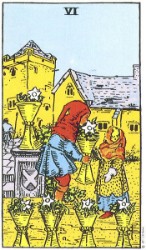
We tend to think of giving as being something that’s transactional and we can see that idea illustrated in the Six of Cups.  The little boy is giving a gift of love (symbolized by the Cup) to the little girl.  Implicit in that image is the next step in the transaction, where the little girl is going to say, “Oh, hey!  What a nice cup!  Thanks so much for thinking of me.”

And then we feel good because we’ve made someone we care about feel good and we feel good about ourselves because, after all, we were thoughtful enough to give something nice to someone we care about.  When we put all of the commercialism and forced jolliness aside, that’s part of the sweetness of Christmas – it’s a chance to give something to others and tell them we love them.

Most of us feel pretty disconnected with that in our general, everyday lives, though.  We may get up in the morning with the intentions of being, “good,” people.  We’re loving with our life partners, we don’t snap at the cashier in the grocery store, we smile at our co-workers and try to work hard at our jobs.  As near as I can tell, right around 90% of us are good people, in the sense that we make some effort to not be shit heads and to be decent to our fellow humans.

Still, a lot of us are afflicted with a sense of meaninglessness.  We feel like we’re slow walking through life in a sort of a daze and we’re not really making any difference.  It’s like we’re born, we eat a lot of t.v. dinners, and then we die and we wonder if anything we’ve done actually matters.

That’s where synchronicity and a leap of faith comes in.  That’s where giving with no sense of attachment to the results comes in.

Each one of us is absolutely unique.  There’s never been anyone exactly like us before and there will never be anyone exactly like us again.  To the extent that we celebrate that uniqueness and share our own individual truths in our lives, we become a walking, talking, breathing gift to the world.

But we almost HAVE to detach that gift from results.  If we make our giving transactional – which is to say, someone saying, “Thank you for being you,”  – we’re setting ourselves up for a lot of disappointment.  The fact of the matter is that most people don’t even see us, in any sort of a meaningful way.  Like us, they’re hustling and bustling through life, trying to pay their bills, hoping they’ve got some clean socks, trying to figure out what in the hell they can cook for their kids that isn’t a t.v. dinner.

And if they do notice us, the odds are that they’re seeing us through so many perceptual filters that they don’t see who we really are.  As the old Indian adage goes, “When a pickpocket looks at a saint, all he sees is pockets.”  

So, we have to make a little leap of faith that we ARE being seen without knowing that we are.  And that we ARE making a difference in other people’s lives and in the world, without any proof that it’s so.  Sometimes it may be like Candy at the meditation center, where words we speak become seeds that grow in other people’s lives.  Sometimes it may be as simple as smiling at a person we pass on the street, never knowing that they were depressed and suicidal until they saw our smile.

We can see that in another card, the Ace of Cups.  The cup represents love flowing into the world, but, unlike the Six of Cups, it’s not attached to anything.  It’s not something we have to earn.  It’s not dependent on being thanked or being noticed or appreciated.  It’s just there in the world and it makes life better by its very presence.

When we finally get it that we’re giving to the world around us and making a difference just by being us to the fullest extent that we can, then we shift into having meaning in our lives because we ARE making a difference.  We may not see it.  Perhaps no one will ever tell us.  Maybe it will take twenty years for that good to ripen in someone else’s life, but we DO matter.  Every single day.

My e-book, “Just the Tarot,” is still available on Amazon for less than the price of a meaningless t.v. dinner and it’s twice as nutritious!

Eating Pancakes with Jesus, Having Lunch with Lucifer and Looking Inward with the Three of Pentacles

A contrast in Christian and Buddhist views of human nature and spirituality.

Are we on the outside looking in or on the inside looking out?

Do we think that heaven or redemption or satori or enlightenment or whatever we want to call it, is, “out there somewhere,” or do we think it’s inside of us, waiting to be uncovered?

Which direction are we gazing? Inside or out? It’s a fundamental, crucial question in terms of how we approach life and our personal spirituality.

In Western Christianity, there’s no question that the focus is very much outward.  Heaven, redemption, blessings are seen as things that exist but they’re not an innate part of us. Christian theology goes something like this:  

“God made you in his self-image but something kind of went wrong.  God is perfect, but you aren’t.  In fact, you’re really, really flawed.  In fact, let’s be honest here, you’re a real piece of  shit.   You like to fornicate and steal and lie to people and, um, eat bacon and shrimp.  You’re pretty much hopeless, unless you change your ways.  If you change your ways, you can eat pancakes with Jesus in heaven, and they use REAL maple syrup, not that Mrs. Butterworth’s crap.  On the other hand, if you DON’T change your ways, well, God is going to have to toss you into a flaming pit where you’ll burn in agony forever.  Because he loves you.”

Now, the salient point in all of that is that THERE IS NO GOOD INSIDE OF US.  Whatever blessings or grace may exist, they exist, “out there,” in God, and it’s only by overcoming our basic, sinful nature that we can have any hope of finding happiness and salvation.

It’s only by becoming, “not us,” that we can get God’s approval and get into that pancake breakfast with Jesus.  That sets us up for a lot of spiritual and psychological tension because, basically, everything we really like to do as human beings is a sin and sends us toward having snacks with Satan, instead of breakfast with Jesus.  Everything from sex, enjoying our possessions, loving a good meal, having a nice lazy day, eating shell fish or pork, even masturbating are ALL deadly sins.

What causes us to commit all of our sins?  Why, our bodies, of course!  It isn’t really ME that wants to get into bed with Mary Jo and fuck like bunnies, it’s my body.  It isn’t really me that wants a BLT, it’s my body.  More specifically, it’s my DAMNED body.  If it weren’t for my body, I could be, like, I dunno . . .  Mother Teresa . . . or maybe Mahatma Gandhi, except he wasn’t a Christian so he went straight to hell, of course. 

The end result of that is that we end up hating even our own bodies because the body is the source of all of those terrible impulses that cause us to sin.  That’s why Medieval christians developed wonderful traditions like whipping themselves and self-crucifixion.  The terrible, sinful body had to be literally beaten into submission so that it wouldn’t make them sin, or they’d end up having lunch with Lucifer or brunch with Beelzebub (also known as, “Beelzebubba,” if you live in Texas.)

It’s interesting and even a little startling to our Western minds, to compare that Christian model of spirituality with the Buddhist model.  Tibetan Buddhists speak of basic human nature in terms of a precious jewel or crystal that is covered with plain rock. Our job, our spiritual quest, is to uncover that beautiful jewel by chipping away at the rock, one little piece at a time.  By meditating, practicing mindfulness, and building loving/kindness into our lives, we gradually reveal more and more of the jewel, our true nature.  As Chagdud Tulku Rinpoche’ put it:

“Enlightenment is not anything new or something we create or bring into existence. It is simply discovering within us what is already there. It is the full realization of our intrinsic nature. 

In sharp contrast to Christian theology, we aren’t terribly flawed,”sinful,” beings.  Instead, we are beings that are incredibly beautiful, holy, and wonder-filled.  We just haven’t uncovered that part of our nature, that precious jewel, yet.

Our redemption isn’t, “out there,” it’s not something we’re going to find in heaven or a book.  It’s very much, “in here.”  It’s something that we find by looking inward, toward our true nature, by meditating, consciousness, and increasing the love in our hearts.

This isn’t to say that Buddhists don’t have their Greatest Hits list of, “sins.”  They condemn anger, judging others, envy, greed, etc.  But, they don’t condemn them in terms of their being a part of our basic nature.  Rather, they’re considered sort of side trips that lead us away from our basic goal of enlightenment.  They’re distractions, rather than definitions of who we really are.

There’s actually a major Buddhist doctrine called, “Precious Human Birth,” which not only says that we’re NOT terrible, sinful creatures, it says that if we were born human, we hit the fucking jackpot.  Only human beings are able to consciously contemplate life, make ethical decisions, and improve our spiritual state of being.  When we consider all of the trillions of other beings on our planet who were incarnated as insects and animals, being humans puts us in a very, very, VERY small minority.  We lucked out.

It’s a major shift in thinking for most of us who were raised in the West.  Our bodies aren’t sources of primal, evil urges; they are precious vessels that contain an ineffable beauty just waiting to be brought to the light.  They are a gift beyond comprehension.  Heaven and salvation aren’t up in the sky or hiding in a holy book – they’re in our hearts.

And if heaven is in our hearts, we are sacred.  Umm . . . really? Hmmm . . .  Are you sure?

The Three of Pentacles is a pretty good illustration of the two choices we can make.  The stone mason stands on a stool, mallet in hand, ready to carve.  Beside him there is a monk and a fool holding a plan.  The monk represents a religious creed, a looking outward to others for answers to our spiritual quest.  The fool represents our basic human nature, that surge of playful, happy spiritual energy that occurs when we gaze within and joyfully embrace what already exists in our hearts and souls.

We just have to understand that everything that we want to be, we already are.

The Star Tarot Card – Ishtar, The Dalai Lama, and the Re-Emergence of The Goddess

Just who is the mysterious woman in the Tarot card, “The Star?”  She’s one of what I call, “the astronomical cards,” that are grouped together at the end of the Major Arcana:  The Star, The Moon, The Sun, and The World.

For some reason it seems easier to relate to the other three cards today.  Perhaps it’s because they are so intimately interwoven with our daily existence.  We live on and with Mother Earth/The World. The Sun makes us happy and marks out our seasons.  The Moon controls the tides and is strongly connected with women’s fertility and men’s insanity.  

But what about The Star?  What comes to mind? Anything?  Not much?

The first known examples of the Tarot emerged 1500-ish.  We know that most of the natural philosophers (they didn’t have scientists, yet) were still using the Greco-Roman model of the universe at that time.  The Earth, of course, was the Center of the Universe because we are SO important. Then extending all around the Earth there was a great circle of a sphere which contained space and the moon and the sun.

The latest, most up-to-date thinking at that time was that stars were actually holes in the sphere that surrounded us and that the light they radiated was heaven shining through the holes.  Which is why heaven is, “up there,” even today.

BUT . . . there were also stars that moved around.  We call them planets now days but the thinking back then was that if they moved around, then, by golly, they must be alive because that’s what living things do and that’s what dead things don’t.

Now, it’s interesting because the Greeks (and their intellectual suck ups the Romans) decided that if there were magical, celestial beings whizzing around in space then most of them must have penises.  Yes, I know . . . there’s poor lonely Venus and she’s a female, but every other, “living star,” was a male. Jupiter, Mars, Saturn, Mercury, Pluto . . . not a vagina in the whole lot of them.

The rest of the world took an entirely different approach, however.  In most cultures there was no doubt that if stars were living beings they were definitely females.  And that’s what showed up in the Tarot, which we are told was a product of medieval Europe and which was still going by Greco-Roman thinking.  A woman. Odd, isn’t it?

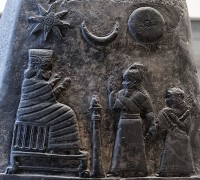
In, “The Alphabet Versus The Goddess,”  Leonard Shlain makes a very strong case that all early civilizations were Goddess-based cultures.  And we can posit that Star Goddesses played a prominent role. The Sumerian/Babylonian Star Goddess Ishtar is portrayed here as her symbol, an eight pointed star:


And here we have an early Tarot deck version of The Star, with . . . ahem . . . an eight pointed star hovering over the Star Woman.


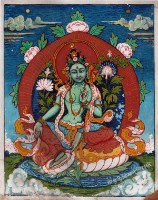
Or take the example of Tara, the Hindu Goddess who crossed over into Tibet.  She is portrayed with seven eyes – two in her hands, two in her feet, and three in her head – because she sees all of our suffering .


When the Buddhists arrived in Tibet they announced that Tara was actually the feminine counterpart of the bodhisattva (“buddha-to-be”) Avalokiteshvara and came into existence from a tear of Avalokiteshvara, which fell to the ground and formed a lake.

Right.  Another example of a man giving birth to a woman.  We know that happens all of the time.

Tara is thought to be the oldest still worshipped Goddess in existence and she was in Tibet a LONG time before Buddhism arrived.  Tara actually means, “Star,” so we can guess that Tibetan society was originally a matriarchal culture centered around the worship of a Star Goddess.

If you want a clincher for that, the term, “Dalai Lama,” literally translates as, “High (or exalted) Mother.”  If the original Dalai Lama didn’t have breasts it would have been a damned peculiar title.

When a Tibetan Buddhist wants to talk about compassion and pure, unadulterated love, they use the the example of the love that flows between a mother and a child.  Several of them that I’ve run across – such as Tulku Thondup who wrote, “Boundless Healing: Meditation Exercises to Enlighten the Mind and Heal the Body,” – expressed frustration in trying to convey that concept to Westerners because we tend to have such screwed up relationships with our parents.  Mother EQUALS love in their culture, if not in ours.

So we can perhaps begin to cobble together a picture of who the Star Woman actually is.  She is a Goddess. A mother. Unconditional love. Compassion. Always there, gently shining down to guide and protect us.  The blessing of feminine energy.

And perhaps, as the Goddess archetype continues to re-emerge in the world, that image and that feeling will once again seem as normal to us as The Sun, The Moon, and The World.

Let’s hope so.

The Magician and Channeling Down Energy

The Magician Tarot card and channeling spiritual energy into our lives.


The person in the Fool Tarot card is infused with pure cosmic energy and he’s dancing with the pure joy of it.

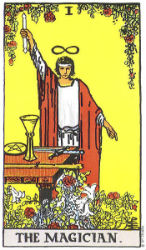
The Magician, on the other hand, is directing that energy.  We see him standing there in his robes, one hand pointed to the sky and the other pointed to the ground.  On his table are the four elements of the Tarot: wands, cups, swords, pentacles, also known as ideas, emotions, energy, and material.

He serves as a reminder that we are not alone.  We are not limited to our personal resources, our bodies and minds, as incarnate in this earth plane.  There are other realms of being and there is an infinite amount of energy available from those realms, energy far beyond what we think we possess.

And you can take a very, very, simplistic approach to that.  You don’t have to be a Master Occultist with secret knowledge of the Astral Planes and how to manifest that energy onto the Earth Plane.  You don’t have to go Full Wiccan and set up a Magic Circle with white candles at the quarters. You don’t have to be a Theosophist with intricate explanations of how the universe works.

Just start with three simple facts:

1 – you exist;

2 – there’s another realm of infinite energy;

3 – you’re connected to it.

No matter how beaten up or beaten down we may be, no matter how physically and spiritually exhausted we are, we have access to all of the energy we need any time we want it.

Don’t get hung up on names for the other realm.  Call it whatever you like – heaven, the astral plane, the angelic realms, foreverland . . . whatever.  I personally like the phrase, “Spirit World,” because it’s descriptive short hand without trying to put it in a box of faiths, creeds, or religions. But call it whatever rings true to you.

Don’t get hung up on methods for contacting it.  There are about a zillion religions and philosophies out there and they all claim to have the EXCLUSIVE method for getting in touch with Spirit World.  Bullshit. Try to think of it the way the Tibetan Buddhists describe it: at the level of our core being we are all beautiful, unique, crystals. The Light will shine through each of us in a different way.  For some, that light may be Reiki. For others, formal religions. For others, Wicca. Look around, experiment, and you’ll find what’s right for you.

In the meantime, there are simple, well established ways to get started with expanding your connections to the other realms.  Prayers work for some people. Meditation for others. Simply sitting quietly in nature and letting their hearts open works for others.  Dancing and shamanic drum circles may be your path.

Personally, I like meditation.  Rajinder Singh has an interesting book on meditating on the Third Eye (or brow chakra) called Inner and Outer Peace through Meditation and that can take you on a Magical Mystery Tour.

Or you might want to try meditations that are more heart centered.  Tara Brach has many, many FREE downloadable guided meditations here.

The path is always there, waiting for you, full of joy, love and energy.

Disclaimer: “As an Amazon Associate I earn from qualifying purchases.”

The Wheel of Fortune and the Gifts of Karma

This is about dealing with bad luck and painful times in our lives. It discusses the Tarot card called The Wheel of Fortune. It also discusses the Tibetan Buddhist concept of accumulating merit through conscious, mindful suffering.


You’re rolling along doing great, happy as a clam, your life full of blue skies and smiles and – BLAM – you get fired from your job.  Or your girlfriend leaves you. Or even worse, you get fired from your job and get terrible, terrible reviews on your exit interview and you know your resume’ will be screwed up for years.  Or . . . wait . . . your girlfriend leaves you for a lesbian who ALSO happens to be your supervisor and fires you and they BOTH give you terrible, terrible reviews on your exit interviews and you know your resume’, your ego and your libido will be screwed up for years.

We’ve all had those moments when life suddenly turns to shit with no warning and for no discernable reason.  It happens to everyone. A rabbi named Harold Kushner even wrote a book about it called, When Bad Things Happen to Good People that sold millions of copies.

Of course, you could also write a book called, “When Good Things Happen to Bad People,” but it probably wouldn’t sell as well.  Or you could write a book called, “When Good People Have Their Lives Turn into Shit Sandwiches and Then All of a Sudden Things Get Better For No Particular Reason.”

As the King of Siam said, “It’s a puzzlement.”

One of the reasons it’s puzzling for most of us is that we get that training from the time that we’re infants:  if you’re good, good things will happen to you. If you’re bad, no fruit cup for dessert and you stand in the corner.  It’s supposed to be a straight, cause and effect transaction that if you’re good you get rewarded, not kicked in the head.

But life is full of ups and downs, and The Wheel of Fortune is a perfect illustration of that.  At best our ill fortune can seem terribly random and at worst it can seem just plain perverse. A turn of some invisible wheel over which we have no control.


As I’ve gotten older I’ve come to take a lot of comfort in the concept of karma.  When a stranger decides he doesn’t like me and he’s going to make my life hell it makes more sense to me to think that I must have screwed with him in a past life than to think that he  just doesn’t like my nose or my aftershave.

And if you really embrace the concept it can actually help you to get through some horrific times.  “Yes, this is terribly painful and I’m going through some serious suffering. On the other hand, think of all of the bad karma I’m burning off.”

I remember the first time I had a serious discussion about karma.  I was taking a tour of a Tibetan Buddhist Meditation Center and the woman who was the tour guide and who lived there said:  “When we get up in the morning we try to live virtuously and if we do that we accumulate merit, which is good karma. And then we consciously dedicate that merit that we’ve earned to anyone who is suffering or in need.  Which is also a virtuous thing to do so we accumulate more merit by doing it and then we consciously dedicate THAT merit to others.”

To which I replied, “Huh?”

It took me a few years to get it but the key words there are, “consciously dedicate.”  

When we encounter the bad times in life – as we always do – live them consciously.  Endure them with grace and dignity. Be determined to learn and to grow spiritually from them.  Consciously dedicate those bad times to earning merit.

And when we’re having good times in life, consciously dedicate some of that extra energy and fortune to helping others who are having hard times.  

Conscious living makes The Wheel of Fortune make sense.

Disclaimer: “As an Amazon Associate I earn from qualifying purchases.”