Learning to Live Without Joy

Many people feel disconnected, numb, or unable to access joy—especially after childhood trauma. This post explores emotional flatness, toxic positivity, and why realness may matter more than happiness.

Did you get ACED when you were a kid?

ACE stands for Adverse Childhood Experience, and the odds are fairly high that you experienced one. ACEs include things like emotional abuse, neglect, parental mental illness, substance abuse, and divorce or separation of the parents.

We tend to think of those kinds of negative experiences as relatively rare. Maybe we got the hell beaten out of us by a crazed, drunk parent—but most people didn’t, right?

After all, just look at how happy everyone else seems.

But according to the CDC-Kaiser ACEs Study, 61% of adults across 25 states reported experiencing at least one ACE. And nearly 1 in 6 (16.7%) reported four or more.

The truth is, a sizable portion of the population is living with the long-term effects of unresolved trauma—including dissociation, emotional blunting, chronic anxiety, and difficulty accessing joy.

The Cultural Pressure to Be Happy

One of the strongest side effects of long-term trauma is the belief that, “Man, I must really be fucked up, because I’m just not happy. Everyone else is happy, but I’m a train wreck. In fact, I’m not even a train wreck, I’m completely off of the tracks.”

That belief is especially potent if you’re American.

American culture—especially through media and marketing—places enormous value on positivity, confidence, and personal success. Like the figures in the Three of Cups, we’re all supposed to be dancing with joy, smiling through life, bubbling over with gratitude. The message is:

“You should be happy, empowered, and in control of your life at all times.”

And if you’re not?

Then something must be seriously wrong with you.

This pressure to appear happy, even when we’re not, creates:

Emotional dissonance: A split between what we feel and what we think we should feel.

Shame about feeling bad: A second layer of suffering on top of the original pain.

Social masking: We say we’re “fine” or “happy” because it’s expected—and we believe others are genuinely feeling that way (even when they aren’t).

Antidepressants and the Emotional Economy

A recent Gallup poll reported that a whopping 78% of Americans say they feel satisfied or very satisfied with their lives. The poll even bemoaned the fact that the “happiness index” was down by two points.

Meanwhile, the U.S. is among the highest consumers of antidepressants in the world.

Some people take them for serious clinical issues—but many of us take them simply to cope with lives that feel emotionally flat or chronically overwhelming.

Years ago, psychologists discovered that one of the most useless surveys in the world was asking teenage boys if they’d had sex. The overwhelming majority said, “yes, of course I have,” —even though many of them didn’t have the slightest clue how to unfasten a bra, let alone what to do next. They thought they were supposed to be having sex, because they assumed all the other boys were doing it—even though they weren’t.

In much the same way, Americans seem to be lying to pollsters about how happy we are, because we think we’re supposed to be happy.

After all, everyone else is smiling.

Even if they’re not.

We’re taking pills to create artificial happiness because we think we should be happy, even when we’re not.

Living With “Flat” Emotions

What if, instead of constantly trying to fix our feelings, we first learned to live with them?

Assuming there’s no organic brain issue involved, there’s always a reason that we’re not happy.

As Gabor Maté points out, when we suffer trauma that we can neither fight nor flee from, we dissociate. We leave our bodies. We stop feeling.

Not feeling becomes a survival mechanism—a way of coping with pain that would otherwise overwhelm and break us.

If you’re among the 61% who’ve had at least one ACE, you’ve probably experienced dissociation and emotional flatness.

If you’re in the 16% who had four or more ACEs, emotional flatness may be how you live most of the time. It’s not that we don’t want to be happy—we just don’t know how.

And that, in itself, can be traumatic, because we’ve been programmed to believe that we should be happy—even when we can’t feel it.

But we can reframe that.

Rather than chasing a happiness ideal that may not be accessible—especially after trauma—it’s possible to:

• Honor emotional flatness as a survival adaptation.

• Shift the goal from happiness to authenticity.

• Value calmness, neutrality, or quiet presence as valid emotional states.

• Find meaning not in chasing joy, but in living gently and truthfully with what is.

This doesn’t mean giving up on healing, but healing might not look like “feeling great all the time.”

It might look more like “being okay with feeling whatever I feel.”

A New Emotional Ethic: Realness Over Happiness

Ideally, we need a massive cultural shift—from:

“I must feel good in order to be okay”

to:

“I’m okay because I’m allowing myself to feel what’s true for me.”

But… yeah. Don’t hold your breath on that one.

What is possible—what’s powerful—is to make that shift within ourselves.

If you’ve had the hell beaten out of you, either physically or emotionally, as a child or as an adult, it’s okay to feel sad.

It’s okay to feel numb.

It’s not just okay—it’s rational.

That doesn’t mean we want to live there forever.

That doesn’t mean we resign ourselves to an existence without joy. But maybe healing begins when we stop pretending. When we stop performing. When we let ourselves feel—or not feel—exactly where we are.

In this new ethic:

• Sadness is not a problem.

• Numbness is a messenger.

• Joy, when it comes, is a gift—not a requirement.

Back in the 1960s the Transactional Psychology movement came up with the catch phrase:  “I’m Okay, You’re Okay.”

To which Elisabeth Kubler-Ross replied:  “I’m Not Okay, You’re Not Okay.  And That’s Okay.”

The first step in the path seems to be honestly saying, “This is who I am.  This is where I’m at. I hurt when I feel and so I try not to feel. And for right now, that’s okay.”
The Alchemy of the Mind: Transforming Your Life With the Seven Principles of the Kybalion

The Three of Cups, Leela, and Playing in the Flow

A look at the Hindu concept of Leela and learning to be a part of a playful Universe.

We wouldn’t put water into the gas tank of our car and expect that it would somehow work alright, would we?  Of course not.  

Putting sadness, anxiety, depression and fear into our minds is exactly like that.  In order for human beings to, “run,” we need to put the right fuel into our energy systems, and that fuel is happiness.

WE ALL KNOW THAT

That proposition isn’t really something that we have to prove, because we already know that it’s true.  

We’ve all had the experience of having to go to work when we were sick.  Perhaps we had the flu or a bad cold, but we still had to drag our asses into work and somehow slog through the day.  No one – ourselves included – expected that we were going to be operating at peak efficiency or do a super duper job when we were ill.  We just had to show up and keep our bodies going through the motions until we could get back home to bed.

Getting through life when we’re extremely depressed, fearful, or anxious is just like that.  All of those states of mind are literally like a poison, like a bacteria or virus that seriously interferes with our abilities to function.  Our bodies are in place, doing what we have to do, but we’re far from being at our best.

HAPPINESS IS THE RIGHT FUEL

In contrast to that, we’ve all had the experience of living when we were extremely happy.  Perhaps we were in love.  Or we just got a promotion.  Or maybe it’s just Springtime and we feel completely zippety doo dah.

When we’re happy, life is easy.  We seem to sail right through difficult projects, our relationships with other people are much easier and more positive, and we attract even more happiness into our existence.

In a very real sense, choosing happiness instead of depression is like putting gasoline into our car instead of water.  It’s the right fuel to optimize human life.

HAPPINESS IS BEING IN THE FLOW

People talk a lot about being, “in the Flow.”  That’s also known as being in the zone, or, as Taoists put it, being in the Tao.

When we’re in the Flow, life is smooth and effortless.  We start to experience a lot of synchronicity and serendipity.  We have an unusual amount of focus and concentration and the task at hand is easy.

Exactly the same things happen when we’re in a state of happiness.  Some people might think that being in the Flow triggers the feeling of happiness, but it’s quite the opposite.  Being happy triggers being in the Flow.

BUT CAN WE REALLY CHOOSE HAPPINESS?

To a large extent, yes, we can.

There are, of course, a few glaring exceptions.  If we’re living in a war zone or someone we dearly love has just died or our house has just been destroyed by a disaster, it can be very difficult for those of us who aren’t spiritual masters to keep a smile on our faces.

The truth of the matter, though, is that for 90% of us, 90% of the time, NOTHING IS WRONG.  Yes, we may have very unhappy memories or we may be very anxious about the future, but right here, right now, in the present moment, nothing is wrong.

The past and the future are just movies that we’re running our own minds.  They literally have no existence outside of our mental images.  We can, in the present moment, choose to be happy or choose to be sad.  As Thich Nhat Hahn said in Peace Is Every Step: The Path of Mindfulness in Everyday Life, “Learn to love, enjoy and embrace what you have in the here and now. That’s all you really need to be happy.”

 HOW DO WE DO THAT?

Oddly, the answer to that seems to be simple:  play.

That can be difficult for us to grasp as Westerners, because our culture and our religions tell us that LIFE IS VERY SERIOUS!!!  We’re supposed to get up in the morning and work hard and sacrifice. We’re supposed to put off all of the things that give us pleasure.  That’s what it means to be a responsible adult, right?

The Hindu philosophy, on the other hand, has a delightful concept called, “Leela.”  Leela literally means, “divine play.” The idea is that when the Goddess made the universe, she didn’t do it as a job, or with a purpose, or even for anything very serious.  She did it because she was playing.  Because it was fun! 

“Hey, I think I’ll make the Universe.  Ooh, that’s a nice color!  Maybe I’ll throw a galaxy in over there.  Why not put some rings around that planet?  Oh, pretty . . .”  

Like the people in the Three of Cups, she was having a ball.

PLAYING IS BEING IN THE FLOW

The real idea behind being in the Flow is that there’s some underlying energy that flows through the entire Universe.  When we’re in alignment with that energy, everything goes smoothly because we’re moving with the natural flow of the Universe.  When we’re out of alignment with that energy, then life is difficult because we’re swimming against the current.

It’s easy to see, then, that if Leela is true – if playfulness is the energy that underlies the entire Universe – then the happier and more playful that we are, the more that we’ll be in alignment with that energy, and the easier life will be.

WHAT ABOUT WHEN LIFE IS HARD?

Life here on the Earth Plane is cyclical.  We see evidence of that everywhere we look.  The moon waxes and wanes, the tides come in and then go out, animals and humans are born, flourish, and then grow old and eventually die.  Even nations rise and then fall.

The Hermetic book, “The Kybalion,” refers to that as the Principle of Rhythm and likens it to the pendulum of a clock.  The Pendulum swings to the left and then it swings an equal amount to the right.  

Our emotions and our personal fortunes seem to operate according to that same principle.  We may have a period of our lives when everything is going perfectly and then that’s followed by a period when everything is difficult.  We may be incredibly happy for a while and then experience deep sorrow.  It’s just the pendulum swinging back and forth.

When we consciously realize that, when we know that any difficulties and sadness that we’re having will change back into happiness eventually, then we cease to take it all so seriously.  We can rise above it, and continue to play.

THE PLAY IS A PLAY

There’s another meaning to the word, “play,” that’s used in the concept of Leela.  That’s the idea of life AS a play.  As something that we might watch playing out on a stage at a theater.  

Like the Principle of Rhythm, that points to the notion that none of this is real or permanent.  These are just parts that we’re playing in this incarnation.  All of our, “sound and fury,” all of the ups and downs, all of the victories and defeats, are just temporary roles that we’re playing and we’ll shed them like old costumes when we move on to our next incarnation.  

All we have to do is learn to play at playing in the play.  We can do that!

Introverts/Extroverts – The Three of Cups and The Hermit

Have you noticed that the term, “introvert,” is gradually being redefined on social media?  There are more and more people who are coming out of the closet and saying, “I really don’t LIKE going to parties.”  Or talking about how happy they are to NOT be in a relationship. Or just putting up posts like, “Thank god, it’s Friday, I’m home, alone, silence, blessed silence . . .”

When I was a kid, “introvert,” was kind of a shameful term.  It implied that you were an odd duck, an eccentric, a wallflower.  That you were painfully shy and that you had no social skills. You weren’t alone because you wanted to be alone or you enjoyed being alone;  you were alone because you just found it too painful to be with other people. Poor thing.

What’s emerging now is that it’s more of an energy set.  Extroverts genuinely enjoy being with other people, being at parties and in crowded social situations.  They draw personal energy from that. It recharges their batteries.

And, conversely, they feel energetically depleted if they spend too much time alone.  They feel that something’s wrong in their lives and that they really, really need to get out and be with other humans.  

And that’s okay.  That’s just the way their energy fields are set up.  Being alone is exhausting and being with others lights up their chakras.

And it IS a matter of energy.  If you look at a card like the Three of Cups you can just feel the energy pouring off of it.  These are three people who are having a hell of a good time. They’ve worked hard, they’ve been successful and now it’s time to PARTY!  There is a synergy there, a combined energy that recharges all of them.

When you look at The Hermit the energy isn’t so blatantly obvious.  He’s alone, standing on his mountaintop, quietly looking off into the distance.  But, my, my, how his lamp does shine. He’s not lonely. He’s quite happy living in his silence and contemplation.

That’s what’s changing, I think.  There is a growing recognition that there’s nothing WRONG with introverts.  They’re not horribly shy. Far from being socially inept many of them can be quite entertaining because they’ve had the time to think, to read, to meditate and contemplate and they actually know what they think in much greater depth than many extroverts.

Their chakras operate in almost the opposite fashion of extroverts, though.  Being in crowds sucks the energy right out of them and being home alone replenishes them.  They prefer one long, in depth conversation to the 40 mini-conversations you might have at a party.  Most of them genuinely like other people, they just need to encounter them in small, measured doses or in a one-on-one, deeply intimate relationship.

And, thanks to social media, they’re finally getting a chance to express all of that and realize that there are a lot of people out there who are just like them.  One more place where we’re learning to celebrate our differences instead of condemn them.

It’s all just energy.

The Sex Cards in the Tarot

Everyone likes sex!  Well, nearly everyone.  I actually read an article recently about people who don’t like sex in any way shape or form and don’t feel any sexual desires.  They’re calling themselves, “asexuals,” and actually have their own organization.  How about that?  What an interesting world.

Just the Tarot, by Dan Adair – a kindle ebook available on Amazon

Anyway, nearly everyone likes sex and there are certain Tarot cards which definitely indicate its’ presence in a persons life.  It can be handy to know when it’s likely to pop up in a relationship, whether you’re interested in the other person or not. Come to think of it, it could even be handy for people who are official Asexuals because they’d know who to avoid.  Nearly everyone, right?

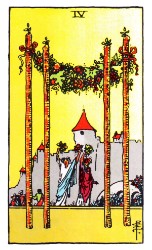
FOUR OF WANDS

Two people dancing beneath what looks very much like a wedding gazebo.  There is an element of sex here but in the more traditional sense of marriage and an on going union.  A happy card that includes the idea of sex without actually signifying it outright.

TWO OF CUPS

A man and a woman hold chalices and gaze into each others eyes.  This is a card of profound bonding and love, the start of a serious relationship.  While it can often indicate something as mundane as a good business partner or a best friend, it can also indicate a deep romantic and sexual relationship.

THREE OF CUPS

Three women dance together, chalices raised in mutual salute. Sex is not necessarily a central theme in this card but it’s a possibility because the central theme is PARTY!!!!  This is a card of joyous celebrations so why not sneak a little whoopee into the celebration? May also indicate a happy three way relationship.

THREE OF SWORDS 

A heart pierced by three swords.  This can often indicate a monogamous relationship in which one of the partners has decided to be not so monogamous.  He or she may be screwing around and it’s breaking the partners heart.

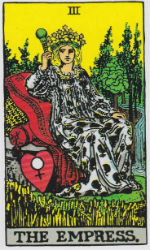
THE EMPRESS

An Earth Mother type of woman reclines on a couch holding a sceptre loosely in one hand.  Again, The Empress is not exclusively about sex but it’s definitely included in her vibrations.  Unlike her sister card, The High Priestess, who appears to be a little prim and proper, The Empress is openly sensual.  She reclines comfortably on her couch, legs slightly spread with a definite, “come hither,” look on her face. If you’re involved with The Empress, expect a good time.  On ALL levels.

THE HIEROPHANT

An individual who looks like a pope sits stiffly on a throne between two pillars while two monks bow down to him.  The Hierophant is mainly about organized religion and dogma, so it may seem strange to include it in this post. The point, though, is that The HIerophant is about CONVENTIONAL religion rather than spirituality.  In that sense, if this card shows up in a reading about a relationship you can expect it to be a very CONVENTIONAL relationship with very CONVENTIONAL sex. In other words, always the missionary position, probably with the lights turned out and only when the kids are fast asleep.  If you’re into sex toys and trapezes in your boudoir, RUN AWAY, RUN AWAY . . .

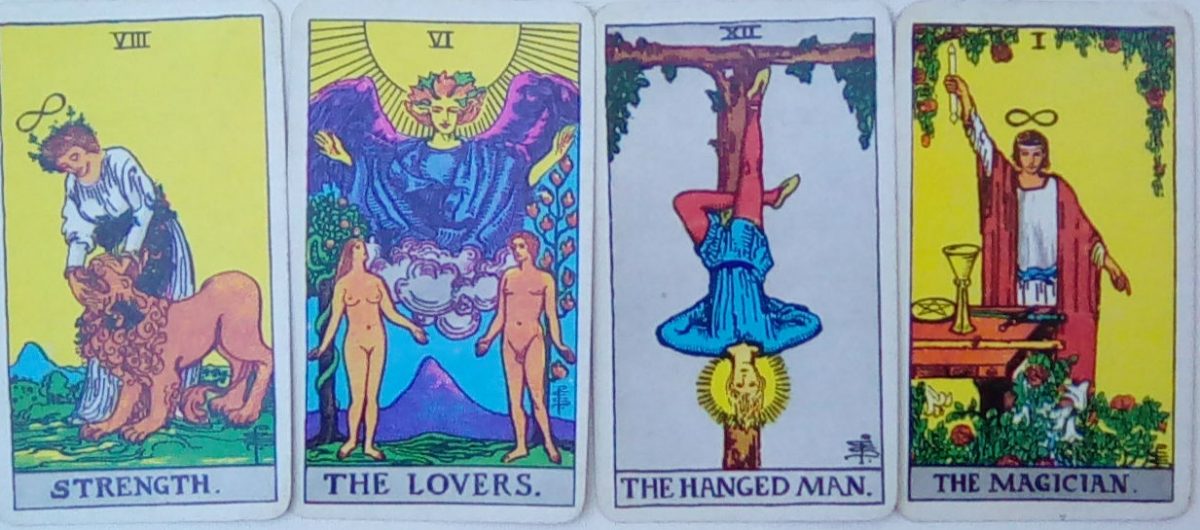
THE LOVERS

A nude man and woman stand in a Garden of Eden setting while a snake climbs a tree next to the woman and an angel hovers over them.  As the name indicates, this card is about love and not JUST love but triple whammie hit in the head with a sledge hammer love. These two people are absolutely thunder struck and there WILL be sex.  Really good sex.

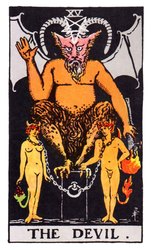
THE DEVIL

This is obviously the same couple from The Lovers, only they’ve been driven out of the Garden of Eden and are now sporting horns and tails while a demon hovers over them instead of an angel.  There is a very strong element of sexuality here but it’s not what you’d describe as happy sex. Instead of joy we find pain and enslavement. It can indicate sexual addiction, BDSM games that have gone WAY too far into pain and humiliation,  or the sexual element of a physically or emotionally abusive relationship. And, to me at least, it’s a sad card: it’s taking one of life’s greatest joys and turning into something sick and twisted.

So there you have it.  When you see these cards in a reading think about sex.  Or think about it anyway – it’s always fun.


Three of Cups

The meaning of the Three of Cups in a Tarot reading, including definitions for the upright and reversed positions.

Three women dance joyously together, chalices raised in a toast.  A pumpkin is in the foreground and ripened crops are in the background.

Upright: Fun, frivolity, celebrations.  A very sweet card indicating a period of happiness and joy.  The pumpkin and crops may indicate that a long season of hard work on a project has paid off.

“Just the Tarot,” by Dan Adair – a kindle ebook available on Amazon

Reversed:  A union or romantic relationship may be falling apart.  It could indicate relationships where there is too heavy an emphasis on sex and good times and too little emphasis on caring and romance.  Possibly indicates a sort of mindless group sex.

EXAMPLES:  The office Christmas party after all of the work has been wrapped up for the season and you’re ready to take time off and enjoy the holidays.

A housewarming gathering of friends and loved ones when the move is finally over, the moving boxes have all been unpacked, and you’re settled into your new home.