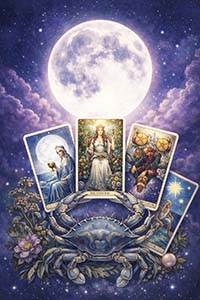
Full Moon in Cancer: Tarot-Friendly Rituals for Emotional Release, Inner Safety, and Soul-Level Nourishment

A gentle Tarot-inspired guide to the Full Moon in Cancer, offering simple practices for emotional release, self-nurturing, and reconnecting with inner safety.

This Full Moon in Cancer invites us to turn inward — away from external goals and future plans — and toward the quieter question of emotional truth. In this post, we explore how Cancer energy supports healing, belonging, and coming home to yourself.

Tomorrow’s Full Moon in Cancer is not loud or dramatic — it’s deeply feeling.

Cancer energy is intuitive, tender, protective, and emotionally wise. It’s less about doing more and more about listening more deeply.

Instead of asking, “What’s next?” this Moon asks:

“What do I need right now to feel safe, held, and whole?”

If you’ve been feeling emotionally tired, overextended, or a little disconnected from yourself, this is a beautiful Full Moon to work with. Below are simple, Tarot-friendly practices (no complicated rituals required) that align with Cancer themes: emotional release, self-nurturing, inner belonging, and gentle healing.

1. The Queen of Cups — Listening to Your Emotional Truth
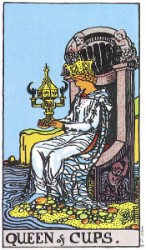
Theme: Emotional awareness, compassion, and self-empathy.

Practice:

Sit quietly with the Queen of Cups (or imagine her presence if you don’t have the card). Let yourself drop out of thinking and into feeling.

Ask gently:

  • What emotion has been trying to get my attention lately?
  • What have I been feeling, but not fully acknowledging?

Let whatever arises be okay. This is not a problem-solving moment — it’s a witnessing moment.

Intention:

“I honor my emotional truth without judgment.”

“Just the Tarot,” by Dan Adair – available on Amazon

2. The Moon — Releasing Old Emotional Patterns
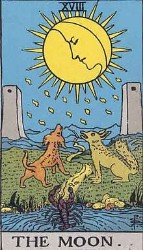
Theme: The unconscious, emotional cycles, and what’s ready to be released.

Cancer is deeply tied to memory and emotional habit. The Full Moon is a natural time for letting go.

Practice:

Write down anything you’re ready to release, especially emotional patterns such as:

  • over-caretaking,
  • emotional self-abandonment,
  • guilt,
  • or old hurts that still echo.

You might phrase them as:

“I release the belief that…”

“I release the habit of…”

“I release the emotional weight of…”

Safely tear up or discard the paper as a symbolic release.

Intention:

“I release what no longer supports my emotional well-being.”

3. The Empress — Nourishing the Inner Self
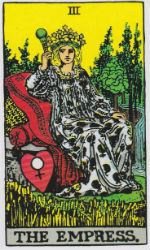
Theme: Nurturing, care, and emotional abundance.

Cancer and The Empress share a deep resonance: both are about emotional nourishment and inner safety.

Practice:

Do one small, loving thing purely for yourself:

  • take a warm bath,
  • drink tea slowly,
  • wrap up in a blanket,
  • cook something comforting,
  • sit near water, or
  • rest without guilt.

Treat this as sacred — not indulgent.

Intention:

“I am worthy of care, comfort, and gentleness.”

4. The Four of Pentacles (Reversed) — Softening Emotional Defenses
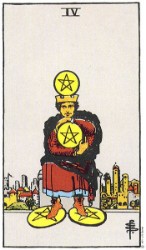
Theme: Letting go of emotional guarding and control.

Sometimes Cancer energy protects by closing. This practice invites softening rather than hardening.

Practice:

Notice where you’ve been emotionally holding tight:

  • withholding vulnerability,
  • staying guarded,
  • keeping yourself small or contained.

Ask:

What would it feel like to soften here — even just a little?

You don’t have to open to others — opening to yourself is enough.

Intention:

“I allow myself to soften into safety.”

5. The Star — Reconnecting to Emotional Hope

Theme: Gentle healing, emotional renewal, and quiet faith.

The Full Moon can stir emotions — The Star reminds us that tenderness itself is healing.

Practice:

Sit quietly and place a hand over your heart or belly. Breathe slowly.

Ask:

What would emotional peace feel like for me right now?

What does healing look like in this season of my life?

Let the answers be felt, not forced.

Intention:

“I trust in gentle healing and quiet renewal.”

Closing Reflection

The Full Moon in Cancer reminds us that strength isn’t only found in movement and achievement — it’s found in presence, feeling, and care.

This is a Moon for:

  • honoring your sensitivity,
  • listening to your emotional body,
  • releasing old emotional weight,
  • and remembering that you are allowed to need comfort.

You don’t have to fix yourself under this Moon.

You only have to be kind to yourself.

And that, in itself, is powerful magic.

A Closer Look at the Star Card – We Are Stardust

This post takes a closer look at The Star card in the Tarot, tracing its origins through medieval thought, astronomy, and spiritual symbolism. From ancient ideas of “ensouled” stars to today’s view of The Star as a card of guidance and renewal, this article explores how the meaning of The Star has shifted through time — and what it offers us now as a symbol of hope, healing, and inspiration.

Have you ever seen the movie Stardust? A star falls to earth, wicked witches chase her to steal her essence, and — improbably — Robert De Niro appears as a pirate captain who does the can-can in drag. It’s a wonderful, magical adult fairy tale.

Oddly enough, it also gives us a few clues about what The Star card in the Tarot is really about.

Origins of the Tarot

No one truly knows where the Tarot came from. Some intriguing hints suggest it may have roots in Egyptian Hermeticism, but there’s no hard evidence for that.

What we do know is that the first recorded Tarot decks appeared in the Italian royal courts around 1450. That makes it very old. And when we interpret the cards, we need to remember that the words and symbols meant something very different to people in the 1400s than they do to us now. The Star is a perfect example.

Modern Astronomy

When I was in the fifth grade, I spent nights in my parents’ backyard with a little Edmund Scientific telescope. Peering up at the moon and stars, I felt pure awe. Even then, though, I knew stars were “distant suns,” cousins of the one that kept me warm every day.

Today, with the Hubble telescope and modern astronomy, we know even more: trillions of stars scattered like glitter across the cosmos, being born and dying every day.

But in the 1400s, that understanding didn’t exist.

Ancient Skies and Ancient Eyes

Back then, knowledge of the stars was still rooted in Greek philosophy and medieval theology. To those eyes, stars were perfect, flawless jewels glowing in the heavens. Perfection, of course, meant divinity.

And to many, they weren’t just divine — they were alive. The “wandering stars” we now call planets were believed to move of their own volition. Movement meant life, and so they were seen as gods. That’s why their names — Mars, Venus, Jupiter — are still with us today.

Angelic Souls

In the 1400s, though, talk of pagan gods could get you burned at the stake. The compromise? Stars weren’t gods — they were “ensouled.” They were divine presences, not quite angels, but spiritual beings with enormous influence.

Astrology was deadly serious business. People genuinely believed their destinies were written in the stars. Contrary to Shakespeare’s later declaration, many in the Middle Ages were convinced their fate was determined above, not within.

Spirit Guides

So what does this mean for The Star card?

Most likely, it was originally meant to depict something very close to what we’d call a “spirit guide” today.

It’s not an angel — Tarot clearly marks angelic figures with wings. Instead, The Star suggests a subtler, quieter presence: a flow of spiritual influence and inspiration. The woman pours water upon the Earth and into the pool, symbolizing a constant infusion of energy, grace, and renewal into our lives.

The Star Today

Seen through modern eyes, The Star becomes both timeless and practical. It’s the card of healing, guidance, and hope. It invites us to trust that the universe has not abandoned us, that unseen currents are still at work.

When The Star appears in a reading, it’s like a deep breath after a storm. It reassures us that life always offers another chance to shine. Whether we call it divine presence, spirit guidance, or simply the return of hope, The Star is a promise that the light will return — and that we, too, are part of that light.

“Just the Tarot,” by Dan Adair – A kindle ebook available on Amazon.