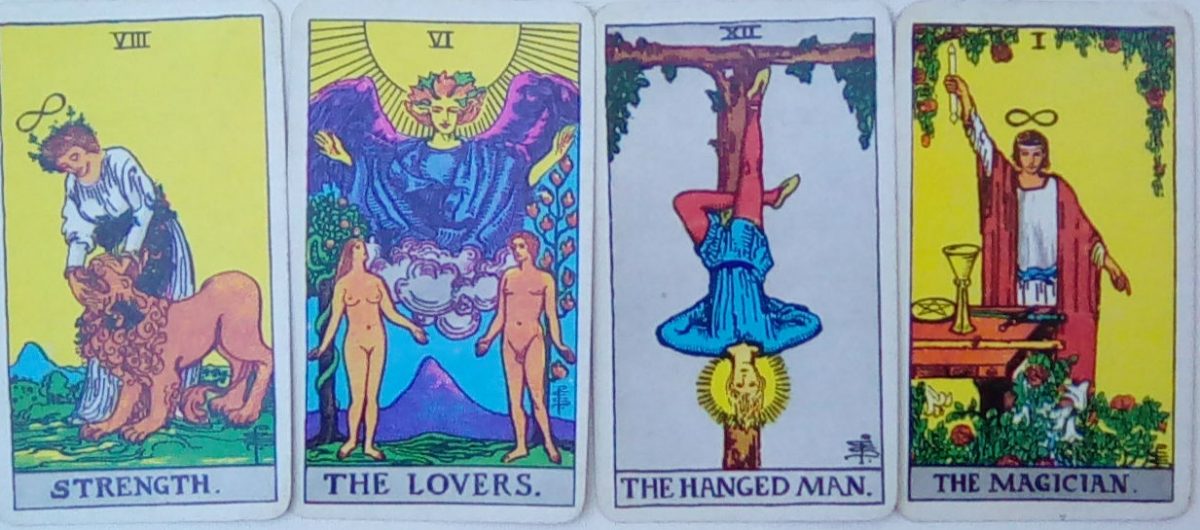
The Fool’s Journey and the Dance of Synchronicity

When The Fool appears in a tarot reading, it may be more than a call to begin—it might be a sign that synchronicity is already at play in your life. In this post, we explore how The Fool’s symbols—from the cliff to the rose—mirror the way meaningful coincidences guide us toward growth, transformation, and spiritual alignment. Learn how to recognize The Fool’s invitation to trust the unknown and follow life’s hidden rhythms.

There are moments in life when something just clicks. A random conversation, a song on the radio, a recurring symbol—these aren’t just coincidences. They feel charged, alive, timely. These are the moments that Carl Jung called synchronicities—meaningful coincidences that seem to guide us, gently but unmistakably, toward the next step in our journey.

And there’s no better symbol for that mysterious push into the unknown than The Fool in the Tarot.

Jung and Synchronicity

Swiss psychologist Carl Jung coined the term synchronicity to describe those uncanny moments when something in the outer world perfectly mirrors something happening inside you—without any logical cause. Like when you think of an old friend you haven’t heard from in years, and just then, the phone rings and it’s her. There’s no rational explanation, but it feels too precise to be chance. Jung believed these moments point to a deeper, hidden order—a mysterious connection between our inner lives and the unfolding world around us.

The Fool as the Signpost of Synchronicity

In the Tarot, The Fool is often misunderstood as naïve or aimless, but in truth, The Fool is the sacred wanderer—the soul on the brink of transformation. When this card appears in a reading, it may be more than a call to take a leap of faith; it may be a signal that synchronicity is actively at work in your life. Like a cosmic green light, The Fool shows up when invisible forces are aligning to open new doors, push you out of old patterns, or introduce the exact people, signs, and nudges you need to move forward. It is the Tarot’s way of saying: “Pay attention. Something meaningful is unfolding, even if you don’t yet understand it.”

The Sacred Zero: Becoming an Empty Vessel

The Fool is the only card in the Major Arcana marked with the number zero—a symbol of pure potential, of being open, unformed, unburdened. In many ways, zero represents the exact state in which synchronicity becomes most alive. When we release the ego’s need to plan, predict, and make sense of everything, we create space for the unexpected to enter. The logical, linear mind wants control; it wants cause and effect. But synchronicity belongs to the language of the soul, not the intellect. It speaks in symbols, dreams, chance encounters—and The Fool, with heart wide open and eyes on the horizon, is its perfect interpreter.

The Dog as the Spirit of Play

One often-overlooked symbol in The Fool card is the small white dog trotting at his side. While some say the dog warns The Fool of the cliff’s edge, it may also represent the playful, instinctive energy that keeps us open to life’s hidden magic. Synchronicity rarely happens when we’re tense, overthinking, or trying to force outcomes. It arises when we’re relaxed, present, and in tune with the moment—much like a happy dog on a walk, open to whatever comes. The dog reminds us that joy, spontaneity, and a sense of wonder are not distractions from the spiritual path—they are the path.

The Cliff: The Edge of the Known

The Fool stands at the edge of a cliff, one foot about to step into the great unknown. It looks dangerous—foolish, even. But from the perspective of synchronicity, the cliff represents the threshold between what we can predict and what we can’t. It’s the edge of logic, the border of the familiar. To experience synchronicity is to step beyond the rational mind and into a world that operates by deeper laws—hidden patterns, Soul timing, and symbolic meaning. When we reach the edge of what we know, we’re invited to trust what we feel. The Fool doesn’t fall; he flies—because synchronicity has a way of catching those who take a leap with an open heart.

The Satchel: What the Soul Already Knows

Slung over The Fool’s shoulder is a small satchel—light, almost weightless, but significant. It contains the inner tools The Fool brings into the unknown: intuition, past experiences, hidden wisdom. In moments of synchronicity, we often feel a sense of recognition—as though some part of us already knows what’s happening, even if we can’t explain it. That’s the satchel at work. It’s the symbolic storage of our soul’s memory, the part of us that is quietly guiding the journey even when our conscious mind is unsure. The synchronicities we encounter may feel random, but they often resonate with something we’ve carried with us all along.

The White Rose: Presence, Purity, and Attunement

In the Rider-Waite depiction of The Fool, he holds a single white rose. In a world obsessed with control and destination, this simple act—pausing to experience beauty fully—is radical. The white rose symbolizes innocence, spiritual purity, and being fully present. And that’s exactly the state in which synchronicity most often occurs. When we are truly attuned to the now—our senses open, our heart soft, our mind quiet—we become receptive to life’s subtle signals. The Fool’s rose is not a distraction; it’s a compass. It reminds us that paying attention to beauty, wonder, and fleeting moments may be how the universe whispers its guidance to us.

Following the Fool’s Footsteps

The Fool is not just the beginning of the tarot’s journey—it’s an invitation to live with openness, curiosity, and trust in life’s mysterious choreography. When The Fool appears in a reading, it may be a signal that synchronicity is stirring, that the universe is aligning unseen threads on your behalf. It asks you to stay present, to pay attention, to sniff the rose, listen to the nudge, follow the sign. It reminds you that the unknown is not empty—it is alive. So next time you draw The Fool, don’t just think of risk or adventure. Think of magic. Think of timing. Think of how the world may be conspiring, right now, to lead you exactly where you need to go.
Eating Pancakes with Jesus, Having Lunch with Lucifer and Looking Inward with the Three of Pentacles

A contrast in Christian and Buddhist views of human nature and spirituality.

Are we on the outside looking in or on the inside looking out?

Do we think that heaven or redemption or satori or enlightenment or whatever we want to call it, is, “out there somewhere,” or do we think it’s inside of us, waiting to be uncovered?

Which direction are we gazing? Inside or out? It’s a fundamental, crucial question in terms of how we approach life and our personal spirituality.

In Western Christianity, there’s no question that the focus is very much outward.  Heaven, redemption, blessings are seen as things that exist but they’re not an innate part of us. Christian theology goes something like this:  

“God made you in his self-image but something kind of went wrong.  God is perfect, but you aren’t.  In fact, you’re really, really flawed.  In fact, let’s be honest here, you’re a real piece of  shit.   You like to fornicate and steal and lie to people and, um, eat bacon and shrimp.  You’re pretty much hopeless, unless you change your ways.  If you change your ways, you can eat pancakes with Jesus in heaven, and they use REAL maple syrup, not that Mrs. Butterworth’s crap.  On the other hand, if you DON’T change your ways, well, God is going to have to toss you into a flaming pit where you’ll burn in agony forever.  Because he loves you.”

Now, the salient point in all of that is that THERE IS NO GOOD INSIDE OF US.  Whatever blessings or grace may exist, they exist, “out there,” in God, and it’s only by overcoming our basic, sinful nature that we can have any hope of finding happiness and salvation.

It’s only by becoming, “not us,” that we can get God’s approval and get into that pancake breakfast with Jesus.  That sets us up for a lot of spiritual and psychological tension because, basically, everything we really like to do as human beings is a sin and sends us toward having snacks with Satan, instead of breakfast with Jesus.  Everything from sex, enjoying our possessions, loving a good meal, having a nice lazy day, eating shell fish or pork, even masturbating are ALL deadly sins.

What causes us to commit all of our sins?  Why, our bodies, of course!  It isn’t really ME that wants to get into bed with Mary Jo and fuck like bunnies, it’s my body.  It isn’t really me that wants a BLT, it’s my body.  More specifically, it’s my DAMNED body.  If it weren’t for my body, I could be, like, I dunno . . .  Mother Teresa . . . or maybe Mahatma Gandhi, except he wasn’t a Christian so he went straight to hell, of course. 

The end result of that is that we end up hating even our own bodies because the body is the source of all of those terrible impulses that cause us to sin.  That’s why Medieval christians developed wonderful traditions like whipping themselves and self-crucifixion.  The terrible, sinful body had to be literally beaten into submission so that it wouldn’t make them sin, or they’d end up having lunch with Lucifer or brunch with Beelzebub (also known as, “Beelzebubba,” if you live in Texas.)

It’s interesting and even a little startling to our Western minds, to compare that Christian model of spirituality with the Buddhist model.  Tibetan Buddhists speak of basic human nature in terms of a precious jewel or crystal that is covered with plain rock. Our job, our spiritual quest, is to uncover that beautiful jewel by chipping away at the rock, one little piece at a time.  By meditating, practicing mindfulness, and building loving/kindness into our lives, we gradually reveal more and more of the jewel, our true nature.  As Chagdud Tulku Rinpoche’ put it:

“Enlightenment is not anything new or something we create or bring into existence. It is simply discovering within us what is already there. It is the full realization of our intrinsic nature. 

In sharp contrast to Christian theology, we aren’t terribly flawed,”sinful,” beings.  Instead, we are beings that are incredibly beautiful, holy, and wonder-filled.  We just haven’t uncovered that part of our nature, that precious jewel, yet.

Our redemption isn’t, “out there,” it’s not something we’re going to find in heaven or a book.  It’s very much, “in here.”  It’s something that we find by looking inward, toward our true nature, by meditating, consciousness, and increasing the love in our hearts.

This isn’t to say that Buddhists don’t have their Greatest Hits list of, “sins.”  They condemn anger, judging others, envy, greed, etc.  But, they don’t condemn them in terms of their being a part of our basic nature.  Rather, they’re considered sort of side trips that lead us away from our basic goal of enlightenment.  They’re distractions, rather than definitions of who we really are.

There’s actually a major Buddhist doctrine called, “Precious Human Birth,” which not only says that we’re NOT terrible, sinful creatures, it says that if we were born human, we hit the fucking jackpot.  Only human beings are able to consciously contemplate life, make ethical decisions, and improve our spiritual state of being.  When we consider all of the trillions of other beings on our planet who were incarnated as insects and animals, being humans puts us in a very, very, VERY small minority.  We lucked out.

It’s a major shift in thinking for most of us who were raised in the West.  Our bodies aren’t sources of primal, evil urges; they are precious vessels that contain an ineffable beauty just waiting to be brought to the light.  They are a gift beyond comprehension.  Heaven and salvation aren’t up in the sky or hiding in a holy book – they’re in our hearts.

And if heaven is in our hearts, we are sacred.  Umm . . . really? Hmmm . . .  Are you sure?

The Three of Pentacles is a pretty good illustration of the two choices we can make.  The stone mason stands on a stool, mallet in hand, ready to carve.  Beside him there is a monk and a fool holding a plan.  The monk represents a religious creed, a looking outward to others for answers to our spiritual quest.  The fool represents our basic human nature, that surge of playful, happy spiritual energy that occurs when we gaze within and joyfully embrace what already exists in our hearts and souls.

We just have to understand that everything that we want to be, we already are.