Synchronicity and The Tower Card: When Crisis Awakens the Miraculous

What if the worst moments of your life are also doorways to spiritual transformation? This post explores how synchronicity often emerges during personal crisis—revealing unseen help, guidance, and even grace. Through the lens of The Tower tarot card and Jungian psychology, discover how collapse can lead to awakening.

The Lightning Struck Tower

 The Bright Side of Synchronicity

New Age thought frequently recognizes synchronicity as something akin to the flow state—a kind of spiritual alignment where life feels effortless. Everything clicks. We meet the right people at the right time, stumble onto unexpected opportunities, and experience a wave of meaningful coincidences that seem to confirm we’re on the right path. It’s a feeling of being “in the zone,” as though the universe is subtly rearranging itself to support our intentions.

In these moments, synchronicity feels like a gift. A sign that we’re in harmony with some larger intelligence or natural rhythm. And it’s tempting to think that this is what synchronicity is supposed to feel like: smooth, supportive, and sweet.

But that’s only one face of it.

Synchronicity can also appear during the darkest, most desperate moments of our lives—when nothing is flowing, when everything has broken down, and when we feel completely alone.

And yet… it shows up.

Synchronicity in the Darkness

 I learned that synchronicity doesn’t only come when life is smooth. In fact, it can erupt—like lightning from a clear sky—when everything is falling apart.

A few years ago, after the loss of my life partner, I found myself in deep emotional and financial trouble. Her children challenged the probate and stripped the bank accounts. I was in devastating grief, virtually penniless, and desperately needed to sell the house we had shared.

And then the pandemic hit. Real estate offices closed indefinitely, and we were all quarantined for months.

I was suicidally depressed and felt completely hopeless. But in the midst of all that destruction, small miracles kept happening. I was able to see a wonderful therapist who helped keep me alive in the darkness. When I was down to my last bag of rice and a single can of beans, an uncashed check would float up from the back of a drawer. A few pieces of my art sold. I was even able to write a book.

Every time I reached what felt like rock bottom, something—or someone—would throw me a lifeline.

It felt very much like what Sonia Choquette describes in her book, “Ask Your Guides”: a kind of a guardian angel effect. As though some invisible presence was stepping in to help. For the first time in my life, I genuinely felt I was receiving spiritual help.

The Tower: Crisis as Awakening

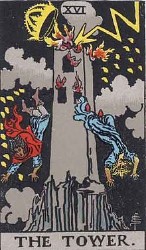
In the Tarot, The Tower is one of the most feared cards in the deck. It shows a tall, rigid structure being blasted by lightning, flames pouring from its windows, and people falling through the air. It’s a card of shock, collapse, and sudden upheaval—those moments when the structures we’ve built our lives around come crashing down.

But The Tower is not a punishment. It’s a wake-up call.

The old structures fall because they’re no longer sustainable. Illusions, attachments, or false beliefs are struck down by truth—sometimes painfully, sometimes without warning. It can feel like a violent loss of control. But it also clears the way for something real, something truer to emerge.

In many ways, The Tower mirrors what I lived through. My life, as I knew it, collapsed. And yet, that collapse seemed to activate something—a kind of spiritual circuit that had never been switched on before. There was no comfort, no predictability, but there was also an undeniable sense of presence, a guiding intelligence operating just beyond the chaos.

That’s the secret of The Tower: what looks like destruction is often the beginning of liberation.

Jung, Crisis, and the Language of Synchronicity

Carl Jung, who first coined the term synchronicity, believed that these meaningful coincidences were not random at all—but messages from the deeper layers of the psyche, or even the soul. He observed that synchronistic events often intensified during times of emotional upheaval or transformation. In fact, crisis seemed to invite them.

As psychologist Richard Tarnas writes:

“Jung observed that in the therapeutic process of his patients, synchronistic events repeatedly played a role, sometimes a powerful one, especially during periods of crisis and transformation.”

It’s as if the breaking open of the known world allows something greater to break in. When our ego defenses collapse—when we’re too exhausted to pretend we’re in control—an opening appears. And through that opening, insight, grace, and symbolic guidance can flow.

These aren’t just random lucky breaks. They’re messages from the unconscious. From spirit. From the soul.

And often, they arrive only after something old has been destroyed—just like the crumbling tower.

When the Tower Appears in Your Life

If you’re going through a Tower moment right now—where everything seems to be falling apart, where the future is unclear and the ground beneath you feels unstable—I want to offer this thought:

You may be closer to grace than you think.

It’s not easy to see when you’re in the middle of it, but the collapse may be clearing space for something new, something more aligned with who you really are. Synchronicity often doesn’t show up instead of hardship—it shows up through it, like gold veins running through broken stone.

So pay attention.

That unexpected phone call. A book that practically falls into your lap. A dream that won’t leave you alone. A stranger’s words that strike you like lightning. These are more than coincidences—they’re the whispers of the sacred trying to help you rebuild, not what you had before, but what you actually need.

The Tower may shake you. But it also strips away what no longer serves. And in its wake, you may discover a deeper kind of support—one that’s always been there, just waiting for the old walls to fall.
Veiled Wisdom: How to Live Intuitively in a Linear World — Lessons from the High Priestess

Learn how to live intuitively in a fast-paced, logic-driven world through the symbolism of the High Priestess Tarot card. Discover practical tools, ancient wisdom, and insights for intuitives and spiritual seekers.

In a world obsessed with logic, speed, and quantifiable results, living intuitively can feel like trying to speak a forgotten language. For those who rely on inner knowing, symbolism, and emotional depth to navigate life this can be truly disorienting. You may feel unseen, misunderstood, or even accused of being irrational.

Fortunately, there is an archetype that understands you perfectly: The High Priestess of the Tarot. She doesn’t live by surface appearances or external systems. She lives behind the veil, where symbols, patterns, and quiet truths guide her every move. If you’ve ever felt like your way of knowing doesn’t fit the world you live in, the High Priestess is your ally.

This post explores how her symbolism offers powerful guidance for anyone trying to live more intuitively in a linear, left-brain world.

The Veil: Honor the Unseen

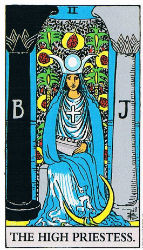
Behind the High Priestess is a veil covered in pomegranates—a symbol of mystery, fertility, and hidden truth. The veil marks the threshold between the seen and the unseen, the conscious and the unconscious.

In daily life, this reminds us to respect what can’t be measured: feelings, dreams, body language, synchronicities. Not everything real can be proven. Living intuitively means acknowledging the unseen world as just as valid as the visible one.  In fact, if you’re an intuitive, your inner world may frequently seem more important than your outer world.

The Moon: Trust Emotional Cycles

The crescent moon at the Priestess’s feet is a classic symbol of intuition, emotion, and cycles. In contrast to the linear, upward march of modern life, the moon reminds us that all things move in rhythms—inner and outer.

This is actually one of the oldest principles of occultism and is discussed extensively in The Kybalion.  Everything on the Earth Plane – everything – moves in cycles.  The tides go in and out.  The Moon waxes and wanes.  Spring gives way to winter.  Even great nations spring up and then fade away.

To live intuitively is to trust your emotional tides. Some days are for action; others for withdrawal, reflection, or stillness. Honoring this inner rhythm—even when it defies external expectations—is a revolutionary act.

The Scroll: Keep Inner Wisdom Sacred

The scroll in the Priestess’s lap is partially hidden and marked “TORA,” suggesting sacred knowledge that isn’t meant for everyone—or even always fully for yourself. This teaches a key lesson of intuitive living: you don’t have to explain yourself.

In a linear world, people often want justification, proof, or evidence. But intuition doesn’t always offer that. Like the scroll, your inner knowing may be incomplete, symbolic, or private. Protect it. Don’t feel pressured to decode everything aloud.

Intuition is frequently about knowing that you know something without knowing how you know it.  You don’t have to defend that to anyone who wants to pick it apart with linear logic.  Sonia Choquette offers a wonderful tip for dealing with it when someone is attacking your intuition:  just smile at them and say, “It works for me.”

The Pillars: Balance Inner and Outer Worlds

The High Priestess sits between two pillars marked B and J (Boaz and Jachin), drawn from the ancient Temple of Solomon. They symbolize polarity—light and dark, masculine and feminine, logic and intuition.

To live intuitively in a linear world, you must balance both forces. Intuition doesn’t reject logic; it expands it. Learn to speak the world’s language when needed, but stay rooted in your own. The magic is in integration.

The Solar Cross: Stay Centered

On the High Priestess’s chest is a solar cross—an ancient symbol of wholeness, representing the four directions, seasons, and elements. Unlike the Christian cross, this symbol is universal. It tells us to stay centered within the circle of life, grounded in your own compass.

Living intuitively means checking inward before reacting outward. It means making decisions from alignment, not anxiety. The solar cross reminds you: you carry your center within you.

It’s also worth noting that the cross is centered over her heart chakra, the energetic mid-point between the lower chakras and the upper.  Intuition pulls in insights from the universe but grounds them in daily life.

Practical Ways to Live Intuitively

Create space for silence and solitude: That’s where intuitive messages come through.  Remember to be patient with that, too.  Intuition speaks in symbols, not type-written messages.  When we sit down to meditate we probably won’t get a telegram from the Universe telling us what to do.  But . . . a particular book that we need to read may fall off of a shelf or a friend may casually say the perfect word to trigger insights.

Journal or use symbols: Tarot, dreamwork, or creative writing can help you listen inward.  The Major Arcana of the Tarot in particular is crammed with archetypal symbols.  Every one of those speaks to Deep Mind and starts a dialog with intuition.

Let go of constant justification: Trust what you know, even if you can’t explain it.  If other people don’t understand what you plainly see, then fuck them.  You’re not the extrovert-whisperer and you don’t need to explain your inner vision to someone who’s blind.

Honor emotional and energetic cycles: Don’t force productivity; honor your timing.  Despite the many New Age gadgets and programs that we may encounter now days, there is NO way to force intuition.  In fact, quite the opposite:  the more relaxed we are, the more likely we are to have a free flow of intuitive insights.  The more we force it, the more it flits away.

Balance logic with knowing: Use your left brain to support your right-brain insights—not to silence them.  Think of left-brain logic as a sort of an editor that connects the dots for you.  The first thing that comes is the intuitive flash:  “Hmmm . . .  I think this is how it actually is, even though it looks differently.”  Then we can use logic to figure out where the insight came from or to explain it to others, but we should never, ever, let logic tell us that our intuition is wrong, simply because we can’t justify it.

It’s Not Impractical – It’s Sacred

The High Priestess doesn’t offer quick answers. She teaches us to dwell in questions, to honor mystery, and to trust the quiet voice within. In a culture addicted to speed and clarity, living intuitively is a radical form of wisdom.

If you feel like you see through the veil or live just outside the edges of ordinary awareness, you’re not lost. You’re listening. And you’re not alone.

Let the High Priestess be your reminder: intuitive living isn’t impractical—it’s sacred.

My new ebook, “The Alchemy of the Mind: Transforming Your Life With the 7 Principles of The Kybalion,” is now available on Amazon.

Faeries and Angels and the Something Out There That Wants to Have a Chat

A closer look at synchronicity and the concept of a responsive universe.

There’s Something Out There.

 . . . And it’s watching you.

Cue in creepy horror story music.

LOL!  Not really.  More like cue in joyous, happy music.  But there IS Something Out There.  Something mysterious that we can occasionally feel but can’t quite focus on.  It flits by at the corner of our eyes but when we turn to look at it, it’s gone.

Here’s a fun experiment that anyone can try.  Think of a problem that you’ve got or a question that you need an answer to.  Really concentrate on it and then send it out into the universe and ask for an answer.

Then over the next week, watch for the answer.  You don’t have to get all serious about it (in fact, that may be the worst thing to do) but just remind yourself to look for the answer every time that you go out the door.  And it will appear.  It will probably be in symbolic form rather than a post-it note dropping out of the sky, but it will be there.  Perhaps a book will fall out of a shelf opened to a page that has the answer.  Maybe it will be a highway sign flashing a message on your way to work.  Maybe it will be a particular song that comes on the radio every time that you turn it on.  Perhaps a total stranger will walk up to you and say something that fits perfectly.  However it appears, if you ask the question and then diligently look for the answer, the answer will appear.

And that’s strange and wonderful and magical and marvelous and has some really interesting implications.

Now, our current term for that is, “synchronicity,” which was coined by Carl Jung.  Jung was one of the few honest scientists of his time and he noticed that weird shit happens and he actually wrote about it.  He noted weird things that  we’ve all experienced, like thinking of someone we haven’t seen in years when the telephone suddenly rings and it’s that very person calling.  One of his own examples was that he was treating a patient who was describing a dream she’d had about a scarab beetle when – shazam – a scarab beetle appeared on the outside of the window.

He looked at those occurrences, analyzed them thoroughly, and then concluded, “That’s weird. Really, really . . . weird.”

Unfortunately, when Jung talked to his fellow scientists about it and asked, “Have you noticed that weird shit happens?” they all said, “No.  We try very hard to not notice that.”  In other words, if they couldn’t explain it, they preferred to ignore it.

Jung’s very careful definition of synchronicity was, “a meaningful convergence of inner and outer events.”  Which is just another way of saying, “When you ask the universe a question, Something Out There answers you.”

There’s Something Out There.

A large part of the history of the human race has been trying to figure out just exactly WHAT or who the Something Out There is.  There have been a lot of interesting answers, too.  Human cultures have had hundreds and hundreds of gods and goddesses whom we have posited as, “the Something Out There,” that answers our questions and solves our problems.

We’ve gotten a bit lazy and unimaginative in modern times and we only seem to be able to come up with one god, but for most of our evolution we actually had specialized gods who answered specific questions.  If we were having problems with a lack of abundance in our lives, we might ask Lakshmi to give us answers for those questions.  Or if we were suffering through a drought, we might appeal to Oshun for rain.  Or if we were faced with insurmountable obstacles, we could turn to Ganesh and ask him to remove them.

All of the gods and goddesses are a recognition of the fact that there’s Something Out There that seems to listen to us and provide the answers that we need.  Some of the more spiritually, “evolved,” religions like Taoism posit that there’s a Something Out There but it’s not too terribly interested in our personal problems.  Rather, the Something Out There is a sort of an impersonal current that runs through the universe and we solve our problems by becoming more aligned with its energy.  The more we’re in harmony with that energy, the more likely we are to be happy and not have any problems that need answers.  We just have to get in the flow, but the flow doesn’t particularly care if we do that or not.

That’s never really been terribly satisfactory to the human spirit, though.  We seem to need to feel a personal connection, to know that the Something Out There actually sees us, hears us, and cares about us.  Despite the fact that Taoism as a philosophy may posit an impersonal universe, Taoism as a religion has plenty of gods and goddesses to talk with, not to mention swarms of ancestors we can consult on a daily basis.  Buddhism as a philosophy may be perfectly acceptable to atheists, but most Buddhists pray to Tara and have altars in their homes.

I love the approach that Brian Froud and Jessica MacBeth took in the Faeries’ Oracle Cards.  Not only is there a Something Out There, there are a LOT of somethings out there, in the form of Faeries, Gnomes, and Elementals who are perfectly willing to give us a wink and tell us when we’re going down the wrong paths.

In a very similar way, I have several friends who see and talk with angels and spirit guides on a regular basis.  To them, those are the Something Out There that answers when they ask a question.  Sonia Choquette has actually mapped out dozens of different types of angels and guides and elementals, each with different functions and different answers.

For as long as humans have existed, we’ve known that there was a Something Out There that is conscious, caring, and interacts with us to make our lives better.  And for just as long, we’ve been trying to fill in the blank about exactly who or what that Something Out There is.  

We don’t really need to do that, though.  We don’t have to be Spiritual Masters or be able to see the angels sitting on our couches.  If we have faeries living in our gardens and they want to appear to us and tell us their names, that’s great, but it’s not necessary.  We can just start with the knowledge that there’s Something Out There, which is magical enough for most of us, and go from there.

“Hey, Something Out There, I really like the person I’ve been dating and I’m wondering if we should move in together?”

“Hi, Something Out There, I’ve been offered a better job, but it means moving away from my family and I’m just not sure if I want to do that.  What do you think?”

“You know, Something Out There, I was wondering if I could really make a living as an artist, or am I just bullshitting myself?”

And the Something Out There will give us the answer and the answer will be right.

All we have to do is . . . Believe . . . Ask . . . and Listen.

Easy peasy.

Remember that my e-book, Just the Tarot, is available on Amazon and is less expensive than a bag of Doritos. If you buy one of those little jars of spinach dip to go along with the Doritos, my book is actually THREE TIMES LESS EXPENSIVE!!! Jesus, what a bargain!

The Lovers, The Devil, and Being Thrown Out of the Garden

Karmic relationships and how to leave them.

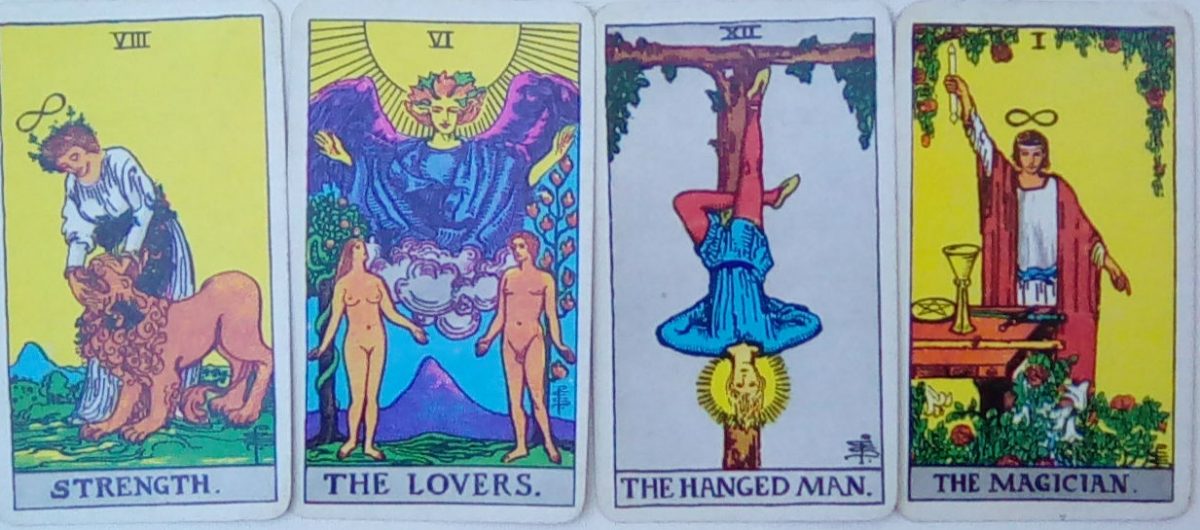
The Lovers Tarot card is a sort of a snapshot of a story we’re all familiar with:  Adam and Eve in the Garden of Eden.  The image is all the more poignant because we know the end of the story.  This picture was taken when the beautiful angel was hovering over them as a guardian and protector.  The very same angel would later cast them out of the garden because – horror of horrors – Eve munched on an apple and that pissed off their psychotic, bipolar god.

In many ways, this is a perfect metaphor for the process of, “falling in love.”  And falling out of love.

When we first meet that perfect someone and fall in love, our brains and bodies are absolutely saturated with pleasure hormones like oxytocin.  We become enchanted with the mere presence of our love object and the entire world seems to glow with a peculiar brightness and joy.  Basically, we’re high as a kite and we feel like we’re living in a beautiful garden.

That oxytocin high lasts about two years (coincidentally, about the same  time it takes to conceive a baby, gestate it, and get it on its feet) and then it just disappears.  Suddenly our brains go back to normal.  This is the, “reassessment period,” in a relationship where we take a good, hard look at our partners and decide if we really want to stay with them.  If, all in all, we feel satisfied and happy with them, we stay in the relationship.  If, after we come down from our oxytocin high, we discover that we’re living with a frog  rather than a prince, we leave.

In other words, we fall out of love.  We’ve been cast out of the enchanted garden.

I’ve been thinking about that process because of a subset of relationships that the amazing Sonia Choquette refers to as, “karmic relationships.”  In her videos, she explains that these are relationships that involve a sort of a, “Soul agreement,” with the other person.  The agreement is that we and the other partner are going to teach each other some serious lessons that will help us grow into our spiritual evolution.

And, “serious,” is the salient word there.  These tend to be very, very heavy relationships.

There’s an element of compulsion in them, for one thing.  We meet someone and suddenly feel a deep compulsion to be with them.  It may not even be someone we particularly like.  They may have values that are completely at odds with our own, or perhaps they’re physically or emotionally someone who is just not our type, not someone we would normally EVER be attracted to.

Yet, we are.  It’s a feeling like two magnets suddenly coming into alignment and pulling us toward each other with an irresistible force.

They also tend to be . . . uncomfortable . . . relationships.  In a romantic karmic relationship, we may feel a HUGE sexual attraction toward someone, but really, really NOT enjoy living with them.  Or we may feel a strong emotional attraction to them but have a terrible, terrible sex life.

In one way or another, it feels like a bad fit for us, because it is.  We’re not there to have a perfect relationship, we’re there to learn some heavy, hard lessons from being in each other’s lives.

That’s where it gets interesting because the timeline on a karmic relationship, the duration of it, is determined by when we learn those lessons and are ready to move on.  It may happen in six months or it may take decades.  In Sonia Choquette’s case, it took 31 years of marriage for her to get the lessons she needed to learn from her ex husband.

Which brings us to one of the most fascinating features of karmic relationships: leaving them.

When a karmic relationship is over, when we’ve finally learned the lessons we were supposed to learn, it becomes massively uncomfortable to stay in those relationships.  As Sonia said, the price we pay for overstaying in them is absolute emotional misery.  We really experience it as if we’re being spiritually expelled from them, as if we’re being thrown out of what we mistakenly thought was a garden but was actually full of weeds.  The same forces that compelled us to enter into the relationship are now compelling us to leave.  Lesson learned, relationship over.

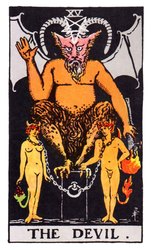
If we ignore those compelling forces, if we insist on staying in the relationship even after the lessons from it have been learned, then we devolve into the couple from The Devil card.  This is the same couple of people from the The Lovers card, but now they’re living in misery and pain.  They’re chained to their karma, refusing to move on from the relationship and grow spiritually.

And, of course, if we examine The Devil card closely, we can see that the chains are very loose.  They could easily lift them over their heads and be free if they CHOSE freedom.  Instead, they cling to their misery.

Both Sonia Choquette and Louise Hay point to a very simple truth which our culture likes to deny:  relationships end.  And they end frequently.  When they d end, we can either choose to be miserable, choose to stay ensnared in the karma, or we can stop to absorb the lessons that we learned from the relationships.  We can either be bitter or we can bow gracefully toward our former partners and thank them for the lessons they helped us to learn.

And if we mutter under our breaths, “Thank you, you son of a bitch,” that’s alright, too.  We’re just humans and this is just a school.  We don’t have to get an A on our report cards every single time.

The Fool, The Magician, and Laughing With the Angels.

Playfulness as a major force in the universe.

I was watching a Sonia Choquette video recently that was about getting in touch with our spirit guides and angels.  She made the point that the first step in that is to get in touch with our own spirits, because spirit talks to spirit.  And she also said that sometimes our spirits are NOT hanging out in our bodies.  The basic idea is that, if we are constantly depressed, angry, and fearful, then our spirits don’t really WANT to be in our bodies because our bodies are so toxic.  Who wants to hang out in a room full of anger and sadness?  Who wants to hang out in a body full of anger and sadness?

Huh . . .

The cure for that is – surprise – to be happy.  Laugh, play, be light.  Make our bodies and minds into places where our spirits want to be.

It started me thinking about two Tarot cards, The Fool and The Magician.  Not the cards from the Waite Tarot deck, which was designed in the early 20th century, but the original, older portrayals from the 14th and 15th centuries.   The portrayals in the Waite deck are stunningly beautiful, but, in some ways, are not at all consistent with the original meanings of the cards.

Here, for instance, we have the Waite version of The Fool.  He/she is a beautiful, elegant, sexually indeterminate youth who is dancing along the edge of a chasm while a little dog dances beside him.  The basic meaning of the card is someone who is so high on cosmic energy, so in tune with universal energies that if he dances off of the cliff, he’ll just keep on dancing on thin air.

Now compare that to The Fool from the old Marseille Tarot deck.  This Fool is kind of a scruffy looking dude wearing the actual clothing of a Fool from the medieval royal courts.  The dog has torn a hole in his britches and he’s not even watching where he’s going.  He’s wearing a funny hat and he has jingle bells hanging off his cloak.

Not exactly elegant, is he?

But he does remind us of the original Fool who would entertain the royal courts.  He had a very, very special status in those courts because he was the only one who was actually allowed to laugh at and make fun of the King.  He was considered sort of a mad idiot, someone who had either been cursed or blessed by the gods with a somewhat insane, totally irreverent sense of humor.  His purpose was to mock the pompous and remind the all-too-serious that life can be seen as a joke.

The same point of view was taken of what we remember in our language as, “the village idiot.”  We might think of him as someone who was perhaps mentally deficient or brain damaged.  To the villagers, however, he was seen as someone who had been touched by the finger of god, someone who was viewed as a blessing to the village and so should be fed and cared for, for free.  He was a treasure in large part because he made people laugh and get in touch with their love.

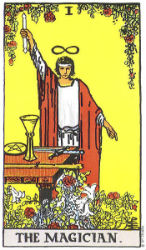
Again, look at The Magician from the Waite deck.  Once more, we see a thoroughly elegant, physically beautiful individual who is very much in charge of his magic.  This is a master of the occult, a Wise Being who channels magic from the astral realm into the physical plane.  

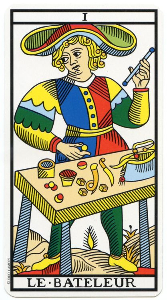
Contrast that with The Magician from the older decks.  This Magician looks a little clumsy.  He, too, is dressed in Fools clothing and isn’t paying attention to what he’s doing.  Displayed on the table before him is a cup and dice and coins, and other random items.  Far from being the magical symbols that we see in the Waite Magician card, these look like things he might have dug out of his pockets and we almost wonder if there might be a few balls of lint scattered in there.

The older Magician was not a master occultist.  The older magician was a street entertainer, much like the stage magicians that we see today.  He might not be sawing women in half or disappearing into a magical box, but he could still put on a hell of a show.  He could make the dice do what he wanted them to do and he probably wasn’t above taking a few pennies from people who couldn’t guess which cup the pea was under.

He was a flim-flam man.  An illusionist.  Someone who knew how to shuffle a deck of cards and astonish us by picking out the Ace of Spades every single time.

He was fun.

That’s what’s missing in the newer, Waite deck portrayals of these two cards.  The sense of fun.  The sense of goofiness.  The sense that life really isn’t supposed to be taken all that seriously and a lot of it is just plain silly. 

Here’s a radical proposition:  what if angels like to play?  What if angels actually have a rip roaring, hilarious sense of humor?  What if that’s the vibration that they actually exist on:  laughter and play?  So then think of the Western approach to prayer.  You know how we get all serious and somber and . . . church like . . . when we pray?  Prayer, after all, is a VERY SERIOUS business.  We all know that, because we’ve been in churches and people weren’t doing a hell of a lot of laughing.

But suppose . . . just suppose . . . that everytime we get all serious and somber, we automatically tune out our angels and guides?  Just like changing to a channel that they’re not broadcasting on.  They’re still there.  They’re still wanting to help us.  But we just tuned them out by completely losing our sense of humor.

It could be that laughter and play are underlying forces in the universe and when we’re playing, we’re in harmony with our true nature and our Higher Selves.  Think of little kids and puppies and kittens.  These are beings who have JUST transported in from the other side and what do they do all day?  They play.  They play and play and play until they fall over exhausted and then, when they wake up, they play some more.

Wouldn’t it be ironic if, by being SO serious about our spirituality, we were turning our backs on our spirituality?  Maybe we need to set up some playgrounds in our churches.  Maybe we need to find some pastors and priests and rabbis and mullahs who can tell a good joke.

Maybe we need to lighten the fuck up.

Laughter lights us up inside, sometimes like a warm, glowing candle and sometimes like fireworks, but it always brings light and lightness.  Laugh and get en-lightened.  Works for me.

Just the Tarot by Dan Adair, a kindle ebook available on Amazon