Doing Justice to Our Beliefs With Byron Katie’s The Work

A look at how to change our core beliefs using the methods from Byron Katie’s, “The Work.”

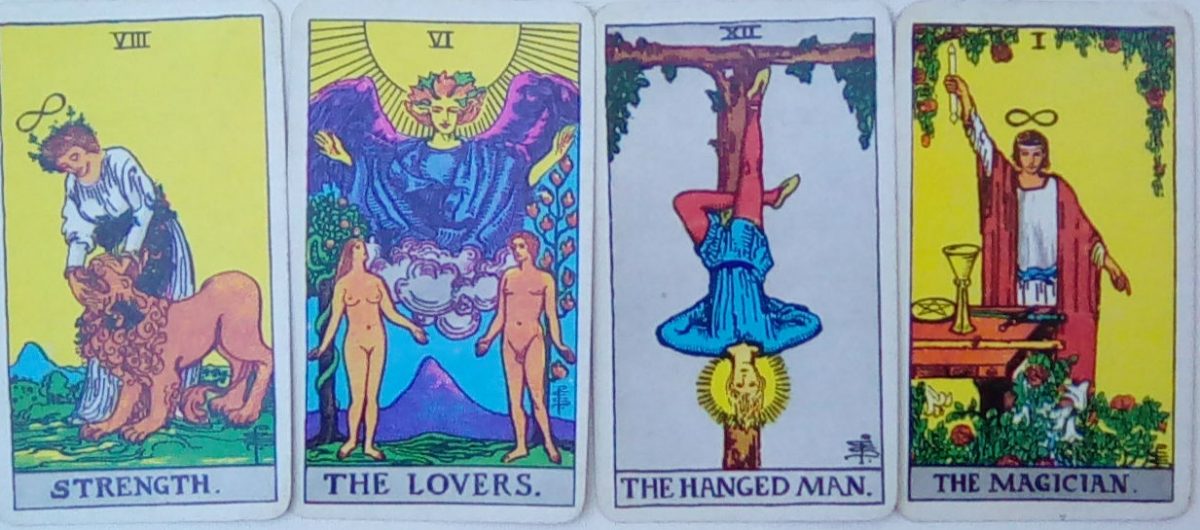
The Justice card in the Tarot is, at its most basic level, about society judging us, but there are few harsher judgements than those which we make about ourselves.  And most of them are horribly unjust.

As Cynthia Kane points out in, “Talk to Yourself Like a Buddhist,”  we say things to ourselves that we would never, ever, in a million years, say to our friends and family.  When we really start listening to our inner dialogue, we may find little poisoned pellets like:

You’re so stupid.

I can’t believe that you fucked that up . . . again.

What in the hell is wrong with you?

Why can’t you ever get anything right?

Your problem is that you’re just lazy.

And on and on and on.  The more dysfunctional that our family of origin was, the more likely we are to have that harsh inner critic constantly deriding us.  Constantly telling us that we don’t measure up and we’re never quite good enough, no matter how hard we try.

Now, there’s a basic formula in New Age Thought that goes like this:

Our thoughts create our emotions.

Our emotions create our vibrations.

Our vibrations create our lives.

When we break that down, it just means that every single thought we have has an emotion attached to it, either positive or negative.  When we think of puppies or cookies, we feel good.  When we think of dentists and written tests, we feel bad.  Our feelings about those thoughts add up to create our overall vibration.  If we’re constantly thinking of things that make us sad or scared, we end up with negative vibrations.  If we’re constantly thinking of things that make us happy, we end up with positive vibrations.  And, eventually, our overall vibrations will draw similar vibrations into our lives.  If we have really negative vibrations, we’ll draw in negative people and failures.  If we have really positive vibrations, we’ll draw in positive people and abundance.

It’s really cool when we figure that out because it empowers us to make changes.  We can jump in at any one of those three points and start to transform our lives. Most of the self-help guides advocate one approach or another.  If we change our thoughts, we’ll change our emotions.  Or if we work on feeling happier about life, that will change our thoughts.  Or if we meditate on raising our vibrations, that will change what we attract.  Pull on any one of those three strings and our lives will start to change.

There’s one element that’s frequently left out of that equation, though, and that element is beliefs.  We can change our thoughts, our emotions, and our vibrations but if we don’t change our underlying beliefs, we’re not going to get anywhere.

The classic example of that is the person who wins the lottery and two years later he’s bankrupt.  Maybe he spent hundreds of hours visualizing getting that winning ticket and wrote out a kazillion affirmations and did vision boards and all of that helped him to win.  But he didn’t change that underlying belief, which was, “I’m poor,” so the money floated away.  It wasn’t a vibrational match for his basic beliefs about himself.

To put it in a nutshell, our beliefs create our thoughts which create our emotions which create our vibrations which create our lives.

Which begs the question, “What IS a belief?”  

A belief is nothing more than a thought that we repeat over and over until we think it’s true.  Sometime they ARE true, but frequently they aren’t.  If we want to know what our real beliefs are, all we have to do is to listen to that inner dialogue.  If we’re constantly degrading and belittling ourselves, then those are beliefs that we need to change before we can effect permanent changes in our lives.

So how do we change our basic, underlying beliefs?  We actually pull them out and look at them.

One of the most powerful tools for doing that is Byron Katie’s, “The Work.”  

To use The Work method, we take a, “work sheet,” (download one here) and focus on four areas:

1- What’s the belief that I need to change?

2- Is it true?

3 – What kind of a person would I be without that belief?

4 – What are some opposite turn arounds that I can substitute for that belief?

Here’s an example of a negative belief that a lot of us carry around:  “I’ll never have enough money.”

IS IT TRUE?  For most of us, it’s not true at all, at least for most of our lives. There are very few of us who have been homeless or starving.  That doesn’t mean that we haven’t gone through some bitchy, bad times.  There may very well have been times when paying our bills or even just buying groceries was a struggle.  Still, if we’re honest with ourselves, most of us, most of the time, manage to pull it together even through the occasional hard times.

Of course, one of the questions that we need to look at there is, “What do I mean by, ‘enough money.’ “  If we put together a vision board that’s covered with pictures of sports cars, McMansions, and private jets, we’ll probably feel like we don’t have, “enough.”  If we think in terms of food, clothing, shelter, a car that runs, and a job, though, we realize that we’ve usually had plenty.

WHO WOULD I BE WITHOUT THAT BELIEF?  Well, for one thing, we’d probably be a lot more grateful.  When we actually focus on the fact that we have always had enough money to eat, enough money for a warm place to live in the winter, enough money to pay our bills, then we can start to see how very lucky we’ve actually been.  

For another thing, we can start feeling a lot less anxious about the future.  If we’re able to look at our past and see that there’s always, somehow, been enough, then we can see that there’s absolutely no empirical evidence for the idea that we won’t have enough in the future.  It’s just a movie playing in our heads that’s based on a bad fantasy.

WHAT ARE SOME OPPOSITE TURN AROUNDS TO THIS BELIEF?  The obvious one, of course, is, “I always have enough money.”  Some others might be, “I manifest what I need as I go along,”  or “The Universe always provides for my needs.”

Once we’re able to flip that basic belief, then some miracles start to happen.  Our thoughts begin to be more positive (“I always have enough money.”). Since our thoughts have changed, our emotions start to change (“I really don’t have anything to worry about financially and I’m happy about that.”). Since our emotions have changed, our vibrations start to change (“I feel really secure, relaxed and positive about life.”).  And when our vibrations change, then we start to create the life that we always wanted.

It’s a really good and relatively simple method for changing our basic beliefs.  Of course, Byron Katie probably named it, “The Work,” for a reason, because it does take some work.  It’s not just a matter of sitting down and filling out a sheet of paper.  It’s actually taking the time to listen to our own thought stream, write down those negative beliefs, and then meditate on them as we fill out the sheets.

And changing negative beliefs is work on a whole different level, as well.  We tend to cling to beliefs about ourselves and the world around us simply because they’re comfortable and they’re what we’re used to.  When we adopt the very opposite of those beliefs, it can initially feel very strange and foreign.  The negatives will keep popping up in our thought streams for a while, but we now have the consciousness to stop and say, “Nope.  It’s not true, it doesn’t make me feel good, and it’s not who I am.”

Note: as a member of Amazon Associates, I may receive a tiny remuneration if you buy a product listed on this page. I am in no way associated with the authors of the books quoted.
The Ten of Wands, Energy Healing, and Over-Thinking Enchiladas

Using energy healing to overcome overthinking.

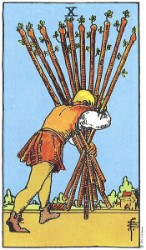
I find myself understanding the poor dude in the 10 of Wands more and more as time goes by.

In the Tarot, the four suits of cards represent different realms of the human experience.  Swords = personal power.  Cups = emotions. Pentacles = material possessions.  And wands = ideas.

So we see this guy in the 10 of Wands who has SO MANY ideas that he can barely stagger along under the weight of them.  His head is pressed firmly into the bundle of wands and he can’t even see what’s going on around him.  He’s just trudging toward a distant destination, hoping he’s going in the right direction and trying to put one foot in front of the other.  His ideas own him, not the other way around.

I was watching an interview with Eileen McKusick, author of, “Electric Body, Electric Health,” and she flat out said, “Overthinking is a cultural brain virus.  Overthinking never, ever solves anything.”  Naturally, my reaction was, “I’ll need to overthink that statement.”

She’s right, though.  What we refer to as, “thinking,” usually means shuffling around a lot of different concepts, trying to make them fit some sort of a coherent pattern.  It’s like a Rubik’s Cube that we keep flipping and flipping and flipping, hoping that all of the squares will line up. 

But conceptualizing is just one part of a much larger process and when we get stuck in that one part, it doesn’t work.  We can never, ever solve anything by just thinking at it.

Somewhere along the line in human evolution -probably about the time we began to develop alphabets and writing – we started to pull out of our bodies and into our heads.  Which is to say that we started to think of our heads, our brains and thoughts, as being somehow separate from our bodies.  Philosopher Gilbert Ryle referred to that as, “the ghost in the machine.”

That name is so apt because most of us suffer from this incredible, mass hallucination that there’s some separate, non-material, “self,” much like a ghost, that sort of rides around in our bodies, as if they were machines that we’re driving.  The ghost, of course, lives in our heads and we peer out at the world through our eyes, just as if they were windshields.

We call the ghost in our heads our, “selves,” or our, “personalities,” or even our, “souls.”  So there’s a ghost that’s our REAL self and then there’s the body, which we’re sort of temporarily driving around in.  That scene is very much like our real self landed at the Earth Airport and went straight to the Hertz Rent a Body so that we’d have a cool ride to tool around in.  “Hey, I’ll take something with fins and a lot of chrome.  Bucket seats.”

We even see that dualism in New Age philosophy, right?  How often have we heard that expression, “You’re not a body that has a Soul;  you’re a Soul that has a body?”  Which is a nice shift toward the spiritual, but it still maintains that strange hallucination that our bodies are somehow NOT our real selves. 

Which is exactly what McKusick was getting at:  we’re not just our brains and we’re not just our bodies – we’re our body/brains/nervous systems/emotions/thoughts/memories, Soul – the whole enchilada.

Or perhaps I should say, “the Soul Enchilada.”

She’s an energy worker who uses the energy of sound to heal us.  Like most energy workers, she heals from the outside in, which is contrary to some New Age thinking.  The basic New Age formula for life runs like this:

Our beliefs create our thoughts.

Our thoughts create our emotions.

Our emotions create our vibrations.

Our vibrations create what we draw into our lives.

New Agers have tended to jump in at the level of thought and say, “Well, if we change our thoughts, we change our emotions, which changes our vibrations, which changes our lives.”  Also known as the power of positive thinking and it’s true.

Energy healers like McKusick, though, are flipping the script on that.  They’re saying, “If we change our vibrations, we change our emotions, which changes our thoughts.”  She’s taking the same holistic approach – we’re all one great big electromagnetic vibration and if you change one thing, you change all of it – but she’s working from the vibration inward to the thoughts.

Her idea is that sound is a form of energy and so are we.  When we listen to certain sound frequencies that are coherent, solid frequencies, it reorganizes the energy in our bioelectric field into a solid, coherent vibration.  As our vibrations become more coherent, so do our emotions and our thoughts.

Does it work?  I don’t know, yet.  I’m spending a significant part of my day banging away on my Tibetan meditation bowl and grooving on the rising and falling of the sounds.  It does seem to be very soothing and it does take me out of my head and into my body.

And now that I’ve over-thought it, I like it.  I really do.

Please remember that my amazing e-book, Just the Tarot, is still available on Amazon for MUCH less than an order of enchiladas. Hell, it’s less than a side of refried beans. What an incredible bargain!

The Moon Card, Lunacy, and Multiple Realities

I have an ex-relative who is bipolar and – in the time honored tradition of many bipolars – about every two or three years he decides to stop taking his medications and blow up his life.

After a certain amount of sleep deprivation during the manic phases he’d start making statements like, “A coven of witches is sending energy beams at my head.”  And, because of my belief systems, I’d have to actually stop and wonder, “Well . . . IS a coven of witches sending energy beams at his head?” And, no, they weren’t, probably because he was an obnoxious, shallow, self-centered twit and why bother to curse someone when they’re doing such a good job of it themselves?

It did start me thinking, though, about so many of the things that we take for granted in New Age terminology, things which would have been considered totally loony tunes about 75 years ago.

Auras. Energy fields.  Spirit Guides. Telepathic communication.  Totem animals. Chakras. These are all so commonplace and accepted today that you can actually go into your therapist’s office and discuss them with him or her.  Perhaps they’ll even recommend a therapeutic massage to clear a blocked second chakra.

It was a far different story in the 1950s, though.  If you told a psychologist that you saw glowing auras around people, or that you were receiving guidance from invisible entities from another dimension, or that particular animals communicate with you telepathically, you’d be on your way to the nearest locked psych ward.  And there you would be rewarded for your beliefs with electroshock therapy or insulin shock or even a lobotomy if you continued to cling to your, “delusions.”

It actually makes me wonder if some of the mental patients back then were simply experiencing phenomena that our society had no explanation for or grasp of at the time.  Maybe they WERE talking with angels. Who knows?

A few advanced thinkers such as Scottish psychiatrist R.D. Laing emerged in the 1960s and suggested that perhaps schizophrenics were actually experiencing EXACTLY what they were reporting and the best, “treatment,” was to just care for them and let them heal on their own.  For the most part, though, if you held New Age beliefs in the 1950s or the early 60s, you were MAD, darling. Quite, quite mad.

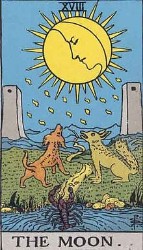
The Moon is the Tarot card that has traditionally represented psychosis and delusion.  The light in the card is murky and objects are out of focus and ill defined. A crustacean crawls out of the still pool of the unconscious while a dog and a wolf bay at the glowing orb overhead.  A rope on the ground might be mistaken for a snake, a dark bush for a lurking beast. The lines of reality are blurred and indistinct.

That may well have been the way that a person who was channeling or highly sensitive to psychic phenomenon would have experienced the world in the 1950s.  So what happened between then and the emergence of New Age philosophy in the 1970s?

Well, the 1960s happened, obviously.  A fairly substantial number of people took a fairly substantial amount of psychedelic drugs and began to view the world and life as magical rather than mundane.  There was a reemergence of occultism, Tarot cards became commonplace in any hippie household, and people began to talk a lot about astral travel and, “vibrations,” of energy (“I’m picking up bad vibes, man.”)

I think one of the most defining moments, though, was the publication of, “The Teachings of Don Juan,” by Carlos Castaneda in 1968.  A new term entered the common lexicon:  “nonordinary reality.”

As Castaneda employed it, it was used to describe the three worlds that shamans pass through on their journeys, but it fit so perfectly with all of the spiritual views that were emerging in the 1970s.

There was suddenly an acceptance that there isn’t just one consensually shared reality.  That there can be many, many different realities and they can ALL be just as true and just as valid as the, “reality,” that most people cling to.

Today we recognize the sacred connection that The Moon has with the human body and mind.  We watch Her cycles, draw down Her energy, and gather together to celebrate when She’s at her zenith.  The,”lunacy,” of the past has become the sanctified vision of the present.

We can finally share those, “nonordinary realities,” with each other and continue to grow and evolve spiritually through that shared knowledge.  How sweet is that?

“I’ll let you be in my dream if I can be in yours.”  – Bob Dylan