Beyond Isolation: How Introverts Can Truly Recharge

A look at creating healing solitude.

If introverts had a battle flag, it would probably have The Hermit card printed on it.  We absolutely love to withdraw into our own cozy little shells and let the world turn without us participating in it.

So, we’ve finally canceled our plans, turned off our phone, and settled into solitude. But after hours of scrolling or zoning out, we still feel drained. What gives?

THE MYTH OF THE INTROVERT RECHARGE

Introverts often mistake social withdrawal for true recharging but miss the neurological component (acetylcholine release) that actually restores their energy.  Just sitting at home is not going to refresh or restore us, although that’s where we need to begin the process.

DOPAMINE VERSUS ACETYLCHOLINE

There are, of course, about a kazillion different chemicals and hormones doing a tango in our busy brains at any given time.  For purposes of this discussion, though, let’s focus in on just two of them, the neurotransmitters called dopamine and acetylcholine.  And let’s just call them, “happy juices,” because they make different people happy in different ways.

Our brains discharge dopamine when we’re exposed to a lot of social stimuli like loud music, parties, crowded shopping malls and lots of other people.  Extroverts actually have many more, “receptors,” for dopamine in their brains than introverts do, so they can soak up an ocean of it and it makes them really happy campers. They feel jazzed, excited, and alive.

Since introverts can’t absorb a lot of dopamine, it basically kicks our asses.  For us, it’s like drinking six cups of really strong Espresso – it makes us jittery, nervous, and quickly worn out.  It’s introvert poison.

Acetylcholine, on the other hand, gives our brains a mellow, quiet buzz.  It’s less like ecstatic dancing at a concert and more like snuggling into a warm bed with nice clean sheets.  It’s quiet and peaceful.  Introverts love it and it drives extroverts crazy with boredom.  It’s our happy juice.

THE ISOLATION TRAP

Now,  since too much dopamine makes us feel like crap, it’s perfectly natural to think that just getting away from situations that cause dopamine will make us feel ever so much better.  After all, if too much, “peopling,” is wearing us out, then non-peopling should recharge us.

So, we fill the moat around our introvert castles with alligators, pull up the drawbridges, and put up a big sign that says, “GO AWAY!”  Free at last!

Unfortunately, by that point, we’re frequently so worn out that we just sit there staring out the window, doom-scrolling on our computers for hours, or binge-watching NetFlix.  Those are what therapists call low-nourishment activities because they don’t do anything to feed our emotions or bodies.  And, specifically with introverts, they don’t feed us any acetylcholine to make our brains happy.

PLANNING FOR A BRAIN BOOST

A good question for introverts to ask when we’re planning for our recharge time is, “Will this activity leave me feeling nourished or merely distracted?” We know that there are specific, fairly low energy activities that refresh and recreate us by increasing acetylcholine production.

Reading and Deep Learning: Encourages relaxed but engaged attention.

Mindfulness Meditation or Breathwork: Activates the parasympathetic nervous system, reducing cortisol and boosting calm focus.

Creative Flow States: Writing, drawing, or music allow for contemplative immersion.

Nature Walks or Gentle Movement: Combines physical and sensory stimulation with mental quiet.

MINDFUL INTENTIONS

Another way of putting that is that we need to be intentional with our solitude.  We need to design an Acetylcholine-Rich Hermit Phase.  We can learn to structure our alone time for maximum benefit.

Conscious solitude planning: Schedule blocks for purposeful recharging activities instead of just avoiding people.

Minimize mindless distraction: Replace passive screen time with meaningful, immersive solo activities.

Create mini rituals: Tea-making, journaling, or slow stretching to ease into relaxation.

And, hell, if we’re not quite ready to jump into being Zen Master Introverts, we can combine some of those activities.  Maybe do some Tai Chi while we’re bing-watching Netflix.

REDEFINING OUR SOLITUDE

We’re all different, of course, and introverts tend to be really different.  For me, painting, writing, or meditating brings on that acetylcholine recharge.  For you, it may be gentle dance motions, working in your garden or reading a good book. For others it might be sitting in the sunshine sipping a cup of tea.

The point is that we all know what makes us feel good.  For an introvert it’s like a lover gently kissing the back of your neck or touching your cheek with her finger tips.  It’s sweet, it’s calm, it’s gentle, and it makes us feel better almost instantly.  Those are the activities that we want to build into our solitude.

Yes, we need to get away from other people on a regular basis, but simply being alone isn’t the answer.  Living in intentional, mindful, loving solitude is what makes us whole again.

The Hermit, Introverted Intuitives, and Letting Our Lights Shine

How intuitives emerge from a Hermit Phase.

As an INFJ personality type, I’ve always felt a particular affinity for The Hermit card.    After all, going into Hermit mode is one of the primary defense mechanisms of intuitives and introverts.   When we feel overwhelmed or hurt, we pull up the drawbridge, slam the gate shut, and self-isolate until we heal.  Sometimes that takes a few weeks and sometimes it can turn into years.

I’ve recently begun focusing on another part of The Hermit card, though, which is the lamp that he’s holding aloft.  He isn’t just hiding out anymore – he’s illuminating a path for others to follow.

 INTUITIVES DON’T LEAD

Doing that is NOT something that highly intuitive or empathetic people are inclined to do, for a couple of reasons.  First – and most obvious – is the fact that most intuitives are also introverts.  We’re not the sort of people who want to have a great deal to do with other people, much less try to lead them anywhere. 

In a very real sense, that’s more of the path of the extrovert.  Extroverts love, love, LOVE to charge out into society, organize everything, and tell other people what they should be doing and when they should be doing it. Which is fine, because someone has to put together the Christmas parties, right?  Better them than us.

INTUITIVES AND SELF-IMAGE

Another reason that intuitives seldom assert themselves as, “leaders,” is that many of us have really rotten self-images.  We feel as if we don’t fit in, as if we’re the original square peg in a round hole.  

Some of that flows out of the fact that society is, once again, pretty much designed by extroverts.  Starting in elementary school, we’re told that daydreaming and wanting to be by ourselves is, “bad.”  How many of us received the dreaded report card that said, “Doesn’t play well with other children?”  Yikes.  

That continues into adult life, of course.  Just look at the modern work spaces, with cubicles piled on top of each other and no sense of privacy or personal space.  They’re extrovert heaven and introvert hell and if we don’t like them there must be something wrong with us.  It turns out we don’t play well with other adults, either.

INTUITIVES AND DYSFUNCTIONAL FAMILIES

There’s a further reason for intuitive introverts having terrible self-images, which is – guess what? – our families.  When I first started digging into intuitive personality types I was astounded at the number of people who reported that they had come from dysfunctional families.  And by, “dysfunctional,” I mean families where one or both parents had serious mental issues, addiction issues, or abuse issues.  

Frequently, a part and parcel of being a terrible parent is blaming the child for your bad parenting skills.  A classic example is a parent who gets drunk, beats the hell out of the kid, and then says, “You made me do that.  If you were a better child, I wouldn’t have to beat you.”  The end result is that the kid is convinced that he or she isn’t a, “good,” person and that they’re somehow to blame for the abuse.  We go into life with the basic premise that we’re flawed and unloveable.

INTUITIVES AND COGNITIVE INTELLIGENCE

So, all of these factors (and more) lead the introverted intuitive to feel that she’s in no position to lead anyone, anywhere.  After all, we’re odd balls and we’re just not quite good enough.  But is that borne out by facts?  Consider these statistics from Susan Storm’s article in PsychologyJunkie:

Of all of the personality types, INFJs have the second highest grades in high school.

INFJs have the highest first semester grades in college and some of the highest undergraduate grades.

INFJs are among the most persistent personality types in actually finishing college.

INFJs tend to score well above average in standardized IQ tests.

INFPs and INFJs read more than any other personality types.  While the average American reads 12 books per year, INFJs average 67 books per year.

INTUITIVES AND EMOTIONAL INTELLIGENCE

While some introverted intuitives are full blown empaths, ALL of them are highly empathetic.  And by empathetic, I mean that they can, “read,” another person’s emotions so deeply and so quickly that they may appear to be psychic.  

When you meet an introverted intuitive, they are instantly scanning your body language, your eyes, your facial expressions, the tone of your voice and even the clothes that you chose to wear that day.  All of this happens so rapidly that the intuitive may not even be aware that he’s doing it.  What’s more, intuitives frequently feel that everyone else must have that same level of perception, simply because it feels so natural to them.  But, no, most people don’t do that.

As Eileen McKusick, author of Tuning the Human Biofield put it, “It’s like having an antenna that goes a little higher than everyone else’s.  We pick up information that normal people don’t.”

COMING OUT OF THE HERMIT PHASE

What usually pulls introverted intuitives out of their Hermit phase is a desire to help other people.  That can manifest as personally as wanting to help a friend who’s gone through a divorce or as broadly as wanting to make some contribution to humanity as whole.  Intuitives are, after all, highly empathetic, which means that we really DO feel other people’s pain, almost as if it were our own.  

In order to help, though, we have to get rid of that old, “I’m not good enough,” self-image.  When we combine our intellectual intelligence with our emotional intelligence, we are actually extraordinarily capable of helping others heal.

It’s estimated that up to 52% of the population may fall into the introvert section of the personality types.  BUT . . . introverted intuitives are a very tiny slice of that.  Only 1 to 2% of the world population are INFJs and only 4.4% are INFPs.  We have unique gifts and unique perspectives.  We just need the self confidence to go along with those gifts. To let our lights shine on other people’s darkened paths.

The Emperor, Robotic Cats, and Suicide Among Elderly Men

Examining the reasons for the high suicide rate among elderly males.

I was just reading an article about suicide in the elderly and the author – a certified therapist with a PhD, mind you – suggested that a good preventative might be a robotic cat or dog that we could talk to and sleep with.  That way, we wouldn’t be lonely and, if we weren’t lonely, we wouldn’t be offing ourselves at record numbers.

Now, if you weren’t already suicidal, the idea of having to get a little cat robot to be your best friend would surely drive you over the edge.  It’s such a radiant example of NOT understanding suicide in the elderly that it’s almost breathtaking.

Here, kitty kitty!  Oh, shit, her batteries are dead.  Might as well just kill myself.

The, “reasons,” for elder suicide are all over the place.  According to the experts, it’s because we’re lonely, or we’re socially isolated, or we’re sick, or we don’t have jobs anymore, or our spouses died, or we’re invisible in a youth-culture, or we never get touched by anyone.

My very favorite is that elderly people commit suicide because they’re . . . drumroll, please . . . depressed.  

You think?

After spending several days combing through articles and studies about why elderly people kill themselves, I came to two conclusions.  One – nobody really knows why.  Two – nobody is very motivated to find out.  From a purely dollars and cents perspective, it doesn’t make a lot of sense to social scientists to study elderly suicide because – hey! – old people are, you know, old.  Why spend a ton of money studying how to keep them alive when they’re supposed to die soon anyway?

They have pretty much pinned down the people at the highest risk. The person who is most likely to commit suicide in the United States is an elderly, white, male, introvert with a family history of suicide.

Males kill themselves four times more than females.  Apparently it’s one of our special skills, though it’s probably best to not note it on our resume’s.  No surprise, then, that those statistics would go across all of the age groups and extend into old age.

I can also understand the factor of the family history of suicide.  Perhaps that’s just a genetic predisposition to depression, but once you’ve seen suicide modeled in your own family, it’s hard to unsee it.

Introversion is a little harder to grasp, because it exists across such a broad spectrum and means so many different things to different people.  About 52% of the general population are introverts but most of them are obviously not suicidal.

Researchers have been quick to make the leap from introversion to loneliness and social isolation, though.  Under that model, introversion = social isolation, which = loneliness, which = depression which causes suicide.

Leaving aside the fact that those us with robotic cats are hardly lonely, other statistics would seem to refute this approach.  Elderly women actually report much higher levels of feeling socially isolated and much higher levels of feeling lonely than elderly men.  If there was causation from those factors, we’d expect to see the gender statistics reversed, with women killing themselves at four times the rate of men.

There’s another interesting difference we can discern when we look at a recent study from UCLA.  Dig this:

“What’s striking about our study is the conspicuous absence of standard psychiatric markers of suicidality across all age groups among a large number of males who die by suicide,” said Kaplan, a professor of social welfare at the UCLA Luskin School of Public Affairs. They found that 60% of victims had no documented mental health conditions.

In other words, the standard perception of suicide as being caused by long term mental illness simply isn’t born out.  Suicidal men aren’t crazy, they’re just suicidal.

So, if elderly men aren’t killing themselves because they’re more lonely, more isolated, crazier, or more introverted than everyone else, what’s causing it?

I suspect that a large part of it may lie in another part of the description, which is, “white male.”

Of all of the many groups in the United States, there is no group that is more likely to fully participate in the toxic masculine paradigm than the Caucasian male.  We have, simply by being born with white skin, more access to the education and financial resources that enable us to become completely enmeshed in the insane pursuit of money, power, and position.  We abandon our own authenticity in that lifelong pursuit.

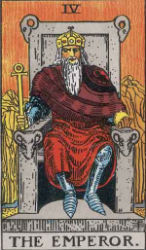
When we look at the Tarot card, The Emperor, we see the ultimate outcome of that paradigm.  Yes, he’s sitting on a throne and he’s powerful.  He’s also completely and totally alone, covered from head to toe in his armor.  Everything around him is a blasted, sterile wasteland. No friends.  No lovers.  No family.

He doesn’t even have a fucking robotic cat to sit on his lap.

When we talk about toxic masculinity, we mainly frame it in terms of the negative effects that it has on women who come into contact with it.  We tend to forget that it’s the men who are carrying all of those toxins around with us.  And it’s killing us.

Is it likely that white American males will begin to look at the female paradigm or perhaps people of color and try to figure out why we’re killing ourselves and they’re not?  Probably not.  On the other hand, artificial intelligence is improving by leaps and bounds.  It’s only a matter of time – hopefully a very short time – until we’ll all have robotic cats and dogs who can actually talk to us and help us deal with our emotional problems more realistically.

Here kitty kitty!  I have some brand new batteries for you, sweetheart.

I am very pleased to announce that my ebook, “Just the Tarot,” is now available FOR FREE on Amazon for anyone who has a Kindle Unlimited membership. The cheapest robotic cat that they offer is $113.00 so this is just one hell of a deal.

Being a Misfit, Being Heard, and the Five of Pentacles

The pain of never being understood and how to use it for growth.

About a year and a half ago, I took the Myers-Briggs Type Indicator (MBTI) personality test and discovered that I belong to a group called the, “INFJ.”  INFJs are essentially introverted intuitives and are as rare as hair on a frog.  Only 1% of the population are INFJs and less than 1/2 of 1% of the population are INFJ males.

Americans love to think of themselves as being special and unique, of course, so a small cottage industry has arisen around being an INFJ.  Claiming to be an INFJ has become sort of a short hand to tell other people how incredibly evolved and spiritual and sensitive you are. 

There are a kazillion videos and books pointing out how FABULOUSLY wonderful INFJs are and you can even buy INFJ tee shirts and bumper stickers just in case some mere mortals missed the bulletin.

I, on the other hand, looked at the description of the personality type and thought, “Oh, I am SO fucked.”

One of the strongest human drives is the need to be heard and acknowledged.  To have the feeling that other human beings – or even ONE human being – truly hears what we’re saying and understands what we’re feeling and thinking.

American couples spend millions of dollars every year going to therapists to learn how to communicate and to listen to each other.  In other words, how to be heard by our partners.

Many of us derive a great deal of pleasure from social media sites like FaceBook because we feel that someone out there is actually hearing us and acknowledging our existence.

Thic Nhat Hahn and other Buddhist masters have stressed the importance of deep and compassionate listening.  Hearing what the other person is really saying rather than composing a clever response while they’re speaking.

Actually being heard for who we are seems to heal the human heart.

While Americans may worship the concept of being, “unique,” they don’t really see the flip side of it, which is that the more different you are, the less likely it is that other people will actually understand you.  Some people might look at the INFJ personality configuration and think, “Oh, boy, I’m SO special.”  What they’re not seeing is that 99% of the people in the world don’t see the world the same way that the INFJ sees it and probably never will.

And that can break your heart. That can drive you to end it.

There are, of course, many other ways besides being an INFJ that will cause a person to not, “fit in.”  I was born into an Army family and military brats are renowned for feeling like perpetual outsiders in the civilian community.  It might be caused by belonging to a racial or ethnic minority, or having a disability, or being gay or trans, or not fitting the cultural standards of being physically attractive.  Janis Ian expressed that so poignantly in her song, “At Seventeen”,:

I learned the truth at seventeen 

That love was meant for beauty queens 

And high school girls with clear-skinned smiles 

Who married young and then retired . . .

High School, perhaps above all else, teaches us the cruel realities of not fitting in.  

Oddly, not fitting in – being a misfit –  can eventually quit breaking our hearts and act as a springboard to spiritual growth.  That only happens, though, when we finally surrender and just give up.  

What happens to a person who truly doesn’t fit in when they try to fit in?  Essentially, they deny their own reality and desperately attempt to, “blend in.”  They try to become what they think other people will like.  They hollow themselves out more and more in the quest to have someone, even one person, understand them and love them for who they really are.

The paradox, of course, is that they’re trying to trick someone into loving them for who they are by being who they aren’t, so even if they snag a friend or a lover or a partner, they’re still not really being seen or loved.

Eventually, if we keep that up, we come to feel like the beggars in the Five of Pentacles, always on the outside in the cold while the, “normal,” people are inside the church receiving all of the blessings that seem to be their birthrights.

There’s something incredibly liberating, though, when we finally admit to ourselves that we don’t fit in and never will.  When we finally admit that we’re never going to be one of the beautiful, golden people who seem to wear their lives like a tailored glove.

No, it doesn’t mean that we’ll finally be heard or acknowledged by other people.  In fact, the more we become our authentic selves, the more likely it is that other people will not hear us.

But . . . we can finally hear our Selves.

Introverts, Extroverts, Neon Nose Rings and Being True to Our Selves

The difficulty of being seen and heard as an authentic person.

There’s an interesting – and somewhat paradoxical – psychological principle which is that THE MORE WE BECOME OURSELVES, THE LESS LIKELY WE ARE TO BE UNDERSTOOD BY OTHER PEOPLE.  That may sound a little grim, but there’s a lot of truth in it.

By way of an example, I’m a male.  In a very basic sense, I have NO idea what it’s like to be a female.  I can empathize with females, I can understand their political, emotional and social issues, I can be a strong supporter of feminism.  But I can’t understand, on a primal level, what it’s like to be a female.  There’s a whole slew of experiences in there – growing breasts, having your first period, prom dates, motherhood, etc. – that just aren’t a part of my being-in-the-world or my personal history.

I can take that up a notch and say that I’m an American male.  So I would definitely NOT understand what it’s like to be an Indonesian female.  Or I could say that I’m an older American male, so I would really, really not understand what it’s like to be a young Indonesian female.

The more different we are, the less we understand each other.

There’s also a very natural human drive called individuation, where we want to become separate, unique individuals.  We see it most clearly in adolescents.  For the first ten years of their lives they’ve been nothing more than extensions of their parents and their families.  Suddenly, as puberty approaches, they want to dress differently, act differently, and explore new ways of thinking.  They are compelled to differentiate themselves from their parents and if that means they get a neon nose ring to prove they’re different, so be it.

Although it’s less obvious, that drive to be, “different,” continues into adult life.  In the United States, we mainly express it through our adult toys and our clothing.  We talk about someone making a unique, “fashion statement,” or we’ve got a friend who drives around in a rare, restored 59 Chevy, or we raise Venus Flytraps .  We take a lot of pride in our uniqueness and tend to denigrate being, “a part of the herd.”.

For some people, though, that drive to be different, to fully express themselves as unique individuals, can have a downside to it as well. The reason for that is that we also have an equally strong drive TO BE HEARD, not just to be seen.  To be understood.  To have meaningful conversations and interactions with other human beings who really get what we’re feeling and thinking.

As Michael P.Nichols put it in, “The Lost Art of Listening,”

“Few aspects of human experience are as powerful as the yearning to be understood. When we think someone listens, we believe we are taken seriously, that our ideas and feelings are acknowledged, and that we have something to share.”

That transaction of communicating and being understood and validated assumes that we have some common ground with the other person.  The more that we have in common with the other person, the more quickly and easily they’ll understand what we’re saying.  If the only language I speak is English and the only language you speak is Spanish, we’re not going to do much meaningful communicating.  If you’re from New York City and I live in a small town in the mountains, we are NOT going to rock and roll.

It’s really a simple ratio:  the more we’re alike, the more easily we’ll communicate.  The more that we’re different, the more difficult it is to communicate.

So what happens if you’re not just different, but radically different from most people?  So different that you share very little common ground?

Here’s an example from the Jungian personality types.  We know that some people are introverts and some people are extroverts.  The more introverted we are, the less likely we are to understand how extroverts see the world, and vice versa.  Then take that up a notch by looking at an introverted personality type called the INFJ.  Only one percent of the people in the world share that personality type.  Take it up another notch by looking at males who have the INFJ personality type.  Only 0.5 percent of the people in the world share that person’s personality.  

That means that if you are a male INFJ personality type, over 99% percent of the people you meet will NOT understand how you process and view the world.  That’s not a lot of common ground.  That’s not even a pebble.

Or suppose you’ve taken a radical spiritual route such as we see in the Tarot card, The Hermit.  You’ve intentionally withdrawn yourself from the world and consciously sought another path like meditation or extreme solitude. After a few years of that kind of a lifestyle, there isn’t just a minor rift between your vision of the world and the way the average person sees it, there’s a giant, fucking chasm.

The more different you are, the less people will understand you.

Now, experts tell us that there’s a sort of an arc in that process that eventually leads people who are very different back to understanding that, on a spiritual level, we’re all the same.  Marsha Sinetar in her book, “Ordinary People as Monks and Mystics,” says that pursuing your true authentic self will inevitably lead to greater compassion and empathy with other people.  People who are largely detached from society eventually reattach on a much deeper level.

But . . . until that happens, until we reach that point of reattachment, it can be a very painful ride.  There can be the realization that people we really care about just don’t understand us.  The feeling that we don’t fit in, not anywhere.  There can be a terrible hunger to have just one person meet us on common ground.  There can be a severe sense of loneliness, isolation, and, yes, not being heard, a despairing feeling that we will never have a real friend or lover.

Put another way, being true to yourself is not for the faint hearted.  If the average person moves into an isolated cabin in the woods with no phone, no neighbors and no social media, he’ll go nuts in very short order.    Being true to yourself and your unique perceptions of the world can feel very much like living in that isolated cabin, even in the middle of a very busy city.

It requires a strong ego structure.  It requires the ability to enjoy emotional solitude, rather than seeing it as a curse.  It takes a lot of resiliency.  More than anything, though, it takes an ability to ferociously believe in ourselves.  Not to criticize others or try to force them to share our visions, but to say, “I am me.  I have a right to be here.  I have a right to be my own unique expression in the world.  I hope that someday you’ll be able to see me.  I hope that someday you’ll be able to hear me.  But the most important thing is that I can see me and I can hear me.”

Introverts, Extroverts, and Becoming a Cookie

My life partner used to say, “I’m my own cookie.”

What she meant by that was that she was the source of her own valuation.  She didn’t need someone to say, “You’ve been a good little girl, so here’s a cookie.”  She could decide on her own that she was a good person AND she could make her own rewards rather than depending on someone else for them.  

Above and beyond all of that – she was her own reward.  Just being herself and being with herself was reward enough.  She was her own cookie.  That’s a hell of a life skill if you can figure out how to do it.

It can also be a really vital life skill if you’re an introvert.  The more introverted we are, the less likely it is that we’re going to get our cookies from someone else.  If we don’t want to starve to death, we’d better figure out how to do some baking.

If you’re reading this, there’s actually a pretty good chance that you’re an introvert.  It’s a pretty simple equation:  people who do Tarot reading are usually empaths.  Empaths are usually introverts.  

When we do a Tarot reading (or any other type of psychic reading) for other people, it’s not about us.  It’s about the life and the experiences and the dilemmas of the person we’re reading.  If we’re going to be effective at that, we have to be able to empathize, to actually put ourselves in their space, and say, “Okay, you’re going through THIS and that makes you feel like you want to do THAT, but perhaps you should consider doing THIS instead.”  If you’re a good reader, you have to be able to suspend your own judgments and really get into the life and vibrations of the other person, to really see it from their perspective.  And that’s called, “empathy,” right?  That’s literally being an empath.

Doctor Judith Orloff, author of, “The Empath’s Survival Guide: Life Strategies for Sensitive People,” flat out states, “An empath can be an introvert or an extrovert, though most are introverts.”  So, if you’re a Tarot reader, you may be one of those wonderful extroverts who likes to dress up like a gypsy and do readings at Renaissance Fairs.  But the odds are that you aren’t.  The odds are that you’re an introvert and you hate crowds and feel intensely uncomfortable when you’re forced to be around too many people.

Which brings us back to baking our own cookies.

Our society is extrovert-driven.  We’re taught from the moment we come into this world that there’s something wonderfully right about being an extrovert and something terribly wrong with being an introvert.  Think of the terms we use to describe extroverts:  

  • He’s the life of the party.
  • She took center stage.
  • They were vibrant and bubbly.

Now think of the terms we use to describe introverts:

  • She’s a shrinking violet.
  • He’s a wall flower.
  • They faded into the background.

As we grow up, introverts are literally shamed just for being who we are, just for the way we were born.  Brene’ Brown, author of, “The Gifts of Imperfection,” says that our society has an epidemic of shame and that our school systems are 90% shame based.  A lot of that shame is aimed at children who are introverts.

  • She’s too quiet.
  • He doesn’t  play well with the other children.
  • She seems to be in her own little world.

In other words we’re taught that everything an introvert is – quiet, socially withdrawn, introspective, etc. – is NOT NORMAL and is a cause for alarm and a sign of neurosis.

Perhaps one of the most prevalent – and most damaging – myths in our society is that introverts are sort of socially backwards (not to say, “socially stupid”) and that they just don’t know HOW to fit in.  That’s why they spend so much time alone – they don’t have any choice.

Actually, the evidence indicates quite the opposite.  Researchers at Yale University asked over a thousand people to predict how the average, normal person would think, feel, and behave in different situations.  The correct answers were based on data they had already gathered about how the average, normal person actually DID react in those situations.

And do you know who scored some of the highest points on the test?  Introverts.  Introverts were able to predict with a high degree of accuracy exactly how, “normal,” people think, react, and behave. Introverts, far from being socially inept, can be highly tuned into and aware of social norms and behavior, even more tuned into what’s going on around them than extroverts.

So if we’re introverts, the start of baking our own cookies, the start of being our own rewards, is to firmly, thoroughly, once and for all, get rid of all of the BULLSHIT that we’ve been taught about ourselves since we were kids.  We are not socially inept, we are not painfully shy, we are not dull and uninteresting.  In fact, we can be a damned sight more interesting than the social butterflies who are getting all of society’s cookies.

But a more important step is to rethink what the terms, “introvert,” and, “extrovert,” actually mean, once we jettison all of the cultural prejudices.  Anna Lemind, author of, “The Power of Misfits: How to Find Your Place in a World You Don’t Fit In,” has a very simple answer for that:  energy systems.

Extroverts recharge their energy systems through large amounts of social contact.

Introverts recharge their energy systems through having a lot of time to themselves.

Period.

Extroverts aren’t any better than introverts and introverts aren’t any better than extroverts.  We’re just different.

The salient point here, though, is that if you’re really and truly an introvert, AND you buy society’s bullshit that you somehow have to be an extrovert to fit in, to get your cookie, you’re going to end up physically exhausted and spiritually depleted. Trying to be around a lot of people sucks you dry. No cookies for you.  Sorry.

As introverts, we really and truly ARE our own cookies.  We draw our energy from ourselves, not from others.  We ARE our own rewards and that’s just how our energy systems work.  The good news is that, much more than extroverts, we get to choose the ingredients that go into our cookies.  Chocolate chips?  Yes!  Sprinkles?  Definitely.  Whole wheat flour?  Ummmm . . . no.

After all, it’s my cookie.

Introverts/Extroverts – The Three of Cups and The Hermit

Have you noticed that the term, “introvert,” is gradually being redefined on social media?  There are more and more people who are coming out of the closet and saying, “I really don’t LIKE going to parties.”  Or talking about how happy they are to NOT be in a relationship. Or just putting up posts like, “Thank god, it’s Friday, I’m home, alone, silence, blessed silence . . .”

When I was a kid, “introvert,” was kind of a shameful term.  It implied that you were an odd duck, an eccentric, a wallflower.  That you were painfully shy and that you had no social skills. You weren’t alone because you wanted to be alone or you enjoyed being alone;  you were alone because you just found it too painful to be with other people. Poor thing.

What’s emerging now is that it’s more of an energy set.  Extroverts genuinely enjoy being with other people, being at parties and in crowded social situations.  They draw personal energy from that. It recharges their batteries.

And, conversely, they feel energetically depleted if they spend too much time alone.  They feel that something’s wrong in their lives and that they really, really need to get out and be with other humans.  

And that’s okay.  That’s just the way their energy fields are set up.  Being alone is exhausting and being with others lights up their chakras.

And it IS a matter of energy.  If you look at a card like the Three of Cups you can just feel the energy pouring off of it.  These are three people who are having a hell of a good time. They’ve worked hard, they’ve been successful and now it’s time to PARTY!  There is a synergy there, a combined energy that recharges all of them.

When you look at The Hermit the energy isn’t so blatantly obvious.  He’s alone, standing on his mountaintop, quietly looking off into the distance.  But, my, my, how his lamp does shine. He’s not lonely. He’s quite happy living in his silence and contemplation.

That’s what’s changing, I think.  There is a growing recognition that there’s nothing WRONG with introverts.  They’re not horribly shy. Far from being socially inept many of them can be quite entertaining because they’ve had the time to think, to read, to meditate and contemplate and they actually know what they think in much greater depth than many extroverts.

Their chakras operate in almost the opposite fashion of extroverts, though.  Being in crowds sucks the energy right out of them and being home alone replenishes them.  They prefer one long, in depth conversation to the 40 mini-conversations you might have at a party.  Most of them genuinely like other people, they just need to encounter them in small, measured doses or in a one-on-one, deeply intimate relationship.

And, thanks to social media, they’re finally getting a chance to express all of that and realize that there are a lot of people out there who are just like them.  One more place where we’re learning to celebrate our differences instead of condemn them.

It’s all just energy.