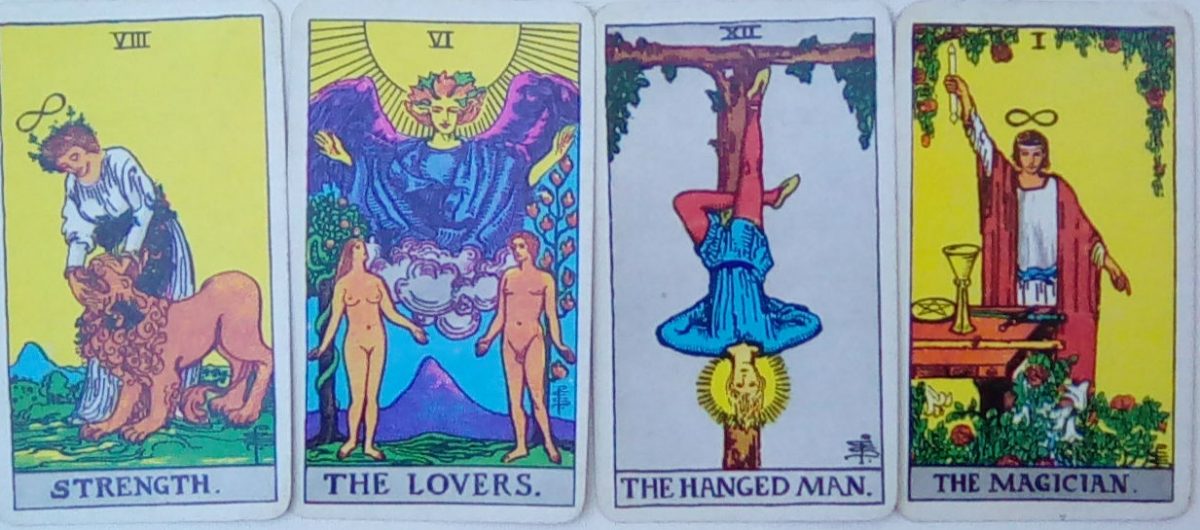
Taking Religion Out of the Tarot – A Look at the Real Tarot Deck

For centuries, Christianity condemned Tarot as witchcraft — yet hidden Christian symbols helped the cards survive the Inquisition. This post uncovers how those overlays disguised the deck’s true archetypal roots.

“Are Tarot cards evil?”

That’s one of the most common Google searches on the Tarot and I assume it comes from people who were raised as, “good Christian folks.”  After all, for centuries Christianity has railed against the Tarot.  Preachers and pastors are still screaming that the cards are the gateways to the Devil and dangerous tools of shadowy occultists.

One of the weird things about that is the Tarot actually contains a strong Christian thread that was intentionally stitched into the deck as camouflage.  It’s chock full of angels and not so subtle allusions to the Bible.  Without them, the Tarot would never have survived the Inquisition.

So let’s take a little closer look at how the Church’s iron grip shaped the early Tarot, what Christian symbols were embedded to disguise it, and what the cards may have actually looked like before that clever cover was sewn in.

TAROT WAS BORN IN DANGEROUS TIMES

The first historical references to the Tarot are in Europe in the 1450s.  Right in the middle of one of history’s most brutal religious crackdowns:  the Inquisition.  It’s hard for us to imagine it today, but ANY sort of fortune telling or divination could mean an automatic death sentence.

The Bible was explicit in its warnings. Leviticus 19:31 commands: “Do not turn to mediums or necromancers; do not seek them out, and so make yourselves unclean by them.”

We may casually lay out a reading today, curious as to what the cards can tell us.  To the Church, though, there was nothing casual about it.  It was witchcraft.  And witchcraft meant torture, trials, and being put to a horrible death.

The death toll from the Inquisition is still debated.  Some historians estimate the death toll from the Catholic Church’s witch hunts as, “low” as 30,000 victims.  Others, like Leonard Shlain in, “The Alphabet Versus the Goddess” place the number as high as 10 million.

Whatever the numbers actually were, the climate of terror was real, daily, and all pervasive.  So how did the Tarot survive?

HOW THE TAROT HID IN PLAIN SIGHT

The disguise of what the Tarot actually is was quite brilliant.

First, the makers announced that it was a card game, plain and simple.  Nothing to see here.   It’s just poker, only with archetypes.

 And then they wove Christian symbols directly into the deck.

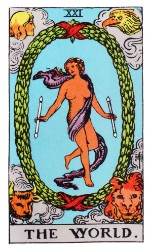
Take The World card.  It’s four corner symbols – lion, ox, eagle, and angel – aren’t just random.  They’re the traditional symbols of the four evangelists:  Matthew, Mark, Luke, and John.
Even more striking are the Four Cardinal Virtues, lifted straight out of Catholic theology:

Justice

Temperance

Fortitude (Strength)

Prudence

By embedding these virtues, the creators of the deck could claim that the Tarot promoted Christian morality rather than undermining it.  It was a survival tactic:  “See – these aren’t pagan symbols.  Ripping up a Tarot deck is just like ripping up a Bible.”

Prudence eventually vanished from the deck (see my previous post, “Dear Prudence – The Mysterious Case of the Missing Tarot Card”), but the other three virtues remain mainstays of the Major Arcana to this day.

WHAT DID THE ORIGINAL DECK LOOK LIKE?

So what happens if we get rid of the Christian overlays, the cards that don’t really belong in the deck?

What remains are the raw archetypes.  Timeless figures like The Fool, The Magician, The Lovers, The Devil, The Wheel of Fortune and Death.  Those cards pulse with universal energies that transcend any single religion.

A question that arises naturally out of this is:  if we’re getting rid of the Virtue cards, why not get rid of The Hierophant, too?  After all, it was originally known as, “The Pope,” and what could be more Catholic than that?  The answer is The Hierophant is nothing but The High Priest in disguise and is the partner card to The High Priestess in the same way that the Emperor is linked to The Empress.

Beneath the Christian veneer lies a much older symbolic system, one that might have looked very different if it hadn’t been forced to wear this mask.

WHERE DID THE TAROT REALLY COME FROM?

Contrary to many modern assumptions, the Tarot did NOT evolve out of Christianity.  

Instead, it seems to have appeared fully formed in the mid-1400s, as though it had been carried forward from some older source.  What that source was – Ancient Egypt or an even older, lost esoteric tradition – remains a mystery.

What’s clear is this:  the Christian layer was camouflage, not origin.  It was a survival strategy, not a birthing.

SEEING THE REAL DECK

The, ‘Christian Themes’ in the Tarot were never a part of the original deck.  They were just part of a clever disguise to get past the censors of the Inquisition.

When we peel back that layer, what we find is a universal language of archetypes.  The Fool, Magician, Death, The Star – these are symbols that speak to something much deeper than mere religious dogma.

And so the question remains:  when we lay the cards out today, are we seeing the archetypes themselves?  Or the clever veil that once kept them alive?

“Just the Tarot” by Daniel Adair – a kindle ebook available on amazon.

The Hierophant Card, Spirituality, and That Time That Ram Dass Got Conned

In this candid exploration of The Hierophant Tarot card, I unpack both the light and shadow sides of spiritual authority. From my own rocky history with organized religion to cautionary tales of gurus gone wrong, this post looks at how The Hierophant can represent both guidance and manipulation. Learn how to spot the difference between a true spiritual teacher and a false one, and why, in the end, your own connection to the Sacred should always be at the center.

The Hierophant Card from the Waite Tarot Deck

I’ve always had a hostile feeling toward The Hierophant card. I was raised in the old, Latin, fundamentalist Catholic Church, and like many a recovering Catholic, the mere sight of a priest, pope, or prelate is enough to make me start hissing and spitting.

The image of the Hierophant sitting on his golden throne while tonsured followers bow before him is a perfect example of what I don’t like about organized religion. It’s not the Sacred Divine that’s central to the image—it’s the priest. The priest is the intermediary you have to go through to get to the Sacred.

This setup isn’t limited to Catholicism, of course. We find it in all religions. There are countless priests, rabbis, pastors, vicars, imams, and gurus who claim to hold the Key to the Kingdom—and you’ve got to drop them a little sugar before they’ll let you see it.

Religion Versus Spirituality

“I’m more spiritual than religious.”

We’ve all heard that one—so often, in fact, it’s become almost a cliché in New Age circles. In very simple terms, religions claim to hold knowledge from God/dess—usually in the form of a book or oral teachings—and you have to pay someone (priest, rabbi, guru, etc.) to interpret it for you.

Spirituality, on the other hand, involves direct knowledge of the Sacred through personal meditation, taking psychedelic drugs, or having some other form of mystical insight. You don’t need to pay anyone to interpret it because you’re the one having the experience.

In Tarot terms, that’s the polarity between The High Priestess and The Hierophant: The High Priestess represents direct spiritual experience, while The Hierophant represents organized religion.

The Good and the Bad Faces of The Hierophant

I recently had a discussion with another Tarot reader who seemed mildly shocked by my open hostility to The Hierophant. I could have jumped right in with thousands of examples: pedophile priests, pastors who are sleeping with members of their flocks, imams and rabbis calling for each other’s destruction.

Organized religion makes that all too easy, right? There really are a lot of creepy critters living under that rock.

But I held off and listened to her. Her point was that The Hierophant can also represent the spiritual teacher who is genuinely a spiritual teacher. Examples might include yoga teachers, meditation guides, or instructors at temples and spiritual retreats.

And yes, I suppose that includes priests and pastors who sincerely try to teach compassion, love, and charity.

There are plenty of people who don’t know how to even begin their spiritual journey, much less reach the destination. For them, spiritual “instructors” can be a vital step on the ladder.

Still… be very, very careful.

The Guru Who Got Conned by a Guru

I’ve long been a fan of Ram Dass. Maybe it’s because he was a fellow Aries and I understood him on that level. Maybe it was his gentle, self-deprecating humor. Maybe it was because about 80% of what he said was solid truth.

If I were to name a “good” spiritual instructor, he’d be near the top of my list.

Despite all of that, he wrote an astounding article in a 1976 edition of Yoga Journal outlining how he had been thoroughly and totally conned by another guru named Joya.  

This was years after receiving his own spiritual transmission from his original guru in India. Despite that grounding, he stumbled right into Joya’s web. Within months, he was having sex with her, convinced she was channeling Indian goddesses, and buying her gold bracelets and rings to “protect her energy.”

He bought it—hook, line, and sinker.

Add to that the drunken sexual abuses of Chögyam Trungpa, the murders and kidnappings that evolved out of the Hari Krishna movement, and, of course, the horrors of the Bhagwan Rajneesh compound in Oregon, and you begin to get the picture.

Even the “good” face of The Hierophant can turn bad. No one following these leaders woke up and thought, “Hey, I’d really like to find a guru who’s going to rip me off, sexually abuse me, and get me involved in criminal activities.”

Who’s in the Center?

We can actually learn a lot just by looking at The Hierophant card.

A. The pope figure is in the center. If the spiritual teaching you’re receiving revolves around a particular person—if that person’s existence is central to the teaching—you’ve got a false teacher.

B. The figure is being worshipped. Unless your teacher can levitate six feet into the air and float around the room, don’t buy the idea that there’s something “divine” about them. Even then, check for wires. Real teachers may have siddhis—extraordinary spiritual powers—but they don’t flaunt them, expect worship, or claim to be gods or goddesses.

C. The figure sits on a throne wearing a golden crown. There’s a reason people contrast the spiritual with the material. Real spiritual teachers don’t hoard treasures. As the old country song asked, “Would Jesus wear a Rolex?”

Um… no. He wouldn’t.

Teachers Are Stepping Stones

If you’re involved in a religious practice—whether Tibetan Buddhism or American Christianity—and you feel it’s making you a better person, more power to you.

But remember: we are meant to evolve beyond teachers. We absorb what we need from them and then move on to the next plateau. Organized religion can be a stepping stone at the start of the journey, but it’s not the destination.

And no… I still don’t like The Hierophant.

“Just the Tarot,”  by Dan Adair, a kindle ebook available on Amazon.

Shine Your Light: The Star Card, Shame, and the Courage to Be Seen

This post explores the deeper meaning of The Star card in the Tarot and reflects on why so many of us struggle to shine our light in the world. Drawing on the work of Brené Brown, Tibetan Buddhism, and real-life dynamics like shame and codependency, I look at the messages—both cultural and personal—that lead us to dim our brilliance. The Star invites us to pour our gifts into the world, not for recognition, but because it’s who we truly are. This is a reflection on healing, self-worth, and the sacred courage it takes to be seen.• shine your light

This image is from one of my new Tarot Affirmation posters, now available on my Etsy art site. I really love how it turned out—but even more than that, I love the message it carries: Shine Your Light.

And yet, for so many of us, that’s easier said than done.

Instead of shining, we hide. Instead of pouring ourselves out like starlight, we dim, shrink, withdraw. Why is it so hard to be radiant in a world that so desperately needs our brilliance?

The Culture of Shame and the Fear of Being Seen

In one of her powerful TED Talks, Brené Brown speaks about the culture of shame we all live in. Even if you didn’t grow up in a dysfunctional family (and statistically, about 60% of us did), we’re still marinated in a society that constantly criticizes, compares, and belittles.

Maybe you brought home a report card with a B, and your parent asked, “Why didn’t you get an A?”

Maybe you’re in a job where meeting your performance goals doesn’t bring a sense of completion—it just earns you a fresh, even more demanding set.

Maybe you’ve internalized the billions of dollars spent by the beauty industry telling you that your face, your body, your age, or your hair simply aren’t good enough.

On social media, the message is constant: unless you’re being validated with likes and followers, you’re invisible.

Advertising tells you your house isn’t elegant enough, your car’s too old, your wardrobe outdated.

Even spirituality isn’t immune. We whisper to ourselves: I should be better. I should care more. I should meditate more. Pray more. Try harder.

Let’s face it: in this world, it’s all too easy to believe that we should be ashamed of simply being ourselves.

As Brown puts it, shame drives two powerful tapes in our heads:

1. You’re never good enough, and

2. Who do you think you are?

And because those tapes run deep, we begin to engineer our own smallness. We shrink ourselves to stay invisible—because visibility feels like a threat. We dim our light so no one will see just how “inadequate” we believe we are. And in doing so, we fail to shine.

Codependency and Dimming Our Own Lights

Sometimes, the reason we hide isn’t culture—it’s relationships.

Too many of us are caught in dynamics where one partner shines while the other fades into the background. It might be dressed up in the language of care or sacrifice, but the effect is the same: one person takes center stage, while the other erases themselves.

It could be a relationship with a narcissist, where one partner is expected to provide constant praise, attention, and emotional caretaking.

It could be a more obvious kind of abuse, where failing to meet someone else’s needs results in punishment, blame, or even violence.

It might even look noble—like staying small to “support” someone who is ill, unstable, or in need. But the underlying belief is this: there isn’t enough light to go around.

And so, we dim ourselves to make the other person shine.

We play down our accomplishments. We pretend we’re not that talented. We take the backseat in our own story. And we tell ourselves it’s virtuous.

But it’s not noble to disappear. It’s not compassionate to go dark.

We were meant to shine.

The Star Card and the Sacred Act of Sharing

The Star card in the Tarot is a card of healing—but it’s not just personal healing. It’s about reconnecting with the world by letting your own light flow into it.

In Tibetan Buddhism, there’s a teaching that each of us carries a radiant jewel inside. It may be buried under layers of dust or encased in stone, but it’s there—glimmering with our true nature. And our task in life is to uncover that jewel and offer it to the world.

That’s what the woman in The Star card is doing. She kneels beside the stream and pours out her water—not hoarding, not holding back. She gives freely to the land and to the flow of life itself.

She’s not asking for praise. She’s not trying to be impressive.

She’s just being who she is: a vessel of light.

And so are you.

You don’t shine for applause.

You don’t shine to prove anything.

You shine because it’s your nature.

And this world is thirsty for that kind of offering.

A Final Thought

You are not just a person. You are a sacred gift.

You are a hidden jewel.

You are starlight in human form.

Let yourself shine.

“Just the Tarot,” by Dan Adair – a kindle ebook available on Amazon

The Hierophant, the Tangerine Blob, and the Moral Collapse of American Christianity

A look at the role of cognitive dissonance in American Christian voters.

One of the larger puzzles of the recent elections in the U.S. is the huge number of people who are self-professed Christians but voted for Trump.  Not to belabor the point, but Jesus was pretty much of a peace, love, and forgiveness dude and the Tangerine Blob is all about hatred, anger, and vengeance.

So how could they possibly reconcile being followers of Jesus with voting for the Malevolent Cheeto?  Hmmm . . .

It’s important to note that American Christianity (and Christianity in general) has always sort of run on two different tracks at the same time. As Dee Brown delineated in his classic book, “Bury My Heart At Wounded Knee,”  Christianity was a driving force behind the genocide that White settlers committed against Native Americans.  The peculiar notion of, “the White man’s burden,” dictated that all people of color MUST be forced to adopt Christianity or be exterminated.

And, of course, the resurgence of the Ku Klux Klan in the 1920s had massive support among the White Protestant churches of the South.  There’s a reason that the Kluxers burn crosses at their rallies.

We’ve regularly had this strange dissonance between the Christianity that purports to be a creed of peace and humility and the Christianity that feels more like a violent Spiritual Imperialism.  It’s like someone saying, “You have to believe in our God of love or we’ll kill you.”

It may be that, “dissonance,” is precisely the word to describe what happened with American Christians and this election.  In psychology, “cognitive dissonance,” is the term that’s used to describe the state where an individual holds two different sets of beliefs that contradict each other, or where their behavior is completely at odds with their values.  

Think of it like a good, family man who professes to love his wife and children but is constantly sneaking off to have liaisons with hookers.  Or a feminist woman who’s strongly attracted to primitive, abusive males.  What happens is that the differences between their self images and their behaviors cause a huge amount of psychic tension and eventually something’s got to give.  Either they change their behaviors or they change their beliefs and that eliminates the dissonance and relieves the tension.

If we start to think of American Christianity in terms of that same sort of a moral and behavioral dissonance, then all of this begins to make sense. The Hierophant card represents the formal teachings of a religion or creed, as opposed to actual spirituality.  It’s what the church tells us that we ought to believe and how we ought to behave.  It’s not necessarily who we truly are.

Jesus, of course, taught that we ought to love each other, we ought to forgive each other, we should help the powerless and the ill, that violence is wrong, and that rich people can’t get into heaven.  Americans, on the other hand, have always been at war more than we’ve been at peace, we love violence in our movies and our sports, we sell more weapons of destruction than any other country in the world, and we worship money and the people who have money.

If you’re a Christian, that’s cognitive dissonance.

Now, it would be inaccurate and melodramatic to describe Trump as, “the Anti-Christ.”  At the end of the day, he’s just one more puffed up wanna-be dictator strutting his stuff on the world stage.  It would be highly accurate, though, to describe him as, “the Anti-Jesus.”  Nearly all of his behaviors and beliefs – the anger, the hatred, the vanity, the vengeance, the gross materialism – are in direct opposition to everything that Jesus taught.

If we stick with our model of cognitive dissonance, Christians voting for Trump would be like the good family man leaving his wife and running off with a hooker.  Or the feminist woman getting married to a man who’s a sexist pig.  Rather than changing their behaviors, they changed their beliefs.

Put another way, the election of Donald Trump can be seen as a substantial shift away from what American Christians claimed to be and toward who they really are.  In fully embracing their Shadow of anger, xenophobia, sexism, and violence, they’ve relieved the psychic tension of that cognitive dissonance.  They feel a whole lot better, even if the rest of us are freaking out.

So it’s really not shocking at all.  That very dark side of Christianity has always been there, operating in the background.  What’s interesting, from a purely sociological point of view, is what American Christianity will become now that they’ve thoroughly expunged Jesus from the equation.  Without the doctrines of peace, love, and brotherhood, what’s left?

In her brilliant book, “The Power Worshippers – Inside the Dangerous Rise of Religious Nationalism,” Katherine Stewart argues that what’s left is essentially a political movement rather than a church.  She traces a nationwide network of religious fundamentalists, ultra-conservative oligarchs, and autocratic preachers who are determined to undermine democracy and impose their world view on the rest of us.  Their world view is that White males should be the ruling class in our society, that women should be subservient breeding stock, and that our constitutional democracy should be replaced with an Old Testament religious theocracy.

Will that movement be able to sustain itself in the long run?  Perhaps.  What’s clear at this moment, though, is that if it’s going to be defeated there will have to be a transformation of the basic values of many Americans.  Unfortunately, the normal vehicle for ethical change in America has always been the Christian church, which apparently isn’t very Christian anymore.  We shall see . . .

“Just the Tarot,” available dirt cheap on Amazon. As a member of the Amazon affiliate program I may receive a very small, itty bitty, tiny remuneration when you click through one of my links and make a purchase.