Lucid Choices, The Four of Swords, and Living the Dream Life

Looking at our lives as lucid dreams.

Have you ever had a dream that seemed so real, so vivid and intense, that you were actually shocked when you woke up and realized it was just an illusion?

Sometimes they’re really GOOD dreams.  Perhaps we’re making incredible love with someone or maybe we’re floating through a starry, magical sky. Sometimes they’re really BAD dreams, where we’re being chased by monsters or night terrors.  Whether they’re good or bad, the one thing they have in common is that – at the moment that we’re having them – they seem absolutely, 100% real.

LIVING THE DREAM

There’s a strong case to be made for the idea that our so-called, “waking life,” is very much like a dream, as well.

In, “The Four Agreements,” that’s the term that Don Miguel Ruiz actually uses to describe our day to day existence:  a dream.  As we grow up, we’re programmed by our parents, our religions, and our societies to see the world in particular ways.  We don’t question those view points as they’re being installed in our little brains because we don’t have the ability to judge whether they’re true at that age.  By the time that we reach adulthood, we’re thoroughly convinced that the way that we see the world is the RIGHT way to see it, perhaps the ONLY way.  But those view points are just someone else’s dreams of how the world really is.

Buddhist and Hindu philosophies approach human life in much the same way:  life as we commonly experience it is an illusion, a dream that’s made up of our emotions, ideas, desires, and aversions.  We’re essentially sleep walkers who go through life laughing, crying, eating, procreating, raising families, working, and eventually dying, with no clue as to why we’re here or what it all means.  We just know that, like our dreams, it seems absolutely 100% real. 

WAKING UP

Occasionally, some of us will wake up just a little bit from the dream that we call our lives.  Usually it’s because our pleasant dreams have turned into a nightmare.  

One of our major dreams is, “I’m going to live happily ever after and nothing bad is going to happen to me.”  We’re taught that if we’re, “good,” people and we work hard and we’re responsible, everything is supposed to work out for us.  We’re going to fall madly in love with just the right person, have 2.5 beautiful children who will be extremely well adjusted, get a nice house, a new car, and all of the material toys. And we’ll live happily ever after.  Shit happens to, “bad,” people, not to us.

And then shit happens to us.

Perhaps we find our wife or husband in bed with someone else.  Perhaps we’re in a terrible auto accident.  Perhaps one of our beautiful children gets very, very sick.  Perhaps we get fired from our jobs and lose all of our material possessions.

It’s very much like suddenly waking up.  All of the things that seemed so rock solid and dependable in our lives turn out to be built on sand.  We may feel like life has betrayed us or the whole world has gone crazy.  Eventually, though, most of will go back to our dream worlds because the dream is so comfortable and waking up hurts.

LUCID DREAMING

There’s something that happens in some dreams where we’re dreaming but we suddenly become aware of the fact that it’s a dream.  We don’t wake up from the dream, but we exist within it, knowing that it’s a dream.  It’s called lucid dreaming and, if you’re not familiar with it you might enjoy reading, “Lucid Dreaming,” by Charlie Morley.

Now, one of the things that happens in lucid dreaming is that, to a large extent, we’re able to control the dream.  If we see a wall in front of us, we can consciously decide to simply grow wings and fly over it.  Or perhaps we can visualize a really beautiful woman or man and make love to them to our heart’s content.  

It’s a dream.  We know it’s a dream. But we can choose what happens in the dream.

LUCID LIVING

In his book, “Change of Heart,” Chagdud Tulku said that very few of us will ever be enlightened.  Most of us will continue to live in a dream state, perhaps for many incarnations.  BUT . . . we can choose whether we want to have a good dream or a bad dream.

Which sounds very much like lucid dreaming, doesn’t it?

When we have one of those life experiences where our day to day dream has turned into a nightmare, when we suddenly get a peek behind the curtain of what we thought was true, we have a choice.

Most people roll over and go right back to sleep, just as quickly as they can.

Some people decide to adopt a stance of total cynicism.  Life sucks.  People are rotten.  It’s all a lie.  These are the, “life is a bitch and then you die,” people.

But a few people will say, “Huh . . . it’s all just a dream.  But it’s an interesting dream.  I wonder if I can grow wings and fly over that wall?”

IT’S NOT ENLIGHTENMENT

One of the things that it’s important to remember is that just because we realize that life may be a dream, it doesn’t mean that we’re suddenly, “enlightened.”  Like the person in the 4 of Swords, we’re still solidly asleep, but now we know that we’re asleep.  Which is an improvement.

Unfortunately, as a brief stroll through the internet will teach us, there are many, many people out there who have decided that they must be gurus, spiritual adepts and geniuses just because they woke up a little bit.  Seeing through the illusions doesn’t mean that we’ve got an answer – it just means that we see the problem.

It’s a paradox, like lucid dreaming, where we’re asleep and awake at the same time.  If we keep meditating and keep working on our personal growth, we’ll wake up a little more and a little more and a little more.

In the meantime, we can choose to have good dreams.  We can have dreams that are full of love and healing and our dreams will make other people’s dreams a little better, too.

As Bob Dylan once said, “I’ll let you be in my dream if you’ll let me be in yours.”

Remember that my ebook, “Just the Tarot,” is available dirt cheap on Amazon. It’s not just a dream. Really. I think.
Judgments, The Dalai Lama, and Putting Your Hat on the Table

How our belief systems affect our lives.

There’s an old saying that the reason our parents can push our buttons is that they installed the control panel. And there is so much truth in that.

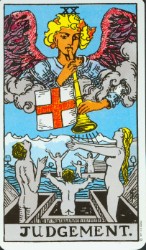
I was watching a presentation from Mike Dooley the other day and he was talking about the importance of our belief systems. For those of you who aren’t familiar with Dooley’s work, he’s a strong advocate of the idea that, “thoughts become things,” and teaches visualization and manifestation techniques. His take on belief systems is that they act as, “regulators,” for what we allow ourselves to think, and since thoughts become things, our beliefs determine what we’re going to think and, therefore, what’s going to manifest in our lives. Our beliefs determine the Judgments that we make about life, which determine the course that our life takes.

For instance, if we have a strong, unconscious belief that we’re unattractive it’s very unlikely that we’ll be able to visualize ourselves with a good, loving partner. We can’t even THINK of that happening, and so it doesn’t. If we have a strongly held belief that rich people are evil, we’re not going to be able to attract money into our lives because we don’t want to see ourselves as evil.

Those are belief systems on a personal level. There are also what we might call, “meta belief systems,” that operate on a more elevated basis. These are systems like religions and politics and they interact with our personal belief systems. Most people in the United States are Christians and an inherent element in that religion is that people are, “sinners,” that life is suffering, and that there’s a loony tunes god in charge who might just throw you into a pit of eternal flames because you masturbated last night.

We can contrast that world view with this statement from the Dalai Lama: “I believe that the purpose of life is to be happy. From the moment of birth, every human being wants happiness and does not want suffering. . . From the very core of our being, we simply desire contentment. I don’t know whether the universe, with its countless galaxies, stars and planets, has a deeper meaning or not, but at the very least, it is clear that we humans who live on this earth face the task of making a happy life for ourselves.

If we believe in the so-called Law of Attraction – the idea that we draw into our lives people and events that are a match with our energy, emotions, and ideas – then we can see where these two belief systems would have massive implications in our personal lives. If we accept the classic Christian view that people are basically evil and life is shit because we got, “thrown out of the garden,” what are we going to attract into our lives? Evil people and shitty experiences. If we listen to the Dalai Lama and believe that the purpose of life is to be happy, we’ll automatically seek out happy people and create positive experiences in our lives.

All of this operates on an unconscious level, of course. If you were to ask the average Christian if she believes that people are rotten and life is meant to be suffering, she would very likely say no. But that’s exactly what we were taught in Sunday schools and church services when we were forming our views of life and were too young to make realistic assessments. All of those buttons – guilt, sin, life hurts – were installed on our control panels and they’re just waiting to be pushed.

Don Miguel Ruiz talks a lot about this in The Four Agreements. As he put it, most of our belief systems are just, “dreams,” illusions passed down from one generation to the next or forced onto us by our society and they remain largely unexamined. Democrats (or Republicans) are evil. People are no damned good. America loves peace (even though we sell more weapons than any other country in the world.) Monogamy works (even though about half of the people who try it get divorced.) Liberals are socialists. Conservatives are fascists. God’s a male. There is no God. We all have tons and tons of opinions and viewpoints that we live by, that we design our lives around, and, for the most part, we haven’t thought about them very much.

I once read about a woman who went into an absolute fury every time that her husband would put his cap on the kitchen table. When he questioned her about it, the only thing she could say was, “It’s just wrong.” She realized that her mother had taught her that lesson, so she asked her mother why it was wrong. Her mother’s response was that her mother had taught her that it was a terrible offense. She finally worked her way back to her great grandmother who started laughing and said, “Oh, lord, child, when I was young everyone had head lice. That’s why it was wrong to put your hat on the table.”

So three generations of her family had passed down a very strong belief and reaction about a simple behavior like putting a hat on a table. And none of them, until her, had ever questioned the belief or wondered what was behind it.

The sad part of this is that so many of our beliefs and judgements are just like that: totally unconscious ways of judging the world and ourselves that were passed down to us by people who weren’t thinking about them and accepted by us without thinking about them.

That’s also the good news.

Once we accept the idea that a lot of our most cherished beliefs – if not most of them – are constructed on total bullshit, then we can just get rid of them. It sounds like a really radical idea when we first encounter it but why not? Why not just get rid of beliefs that limit us and restrict us, and adopt beliefs that serve us better and allow us to expand our lives?

For instance, the belief that I’ll NEVER have enough money, shuts me down and keeps me frozen in place. The belief that the Universe is filled with abundance and I deserve my share opens me up to expanding and receiving. The belief that I have a RIGHT to be angry keeps me upset and repels positive people. The belief that I have a RIGHT to be a loving person attracts positive, loving people into my life and reinforces the idea that I’m lovable.

The Tibetan Buddhist teacher Chagdud Tulku Rinpoche said that most of us will never become enlightened in this life and that we’ll continue to live in the dream of illusion. But he also said that we CAN decide whether we want to have a good dream or a bad dream. And the road to a good dream starts with our beliefs about that dream.

The Moon Card, Insanity, and 40 Rolls of Toilet Paper

Moving toward a new definition of normality after the pandemic.

So . . . we appear to be coming out of the other end of the corona virus pandemic.  After a year plus of being told to stay home, live in isolation, and wear masks, we’re being told that it’s at least semi okay to start to take off the masks and socialize a bit.  It’s rational to have some hope that we’re not all going to die horrible deaths in understaffed Intensive Care Units.

Huzzah!  Now we can get back to normal!

The question that I’ve been dealing with lately is what exactly IS, “normal?”  And, secondarily, did I ever really, truly KNOW what normal is?  Because it appears to me, in looking back over the past year, that a whole lot of people are a whole lot crazier than I ever thought they were.

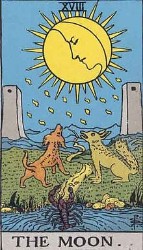
The Moon is, “the crazy card,” in the Tarot.  It represents insanity, delusions, illusions, self-deception.  The juxtaposition of the dog and the wolf howling at the moon show us that our evolution from pure animal state was not that long ago.  The crawfish crawling out of the water shows our most primitive, prehistoric state of being emerging from its murky depths.

We’ve seen a lot of murky depths and de-evolution over the last year.  Two things stand out in particular.

The first is The Great Toilet Paper Insanity of 2020.  We, as a society, received the news that we were faced with a horrible epidemic that could kill millions and millions of people.  A virulent plague such as the world hadn’t seen in a hundred years.  Humans were dying like flies in a cosmic spider web in China, Italy, New York, and no end was in sight.  

And our response was . . . BUY TOILET PAPER!!!  Lots and lots and lots of toilet paper.  Buy so much toilet paper that the shelves of grocery stores would be stripped of the stuff for months.  Buy more toilet paper than we could use in five years. If elderly people and weak people who couldn’t shoulder their ways into the head of the line didn’t have any toilet paper because we’d bought it all . . . well, FUCK them!

It was truly insane in the real definition of the word.  You can’t eat toilet paper.  You can’t heat your house with toilet paper.  You can’t wrap your shivering body in toilet paper during the freezing winter months.  Toilet paper – to a sane mind – has a very limited value in our overall lives.  It’s good for wiping our asses and blowing our noses.  Period.

Yet, in a matter of just a few weeks, people had been hypnotized into believing that it was the most valuable commodity on earth.  And it was a truly bipartisan hypnosis.  This wasn’t just a bunch of far right, neo-conservative survivalists hoarding toilet paper.  I have friends on social media who are life-long, foaming at the mouth, liberal-progressives who were proudly posting pictures of the two hundred rolls of toilet paper they had stashed in their hall closets.

Huh . . . who could have seen that coming?  In all of the post-apocalyptic movies we’ve seen, in all of the creepy end-of-civilization Stephen King novels we’ve read, has anyone EVER mentioned toilet paper?  Was there EVER a scene of a howling mob breaking into a grocery store and killing each other over . . . toilet paper?

Not.

The second, much darker, much more disturbing scenario that emerged was the embrace of the, “herd,”  vision of humanity, particularly as it applied to frail people and old people.  At a certain point, the medical model of the virus that emerged was that it was very likely to kill older people and people with pre-existing health problems, less likely to kill healthy middle aged people, and unlikely to kill younger people.

Using that knowledge base, a pretty brutal theory emerged:  for the sake of, “the herd,” it would be better if older people and sick people were exposed to the virus and just . . . you know . . . died.  The Lieutenant Governor of Texas actually said that it was somehow the DUTY of older people to get out there, get exposed to the virus and die, because that would get the economy open faster and there, “are more important things than living.”   

Strong evidence has emerged that the anti-mask movement that many of us found so puzzling was never about, “political freedom,” at all.  It was about ensuring that the maximum number of people would be exposed to the virus as quickly as possible in order to achieve “herd immunity.”

Now, that’s basically one small step down from Nazi eugenics.  It’s a theory that views humans as a herd, rather than as individuals.  If there are members of the herd who are sick or old, they need to be, “culled,” out so that the herd will stay healthy and vital.  Yes, millions of people will die, but think how much healthier we’ll be AS A WHOLE after all of them are dead!

It’s exactly the same mentality that led the Nazis to proclaim that, “the Herd,” (the Master Race) would be SO much better after we eliminated the Jews, the Blacks, the Gypsies and pretty much anyone who wasn’t a pure aryan, whatever the hell that is.  If you’re willing to expose people to a virus that you KNOW is going to kill them, that’s essentially a gas chamber mentality.

The salient point, of course, is that we AREN’T a herd.  We’re a society.  One of the hallmarks of virtually all societies is that they take care of people who are old and ill, they don’t just kill them.  We don’t toss Grandma into a lake with a cinder block around her neck because she’s become a bit of a pain in the ass.  We don’t execute people because they’ve got cancer.

So, yes, in reviewing this last year, I have to conclude that there are a whole bunch of us who are pretty fucking nuts.  And some of us are pretty fucking nuts and pretty fucking brutal.

The question is –  being realistic and acknowledging those facts – where do we go with that knowledge?  How do we react to the idea that the lunatics seem to be running a large part of the asylum?  Do we withdraw and hide?  Do we view other people with contempt or fear?

The only thing I’ve been able to come up with is to just react with compassion.  

In The Four Agreements: A Practical Guide to Personal Freedom (A Toltec Wisdom Book) don Miguel Ruiz points out that many people are barely conscious.  They’ve been programmed by their parents, their churches, their schools, and society at large to NOT think.  To NOT question their values or their reality.  They just get wound up like little robots when they’re children and they go through their lives never really waking up.  In essence, they’re Sleep Walkers, stumbling around in the darkness and not even having their own dreams.

When we see something like The Great Toilet Paper Insanity of 2020, it just reinforces that truth.  If your response to a life threatening situation is to grab as much toilet paper as you can, you’re not thinking, you’re not reasoning, you’re not even awake.  And that is sad and that deserves compassion.

If your response to a life threatening situation is to view other humans as being somehow expendable so that you have a better chance to live, as mere members of a herd, then you’re cut off from love, from empathy, from basic human decency, and you’re living in fear.  And that is sad and that deserves compassion.

 What I believed to be, “normal human behavior,” has turned out to be a pretty thin veneer over a LOT of crazy shit. I’m probably going to be a little more cautious around my fellow humans after this, a little less open and willing to believe that we have a common vision of the world.  But I also know I’m going to be a lot more compassionate toward them.

And that’s a good thing.  Hell, I’d trade 40 rolls of toilet paper for a little more compassion.

Disclaimer: “As an Amazon Associate I earn from qualifying purchases.”

The Sun Card and The Uncarved Block

Seeing the human Soul in the Taoist concept of The Uncarved Block.

One of the core tenets of Taoism is an idea called, “The Uncarved Block,”  or, as it’s written in Chinese, “Pu,” (not to be confused with The Tao of Pooh although it IS the Tao of Pu.)  

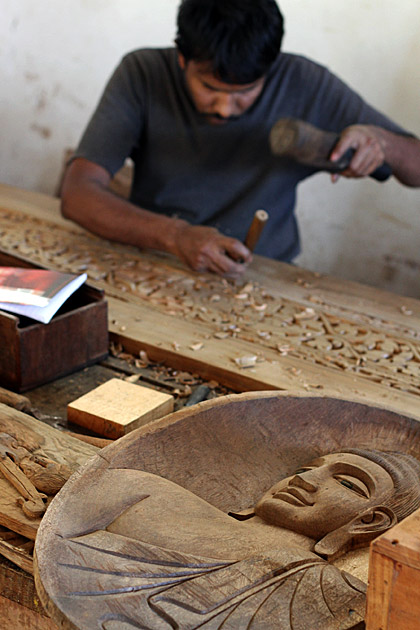
It refers, quite simply, to a piece of wood that’s never been touched, never been carved into a statue or an ornament or a utensil.  It’s just the wood, as it came into and grew into this world.  It’s in its’ primal, original state of being.

When the term is used to refer to the human experience, it means the primal state in which WE came into this world, untouched by experiences, prejudices, or dualistic thinking.  And, of course, it implies that there was a SOMETHING that arrived when we were born, other than just a tiny little human body.  There was a primal NATURE that came into the human body. Some people call it a Soul.

This has actually been a pretty hot topic for philosophers and psychologists for hundreds of years.  Are we just reducible to the sum total of our bodies and brains, or is there something else that’s greater and somehow inhabits our bodies and brains?  Another way of putting it is, “nature versus nurture:”  are we born with a certain nature, an essence that existed before our birth, or are we simply whatever we learn as we go along in life, whatever we learn by being nurtured by our culture?

Aristotle came down firmly on the nurture side of the equation, saying that we are born as a, “tabula rasa,” a blank slate that life and culture writes upon.  There is no soul, no pre-existing essence. The idea was later picked up by the English philosopher John Locke and thus made its way into modern psychology.

New Thought writers, of course, are advocates of nature, of the idea of our having a Soul that, “arrives,” in this world using the vehicle of our bodies.  What’s more, they see the Soul as being pretty cool when it dances into the physical world.  To quote Esther Hicks/ Abraham in Ask and It Is Given: Learning to Manifest Your Desires

“You are eternal beings who have chosen to participate in this specific physical life experience for many wonderful reasons . . . You are eternal Consciousness, currently in this wonderful physical body for the thrill and exhilaration of specific focus and creation.”

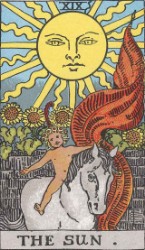
In other words, when we first get here we are beautiful, spiritual beings, full of joy, who have come here on a mission that INCLUDES having a lot of fun.  To use a phrase from AA, we are happy, joyous, and free.  We would feel a lot like The Sun Tarot card looks.

We arrive as beautiful, innocent, children, full of elation and radiating the euphoria of being alive in this enchanted garden that we call the Earth.  We are naked and unadorned, and our original nature, our essence, our, “uncarved block,” is love.  Pure love.

But then something happens.  Perhaps we forget our original nature in the process of transitioning from being Spirits to existing in physical bodies.  Perhaps, as some children do, we remember our original nature and still see the angels and the fairies, but our families and society soon beat that magic out of us.  As Don Miguel Ruiz put it in The Four Agreements: A Practical Guide to Personal Freedom (A Toltec Wisdom Book)

“We are born with the capacity to learn how to dream, and the humans who live before us teach how to dream the way society dreams . . . we learned a whole new reality, a whole new dream.  We never had the opportunity to choose what to believe or what not to believe.”

And we find ourselves wandering in Paradise, lost in the collective dream of our existence, with no memory that we are something far, far greater than our mere physical bodies.  As the bible expressed it – in a phrase that christians never, never, never EVER quote – because then we wouldn’t need preachers:  “You are gods, sons of the Most High, all of you.” 

 Or to use Joni Mitchel’s riff on it, “We are stardust, we are golden, and we’ve got to get ourselves back to the garden.”

That’s the rub, that’s the rough part for most of us: just remembering that we ARE spiritual beings and getting back to that garden.  It’s not as if society exactly encourages us to act like we’ve all got Souls.  If we really believed that we’re all part of the Divine, we’d treat each other with a shade more respect, wouldn’t we?  If we actually looked at killing as killing a part of the Divine, we’d have a lot fewer wars, doncha think?

It’s actually become quite fashionable to laugh at the idea of a Soul.  Many people view it as an anachronistic belief on a par with the idea that god is an old man sitting on a golden throne.  Just silly crap that’s left over from our primitive religious views.

Can we PROVE that there’s a Soul?  Of course not.  Can materialists or atheists prove that there ISN’T a Soul?  Of course not.  What we CAN do is to intuit that there is a something that lies beyond and beneath our ordinary consciousness and reality.

In discussing the difference between the ego and what we really are in A New Earth: Awakening to Your Life’s Purpose (Oprah’s Book Club, Selection 61) Eckhart Tolle says:

“What a liberation to realize that the ‘voice in my head’ is not who I am.  Who am I then?  The one who sees that.  The awareness that is prior to thought, the space in which the thought happens.”

In a similar vein, Jeffrey Schwartz, who is a neuropsychiatrist and uses very strict scientific standards of proof,  argues in You Are Not Your Brain: The 4-Step Solution for Changing Bad Habits, Ending Unhealthy Thinking, and Taking Control of Your Life that there is something beyond the mere thoughts that our physical brains generate, something that directs our focus and can override our thoughts.  He calls it, “The Wise Advocate,” and it sounds very much like the description of a Soul.

“The Wise Advocate knows what is best for you, it loves and cares for you, so it encourages you to make decisions in a rational way based on what’s in your overall best interest in the long term.”

That Wise Advocate, that space that exists between our thoughts, is where our Soul lives.  It’s where our Soul is still naked, beautiful, innocent, and playing.  It’s our original nature, our uncarved block.  

All we have to do is find it again. Or at least try to be a chip off the old block.