
Karma, Having Sex with Republicans, and Being Kind to Yaks

Seeing karma as a way to change our past.

One of my favorite internet memes says, “Karma – It’s spelled K-A-R-M-A and it’s pronounced, ‘Ha, ha, fuck you.’”  

That’s a perfect explanation of our usual understanding of karma which is basically, “If you do some shit, you get some shit.”  If we do something terrible to another person, something terrible is going to happen to us. If we do something nice, something nice is going to happen to us.

OH, WELL, IT’S KARMA

Counter-intuitively, karma is also used an explanation for why bad things happen to good people.  We may have a friend who’s a wonderful person and goes through his life supporting and nurturing others, who’s full of love and gentleness and kindness.  And then something horrendous happens to him, like he falls of a cliff or discovers his wife is having sex with a Republican.

We simply can’t understand why such a good person would have such bad luck.  Certainly, he did nothing to deserve it and, according to the Law of Karma, all of his good behavior should have been rewarded with good things happening to him.

But . . . we’re told . . . perhaps he did something really, really terrible in a previous incarnation.  Maybe he pushed someone off of a cliff or maybe he had sex with a Republican.  Maybe he actually – shudder – enjoyed having sex with a Republican.

That allows us to restore some sense of cosmic balance and we say, “Oh, well, it’s just karma.”

IT AIN’T ME, BABE

We can certainly understand that concept when something bad happens to someone else, but it’s difficult to swallow when it happens to us.

Let’s face it, most of us are NOT the Dalai Lama and we have very little memory of our past lives.  We may accept the general idea that we’ve lived other lives, but we don’t actually remember being a Yak herder in Mongolia in 40 A.D. or a courtesan in Paris during World War I. 

From our current point of view, those people who we were in our past lives were literally someone else and not us.  

The idea that I broke my wrist today because some other guy kicked a Yak 2000 years ago seems entirely capricious and cruel and unjust.  It feels like . . . how shall I put this? . . . bullshit.

KARMA AND DETERMINISM

From that perspective, karma feels very much like determinism.  Determinism is the view that every single thing that happens to us is pre-determined from the moment of birth.  There really isn’t any free will or choice in life because our lives are a result of our genetics, our cultures, the families we’re born into, and the times we live in.

We can actually make a strong case for that.  Even in the United States, where we worship the idea of free will and choosing our own destinies, the statistics say it ain’t so.  If we’re born into a dirt poor family, we’ll probably die dirt poor.  If we’re born into great wealth, we’ll probably die rich.   If our parents were conservative Catholics, we’ll probably be conservative Catholics.  If our grandfather hated socialists for no particular reason, we’ll probably hate socialists for no particular reason.

We tell ourselves that we’re making choices about those issues, but for the most part we aren’t.  It was all programmed into us before we came down the birth canal.  Life is something that happens to us, not something that we create.

Karma can feel a lot the same way.  I, me, the person who I am right now, did NOT kick that Yak 2000 years ago, so why am I being punished for it?  It’s something that’s just happening to me, not something I can control or make any choices about.

BUT KARMA’S A CHOICE

Paradoxically, being the people who we are, right here, right now, is the good news about karma.  

Determinism basically says, “You’re fucked or you’re not fucked and there’s not one damned thing you can do about it.  You have NO choice in the matter.”  It’s all predetermined.

The Law of Karma, on the other hand, says that what we do right now is what really counts.  Far from saying that we have NO choice in the matter, karma is saying that we always have a choice.  And our choices are what determine our karma.

As David Michie said in, “Buddhism for Busy People,” 

“A lot of Western people wrongly think that karma equals fate or predestination.  They think it’s something you don’t have any power to change.  This is a misunderstanding.  It is we who create our own karma and we can change it in a powerful, dynamic way. We are creating hundreds, even thousands of such causes every day of our lives.”

Put another way, we are creating our own karma ALL THE TIME.  It’s not something from the past that just pops up to bite us in the ass every once in a while.  It’s not like The Wheel of Fortune, where we have good luck for a while and then bad luck, for no apparent reason.  It’s something we personally create by either being good people or being bad people.

THE PRESENT AS PROLOGUE TO THE PAST

Now, there’s a particularly fascinating doctrine in some schools of Buddhism that says that we can actually change our past karma by how we behave in our present lives.  

Suppose, for instance, that I was a really notorious Yak kicker in Mongolia in 40 A.D.  I didn’t just kick Yaks occasionally.  No, I was a mean, nasty, evil spirited son of a bitch who got up every single morning and kicked the hell out of as many Yaks as I could reach.

Fast forward 1985 years to my current life.  Suppose I start an, “adopt a Yak program,” and spend years rescuing and feeding homeless Yaks.  I learn to love Yaks and have great compassion for them.  Perhaps I even dress them in Yak finery for special occasions.

Under this particular doctrine, I wouldn’t JUST be creating good karma for my present self.  My good karma would go backwards through time and actually change the character and behavior of my previous self, the notorious Yak kicker. He might learn to love Yaks just as much as I do and my bad Yak karma would be erased.

IT’S NOT THAT WILD

If that sort of time traveling karma sounds a little too wild, just consider what most of us already believe about karma.

We believe that we have one Soul with many different historical identities and that what a previous identity does can travel through time to affect the life of our current identity.  So if all of these past identities are somehow in touch with our current identity, why wouldn’t our current identity be in touch with our past identities?  If they can affect us, it stands to reason that we can affect them.

KARMA AS AN ONGOING PROJECT

When we shift our perspective in that way, then karma becomes an on-going project.  We’re no longer victims of our past.  We’re actually re-creating our past through our current actions.

And if that isn’t free will and choice, I don’t know what is.

Being compassionate, decent people every day and right now is good for us and it’s good for the people around us.  And, ultimately, it’s good for the Yaks.  

Do it for the Yaks.
Just a reminder that my ebook, “Just the Tarot,” is available on Amazon for much less than a bag of Yak feed.

The Five of Pentacles, Karma, and God’s Little Baskets of Muffins

Transforming ourselves through karmic selfishness.

I have a younger friend who HATES karma.

More specifically, he hates when he’s in the middle of an, “Oh poor me,” bitching session and someone shrugs her shoulders and says, “Well, that’s karma.”  

First of all, it interrupts the rhythm of his complaining and he has to go back and remember what he was so upset about.  

“What was I saying?  I know it was important . . . oh, I remember . . . life is meaningless and no one understands me . . .”

Secondly, it infuriates him because it suggests that the mess he finds himself in is somehow HIS fault and the whole point of his rap is that it’s everything and everyone else’s fault.  Which is just further proof that no one understands him.

This guy was raised by a Buddhist and that may have something to do with his constant irritation.  It’s developmentally important that teenagers be able to rebel against their parents.  The first way that we really begin to define who we are in the world is by making it clear that we aren’t our parents.  I imagine that it must be pretty damned difficult for a teenager to get any rebellion traction against a Buddhist parent.

“You know, Dad, sometimes I really hate you.”

“Well, son, all strong emotions will pass if we simply do a little deep breathing.  Remember, you’re the sky and your emotions are just clouds drifting by.”

Or

“I’ve been think about getting a tattoo.  What do you think about that?”

“Ah . . . perhaps you should get a tattoo of a double dorje or some other sacred symbol.  In a sense, it would be a constant reminder of the spiritual nature that dwells in physical matter.”

Or

“Maybe I’ll paint my face blue and dye my hair orange.”

“Hmmm . . . I wonder if you were a Druid in a past life.  Do you feel a particular attraction to oak trees?”

Aargh!  So it’s possible that this guy was deeply emotionally scarred by all of that loving kindness and unconditional acceptance from his parents.  If only they’d yelled at him or told him he was an idiot occasionally!  

Still, he does have a bit of a point about the notion of karma.

It’s perfectly understandable that people get a little riled up over the idea of crappy things happening to them because of what they may have done in a past life.  After all, most of us have absolutely no memory of our past lives and so it feels like we’re being punished for something that someone else did.  

Suppose I was Attila the Hun in a past life and in a fit of Barbarian Rage I whipped out my scimitar and beheaded a turtle.  Then 200 lifetimes later –   as Dan Adair –  I’m in a traffic accident and I get whiplash BECAUSE I decapitated that turtle.  That seems a little . . . unjust.  I mean, I’m NOT Attila in any sort of a meaningful sense, so why should I get sent to the principal’s office because Attila was a dick?

And then, to make it even worse, when I’m sitting there in my cervical collar reflecting on exactly HOW unjust it all is, an acquaintance says, “Oh, well, that’s karma.”  As my younger friend would put it:  “Fuck you.”

Now, there’s a particularly odious Christian doctrine called, “predestination.”  It holds that some people are born with the unchangeable destiny that they’re going to heaven when they die. Other people are born with the unchangeable destiny that they’re going straight to hell when they die.  It doesn’t matter what we do or how we behave, our ultimate destiny has already been decided at the moment of birth.

It’s like God is up there in the Kosmic Kitchen baking up human Souls and, as he pulls each one out of the Soul Muffin Pan, he tosses them into separate baskets marked, “Heaven,” and, “Hell.”

“Okay, heaven, heaven, heaven – whoops, you’re fucked – hell, heaven, fucked again, heaven . . .”  Like the beggars in the Five of Pentacles, we’re out in the cold and we’re going to stay there.

Theologians came up with a perfectly logical reason for this totally insane doctrine.  The idea is that God is all powerful and all knowing.  So if God knows everything, then that must mean that he knows everything that happened in the past, the present, AND the future!  And if God already knows what’s going to happen in the future, then he must already know who’s going to heaven and who’s going to hell.  Shazam!  There you are – it’s already determined.

That’s the kind of weird, Left-Brain, cuckoo for coco puffs vibe that a lot of people get off of the notion of karma.  It seems to be some sort of an inexorable process that was put into motion a long time before we came along and there’s not a damned thing we can do about it.  We’re either in the Heaven Basket or we’re in the Oh, You’re So Fucked Basket.  Like it’s something that happens TO us for no particular reason.

Of course, the important point that most of us miss is that karma isn’t happening to us, we’re happening to karma.  It’s a totally dynamic process and it’s something that we can change every single day simply by the ways that we behave right now.

The most simplistic way to think of it is as a sort of a bank account.  Rather than being born into a You’re-Going-to-Hell Basket or a You’re-Going-to-Heaven Basket, we’re born with a certain amount of Karmic Kash that we earned (or didn’t earn) in past lives.  The Dalai Lama will probably be reborn with several savings accounts, a really huge checking account, many certificates of deposit and a great coin collection.  Attila the Turtle Beheader, on the other hand, will be reborn with 50 cents in the bank and a lot of overdue bills.

The thing is, though, that the way that we’re born isn’t our destiny.  The way that we behave is our destiny.  Attila, for instance, might start a refuge for homeless turtles.  Every single time that he saves a turtle and gives it a meaningful life – KA -CHING – that’s another deposit in his Karma Account.  The Dalai Lama, on the other hand, might decide to support Eric Trump for President and – ZAP – that’s a major withdrawal from his Karmic Account.

As David Michie said in, “Buddhism for Busy People,” 

In what is one of the most outstandingly ingenious aspects of Buddhist teachings, we come to realize that our own selfish interests lie in being altruistic . . .months, years or decades of being generous for selfish reasons begin to have a predictable effect . . .what starts out as a contrived and self-conscious change of attitude and behavior results in a genuine metamorphosis.

In other words, we don’t have to start out as Mother Theresa or an Awakened Master.  We can start out as perfectly normal, selfish, self-centered human beings who are being kind to other beings because we DON’T want to end up wearing a cervical collar.  When we pick up a turtle that’s in the middle of the road and leave it safely on the other side, we can be doing it for the completely selfish reason of wanting to fill up our Karmic Account.

As we continue those little acts of kindness they gradually transform us.  They become acts of loving/kindness, where we’re actually noticing and caring about the welfare of the people and beings around us.  The translation of the word, “karma,” is, “action,” and that’s the key.  Our actions change us, even if they originate in selfishness.

And that’s how Attila the Hun becomes the Dalai Lama.  Pretty simple.

Happy Buddhists, Christian Apple Munchers and Garden Gnomes in Tutus

Why Buddhism is actually a happy religion.

The Dalai Lama giggles a lot.  Have you ever noticed that?  On a certain level, he seems to find life to be absolutely hilarious.  For instance, there’s this wonderful interview that Barbara Walters did with him and, toward the end of the video, he absolutely cracks up about the fact that Eskimos kiss each other by rubbing noses.

It seems a little strange because Buddhism has a reputation for being a very dark, solemn sort of a religion.  That reputation probably flows out of the Buddha’s admonition that, “life is suffering,” which is not exactly what he said, but it’s the way that it’s frequently translated.  So we have this religious doctrine that seems to say that life is suffering, yet we see Buddhists like the Dalai Lama and Thic Nhat Hahn who not only seem to be happy, they seem to be really, really, REALLY happy.

What’s up with that?

The tarot card, The Hierophant, is all about formal doctrine, rather than first hand experience.  Religion, rather than spirituality.  It represents what religions SAY they are, rather than the way that they’re actually practiced on a daily basis by their followers.  Oddly, there’s a curious optimism that permeates Buddhism once we get past the doctrines and get into the actual experience of, “living Buddhism.”  

Although I’m sure that the Buddha wouldn’t dig my doing this because it involves a lot of judgment,  one of the best ways to illustrate that optimism  is by contrasting it with the dominant Western religion, Christianity.  In particular, how do the two religions actually VIEW human beings?

Christianity starts out with the basic premise that humans are miserable, flawed sinners.  According to Christian doctrine, we’re actually born that way, which doctrine is referred to as, “original sin.”  Now, it’s kind of hard to get a grasp on what original sin really means, but when you wrestle it to the ground it seems to mean that every single one of us was born with, “the stain of Adam,” on our souls.  Which goes back to Adam and Eve getting thrown out of the Garden of Eden because that bitch Eve just HAD to have an apple

I know, right?  It’s kind of hard to figure the reasoning.  Still, it appears to say that because our great, great, great, great, great grandmother to the hundredth power munched on an apple, we’re all born sinners and destined to go straight to hell if we don’t find redemption.  That’s also, by the way, the reason that women have been, “cursed,” with having periods every month.

I’m not making this shit up.  

So, according to Christianity, at the core of every human being there’s a rotten, sinful, apple muncher and we come into the world that way.  That’s why you’ve got to get babies baptized right away, because babies are basically pure evil, as we all know.

The Buddhist viewpoint is very much the opposite.  Buddhists believe that at the core of every human being is absolute perfection.  We just don’t know it.  Tibetan Buddhist Master, Chagdud Tulku Rinpoche, described this by saying that we all have a beautiful jewel at the center of our hearts which is covered over by common rock.  Our job is to slowly chip away at the rock that’s covering our jewel so that more and more of it is exposed as we go through our lives. Yes, life is suffering, but it’s suffering because we remain ignorant of our true nature, which is bliss and joy.

To put all of that in a nutshell, Christianity says that we should pretty much hate ourselves and Buddhism says that we should pretty much love ourselves.  It shouldn’t be a major news flash to anyone that hating yourself feels really, really bad and loving yourself feels really, really good.

Which may be why the Pope doesn’t do a lot of giggling.

There’s another major implication here, which is that Chrisitanity views, “salvation,” as coming from an outside source and Buddhism sees it as very much of an inside job.  Christianity says that we are SO fucked up and miserable and down in the dirt that we literally have no chance of saving ourselves.  We just have to pray and hope that Jesus is going to ride in on his white horse and whack us with his redemption wand and THEN we get to go to heaven.

Buddhists believe that our salvation, our Buddha nature, is already inside of us, so ANYONE can become a Buddha.  That means you, me, our Aunt Gertrude, or even the weird guy down the block who collects garden gnomes and dresses them in tutus. And we don’t get there by some outside deity or force, “forgiving us,” we get there by sitting our asses down on the meditation cushion and by practicing love and compassion in our daily lives.

Which is a lot of work and a lot of responsibility but it’s also tremendously liberating.  It’s looking at ourselves and realizing that if we’re not happy it’s because we didn’t do the work.  We may have talked the talk but we didn’t walk the walk.  We didn’t uncover that jewel inside of us.  It’s TOTALLY up to us.

Wow!

Another probable reason that the Dalai Lama giggles a lot is that Buddhists believe that we are all connected.  I don’t mean that in some generalized sense of, “our common humanity,”  or, “our shared heritage,”  or the Christian sense that we’re all, “born in sin.”  No, I mean, really, genuinely, energetically connected to each other, just like there’s some invisible thread that runs from me to you and from you to another person and so on and on.  Whatever we’re feeling and experiencing emotionally and spiritually is going out into a sort of a giant, collective web of consciousness and affects not just us, but everyone else, as well.

Think of it this way:  if we’re going out grocery shopping and we’re in a really high vibrations, zippety doo dah sort of a mood, some of that positive energy is going to spark off of us to everyone we encounter, from the kid stacking tomatoes at the vegetable section to the cashier who checks us out.  On the other hand, if we’re in a really sour bah humbug fuck you mood, some of that negative energy will be transferred to other people as well.  We leave everyone we meet either feeling a little better or a little worse.

Now take that same phenomenon of energy transfer and magnify it to influencing every person on the entire planet.  That doesn’t mean that if we wake up in a rotten mood trains will crash and someone’s flower garden will die.  But it does mean that everything we’re feeling is radiating out to everyone else, even if it’s one little drip at a time.  The way that the Buddha put it was:

“Goodness, like rain in a bucket, gathers one drop at a time.

Evil, like rain in a bucket, gathers one drop at a time.”

So, if you’re a really highly evolved, spiritually aware person and you KNOW that everything you’re feeling is affecting everyone else, what are you going to do?  Are you going to sit around your house feeling like crap and radiating out bad vibes?  Or are you going to try to stay in as high and loving a place as possible, as much of the time as possible, and send out good vibes?

Obviously, you’re going to try to stay as happy as possible.  And if you stay as happy as possible, for a long enough period of time, you’ll probably start to giggle.

Judgments, The Dalai Lama, and Putting Your Hat on the Table

How our belief systems affect our lives.

There’s an old saying that the reason our parents can push our buttons is that they installed the control panel. And there is so much truth in that.

I was watching a presentation from Mike Dooley the other day and he was talking about the importance of our belief systems. For those of you who aren’t familiar with Dooley’s work, he’s a strong advocate of the idea that, “thoughts become things,” and teaches visualization and manifestation techniques. His take on belief systems is that they act as, “regulators,” for what we allow ourselves to think, and since thoughts become things, our beliefs determine what we’re going to think and, therefore, what’s going to manifest in our lives. Our beliefs determine the Judgments that we make about life, which determine the course that our life takes.

For instance, if we have a strong, unconscious belief that we’re unattractive it’s very unlikely that we’ll be able to visualize ourselves with a good, loving partner. We can’t even THINK of that happening, and so it doesn’t. If we have a strongly held belief that rich people are evil, we’re not going to be able to attract money into our lives because we don’t want to see ourselves as evil.

Those are belief systems on a personal level. There are also what we might call, “meta belief systems,” that operate on a more elevated basis. These are systems like religions and politics and they interact with our personal belief systems. Most people in the United States are Christians and an inherent element in that religion is that people are, “sinners,” that life is suffering, and that there’s a loony tunes god in charge who might just throw you into a pit of eternal flames because you masturbated last night.

We can contrast that world view with this statement from the Dalai Lama: “I believe that the purpose of life is to be happy. From the moment of birth, every human being wants happiness and does not want suffering. . . From the very core of our being, we simply desire contentment. I don’t know whether the universe, with its countless galaxies, stars and planets, has a deeper meaning or not, but at the very least, it is clear that we humans who live on this earth face the task of making a happy life for ourselves.

If we believe in the so-called Law of Attraction – the idea that we draw into our lives people and events that are a match with our energy, emotions, and ideas – then we can see where these two belief systems would have massive implications in our personal lives. If we accept the classic Christian view that people are basically evil and life is shit because we got, “thrown out of the garden,” what are we going to attract into our lives? Evil people and shitty experiences. If we listen to the Dalai Lama and believe that the purpose of life is to be happy, we’ll automatically seek out happy people and create positive experiences in our lives.

All of this operates on an unconscious level, of course. If you were to ask the average Christian if she believes that people are rotten and life is meant to be suffering, she would very likely say no. But that’s exactly what we were taught in Sunday schools and church services when we were forming our views of life and were too young to make realistic assessments. All of those buttons – guilt, sin, life hurts – were installed on our control panels and they’re just waiting to be pushed.

Don Miguel Ruiz talks a lot about this in The Four Agreements. As he put it, most of our belief systems are just, “dreams,” illusions passed down from one generation to the next or forced onto us by our society and they remain largely unexamined. Democrats (or Republicans) are evil. People are no damned good. America loves peace (even though we sell more weapons than any other country in the world.) Monogamy works (even though about half of the people who try it get divorced.) Liberals are socialists. Conservatives are fascists. God’s a male. There is no God. We all have tons and tons of opinions and viewpoints that we live by, that we design our lives around, and, for the most part, we haven’t thought about them very much.

I once read about a woman who went into an absolute fury every time that her husband would put his cap on the kitchen table. When he questioned her about it, the only thing she could say was, “It’s just wrong.” She realized that her mother had taught her that lesson, so she asked her mother why it was wrong. Her mother’s response was that her mother had taught her that it was a terrible offense. She finally worked her way back to her great grandmother who started laughing and said, “Oh, lord, child, when I was young everyone had head lice. That’s why it was wrong to put your hat on the table.”

So three generations of her family had passed down a very strong belief and reaction about a simple behavior like putting a hat on a table. And none of them, until her, had ever questioned the belief or wondered what was behind it.

The sad part of this is that so many of our beliefs and judgements are just like that: totally unconscious ways of judging the world and ourselves that were passed down to us by people who weren’t thinking about them and accepted by us without thinking about them.

That’s also the good news.

Once we accept the idea that a lot of our most cherished beliefs – if not most of them – are constructed on total bullshit, then we can just get rid of them. It sounds like a really radical idea when we first encounter it but why not? Why not just get rid of beliefs that limit us and restrict us, and adopt beliefs that serve us better and allow us to expand our lives?

For instance, the belief that I’ll NEVER have enough money, shuts me down and keeps me frozen in place. The belief that the Universe is filled with abundance and I deserve my share opens me up to expanding and receiving. The belief that I have a RIGHT to be angry keeps me upset and repels positive people. The belief that I have a RIGHT to be a loving person attracts positive, loving people into my life and reinforces the idea that I’m lovable.

The Tibetan Buddhist teacher Chagdud Tulku Rinpoche said that most of us will never become enlightened in this life and that we’ll continue to live in the dream of illusion. But he also said that we CAN decide whether we want to have a good dream or a bad dream. And the road to a good dream starts with our beliefs about that dream.

The Star Tarot Card – Ishtar, The Dalai Lama, and the Re-Emergence of The Goddess

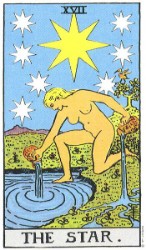
Just who is the mysterious woman in the Tarot card, “The Star?”  She’s one of what I call, “the astronomical cards,” that are grouped together at the end of the Major Arcana:  The Star, The Moon, The Sun, and The World.

For some reason it seems easier to relate to the other three cards today.  Perhaps it’s because they are so intimately interwoven with our daily existence.  We live on and with Mother Earth/The World. The Sun makes us happy and marks out our seasons.  The Moon controls the tides and is strongly connected with women’s fertility and men’s insanity.  

But what about The Star?  What comes to mind? Anything?  Not much?

The first known examples of the Tarot emerged 1500-ish.  We know that most of the natural philosophers (they didn’t have scientists, yet) were still using the Greco-Roman model of the universe at that time.  The Earth, of course, was the Center of the Universe because we are SO important. Then extending all around the Earth there was a great circle of a sphere which contained space and the moon and the sun.

The latest, most up-to-date thinking at that time was that stars were actually holes in the sphere that surrounded us and that the light they radiated was heaven shining through the holes.  Which is why heaven is, “up there,” even today.

BUT . . . there were also stars that moved around.  We call them planets now days but the thinking back then was that if they moved around, then, by golly, they must be alive because that’s what living things do and that’s what dead things don’t.

Now, it’s interesting because the Greeks (and their intellectual suck ups the Romans) decided that if there were magical, celestial beings whizzing around in space then most of them must have penises.  Yes, I know . . . there’s poor lonely Venus and she’s a female, but every other, “living star,” was a male. Jupiter, Mars, Saturn, Mercury, Pluto . . . not a vagina in the whole lot of them.

The rest of the world took an entirely different approach, however.  In most cultures there was no doubt that if stars were living beings they were definitely females.  And that’s what showed up in the Tarot, which we are told was a product of medieval Europe and which was still going by Greco-Roman thinking.  A woman. Odd, isn’t it?

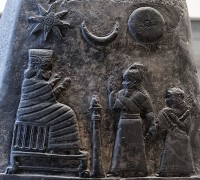
In, “The Alphabet Versus The Goddess,”  Leonard Shlain makes a very strong case that all early civilizations were Goddess-based cultures.  And we can posit that Star Goddesses played a prominent role. The Sumerian/Babylonian Star Goddess Ishtar is portrayed here as her symbol, an eight pointed star:


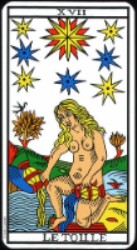
And here we have an early Tarot deck version of The Star, with . . . ahem . . . an eight pointed star hovering over the Star Woman.


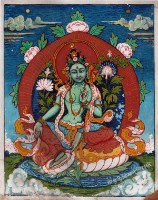
Or take the example of Tara, the Hindu Goddess who crossed over into Tibet.  She is portrayed with seven eyes – two in her hands, two in her feet, and three in her head – because she sees all of our suffering .


When the Buddhists arrived in Tibet they announced that Tara was actually the feminine counterpart of the bodhisattva (“buddha-to-be”) Avalokiteshvara and came into existence from a tear of Avalokiteshvara, which fell to the ground and formed a lake.

Right.  Another example of a man giving birth to a woman.  We know that happens all of the time.

Tara is thought to be the oldest still worshipped Goddess in existence and she was in Tibet a LONG time before Buddhism arrived.  Tara actually means, “Star,” so we can guess that Tibetan society was originally a matriarchal culture centered around the worship of a Star Goddess.

If you want a clincher for that, the term, “Dalai Lama,” literally translates as, “High (or exalted) Mother.”  If the original Dalai Lama didn’t have breasts it would have been a damned peculiar title.

When a Tibetan Buddhist wants to talk about compassion and pure, unadulterated love, they use the the example of the love that flows between a mother and a child.  Several of them that I’ve run across – such as Tulku Thondup who wrote, “Boundless Healing: Meditation Exercises to Enlighten the Mind and Heal the Body,” – expressed frustration in trying to convey that concept to Westerners because we tend to have such screwed up relationships with our parents.  Mother EQUALS love in their culture, if not in ours.

So we can perhaps begin to cobble together a picture of who the Star Woman actually is.  She is a Goddess. A mother. Unconditional love. Compassion. Always there, gently shining down to guide and protect us.  The blessing of feminine energy.

And perhaps, as the Goddess archetype continues to re-emerge in the world, that image and that feeling will once again seem as normal to us as The Sun, The Moon, and The World.

Let’s hope so.