Did you ever walk into a room and then have absolutely NO clue why you did it? We stand there for a couple of seconds, asking ourselves, “What in the hell am I doing in here? What did I want in this room?” Blank. And then we remember that we were looking for our car keys or we wanted to make the bed or maybe there’s a book that we left somewhere and we need to find it.
That happens to everyone, of course, and older people even joke about it. “I wouldn’t remember where my head was if it wasn’t screwed on. Maybe I’m getting the OldTimers Disease.”
If it KEEPS happening, though, we may start to hear a little voice inside our mind that’s sounding an alarm. “Hey, dude, maybe you are getting Alzheimer’s. Or maybe you shouldn’t have taken all of those recreational drugs when you were a kid. Or – oh, my god – maybe you’ve got a brain tumor! Or maybe you’ve got ADHD!”
ADHD-ISH
The truth of the matter is that a lot of us are feeling ADHD-ish these days. After all, attention deficits can also spring straight out of anxiety and depression and these aren’t the most tranquil of times, are they? Even if we don’t have personal problems, the news networks and the internet are constantly blasting out the message that the sky is falling and we’re all going to die. Climate change, pandemics, wildfires, dead celebrities, crazy politicians, oh, my!
Huge numbers of people are feeling distracted, nervous, upset, and having trouble concentrating. There’s an epidemic of lost car keys and many of us aren’t just keeping to-do lists, we’re keeping lists of our to-do lists. Try an internet search on, “how to get organized,” and you’ll see how very many us are bewildered, befuddled and befucked.
AN ALTERNATE VIEW
Now, WAY BACK in the 2010s, Emilie Wapnick noticed that there were many, many people feeling this way. It wasn’t just that they were having trouble with their attention spans or with getting organized. Their entire lives felt unfocussed, as if they simply couldn’t decide what they should do next.
She gave an incredibly influential TED talk called, “Why Some of Us Don’t Have One True Calling,” and she introduced a radical idea. Maybe, she suggested, we’re not really ding bats who keep getting distracted by shiny objects. Maybe we’re actually just incredibly creative people who can’t and won’t be satisfied by a single pursuit.
The term that she uses to describe people like that is, “multipotentialite.” As she outlines in her wonderful book, “How to Be Everything: A Guide for Those Who (Still) Don’t Know What They Want to Be When They Grow Up,” there are some of us who simply aren’t wired to be single-pursuit human beings. We may be simultaneously (and passionately) pursuing vocations in art, writing, and auto repair, all the while researching a half a dozen other fields that we’re interested in. In the past, such a person might have been admired and even lauded for their intellectual curiosity. Today, they’re frequently labeled as being dysfunctional or misdiagnosed as having attention deficit disorder.
HENRY FORD’S DEMON BABY
Almost from its inception, the Industrial Revolution attempted to turn human beings into mere slaves who operated the machines in the factories. The model wasn’t really perfected, though, until Henry Ford introduced his, “rolling assembly line,” in December of 1913. Using that model, workers stand in one place as the product rolls by on a conveyor belt. Each worker performs one job in assembling the product, and they do that one job over and over, hundreds of times a day. This ushered in the age of specialists.
There is no question that Henry Ford was a thoroughly evil man. He was such a rotten person that Adolph Hitler mentioned him admiringly in Mein Kampf and kept a large portrait of Ford behind his desk. Perhaps the worst thing that he did, though, was to champion the idea that a person should specialize in only one thing and do it over and over until his soul dies from sheer boredom.
NOT BELONGING IN THE AGE OF SPECIALIZATION
That idea of specializing in only one thing has it’s advantages, of course. For instance, if we’re having a heart valve replaced it’s comforting to know that the surgeon has performed the same operation hundreds of time before. Still, it can have devastating effects if it’s presented as the ONLY model of functioning in our society.
To be clear, multipotentialites don’t just like to pursue multiple interests at once: it’s what they do. It’s wired into their brains. Telling a multipotentialite to specialize in just one area is like telling an introvert to go to more parties or telling a cat to fetch a stick and bark.
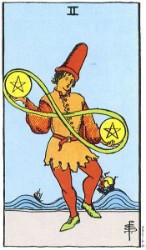
When we take that natural behavior, though – that need to pursue many different interests at once – and drop it into our linear, specialized society, it looks a lot like . . . guess what? ADHD. In a culture where concentrating on one task at a time is the behavior that’s rewarded and reinforced, the multipotentialite is frequently perceived as being highly dysfunctional. Why can’t you concentrate? Why don’t you ever get anything finished? Why do you keep jumping from one thing to the next? Those are questions that the multipotentialite will hear her entire life and it can leave her feeling inadequate, guilty, and shamed. Like the figure in the Two of the Pentacles, life seems like a constant balancing act, rather than a fulfilling adventure.
STRATEGIZING FOR A HAPPY LIFE
If all of this is striking a chord with you, if you feel that you may be a multipotentialite, then rest assured, there are still ways to find happiness. There are a few simple strategies that can make you feel like you’ve got super-powers instead of constantly feeling less than.
1. Embrace Your Identity and Fix Your Self-Image: Recognize that being a multipotentialite is a strength, not a flaw. Celebrate your curiosity and versatility instead of forcing yourself into a specialist mold.
2. Consciously Design a Portfolio Career: Instead of choosing one path, build a career that allows you to explore multiple interests. This could mean freelancing, consulting, or combining part-time roles. If you’re an artist and a writer, for instance, you could do illustrations set off with poetry.
3. Set “Seasons” for Your Passions: Focus on specific interests for a set period, then rotate to another. This prevents burnout and keeps things fresh. This allows you to hyper-focus on a particular avocation, but use boredom as a signal for when it’s time to switch to another.
4. Create a “Renaissance Schedule”: Dedicate blocks of time to different pursuits. For example, Mondays for art, Tuesdays for coding, and so on. Structure helps manage your many passions without feeling scattered.
5. Prioritize Projects: Not every interest needs to become a lifelong commitment. Learn to distinguish between short-term fascinations and long-term passions.
6. Find Overlaps: Look for ways to combine your interests into unique projects. A multipotentialite superpower is the ability to innovate by connecting ideas from different fields.
If you’re interested in exploring more multipotentialite options for living, I’d really encourage you to visit Emilie’s website, “puttylike. Creativity and curiosity are options that many people seem to have missed out on, so let’s take them to the max.






 Just the Tarot