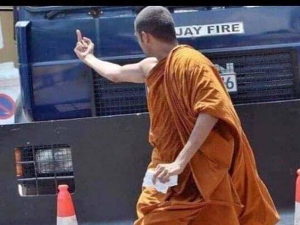
Judgments, The Dalai Lama, and Putting Your Hat on the Table

How our belief systems affect our lives.

There’s an old saying that the reason our parents can push our buttons is that they installed the control panel. And there is so much truth in that.

I was watching a presentation from Mike Dooley the other day and he was talking about the importance of our belief systems. For those of you who aren’t familiar with Dooley’s work, he’s a strong advocate of the idea that, “thoughts become things,” and teaches visualization and manifestation techniques. His take on belief systems is that they act as, “regulators,” for what we allow ourselves to think, and since thoughts become things, our beliefs determine what we’re going to think and, therefore, what’s going to manifest in our lives. Our beliefs determine the Judgments that we make about life, which determine the course that our life takes.

For instance, if we have a strong, unconscious belief that we’re unattractive it’s very unlikely that we’ll be able to visualize ourselves with a good, loving partner. We can’t even THINK of that happening, and so it doesn’t. If we have a strongly held belief that rich people are evil, we’re not going to be able to attract money into our lives because we don’t want to see ourselves as evil.

Those are belief systems on a personal level. There are also what we might call, “meta belief systems,” that operate on a more elevated basis. These are systems like religions and politics and they interact with our personal belief systems. Most people in the United States are Christians and an inherent element in that religion is that people are, “sinners,” that life is suffering, and that there’s a loony tunes god in charge who might just throw you into a pit of eternal flames because you masturbated last night.

We can contrast that world view with this statement from the Dalai Lama: “I believe that the purpose of life is to be happy. From the moment of birth, every human being wants happiness and does not want suffering. . . From the very core of our being, we simply desire contentment. I don’t know whether the universe, with its countless galaxies, stars and planets, has a deeper meaning or not, but at the very least, it is clear that we humans who live on this earth face the task of making a happy life for ourselves.

If we believe in the so-called Law of Attraction – the idea that we draw into our lives people and events that are a match with our energy, emotions, and ideas – then we can see where these two belief systems would have massive implications in our personal lives. If we accept the classic Christian view that people are basically evil and life is shit because we got, “thrown out of the garden,” what are we going to attract into our lives? Evil people and shitty experiences. If we listen to the Dalai Lama and believe that the purpose of life is to be happy, we’ll automatically seek out happy people and create positive experiences in our lives.

All of this operates on an unconscious level, of course. If you were to ask the average Christian if she believes that people are rotten and life is meant to be suffering, she would very likely say no. But that’s exactly what we were taught in Sunday schools and church services when we were forming our views of life and were too young to make realistic assessments. All of those buttons – guilt, sin, life hurts – were installed on our control panels and they’re just waiting to be pushed.

Don Miguel Ruiz talks a lot about this in The Four Agreements. As he put it, most of our belief systems are just, “dreams,” illusions passed down from one generation to the next or forced onto us by our society and they remain largely unexamined. Democrats (or Republicans) are evil. People are no damned good. America loves peace (even though we sell more weapons than any other country in the world.) Monogamy works (even though about half of the people who try it get divorced.) Liberals are socialists. Conservatives are fascists. God’s a male. There is no God. We all have tons and tons of opinions and viewpoints that we live by, that we design our lives around, and, for the most part, we haven’t thought about them very much.

I once read about a woman who went into an absolute fury every time that her husband would put his cap on the kitchen table. When he questioned her about it, the only thing she could say was, “It’s just wrong.” She realized that her mother had taught her that lesson, so she asked her mother why it was wrong. Her mother’s response was that her mother had taught her that it was a terrible offense. She finally worked her way back to her great grandmother who started laughing and said, “Oh, lord, child, when I was young everyone had head lice. That’s why it was wrong to put your hat on the table.”

So three generations of her family had passed down a very strong belief and reaction about a simple behavior like putting a hat on a table. And none of them, until her, had ever questioned the belief or wondered what was behind it.

The sad part of this is that so many of our beliefs and judgements are just like that: totally unconscious ways of judging the world and ourselves that were passed down to us by people who weren’t thinking about them and accepted by us without thinking about them.

That’s also the good news.

Once we accept the idea that a lot of our most cherished beliefs – if not most of them – are constructed on total bullshit, then we can just get rid of them. It sounds like a really radical idea when we first encounter it but why not? Why not just get rid of beliefs that limit us and restrict us, and adopt beliefs that serve us better and allow us to expand our lives?

For instance, the belief that I’ll NEVER have enough money, shuts me down and keeps me frozen in place. The belief that the Universe is filled with abundance and I deserve my share opens me up to expanding and receiving. The belief that I have a RIGHT to be angry keeps me upset and repels positive people. The belief that I have a RIGHT to be a loving person attracts positive, loving people into my life and reinforces the idea that I’m lovable.

The Tibetan Buddhist teacher Chagdud Tulku Rinpoche said that most of us will never become enlightened in this life and that we’ll continue to live in the dream of illusion. But he also said that we CAN decide whether we want to have a good dream or a bad dream. And the road to a good dream starts with our beliefs about that dream.
Trauma, The Tower, and The Shit Happens Factor

The causes of trauma and how to deal with it.

Philosophers and religious leaders have long been fascinated with what we might call the, “shit happens,” factor in life.  Perhaps it’s because of our human tendency toward binary thinking, but most creeds will fall into one of two categories:  life is good and the universe is benevolent and loving; or life is hard and the universe is cold, capricious, and/or meaningless.  The more spiritual religions tend toward the first view that life is good and the more primitive religions tend toward the view that life is hard.

If we look at it objectively, life is pretty good, pretty much most of the time.  Unless we have the severe misfortune of living in a war zone or a climate disaster, most of us don’t have something terrible happening to us, right around 98% of the time.  Most of us aren’t starving to death, suffering from a terrible disease, or in a constant series of car wrecks.  To the extent that we’re unhappy or dissatisfied, it’s because of our own view of the world and not because something exterior is wrong.

It’s fairly easy, then, to build a case for the idea that life is good and the universe is benevolent and loving.  Food is good, drink is good, sex is good, friends are good, creative fulfillment is good.  Butterflies are good, birds are good, crystals and candles and incense and vibrators are good.  There are a LOT of things about life that are good, and very few things that are bad.

Most of the time.  But shit happens.  Sometimes, really SERIOUS shit happens.

We can be walking along, singing a song, happy and free, when suddenly a speeding ice cream truck jumps the curb, runs over us and we’re in the hospital for months.  And while we’re there, we lose our job, our house and car are repossessed, and our partner runs off to Tierra del Fuego with a tattoo artist.

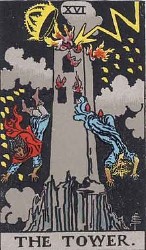
That kind of an experience is exemplified in The Tower card.  It’s the kind of an experience where everything in our lives is absolutely blasted into dust and we’re left standing there, psychically naked and bleeding, realizing that everything we believed in, everything we took to be solid and dependable, was nothing more than an illusion.

There’s a word for what happens to us internally when we go through that kind of experience:  trauma.  Gabor Mate’, who is one of the leading experts on trauma, says that trauma is a perfectly normal reaction to a completely abnormal event.  

There are several components to trauma that have to be unpacked.  First of all, it’s not a mild or everyday experience.  We tend to overuse the word and talk about how a scary movie was traumatizing or it was traumatizing to spend Thanksgiving with relatives we don’t like.  That’s not it.  Trauma is caused by events that completely overwhelm the individual’s resources and leave her feeling absolutely powerless.  These are things like rape, beatings, war, abandonment or abuse as a child, the death of a partner.  These are HUGE events in a person’s life.

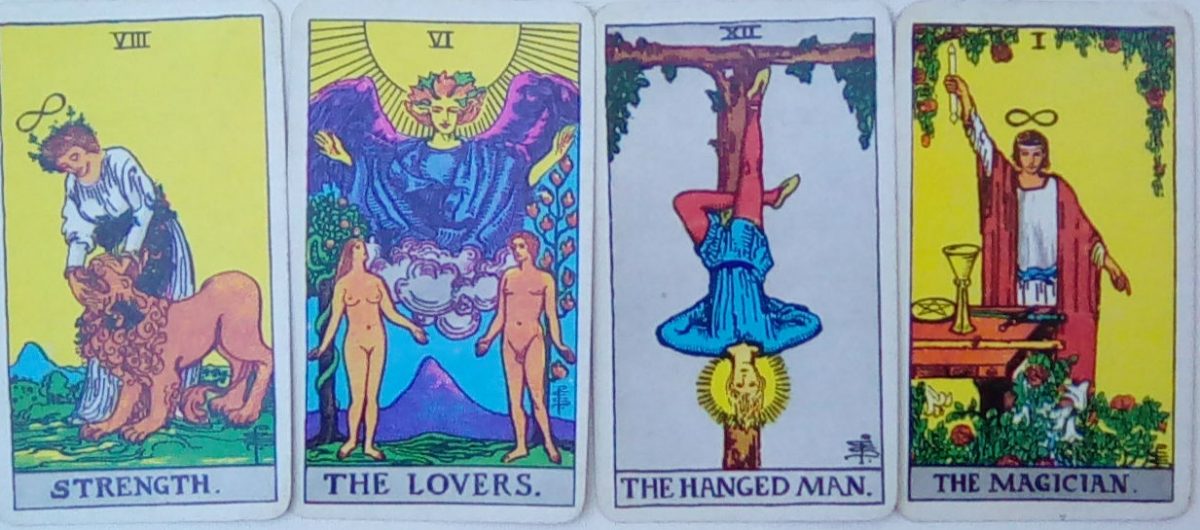
Another element in trauma is a sort of a psychic frozenness, a process where the person gets stuck in the traumatic experience.  A very important point here is that deep suffering does not necessarily equal trauma.  In the Tarot card, The Hanged Man, we see someone who has gone through very deep suffering but has come out on the other side with profound emotional and spiritual growth.  He didn’t get stuck in the pain, he grew from it.

Put another way, he had the emotional and spiritual tools that were necessary to deal with the pain, therefore he wasn’t overwhelmed by it, therefore he wasn’t traumatized.

If we look at it on a purely physiological level, there’s a defined sequence of events that takes place in our brains when we’re confronted by a dangerous event.

1 – The amygdala (the so-called, “lizard brain”) starts the fight or flight reaction.  We’re flooded with stress hormones, our hearts race, our hands shake. We either attack what’s threatening us or we run away from it.  Either way, we resolve the danger.

2 – The amygdala shuts down the fight or flight reaction and our bodies and brains return to a normal state.

3 – The hippocampus, which is the part of our brains that controls memory, basically says, “Whew, glad that’s over,” and files it away as a completed event.

4 – Just in case that sequence doesn’t happen, the prefrontal cortex, which is like the CEO of our brains, says, “HEY!  It’s over.  Settle down, kids.”

We know from functional brain scans that this normal sequence doesn’t take place in trauma.  The amygdala starts the fight or flight reaction but it never ends it.  The hippocampus never properly files away the experience as being over and so we keep re-experiencing the traumatic event in the form of flashbacks and anxiety triggers.  And the prefrontal cortex shows markedly diminished activity so it never says, “Hey, there’s nothing out there to threaten you.”

That’s why a combat veteran may end up cowering in a corner from hearing fireworks on the 4th of July.  That’s why a rape victim may go into a full blown panic attack when she sees a harmless stranger in a parking garage.  That’s why so many trauma victims become alcoholics and drug addicts in an attempt to numb what they’re feeling.  Because, in a very real sense, it’s NOT over for them.  They’re still living in active fight or flight mode, they’ve never been able to digest the event as a memory, and they’re not able to intervene rationally and say, “There’s no danger.”

So what can we do about all of that?  What can we do to draw ourselves out of the disaster of The Tower card and into the spiritual wisdom of The Hanged Man?

First and foremost, a good therapist can be invaluable.  Remember, the trauma happened because the person felt overwhelmed and didn’t have the resources to deal with it.  A good therapist can start to fill up our emotional and spiritual tool boxes and give us those resources that we didn’t have when we were overwhelmed.  We can learn to reframe the experience, to intervene with compulsive anxiety patterns, to stop in the middle of a panic attack and really tell ourselves, “There is NOTHING wrong.  Breathe deeply.  Relax.”

There are a couple of simple techniques we can use at home, as well.  Harvard Medical School and Dr. Dawson Church have both demonstrated that EFT Tapping sessions can dramatically reduce the presence of the stress hormone cortisol and calm the activity of the amygdala.  Tapping basically takes us out of the endless loop of the fight or flight reaction and begins to turn the traumatic event into a neutral memory.  There are resources for tapping all over the internet but a good place to start is with Rick Ortner, who’s done so much to disseminate the technique.

Another simple technique is mindfulness meditation.  Like tapping, mindfulness meditation reduces cortisol and calms the amygdala’s fight or flight response.  Even more dramatically, though, after only 8 weeks of practicing mindfulness meditation, the amygdala actually shrinks and the prefrontal cortex grows.  Literally, anxiety and fear are physically shrinking while rational thought is growing.  Again, there are resources all over the internet for practicing mindfulness, but here’s a nice guided meditation from Great Meditations to get you started.

Most of us who are on a spiritual path prefer to think that life is basically good and that the universe has an underlying energy of love and creativity.  Nonetheless, shit happens.  To all of us, sooner or later.  We don’t have to make it a continuing feature of our lives, though.  We can move out of painful experiences stronger, wiser, and more evolved than when they occurred and get back to enjoying butterflies and birds, crystals and incense, good friends and vibrators.  L’chaim!

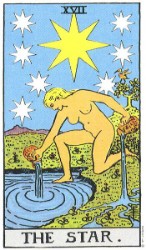
The Star, Fairies, Cat’s Milk, and Roe V. Wade

Our ancient ancestors believed that some stars were alive.  They looked at the night skies and observed that some of the stars, which we now call planets, moved around in the sky.  Since things which are alive move, it was perfectly reasonable – given the extent of their knowledge at the time –  to conclude that these moving stars were actual living beings and give them names like Mars, Jupiter, or Venus.  They couldn’t prove they were alive but this unprovable metaphysical belief was accepted by most of humanity throughout most of our history.  Some people still think that stars and planets are alive and have their own souls, which is a perfectly fine, harmless metaphysical belief.

All metaphysical beliefs are created equal.

If that sounds a little abstruse, allow me to explain.  All metaphysical beliefs – ALL OF THEM – are by their nature unprovable using physical means.  Metaphysical beliefs deal with the invisible world of souls, spirits, gods, demons, elves, fairies.  These are not physical entities and, therefore, cannot be quantified in the physical world.

I may believe very strongly in the existence of the Soul – and I do – but I can’t prove its existence.  I can’t take a picture of it, I can’t weigh it, I can’t pull it out of a paper bag and say, “See?  Here it is.  Told you it existed, didn’t I?”

I also believe in elves, fairies, ghosts and gods and goddesses in the plural.  If you’re a materialistic atheist, you might look at me and say, “You know, you’re a little touched in the head.  You’re saying that you believe in invisible things that no one can actually prove exist.”  

That would be quite a reasonable statement from a materialist atheist, and it would be equally reasonable for me to say, “So what?  What business is it of yours, what I believe in?  If I believe in fairies, it’s not hurting you in the least, is it?  It’s not like my fairies are stealing your cat’s milk or anything.”

Keep in mind, though, that this scenario is valid for ALL metaphysical beliefs, not just fairies and elves and ghosts.  It applies equally to Jesus, Jehovah, Allah, Ganesh, and Tara.  All of these are beliefs in invisible beings whose existence can’t be proved (or disproved) any more than hob-goblins and imps.  

All metaphysical beliefs are created equal.  And equally unprovable.  

As long as they don’t hurt anyone else, there’s really no problem with them.  For millions of people, they’re actually sources of great comfort.  They help us to feel that we’re not alone in a vast, cold universe and that there’s some meaning and purpose to our existence.  They help us to face death and tragedy with faith and courage.  There’s much to be said for them, but they are ALL equally unprovable.

Where we start to run into a little trouble with them is when we decide that OUR unprovable metaphysical beliefs are better than THEIR unprovable metaphysical beliefs.  To a certain extent that’s just human nature and doesn’t cause any great harm.  If I say, “My Goddess is better than your Jesus, neener, neener, neener!” you may find that obnoxious and annoying, but it doesn’t really harm you in any way.

Where we run into REAL trouble is when we decide that OUR unprovable metaphysical beliefs are better than THEIR unprovable metaphysical beliefs, THEREFORE they have an obligation to adopt our unprovable beliefs and abandon their own.

By way of an example, if I believe in fairies, this belief isn’t harming you at all (assuming my fairies aren’t stealing your cat’s milk.)  On the other hand, if I go up on a mountain top to meditate and I come back down with the Ten Fairy Commandments and DEMAND, on penalty of death, that everyone follow the Fairy Commandments, then I’ve made a very serious step into a spiritual dictatorship.  If I decide that the faces of fairies are sacred and that it’s a sin to portray them in paintings and drawings, and that it’s okay for me to kill anyone who does that, I’m a psychopath who should be locked up.

Because, you see, they’re all unprovable metaphysical beliefs.

We laugh at the idea of the fairies issuing Ten Commandments, or them behaving like Allah and saying their faces can’t be depicted.  We might not laugh at the idea of a fairy who was crucified, killed, and then walked out of his tomb, but we’d at least find the story goddamned peculiar.

Now, all of these stories and cultural myths about unprovable beliefs are, as I said, relatively harmless, right up to the point where we insist that other people have to share our belief in them.  In forcing other people to act according to our beliefs, we violate their freedom and their personal choice.

There’s a matter of degree in that, of course, and it’s based on how much the other person’s beliefs are actually harming us and interfering in our lives.  I have atheist friends, for instance, who become quite irate over the fact that United States coins bear the slogan, “In God We Trust.”  For the most part, we shrug that off because it really doesn’t harm us in any way, therefore it’s not important.  On the other hand, if they were to put Jesus or Allah on the quarter dollars, we’d be pissed.  That’s crossing a line where someone is trying to impose their unprovable metaphysical beliefs on our daily lives and that violates our freedom and personal choice.  It’s going from a generic, multi-purpose god-we-trust to a specific, “In THIS god we trust.”

All of which brings us to the overturning of Roe V. Wade.

Now, there’s been a lot of political posturing and folderol wrapped around that decision by the Not Very Supreme Court.  There are people writing about constitutional, “originalism,” and states rights and decentralizing our government to return power to the voters.  All of which is bullshit.

The real issue here is exemplified by the anti-abortion protesters holding up signs that say, “Abortion Is Murder.”  

We all know what murder is:  it’s the killing of another human being.  If you walk up and shoot me in the head, that’s murder.  If I fly into a rage and run over you with an ice cream truck, that’s murder (even if it’s a slightly more interesting form of murder.)  There’s no debate or ambiguity in our minds about exactly what constitutes murder.  No, the question revolves around exactly what constitutes a human being.

On the face of it, the answer to that seems simple. I’m a human, you’re a human, all of those bipedal critters at the mall are humans.  We tend to define humanness in terms of walking around, talking, being conscious, and being able to interact with the world.  There are certain physical, cognitive, and emotional qualities which, when taken together, we call a human being.

There are basic qualities that we all recognize as a being that’s human and we don’t pretend that something which doesn’t have those qualities IS human.  While we may know that every sperm cell is a POTENTIAL human being, we don’t view them as actually BEING humans and prosecute men for mass murder when they masturbate.  We may know that every egg that a woman produces is a POTENTIAL human being, but we don’t hold a funeral when she has her period.

Roe V. Wade was the simple recognition of the fact that when a sperm cell penetrates an egg, it remains a POTENTIAL human being.  At the point of impregnation and well through a large part of the pregnancy, the fetus has NO characteristics that constitute what we think of as a human being.  Pregnancy is a continuum in which the fetus becomes more and more human but is not, in fact, a human being at the inception of the pregnancy.  And if there’s no human, there can’t be any murder.  There can’t be any violation of human rights because there isn’t a human being there until late into the second trimester.  

What’s glitching up our national conversation on this is the unprovable metaphysical belief that there is an entity called, “the soul,” combined with the unprovable metaphysical belief that this invisible entity enters into the egg at the exact second that the sperm cell does and – shazam! – we have a full human being. 

If – and only if – we all mutually accept those unprovable metaphysical beliefs is it legitimate for the courts to abolish abortion.  Since most of us DON’T accept those metaphysical beliefs, what’s happening is that a minority’s religious views are being imposed on the majority without their consent.  Which is a theocracy, not a democracy.

I’m not meaning to denigrate or mock christian beliefs.  If they want to believe that the Soul zips into an egg the second a sperm cell enters it, that doesn’t hurt me a bit.  As long as it doesn’t steal my cat’s milk, their christian soul is welcome to do whatever it fancies. 

What does hurt me, though, is when those unprovable beliefs are imposed on me as a government policy.  Because, let’s face it, the christians do NOT have a good track record in being a part of governments.  These are the same fine folks who brought us the Inquisition.  These are the same folks who raped and pillaged and murdered their way through South America in the name of Jesus.  These are the same folks who enslaved millions of innocent Africans because the Bible said that slavery was alright.  These are the same folks who sat silently in their golden churches while Hitler murdered most of the European Jews.

We have no reason to believe that christian fanatics will respect other people’s beliefs or even their lives.  And we have many reasons to believe that they won’t, so we need to stop this, now, before it gets worse.  And that is NOT an unprovable metaphysical belief.  That’s history.

The Two of Cups, Low Libidos, and Smoldering Men in Skirts

A brief look at the myths and expectations surrounding American sexuality.

It’s always kind of fun – and illuminating – to identify a cultural myth.  Cultural myths are strong beliefs and assumptions that we have about our societies or countries which are almost totally unsupported by facts.  But we still believe them.

I remember that my first experience in cultural, “myth busting,” concerned monogamy.  Most Americans hold a very strong faith in the notion that everyone has a Soul Mate, that we will eventually meet that Soul Mate, and that we will live happily ever after when that happens.  But, of course, our divorce rate has held steady at 45 to 50% for decades, so it’s pretty obvious that the standard monogamy model isn’t working out very well for at least half of us.  Nonetheless, we keep getting married.  And divorced.  And married.  And divorced.

It was such a liberating experience for me to finally get some perspective on that issue and be able to say, “Oh . . . it’s just bullshit.  I’m not a failure and all of my friends who’ve been divorced aren’t failures.  The model is flawed.  Happily Ever After Marriage for everyone is a cultural myth.”

Many cultural myths are relatively harmless exercises in ego.  Germans, for instance, have long considered themselves to be an extremely clean and fastidious people.  Yet, some polling in the 1970s found that they’re the least likely of all Europeans to change their underwear on a regular basis.  Italian men have always been seen as red hot lovers, but Italian women report that they have a dreadfully low rate of orgasm during sex.  The British think of themselves as wonderfully sophisticated but . . . you know . . . blood pudding and kidney pies?  Really?

Other cultural myths are darker and more disturbing.  Almost 50% of the Japanese identify as Buddhists, a religion which teaches the sacredness of all sentient beings.  That hasn’t prevented their culture from ruthlessly hunting down and slaughtering whales and dolphins, which are some of the most sentient beings on the earth.  A majority of Americans claim to follow the teachings of Jesus, which are all about love and compassion, but we’re one of the most violent societies in the world and half of us voted for Donald Trump.  In both cases, our cultural myths have allowed us to deny and rationalize our actual behavior.  “We’re not really like that.”

Yes, we are.

One of the most important things about cultural myths is that they carry with them a set of unconscious expectations.  We think of them, not just as the way things ARE, but as the way things OUGHT TO BE.   And when we feel that we haven’t lived up to those sets of expectations, we beat the hell out of ourselves psychologically.  In the example of monogamy, for instance, we have the expectation that our marriages OUGHT to succeed and, when they don’t, we feel like miserable failures.  If we can step back from that a little bit and realize that about half of all marriages DON’T last, then it removes the sense of personal failure.

It’s the expectations that are killing us, not the reality.

All of which is offered as an explanation for why my radar started pinging this week when I ran across this article about American sexuality.  Or, more specifically, American libido, also known as, “sex drive.”  Over 26% of American adults reported that they hadn’t had sex in the previous year.  Not even once.

The first thought, of course, is, “Oh, the damned pandemic.”  We’ve all been isolated so we couldn’t have as much sex.  Not true.  In 2018, the percentage of sexless Americans was 24% and in 2016 it was 23%.  So right around 1 in 4 of us are NOT getting any sugar and haven’t been for years. 

 It’s probably a higher number than that, simply because of the nature of the male ego.  If you ask a normal male if he’s gotten laid in the last year his immediate response is going to be, “Oh, yeah.  Lots of times.  Women are crazy about me.  Just can’t get enough.  I’m worn out from it, I tell ya.”

Not.

I’m tagging this as evidence of a cultural myth because Americans think of ourselves as being a HIGHLY sexual culture.  In so many ways we become obsessed with our bodies, not just to be healthy, but to make them more attractive sexually.  We spend millions of dollars every year on clothing and gym fees so that we can look as tight and sexy as possible.  Our pornography industry is booming.  Our movies and television shows and books are replete with sexual references and innuendo.  Our most popular comedians would be at a loss for words if they couldn’t rap about sex. 

Just looking at the surface of our culture, we’d have to conclude that Americans LOVE sex.  We think about it and talk about it and joke about it almost constantly.  We sell hundreds of books and videos on how to be better lovers and keep our partners so satisfied that they’ll melt into the mattress when we’re through making love.

But then we look at those statistics again.  One quarter of Americans aren’t having sex at all.  This isn’t some sexual blip that’s caused by the baby boomers getting older, either.  The people who aren’t having sex are young, middle aged, old, Republicans, Democrats, liberals, conservatives, the full spectrum.

Does it matter?  

It’s an interesting question because, as one sex researcher put it, “Low libido is only a problem if you think it’s a problem.”  The traditional approach has been to view it as a problem from the beginning and then look for the source of the problem, which is the real problem. What’s CAUSING your lack of libido?  Is it high blood pressure, low blood pressure, anxiety, depression, lack of exercise, obesity, sexual dysfunction, constant fatigue?  

But suppose it’s none of the above and a lot of Americans just don’t much like sex.  Is that a problem?

Not in and of itself.  If we can become dispassionate enough to look at having sex as merely a human activity, much like jogging or playing golf, then it’s no problem at all.  Some people like to get out and smack their balls around the old course and others don’t.  No problem.

It’s when we get into the expectations that go along with the cultural myth that we begin to encounter the, “problems.”  Historically, most of these libido studies have been aimed squarely at women.  There is a sort of an underlying assumption that all healthy, normal males like to fuck like bunnies under a full moon all the time and – if their wives and girlfriends aren’t willing to accommodate them –  that’s a problem.  The woman’s problem.

Realistically, yes, it is a problem when one romantic partner has a high sex drive and the other partner has a very low sex drive, but it has nothing to do with gender.  And it’s a problem that could be avoided by some honest discussion going into the relationship.  “Okay, I like sex a LOT and you don’t like it much at all.  What are we going to do about that?  Do we have an open marriage?  Is it okay for us to get our needs met outside of the relationship?  Is this a big enough problem that we just shouldn’t be together at all?”  

The basic expectation here is that all sex drives are created equal and that most of them are set on, “high.”  Therefore, if I like sex more than you like sex, then there’s obviously something wrong with you, like maybe you’re frigid.  Or, flipping that, maybe there’s something wrong with me, because I like sex too much and I must be some kind of a pervert.

There’s also a built in expectation that, somehow, everyone else must be having sex – really good sex – pretty much constantly and, since we’re not, there must be something dreadfully wrong with us.  We must be . . . uh, oh . . . sexually unattractive.  Or too fat.  Or too skinny.  Or too shy.  Or too outgoing.  Or too young.  Or too old.  Or our breasts aren’t perky enough or our dicks aren’t big enough.  Or maybe we’re just ugly and we dress funny.  

Again, if we can step back from that and realize that 1 out of every 4 people we meet apparently don’t have any sexual desire at all – or so little desire that it’s not even worth pursuing – then we can jettison all of those negative self images.  Perhaps, just perhaps, that person who doesn’t find us attractive doesn’t find ANYONE attractive.  

Hmmm . . .

The Two of Cups shows a couple staring deeply into each other’s eyes and the man’s hand reaching out to touch the woman.  A lion, the symbol of power and sensuality, hovers between them in the air and we can almost feel the sexual attraction smoldering like an ember that’s about to burst into flames.

Woof.  Smolder, smolder.

But suppose she’s looking at him and thinking, “What kind of a guy wears a skirt?”  Or he’s looking at her and thinking, “If she’s not going to drink her wine, maybe I could have it.”

Maybe they haven’t had sex in over a year and they don’t want to have it now.

As a society, we’ve made great strides in realizing that there’s nothing wrong with sex.  We pretty much accept it, in all of its amazing varieties, as perfectly normal and healthy, magical and fun.

We have a ways to go, though, in accepting that, while there’s nothing wrong with sex, there isn’t necessarily anything right with sex, either.  There’s no, “norm,” that we all have to meet, no perfect amount of sex that we’re supposed to have, no particular number of notches we’re supposed to cut into our bedposts to show that we’re, “healthy, well adjusted human beings.”  And judging our personal worth by the number of bed partners we have is insane.

If we have an extremely high sex drive, that’s okay.  If we have an extremely low sex drive, that’s okay, too.  It’s only a problem if we think it’s a problem. 

Everything else is just a myth.

Just the Tarot by Dan Adair – a kindle ebook available on Amazon

The Hierophant, The Sky Thingie, and Noshing at the Spiritual Buffet.

An exploration of religion versus spirituality as illustrated by buffet lines.

The Tarot card The Hierophant shows us a Pope-like figure seated on a throne, with acolytes bowing down to him.  In a general sense, The Hierophant represents all that is traditional, conformist, and conventional.  In a more specific sense, he represents dogmatic religion, as opposed to spirituality.

The basic idea here is that if you want to learn about religion and what it teaches, you go to a priest, a pastor, a rabbi, or an imam.  If you want to learn about spirituality, you meditate or you take psychedelics or get involved with a tradition such as shamanism or ecstatic dance.  Religion involves learning about other people’s interactions with the divine.  Spirituality is about having your own interaction with the divine.

I started thinking about all of this the other day when I read this passage from David Michies sweet little book, “Buddhism for Busy People:”

“One of the refreshing things about Buddhism, however, is its insistence that you should only take up those practices which benefit you.  If certain aspects aren’t helpful, simply put them to one side.  You can always come back to them later.  You won’t go to hell because you don’t believe in karma.  Nor will believing in it guarantee you a place in heaven – like everything else in Buddhism, it is what you DO that counts, not what you say you believe.”

I was contrasting that in my own mind to a Catholic priest I saw on a news show recently inveighing on the subject of Catholics who supported a woman’s right to have an abortion.  “We don’t agree with, ‘super-market Catholicism,’ “ he said.  “You’re not allowed to push your cart down the aisle and pick out this part of the Catholic faith but reject other parts.  You have to accept the entire doctrine or you’re not really a practicing Catholic.”

The differences in the two approaches couldn’t be any clearer.  Buddhism is basically saying, “Hey, here’s what we think the truth is but you need to pick out what works for you.”  Traditional religions are saying, “Here’s what the truth is and you need to agree with it, even if it seems like nonsense to you.”  The Buddha actually encouraged his followers to debate him on concepts  they disagreed with and cast aside whatever they thought was wrong.  On the other hand, it’s Catholic doctrine that whatever the Pope says about faith is infallibly true.  Always.  From god’s mouth to his ear.  Period.

The difference in those approaches probably lies in ancient human history when our cultures had shamans rather than priests and pastors.  Our ancestors undoubtedly found the world to be a scary place that was full of mysterious and sometimes life threatening occurrences.  We can easily imagine a cave woman leaning against a tree enjoying a rainstorm when -KABLAM!!!!!!!! – a bolt of lightning blows the tree into splinters and flings her twenty feet through the air.

Her first response would probably be something along the lines of, “Holy shit, what was THAT?!?”

As she clambered to her feet, though, and brushed the mud and splinters from her loin cloth she’d have a brilliant insight:  something must have CAUSED the lightning thingie that blew up  the tree.  And since the lightning thingie came out of the sky, whatever caused it must live . . . up there . . . in the sky.  

She’d probably spend many nights around the cave fire discussing this with the other tribe members, comparing notes, and arguing about the exact nature of the . . . Sky Thingie . . . that threw the . . . lightning thingie . . . at the tree.  What was it like?  Was it like a human being?  Why would it do such a thing?  Did it hate trees?  Perhaps it had been aiming the lightning at the woman and missed her and hit the tree?  Did it have poor eyesight, then?  What was it so pissed off about, anyway?  Was it a male or a female thingie?  And if it was a male thingie, did it have . . . you know . . . a thingie?

So there would have been many complex disputations arising out of the tree being hit by the lightning.  At a certain point, a cave person would step out of the shadows and say, “Hey, I had a dream about the Sky Thingie that threw the lightning thingie.  He says that if you’ll sacrifice a goat and not eat shellfish he won’t do it again.”

“Oh, really?” someone might reply.  “So the Sky Thingie is definitely a male?”

“Well, yes.  And he has a beard and wears sandals and sits on a golden rock.”

“So, you can talk to him, then?  Did he say why he’s throwing lightning thingies at us?”

“He did it because you didn’t sacrifice a goat and you ate clams.  Those are the rules.  He told me.”

Thus was born the shaman:  a special class of human beings who had knowledge of and were able to intervene with supernatural forces.  He or she would no doubt have been seen as just as important – or more so – than the tribal hunters, fishers, or gatherers.  After all, she had a special relationship with the Sky Thingie and could protect the tribe from supernatural temper fits and, um, sky anomalies. 

The tribe would have soon realized two things:  (a) like all humans the shaman was mortal and would die at some point; (b) therefore, he needed to train other shamans to take his place and keep a record of the Sky Thingie’s rules.

Thus were born priests and religions.

As the centuries passed and the priest/shamans had more and more visions and wrote down more and more rules from the Sky Thingies, the rules got more and more complex and began to include things like:

  • Don’t eat bacon.
  • Don’t trip blind people.
  • Don’t have sex with sheep.
  • Don’t work on Saturday.
  • It’s okay to have slaves, but only for seven years.
  • The Sky Thingie loves you and if you don’t believe that we’ll kill you.
  • Always capitalize the Sky Thingie’s name.  If you don’t, we’ll kill you.
  • Never draw a picture of the Sky Thingie or we’ll kill you.
  • Women are property and they should cover their heads and faces.  Or we’ll kill you.

You can tell from the last few rules that things started to take a nasty turn somewhere along the way and that the priests and religions were getting more powerful in society.  Not only had they established themselves as the only people who could interpret what the Sky Thingie wanted, they could also kill anyone who even tried to talk to the Sky Thingie on their own.

That’s really the point that we’re at with many of today’s formal religions.  They consist of centuries of barnacle-like accretions of irrational rules that can only be interpreted by the priests and pastors and rabbis.  Intelligent self inquiry is NOT encouraged.

Which is why the Buddhist approach is so refreshing.  

Formal religions have rules like, “Don’t eat bacon because the Sky Thingie says not to.”   Buddhist discussions are more like:

“Don’t eat bacon.”  

“Why not?  I really like BLT’s.”

“Do you want to be happy and avoid pain?”

“Well, yes.”

“Do you think pigs want to be happy and avoid pain?”

“Um . . . well . . . yes.  I suppose they do.”

“Do you think it’s painful to be raised in a tiny pen and killed when you’re young?”

“Well . . . yes.”

“Would you be happy if someone cut you up, fried you in a teflon pan and slapped you on a piece of bread with some tomatoes and lettuce?”

“Well, no.”

“Then don’t eat bacon.”

And, of course, even then, you’re free to eat bacon sandwiches if you want to.  No one will kill you and you won’t go to hell.  You might reincarnate as a pig, but, hey, fair’s fair, right?

As long as we’re on the subject of food, think of it this way:  religion is like being invited to a huge Thanksgiving dinner.  There are platters full of turkey and mashed potatoes and baked yams and apple pies and cornbread dressing and green bean casseroles with those strange fried onion things on top.  

Maybe you really hate baked yams or green beans and you just want a little turkey and dressing with mashed potatoes and gravy.  But, no, there’s a huge scary guy with a baseball bat at the head of the table and he says that you have to eat EVERYTHING!!!  Especially the green beans and yams.  Or he’ll kill you.  And then you’ll go to hell.  Gulp.

Spirituality, on the other hand, is more like a buffet line.  You walk along, looking at the varieties of food and you only pick out the food that appeals to YOU.  You don’t force down every single thing on the line just to prove that you’re faithful.  If you feel like a shrimp salad instead of Swedish meatballs, that’s what you get.  

“Meditation?  Yes, I think I’ll take a bit of that. Hmmm . . . Wicca . . . does that fit on my plate right now?  Maybe as a side dish?  Oh, look . . . it’s affirmations and positive thinking.  Man, I haven’t had those in FOREVER.  Yum. . .”

There are no priests or pastors standing at your shoulder telling you that you REALLY want the roast beef instead of the tacos.  YOU choose what’s nourishing for you at that moment and take a pass on what doesn’t feed your soul.  And it’s an all you can eat buffet.  You’re always free to go back for second helpings.

But maybe skip the bacon sandwich.  Just consider it.

Lost Car Keys, Emotional Ladders and Being Ram Dass’s Illegitimate Child

Learning to climb our emotional ladders.

Did you ever have one of those morning meditations that was absolutely perfect?  Maybe you get up out of bed, light a candle on your altar, close your eyes, and the love and peace just FLOW into you as you sit there.  You feel compassion for all living beings and you feel oneness with the entire cosmos.  You feel that if you aren’t totally Buddha-like, you must at least be the illegitimate child that Ram Dass never acknowledged.  You are just SO high, SO spiritual, SO totally in the flow!

The feeling may continue as you take your shower, allowing the warm water to wash all the negativity from your aura.  And then again, as you eat your oatmeal, reminding yourself that you honor all living beings by not eating the flesh of animals.  You know you’ll have a perfect day at work.

And then . . . and then . . . you can’t find your car keys.  You go through the pockets of the clothes you wore the day before.  Check your night stand.  Look under the bed.  Scour your sock drawer.  Crawl around on the floor in case you dropped them.  Within the span of a few moments you’ve been transformed from Pema Chodron into a snarling, wild eyed beast.

“Where are you, you goddamned little jingly bastards?  Where in the fuck ARE you?”

Ironically, at the very height of your fury and hysteria, you locate the keys.  On your altar.

Sigh.  Another failed leap into enlightenment.

In their book, “Ask and It Is Given,”  Esther and Jerry Hicks make the point that sometimes it’s perfectly okay to feel angry.  In fact, sometimes getting really pissed off can be a sign that our mental health is improving.

It’s kind of a breath of fresh air in the New Age/New Thought movement.  We are constantly being told that we must stay positive and that, because of the Law of Attraction, being angry will do nothing but attract angry people and unpleasant events into our lives.  We find ourselves trying to censor our emotions, consistently trying to not feel what we’re feeling –  if what we’re feeling is anger –  and then feeling guilty when we can’t do it.

The Hicks look at it from a slightly different vantage point, which is that angry emotion is better than no emotion.  The basic premise is that our emotions are what motivate us, what keep us moving in life, what draw us toward love and make us run away from hatred.  Without emotions, we’re just stuck, dead in the water.

They say we live on a sort of a ladder of emotions, with apathy and depression at the bottom rungs of the ladder and love and joy at the top. In between joy and depression there are our other emotional states like irritation, feeling overwhelmed, pessimism, hopefulness, and so on.  As we climb the ladder and become more fully emotionally engaged with joy, we become more fully alive. When we descend the ladder into depression and apathy, we’re not really living, we’re just existing.  The ladder would look a lot like this:

JOY

POSITIVE EXPECTATION

OPTIMISM

HOPEFULNESS

PESSIMISM

IRRITATION

OVERWHELM

BLAME

ANGER

REVENGE 

RAGE

DEPRESSION

APATHY

I really like that idea of an emotional ladder because it allows me to be the mess that I frequently am and be honest with myself about where I’m at.  As the Hicks said in another book, it’s easy to program a GPS to take you from Phoenix to L.A. but first you have to know that you’re in Phoenix.  If we’re on the second to the top rung of the ladder – positive expectation – then it’s relatively easy to take that next step up to joy.  On the other hand, if we’re stuck WAY down the ladder in anger and we try to jump straight  up into joy, we’re probably going to fall off of the ladder and land on our asses.  It’s important to be honest with ourselves about where we really are on our emotional journey.  It saves us from broken asses.

And that leads into another neat concept which the Hicks came up with: the, “emotional set point.”  Basically, that’s just the rung of the emotional ladder that we live on most of the time.  We humans tend to be creatures of habit and so we pretty much maintain a consistent emotional state.  If we’re happy most of the time, we’ll stay happy most of the time.  If we’re sad most of the time, we’ll stay sad most of the time.  We may occasionally climb up and down a few rungs on the emotional ladder as life brings us good or bad events, but we tend to return to what feels like our, “natural,” state of being.

And there is a certain natural, genetic component involved in that.  According to The Harvard Health Blog, about half of the reason we may be happy or sad is based on the disposition we were born with.  So that person you know who’s always chirpy and perky and bright and annoyingly happy?  Yeah, that’s probably real.  They were likely just born that way.  And the friend who always seems a little sad may have just inherited it from his parents.  It’s their natural emotional set points.

The good news behind that, though, is that we can change our emotional set points.  Just because it feels, “natural,” to be in a certain emotional state doesn’t mean that we have to stay in that emotional state.

Suppose, for instance, that I’m a perfectionist.  I would want everything to go exactly according to plan and turn out just the way I’d envisioned it. 

What would flow out of that state of being would be a great deal of impatience with my co-workers and/or family members because they weren’t living up to the high standards that I set.  I might be constantly criticizing them, sniping at them, belittling their efforts and generally acting like an insufferable prick.

The cure for that could be to do loving-kindness meditations.  Starting to actively envision what other people are going through and building in empathy for the fact that they’re struggling with life the same way that I am.  As I continued to do that, my perfectionist expectations would drop away and I’d begin to see the people around me as fully dimensional human beings who deserve caring and patience.  I’m changing my emotional set point.

Or perhaps, like so many of us, we grew up in physically or emotionally abusive families.  Our, “go to,” response to stress in life might then be emotional flatness.  We learned very early in life that it’s easier to just turn off our emotions rather than feel the pain of the abuse.  

What flows out of that is becoming emotionally absent with our partners or children whenever there’s a problem.  Even worse, we abandon ourselves emotionally and fail to experience joy and deep love because we’re so shut down.

The cure for that could be to start doing, “happiness meditations.”  Just sit down once or twice a day and meditate on something that makes us happy, even if it’s a distant childhood memory of a beloved dog.  Start learning to live in that emotion again.  Stopping several times during the day and asking ourselves, “Am I happy right now?”  And, if we’re not, pull up that memory again until happiness becomes a habit.

The point is that it’s a practice, the same way that yoga or meditation are practices.  We don’t get where we want to go all at once.  If we come home and find our life partner shtupping our best friend, it’s okay to be angry.  In fact, it’s a hell of a lot better to be angry than it is to be depressed.  Anger can empower us but depression takes our power away.

As long as we’re feeling something, we’re still okay.  We’re still moving.  We’re still growing.  And, as the Hicks said, we can reach up for that next best emotion on the ladder. We can change our emotional set point.  It’s better to feel irritation than to feel overwhelmed.  It’s better to feel pessimism than to feel irritation.  It’s better to feel hopefulness than to feel irritation.  We can steadily, consciously move our emotional set point upward toward joy as long as we’re honest about what we’re feeling and we don’t shut ourselves down.

If we don’t feel it, we don’t heal it.  If we don’t heal it, we don’t grow.  And growing toward happiness is even better than knowing where your car keys are hiding.

Putin, Ukraine, Toxic Males, and The Emperor Card

Toxic-Male psychopathology in the invasion of Ukraine.

We’re at about the three week mark in the Russian invasion of Ukraine.  Anyone who’s a decent person has been shocked, appalled, and nauseated by what we’ve seen.  A quiet, peaceful country primarily known for its wheat and decorated Easter eggs is being bombed into dust.

For no apparent reason.

The horror of what we’re seeing on the news everyday is hard to grasp, but equally hard to grasp in the, “why,” of it.  Why would Russia suddenly launch a brutal military campaign – the likes of which we haven’t seen since the Nazis – against a neighbor who was absolutely no threat to its security?

I saw a talking head on one of the news shows tonight who asked, “Just how much of a psychopath is Vladimir Putin?”  It’s a revealing question because it points to the fact that we already knew Putin was a psychopath, we just didn’t know (and still don’t) how truly crazy he may be.

That truth points to another truth, which is that we’ve developed a remarkably high tolerance for psychopathology.  We put up with it.  We accept it.  It isn’t as if Putin hasn’t been doing dreadful things for decades.  He almost single handedly destroyed whatever small hope the Russian people had for freedom and democracy.  His political opponents end up poisoned, dead, or in prison.  He employed chemical warfare in Syria.

He’s a bad guy.  A crook.  A thug.  A criminal.  And he has been all of those things all of the time that he’s been in power.  Still, the world leaders kept inviting him to the dinner table.  Kept trading with Russia, inviting their teams to the Olympics, welcoming their tourists and investors, just as if Putin was somehow a normal, civilized leader.  It wasn’t until he decided to obliterate a modern society for no particular reason that we began to treat him like the psychopath that he is.

Just to define our terms before we go any further, what exactly do we mean when we say that someone is a psychopath?  According to Wikipedia, psychopathology is:

“characterized by persistent antisocial behavior, impaired empathy and remorse, and bold, disinhibited and egotistical traits.”

Put another way, a psychopath is a cold blooded, egotistical prick who causes a lot of suffering and really doesn’t give a shit about how many people he hurts.

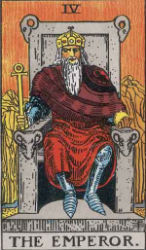
I have argued previously in this blog that psychopathology is an inherent part of the Toxic-Male paradigm which our society too often embraces.  We see some of that exemplified in the Tarot card, The Emperor.  We can tell from his throne, scepter and title that he’s a powerful leader, a king of kings.  When we look a little more closely at the card, though, we see that he’s completely alone, armored, rigid, and surrounded by a blighted, sterile landscape.  His power is so toxic that not a tree or a flower can grow in his poisonous energy field. Still,  we focus on the power and not the devastation.  

Power that destroys everything around it for the sake of power is psychopathic.

Many of us actually admire and reward psychopathic behavior.  Consider this article from Forbes magazine in which they estimate that up to 12% of corporate CEOs may be psychopaths.  They are in those positions precisely because they are ruthless, have a total lack of empathy and will place corporate profit above the human suffering of their employees every time.

Remember when the CEO of the mortgage company Better.com fired over 900 employees at a goddamned Zoom meeting just before Christmas?  People across the country were shocked at the totally heartless, callous way that he’d behaved, but he wasn’t fired.  He took a month-long hiatus (translate:  he took Christmas vacation) and was back at work within a month.  He issued a tepid apology which was much more of an, “I’m sorry I got caught,” than it was an, “I’m sorry.”  He kept his job because the board of directors at Better.com wanted someone with psychopathic traits running their company.

We may shake our heads at the horrible behavior of Vladimir Putin but while we’re doing that we should take a very careful look at the behavior of Donald Trump. Persistent antisocial behavior?  Check.  Impaired empathy?  Check.  Total lack of remorse?  Check.  Bold, disinhibited and egotistical traits?  Check.  Can we really doubt that the primary difference between Putin and Trump is one of power?  Can we really doubt that Trump would have happily shut down a free press and had his opponents imprisoned if he could have gotten away with it?  Trump is a classic CEO psychopath.

And just about half of the population of the United States voted for him.  If you need any evidence that we have an increasing tolerance for psychopathic behavior, there it is.

When we look at written history, legends, and myths, it’s a safe bet that psychopaths have always been scattered throughout the human race.  Wherever we find suffering, cruelty, torture, war and rape, there we find psychopaths.  Is it fair, though, to tag this trait as a part of Toxic-Males?  After all, there are female psychopaths, too.

The answer to that question is a resounding, “yes.”  Psychopathology is toxic and it is very much a male behavior.  The ratio of male to female psychopaths may be as high as 20:1.  Virtually all serial killers have been males.  Mass shootings are overwhelmingly committed by males.  The prison population of violent offenders is heavily weighted toward males.

We can see the same evidence in human history.  Leonard Shlain, author of “The Alphabet Versus the Goddess: The Conflict Between Word and Image,” hypothesizes that most of the earliest human cultures were matriarchal, goddess based and peaceful.  It wasn’t until the emergence of patriarchal society that we began to see psychopath kings and leaders.  There is no historical record of females leading hordes of barbarians to murder, rape, and pillage.  Virtually all of the monsters in human form – Ghengis Khan, Hitler, Napolean, Pol Pot, to name just a few – have been males.

It might be tempting for us to simply shrug our shoulders and say, “Oh, well . . . they’ve always been a part of the human race.  What can we do about that?”  Unfortunately – or perhaps fortunately – the human race is at a crossroads and, as Eckhart Tolle has pointed out, we are in imminent danger of extinction if we don’t begin to evolve out of our current ways of thinking.  We now have weapons capable of destroying life on earth.  Millions – not thousands – of people were killed in wars and other armed conflicts during the 20th century and it’s not looking a hell of a lot better in this century.

To put it mildly, “Houston, we have a problem.”  A major component in that problem is Toxic-Male psychopathology.  By far and away, the majority of human beings – male and female – are NOT out there killing people and spreading terror.  It’s this tiny, tiny minority that’s threatening our very existence.  

So we must be rid of them.  One way or another, we MUST be rid of them.  We start that process with our own minds.  We start that process by recognizing that they are sick, depraved, deeply flawed human beings.  We stop, “admiring,” their so-called toughness and ruthlessness and realize that it’s really nothing more than a thin veneer over a sadistic personality.  We stop describing them as, “geniuses,” when they put their brutality on full display.  We stop voting for them when they run for office.  We stop promoting them to positions of leadership in businesses.  We stop acting as if it’s somehow okay or inevitable that mass shootings continue in our society or that our leaders are braggadocious bullies.

Above all else, we need to start holding up and supporting the model of emotionally healthy, nurturing, caring males.  Most men are not like these psychopaths – we know that.  Most men love their partners and their families and just want to live their lives in peace and harmony.  At the same time, though, as males we are constantly confronted with the stereotypes of what, “real,” men are like.  And those stereotypes look an awful lot like the psychopaths:  ruthless, emotionless, physically dominant, violent, and lacking in empathy.  That ideation of the, “alpha male,” is buried WAY deep down inside the collective psyches of both males and females.  We have to start digging it out, holding it up to the light of day, and rejecting it.

It really is a matter of our survival.

The Wheel of Fortune – Good Luck, Bad Luck, Flying Monkeys and Eckhart Tolle

A closer look at good luck and bad luck in The Wheel of Fortune

Luck.  It seems to be a universal concept, found in every human culture.  There are blues songs bemoaning the fact that, “if it wasn’t for bad luck, I wouldn’t have no luck at all.”  People talk about how their luck’s been so bad they’d have to look up to see the belly of a snake.  Then there are other people who seem to live enchanted lives, lives where one good thing after another happens to them for no apparent reason other than they’ve got really good luck.

The Wheel of Fortune Tarot card is obviously about luck, but the modern, Waite Deck depiction of it is really just about good luck.  It shows a wheel bedecked with Egyptian deities and surrounded by symbols of the four elements or, perhaps, the four apostles.  There’s nothing threatening or scary about this version of the card.

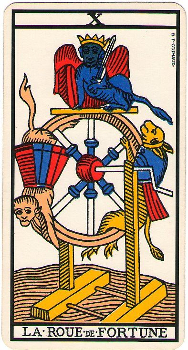
When we look at the old, Marseilles deck version of the card, though, we see a different story.  Instead of Egyptian deities, we see . . . um . . . monkey critters.  Wizard of Oz flying monkeys, one perched atop the wheel, wearing a crown and wielding a sword, one being carried upward on the wheel and one being cast down by the wheel.  This is really much more in keeping with that very primal perception of luck that we humans have always had about luck.  It’s something kind of creepy, magical, and outside of us, outside of our control.  We can never tell when a flying monkey might swoop down out of nowhere and carry us away in its nasty little talons

Humans are always trying to find a way to harness luck, to somehow bring it under our control.  There are dozens of gods of good luck that we’ve worshiped through history – Hotei, Fortuna, Lakshmi, etc. – hoping that they’ll bless us with strong luck.  Many people carry a rabbit’s foot or a lucky penny or have, “lucky socks,” or jeans that they favor.  A lot of obsessive compulsive behavior flows out of a ritualistic quest for luck.  OCDs may feel an urgent need to wipe the counter exactly seven times or wash their hands three times in order to avoid something catastrophic happening.  Most of us were taught the basics of avoiding bad luck as children.  Don’t step on a crack or you’ll break your mother’s back.  Don’t walk under a ladder.  Don’t break a mirror.  Oh, shit, it’s a black cat!

The older Tarot card shows both good luck and back luck – one monkey is rising on the Wheel of Fortune and one is descending.  The two phenomena seem to go together, to be attached, one rising from the other.  The second verse of the Tao Te Ching alludes to this when it says:

Once we know beauty, we know ugliness.

Once we know good, we know evil.

High and low, long and short—all these opposites support each other and can’t exist without one another.

That duality, that sense of opposites always going together, seems to apply to everything on the material plane, including luck.  Good luck seems to give way to bad luck and bad luck gives way to good luck, or that’s the way that we conceptualize it.

Eckhart Tolle suggests that, at least to some extent, it really is just about the way that we conceptualize it.  Many times, what we view as bad luck is just the end of a cycle.  Everything grows and then it diminishes and then it grows again.  We don’t view plants dying at the onset of winter as a tragedy, but we do view humans dying at the end of their incarnations as tragic.

Louise Hay has much the same view of the ends of relationships.  When we break up with someone or we get a divorce or our partners die, it feels like a horrible, painful tragedy.  It feels like bad luck.  She suggests viewing it instead as a sort of a graduation.  At the point the relationship ends, it means that we’ve learned everything we were supposed to learn from the dynamic of that relationship and it’s time to say, “thank you for the wisdom,” and move on.

The Law of Attraction people tell us that good luck and bad luck can actually be learned behaviors, patterns that we get into that, “attract,” more of the same.  If we can learn how to maintain a positive, healthy outlook on life, we tend to attract positive, healthy people and things into our lives.  In the same sense, if we see life as a terrible, crappy experience where we’ve got nothing but bad luck happening, that’s what we attract.  Even worse, we attract people with the same negative vibes and then we get to deal with their shit in addition to our own.  That can go a long way toward explaining why some people always seem to be lucky and some people seem to have a curse on them.

Pema Chodron said that life is all about being constantly thrown out of our nest. Constantly forced to give up our security and adapt to new experiences.  Quite a bit of what we call, “bad luck,” is that simple, elemental human experience of not wanting things to change.  We envision an idyllic, static existence where nothing new or challenging ever happens to us because change is scary.  Getting fired from our jobs, losing our partners, having to move out of our houses – these are all bad luck because they’re changes that we don’t want.

There are a couple of things worthy of noting about that, though.  The more that we resist change – the more that we say, “no,” to the end of a cycle –  the more dramatic that change is eventually going to be.  It’s almost like an explosive force that just keeps getting more and more powerful the longer we sit on it, until it eventually blows our existence into tiny, smoldering pieces.  A small change that we resist can easily grow into a catastrophe that we could have avoided.

The other thing to note is that good luck so often grows out of bad luck.  After we’ve had a period of seriously rotten luck, we frequently find our lives being showered with blessings of all sorts.  It could be that, as the Taoists assert, good luck is attached to bad luck and one inevitably gives rise to the other.  Or, as Tolle said, perhaps we’re just ending one cycle and plowing the dead weeds under the ground to make room for the new growth.

That can make a huge difference in how we experience those periods of, “bad luck.”  We can realize that The Wheel of Fortune is a wheel that’s constantly turning and that we’re never stuck in one place.  It just feels like it.  Being thrown out of the nest may feel incredibly uncomfortable emotionally.  It may be terrifying.  It may feel like horrible luck.  But it’s the only way we learn how to fly.

Dan Adair is the author of, “Just the Tarot,” available on Amazon.com at a very reasonable price.

The Canyon of the Vaginas, The World Card, and the Loss of Male Magic

A friend gave me a book for Christmas called, “Ducks Flying Backward.”  It’s a wonderful collection of essays by Tom Robbins and the first entry is called, “The Canyon of the Vaginas.”  It’s about his quest to find a mysterious, obscure canyon in Nevada, the walls of which are covered with Native American petroglyph carvings of . . . well . . . vaginas.

Imagine that:  hundreds of Native shamans going to this one site over hundreds of years to carve depictions of vaginas!  And keep in mind, the Native petroglyphs weren’t casually done.  They were considered sacred symbols and it took considerable effort to incise them in the rock.

It started me musing on The World Tarot card.  It’s a card of rebirths, new beginnings and the successful gestation of projects.  It depicts a semi-nude woman emerging into the world with a magical wand held in each hand, a symbol not just of power but of balance.

The most interesting feature of the card, though, is probably the oval shape surrounding the woman.  Although it’s disguised as some sort of a wreath, it’s quite obviously symbolic of a vulva, complete with a clitoral bow perched at the top.  This card is really about the primal, archetypal, universal experience of birth.

Now, the Tarot also has a Death card and there’s nothing at all ambiguous about it.  It’s labeled, “DEATH,” and it has a grim reaper astride a black horse.  Why, then, would The World not have been labeled, “BIRTH?”  Or, if you wanted to extend that idea into our daily lives, “REBIRTH?”  Why disguise the vulva as a wreath?  If you wanted to depict the moment of birth, why not just do a painting of a baby emerging from a vagina?

The wreath is, of course, a symbol and, like all symbols, points toward a truth without actually expressing that truth in words.  As the Tao Te Ching says, “the word that can be spoken is not the eternal word.”  The moment that we try to express a symbol in words, we lose its essential truth, which is to say, the essence which is its truth.

Birth, in all of its forms – but particularly human birth – is one of the most deeply profound and mysterious events in human experience.  Science has, with its usual methodology, attempted to reduce that experience to the mere phenomenon of a sperm cell penetrating an egg, but no amount of reductionism can lessen the wonder of the process.  How do a few cells multiply into the complex, complicated, astounding beings we call, “humans?”  How do a sperm and an egg end up being a Buddha or a Mary Magdalene, an Einstein or a Marie Curie?

It’s a mystery.  Moreover, it’s a mystery which is contained primarily within the female body.  Yes, of course, men contribute sperm cells and the attached DNA but the process of actually creating a new human being is uniquely female.  And powerful. And magical.

If that process remains mysterious to us, with all of our instrumentation and ability to scan a fetus virtually from conception to birth, we can only guess what it must have felt like to our primitive ancestors.  It’s not hard to imagine a cave dweller gaping at a woman who had just given birth and exclaiming, “How in the hell did you DO that?”

Somehow in the course of our evolution women’s bodies became much more deeply connected to our universe than men’s bodies.  We see that plainly in the lunar cycles that cause oceans to rise and fall and women to menstruate whereas men feel . . . sort of uncomfortable . . . when the moon is full.

That’s not a subject for debate or sexual politics, it’s just a fact.  We’re at a point where our old buddy Science is beginning to document the very real differences between the state of a woman-being-in-the-world and a man-being-in-the-world.  For instance, we’re finding that women generally tend to have a much stronger connection between the two hemispheres of the brain than men and, therefore, a much deeper connection with intuition and symbolism.  (For more on that, see my post, “The High Priestess and the Hallway in Our Brains.”)

We can see these differences, we can observe them, but we still don’t fully comprehend them.  There’s still that very primitive sense that there’s something magical happening with the female spirit that’s NOT happening with the male spirit and it eludes us.  We could make a very strong case that the whole sorry history of patriarchy, treating women as property to be taken and enslaved and raped, and our current marriage laws spring straight out of that male desire to somehow capture that magic that males are missing in their own souls, even if by force.

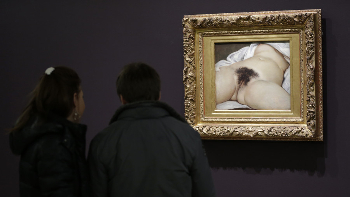
The most visited painting in the Louvre right now is called, “The Origin of the World,” by Gustave Courbet.  It’s usually surrounded by crowds of tittering, semi-embarrassed Americans, gaping at the realistic portrayal of a woman’s genitals.  It might be tempting to brush this off as casual prurience, as prudes seizing a chance of peeking under a woman’s panties, but in it’s own way it’s become a sort of a shrine and the people have become pilgrims.  It’s not too hard a stretch to connect that painting with ancient Native Americans carving hundreds of vaginas into canyon walls.

The bottom line on it, I think, is that males have become so totally alienated from their own Divine Feminine that they have to project it outwards as a symbol.  They then worship it or attempt to capture it or – as in much of our pornography – degrade and devalue it.  As long as men continue to view the Feminine Principle in purely symbolic terms – a vagina rather than a spirit –  instead of fully integrating it into our consciousness, women will continue to be objectified as the unwilling, symbolic bearers of the magic that men have lost.

When we take a final look at The World card, we can note that the woman’s genitals are covered by a sort of a free-floating cloth.  The mystery remains concealed.  At least for now.

Old Souls, Young Souls and Reflections on the Death of Thich Nhat Hahn

Upon the death of Thich Nhat Hahn . . .

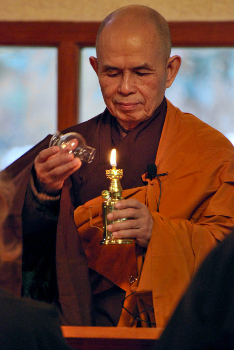
The great spiritual master, Thich Nhat Hanh, just died.  And the world took little note of his passing.  There was a brief note from the Dalai Lama. The United States State Department put out about a three paragraph memo recognizing him.  The Pope, as near I can tell, didn’t say a word.

I actually scanned through the pages of my FaceBook friends and found a total of three people who mentioned his death.  There were far more discussions of the death of a rock star named Meatloaf than there was of Thich Nhat Hanh.

Initially, I was fairly dismayed.  And saddened.  And a wee bit shocked.  I can’t tell you how many memes I’ve seen on FaceBook over the years that were quotations from Thich Nhat Hanh.  I’m sure you’ve seen them, too.  They’re usually posted with a picture of someone meditating or doing yoga or sitting blissfully under a tree.  I would guess that the number of them I’ve seen runs into the hundreds or possibly the thousands. 

 I found myself wondering – did all of those quotations actually mean anything to the people who posted them?  Did they read his books?  Did they watch his videos?  Did they in any way absorb anything that he said or believed?

I remembered a few months ago when Ram Dass passed over and there was very much the same reaction.  “Oh, yeah . . . I heard something about that.  Oh, well . . . he was pretty old, wasn’t he?”

Between the two of them, these people had a MASSIVE spiritual transmission.  They brought concepts and perspectives to the table that have helped millions – literally millions – of people across the world.  I don’t know what I expected at the news of their passing but it wasn’t, “Man, did you hear Meatloaf died?”

I know as I’m writing this that they’d both be laughing at the idea that their deaths were somehow important.  Both of them stressed throughout their decades of teachings that the whole, “my death matters,” rap is just an ego trip.  Ram Dass said that, “death is not an outrage,” it’s the most natural thing in the world.  Thich Nhat Hanh said that there is no death and no birth, just transitions of our forms.

Still, I think they were both exemplars of the fact that LIFE matters.  That the way we live our lives, that the amount of love and compassion and caring that we manifest matters very much.  In the middle of an ocean of pain and suffering and cruelty and despair, they continued to repeat that one simple, brave message:  love each other.

So . . . I  ponder over the fact that this beautiful human being, this compassionate, loving, deeply insightful man could pass away and it made such a tiny ripple on the consciousness of the world.

I think that the answer is probably that people have become accustomed to NOT having any sort of a spiritual practice, in the sense of consciously integrating spiritual values into their daily lives.  There’s a sort of a cliche’ in Texas about the good old boy Southern Baptist businessman who goes to church on Sundays and Wednesdays and screws people over the rest of the week.  When you ask him why he’d behave that way, the response is, “Well, that’s just binness (business).”

In other words, there’s a clear demarcation in his mind between spirituality – which happens on Sunday and Wednesday – and business, which happens on Monday, Tuesday, Thursday, Friday, and Saturday.  There’s a sort of a spirituality cubby hole in his existence that needs to be filled, but he manages to keep it very much in the background for most of his life.

I would guess that, for many people, posting, “spirituality memes,” on FaceBook operates in much the same way.  It’s a way of saying to others – and to ourselves – “Hey, I’m actually a deeply spiritual person.  See – I just posted a meme from Ram Dass or Thich Nhat Hanh or Pema Chodron.” And then our friends shine that right back at us and that fills that spirituality cubby hole.

Spirituality becomes a sort of a bon bon rather than a steady diet.  It’s something we post, not something we live.  It’s scratching an itch, rather than wondering why we’re itching to begin with.

I know that neither Ram Dass nor Thich Nhat Hanh would say, “Yeah, people are pretty much shallow assholes.”  I suspect they would say, “Yeah, there’s still a lot of work to do.  We need to get back on to our part of it.”

I’m finding a lot of comfort in a paradigm from the 1960s, which is that there are Old Souls and Young Souls.  If you’re an Old Soul, if you’ve been around the reincarnation cycle a few thousand times, then people like Thich Nhat Hanh resonate a lot more deeply in your heart than they might for a Young Soul.  This isn’t to say that being an Old Soul is somehow superior to or better than or wiser than a Young Soul.  It’s not an elitist trip.  It’s not a superiority trip.  It’s just being in a different place on the path.

The world seems to be awash in Young Souls right now and the best thing to do seems to be to constantly and consistently repeat that message from Ram Dass and Thich Nhat Hanh: love each other. 

Ironically, they’d both agree with the assessment of the Young Souls that their deaths didn’t really matter.  But their lives did.

Love each other.

Namaste’ Thich Nhat Hanh.