The Fool in Tarot Readings

The Meaning of The Fool Card in the Tarot.

The Fool is numbered, “Zero,” and you can either consider it the beginning or the end of the Tarot deck.  In my book, “Just the Tarot” I wrote this about The Fool:

“This is a card of pure, undifferentiated energy.  It is Spirit before it enters into the material world.  Christianity tends to refer to it as, “the Holy Spirit,” whereas Eastern religions may refer to it as, “Prana.”    It is the underlying force that energizes the universe and some would go so far as to say that it is Love.”

And that’s really the essence of The Fool.  It represents energy. Really, really good energy.  And it’s also freshness and innocence.

Have you ever stepped outside on one of the first days of Spring and it’s all so beautiful that you just feel high?  Like the world – and you – have been reborn and everything is fresh and shiny and full of possibilities. That’s the energy of The Fool.

fool

We are now beginning to evolve a philosophy (and religions) that hold that the Earth herself is sacred and holy.  For most of history, however, this wasn’t the case. The Earth plane was viewed as evil and dark or, at the least, neutral.  Light, inspiration, spirituality came from outside the Earth into the Earth.

Many of the definitions you’ll find on The Fool are based upon that model.  Spiritual energy is pouring into the Earth Plane from an outside source but it hasn’t really taken form yet.  It’s just that sheer joyous ZAP flowing through your life and your spirit and your body. Whether you think it’s flowing down from the astral plane or up from Mother Earth, it’s there.

The Fool is also about endless possibilities.  When The Fool appears in your reading you have all of power that you need to do anything that you want, but you may not have the slightest idea what it is that you want to do.  Pick a card. Any card. You’ve got the juice to make it happen.

The Fool is also irreverent and doesn’t care even a little bit about being socially proper.  To really get that you have to go back to medieval times and remember what The Fool was back then.  The Fool was the court jester, the only one who was allowed to make fun of the King and Queen and even point out that the Emperor had no clothes.  People with The Fool manifesting in their lives tend to laugh at conventions and norms and act silly when everyone else is being solemn and correct.

And people may laugh at The Fool, just as he laughs at them.  The village idiot was often chosen as the court jester. To some, The Fool may appear simple minded in his boundless optimism and joy.  Cynics and pessimists are very uncomfortable around The Fool’s energy.

REVERSED: When The Fool is reversed he shows another side of his nature which is fool-hardiness.  He’s so high on what he’s feeling that he may be sloppy about details and make mistakes.  “Fools rush in where angels fear to tread,” and The Fool is definitely no angel.

My best advice when you get The Fool in your reading is . . . enjoy!  You’ve got a wonderful force blowing through your life. Don’t worry. Be happy.

If you have questions about this card or its meaning in one of your readings, please don’t hesitate to leave a comment.  I’ll get back to you as soon as I can.

“Just the Tarot,” by Dan Adair – a kindle ebook available on Amazon

Doing Your First Tarot Reading – Start Small

An online lesson in how to do a Tarot reading including an example reading.

BACK to the Tarot Course index.

One of the things that I’d really recommend for your first reading is to start small.  If you look through the sites on the internet you’ll find some monstrous huge patterns for laying out the cards.  Lots and lots of details and sometimes dozens of cards. A beginner using one of those is sort of like deciding you’re going to write a computer program right after you figured out how to put a ringtone on your smartphone.  Start off with some smaller layouts and get a feel for the cards before you get too complex.

I actually prefer smaller reading layouts and I do at least one a week just to check in and get a little perspective on where I’m at and where I’m going.  Here’s a simple layout that takes just a little time to do but touches most of the important bases.

1 2 3 4

1 – Current conditions

2 – What needs to be done

3 – Factors working against the questioner

4 – The probable outcome

Now here’s an actual reading using this layout.  This was done for a woman who was in her fifties, professed to be deeply religious, but was not a very happy camper.

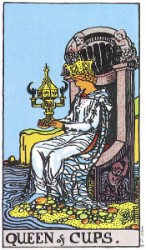
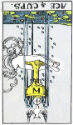
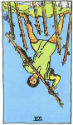
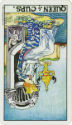
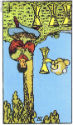
ace 7wands queenofcups 4cups

1 – Current conditions – Ace of Cups Reversed

2 – What needs to be done – 7 of Wands Reversed

3 – Factors working against the questioner – Queen of Cups Reversed

4 – The probable outcome – 4 of Cups Reversed

Now, if you read my previous post – A Few Tips Before You Start Reading Tarot Cards – you’ll recognize a couple of factors immediately.  First, all of the cards are reversed. This means that the questioner is in a very subjective state of mind and is probably not dealing realistically with what’s going on.  Second, 3 out of 4 of the cards are cups, meaning that this reading is primarily about emotions.

If you’re using the definitions from my book, “Just the Tarot,” (available on Amazon.com as an ebook for less than the cost of a can of beer – just saying)  here’s what you find:

1 – Current conditions – Ace of Cups Reversed – It’s possible that the questioner thinks he or she is love but the other person views it as just a friendship.  Another possibility is that there has been true love but it’s fading away.

2 – What needs to be done – 7 of Wands Reversed – There are just too many opponents or problems for the time being.  Disengage from conflict and deal with what you can or you must.

3 – Factors working against the questioner – Queen of Cups Reversed – This may be a person who has a sour attitude toward love and affection.  Perhaps a very materialistic person who prizes possessions over true affection.

4 – The probable outcome – 4 of Cups Reversed – The individual is letting go of old relationships and is starting over.  Perhaps a new love interest or romance.

It doesn’t take long to conclude that this reading is about a romantic relationship and that something is rotten in a Scandinavian country.  The Ace of Cups upright shows that love is blossoming but when it’s reversed it shows that love is dying. The Queen of Cups reversed in the position of opposing factors shows us that one of the people in the relationship – perhaps the questioner or perhaps her partner – has got a pretty bad attitude happening about love and romance.  The 7 of Wands in the position of what needs to be done shows us that there are just too many problems in this relationship for it to have a good outcome. And the 4 of Cups reversed shows us that the questioner or her partner will probably come to that conclusion and just walk away and start over.

See how easy that was?  You lay out the cards, you look for a pattern, and you put the story together.  Now you try it . . .

“Just the Tarot,” by Dan Adair – a kindle ebook available on Amazon

A Few Tips Before You Start Reading Tarot Cards

An online lesson with a few tips a reader should know about doing Tarot readings.

BACK to the course index

ON to the next lesson

Here are a few little tips you should know about reading Tarot Cards that I cover in my book, “Just the Tarot, by Daniel Adair.”  (Available on Amazon.com for less than the price of a bagel at your favorite coffee shop. Just saying.)

LOOK FOR LARGE NUMBERS OF THE SAME SUIT.  The Tarot basically divides our world into four different elements that match the suits of the Minor Arcana.  Wands equal ideas. Cups equal emotions. Swords equal personal power. Pentacles equal money and possessions.

So, if you’re doing a reading and you see that the majority of the cards are pentacles, you can assume that money and possessions are a very dominant part of the questioners life right now.  A majority of wands might indicate someone who is an intellectual or is exploring a lot of new ideas. Cups would show that this is a very emotional time in the questioners life. Swords would show that a quest for power and position or power struggles are very present in the questioners life.


COMBINING THE SUITS – You can also find some clues in combinations of the suits.  Suppose the reading has a majority of swords and cups: you might reasonably assume that there are some power struggles going on in the person’s romantic or emotional life.
A combination of wands and cups might indicate a person who takes a sort of
intellectual approach to romance.  Pentacles and cups could show a person who pairs romance and materialism, like a trophy wife or husband.  Pentacles and swords can show power struggles in the workplace, and so on.

REVERSED VERSUS UPRIGHT CARDS – If a majority of the cards are reversed you can assume that there is a lot going on in the questioners life that she isn’t dealing with on a conscious level.  Look for denial, repression or factors that are hidden from the questioner. If the majority of the cards are upright you can assume that the questioner is fairly aware of what’s going on in his or her life and is dealing with it on a conscious level.

NUMBERS, NUMBERS, NUMBERS – There are schools of thought on the Tarot that assign meaning to the cards based on their numerological ranking.  I’m not personally a big fan of numerology so I’m not going to mess with it here. If you’re curious or numerology floats your boat you can look it up on the internet.

MAJOR VERSUS MINOR – As I’ve said in previous posts, ALWAYS pay close attention to any cards from the Major Arcana.  The Minor Arcana tend to show the little crap that we all put up with every day. The Major Arcana show life changing forces in the questioners reading.  There’s even a method that some readers use where they REMOVE all of the Minor Arcana cards prior to the reading so that they concentrate on the major forces.

On to the next lesson!

Just the Tarot,” by Dan Adair – A kindle ebook available on Amazon.

How to Shuffle Tarot Cards

A lesson in how to shuffle Tarot cards prior to doing a reading.

“Just the Tarot,” by Dan Adair – available on Amazon

BACK to the course index

ON to the next lesson

HOW TO SHUFFLE TAROT CARDS?

In a word, “DON’T!!!!!!!!!”

I talk about this in my book, “Just the Tarot,” and it’s kind of a sore point with me.  You shuffle a deck of cards to make them as random and disorganized as possible. To say the least that is NOT we want when we’re putting together a reading.  We want the specific cards that apply to that question at that point in time. Never, ever shuffle Tarot cards like you were about to play poker.

Another method of selecting cards that gets my hackles up is when the reader pulls the cards out of the deck based on her feelings of what cards are appropriate.  I actually had that done for my very first Tarot reading. The reader was a beautiful, young hippie with long, black hair who dressed in silk sarongs and wore oval sunglasses constantly, even indoors.  Suzanne advertised herself as a witch and would intimate that she had deep psychic powers that she’d been born with and that her incredible sensitivity had spawned a deeply troubled childhood. No mere mortal, after all, could see what she could see.

I sat there, totally enchanted as she she spread the deck, face up, before her and selected the cards for my reading.  Hell, I was 14 years old and I’d have been enchanted if she was peeling a potato. Did I mention she was beautiful?

I really don’t remember the reading and can’t tell you whether it was accurate or not.   What I can tell you at this point is that was NOT a Tarot reading. When a reader selects cards based on her psychic impressions what you’re getting is a psychic reading, not a Tarot reading.  It may be incredibly accurate depending upon the psychic but it is NOT a Tarot reading.

You see, the magic is in the cards, not in the reader.

After all of these years of reading cards here’s what I recommend:  make a mess. Make a BIG mess. Clear a space on a table or a clean floor that’s about 3 feet by 3 feet.  Put the deck of cards in front of the questioner and have him or her spread the cards out – FACE DOWN – in a rotating circle.  Keep spreading the cards until they’re all loose and then keep them flowing in that pile, around and around, until they, “feel,” right or complete to the questioner.  Then have him or her reassemble the cards into a deck and take it from them. Lay out the reading you’ve chosen using the top card as the first card, the next card as the second, and so on.  Once you have the cards in the layout turn them over and begin the reading.

There’s some method in that madness and it’s based on my theory of how the cards work.  You can view every human as an energy field rather than just a body or a mind. We are constantly putting out energy based upon how we feel, what we’re thinking, and what we’re experiencing.  And that energy is magnetic. It draws similar energies to it. It’s a truism, for instance, that negative energy will draw negative experiences and positive will draw positive.

Think of each Tarot card as its own little energy field.  Some of them are positive, some of them are negative, and some of them are in between.  As you handle the cards your energy field magnetizes the cards that are in synch with what you’re going through at that moment and what the probable outcomes are based on your energy pattern.

Soooooo . . . the more that the questioner handles the cards the more probable you are to get an accurate reading.  Don’t put any time limit on how long the cards are touched and moved around. Let them take as long as they like and you vastly improve the probability of an accurate reading.

On to the next lesson!