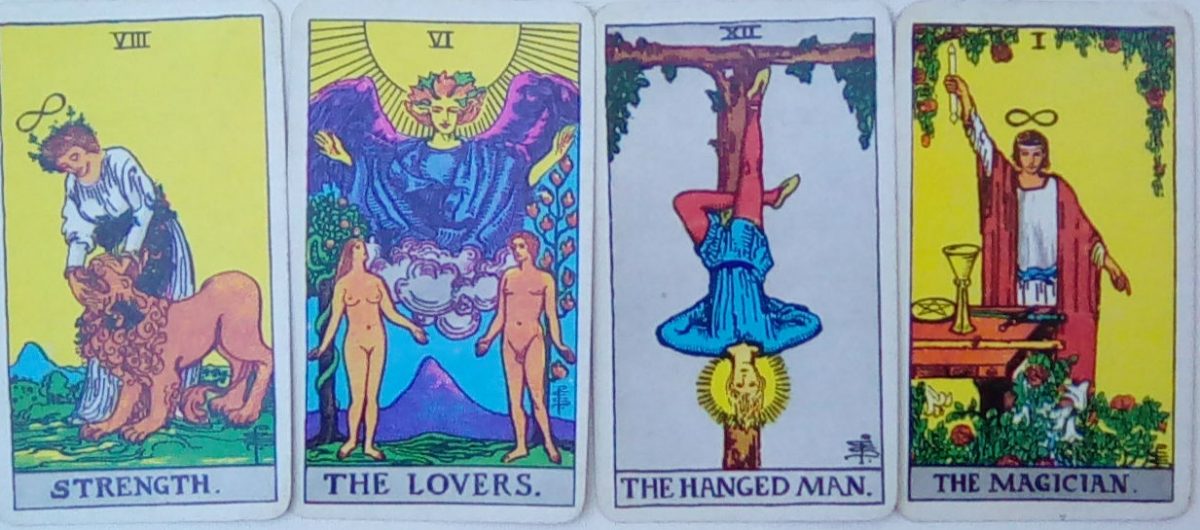
The Death Card in Tarot

The meaning of the Death card in the Tarot. This includes definitions for the upright and reversed positions.

Death

This is that card that always causes Tarot readers to rush to say, “It doesn’t really mean death.  It just says death.”

Doncha feel better now?

Upright: In some of my readings it actually has meant death, but it was a statement after the fact.  For instance, Death appeared in my readings for months after my partner died but not before her death.  The cards weren’t predicting death, they were just saying, “Okay, someone you loved very much has died and you’re dealing with death.”

In most instances, though, the card indicates a radical, transformative change that is not associated with a physical death.  Rather, it indicates that the questioner is saying goodbye to one phase of his or her life which is, “dying away,” and saying hello to a new phase that will be radically different.  We’ve all had those turning points in life where we suddenly walked down a totally new path and away from what we were accustomed to and Death presages those turnings.

Still, it’s a spooky, creepy looking card and no matter how much New Age Optimism you throw at it it’s still unsettling.  And that’s another aspect of the card: the changes that the questioner is about to go through may not feel at ALL comfortable to begin with.  In fact, they may feel downright scary and unsettling at first. They will lead to positive developments, though, so just hang on and work through it.

REVERSED – A lot the same as in the upright position but the changes will probably be more gradual and feel less like the world has been turned upside down.  There is a warning that the questioner may be resisting necessary change and this could lead to a life that’s stuck in neutral.

If you have questions about this card or its meaning in one of your readings, please don’t hesitate to leave a comment.  I’ll get back to you as soon as I can.

A Few More Thoughts on  . . . you know . . . D-E-A-T-H

It’s interesting to note that in the earliest versions of the Tarot the Death card was the only card without a label.  It was almost as if they were saying, “It’s him. You know . . . HIM. Don’t mention his name or he might look at us and then we might . . . you know . . . die.”

To a large extent we seem to share that same superstition in 21st century America.  It’s cliched but still relevant to point out that we have largely sanitized death in our culture.  Most deaths take place in hospitals rather than homes and we let strangers tend to our loved ones bodies after their demise.

Let’s face it:   DEATH . . . FREAKS . . . US . . . OUT!

And isn’t that odd?

Death is the most natural thing in the world.  Everything that is born dies. As the old blues song says, “No matter how you struggle and strive/you’ll never get out of this world alive.”

As Ram Dass put it,”Death is not an outrage.”

So why is it that we hold it in such awe and fear?

Probably because it puts an end to the little magic act that our ego performs every day.  I am immortal. I will go on and on. The entire world revolves around me and my self image and my needs and wants.  Hell, even if we CAN envision ourselves as ghosts it’s usually as pretty much the same body we have now only sort of translucent and vaporous.

Only, NOT.  Your body is going to be . . . you know . . . D-E-A-D.

Buddhists point out that we all have a craving for permanence and security.  It seems to be hard wired into the human Self. We need to feel that we’ll be happy forever.  That we’ll be in love forever. That we’ll go on and on in our little homes and tragedy will never touch us.  That our loved ones will never die and neither will we.

And then Death comes along and blows all of that into a million pieces.  And that causes pain and suffering like we never knew we could endure.

The answer to that suffering seems to be to try to keep an awareness of Death every day.  It sounds depressing and dark, but it’s really not. Knowing – truly knowing – in your heart that you have a very limited period of time lets you enjoy each moment.  It lets you be aware of how amazingly precious and beautiful your life really is.

Yes, it’s the death of the ego and ego HATES that.  But it’s the birth of the Soul. No real awareness of death = no real awareness of life.  As Pema Chodron said:

“To be fully alive, fully human, and completely awake is to be continually thrown out of the nest. To live fully is to be always in no-man’s-land, to experience each moment as completely new and fresh. To live is to be willing to die over and over again. ”

“Just the Tarot,” by Dan Adair – a kindle ebook available on Amazon

The Hanged Man – Suffering and Rebirth

The meaning of The Hanged Man card in the Tarot, including definitions for the upright and reversed positions.

hangedman

A young man hangs suspended by one foot from a tee shaped cross of living wood.  His hands appear to be tied behind his back and a glowing nimbus surrounds his head.

Upright: The key word in the description above is, “suspended.”  This card indicates a time out, a period during which the questioner may, “suspend,” life for a while and take a break to rethink and re-create his or her life.  The suspension of activities precedes a change in the person’s life and attitudes.

This actually happens fairly frequently in our society and in some cases we describe it as a mid-life crisis.  A person wakes up one morning and thinks, “What in the hell am I doing with my life? This sucks.” And, in more radical instances, they may quit their jobs, walk away from everything, and join a monastery or meditation center for a while to sort things out.

Even without taking it to those extremes this card represents a self-imposed period of sacrifice and relative isolation in order to grow spiritually or mentally.  On a romantic level it may indicate walking away from relationships for a while in order to become a more balanced person and have better relationships in the future.  On an employment level it may signal a need to quit a job that you don’t like and retrain for something that you will like. In any event, it always signals temporary sacrifice that allows the questioner to grow and improve in the future.

REVERSED:  Take a careful look at the sacrifices that you are making in life and be sure that they’re worth it and that something better will emerge as a result of them.  It may also indicate a strong desire for change without any ability to make it happen. A time when you’d really like something different to emerge but you just can’t take a break from your responsibilities and make it happen.

If you have questions about this card or its meaning in one of your readings, please don’t hesitate to leave a comment.  I’ll get back to you as soon as I can.

A Few More Thoughts About The Hanged Man:

There are actually two components to The Hanged Man.  One is suffering and the other involves a period of retreat leading to a spiritual rebirth.

In my experience many of the Tarot definitions which you find today – particularly those with a heavy New Age emphasis – tend to overplay the spiritual rebirth part and underplay the suffering.  It is, after all, the suffering which causes the spiritual rebirth in the first place.

A person who draws The Hanged Man in a reading has gone through the emotional equivalent of being hit in the face with a two by four.  They have gone through something that was so shocking, so devastating that it’s knocked them out of the orbit of their normal lives. They have to pull back, retreat, and rethink what their lives are all about.

I began pulling The Hanged Man on a consistent basis after the death of my life partner.  We’d been together for 19 years and suddenly the center of my universe, my reason for being, was gone.  The grief was excruciating, something I hope I never have to go through again and, at its’ core, was the knowledge that life would never be the same.  It took months of meditating, journaling, and pondering before I began to crawl out of that horrible black hole to put my existence back in order.

That’s the kind of incident that precedes The Hanged Man appearing in a person’s reading.  For some it may be a divorce or finding their spouses were cheating on them. For others it may be the sudden realization that they’ve been living a life without meaning or purpose and that our time on this earth plane is limited.

First there is the pain.  Then there’s a retreat from normal life which probably starts on the very basic level of licking your wounds and trying to not go crazy.  And then there’s an extended period of questioning what life is about, what your values are, and how you want to live.

The Hanged Man doesn’t move through your life quickly.  It’s not something that’s over within a few days or a few weeks.  This card can show months or even years of rebirth and regrowth. The good news is that you come out of the other side of it a much stronger and much better person.

“Just the Tarot,” by Dan Adair – a kindle ebook available on Amazon

The Justice Tarot Card

The meaning of the Justice card in the Tarot, including definitions for the upright and reversed positions.

justice

This is one of the simpler and least symbolic cards of the deck.  On a very basic level it represents justice and fairness.

Since justice is usually played out in the court systems in our society this may indicate a favorable legal settlement for the questioner.  On the same level it may indicate an honest lawyer or a fair and impartial judge or jury.

In the realm of relationships this may indicate a romantic or business relationship which is well balanced and in which both parties are getting what they deserve.

On a personal level this can indicate that the questioner is a fair and honest person who treats others carefully and with consideration.

REVERSED:  If there are legal matters pending there may be an unfavorable outcome for the questioner.  On a personal level this may indicate a person who overly judgmental and critical, even harsh.  The questioner needs to take a good hard look at his or her life and relationships and decide if she’s being honest, open, and fair.

How you perceive the Justice card depends upon whether you want to think of it as Justice-small-j or Justice-big-j.

If you have questions about this card or its meaning in one of your readings, please don’t hesitate to leave a comment.  I’ll get back to you as soon as I can.

A Few More Thoughts About Justice:

Justice-small-j has to do with our court systems and what you might call ordinary, earth based justice.  It will almost always appear in readings when the questioner is involved with some legal process or litigation.  

From a small-j perspective it looks very much like The Hierophant card.  A person sitting on a throne between two gray pillars. The Hierophant represents organized religion as opposed to true spirituality and, in the same sense, Justice represents organized justice as opposed to morality based justice.  The Hierophant is spirituality as it has been collected in books and organized into long standing traditions. Justice-small-j represents justice as it has been collected in books and organized into long standing precedents.

Justice-small-j is all about court rooms, judges, law books, and lawyers.  It’s what attorneys go to law school to learn.

Justice-big-j is a whole different kettle of fish.  It’s about the principle of justice and whether or not it exists independently from the court systems.  We don’t talk about that much anymore but it was actually a very hot topic from ancient times right through the early twentieth century.

Plato argued that there was a, “form,” of Justice, sort of an archetype of righteousness that descended into the material plane and the human mind and heart.

In her wonderful book, “Jung and Tarot, An Archetypal Journey,”  Sallie Nichols quotes Carl Jung as saying this:

“It should never be forgotten . . . that morality was not brought down on tables of stone from Sinai and imposed on the people, but is a function of the human soul, as old as humanity itself.”

Dig that:  morality is a function of the human soul.  In other words, we instinctively seek to do right and to avoid doing what’s wrong.  

The Tibetan Buddhists talk about the human soul in much the same way.  Chagdud Tulku Rinpoche described it as a beautiful, glowing crystal that’s encased in rock.  Each time that we meditate or intentionally act with love and compassion a little more of the rock obscuring the crystal gets chipped away.  A little more of our beauty emerges.

We know that at the time the Tarot first appeared Plato was still being studied as the Great Master of philosophy.  And we know that the rest of the cards in the Major Arcana are very much archetypal images. So it’s not a stretch at all to assume that Justice was included in the Tarot deck not as a small-j but as a big-j.  

When you get Justice in a reading, yes, look for legal matters to crop up in your life.  But also look for the principle of Justice to be blowing through your life.  Something has been out of balance in the way you’ve been treated and karmic principles are stepping in to adjust that and bring it back into balance.  

BIG J!

 
“Just the Tarot,” by Dan Adair – a kindle ebook available on Amazon

The Wheel of Fortune

The meaning of The Wheel of Fortune card in the Tarot, including definitions for the upright and reversed positions.

wheel

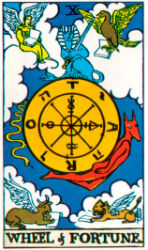
The Waite deck obviously went all out on this card and crammed as much occult symbolism into one little package as the mind can conceive.  I personally think you’re pretty much always going in the wrong direction when you combine the new testament with Egyptian gods, but – hey! – to each his own.

The word Taro in the center of the wheel is a reversal of the word Rota, meaning wheel and it emphasizes that our journey through this life is very much like being affixed to a turning wheel.  What goes up must inevitably come down and then, in the nature of the wheel, go back up again. This card is talking about the fact that change is inevitable.  Nothing remains fixed or static in this world and you may be riding high one day and fall off your horse the next.  You may be flat busted and then have a crazy idea that makes you a fortune. Life is always changing and we just pretend that it isn’t because it makes us more comfortable.

When the Wheel of Fortune shows up in a reading you know that a large change is about to happen.  The card doesn’t speak to whether the change is good, bad, or indifferent: it’s just telling you that something big is about to happen and you should be prepared for it.  When it happens it will probably feel like a bolt from the blue, a sudden stroke of good luck or a lightning flash of bad luck. Other cards in the reading may give clues as to the area of life in which you can expect the changes.

REVERSED:  There’s not a huge difference between the upright and reversed card, except the reversed card shows more of an aspect of bad luck.  It’s possible that the questioner is about to enter into a period of hard times or that he or she is simply going to have a string of bad luck.  The main lesson for this card is to use the tough times to develop stronger character. Persevere and grow.

If you have questions about this card or its meaning in one of your readings, please don’t hesitate to leave a comment.  I’ll get back to you as soon as I can.

A Few Other Thoughts About The Wheel of Fortune:

The Wheel of Fortune represents a glitch in the fabric of their well-ordered universes which organized religions have been trying to ignore since their inception.

Which is to say . . . luck.  Good luck, bad luck, and no luck.  

If The Hierophant represents the well-oiled machinery of organized religion, the The Wheel of Fortune represents a huge monkey wrench that got thrown into the gears of that machinery.  Organized religions teach – put simplistically – that if you’re a good person then good things will happen to you. And if you’re a bad person, then bad things will happen to you.

And, of course, that flies in the face of much of what we see around us.  Why do kind, gentle people of faith sitting in a synagogue in Philadelphia get gunned down by a vile racist who is consumed with hate?   Why do billionaires who celebrate avarice and greed live lives of luxury while the pious frequently don’t have enough food for their children?

It’s a conundrum that religions have been hard put to explain.  In the christian religion we see the rather sickening tale of god and the devil deciding to turn Job into a human ping pong ball, kill his children and his livestock, and give him some sort of a leprous disease just to, “test his faith.”

The most logical explanation I’ve run across is the Buddhist idea of karma.  We plant seeds of hate and violence in past lives and they may bloom into poisonous flowers hundreds of lifetimes later.  Thus, bad things happening to us aren’t the random, crazy things that they seem to be but just natural consequences of our past actions.

That’s what I personally believe but, like all metaphysical assertions, it’s an unprovable hypothesis based on my experiences, thoughts, and feelings.

The Wheel of Fortune pushes aside all of the metaphysical hypotheses and organized religions and just says, “Look:  shit happens. And good things happen.” Period. You don’t have to have an explanation for it to recognize that it happens.

The nicest, most successful person in the world can hit a string of really putrid luck and have everything she’s worked for destroyed.  The biggest bastard in the world can hit a string of really good luck and end up in the White House.

It’s a principle of randomness that seems to be built into the universe.  What goes up, must come down, and vice verse. Today’s rooster is tomorrow’s feather duster.  Life moves in cycles and we have no choice but to move with them and do the best that we can. The Wheel of Fortune is a reminder of that.  

Ultimately none of the castles that we build – or lose – on this earth plane are real.  Figure out what things ARE real. Your values. Your heart. Your love for and from others.  Those are things we create ourselves with the way that we live our lives. No change of fortune can give them to you and no change of fortune can take them away.

“Just the Tarot,” by Dan Adair – a kindle ebook available on Amazon

The Hermit in Tarot Readings

The meaning of The Hermit Card in the Tarot, including definition for the upright and reversed positions.

hermit

This is one of the more mysterious cards in the deck and hearkens very much to Gandalf the Gray from the Tolkien Trilogy.  This card can indicate a person who has withdrawn from society and is living a life of contemplation and meditation. On the other hand it can indicate that the questioner needs to withdraw from normal life for a while and go through a period of self examination and deeper thought about the meaning of his or her life.

It can also indicate a wise counselor who can give the questioner much needed advice and insights.  The lantern represents psychic and psychological insight and the figure is on a much higher plane than the rest of us, so it may be that the questioner should seek out the counsel of a Wise Woman or Man.

In any case, this is a card of solitude and the individual is very much withdrawn from others around him.  This isn’t a bad sort of solitude, however, this is a solitude that involves spiritual growth and contemplation.

REVERSED – This can be interpreted in several different ways.  It may indicate someone who is spending far, far too much time alone and needs the feedback and companionship of other human beings.

On the other hand, it can indicate a social butterfly who is spending far, far too little time alone and needs to withdraw for a while and develop a little spiritual and emotional depth.

On the relationship level it can indicate a partner who is having a MAJOR sulk and snit fit and is holed up feeling sorry for his or her self.  It can also indicate that a relationship is over for good.

If you have questions about this card or its meaning in one of your readings, please don’t hesitate to leave a comment.  I’ll get back to you as soon as I can.

A Few More Thoughts About the Hermit:

I ran across an online definition of The Hermit in which the author said that it was a, “sad,” card and that The Hermit’s wisdom, “has no substance,” until it’s shared with others.

Sigh . . .

Togetherness and, “sharing,” have almost become a disease in our society.  And the point is that you have to have something to share.  Increasingly, people don’t. Look at it this way:

circle

Suppose that this circle represents you as an energy field.  It contains all of your emotions, your thoughts, your physical body.    Then you fall in love with someone and become partners and that looks a lot like this:

Circles 2

Part of your energy field has merged with part of his or her energy field.  There’s still a part of you which is separate and unique but there’s also a part of you that is an amalgam of you and your partner.  Then say that you have children or even just get a roommate and it starts to look like this:

3circles

So your energy field – the part of you that is uniquely you – is now merged with two other energy fields.  Then throw in the people at your job and you look like this:

4circles

As I’m sure you noticed the part that is uniquely you just keeps getting smaller.  You can make a very good argument that all of those other energy fields merging with your energy field is a good thing.  We draw strength and inspiration and love from interacting with other humans. But if you keep adding and adding and adding energy fields, at a certain point you’re so merged with other people’s thoughts and feelings that you don’t know which are yours and which are theirs.

And, as if all that weren’t enough, throw in the internet.  And facebook. And instagram. And twitter. You encounter people in the stores and on the streets who appear to have their smart phones permanently affixed to their ears and they respond to every post, every personal message, every tweet.  It’s as if the internet has become a secondary sensory system for them, tendrils reaching endlessly in and out into virtual reality.

The Hermit is a deliberate withdrawal from all of that.  And it begins with a single question: “Who in the hell am I?”

All Native cultures honor the tradition of, “the Spirit Quest.”  An individual goes off to be alone, fast, meditate, and seek visions and messages from the Spirit World.  Not just to ask, “Who am I?” but to ask what am I? What is my place in this world? What should I be doing in this lifetime?  Why do I exist?

And that’s what The Hermit represents.  It’s a period of withdrawal from the world, an emptying out of, “others” so that you can find your authentic self.   And, no, it is not made any more or less valuable by sharing it with others. It stands alone.

“Just the Tarot,” by Dan Adair – a kindle ebook available on Amazon

The Strength Card in the Tarot

The meaning of the Strength card in the Tarot, including definitions for the upright and reversed positions.

Strength

This is, obviously, first and foremost a card denoting strength.  It is, however, a quiet, gentle, enduring strength rather than a blustering, muscle flexing type of strength.  Note how gently the woman is closing the lion’s mouth. She almost appears to be petting it, rather than subduing it.

The lemniscate hovering above her head indicates that she is channeling the Higher Power and the realm of spirit.  This is very much the strength of the Goddess, loving and nurturing to all of her creatures and conquering with enduring love rather than brute force.

This card shows that the questioner will overcome challenges and be successful in the long term.  The key to this is quiet perseverance rather than an all out frontal assault on the problems. The urge to fight – represented by the lion – is overcome and supplanted by the loving strength of her higher nature.  So, too, the questioner should approach problems with loving kindness rather than aggression and will win out in the end.

On a simple physical level this card may show an individual who has been ill for some time but is slowly recovering and gaining strength.

REVERSED – A lack of strength and resolve.  The questioner may be overcome by foes and enemies because he or she isn’t strong enough to stand up to them.  If conflicts arise try to delay and retreat.

This may also show a person who is chronically ill or fatigued and is failing to get better.  A long term, serious illness.

If you have questions about this card or its meaning in one of your readings, please don’t hesitate to leave a comment.  I’ll get back to you as soon as I can.

A FEW MORE THOUGHTS ABOUT STRENGTH:

Strength has some of the most cliched definitions attached to it of any card in the Major Arcana.  It’s a woman closing a lion’s mouth. So the lion is an animal, right? And the woman is, well, a woman.  And, hey, she’s got the symbol for eternity floating over her head! So . . . um . . . it must be about using our higher nature to control our animal instincts, right?

And, of course, the second someone mentions, “animal instincts,” being the good little puritans we are, we immediately think of . . . you know . . . S-E-X.  And somehow this rather interesting portrayal of a woman quietly closing the mouth of a lion morphs into a morality play about being more spiritual and less sexual because, of course, sex and spirituality are opposites.  

It’s my belief that Strength is actually about a state of being called, “Ahimsa.”  For those of you who aren’t familiar with it Ahimsa is a phrase which basically means, “being harmless,”  or, “doing no harm.” It’s practiced in Hinduism, Buddhism, and Jainism and is mentioned prominently in the Yoga Sutras of Patanjali.  And, yes, it’s usually described as a practice but it’s also a state of being. It’s a state of projecting absolutely no harmful or aggressive vibrations at all.

Let me give you an example.  My life partner Carol had an old Persian cat who liked to lie out in the sunshine during the summer.  I glanced out the kitchen window one day and was astonished to see this large, white cat stretched out on the ground and completely surrounded by birds.  They were strolling around, pecking at the ground, grooming themselves, and literally within inches of one of their worst predators, a cat.

They had absolutely no fear of the cat because they somehow knew that the cat had absolutely no interest in harming them.  The cat was practicing kitty-ahimsa and the birds were responding in kind.

You find similar scenarios in the tales from India.  Ferocious tigers and snakes who become completely docile in the presence of a master practicing ahimsa.

Here’s what Swami Kriyananda said about it:  “Ahimsa, rightly understood, becomes the ultimate weapon;  it turns one’s enemy into one’s friend, thereby banishing the possibility of further conflict.”

You could call it the ultimate weapon, as he did, or the ultimate STRENGTH.

I told the story about the cat and the birds to a conservative friend of mine.  He sneered and said, “Well, it’s a good thing that cat has someone to feed it or it would starve to death.”

He didn’t get it.  The cat was fully capable of killing those birds in seconds but the cat chose not to.  Instead of spreading blood and gore all over the back yard the cat chose to enjoy the sunny day and, perhaps, the songs of the birds.  He projected peace and peace is what was projected back at him.

Violence, aggression, anger, fear, those are all ultimately choices that we make.  If we put out those vibrations the beings around us respond on the same vibrational level.  If we put out peace and harmlessness the beings around us respond with peace and harmlessness.

Ahimsa can be a difficult concept for Westerners to grasp.  We tend to think of strength as something we’re doing, some positive action, or at least the ability to endure something unpleasant.  Ahimsa, on the other hand, is not-doing. It’s a deliberate withdrawing from any actions that might cause harm, anger, or fear.  It seems totally paradoxical:  you are ARMING yourself with peace.  And thus you overcome violence.

This card calls for taking a good, deep look at what we mean when we use the word, “Strength.”  Is it aggression? Dominance? Walking over people who disagree with you? Or is it quite the opposite?

“Just the Tarot,” by Dan Adair – a kindle ebook available on Amazon

The Chariot Card

The meaning of The Chariot Card in the Tarot, including definitions for the upright and reversed positions.

Chariot

Some authors interpret this card as a sign of triumph and victory, Caesar arriving in a chariot after defeating his enemies.  What this card is really all about is control, effort, and work. The black and white sphinxes represent opposing forces harnessed, unfortunately, to the same vehicle.  The charioteer is charged with maintaining control over forces which may be incompatible and pulling him in opposite directions, maintaining balance in the midst of chaos.  

Note that the Chariot is not going anywhere.  It’s sitting perfectly still and the sphinxes are pretty much sitting on their asses and staring off in different directions.  This indicates that the questioner is going to have to work hard to even get things moving and then work harder to keep them under control.  

There is also a strong element of the mystical and calling on higher powers for help in this card.  He carries a wand, showing that he is channeling power and inspiration from a higher realm of being and the square on his chest shows that he is integrating all of the four elements into his efforts.

All in all, this is a card that shows a period of hard work, the need for control over forces or people that may have opposite views or be totally unmotivated, and the need to channel inspiration and higher guidance.  The crescent moons on his shoulders indicate that the period of hard work may last about a month and – in all probability – there will be a favorable outcome.

On a very mundane level, this card can indicate that the questioner is about to get a new vehicle or do some serious traveling.

REVERSED:  This can indicate that things are – or at least feel – totally out of control.  A period of chaos in the questioners life when he or she feels that exterior forces or people are controlling her destiny.

People in 12 Step Programs often emphasize the need to acknowledge – gracefully – that we are powerless over certain things in our lives.  That can be a big key in dealing with this card. Don’t fight or lash out at people or situations; just acknowledge that this is something that you can’t control and turn it over to your Higher Power.

Again, on a mundane level, this can indicate some sort of a problem with your car or delays in travel arrangements.

If you have questions about this card or its meaning in one of your readings, please don’t hesitate to leave a comment.  I’ll get back to you as soon as I can.

Some Additional Thoughts About the Chariot:

The Chariot is a very weird card.  On the surface the Charioteer looks very butch.  He’s got his armor on and a really impressive crown and there are crescent moons sitting on his shoulders and he’s protected by a canopy of stars.  He’s the kind of a guy that if you saw him sitting in his chariot at a stop light you might think, “Wow!”

Or even, “Zounds!”

But if you take a closer look there are some obvious signs that something’s wrong with this picture.  As I said in the basic definition the sphinxes aren’t going anywhere. They’re sitting on their butts and pointing in different directions.  Not exactly champing at their bits. Because – hey! – there are no bits. And while we’re at it, there are no reins. And there’s no harness.

Hmmmm . . .

So what we have is this guy sitting in his magnificent chariot with no way to make it go anywhere and no way to direct it even if it does go somewhere.   Which means that if you pull The Chariot in a reading you’ve got to start off with the basics.

First of all you have to get both sphinxes pointed in the same direction.  They represent your motive force, your motivations, your desires to go somewhere and achieve your goals.  The Chariot points to the fact that you’re probably going through a period in your life where you have a lot of different goals and they may not be compatible with each other.  You literally feel torn in a lot of different directions.

You need to get your goals straightened out and figure out where you want to go.  You’re at Point A and before you can figure out how to get to Point B you need to figure out what Point B is.  What do you WANT?

Hopefully you figure out your goal, you get both your sphinxes turned in that direction and you’re all ready to go!  Except . . . wait . . . you still don’t have reins and the sphinxes still aren’t harnessed to anything. That’s the next step.  

The sphinxes are your motivation, your power to get where you want to go.  But you need to learn how to control the power that flows out of that motivation.  To discipline yourself, keep your shit together and keep going on the path that you’ve chosen without flying off in a million different directions.

That’s the paradox of The Chariot.  At first glance it seems to portray someone who really has it together.  A closer look shows someone who is going to have a tough battle ahead and isn’t prepared for it.  Yet. There are basic lessons about discipline and control to be learned before the wheels of the chariot even start to turn.

As I said, The Chariot is a very weird card.

“Just the Tarot,” by Dan Adair – a kindle ebook available on Amazon

The Lovers Tarot Card

The Meaning of The Lovers Tarot Card, including definitions for the upright and reversed positions.

the-lovers

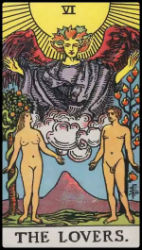
This is a card with multiple layers of meaning.  The obvious theme is the Garden of Eden and all that it implies but the name of the card is The Lovers and all that implies.  So the first layer of meaning involves new love:  fresh, pristine, innocent, glowing, lovely love. Quite simply, two people who are madly, head over heels, wonderfully in love.  Since it is situated in the Garden of Eden we can assume that this is probably a fairly new relationship and it has emerged like magic into the two people’s lives.

It can also indicate a strong sense of bonding with a coworker or an associate.  Not necessarily on a sexual level but on a deep, almost Soul level of understanding and appreciating each other.

And – back to the Garden – another layer of meaning in this card is about choice and the consequences of choosing.  We all know the somewhat insane biblical fable of the tyrannical, authoritarian god throwing an absolute hissy fit because Eve took a bite of an apple, throwing them out of the Garden, and cursing all of their offspring and heirs to lives of pain and suffering FOREVER.  Naturally, it was the uppity woman who did it and not the man. Just like a woman, right?

Well, despite the absolutely tweaky, weird, sexist fairy tale the underlying theme is about choosing and about knowledge.  On a relationship level, this can be about choosing the type of a relationship that you have. Will it be based on love and trust and belief in each other or will it be based on emotional addiction and lust?  On a workplace level, this may indicate that there are different options that are about to manifest in your career and you’ll need to consider them very carefully prior to making a commitment to one or the other.

REVERSED:  This can indicate a loss of innocence and/or the end of a relationship.  Perhaps, as you have gained more knowledge of each other, the beautiful, rosy glow of your new found love is starting to fade and you’re beginning to wonder why you ever got involved with that jerk in the first place.

This can also indicate the end of the honeymoon phase of the relationship and the time when you actually have to get down to making it work if you want it to last.  Remember, the two lovers were protected by the angel in the Garden, but he’s also the one that threw them out. That sense of divine protection in a new and beautiful relationship may be going away and you may be dismayed by the challenge of being together in the real world.

It may indicate that you made a really bad decision in some area of your life, whether romance, employment, or real estate, and now you have to figure out how to correct it.

If you have questions about this card or its meaning in one of your readings, please don’t hesitate to leave a comment.  I’ll get back to you as soon as I can.

A Few Random Thoughts About The Lovers:

Not long ago a friend of mine asked, “Haven’t you ever had a relationship with someone where you just KNEW that you could tell them anything and it would be alright?”

And my answer was, “No.”  I really didn’t think that telling your lover everything about yourself was either possible or desirable.  After all, we’ve all got some dark little pockets in our hearts and our pasts that are perhaps better left alone.

I’ve since discussed it with several people for whom I have great respect and they disagree with me and assure me that a relationship like that is very possible.  I have my doubts but wherever the truth may lie it brings up an interesting aspect of The Lovers, which is knowledge.

On the left hand side of the card you can see the fabled apple tree with our old friend the snake wrapped around its’ trunk.  And what is it that the snake is purported to have offered Eve beside a bite of a juicy Granny Smith apple? Knowledge. Or, perhaps, self-knowledge.

A serious relationship with another person is a journey of discovery.  You meet, you get to know each other, you like each other and feel attracted, a sexual relationship gets built in, and perhaps you move in together.

During that entire sequence there’s a sort of a rosy glow around the relationship.  It feels like magic and you’re happy and satisfied and you think it will be that way forever.  And then comes the reality of living with another human being every day and every night. The rosy glow can fade away very quickly.

It may be small, relatively petty things like him leaving his underwear on the floor or her blowing her nose and leaving the tissues on the bathroom counter.  Usually those issues can be resolved if you are really in love. Minor adjustments, right?

But there’s also a much deeper discovery of each other that takes place as life goes along.  Is he capable of staying steady and strong during a family emergency? Is she willing to compromise during a heated argument or does she just keep screaming and insisting that she’s right?  Does he recognize when she’s hurting and respond with love or is always all about him?

In other words . . . character.

When you love someone and live with them you come to know on a very deep level not just their strengths but also their flaws.  And sooner or later either the positives will outweigh the negatives or vice verse. Sooner or later you have to make that evaluation:  is this relationship worth it? Is this relationship nourishing me and helping me to grow as a human being or is it stunting me and turning me into someone I don’t like?

If the negatives outweigh the positives, hopefully you leave.  If the positives outweigh the negatives, hopefully you stay.

There is a third path you can take, of course, and that’s growth.  If both people are willing to look honestly at their own flaws and work hard to become better people then they truly become The Lovers on a much deeper level.  They really KNOW each other and the love still remains.

The definition of The Lovers Card in the Tarot.
“Just the Tarot,” by Dan Adair – a kindle ebook available on Amazon

The Emperor in the Tarot

The meaning of The Emperor card in the Tarot, including definitions for the upright and reversed positions.

Emperor

There is a tendency among Tarot readers to associate the Emperor with the Empress.  If the Empress is the ultimate Feminine Energy then the the Emperor must be the ultimate Masculine Energy.  It makes sense, both because of the names of the cards and their proximity to each other in the deck. They seem to be two sides of the same coin, yin and yang.

It’s just not so, however.  The Empress is wild, unbridled, sensual, ready for a good roll in the hay at a moments notice.  The Emperor, on the other hand, looks like he’s had a bad case of constipation for twenty years and would probably need a double dose of viagra to even think about a roll in the hay.  And let’s face it: who wants to go to bed with someone who’s dressed in armor?

Another very common misconception is that he’s associated with the astrological sign Aries the Ram.  It makes sense on the face of it because there are ram’s heads all over the card. That’s about the only way it make sense.  Aries is associated with the number one, not the Emperor’s number four. Additionally, Aries is the child of the zodiac, fresh, impulsive, trusting, headstrong.  The Emperor is obviously a very old man and there’s nothing ram like about his demeanor or his posture. The rams, like the barren mountains in the background, are meant to suggest that the Emperor dwells in isolation high above the common folk of the world.

So, yes, the Emperor represents male energy but only a very narrow spectrum of it.  If this archetype is blowing through your life you may be about to encounter someone who is rock solid, a very strong individual who is fully capable of taking charge and does so.  He probably won’t be a barrel of laughs – if fact, he may not have any sense of humor at all – but he will be experienced and totally dependable.

If the card represents the questioner it may show that he or she is in a position to take charge and reach their goals.  They are well suited to the task at hand and there is an emphasis upon using the intellect rather than emotions. There is a warning to not come across as too authoritarian.  “My way or the highway,” is an approach that will cause some people to head for the highway.

Reversed:  This warns that someone you are relying may not be all they’re cracked up to be, that they may be pretending to be more capable than they are and that you are in for a disappointment.  If the card represents the questioner it suggests that there is a lack of focus and concentration.

If you have questions about this card or its meaning in one of your readings, please don’t hesitate to leave a comment.  I’ll get back to you as soon as I can.

A Few Extra Thoughts:

When you pull The Emperor in a reading it may be a good time to think about positions of power in general and male power in particular.

We live in a society where the dominant model for power is that it flows from the top down.  Whether you’re talking about the president in our political structure or CEOs in the corporate world there is one person – usually male – who wields the overwhelming majority of power.  He makes the decisions, he gives the orders, he expects those orders to be followed. If they aren’t he crushes anyone who was, “insubordinate.”

Basically that’s a pretty medieval structure.  It’s no mistake that we still use the phrase, “they seized power,” when we’re talking about one political party or the other winning an election.  It goes back to the era when power literally WAS seized at the point of a sword by one tyrant or the other who then got to live in luxury while the rest of the people worked to support his lifestyle.  As Mel Brookes said, “It’s good to be the king.”

Unfortunately, it’s not a very good model for the rest of us.  If you’re a boss or a supervisor and you pull this card try to imagine some different ways of using power rather than just being a my way or the highway person.  How can you share the power? How can you get your employees more involved in the decision making? How can you make your workplace more of a democracy and less of a kingdom?

And any male who gets The Emperor in a reading should take a little time to think about, “male power.”  What does it mean to you to be a powerful male? Is it located in your body? Do you think of it as being able to dominate other people physically and, “kick some ass?”  Is it in your intellect and you seek to dominate other people on that level?

Does it have to involve dominance at all?  

Can you be strong in your ability to nurture, to comfort, to care and show up day after day after day to do the things that need to be done?  I’ve known some men who did home caregiving for sick wives or children who were far, far stronger than the bullies in the workplace thumping their chests.

What does it mean to be, “a powerful male?”  The jury is still out on that one.

“Just the Tarot,” by Dan Adair – a kindle ebook available on Amazon

The Empress Tarot Card

The meaning of The Empress Card in the Tarot, including definitions for the upright and reversed positions.

empress

The Empress is, quite simply, the Earth Goddess.  She is feminine sensuality and creativity at its’ height.  Unlike the High Priestess she doesn’t sit rigidly on a throne but reclines casually on a chair that looks like it was made for making love.  Her legs are slightly spread and she is openly sexual.

When the archetype of the Empress is blowing through your life you will experience a powerful blast of the feminine and all of its’ creative energy.  For a woman this card may indicate a pregnancy or a desire for pregnancy. If already a mother it may show a refocusing on the nurturing, feminine side of parenting.  For a man, this may show a gently powerful, nurturing person entering his life. There can be a period of material comfort and emotional abundance as a result of this.  There may be an opening of the man’s gentler, kinder nature.

For either sex, this can indicate a period of immense creativity and fertility.  The wheat in the foreground hearkens back to Demeter, the Goddess of Earth, agriculture, and fertility.  This may represent a strong interest in gardening and growing and a need to reconnect with Mother Earth.

There is quite simply nothing negative about this card.  It’s a card of growth, creativity, sensuality, fertility and expansion.  We like it.

Reversed:  Blocked creativity and a lack of abundance.  In a woman it may represent complications around the issue of birth:  unwanted or complicated pregnancies, infertility, abortion. In a man it may represent a total rejection of his feminine, nurturing side and embracing the cold, male archetype or perhaps sterility or vasectomies.  In either sex it can indicate poor parenting and withdrawn, disinterested mothers or fathers. If real estate is involved it may indicate a poor choice that fails to enhance the spirits and lives of the buyers. A period of lack of financial resources may be at hand.

If you have questions about this card or its meaning in one of your readings, please don’t hesitate to leave a comment.  I’ll get back to you as soon as I can.

A few thoughts on this card beyond what I go in to in my book, “Just the Tarot.”

The United States is a society which was firmly rooted in puritanism.  The Empress runs smack up against those elements.

For one thing, she is openly, joyously sexual.  There is nothing hidden or coy about it. She is firmly and comfortably settled in her body and happy to be 100% of a woman.  We emerged from a tradition that viewed women as socially and intellectually inferior and viewed their bodies as – at the worst, unclean and unholy – and at the best as some sort of fleshly trap to make good christian men think evil, lustful thoughts.    The Empress looks those men straight in the eyes and says, “Go ahead and think all the lustful thoughts you want. In fact . . . what have you got?”

Another aspect of The Empress that goes against that puritan tradition is her wonderful sensuality.  She is all about comfort, leisure, hot baths, tenderness and just plain loving life right here on this beautiful Earth.  

The puritan tradition tells us that life is hard and that’s good.  The more we deny our own sensuality the holier and closer to god we become.  Think of the Shaker chair: upright, stiff, designed so that the person who is using it WON’T be comfortable because comfort might make us enjoy our bodies.

shaker

The Empress quite clearly says, “To hell with that!  You couldn’t even make love in that chair without it falling over.  Where’s my couch?”

Unfortunately, that’s still an ongoing battle in our national psyche.  There are still way too many people who think that taking a little time for themselves, enjoying their bodies and luxuriating in this beautiful world is wrong.   Incorporating The Empress into your life is about rejecting that puritan, workaholic, type A model and learning to self-nurture.  Relax, stroke, love.

The definition of The Empress Card in the Tarot.
“Just the Tarot,” by Dan Adair – a kindle ebook available on Amazon