The Four of Pentacles, New Age Capitalists, and Buddha in an F-150 Pickup Truck

A look at the New Age fascination with money.

“I wanted to be able to help people financially.  If you have enough money, you can buy health.  A rich man can always find a woman.  If you have enough money, you can buy almost anything.” – Jerry Hicks

There is a very peculiar – and very strong – connection between the New Age/New Thought movement and good old American capitalism.

The Four of Pentacles shows a guy with his feet on money, holding money, and money on his mind, and that’s a LOT of the New Age movement and its leaders.

Mike Dooley, who is best known for his credo, “Thoughts become things,” was an international tax specialist for Price Waterhouse and his primary client was Saudi Freaking Arabia.

Prior to channeling Abraham, Esther Hicks was a business accountant and Jerry Hicks was THE leading Amway salesman in the United States.

Stuart Wilde made a fortune selling Mod clothing on Carnaby Street before he took up Taoism and made another fortune selling books about how spiritual it is to make a fortune.

Even the much beloved Ram Dass was born into a very wealthy family, never experienced a day of poverty or want, franchised his spirituality very successfully and died on his massive estate in Hawaii.

I have to admit that I was somewhat puzzled by the extreme emphasis on money and material possessions when I first stumbled into the New Age movement.  I started my spiritual journey as a young kid in a midwestern state, taking LARGE amounts of LSD, reading Tarot cards, and convinced that it really was the Dawning of the Age of Aquarius.

Racism, war and poverty would be eliminated.  We’d all live in peace and harmony and people would really and truly realize that love is all that matters.  Those were my dreams when I was a young man.

Duh.  I know.  It didn’t exactly turn out that way, did it?  Still, there was a nobility and a grandeur to the dreams that I think all young people should have. 

And so, when Mike Dooley talked about his dreams as a young man, I was a bit mystified.  “I wanted to make a million bucks, own my own private plane and travel internationally with a beautiful woman by my side.”

Or Stuart Wilde’s statement that, “Money doesn’t imply that rich people are spiritual but it does infer that poor people probably are not.”

Or the (I’m sure inadvertent but telling) juxtaposition in Jerry Hicks statement, “A rich man can always find a woman.  If you have enough money, you can buy almost anything.”

Esther and Jerry Hicks probably took the wedding of capitalism to spirituality further than anyone else.  Their basic position is that our desire for material goods – for the goodies in life – is what drives us into greater and greater spiritual growth.  In their view, we have a sort of an internal wish list that’s composed of things like boats, cars, money, houses. As we tell the Universe what we want, the Universe provides all of those things on the wish list.

BUT . . . as we fulfill one wish list, another list spontaneously arises and we want even more, which the Universe provides and then we want even more, and so on. 

Oddly, that very process is exactly what the Buddha described as the source of all suffering.  It’s the constant desire for more and more and more, without the realization that more is never enough to make us happy. One wish list will always be replaced by another.

What I eventually realized is that these people – despite being rampant, unapologetic capitalists – ARE spreading a lot of spirituality through the world, no matter how paradoxical that might sound. 

Here’s the thing:  American capitalism is the dominant force in the world right now.  And the lingua franca of capitalism is M-O-N-E-Y.  

Who are the people who are going to all of the seminars and retreats of the New Age gurus and buying all of the millions of books they produce every year?  They sure as hell aren’t Buddhist monks or old hippies.  

They’re business people.  Amway salesmen.  Used car dealers.  Advertising guys.  Executive secretaries and career women.  Their dreams aren’t about world peace or brotherhood; their dreams are composed of F-150 pick up trucks, big houses, ski boats, and, yes, all the women they can buy with their fabulous wealth.

The ironic thing about it is that as they’re attending the Let’s-All-Get-Rich rallies, they’re also getting a HUGE dose of spirituality.  What’s really behind the idea of visualization and manifestation is that the physical world is not at ALL what it looks like.  We really CAN manifest whatever we want, seemingly out of nothing.  Magic really DOES exist.  There IS huge abundance in the world and we can tap into it with the power of attraction.

These are exactly the same people who love to mock California woo-woos and think that psychics and sensitives are crack pots.  But there they are, hunkered down in their split level homes in Nebraska, Utah, and Kentucky, pasting together vision boards and writing out affirmations.

LOL – which is doing magic.  Plain and simple.  If you’re trying to make something appear out of nothing using the power of your mind, you’re casting a magic spell.  Surprise!

It’s all very bizarre and puzzling, but it’s an improvement.  It’s a definite improvement.

Love, Therapy, Ram Dass, and God in Drag

A look at the sources of love.

I’ve been reading a book called, “Getting the Love You Want,” by a psychotherapist named Harville Hendrix.  The theme of the book is basically, “We all fall in love, a lot of us fall out of love, and here’s how to fix that.”  He’s a smart guy, did some excellent analysis, and I’d probably recommend the book.

But he never did get into that basic question of, “What IS love?”

Now, there’s been an awful lot of brain and biochemistry research over the last 20 years.  What the scientists have determined is that when we magically meet, “the right person,”  giant sparks fly out of both our genitals and our subconscious minds, then our brains start pumping huge amounts of endorphins, and – SHAZAM! – we’re in love.

That’s what we could call the, “reductionist,” approach to love.  What we call love is ultimately reduced to brain and body chemicals that cause us to feel wonderful.  From that point of view, love is nothing more than a biochemical reaction – probably based on the need for the species to procreate – that we dress up with a lot of romantic notions, boxes of candy, and Hallmark cards.

It’s a classic case of the whole being more than the sum of the parts, though.  Love isn’t just hormones.

Love is an energy.  When we have it in our lives, we don’t just feel better, our lives actually work better.  Its presence seems to trigger huge amounts of synchronicity and serendipity, we suddenly have solutions to most of the problems that we encounter, and we’re harmonious with the Tao, the Universal Flow.  When we don’t have it, life can feel like a meaningless slog through knee deep mud.

So the obvious course of action seems to be that we should all run right out, throw a net over someone, and fall in love with them.  Unfortunately, as Hendrix pointed out, right around 50% of us fall out of love, which is extremely painful, and we’re right back where we started, only we hurt a little more than we did before and we’re a lot more cynical.  Then we go back out, find another person to fall in love with, and rinse and repeat. 

 As much as Americans revere the idea of finding our Soul Mates, most of us are actually serial monogamists, who find one Soul Mate after another after another until one of them finally sticks.

I got a BIG clue on all of this a few years ago when I was listening to a Ram Dass talk after my partner had died.  He said that the reason that we feel so devastated after a death, a divorce, or a break up is that we mistake the person for the love.  The person is the vehicle that gets us to the love, not the love itself.  Since we have so totally identified the love with the person, though, when they go away it feels as if all of the love has gone away.

As near as I’ve been able to figure out, there are basically three sources of love.  There’s the love we derive from our relationships with other people.  There’s self-love, which so many of us struggle to achieve.  And then there’s the love that flows out of our spiritual connection with Source Energy, the god-head, the Tao, the Flow.

The trick is to understand that all three of the different forms are actually the same energy, the Source Energy, dressed up in different costumes.

Human beings are hardwired to receive love from other human beings.  And that’s a very good thing, indeed.  It’s like a built in on-ramp to Source Energy and it should be an effortless, natural process.  Unfortunately, the second that we enter the world, a lot of other ingredients get added to that process.  We start out with pure love and then we throw in crazy parents, cultural expectations, dysfunctional partners, etc., etc., etc, until the love becomes a shit show.  

Then we find ourselves sitting in a therapist’s office, asking, “What happened?  All I wanted was for someone to love me.  What happened?”  If we’re blessed with a really good therapist, we can start to untangle those knots and sort it all out.  “Okay, this part of the shit show came from your depressed mother and this part of the shit show came from high school and this part of the shit came from your ex-husband.”  As we identify and subtract more and more of the added ingredients that doomed our relationships, we move closer to that model of pure love that we were born with.

Where our culture lets us down, though, is in not identifying the actual origin of that energy that we call, “love.”  When we finally realize that the love is flowing OUT of Source and THROUGH our partners, then we can wake up and realize, “Huh . . .the love is always there and it’s abundant.  I can find it through my partners, but I can find it in a lot of other ways, too.  I can actually love myself.  I can meditate on Source.  I can connect with that energy in a zillion different ways.”

That’s not to put down romantic love in any way.  Romantic love is a grand sort of a feeling and it’s probably the fastest way for us, as a species, to reach that love energy.  BUT . . . it’s not the origin of the energy.

Perhaps the best solution is something else that Ram Dass suggested:  “Treat everyone you meet as if they were God in drag.”  When we start looking at the people we love as little bits of that God/Goddess/Love energy shining out at us through their human forms, then we can honor them, honor the process, and honor the love.

Christmas Candy, the Meaning of Giving, and Tibetan Meditation Centers

Making our lives into gifts.

Here in the United States we’re just finishing up the annual emotional and commercial orgy of Christmas, also known as, “the season of giving.”  It started me thinking about the nature of giving and, oddly, a Tibetan meditation center I toured over 20 years ago.

Our guide was a woman who lived there with the improbable name of, “Candy.”  I’m guessing that trying to explain the intricacies of Buddhist philosophy to a group of tourists in Bermuda shorts was not the highlight of her day, but she was pleasant, kind, and patient.  One of the concepts that she put in a nutshell for us was the idea of accumulating merit.

“We get up in the morning with the idea of helping other sentient beings and, if we do that, it earns us karmic merit.  And then, instead of clinging to that merit for ourselves, we dedicate it to the good of other sentient beings.  Which accumulates more merit, which we dedicate to the good of other sentient beings.”

I glanced around at the people I was with and their faces were frozen in expressions that pretty much conveyed, “I don’t know what in the fuck you’re talking about, but you seem relatively harmless.”  To me, though, it was a major revelation.  In just those few sentences, I understood the concept of giving with absolutely no expectations of getting anything back.  It’s been something I’ve gone back to again and again over the last two decades.  A lasting treasure.

Now, here’s the thing:  I feel absolutely sure that Candy had no idea that she was making a major impact in another person’s life and thoughts.  We spent maybe 30 minutes with her and I’ve never seen her again, but I still remember that moment like it happened yesterday.  It was a gift, and the gift was her just living her life and telling her truth.

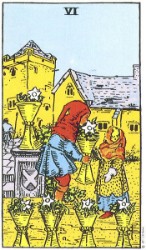
We tend to think of giving as being something that’s transactional and we can see that idea illustrated in the Six of Cups.  The little boy is giving a gift of love (symbolized by the Cup) to the little girl.  Implicit in that image is the next step in the transaction, where the little girl is going to say, “Oh, hey!  What a nice cup!  Thanks so much for thinking of me.”

And then we feel good because we’ve made someone we care about feel good and we feel good about ourselves because, after all, we were thoughtful enough to give something nice to someone we care about.  When we put all of the commercialism and forced jolliness aside, that’s part of the sweetness of Christmas – it’s a chance to give something to others and tell them we love them.

Most of us feel pretty disconnected with that in our general, everyday lives, though.  We may get up in the morning with the intentions of being, “good,” people.  We’re loving with our life partners, we don’t snap at the cashier in the grocery store, we smile at our co-workers and try to work hard at our jobs.  As near as I can tell, right around 90% of us are good people, in the sense that we make some effort to not be shit heads and to be decent to our fellow humans.

Still, a lot of us are afflicted with a sense of meaninglessness.  We feel like we’re slow walking through life in a sort of a daze and we’re not really making any difference.  It’s like we’re born, we eat a lot of t.v. dinners, and then we die and we wonder if anything we’ve done actually matters.

That’s where synchronicity and a leap of faith comes in.  That’s where giving with no sense of attachment to the results comes in.

Each one of us is absolutely unique.  There’s never been anyone exactly like us before and there will never be anyone exactly like us again.  To the extent that we celebrate that uniqueness and share our own individual truths in our lives, we become a walking, talking, breathing gift to the world.

But we almost HAVE to detach that gift from results.  If we make our giving transactional – which is to say, someone saying, “Thank you for being you,”  – we’re setting ourselves up for a lot of disappointment.  The fact of the matter is that most people don’t even see us, in any sort of a meaningful way.  Like us, they’re hustling and bustling through life, trying to pay their bills, hoping they’ve got some clean socks, trying to figure out what in the hell they can cook for their kids that isn’t a t.v. dinner.

And if they do notice us, the odds are that they’re seeing us through so many perceptual filters that they don’t see who we really are.  As the old Indian adage goes, “When a pickpocket looks at a saint, all he sees is pockets.”  

So, we have to make a little leap of faith that we ARE being seen without knowing that we are.  And that we ARE making a difference in other people’s lives and in the world, without any proof that it’s so.  Sometimes it may be like Candy at the meditation center, where words we speak become seeds that grow in other people’s lives.  Sometimes it may be as simple as smiling at a person we pass on the street, never knowing that they were depressed and suicidal until they saw our smile.

We can see that in another card, the Ace of Cups.  The cup represents love flowing into the world, but, unlike the Six of Cups, it’s not attached to anything.  It’s not something we have to earn.  It’s not dependent on being thanked or being noticed or appreciated.  It’s just there in the world and it makes life better by its very presence.

When we finally get it that we’re giving to the world around us and making a difference just by being us to the fullest extent that we can, then we shift into having meaning in our lives because we ARE making a difference.  We may not see it.  Perhaps no one will ever tell us.  Maybe it will take twenty years for that good to ripen in someone else’s life, but we DO matter.  Every single day.

My e-book, “Just the Tarot,” is still available on Amazon for less than the price of a meaningless t.v. dinner and it’s twice as nutritious!

The Rules of Synchronicity Number Two: Lighten the Fuck Up and Walk on Some Water

Playfulness as a key to synchronicity.

In my previous post, The Rules of Synchronicity, Having Sex with Pizzas, and Becoming More Flow-ish, I began to lay out some basic rules for increasing synchronicity in our lives.  We then use that synchronicity to get into The Flow State and life becomes a lot easier.

  Rule number one, of course, is to ask for synchronicity.  It’s like knocking on a door – if you don’t knock, no one will answer.

Rule number two is . . . play.

Just play.  As in, don’t take ourselves so seriously.  Lighten the fuck up.  Mellow out.  Have some fun.

Now, to many people, that’s going to sound counter-intuitive.  After all, we’re asking the Universe for guidance in our lives!  And that’s serious stuff, by golly, and we should act very solemn about it.  Maybe dress all in black and look pained and tragic.  Or maybe even fall down on our knees and sob about it.

Not.

There is a, “Whatever-It-Is,” out there in the Universe that answers our questions and gives us guidance when we ask.  Call it god, call it the faery folk, call it angels, call it whatever you like.  It’s there and it engages with us when we engage with it.

Now, the Whatever-It-Is has some basic characteristics, just like a person.  In fact, it might be easier to think of Whatever-It-Is as a person or even a friend.  One of it’s characteristics is that it’s playful.  It likes to engage with people who have a sense of humor and a light heart.  It’s not that Whatever-It-Is WON’T engage with us if we’re all serious and dejected and depressed.  It would just rather engage with someone who’s a little more fun.

Using the analogy of a friend again, we all have friends who are in a dark, depressed place.  Everyone goes in and out of the light and some people stay in the darkness a little longer than others.  If we have a friend like that, we don’t turn our backs on him.  If she needs to have a cup of coffee and just unload about how miserable her life is, we’ll do that.  We’re willing to pat his shoulder and say, “There, there . . . it will all work out.”

On the other hand, if we see that particular friend coming toward us a block away, we might cross the street and peer into a shop window until he passes by.  We’re compassionate, but we’re not masochistic.  We’re there to help, but we don’t seek out the darkness they’re living in.

Put another way, we’re all attracted to people who are positive, humorous, and light hearted.  Their positive energy gives us a good energetic charge and, hopefully, we give them one as well.

In very much the same way, Whatever-It-Is is much more likely to engage with us when we’re living in a fun, humorous, positive space.  It has a light, playful energy and so it’s much more compatible with OUR energy when we’re light and playful.

This is, of course, completely contrary to what we’ve been raised to believe.  Traditionally, people have sought out a connection with Whatever-It-Is in churches.  And what do we know about going to church?  It’s very, very, very serious.  And solemn.  And pretty damned uncomfortable.  No giggling allowed, thank you very much.  

Catholics even have a tradition of smacking themselves in their chests with their fists and saying, “Mea culpa, mea culpa, mea MAXIMA culpa.”  That translates as, “I am guilty, I am guilty, I am SO FUCKING guilty.”

Would you like to have a conversation like that with a friend?  Of course not.  So why do we assume that Whatever-It-Is wants to have that conversation with us?  The ironic thing is that we’ve been taught that, in order to talk with Whatever-It-Is, we have to get into a really dark, serious emotional space and this is totally non-productive.  It just makes it that much harder for the positive energy and guidance to flow to us, because our vibration is incompatible.

Another problem that many of us – especially those of us who were raised as christians – encounter is that we’ve been taught from the get-go that GOD IS NOT OUR FRIEND!  The word, “god,” is just the term that most Westerners use to describe Whatever-It-Is.  It’s the something out there that we talk to when we need guidance and help, which we call, “praying,”  and when it answers us we call that, “miracles.”  

Unfortunately, we’ve also been taught that this god person pretty much doesn’t like anything that makes us happy.  That includes masturbation, sex, lying around being lazy, eating too much, and getting high.  He’s making a list and he’s checking it twice and he’s going to find out if we’re naughty or nice.  And if we’re naughty, we’re going straight to hell. Forever.  Period.

In other words, god doesn’t have much of a sense of humor.  In fact, you can flip through the entire bible and hardly find one single instance where god appeared to be having any fun or told a joke or did a dance.  The one exception I can think of was when Jesus decided to walk on the water just to freak out the local fishermen, but that’s a different story.

So, once again, this is a mind-set that we need to TOTALLY get out of.  Whatever-It-Is (call it god if you want to) LIKES for us to have fun.  Whatever-It-Is LIKES people who have sex and lie around in a hammock on a sunny day and tell jokes and dance.  Who wouldn’t?

Just to recap where we’re at in this discussion at this point:

  1. – We’re much happier, more fulfilled, and content when we’re living in the state of consciousness that we call, “The Flow.”
  2. – That state of consciousness always occurs coincident with synchronicity, so if we can increase our synchronicity, we increase the time we spend in The Flow.
  3. – Synchronicity means having contact with, asking questions of, and getting guidance from the spiritual source that some people call god/goddess or the faery folk or angels or spirit guides or even Whatever-It-Is.
  4. – The first step in achieving synchronicity is to actually, consciously ask for guidance and then watch for answers.
  5. – The answers will come a lot easier if we stay in a happy, light, positive vibration and remember that Whatever-It-Is is a benevolent friend who likes to have fun.

I’ll be posting some more about synchronicity in the near future, but for now just remember that the way to enlightenment is to lighten the fuck up.  We can do that!

Remember that my e-book, Just the Tarot, is available on Amazon for much less than what you’d pay for a box of chocolates and you’ll know EXACTLY what you’re getting.

Cheatin’ Horndogs, Vibrators in the Refrigerator, and Tarot Cards that Indicate Infidelity

Tarot cards that indicate infidelity in a relationship.

“She just started liking cheating songs,
And what’s bothering me,
I don’t know if it’s the cheating she likes,
Or just the melody.” – John Anderson

If you read Tarot cards for other people, you’ll find that one of the major topics that those people want to know about is love and romance.

Is she the right one for me?
Does he feel the same about me that I feel about him?
Should I ask her out?
Should we move in together?
Are we meant to get married?
Will this relationship last?

And, of course, with love and romance there are frequently questions about fidelity and cheating. Most marriages and relationships are, “monogamous,” which is derived from the Greek, meaning, “keep your dick in your pants,” (except when you’re with me.) A very large part of the marital and partnership contract is that when we fall in love we’ll be sexually and emotionally exclusive to that one other person.

Just the Tarot by Dan Adair – a kindle ebook available on Amazon

Having sex with or becoming emotionally attached to a third party is seen as a major violation of that contract and is grounds for terminating it. And there are major penalties that go along with that violation, such as being locked out of your house in your bathrobe, or having your partner pour maple syrup all over your best clothes just before she throws them out into the front yard. And many times, it’s not even REAL maple syrup, it’s that cheap, artificially flavored crap like Mrs. Butterworths.

Quite naturally, then, people who are cheating on their partners will go to great lengths to conceal it. And, quite naturally, the partner who’s being cheated on will somehow know, on a very deep, almost psychic level, that their mates are being unfaithful. There may be extremely subtle, subliminal clues, such as your husband having a giant hickey on his neck, or finding a pair of jockey shorts under the pillow when you wear boxer shorts. Or perhaps coming home early from work and seeing a naked man running out your back door, or finding a strange vibrator in the refrigerator next to the carton of eggs.

Those are the kinds of subdued, low key signals that will often make a person stop and ponder if there’s something more going on in their marriage than meets the eye. Still, their partners will tend to deny it. The vibrator in the refrigerator must have accidentally fallen into the grocery bag at the supermarket and really belongs to someone else. The naked man running out the backdoor was the plumber, who was sleepwalking, and was completely shocked when he awakened without clothes while he was working on the dripping faucet in the bathroom. The hickey on your husband’s neck was the result of a near tragic vacuum cleaner accident at work. The jockey shorts under the pillow were meant to be a present and now you’ve gone and ruined the surprise.

Even though these are all perfectly rational, reasonable explanations, there may still be lingering suspicions and so your client will want to consult the Tarot cards to determine the truth. Here are a few cards that may indicate that the questioner’s partner is what is clinically referred to as a, “cheatin’ horndog.”

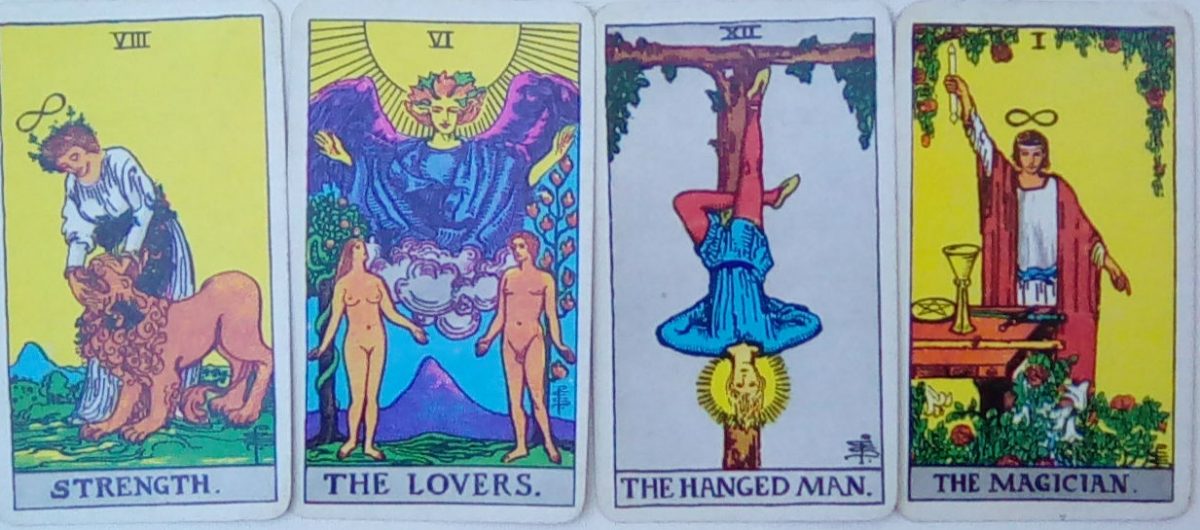
THE LOVERS REVERSED

The Lovers is obviously THE romantic relationship card in the Tarot deck. It shows that period of time when you’re first together with your romantic partner and the whole world seems magical and glowing. It’s just the two of you, in your shining little garden. Just you and the angels and . . . um . . . that pesky snake climbing up the tree. When it’s reversed, the party’s over, baby. You’ve been thrown out of the garden and it’s time to deal with reality.

THE DEVIL (UPRIGHT OR REVERSED)

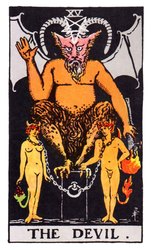
The Devil card shows the same two figures from The Lovers card, only things don’t seem to be as peachy anymore. For one thing, instead of an angel hovering over them, there’s a great big horny kind of a goat/bat demon thingie. They’re chained to a black stone or altar and they have tails which are on fire. (Having your tail burst into flames is another one of those subtle signs that there may be something wrong.) The Devil card can mean a lot of rotten things, such as addictions, super negativity, etc, etc,, but in this context – cheatin’ horndogs – it probably indicates a sexual affair that’s going on and it probably indicates that it’s a pretty heavy duty affair that may have strong elements of BDSM. I mean, horny goats, chains and flaming tails? Really?

THE TOWER (UPRIGHT OR REVERSED)

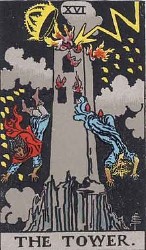
The Tower, as you might guess, is NOT a positive card. It usually indicates a freaking disaster that’s happening right in the middle of our happy little lives. The flash of the lightning bolts indicates that it’s sudden and shocking. It tends to destroy our lives right down to the foundation and then we’ve got to start rebuilding them, piece by piece. Having this show up in a reading about fidelity would indicate the sudden knowledge that your partner has been unfaithful and the relationship has been completely destroyed by that lack of fidelity.

FIVE OF WANDS

The Five of Wands may show up in a relationship where there’s a LOT of emotional turmoil. In the South, they talk about, “fight and fuck,” relationships. These are relationships where the two people involved have huge fights with much screaming and throwing of plates, and then they reconcile and have make-up sex that’s incredibly good. There are spoken phrases in there like, “Oh, baby, I’m so sorry,” and, “I promise this will never happen again, ‘cause you’re the dumplings in my chicken soup, honey buns.” Yes, I know honey buns and chicken soup are a disgusting combination, but you get the idea. There’s cheating going on, but they’ll probably reconcile and spend the next week in bed.


QUEEN OF WANDS REVERSED

The Queen of Wands has a lot of good characteristics and, among them, is fidelity. If she shows up reversed, there’s a very good chance that someone isn’t practicing that virtue.

ACE OF CUPS REVERSED

The Ace of Cups shows pure, unadulterated love pouring into the world. It tends to appear when someone is just starting off on a new romantic relationship and their hearts are full of love. When it’s reversed, there’s a good chance that their love got adulterated by a cheatin’, adulterating horndog.

THREE OF CUPS REVERSED

Obviously, this is very much of a party hardy card. When it’s upright, it’s healthy, joyous and free partying. When it’s reversed and shows up in this kind of a reading it can indicate that the joy is leaving or that your partner is partying with someone else.

TEN OF CUPS REVERSED

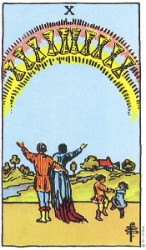
Among other things, the Ten of Cups is the Happy Family card. When it’s reversed it can be a sign that the happy family is breaking up, particularly if it’s a family with children involved.

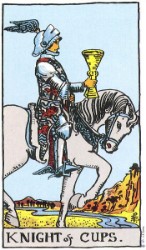
KNIGHT OF CUPS REVERSED

The Knight of Cups is riding out on a sincere quest for love. Reversed, it indicates that the love wasn’t found.

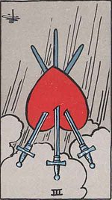
THREE OF SWORDS

LOL – well . . . yeah . . . that one’s pretty obvious. Stabbed right in the heart.

SEVEN OF SWORDS

The Seven of Swords is all about sneaking around and stealing someone else’s power. This is the kind of person who has an affair right in front of everyone’s eyes and somehow gets away with it. This card also shows up frequently when you’re involved with a malignant narcissist who’s just using you for their own ego gratification.

TWO OF PENTACLES

The Two of Pentacles may show up in a reading like this to indicate someone who’s trying to juggle two different love affairs and keep both of them going.

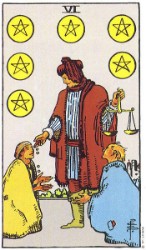
SIX OF PENTACLES

This may indicate a lover who’s not really giving with a whole, loving heart. Love is being measured out very carefully.

Those are just a few of the red flags that may show up if your questioner wants to know if his or her partner is running around.

Remember to be very careful with these types of readings. Many people are in a great deal of denial when relationships are falling apart and really, really DON’T want you to tell them what you see in the reading. What they want is for you to tell them that they were wrong and that the vibrator in the refrigerator is really just a whipped cream dispenser. If you’re doing a reading for your best friend and you tell her that her husband is playing hide-the-sausage with his secretary, she may not be pleased with you. At all.

And, of course, it’s always possible that the questioner’s partner might NOT be a cheatin’ horn dog. He could just be a rat faced dingleberry, which is an entirely different kettle of fish. In either case, approach this topic with caution. Practice using phrases such as:

It seems that all may not be as it appears.
There’s a certain murkiness here.
There appears to be a fork in the road of life.

Avoid using phrases such as:

I think he’s dipping his wick with your best friend.
She’s a real bottom feeder and believe me, I MEAN bottom.
You should have listened to your mother. By the way, does your mother still have that spare room?

The Five of Cups and the Dark and Magical Path to Happiness.

Happiness as a choice, rather than just a state of being.

The Five of Cups shows a person who is in deep grief.  He’s lost something vital in his life and he’s mourning it on the deepest, most profound  level.  In the system of the Tarot, Cups represent emotions and he sees three of his cups lying on the ground, tipped over, and spilling out their emotions.  He’s literally hypnotized and immobilized by his sadness.

A sub-theme of this card is that he is also NOT focusing on the two remaining cups, which are upright and full.  He is so concentrated on what he’s lost that he’s not perceiving that he still has something left to be grateful for.

Happiness is one of those things in life that we seldom contemplate until we lose it.  Most humans are born happy.  Sure, there are the inevitable times when babies get, “fussy,” or decide to stay awake screaming their little heads off all night, but most young critters are happy, playful and content.  It doesn’t matter if we’re talking about human babies, puppies, kittens, or deer, the young are pretty much happy, pretty much most of the time.

So in many ways, happiness is a birthright of most living beings.  It’s also frequently a matter of inertia – objects in motion tend to stay in motion and happy people tend to stay happy.  We don’t even think about it until it disappears – we’re just pretty much happy, pretty much most of the time.  In the words of the old blues song, “You don’t miss your water ‘til your well runs dry.”

We’re told that into each life a little shit must fall, and, sure enough, we all suffer a certain amount of loss and grief.  We all have loved ones who die or become very ill, we get fired from jobs, we go through separations and divorces, and we occasionally get into car wrecks or fall down and break something that we’d rather not have broken. 

Thankfully, for most of us, those losses come in fairly measured doses and we have enough support built into our lives to recover and return to our natural state of happiness.  But there are also those of us who get absolutely hammered by loss and grief.  Who don’t just experience the death of loved ones, but the tragic death of loved ones.  Who don’t just go through a divorce but go through a devastating divorce, lose their homes, lose their jobs, and find themselves out on the street with nothing but the lint in the pockets of their overcoats.  Who not only lose their happiness, but lose it for a LONG time.  

Oddly, those are the people who probably appreciate happiness the most, because they’re the people who were forced to live without it.  They’re the people who had to fight to regain it, often alone, frightened, and hopeless.  To my mind, they’re some of the real heroes in life, the spiritual warriors who made it back from the dark side, from the brink of madness and suicide.

If you’ve ever gone through that kind of a loss, you’ll know what I mean.  If you’ve suffered a major nervous breakdown, or battled with alcoholism and addiction, or lived with crippling depression, you know what it’s like to be so down that you can’t even see up anymore.  Life becomes a meaningless, seemingly endless, series of days and nights filled with darkness, sadness, and extreme anxiety.  You don’t really know why you go on living, but you do, putting one foot in front of the other and slogging along toward nothing.

Now, some of us don’t make it back from that journey into darkness.  Some of us get swept over the precipice into oblivion.  Suicide is the 12th leading cause of death in the United States.  In 2020 there were 1.2 million suicide attempts in the country and nearly 46,000 successful suicides.  Those are, of course, only the suicides we know about because many of them are concealed.

For those of us who do make it back, happiness becomes a desperate quest and a practice.  We realize at some point that if we’re going to stay alive we somehow have to find a way to recapture happiness and build it back into our lives.  For some of us, that means finding a really good therapist to help us unravel all of the emotional knots and heal the psychic wounds.  For others, the gateway to happiness is the doorway to an Alcoholics Anonymous meeting hall.  Perhaps happiness arrives in the form of a prescription for Prozac or a spiritual reawakening or even a psilocybin mushroom. 

Happiness doesn’t arrive all at once, neatly bound in wrapping paper and ribbons.  It’s something that we carefully build back into our lives, one trembling step at a time.  We may need to learn how to control our thoughts that obsessively lead us back to melancholy view points.  We may need to learn how to control our emotions and just do some deep belly breathing and meditation when we feel overwhelmed with sadness.  We may need to sit down with a therapist and do some serious exploration of why our paths crumbled under our feet.

Happiness at that point is transformed from a natural occurrence into a set of skills that we practice in our daily lives.

For me, one of the major breakthroughs was my therapist teaching me that we can be happy whenever we want to be.  We can sit down, meditate on something that makes us happy, and we will feel happy, even if just for a few moments.  If we string together enough of those meditations, we have a happy day.  If we string together enough of those days, we have a happy life.  It’s a skill.  It’s a practice.

The other day I was listening to this delightful video from author Mary Pipher about her book, “Women Rowing North.”  

The book is primarily about women and about aging, but it also has a lot of good information on happiness.  One of the things she said that really jumped out at me is that happiness is an existential choice.

There’s a deeply profound lesson in there because happiness can’t be a choice until we’ve lost it and then we’ve finally learned how to regain it.

When happiness is just our natural state of being, we’re on spiritual cruise control.  When we’re pretty much happy, pretty much most of the time, like puppies and kittens and babies,  we’re not choosing happiness – we just ARE happy.  And happiness is frequently perceived as something that’s outside of us, that happens to us, rather than something we create.  We meet the right partner, we stumble into a good job, we have a nice summer, we get laid, we see a funny movie.  It’s all a sort of a pleasant parade of sweet events that we have absolutely no control over.

When we lose our happiness – really and truly lose it for an extended period of time – and we learn how to recreate it in our lives, then it becomes something that we can control.  It becomes a product of practicing certain skill sets like meditating, staying in positive thinking, avoiding negative situations and people, and performing all of the little mental and emotional hygiene tasks that are required to stay in a state of happiness.  We’re trying to stay in a state of happiness because we KNOW that we’ll die if we don’t.

There’s a step beyond that, though, which is what Mary Pipher is talking about.  When we practice happiness long enough, there comes a wonderful day when we realize that we CHOOSE to be happy.  At that point, happiness isn’t just a survival mechanism, it isn’t just a way to avoid the darkness.  It’s an active, conscious embrace of the Light.  Happiness isn’t just a way to get along, it becomes our primary value and our choice and we know that we’ll never live without it again.

It’s a huge gift in life.  We only find it at the end of some very dark paths, but when we reach that point we realize that the journey has been a magical quest that led us to our own inner light.

The Ace of Cups, Love Without a Pronoun, and Purple Thongs in the Back Seat of the Mercedes

A look at love as existing independently from people.

In the esoteric system of the Tarot, Cups represent emotions and the Ace of Cups represents pure love.  This is a card of love-as-an-energy, pouring into the world out of thin air, magically filling our lives with wonder and ecstasy. The love isn’t, “attached,” to anything, it’s just there, existing by itself.

Love-as-an-energy is a notion that’s foreign to most Westerners, so it takes a little bit of work to wrap our heads around it.  We can see a similar notion in Reiki energy healing. The Reiki practitioner directs healing energy (which we could call, “love”) to the person or situation that is sick.  BUT . . . and this is a subtle and important distinction . . . the practitioner doesn’t tell the energy what to do.  She just sends the energy and the energy solves the problems.

Huh?  What in the hell does that mean?

Well, suppose we’ve got a friend who’s got kidney problems, or at least that’s what the doctor told him.  So we sit down and light our white candles and incense and we try to visualize as much healing and love flowing toward our friend’s kidneys as we possibly can.  Only the doctor our friend saw was distracted that morning because his mistress had left her purple thong in the back seat of his Mercedes and his wife found it and now his wife and his children aren’t speaking to him and his mistress wants her thong back and his life has just turned into a shit burger.  So he accidentally grabs the wrong chart and diagnoses a kidney problem when our friend actually has exhausted adrenals.

There we are, then, sending tons of healing energy to our friend’s kidneys when his kidneys are perfectly fine and it’s his adrenals that need a little TLC.  Instead of helping, we’re accidentally short circuiting the healing process because we decided what the problem is and we were wrong.  

The Reiki practitioner, on the other hand, just sets the intention of sending the healing energy to his friend but lets the energy figure out what the real problem is and what really needs to be healed.  In other words, he views the energy of love and healing as something that exists independently of the healer and something that has its own intelligence, an intelligence that’s far greater than ours.  You send it, but you don’t direct it.

All of which seems completely weird to most of us, because we view love as coming out of SOMEONE.  We view love as always being attached to a pronoun.  I love YOU.  YOU love me.  SHE loves him.  We view it as something that people generate themselves and bestow on others, not something that flows THROUGH us, but isn’t really ours.  Even when we talk about divine love, we view it as a very personal transaction where God or the Goddess or the Angels or the Guides are personally sending us love because, you know, we’re really nice people and why wouldn’t they?  We don’t just want the love, we want the hug that goes with it.

Ram Dass expressed a lot of the same ideas when he talked about love and relationships.  What happens when we fall in love?  We’re tritty-trotting down The Great Road of Life when we suddenly see another human being and, for whatever reason, something inside of us says, “YUM!!!  I want some of that.”  So, penises get hard, vaginas get moist, we leap into the nearest bed at the first opportunity and make love like bunnies until we fall over in an intertwined heap of sweat and hormones.  Big, silly grins for everyone.  Yay!

There’s a lot going on beneath the surface, of course.  Our brains are pumping out oxytocin and we feel high as a kite because, “we’re in love.”  That very feeling and all of those pleasure hormones predispose us to view the other person favorably and as someone who’s wonderful and magical and the source of that amazing feeling of being in love.  Many times we’re totally puzzled because our friends see our love object as a schlub with a bad haircut, instead of the Amazing Wizard of Love and Happiness that we perceive, and so we begin to cut our friends out of our lives and our lover becomes the SOLE source of love in our existence.

What happens when our lovers die or we break up because we caught them playing hide the sausage with the neighbor’s teenage daughter?  Grief happens.  Deep, devastating, profound grief.

Ram Dass looked at that whole process and said, “Yup, that’s what happens,” but he put an interesting twist on it.  He said that it isn’t the loss of the person that we’re grieving, it’s the loss of love.  The person was just a vehicle in human form that GOT us to the love that we craved and we thought he or she was the source.  Put another way, we mistook the car for the destination.  

That’s basically seeing love-as-an-energy.  It isn’t an energy that comes FROM our lovers, it’s an energy that flows THROUGH them.

None of that denigrates or diminishes the wonderful process that we call, “falling in love.”  Falling in love seems to be one of the ways that nature has hard wired us to reach that state of love that heals us and makes us whole.  It’s a good thing.

What it DOES do, though, is to remove a lot of the negative qualities that too frequently go along with that process.  When we realize that love is out there, that it exists independently of other people, then falling in love loses its addictive and dependent nature.  We don’t view the other person as the source of love, we view them as a portal in our lives – sometimes temporary and sometimes lasting – through which the love flows.  We don’t depend on them for our source of love, like a junkie depends on his dealer for heroin.

If the other person goes away, that’s okay, because the love remains and we can tap into it any time that we want to, just by opening our hearts to that energy.  In a very real sense, we become the source of our own love, because we’re the ones who are making the conscious decision to stay open to that amazing energy, no matter what happens or who comes and goes in our lives.

And then we’re living in love, instead of falling in love.

It’s a good thing.

The Two of Cups, Low Libidos, and Smoldering Men in Skirts

A brief look at the myths and expectations surrounding American sexuality.

It’s always kind of fun – and illuminating – to identify a cultural myth.  Cultural myths are strong beliefs and assumptions that we have about our societies or countries which are almost totally unsupported by facts.  But we still believe them.

I remember that my first experience in cultural, “myth busting,” concerned monogamy.  Most Americans hold a very strong faith in the notion that everyone has a Soul Mate, that we will eventually meet that Soul Mate, and that we will live happily ever after when that happens.  But, of course, our divorce rate has held steady at 45 to 50% for decades, so it’s pretty obvious that the standard monogamy model isn’t working out very well for at least half of us.  Nonetheless, we keep getting married.  And divorced.  And married.  And divorced.

It was such a liberating experience for me to finally get some perspective on that issue and be able to say, “Oh . . . it’s just bullshit.  I’m not a failure and all of my friends who’ve been divorced aren’t failures.  The model is flawed.  Happily Ever After Marriage for everyone is a cultural myth.”

Many cultural myths are relatively harmless exercises in ego.  Germans, for instance, have long considered themselves to be an extremely clean and fastidious people.  Yet, some polling in the 1970s found that they’re the least likely of all Europeans to change their underwear on a regular basis.  Italian men have always been seen as red hot lovers, but Italian women report that they have a dreadfully low rate of orgasm during sex.  The British think of themselves as wonderfully sophisticated but . . . you know . . . blood pudding and kidney pies?  Really?

Other cultural myths are darker and more disturbing.  Almost 50% of the Japanese identify as Buddhists, a religion which teaches the sacredness of all sentient beings.  That hasn’t prevented their culture from ruthlessly hunting down and slaughtering whales and dolphins, which are some of the most sentient beings on the earth.  A majority of Americans claim to follow the teachings of Jesus, which are all about love and compassion, but we’re one of the most violent societies in the world and half of us voted for Donald Trump.  In both cases, our cultural myths have allowed us to deny and rationalize our actual behavior.  “We’re not really like that.”

Yes, we are.

One of the most important things about cultural myths is that they carry with them a set of unconscious expectations.  We think of them, not just as the way things ARE, but as the way things OUGHT TO BE.   And when we feel that we haven’t lived up to those sets of expectations, we beat the hell out of ourselves psychologically.  In the example of monogamy, for instance, we have the expectation that our marriages OUGHT to succeed and, when they don’t, we feel like miserable failures.  If we can step back from that a little bit and realize that about half of all marriages DON’T last, then it removes the sense of personal failure.

It’s the expectations that are killing us, not the reality.

All of which is offered as an explanation for why my radar started pinging this week when I ran across this article about American sexuality.  Or, more specifically, American libido, also known as, “sex drive.”  Over 26% of American adults reported that they hadn’t had sex in the previous year.  Not even once.

The first thought, of course, is, “Oh, the damned pandemic.”  We’ve all been isolated so we couldn’t have as much sex.  Not true.  In 2018, the percentage of sexless Americans was 24% and in 2016 it was 23%.  So right around 1 in 4 of us are NOT getting any sugar and haven’t been for years. 

 It’s probably a higher number than that, simply because of the nature of the male ego.  If you ask a normal male if he’s gotten laid in the last year his immediate response is going to be, “Oh, yeah.  Lots of times.  Women are crazy about me.  Just can’t get enough.  I’m worn out from it, I tell ya.”

Not.

I’m tagging this as evidence of a cultural myth because Americans think of ourselves as being a HIGHLY sexual culture.  In so many ways we become obsessed with our bodies, not just to be healthy, but to make them more attractive sexually.  We spend millions of dollars every year on clothing and gym fees so that we can look as tight and sexy as possible.  Our pornography industry is booming.  Our movies and television shows and books are replete with sexual references and innuendo.  Our most popular comedians would be at a loss for words if they couldn’t rap about sex. 

Just looking at the surface of our culture, we’d have to conclude that Americans LOVE sex.  We think about it and talk about it and joke about it almost constantly.  We sell hundreds of books and videos on how to be better lovers and keep our partners so satisfied that they’ll melt into the mattress when we’re through making love.

But then we look at those statistics again.  One quarter of Americans aren’t having sex at all.  This isn’t some sexual blip that’s caused by the baby boomers getting older, either.  The people who aren’t having sex are young, middle aged, old, Republicans, Democrats, liberals, conservatives, the full spectrum.

Does it matter?  

It’s an interesting question because, as one sex researcher put it, “Low libido is only a problem if you think it’s a problem.”  The traditional approach has been to view it as a problem from the beginning and then look for the source of the problem, which is the real problem. What’s CAUSING your lack of libido?  Is it high blood pressure, low blood pressure, anxiety, depression, lack of exercise, obesity, sexual dysfunction, constant fatigue?  

But suppose it’s none of the above and a lot of Americans just don’t much like sex.  Is that a problem?

Not in and of itself.  If we can become dispassionate enough to look at having sex as merely a human activity, much like jogging or playing golf, then it’s no problem at all.  Some people like to get out and smack their balls around the old course and others don’t.  No problem.

It’s when we get into the expectations that go along with the cultural myth that we begin to encounter the, “problems.”  Historically, most of these libido studies have been aimed squarely at women.  There is a sort of an underlying assumption that all healthy, normal males like to fuck like bunnies under a full moon all the time and – if their wives and girlfriends aren’t willing to accommodate them –  that’s a problem.  The woman’s problem.

Realistically, yes, it is a problem when one romantic partner has a high sex drive and the other partner has a very low sex drive, but it has nothing to do with gender.  And it’s a problem that could be avoided by some honest discussion going into the relationship.  “Okay, I like sex a LOT and you don’t like it much at all.  What are we going to do about that?  Do we have an open marriage?  Is it okay for us to get our needs met outside of the relationship?  Is this a big enough problem that we just shouldn’t be together at all?”  

The basic expectation here is that all sex drives are created equal and that most of them are set on, “high.”  Therefore, if I like sex more than you like sex, then there’s obviously something wrong with you, like maybe you’re frigid.  Or, flipping that, maybe there’s something wrong with me, because I like sex too much and I must be some kind of a pervert.

There’s also a built in expectation that, somehow, everyone else must be having sex – really good sex – pretty much constantly and, since we’re not, there must be something dreadfully wrong with us.  We must be . . . uh, oh . . . sexually unattractive.  Or too fat.  Or too skinny.  Or too shy.  Or too outgoing.  Or too young.  Or too old.  Or our breasts aren’t perky enough or our dicks aren’t big enough.  Or maybe we’re just ugly and we dress funny.  

Again, if we can step back from that and realize that 1 out of every 4 people we meet apparently don’t have any sexual desire at all – or so little desire that it’s not even worth pursuing – then we can jettison all of those negative self images.  Perhaps, just perhaps, that person who doesn’t find us attractive doesn’t find ANYONE attractive.  

Hmmm . . .

The Two of Cups shows a couple staring deeply into each other’s eyes and the man’s hand reaching out to touch the woman.  A lion, the symbol of power and sensuality, hovers between them in the air and we can almost feel the sexual attraction smoldering like an ember that’s about to burst into flames.

Woof.  Smolder, smolder.

But suppose she’s looking at him and thinking, “What kind of a guy wears a skirt?”  Or he’s looking at her and thinking, “If she’s not going to drink her wine, maybe I could have it.”

Maybe they haven’t had sex in over a year and they don’t want to have it now.

As a society, we’ve made great strides in realizing that there’s nothing wrong with sex.  We pretty much accept it, in all of its amazing varieties, as perfectly normal and healthy, magical and fun.

We have a ways to go, though, in accepting that, while there’s nothing wrong with sex, there isn’t necessarily anything right with sex, either.  There’s no, “norm,” that we all have to meet, no perfect amount of sex that we’re supposed to have, no particular number of notches we’re supposed to cut into our bedposts to show that we’re, “healthy, well adjusted human beings.”  And judging our personal worth by the number of bed partners we have is insane.

If we have an extremely high sex drive, that’s okay.  If we have an extremely low sex drive, that’s okay, too.  It’s only a problem if we think it’s a problem. 

Everything else is just a myth.

Just the Tarot by Dan Adair – a kindle ebook available on Amazon

The Knight of Cups and Love as a Class Room

Developing a healthier model for love and romance.

The Tarot suit of Cups is the suit of emotions and particularly of love, the grandest of all of the emotions.  The Knight of Cups shows a Knight riding forth on a quest, his cup extended in front of him.  He’s on a quest of some sort having to do with love, but we can’t see the contents of his cup. 

 Is it full of love that he wants to share with someone else?

Or is it empty and he wants someone to fill it for him?

Kind of a crap shoot, isn’t it?  And it’s pretty much like what we go through when we start a new relationship.  The other person is on his or her best behavior and we can feel quite certain that their armor is buffed to a high polish and their horse has been carefully groomed.  They look mighty good at first glance.  But what’s going on with that cup?  Are they full or are they empty?  Do they have something to share or do they want us to somehow fill up their emptiness?  Or maybe a little bit of both. . .

There is also, of course, the ass end of relationships, where they’ve ended, our hearts have been broken, and we’re recovering and trying to move on.  In the Tarot, that’s represented by the Three of Hearts reversed, showing that our hearts have been pierced with pain but the swords are falling out and the pain is going away.

Oddly, those two phases – the quest for love and the end of love – are very intimately connected in our culture. They’re connected with what we might call the, “til death do us part,” model of love.  The idea is that love is for life, that it’s a permanent, life-time commitment.  

Of course, the divorce statistics tell us – plain and simple – that that’s a bullshit idea.  Most relationships are NOT for life and about fifty percent of them end up in parting.

Still, we cling to that idea that a romantic relationship is for a lifetime. That belief causes us unbelievable amounts of pain when reality rears its’ ugly head and we have to split the sheets with someone we loved.  And then we beat the hell out of ourselves.

What went wrong?

What’s wrong with me?

Am I just totally unloveable?

Louise Hay, in her wonderful book, You Can Heal Your Life ,proposed a different model of love that takes away a lot of the pain, and it’s just a matter of having a different perspective on relationships.  And a different perspective on ourselves.

“Being needy is the best way to find an unhealthy relationship.”  Louise Hay.

That’s a pretty powerful statement when we take the time to think about it because it focuses straight onto the question of why we feel that we need (as opposed to want) a romantic relationship.  What is it that we’re trying to get from the other person?  Why is it that we feel so devastated when we don’t get it?

She suggests a simple exercise:  get out a pen and a pad of paper and make a list of all of the qualities that you want in your lover.  What should he or she be to make you feel fulfilled?  

Compassion?

Tenderness?

Strength?

Humor?

Empathy?

Now flip it around and ask yourself:  how much of those qualities do I have toward myself?  Do I treat myself with compassion?  With tenderness?  Am I strong and reassuring to myself?  Can I see the humor in my life and laugh out loud when it’s just me here?  Do I really have empathy and understanding for my self?  And then start working on building those qualities, in your self.

You get the drift:  the more we have those qualities in our own lives, the less we’ll feel the desperate need to find them in someone else.  And the less devastated we’ll feel when the other person goes away.

The other person going away is also a part of the process.

As I said, the divorce statistics don’t lie.  In our culture, nobody gets married with the idea that it’s for six months or a year, or maybe a three month contract with the option to renew.  It’s for a freaking lifetime.  Til death do us part.  

Which means that if you’re not RIGHT THERE AT MY BEDSIDE WHEN I CROAK at the age of 186, then you didn’t really love me, you bastard!  Uh, huh.

So . . . getting back to reality . . . as Hay said, all relationships eventually end, except for the one that we have with ourselves.  If we can get our heads around that reality and honestly say to ourselves, “I’m going to be with this person for a while,” then love gets a lot easier and relationships, paradoxically, become a lot more meaningful.

Because then we begin to really focus on why we’re with this person for this limited period of time and we don’t take it for granted that we’ve got forever to get it right.  

It also changes the meaning of what it means, “to get it right.”  Getting it right no longer means simple longevity.  It no longer means that our relationship with that person was somehow, “good,” just because we managed to hang in there through decades of not being heard or not being seen or not being loved back or putting up with a rotten sex life.

It shifts the focus to, “why are we here?”  We’re here, as two autonomous, strong, healthy human beings sharing our space, energy and love for this period of time – and that can be a month or sixty years – for a reason.  What lessons are we here to teach each other?  In what ways can we help each other grow?  In what ways can we support each other to evolve?

In other words, the relationship becomes a life lesson.  And when we’ve learned that lesson, class is over, we graduated, time to move on to another lesson.

There’s nothing inherently sad about that.  We’ve just been taught that it’s sad.  If we view the relationship as a life lesson, then we can be grateful to our ex-partners for what they taught us and for allowing us to teach them, and move on with gratitude and love in our hearts.

It ain’t easy.  The beliefs that love relationships are supposed to be permanent, that we’ve somehow failed if they aren’t, and that we should just go right back out and do the same stupid thing again, are so deeply ingrained in our culture that it takes a lot of conscious effort to pull out of them.

As Hay says, though, relationships ending is NORMAL AND NATURAL.  We don’t need to put up with a worn out relationship just to avoid the pain of the parting.  We’ve learned what we were supposed to learn.

I love her affirmation for ending relationships, which I shall keep near me in the future:  I bless you with love and I release you – you are free and I am free.

Yes.

Disclaimer: “As an Amazon Associate I earn from qualifying purchases.”

The Ace of Cups, Heart Chakras, and Flounders in Rayon Golf Shirts

Opening our heart chakras to find love when our relationships aren’t working out.

I’ve been thinking a lot about broken hearts.  LOL – Again.

 At one point or another, whether it was the result of an adolescent crush gone awry or a mid-life divorce, most of us have gone through the experience that we tag as, “a broken heart.”  We fall deeply in love with someone and they don’t love us back.  Or they love us and leave us.  Or they, “love us,” in such destructive ways that we end up in shreds.

It hurts like hell.  Jeeeeezus, it hurts.

The 3 of Swords shows the classic broken heart scenario where two people were in love and one of them fell in love (or lust) with someone else.  The heart is pierced with swords and the person who was betrayed is so deeply wounded that he feels that he may never heal from the pain.

So what do we do with our poor broken hearts after someone stomped them into a jelly with their hobnail boots?

One popular solution is to just jump right back into another relationship.  “There are lots of fish in the sea,” we tell ourselves, “and I’m gonna hook me a big old flounder.”

Sometimes that works but a lot of times it doesn’t.  The divorce rate in the U.S. regularly hovers between 45 and 50 percent, which means that an awful lot of serious relationships end up as flaming disasters.

One of the big problems with just catching another fish is that, “life is a mirror,” as Louise Hay says in You Can Heal Your Life, and we tend to catch the same damned flounder over and over and over.  Whatever energy we’re radiating out into the Universe is the energy that’s going to come right back at us, in this case in the form of a lover. 

 If we’re really emotionally needy, clinging people, then we’ll probably attract other emotionally needy, clinging people and then – JOY OF JOYS – we can be needy and clinging together!  Or, if you really hate yourself and you’re constantly treating yourself like shit, you’ll probably attract an abuser to do the job FOR you.

So, basically, unless we change our energy patterns, unless we change what we’re radiating out to others, we’re going to continue to attract the same kinds of people, the same lovers who broke our hearts, only in different clothing.  (Hopefully stylish clothing, at least.  It’s doubly tragic when your new flounder shows up in a rayon golf shirt.)

That can even happen to kind, loving people who’ve gotten therapy, who’ve done the spiritual work, and are really, sincerely looking for a healthy, compassionate partner.  In some ways, people who are truly loving and on a sincere quest for genuine love may be even more vulnerable.  Just take a moment or two to listen to this video from the wonderful Doctor Ramani about malignant narcissists and, “love bombing.”

Remember what it’s like when you’re really, really, REALLY in love with someone?  You feel like – to use an old Southern expression – they hung the moon.  Everything they do is perfect, everything they say is a glittering gem of wisdom, and just being around them makes you ecstatic.

The malignant narcissist gets to us because they can perfectly mimic that feeling of being in love.  They praise us, they flatter us, they tell us that we’re smart and sexy and funny.  Just like someone who really loved us would do.  And then they destroy us.

Oops.  Another goddamned flounder.

Hopefully, we go BACK to our therapist and he or she teaches us about malignant narcissists and how to spot them and how to build healthy boundaries.  It’s all very complicated and it can take a lot of time along with a lot of emotional work and commitment.

In the meantime, in between time, we’re just hanging there with no love in our lives.  I mean, we KNOW that if we just go back out fishing without cleaning up our own emotional messes, we’re just going to get the same fish again.  And that’s not a good thing.  Living without love is NOT a good idea.  We NEED love.  It nurtures us.  It heals us.  It grows us.  So what do we do?

We can find at least a partial answer in the Ace of Cups.  It shows love – pure, undifferentiated, unattached, unconditional love – pouring into the world.

Believe it or not, we can manifest that love in our hearts and in our lives without a relationship and without a mate.  We all have a very special place in our energy systems called, “the heart chakra.”  This is the place where we receive, store, and generate love.

We can sit down at any time that we choose, do a heart chakra meditation, and, “grow,” the love that is in our hearts.  It’s not hard, it’s not complicated, and we don’t have to be spiritual masters to do it.  There are heart chakra meditations all over the internet, so you can start loving TODAY, if you want to.  (Here’s a nice one to get you started.)

The thing we frequently miss is that love exists.  It’s a force in the Universe that’s out there, independent of people, and we can let it into our lives and our being anytime that we want to.  Hell, we can set aside an afternoon for meditation and just BATHE in that energy if we want to.  All we have to do is open our heart chakras.

That’s not to put down loving another person at all.  Being in love can be one of the most magical, wonder-FULL things that ever happens to us.  It’s really hard to beat snuggling up against your partners back on a cold, snowy night, right?  (Well . . . neck kisses.  Neck kisses might beat it.  Of course, you could do both.)

Until that happens, though, until we can untie all of the weird, dysfunctional emotional knots that keep us from finding that relationship, we can remember that our lovers aren’t love itself.  They are vehicles that get us to love, but we can still experience love without a relationship.

It’s right there in our hearts.

Disclaimer: “As an Amazon Associate I earn from qualifying purchases.”