Psychic Empathy, Boundary Violations, and Deep Sadness

I have struggled with being a psychic empath for most of my adult life and probably a good portion of my childhood.  I don’t much discuss it with other people because most people can’t comprehend the sensations that psychic empaths deal with on a daily basis.  There’s just no point in it.

Now, just to be clear, most of the ideas that people have about psychic empaths are garbage.  There’s a Hollywood image of someone, “picking up,” crystal clear messages out of the ether, making astonishing predictions about the future, or having amazing insights about other people’s thoughts.  The truth of the matter is that living with those, “gifts,” frequently feels like pure chaos. 

INSIDE AND OUTSIDE

As near as I can tell, most people have a very clearly defined sense of inside versus outside, both in terms of their bodies and their emotions.  In other words, they have an innate sense of, “I’m in here, and you’re over there.”

To a large extent, that sense of differentiation doesn’t exist for psychic empaths.  We can, “feel,” other people’s energy, their moods, their emotions, their private thoughts just as if they were expressing them out loud.  Sometimes – especially with people we love or have some other strong bond with – we can feel their energy from a very great distance.  We somehow know when people we care about are upset, depressed, or in trouble.  We also know when they’re happy, joyful.

That’s not unheard of, even for normal people.  Many people have had the experience of thinking of someone that they haven’t heard from for years, when suddenly the phone rings and it’s that person.  It happens.  Now try to imagine if it happened to you every single day.  At a certain point, the psychic empath will begin to feel like a sponge, like we don’t know which energy is ours and which energy belongs to other people.  It can be very confusing:  why am I suddenly terribly depressed?  Is it me or is it that someone else’s energy?

EMPATHS VERSUS PSYCHIC EMPATHS

Claiming to be an, “empath,” has gotten to be kind of trendy.  There are articles about it all over the internet and I guess it’s a way of saying, “Hey, I’m a really sensitive, caring person.”  Which is cool.  We LIKE sensitive caring people.  But there is a major difference between empaths and psychic empaths.  It all exists on a spectrum, so imagine a straight line with different points on it.

A ———-B———C———D

At point A you find people with NO empathy at all:  sociopaths, narcissists, psychopaths.  At point B, you find, “normal,” people with some empathy but clearly defined and sometimes rigid boundaries between themselves and other people.  At point C, you’d find emotional empaths, who are people who can STRONGLY (and emotionally) identify with other people’s feelings.  At point D, you’d find psychic empaths who actually experience other people’s emotional energy as being mixed in with their own, frequently on an involuntary basis.

And, “involuntary,” is the salient word.  Contrary to the fictionalized image of the psychic, most psychics don’t intentionally, consciously, “tune into,” other people’s emotions and thoughts.  It’s just something that happens as a part of our innate make up.  It’s what we do, whether we like it or not.

BEING PSYCHIC VERSUS BEING HYPER-VIGILANT

People who grew up in highly abusive households, people who have suffered spousal abuse, people who have been in combat, and people who have extremely high stress jobs tend to become hyper-vigilant.  What that means is that they are in a nearly constant, “fight or flight,” reaction.  They have become so habituated to living in a dangerous environment that they are constantly, “scanning,” for any signs of threats.  They are in a constant reactive mode. 

Hyper-vigilance – that scanning for danger – can occur at such an amazingly rapid rate that it almost appears to be psychic.  People who are hyper-vigilant are taking in and processing cues from their environment at a speed that’s nearly incomprehensible to a, “normal,” person.  That’s how they survived in surroundings that were fraught with danger, by being extremely sensitive to the slightest nuances of what’s going on around them.

The difference between being hyper-vigilant behavior and psychic behavior may actually look blurry to an outsider.  Hyper-vigilant behavior, though, is learned, adaptive, behavior and psychic behavior is something that you’re born with.  The difference can get even blurrier because people who are psychic will frequently become hyper-vigilant as a result of being so open to other people’s energy.

BOUNDARIES:  BEING VIOLATED AND VIOLATING

If you do a quick survey of articles on the internet about empaths you’ll find that boundaries are a big issue.  Most of the articles and books out there are oriented toward helping empaths have stronger personal boundaries.  If you’re highly empathic – much less psychically empathic – keeping your energy and your emotions separated from other people’s energies and emotions can be a huge challenge.

I’ve recently become aware of a different aspect of that, though, which is that, “normal,” people frequently feel that their boundaries are being violated by psychic empaths.  And I don’t really know why it hadn’t occurred to me before.

To a large extent, all I can do is to describe it from my side of the experience.  When I sit down across from someone, I feel almost bombarded with energetic and emotional impressions.  I’m not just listening to their words and reading their body language and facial expressions, I’m processing – frequently on a subconscious level – a whole array of vibrations that they’re emanating.

While I’m doing that, it can be difficult to keep what I’m picking up on a psychic level separate from what the person is telling me verbally.  And inadvertently responding to the unspoken psychic content can make the other person feel personally violated.

Let me give you an example.  Suppose a psychic empath is sitting down having a nice chat with a stranger about the weather.  Unbeknownst to the empath, the person they’re chatting with has been having a lot of emotional issues with a romantic relationship she’s involved in.  So the conversation might go something like:

“Nice weather we’re having.”

“Yes, but they say it might rain.”

“You never can tell this time of the year.”

“Yeah, the weatherman always seems to get it wrong.  What’s up with your boyfriend yelling at you?”

And, NO, the stranger is NOT going to say, “Oh, gee, you must be psychic!”  They’re going to say, “That’s personal and it’s none of your damned business.” And then they’re going to feel creeped out.

The point is that the psychic empath wasn’t trying to intrude.  He wasn’t meaning to pick up on something that’s a deeply private issue to the other person – it just happens.  Psychics pick it up and it pops out of our mouths. And, yes, it can feel very much like a boundary violation to the person who just got, “read.”  (Interestingly, I’ve only been able to find one article that addresses this issue.  It’s called, “Hey, Don’t Read My Mind,” though it might as well be called, “Don’t Read My Mind, Goddamnit!”)

BEING PSYCHIC AND BEING ALIENATED

I realized as I was writing this post that I was feeling an immense sense of sadness.  There are virtually no people out there that psychic empaths can talk to about these issues.  It’s paradoxical:  being highly empathetic almost always leads to a sense of being highly alienated.  The longer you live, the more aware you become of the fact that you are fundamentally different from the majority of people you will encounter in life.  The more that you authentically honor your own nature – the very way that you were born – the less you feel that you will ever belong.

I’m not offering this little post in the hope that most people will understand what I’m trying to say.  Rather, I’m putting it out there for other people who are dealing with the same experiences and feel that no one understands.

You are not alone.

The Devil, The Star, and the Mystery of the Disappearing Demon

The concept of evil as a projection of human characteristics on nature.

When you first look at the Tarot card, The Devil, you might experience a deeply profound, spiritual reaction.  Something like, “YIKES!!!!

I mean, he’s big and he’s scary and he’s pissed off.  He’s sort of a goat but he has those bat wings happening and talons on his feet.  And, as Inga said in Young Frankenstein, “He vould have an enormous schwanzstucker!”

He’s the stuff of nightmares, really.  And he always makes me think of the planet Venus.  I know, I know . . . weird . . . but bear with me.

We all remember the childhood ditty that said:

“Twinkle, twinkle little star.

How I wonder what you are . . .”

Primitive humans actually had the same reaction to the stars, only it was more along the lines of, “What in the hell ARE those things?”  As educated, modern humans we look at the stars and we might think something like, “Glowing orbs of burning gaseous matter.”  Our ancestors, though, would look at them and think, “Wow . . . magic!”

As they studied them more and more, they realized that some of the stars actually moved around in the sky.  What they were seeing moving is what we call planets, but to the ancients they were glowing stars that were in motion.  And, of course, if something moves that means that it’s alive, as opposed to not moving which frequently means that you’re dead, or maybe a rock or a doorstop.

So, primitive humans had reached a point where they were able to observe the night skies, chart different constellations, and notice that some of the stars seemed to be alive.  And they went from their original question about the stars – “What in the hell ARE those things?”  to a deeper understanding.  This was verbalized as, “No, REALLY, what in the hell ARE those things?”

They started to make up stories about the apparently living creatures that were moving around the sky.  They decided that since the moving stars are above us, then they must be – you know – ABOVE us, as in superior to us, and so they came to believe that the moving stars were gods or angels.

All of that’s perfectly rational thinking, given the degree of knowledge that primitive humans possessed.  They went on to assign characteristics to the star gods, based on appearance and behavior.  Mars was blood red, so he must be the god of war.  Jupiter was huge, so he must be the main god.  Mercury was very zippy, so he must be a messenger with wings on his heels that let him flash around the sky very quickly.

When they looked at Venus, though, one thing stood out to a lot of the ancient star gazers:  Venus disappears.  In fact, Venus has very, very strange behavior, indeed.  Venus appears as a morning star for 263 days and then, for the next 50 days, Venus disappears and cannot be seen in the sky at all.  And THEN Venus reappears, but in the evening sky, where it remains for another 263-day phase before disappearing below the horizon for 8 days. At the end of these 8 days, Venus reappears as a morning star, and the cycle begins again.

So our ancestors looked at this very peculiar behavior on the part of this particular star god and tried to figure out what it meant.  Why did the star god keep switch-hitting between being a morning star god and an evening star god?  And where in the hell did it GO when it disappeared?  It was all very perplexing.

The Romans and the Greeks focused on the fact that Venus (as a morning star god) was always brightest right before the dawn.  They reasoned, then, that Venus must somehow be bringing the dawn into existence each day, and they named it, “the light bringer,” which in Latin is written as, “Lucifer.”

The Middle Eastern star gazers had a different take on it.  As we all know, Middle Eastern religions tend to favor angry, bi-polar male gods and so they reasoned that Venus was PISSING OFF god, and doing it on a regular basis.  When god got pissed off at Venus, he made the star god just disappear from heaven.  “All right . . . that’s IT . . . get out!  And don’t come back for 50 days, if you know what’s good for you!”

As the story evolved into judeo-christian theology, god wasn’t just making Venus disappear, he was throwing his ass out the door.  He was tossing the star god – now known as Satan – out of heaven and Satan was plummeting into darkness and hell fire.  When the expanding christian culture encountered the Greco-Roman god Lucifer, they said, “Oh, yeah . . . disappearing star god . . . we know about him . . . that’s Satan.”

And so Lucifer became Satan and Satan became the Devil and we ended up with this bat goat critter with an enormous schwanzstucker.

All of this would be kind of hilarious if it didn’t represent an amazing projection of our own very human fear, anger, and malice onto the universe.  There is no crazy god with a white beard throwing devils out of heaven every 50 days.  Bats aren’t evil, they’re just . . . you know . . . bats.  The goat is being used as a symbol of rampant sexuality but the truth is that goats aren’t nearly as horny as people.  

Bottom lining it, we’ve taken our very worst traits – our, “evil,” if you will – projected it onto nature, and then declared nature to be evil.  And then we made war on nature.

And, yep, our first reaction is probably appropriate:  Yikes!

The Five of Wands, Compassion, and the Invasion of The Trumpster Amygdaloids

Developing compassion for Trump supporters based on their inflamed amygdalas.

I’ve been trying to reach a space of compassion in my heart for rabid Trump supporters and it hasn’t been easy.  Any time that we see pictures of them, they seem to exist in a sea of snarling, angry, hate-filled faces.  Their social media posts are contemptuous, bigoted, ill-informed diatribes that frequently feature images of people with guns, swastikas, and confederate flags.

They, “feel,” very much like the Five of Wands.  A group of people swinging clubs as fast and as hard as they possibly can and rarely connecting with anything useful.  

There’s not much there to love or empathize with. It became much, much harder to feel a sense of common humanity with them after they stormed the Capitol Building on January the Sixth.  They exhibited all of the rage, fury, and mindlessness of a lynch mob and it’s plain that people would have been seriously injured or killed if the Trumpsters had been able to reach them.

I DO have a need and a perceived duty to feel compassion for my fellow humans.  If we believe, as I do, that we are ALL Souls at our core – small sparks from the Sacred Fire of the universe –  then we need to treat one another with the same respect that we would show for the origin of the Sacred and the Divine.  The rabid Trumpsters, then, could be perceived as wandering, confused, temporarily misguided human Souls.

But they’re such assholes.

I mean, they’re really, really REALLY hard to like.  I don’t like their politics, I don’t like their snotty, condescending attitudes, I don’t like their hatred or their guns or their racism.  So I was having an extremely hard time trying to come up with one thing, just one thing, where I could find some common ground and tell myself, “Yeah . . . THERE’S something we have in common!  There’s a basis for some empathy and compassion.”

And I finally settled on their amygdalas.

The amygdala, in case you’re not familiar with it, is a walnut shaped organ at the base of our brains.  It’s probably the most ancient part of our brains which is why it’s referred to as, “the crocodile brain,” meaning that it’s on about the same primitive evolutionary level as a crocodile.  

It’s also in charge of the fight, flight, or freeze reaction.  If we’re confronted with danger, the amygdala fires off and our brains and bodies are flooded with stress hormones like cortisol and adrenaline.  We’re on full alert and we’re instantly ready to fight like hell, run like hell, or freeze in place.

Also – and this is VERY important with understanding the Trumpsters – when the amygdala is fully activated the prefrontal cortex, which is the THINKING part of the brain, the RATIONAL part of the brain, shuts down.  Turns off.  Quits working.

One other curious fact about the amygdala is that the more it’s activated, the more dominant it becomes.  When we’re constantly frightened or angry, the amygdala actually GROWS in size and our bodies become like a sea of stress hormones.

Even to a rational, normal person, the last four years have been extremely irritating.  Until they took Trump’s Twitter account away from him, there was a constant, never-ending barrage of Twisted Trump Tweets.  Many times a day there were messages that basically said, “Be afraid!  Be very, very afraid!”

The Socialists are coming for you!

The Communists are coming for you!

The Chinese are coming for you!

The Mexican rapists are coming for you!

The Anitifas are coming for you!

The Democrats are coming for you!

The liberals are coming for you!

Toilets that you have to flush twice are coming for you!

Be afraid!   And – also –  be very, very, very ANGRY!

For most of us the tweets went from being stupid to being annoying to, “Doesn’t that guy EVER shut the fuck up?”

But now imagine what those tweets must have been doing to the rabid Trumpsters.  These were people whose amygdalas must have already been pretty active since they voted for Trump and his fear and his anger to begin with.  Then add a four year stream of poisonous messages from the Tangerine Troll and they had to have gone totally into Tilt.

If the amygdala actually grows every time we get angry or become frightened, they must have amygdalas the size of freaking watermelons.  And if the prefrontal cortex shuts down every time the amygdala fires off, well shit, they haven’t had a rational thought in years.

Bless their little hearts.

So I’m using that as my basis for compassion.  These people aren’t just assholes.  They’re actually suffering from extremely inflamed amygdalas, aggravated by shrivelled prefrontal cortexes.  I’m even beginning to think of them less as rabid Trump supporters and more as Amygdaloids.

“Yes, it was tragic.  When he was born he seemed perfectly normal, but sometime in his later development turned into an Amygdaloid.  No known treatment for it, you know.  Just . . . tragic.”

There now.  I feel better already.

The Hanged Man, Eckhart Tolle, Byron Katie, and Getting Shazammed

Exploring rapid versus gradual spirit growth and how we have to be our own miracles.

Have you ever been really, really, REALLY unhappy for a REALLY long period of time?  One of those stretches in life where you feel like nothing’s going right, nobody loves you, and the future looks like a whole lot of storm clouds and very few rainbows?

In the South, they’d say, “By god, I’m so down I’d have to look up to see a snake’s belly.”

The Hanged Man shows someone who’s been through that experience.  He’s suffered so deeply that he’s barely survived and now he’s about to travel down a road of spiritual rebirth.  In the meantime, he’s just hanging there in space and time trying to figure out what it all meant and why it happened.

Willam James, the founder of American Pragmatism, wrote a lot about what The Hanged Man goes through in his book, The Varieties of Religious Experience: A Study in Human Nature (Penguin American Library)  He called it a conversion experience.  In simple terms, that just means that a miserable, unhappy, deeply depressed, highly dysfunctional human being is somehow converted into a person who is happy, joyous and free.

 The most fascinating examples of it are when the conversions appear to happen very rapidly.  A person is full of despair and totally heart sick on Tuesday, but they wake up on Wednesday full of joy and love.

Shazam!  Brand new person!

The classic example of that, of course, is Ebeneezer Scrooge.  I’ve often wondered if Dickens hadn’t read Varieties of Religious Experience.  “Hmmm . . . miserable son-of-a-bitch turns into a happy, compassionate person over-night . . . what an interesting plot . . .”

We can find modern day examples of that experience in a couple of the New Thought leaders:  Eckhart Tolle and Byron Katie.  Tolle was, by his own account, an overly sensitive, deeply depressed, frequently suicidal person.  Katie was an alcoholic drug addict who found herself locked in the attic of a woman’s rehab facility because the other women in the house were afraid of her.  In both cases, they suddenly, “woke up,” one day, finally understanding what life is all about and totally joy-full.

Shazam And A Half!!!!

Of course, the thing they don’t much talk about is that it wasn’t an overnight miracle.  In fact, both of them had been stewing in their own misery for years and years and years before something popped, before that shift in consciousness occurred.  The shift in consciousness took on the qualities of a, “miracle,” simply because the shift appeared to happen so rapidly, but it had been processing in their subconscious minds for a very long time.

Now, I’m not meaning to denigrate either of them or diminish the help that they’ve provided to other people.  I’m actually a huge fan of Eckhart Tolle, but the fact remains that both he and Katie have done a very good job of marketing their, “miracles,” to other people.  Tolle is currently offering a virtual spiritual retreat for ONLY $997.00 (that’s a $300 discount by the way, and DON’T WORRY, you can put it on your Visa, Mastercard, or American Express.)  Katie offers a 9 day workshop for ONLY $3,500 dollars or, alternatively, you can stay at her, “Turn Around House,” for 28 days at ONLY $20,000.

There’s another saying in the South, which is, “Never trust a fat preacher.”  Since I’ve gotten old and fat, I’m going to modify that to, “Never trust a preacher who wears a Rolex.”  

In other words, if someone is selling you spirituality, if they’ve decided that you can put a price on miracles – and it’s exactly $997.00 – it’s appropriate to approach with caution.

Tolle has a deep background in philosophy and psychology and he IS a very profound thinker.  Katie, not so much.  In both cases, though, they aren’t just selling their philosophies or their ideas – they’re selling their miracles.  They’re saying, “HEY!  I was a miserable, unhappy bastard and I got Shazammed.  If you sit real close to me, it might happen to you, too.”  And there’s a definite messianic flavor to their gatherings and their followers.

The unfortunate thing, though, is that you can’t borrow someone else’s miracle.  You can’t even buy it.  Not even for $20,000.  You kind of have to make your own.

Another person who had what appeared to be a, “rapid,” conversion experience was Bill Wilson, the founder of Alcoholics Anonymous.  After decades of hopeless alcoholism, dozens of jobs lost, and hundreds of relationships destroyed, he had a sudden spiritual revelation while lying in a hospital bed waiting to die.  In a phrase, “he got struck sober,” and he never had another drink.

Wilson realized that by far and away, most people will never have a sudden, dramatic conversion experience like he had.  Using Varieties of Religious Experience as a sort of a manual, though, he set out to create a method to consciously create slow, gradual conversion experiences in other alcoholics.  The result of that effort was the now famous 12 Step Program.

And the price of it is . . . nothing.  It’s absolutely free.  Well, they do appreciate it if you drop a dollar in the basket when they pass it, but you don’t have to.

I’m not suggesting that everyone should go out and adopt the 12 Step Program for their lives, and neither would Bill Wilson.  In fact, he designed it specifically for people who were serious alcoholics, and by serious he meant, “almost dead.”

Where I think we can get some helpful insight, though, is that Wilson designed a program for spiritual change that involves a sort of a miracle in slow motion.  He was wise enough to realize that his, “sudden,” conversion was the result of many years of deep suffering and affliction.  He tried to set up a program that would shorten that period of suffering, but he never denied that the suffering was a necessary part of the whole package for alcoholics.

And isn’t that a drag?

I would LOVE to get Shazammed.  I’d love it if an angel would suddenly appear to me at night and say, “Danny, boy, you’re cured.”  Or maybe Glenda, the Good Witch of the North, could whack me with her wand and tell me to just click my goddamned heels together. 

 I mean, damn, why can’t I have one of those really FAST miracles?  

Because – for most people – they never happen.  Most of us have to take the slow, sometimes intensely painful, sometimes tedious – occasionally joyous – route of creating our own miracles.  We have to take the time to sit down with our therapists and do our own emotional work, we have to actually sit our butts down on the meditation pillows and do our own spiritual work. We have to create the miracle that is us.

In a very real sense, we have to design our own programs.  Maybe they’ll involve 12 Steps.  Maybe they’ll involve 36 Steps. Or 210 Steps.  But they’ll never involve 1 Step.  And they sure as hell shouldn’t involve $20,000.  

The bad news is that miracles can take a lot of work.  You can’t catch one by sitting next to someone else who had one. The good news is that they’re free. 

Well . . . maybe a dollar.

Disclaimer: “As an Amazon Associate I earn from qualifying purchases.”

The Nine of Wands, Spiritual Post-It-Notes, and Being Okay With Not Being Okay

I was recently watching an interview with Brad Yates, author of A Garden of Emotions: Cultivating Peace through EFT Tapping, and he made the point that social media can have the inadvertent effect of making us feel pretty inadequate.  It can slide us right into the, “comparison trap,” and we start to think that there must be something really wrong with us and our way of thinking.   I sat right up and took notice when he said that, because it rang a major, huge, giant brass bell in my head.

What he was talking about was FaceBook, “positivity.”  If we’re involved with the New Age or New Thought movements at all, we run into a LOT of positivity with our on-line friends.  We get up in the morning, crank up our Internet Machines, and there’s a virtual blizzard of Spiritual Post-It-Notes.  Things like, “I am SO grateful for this beautiful morning!”

Or, “I count my blessings with every breath!”

Or, “Healthy boundaries make for healthy relationships!”

Or, “Always live in an attitude of gratitude!”

And –  as actual human beings – sometimes we feel like shit.  In fact, sometimes we feel like shit a lot of the time.  But we’re looking at all of these bright, shiny thoughts from all of these bright, shiny people and THEY don’t seem to feel like shit all of the time, or even some of the time, or even, for god’s sake, EVER.  

Almost inevitably we slide into comparing ourselves to them and start thinking that there must be something really wrong with US.  How come I don’t feel like a million dollars every single goddamned day the way that they do?  I must be a really low-vibes, depressing/depressed human being because a lot of the time I hurt and I don’t feel very freaking grateful.

Of course, the truth of the matter is that if someone says that they’re grateful, happy, joyous and free EVERY SINGLE DAY, they’re either shallow or they’re a saint or they’re in denial or they’ve got some really, really good weed.

All right, granted, there are some people out there who really are happy most of the time and more power to them.  Some of them were born with a basically happy disposition.  Some of them have worked very, very hard to get into a place of grace and joy.  I’m not denigrating or diminishing that at all.  

Most of us, though,  don’t wake up grinning every single freaking morning. For some of us life feels very much like the Nine of Wands tarot card:  we’re still standing, we’re still upright and strong, but we’ve had the crap beaten out of us by life and we’re pretty wounded.

And that’s okay.  

That’s where we’re at.  That’s our starting point on the map for the rest of our journey.

Mike Dooley, who has done such wonderful teaching about manifesting and visualizations, often compares reaching our goals to setting a GPS in our cars.  We feed in the information about where we want to go and then the gizmo just takes it from there.  We don’t argue with it or second guess it – we just follow the directions.  In the same sense, he says, we can just set our goals and then let the Universe take it from there.  We don’t need to constantly obsess about the details (what he calls, “the poisoned hows,”) because the Universe will keep popping up new road signs and different paths to get us there.

Implicit in that, though, is the idea that we KNOW where we’re located at the beginning of the journey and we’re HONEST about it.  If I’m in San Jose and I want to get to Phoenix, but I tell my GPS that I’m in Dallas, it ain’t gonna work out too well.

And, in just the same way, if I’m beat up, knocked down, drug around, and life has beaten the stuffing right out of my meditation pillow, putting up Spiritual Post-It-Notes about how grateful I am ain’t gonna work out too well.

Unfortunately, social media sites are generally piss-poor places to be honest about what we’re really feeling.  It’s difficult to admit publicly that we’re NOT the Great and Mighty Wizard of Oz and there may be a lonely, sometimes sad, sometimes frightened person behind the curtain who’s just pulling levers.  It’s especially difficult when so many other people seem to be doing so well.  At least, all of their posts say they’re doing so well.

In a way – and perhaps a healthy way – this impossibly cheerful positivity has intensified since the start of the pandemic.  People really ARE struggling with depression and fear and loneliness and we’re trying to encourage each other to stay in healthy, positive frames of mind as much as we can.

So it may be a good, temporary coping mechanism.  Maybe we DO need to be as optimistic and up-beat as we can be, until we find our way out of this weird, scary virus maze.  It’s what we used to call, “whistling past the graveyard,” and in this case the graveyard is very real and it’s got a half a million Americans in it.

Long term, though, simply pretending that everything is alright when it’s not, doesn’t really work.  It doesn’t get us to our destinations because we’re not being honest about where we’re starting from.

Brad Yates went on to say that there are no such things as negative emotions.  WOW!  But . . . but . . . but . . . I thought I was supposed to be happy all of the time!

Not.  

Repeat – there are no such things as negative emotions.  There are no BAD emotions. 

There are emotions that are uncomfortable.  There are emotions that feel sad or that arise out of situations that are depressing or painful.  But they are all our emotions, they are all part of our story, and they serve to tell us where we are before we take the next step in our journeys.

In 1967, Thomas Harris published a wonderfully cheery book entitled, “I’m Okay, You’re Okay.”  In a nutshell, it promulgated the idea that we’re all just fine, we just misunderstand one another sometimes, and we should always remember that you and I and – gee whiz! –  pretty much everyone is . . . well . . . okay.

To which Elisabeth Kubler-Ross, that amazing wizardess who spent a lifetime studying death and dying, replied:

“I’m Not Okay.

You’re Not Okay.

And That’s Okay.”

And it really IS okay.  It’s right where we’re supposed to be when we take our next step on the journey.

Panic Attacks, Gas Lighting and The Moon Card

Have you ever had a panic attack?

They’re absolutely, 100%, no doubt about it, HORRIBLE.  You can’t catch your breath, your pulse rate goes through the ceiling, your heart is like a jack hammer in the middle of your chest, and you feel like you’re going to die.

And it’s all an illusion.  There’s really NOTHING wrong with you, at all, but it FEELS like the world is ending and vultures are sitting on your shoulders.  

I had a series of them about ten years ago when my life partner was becoming seriously ill.  One of the lovely things about them is that they seem to come totally out of the blue.  With the first one, I was driving merrily along The Great Highway of Life in my little Honda and WHAM!!!  “Danger, Will Robinson, danger, danger!  Be afraid!  Be very, very afraid.”  I somehow managed to get myself to the local emergency room where they examined me and gave me an extremely professional shrug of the shoulders.

“Nothing’s wrong with you, man.  Blood pressure’s normal, EEG’s normal, you’re incredibly sexy and good looking.”

Well, they didn’t really say the part about being sexy and good looking but I’m sure it was on their minds.

I couldn’t believe it.  I was dying and it was just . . . in my head.  Hmmmm . . .

Once I figured out what was going on I did a lot of research on panic attacks.  There are some interesting theories out there about what causes them, but nothing definitive.  Breathing into a paper bag can help.  Benadryl can help.  My favorite piece of advice was, “Think of something else.  Sing something happy.”  Oddly it works.

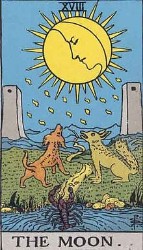
But I want to go back to the part about them being illusions.  The Moon card is all about psychological illusions.  As I said in my original definition:

Think of seeing the world under the light of the moon rather than the sun.  Shadows and light blend into one another and our eyes and mind see things that aren’t really there.  Or maybe they are.

There is a tendency for the unconscious, unexamined contents of our minds to come forth when The Moon is present.

What I eventually figured out about my panic attacks is that I was living in an illusion and my subconscious didn’t like it.  Not at all.  My partner was becoming increasingly, seriously ill and I was trying to stay very upbeat  about it and reassure her – and myself and her children – that it was nothing to be concerned about, that if we just kept a positive attitude we’d get through it and she’d be just fine.  My subconscious, on the other hand, was looking at it and saying, “Holy shit!  Carol is really, really sick.  You need to pay attention to this, Dan!”

And, when I didn’t pay attention to it, my subconscious said, “Okay . . . well how about this?  How about if I throw an absolute screaming fit and make you FEEL like you’re dying?  How about a nice big fat panic attack or three?  Will you pay attention now?”

I paid attention.  The panic attacks stopped.

The point is that there is something in our psyches that is always watching over us and warning us if we go too far off track, if we get too disconnected from reality.  Eckhart Tolle calls it, “the Watcher.”  Jeffrey Schwartz calls it, “The Wise Advocate.”  I’m referring to it here as, “the subconscious.”  It’s reality based, it’s dispassionate, and it will always blow a very loud whistle if we get too delusional about what’s really going on in our lives.  Some of us may have panic attacks, some of us may start having inexplicable accidents or become very anxious and distracted or angry.  It’s our inner guidance system saying, “Pay attention.  This is serious.”

It’s also a great defense against narcissistic gaslighting.  The term gaslighting is derived from the 1944 film Gaslight, where a husband tries to convince his wife that she’s insane by causing her to question herself and her reality.  Gaslighting is standard operating procedure for narcissists at a certain point in their destructive relationships.

As Doctor Ramani explains in this video, narcissists will eventually begin to treat you like shit and betray your trust in every imaginable way.  It’s what they do.  BUT . . . just to make it a little bit worse, they will always tell you that you’re just imagining it.

They put you down in front of your friends – you’re just imagining it!

They devalue or ignore your opinions – you’re just being delusional!

They screw around on you – you’re just being paranoid!

There’s actually an old joke in Texas where a woman walks in on her husband while he’s in bed with another woman and he says, “Now, darlin’, who are you going to believe – me or your lying eyes?”

It’s a funny joke but that’s precisely the level that narcissists operate on.  And it makes their partners crazy, just like in the movie.

But that’s a good thing.  That’s our subconscious, our Watcher, our Wise Advocate, saying, “Something here is very, very, wrong. Pay attention.”

And, if we can manage that shift in perspective, if we can say, “Wait a minute . . . maybe I’m NOT crazy, maybe this really IS happening,” then our so-called symptoms are suddenly transformed into very healthy warning signs.  If I’m depressed, if I’m angry, if I’m anxious – and, yes, if I’m having panic attacks – something is out of whack in my life.  Something in my conscious life is out of synch with my Watcher and my Watcher is ALWAYS right.

When we do that course correction and bring our conscious perceptions back into alignment with our subconscious Watcher, the symptoms disappear.  It’s not necessarily because anything in our environment has changed or gotten better, it’s simply that we’re being honest about what’s going on and there’s no longer a split in our consciousness. 

We’ve achieved integrity as defined by the dictionary:  the quality or state of being complete or undivided. Which is way better than feeling like you have an elephant sitting on your chest and you’re about to die. In the immortal words of Douglas Adams in The Hitchhiker’s Guide to the Galaxy, “Don’t panic and carry a towel.”

And you’ll be alright.

The Ace of Cups, Heart Chakras, and Flounders in Rayon Golf Shirts

Opening our heart chakras to find love when our relationships aren’t working out.

I’ve been thinking a lot about broken hearts.  LOL – Again.

 At one point or another, whether it was the result of an adolescent crush gone awry or a mid-life divorce, most of us have gone through the experience that we tag as, “a broken heart.”  We fall deeply in love with someone and they don’t love us back.  Or they love us and leave us.  Or they, “love us,” in such destructive ways that we end up in shreds.

It hurts like hell.  Jeeeeezus, it hurts.

The 3 of Swords shows the classic broken heart scenario where two people were in love and one of them fell in love (or lust) with someone else.  The heart is pierced with swords and the person who was betrayed is so deeply wounded that he feels that he may never heal from the pain.

So what do we do with our poor broken hearts after someone stomped them into a jelly with their hobnail boots?

One popular solution is to just jump right back into another relationship.  “There are lots of fish in the sea,” we tell ourselves, “and I’m gonna hook me a big old flounder.”

Sometimes that works but a lot of times it doesn’t.  The divorce rate in the U.S. regularly hovers between 45 and 50 percent, which means that an awful lot of serious relationships end up as flaming disasters.

One of the big problems with just catching another fish is that, “life is a mirror,” as Louise Hay says in You Can Heal Your Life, and we tend to catch the same damned flounder over and over and over.  Whatever energy we’re radiating out into the Universe is the energy that’s going to come right back at us, in this case in the form of a lover. 

 If we’re really emotionally needy, clinging people, then we’ll probably attract other emotionally needy, clinging people and then – JOY OF JOYS – we can be needy and clinging together!  Or, if you really hate yourself and you’re constantly treating yourself like shit, you’ll probably attract an abuser to do the job FOR you.

So, basically, unless we change our energy patterns, unless we change what we’re radiating out to others, we’re going to continue to attract the same kinds of people, the same lovers who broke our hearts, only in different clothing.  (Hopefully stylish clothing, at least.  It’s doubly tragic when your new flounder shows up in a rayon golf shirt.)

That can even happen to kind, loving people who’ve gotten therapy, who’ve done the spiritual work, and are really, sincerely looking for a healthy, compassionate partner.  In some ways, people who are truly loving and on a sincere quest for genuine love may be even more vulnerable.  Just take a moment or two to listen to this video from the wonderful Doctor Ramani about malignant narcissists and, “love bombing.”

Remember what it’s like when you’re really, really, REALLY in love with someone?  You feel like – to use an old Southern expression – they hung the moon.  Everything they do is perfect, everything they say is a glittering gem of wisdom, and just being around them makes you ecstatic.

The malignant narcissist gets to us because they can perfectly mimic that feeling of being in love.  They praise us, they flatter us, they tell us that we’re smart and sexy and funny.  Just like someone who really loved us would do.  And then they destroy us.

Oops.  Another goddamned flounder.

Hopefully, we go BACK to our therapist and he or she teaches us about malignant narcissists and how to spot them and how to build healthy boundaries.  It’s all very complicated and it can take a lot of time along with a lot of emotional work and commitment.

In the meantime, in between time, we’re just hanging there with no love in our lives.  I mean, we KNOW that if we just go back out fishing without cleaning up our own emotional messes, we’re just going to get the same fish again.  And that’s not a good thing.  Living without love is NOT a good idea.  We NEED love.  It nurtures us.  It heals us.  It grows us.  So what do we do?

We can find at least a partial answer in the Ace of Cups.  It shows love – pure, undifferentiated, unattached, unconditional love – pouring into the world.

Believe it or not, we can manifest that love in our hearts and in our lives without a relationship and without a mate.  We all have a very special place in our energy systems called, “the heart chakra.”  This is the place where we receive, store, and generate love.

We can sit down at any time that we choose, do a heart chakra meditation, and, “grow,” the love that is in our hearts.  It’s not hard, it’s not complicated, and we don’t have to be spiritual masters to do it.  There are heart chakra meditations all over the internet, so you can start loving TODAY, if you want to.  (Here’s a nice one to get you started.)

The thing we frequently miss is that love exists.  It’s a force in the Universe that’s out there, independent of people, and we can let it into our lives and our being anytime that we want to.  Hell, we can set aside an afternoon for meditation and just BATHE in that energy if we want to.  All we have to do is open our heart chakras.

That’s not to put down loving another person at all.  Being in love can be one of the most magical, wonder-FULL things that ever happens to us.  It’s really hard to beat snuggling up against your partners back on a cold, snowy night, right?  (Well . . . neck kisses.  Neck kisses might beat it.  Of course, you could do both.)

Until that happens, though, until we can untie all of the weird, dysfunctional emotional knots that keep us from finding that relationship, we can remember that our lovers aren’t love itself.  They are vehicles that get us to love, but we can still experience love without a relationship.

It’s right there in our hearts.

Disclaimer: “As an Amazon Associate I earn from qualifying purchases.”

The Sun Card and The Uncarved Block

Seeing the human Soul in the Taoist concept of The Uncarved Block.

One of the core tenets of Taoism is an idea called, “The Uncarved Block,”  or, as it’s written in Chinese, “Pu,” (not to be confused with The Tao of Pooh although it IS the Tao of Pu.)  

It refers, quite simply, to a piece of wood that’s never been touched, never been carved into a statue or an ornament or a utensil.  It’s just the wood, as it came into and grew into this world.  It’s in its’ primal, original state of being.

When the term is used to refer to the human experience, it means the primal state in which WE came into this world, untouched by experiences, prejudices, or dualistic thinking.  And, of course, it implies that there was a SOMETHING that arrived when we were born, other than just a tiny little human body.  There was a primal NATURE that came into the human body. Some people call it a Soul.

This has actually been a pretty hot topic for philosophers and psychologists for hundreds of years.  Are we just reducible to the sum total of our bodies and brains, or is there something else that’s greater and somehow inhabits our bodies and brains?  Another way of putting it is, “nature versus nurture:”  are we born with a certain nature, an essence that existed before our birth, or are we simply whatever we learn as we go along in life, whatever we learn by being nurtured by our culture?

Aristotle came down firmly on the nurture side of the equation, saying that we are born as a, “tabula rasa,” a blank slate that life and culture writes upon.  There is no soul, no pre-existing essence. The idea was later picked up by the English philosopher John Locke and thus made its way into modern psychology.

New Thought writers, of course, are advocates of nature, of the idea of our having a Soul that, “arrives,” in this world using the vehicle of our bodies.  What’s more, they see the Soul as being pretty cool when it dances into the physical world.  To quote Esther Hicks/ Abraham in Ask and It Is Given: Learning to Manifest Your Desires

“You are eternal beings who have chosen to participate in this specific physical life experience for many wonderful reasons . . . You are eternal Consciousness, currently in this wonderful physical body for the thrill and exhilaration of specific focus and creation.”

In other words, when we first get here we are beautiful, spiritual beings, full of joy, who have come here on a mission that INCLUDES having a lot of fun.  To use a phrase from AA, we are happy, joyous, and free.  We would feel a lot like The Sun Tarot card looks.

We arrive as beautiful, innocent, children, full of elation and radiating the euphoria of being alive in this enchanted garden that we call the Earth.  We are naked and unadorned, and our original nature, our essence, our, “uncarved block,” is love.  Pure love.

But then something happens.  Perhaps we forget our original nature in the process of transitioning from being Spirits to existing in physical bodies.  Perhaps, as some children do, we remember our original nature and still see the angels and the fairies, but our families and society soon beat that magic out of us.  As Don Miguel Ruiz put it in The Four Agreements: A Practical Guide to Personal Freedom (A Toltec Wisdom Book)

“We are born with the capacity to learn how to dream, and the humans who live before us teach how to dream the way society dreams . . . we learned a whole new reality, a whole new dream.  We never had the opportunity to choose what to believe or what not to believe.”

And we find ourselves wandering in Paradise, lost in the collective dream of our existence, with no memory that we are something far, far greater than our mere physical bodies.  As the bible expressed it – in a phrase that christians never, never, never EVER quote – because then we wouldn’t need preachers:  “You are gods, sons of the Most High, all of you.” 

 Or to use Joni Mitchel’s riff on it, “We are stardust, we are golden, and we’ve got to get ourselves back to the garden.”

That’s the rub, that’s the rough part for most of us: just remembering that we ARE spiritual beings and getting back to that garden.  It’s not as if society exactly encourages us to act like we’ve all got Souls.  If we really believed that we’re all part of the Divine, we’d treat each other with a shade more respect, wouldn’t we?  If we actually looked at killing as killing a part of the Divine, we’d have a lot fewer wars, doncha think?

It’s actually become quite fashionable to laugh at the idea of a Soul.  Many people view it as an anachronistic belief on a par with the idea that god is an old man sitting on a golden throne.  Just silly crap that’s left over from our primitive religious views.

Can we PROVE that there’s a Soul?  Of course not.  Can materialists or atheists prove that there ISN’T a Soul?  Of course not.  What we CAN do is to intuit that there is a something that lies beyond and beneath our ordinary consciousness and reality.

In discussing the difference between the ego and what we really are in A New Earth: Awakening to Your Life’s Purpose (Oprah’s Book Club, Selection 61) Eckhart Tolle says:

“What a liberation to realize that the ‘voice in my head’ is not who I am.  Who am I then?  The one who sees that.  The awareness that is prior to thought, the space in which the thought happens.”

In a similar vein, Jeffrey Schwartz, who is a neuropsychiatrist and uses very strict scientific standards of proof,  argues in You Are Not Your Brain: The 4-Step Solution for Changing Bad Habits, Ending Unhealthy Thinking, and Taking Control of Your Life that there is something beyond the mere thoughts that our physical brains generate, something that directs our focus and can override our thoughts.  He calls it, “The Wise Advocate,” and it sounds very much like the description of a Soul.

“The Wise Advocate knows what is best for you, it loves and cares for you, so it encourages you to make decisions in a rational way based on what’s in your overall best interest in the long term.”

That Wise Advocate, that space that exists between our thoughts, is where our Soul lives.  It’s where our Soul is still naked, beautiful, innocent, and playing.  It’s our original nature, our uncarved block.  

All we have to do is find it again. Or at least try to be a chip off the old block.

The Fool, Wu Wei, and Touching Your Woo Hoo

Exploring the concept of Wu Wei and the work ethic of drifting.

We all know how to be a success in life, right?  We set our alarms so that we can get up before the sun rises and we work our asses off all day.  We do twice as much as everyone else, put in lots of overtime, and keep working right up until we go to bed.  And some of us actually keep working in our dreams, mulling over the day while we sleep, running through scenarios for when we go back to work tomorrow.  We even have lots of inspirational sayings to reinforce our work-a-holic thinking.

“The early bird catches the worm.”

“Genius is one percent inspiration and ninety-nine percent perspiration.”

“Stay positive, work hard, and make it happen.”

Yay!  Let’s get out there and WORK!

But what if all of that is wrong?  In fact, what if most of it is bullshit?

The Taoists have an interesting concept called Wu Wei, which can be loosely translated as, “doing nothing,” and they say that it’s a major key to success.  A more accurate translation might be, “purposeful inaction,” and the basic idea is that the harder we work, the behinder we get. Taoists love to use rivers and lakes and water in general as metaphors, so we can do that to explain Wu Wei.

Suppose that you’re floating down a beautiful, green river in your little Rowboat of Life.  There’s a gentle current that’s carrying you along nicely and you’re making good forward progress.  It’s so quiet and peaceful and you can feel the sun warming your face and body.  Perhaps you let one hand trail behind you in the crystal clear water and for just a moment it feels like everything is absolutely perfect.  

BUT . . . you suddenly decide that you want to go faster, because faster must be better, so you grab your oars and you row like hell until you’re exhausted.  And you really haven’t gotten much further down the river.  All you’ve accomplished is to wear yourself out when you could have been just drifting along, enjoying the ride.

But WAIT!  You remind yourself that drifting is wrong!  Drifting is bad!  We need to be GOAL ORIENTED and MOVING FORWARD with MAXIMUM ENERGY AND MOTIVATION at all times.  By now, you know that rowing forward didn’t accomplish much, so you start paddling your Rowboat of Life from one side of the river to the other, just to be doing SOMETHING.  After all, you’re the Captain of your Rowboat!  YOU determine where you’re going and YOU’RE in charge of your destiny!  

 Eventually you realize that you’re making even less forward progress and after a while you get discouraged and put your paddles back in the boat.  You drift along thinking about it and beating yourself up for not making more effort.  Maybe a dragonfly lands on your nose while you’re cogitating.  “Am I lazy?” you ask the dragonfly.  “Do I just not have what it takes to be a winner?”

As you work it all out in your head, you realize that WINNERS KEEP GOING, no matter what the odds are against them.  Real winners are willing to work as hard as they can and then DIG DEEP to find that last reserve of energy to carry them across the finish line!  The harder you work, the more it proves that you’ve GOT WHAT IT TAKES, by god!

So just to prove how hard you work and how inspired you are, you turn your Rowboat of Life around and start paddling AGAINST the current.  You struggle and you strain and at a certain point you have a massive coronary and die, but at least you died a winner, right?

The whole point of this, of course, is that there are underlying currents of energy in the Universe.  They actually help us get to our goals if we just surrender to them and go with the flow.  Life isn’t an enemy.  Life isn’t something we have to fight.  Nature isn’t something we’re supposed to conquer.  We are meant to float as gently on the currents of life as a blossom drifting down a broad, quiet river.

Most of the New Thought writers and speakers have this concept as a central pillar of their philosophy.  In Choose Them Wisely: Thoughts Become Things! Mike Dooley talks about visualizing your goal in general terms and then moving toward it.  BUT he emphasizes very strongly that we don’t need to sweat the details about how we’re going to get there.  The Universe will provide the means and the ways and the paths once we get in harmony with the flow.

Louise Hay, in You Can Heal Your Life writes, “I believe in a power far greater than I am that flows through me every moment of every day . . . Out of this One Intelligence comes all the answers, all the solutions, all the healings, all the new creations.”

In Ask and It Is Given: Learning to Manifest Your Desires Esther Hicks/Abraham, says, “Well-Being is the basis of the Universe.  Well-Being is the basis of All-That-Is.  It flows to you and through you.  You have only to allow it.  Like the air you breathe, you have only to open, relax, and draw it into your being.”

In other words, there is a current of energy, of love, that underlies the entire Universe and our, “job,” our only true, “work,” is to align ourselves with that energy current and drift along on it, knowing that it will take us where we want to go.

The Fool Tarot card is the perfect illustration of this.  She dances along on the edge of a cliff, filled with the energy of love, totally unconcerned about where she’s going or how.  She’s in the flow.  She’s dancing with the energy and if she walks off of the cliff, she’ll just walk on air.

So . . . how do we get to the Flow and how do we know when we’re out of it?  How do we know when we’re paddling up the river, instead of riding the current?

According to Esther Hicks/Abraham, we actually have a compass in our little Rowboat of Life.  It’s called emotions.  And we can check that compass anytime that we want to.  HOW DO YOU FEEL?  If you feel crappy, angry, sad, or resentful, you’re paddling upstream.  If you feel happy, joyous, free, and content, then you’re floating down the river with a dragonfly perched on your nose.  If you’re not feeling anything at all, if you’re emotionally flat and apathetic, then your Rowboat is stuck on a freaking sandbar.  So the key is to get up every morning and say, “Woo Hoo!  I’m alive and I love it!”

We all need to stay in touch with our Woo Hoos a lot more than we are.  We can do that.

Of course, all of this is totally un-American.  Hard work and a lot of sweat are the answers.  Anyone who says different is plain Fool-ish.

Disclaimer: “As an Amazon Associate I earn from qualifying purchases.”

The Ten of Wands, Mike Dooley, and Becoming a Topless Cellist

This is a post about Mike Dooley’s concepts of choosing our goals, visualizing them, and manifesting them. It discusses the Ten of Wands tarot card as a representation of someone who has too many goals and needs to narrow her focus while remaining open to all possibilities.

If you’re a Great Thinker – and most of us at least believe that we are – you probably have a lot of Great Ideas.  In fact, you may have too many.  Way too many.  Let’s talk about that a little bit.

Mike Dooley has a wonderful book called Choose Them Wisely: Thoughts Become Things! As the title implies, what we think will inevitably manifest in our physical lives, sometimes more quickly, sometimes more slowly, but what we think will become our physical realities.  

Now, the Tarot slices our everyday lives into four quarters represented by the Minor Arcana.  The suit of Cups represent our emotions, Pentacles represent our relationship with physical possessions, Swords represent our physical drives and aggressions, and Wands represent our ideas, our thoughts.

The Ten of Wands is a wonderful representation of someone who has way too many Great Ideas.  Each wand represents a thought and this poor son of a bitch has SO many thoughts going on in his head that he can barely stagger along his path.  He’s literally weighted down with all of his wonderful, fabulous, potentially AMAZING thoughts.  So much so that he can’t even lift up his head and look at the world around him.  All he can do is carry the burden of his thoughts and stare at the path that he’s on, hoping he doesn’t stumble and fall and – goddess forbid – lose his stupefying collection of Great Ideas.

The bad thing about having too many Great Ideas is that it can be just as discouraging as having too few Great Ideas.  It can paralyze us.  We have so many options swimming around in our heads that we just really can’t decide which direction to go in – so we go nowhere.  It’s like we’re saying to ourselves, “Well, I could be a Great Artist, but if I put all of that time and energy into being a Great Artist then I won’t have any time and energy to put into being a Great Writer.”

So we sit around on our asses and worry about that and – in the meantime – we don’t write and we don’t paint.  We’re stuck.  

We can actually see a pretty good representation of this with The Chariot card.  You can take one look at this guy and tell that he has some Great Ideas.  I mean, look at those shoulder pads!  Who wouldn’t want a jacket with Moon shoulders?  He’s glorious!  But if you take a little closer look, you see that the Sphinxes aren’t harnessed to anything and he doesn’t have any reins in his hands.  He looks fabulous, but he’s not going anywhere because he doesn’t have any direction, he doesn’t have any focus.  He just can’t decide which way to go.

One of Dooley’s ideas about getting out of the trap of having too few options can also be useful in dealing with having too many options.  Make up a list of your options, of all of the things that you could possibly do to move forward in your life, and then choose the three LEAST SUCKY options and move forward with those.

If you have too many Great Ideas, that may sound like a daunting task, but it really isn’t.  My experience is that a lot of my Great Ideas can be slotted under the category of, “Probably Ain’t Gonna Happen.”  For instance, when I was in Junior High School, I got it into my head that I wanted to jump hurdles on the track team.  And I would have been absolutely amazing at it except for the fact that everyone in my family has short legs and I kept jumping into the hurdles instead of over them. 

In the same sense, if you’ve always dreamed of being a porn star and you have a small penis, that, “Probably Ain’t Gonna Happen.”  It doesn’t mean that there’s anything wrong with my short legs or your small penis, it’s just not a good fit.  So to speak.

So we can winnow out a lot of our Great Ideas from the get-go.  And, as we do that, we find that a lot of them are actually pretty Sucky Ideas.  Eventually, as we continue to work on our lists of Great and Sucky Ideas, we’ll come down to the three that are the least Sucky and we can move forward with those.

This is the point where a lot of us get paralyzed again.  Should I really give up on my life-long dream of being a world famous Juggler on the Ed Sullivan Show, just because Ed Sullivan is dead?  Am I making a dreadful mistake in abandoning my idea of being a Topless Cellist at Carnegie Hall?

This is also where Mike Dooley came up with a genius concept:  IT DOESN’T MATTER.  

No matter what we choose, it doesn’t matter.  The main thing is to choose something and then start moving forward with it.  That’s probably the single most important thing that we can do:  get off of our asses and start moving.  And, as we begin to move forward – with ANYTHING – the Universe will provide the next step and then the next step and then the next step and eventually we end up exactly where we want to be.

That takes a tremendous load off of our shoulders, especially if we’re Great Thinkers with lots of Great Ideas.  We really don’t have to decide too much.  We don’t have to spend endless hours analyzing our options, playing scenario tapes in our heads, and fretting over possible disasters.  All we have to do is figure out a couple of our least sucky options and start moving toward them.  We provide the moving feet and the Universe provides the path to walk on.

As Dooley put it, “Do WHAT you can, with WHAT you’ve got, from WHERE you are, and it will ALWAYS be enough.”

And we can overcome any hurdles.  Or, if we’ve got short legs,  we can learn to run sprints.  It’s all good.  It’s all just right.

Disclaimer: “As an Amazon Associate I earn from qualifying purchases.”