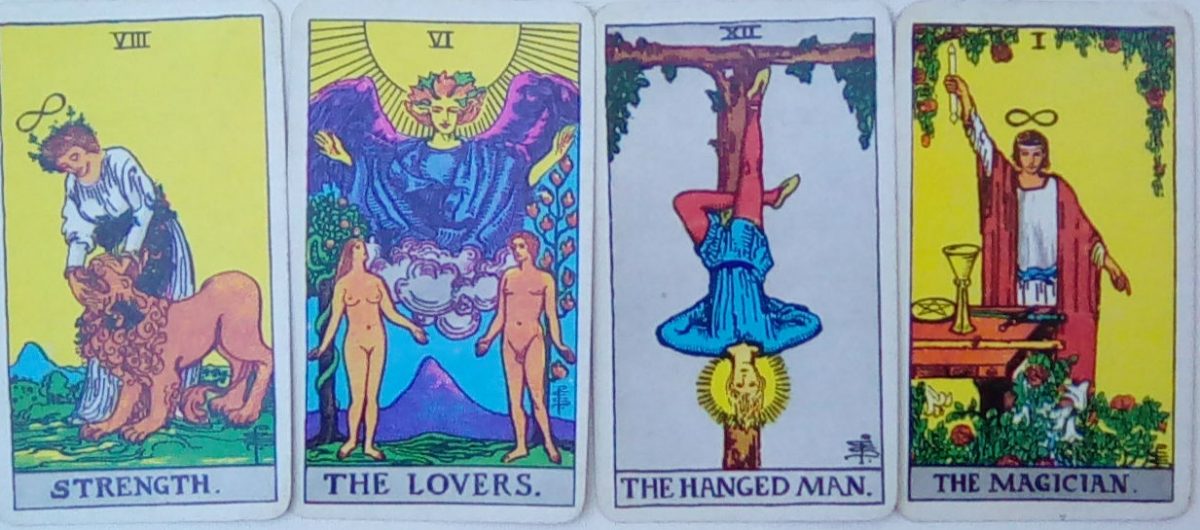

I’ve been having a lot of fun playing with Colette Baron-Reid’s Wisdom of the Oracle deck lately. They seem to be highly accurate and the illustrations are really magical.
There are, of course, about 80 kazillion different decks out there by now, so it can be difficult to decide which one to get. On average, they’re about 20 bucks a pop, so it’s not like most people can order a dozen of them and figure it out later. If you’re in the market for a new deck, here are a few things to consider.
ARE THEY REALLY ORACLE DECKS?
That’s not as silly as it sounds. There are quite a few decks that really have nothing to do with, “fortune telling.” For instance, Louise Hay has several decks like, “Heart Thoughts Cards: A Deck of 64 Affirmations,” which are collections of affirmations printed on separate cards. They’re lovely, inspiring thoughts, but they have nothing to do with predicting the future or understanding the past.
“Healing the Inner Child Oracle: A Transformative Quest,” is another example. It’s a charming deck that offers words of solace for anyone with a wounded Inner Child, but it isn’t in any sense, “oracular.” Basically, what we’re looking for in an oracle deck is one that’s capable of saying, “You are here. This is how you got here. This is what’s going to happen if you keep on your present course.” If it can’t fulfill those simple parameters, it’s not an oracle deck.
DO YOU TRUST THE AUTHOR?
A little bit of research can tell us a lot about the author of a deck. Some basic questions we can ask are: is the author experienced? Does the author have some sort of psychic ability that would lend her credence in designing a deck of cards? Is the author in a positive flow of energy?
Colette Baron Reid, for instance, is a psychic and has been reading cards professionally for 25 years. (Check out her web site here: https://www.colettebaronreid.com/)\]. For me, personally, the fact that she’s gone through some serious shit in her life and emerged with a positive message and positive energy adds greatly to her credibility.
We can contrast that with Aleister Crowley’s Thoth Tarot deck. It’s a well designed deck and Crowley had a deep knowledge of occultism. He was also deeply involved with black magic, sacrificed animals in his rituals, and was a heroin addict. I wouldn’t want his deck or his energy anywhere near my house.
IS THE DECK MAGICAL?
This is obviously highly subjective. The question here is, “Does the deck call out to your Deep Mind?” Does it stir something inside of you that resonates and feels magical?
I would answer, “absolutely,” with Baron-Reid’s deck. The illustrations are by Jenna DellaGrottaglia and her art is like something channeled from another world. The second I picked up the deck I could almost feel it vibrating in my hands.
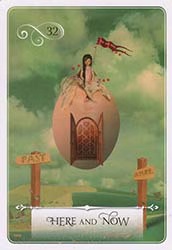
They’re whimsical, thought provoking, and perfect illustrations of the situations we find ourselves in on a daily basis. You can see more of her art here.
On the other hand, we can look at cards like those from Doreen Virtue’s original angel decks and feel a resounding, “Blechhh.” They’re really just Hallmark greeting cards compiled into a deck. Despite the fact that they sold in the hundreds of thousands, they’re flat and low vibration.
ARE THEY ACCURATE?
Although this is, of course, the most important question, it’s hard to ascertain without actually buying one of the decks and trying them. We can try to get a, “feel,” for them by reading the reviews on sites like Amazon, but even those can be highly suspect.
If you’re just starting out on your card reading adventure, one indicator you might use is how long the deck has been around. Decks that don’t work tend to disappear fairly quickly. The Waite Tarot deck, for instance, is pretty much the gold standard for accuracy and was first published in 1909. The much, much older Marseilles deck has been used for centuries, but is a little more difficult for beginners to work with.
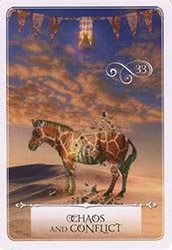
In the limited period of time that I’ve been using Baron-Reid’s deck, I’ve found it to be highly accurate. I inquired, for instance, about the outcome of the presidential election here in the U.S. and drew a card titled Conflict and Chaos. Perfect.
WHAT ARE YOU USING THEM FOR?
Finally, it’s good to consider how we’ll actually be using the cards. If we’re deeply into metaphysical inquiries and are looking for the underlying currents in life, we might want to go for a deck that relies heavily on archetypes. One example is Baron-Reid’s Goddess deck. Or we might want to go straight to the source and use an archetype deck like this one from Caroline Myss.
I tend to use my cards much more for mundane inquiries than for metaphysical explorations. In other words, my questions are more like, “What in the hell am I supposed to be doing this week?” And less like, “What is the meaning of life?”
Which is another reason why I particularly like this deck. The cards are mainly flat out, practical, day to day advice, like, “You need to get more rest.” Or, “this venture isn’t going to work so make a u-turn.” Or, “use your imagination, not your logic.”
We can achieve much the same result by taking a classic Tarot deck like the Waite deck and simply removing all of the Major Arcana (archetype) cards. When we use only the Minor Arcana, we’re only looking at the mundane, practical factors in life. That’s kind of a hassle but it works.
Ultimately, the deck you choose will be all about you. If it calls out to you, if it resonates with your vibrations, if you trust it, that’s your deck.

 Just the Tarot