Being a Misfit, Being Heard, and the Five of Pentacles

The pain of never being understood and how to use it for growth.

About a year and a half ago, I took the Myers-Briggs Type Indicator (MBTI) personality test and discovered that I belong to a group called the, “INFJ.”  INFJs are essentially introverted intuitives and are as rare as hair on a frog.  Only 1% of the population are INFJs and less than 1/2 of 1% of the population are INFJ males.

Americans love to think of themselves as being special and unique, of course, so a small cottage industry has arisen around being an INFJ.  Claiming to be an INFJ has become sort of a short hand to tell other people how incredibly evolved and spiritual and sensitive you are. 

There are a kazillion videos and books pointing out how FABULOUSLY wonderful INFJs are and you can even buy INFJ tee shirts and bumper stickers just in case some mere mortals missed the bulletin.

I, on the other hand, looked at the description of the personality type and thought, “Oh, I am SO fucked.”

One of the strongest human drives is the need to be heard and acknowledged.  To have the feeling that other human beings – or even ONE human being – truly hears what we’re saying and understands what we’re feeling and thinking.

American couples spend millions of dollars every year going to therapists to learn how to communicate and to listen to each other.  In other words, how to be heard by our partners.

Many of us derive a great deal of pleasure from social media sites like FaceBook because we feel that someone out there is actually hearing us and acknowledging our existence.

Thic Nhat Hahn and other Buddhist masters have stressed the importance of deep and compassionate listening.  Hearing what the other person is really saying rather than composing a clever response while they’re speaking.

Actually being heard for who we are seems to heal the human heart.

While Americans may worship the concept of being, “unique,” they don’t really see the flip side of it, which is that the more different you are, the less likely it is that other people will actually understand you.  Some people might look at the INFJ personality configuration and think, “Oh, boy, I’m SO special.”  What they’re not seeing is that 99% of the people in the world don’t see the world the same way that the INFJ sees it and probably never will.

And that can break your heart. That can drive you to end it.

There are, of course, many other ways besides being an INFJ that will cause a person to not, “fit in.”  I was born into an Army family and military brats are renowned for feeling like perpetual outsiders in the civilian community.  It might be caused by belonging to a racial or ethnic minority, or having a disability, or being gay or trans, or not fitting the cultural standards of being physically attractive.  Janis Ian expressed that so poignantly in her song, “At Seventeen”,:

I learned the truth at seventeen 

That love was meant for beauty queens 

And high school girls with clear-skinned smiles 

Who married young and then retired . . .

High School, perhaps above all else, teaches us the cruel realities of not fitting in.  

Oddly, not fitting in – being a misfit –  can eventually quit breaking our hearts and act as a springboard to spiritual growth.  That only happens, though, when we finally surrender and just give up.  

What happens to a person who truly doesn’t fit in when they try to fit in?  Essentially, they deny their own reality and desperately attempt to, “blend in.”  They try to become what they think other people will like.  They hollow themselves out more and more in the quest to have someone, even one person, understand them and love them for who they really are.

The paradox, of course, is that they’re trying to trick someone into loving them for who they are by being who they aren’t, so even if they snag a friend or a lover or a partner, they’re still not really being seen or loved.

Eventually, if we keep that up, we come to feel like the beggars in the Five of Pentacles, always on the outside in the cold while the, “normal,” people are inside the church receiving all of the blessings that seem to be their birthrights.

There’s something incredibly liberating, though, when we finally admit to ourselves that we don’t fit in and never will.  When we finally admit that we’re never going to be one of the beautiful, golden people who seem to wear their lives like a tailored glove.

No, it doesn’t mean that we’ll finally be heard or acknowledged by other people.  In fact, the more we become our authentic selves, the more likely it is that other people will not hear us.

But . . . we can finally hear our Selves.

Happy Buddhists, Christian Apple Munchers and Garden Gnomes in Tutus

Why Buddhism is actually a happy religion.

The Dalai Lama giggles a lot.  Have you ever noticed that?  On a certain level, he seems to find life to be absolutely hilarious.  For instance, there’s this wonderful interview that Barbara Walters did with him and, toward the end of the video, he absolutely cracks up about the fact that Eskimos kiss each other by rubbing noses.

It seems a little strange because Buddhism has a reputation for being a very dark, solemn sort of a religion.  That reputation probably flows out of the Buddha’s admonition that, “life is suffering,” which is not exactly what he said, but it’s the way that it’s frequently translated.  So we have this religious doctrine that seems to say that life is suffering, yet we see Buddhists like the Dalai Lama and Thic Nhat Hahn who not only seem to be happy, they seem to be really, really, REALLY happy.

What’s up with that?

The tarot card, The Hierophant, is all about formal doctrine, rather than first hand experience.  Religion, rather than spirituality.  It represents what religions SAY they are, rather than the way that they’re actually practiced on a daily basis by their followers.  Oddly, there’s a curious optimism that permeates Buddhism once we get past the doctrines and get into the actual experience of, “living Buddhism.”  

Although I’m sure that the Buddha wouldn’t dig my doing this because it involves a lot of judgment,  one of the best ways to illustrate that optimism  is by contrasting it with the dominant Western religion, Christianity.  In particular, how do the two religions actually VIEW human beings?

Christianity starts out with the basic premise that humans are miserable, flawed sinners.  According to Christian doctrine, we’re actually born that way, which doctrine is referred to as, “original sin.”  Now, it’s kind of hard to get a grasp on what original sin really means, but when you wrestle it to the ground it seems to mean that every single one of us was born with, “the stain of Adam,” on our souls.  Which goes back to Adam and Eve getting thrown out of the Garden of Eden because that bitch Eve just HAD to have an apple

I know, right?  It’s kind of hard to figure the reasoning.  Still, it appears to say that because our great, great, great, great, great grandmother to the hundredth power munched on an apple, we’re all born sinners and destined to go straight to hell if we don’t find redemption.  That’s also, by the way, the reason that women have been, “cursed,” with having periods every month.

I’m not making this shit up.  

So, according to Christianity, at the core of every human being there’s a rotten, sinful, apple muncher and we come into the world that way.  That’s why you’ve got to get babies baptized right away, because babies are basically pure evil, as we all know.

The Buddhist viewpoint is very much the opposite.  Buddhists believe that at the core of every human being is absolute perfection.  We just don’t know it.  Tibetan Buddhist Master, Chagdud Tulku Rinpoche, described this by saying that we all have a beautiful jewel at the center of our hearts which is covered over by common rock.  Our job is to slowly chip away at the rock that’s covering our jewel so that more and more of it is exposed as we go through our lives. Yes, life is suffering, but it’s suffering because we remain ignorant of our true nature, which is bliss and joy.

To put all of that in a nutshell, Christianity says that we should pretty much hate ourselves and Buddhism says that we should pretty much love ourselves.  It shouldn’t be a major news flash to anyone that hating yourself feels really, really bad and loving yourself feels really, really good.

Which may be why the Pope doesn’t do a lot of giggling.

There’s another major implication here, which is that Chrisitanity views, “salvation,” as coming from an outside source and Buddhism sees it as very much of an inside job.  Christianity says that we are SO fucked up and miserable and down in the dirt that we literally have no chance of saving ourselves.  We just have to pray and hope that Jesus is going to ride in on his white horse and whack us with his redemption wand and THEN we get to go to heaven.

Buddhists believe that our salvation, our Buddha nature, is already inside of us, so ANYONE can become a Buddha.  That means you, me, our Aunt Gertrude, or even the weird guy down the block who collects garden gnomes and dresses them in tutus. And we don’t get there by some outside deity or force, “forgiving us,” we get there by sitting our asses down on the meditation cushion and by practicing love and compassion in our daily lives.

Which is a lot of work and a lot of responsibility but it’s also tremendously liberating.  It’s looking at ourselves and realizing that if we’re not happy it’s because we didn’t do the work.  We may have talked the talk but we didn’t walk the walk.  We didn’t uncover that jewel inside of us.  It’s TOTALLY up to us.

Wow!

Another probable reason that the Dalai Lama giggles a lot is that Buddhists believe that we are all connected.  I don’t mean that in some generalized sense of, “our common humanity,”  or, “our shared heritage,”  or the Christian sense that we’re all, “born in sin.”  No, I mean, really, genuinely, energetically connected to each other, just like there’s some invisible thread that runs from me to you and from you to another person and so on and on.  Whatever we’re feeling and experiencing emotionally and spiritually is going out into a sort of a giant, collective web of consciousness and affects not just us, but everyone else, as well.

Think of it this way:  if we’re going out grocery shopping and we’re in a really high vibrations, zippety doo dah sort of a mood, some of that positive energy is going to spark off of us to everyone we encounter, from the kid stacking tomatoes at the vegetable section to the cashier who checks us out.  On the other hand, if we’re in a really sour bah humbug fuck you mood, some of that negative energy will be transferred to other people as well.  We leave everyone we meet either feeling a little better or a little worse.

Now take that same phenomenon of energy transfer and magnify it to influencing every person on the entire planet.  That doesn’t mean that if we wake up in a rotten mood trains will crash and someone’s flower garden will die.  But it does mean that everything we’re feeling is radiating out to everyone else, even if it’s one little drip at a time.  The way that the Buddha put it was:

“Goodness, like rain in a bucket, gathers one drop at a time.

Evil, like rain in a bucket, gathers one drop at a time.”

So, if you’re a really highly evolved, spiritually aware person and you KNOW that everything you’re feeling is affecting everyone else, what are you going to do?  Are you going to sit around your house feeling like crap and radiating out bad vibes?  Or are you going to try to stay in as high and loving a place as possible, as much of the time as possible, and send out good vibes?

Obviously, you’re going to try to stay as happy as possible.  And if you stay as happy as possible, for a long enough period of time, you’ll probably start to giggle.

The Lovers, The Goddess, and The Monogamy Model

Did you ever have a good friend just disappear on you when they became romantically involved with someone?  You know:  a friend you loved to hang out with, a person who was your go-to buddy for a cup of coffee or a drink, the first person you’d call when something really good (or really bad) happened to you?

And then they fall in love and suddenly you can’t reach them.  You ask if they’d like to have a cup of coffee and they reply, “I don’t know;  I’ll have to see what WE’RE doing.”  On the one hand, you’re happy for them to be in love, but on the other hand, you really kind of feel like you just got dumped.

The bottom line on it is that romantic love, as we currently practice it, tends to be very exclusionary.  We’re a decidedly monogamist society, so 99% of the time falling in love involves two people, period.  And, yes, there is a strong expectation that those two people will devote the majority of their loving and caring to each other and not to people who are outside of the relationship.  It’s very much as if your former best friend is saying, “Well, yeah, I loved you but that was what I was doing until I could find someone to fall IN love with and now I’m busy.  Bye!”

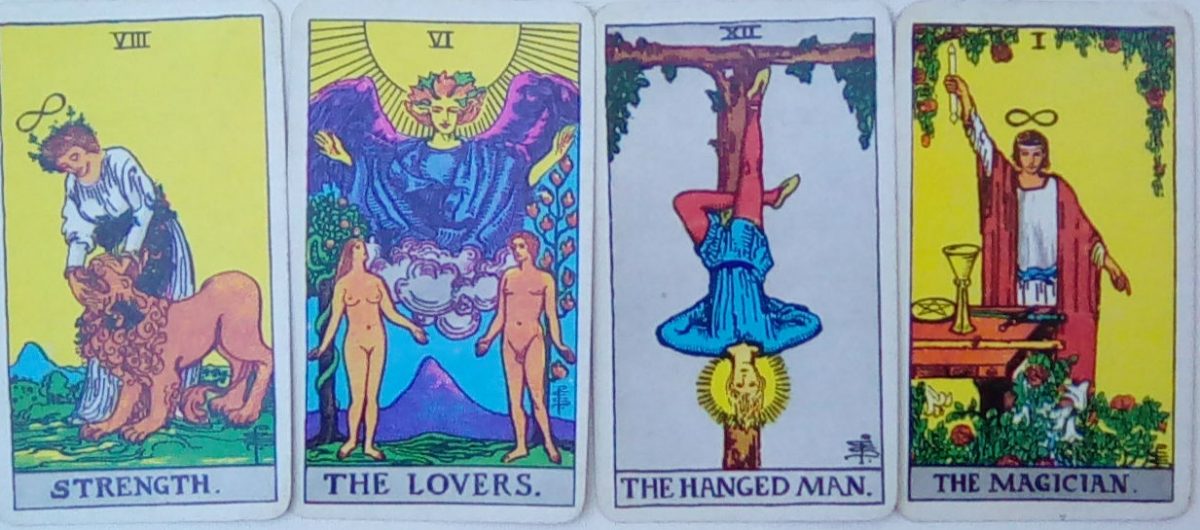
The Lovers tarot card beautifully illustrates the romantic model of love that the Victorians positively adored.  A man and a woman stand beside each other, nude, but not touching, not even making eye contact, while an angel hovers overhead, its wings spread protectively over the couple.  The message is loud and clear:  romantic love is holy and ethereal and, yes, we have bodies, but REAL love is about those heavenly emotions and not about . . . you know . . . S-E-X.

And, yes, it’s about two people and two people only.  You don’t see any best friends hanging out in this card.

Thic Nhat Hanh says that true love, as opposed to our normal idea of romantic love, includes four elements:  (1) loving/kindness which is the ability to offer happiness to the other person; (2) the energy of compassion, which removes suffering from you and the other person; (3) joy in loving; and (4) inclusiveness, which is removing the barriers between you and the other person.  BUT – and this is the kicker with our western concept of love – if it’s really true love then those energies will continue to expand, particularly the energy of inclusiveness. 

 In our romantic love model we draw a circle around ourselves and our partners and say, “Okay, we’re in love – go away.”  In this alternate model, romantic love becomes a spiritual practice that expands to include, rather than exclude, others. In other words, if it’s real love it grows your circle, it doesn’t contract it.

Which leads to a very sensitive and perhaps painful question:  Is monogamy really a healthy model for growing love in our lives?  

Unfortunately, the very question comes packed with a lot of poisonous images.  We think of the middle aged man cheating on his wife with the babysitter.  Or unhappy housewives having miserable affairs with the next door neighbor.  Or swingers, who basically just want to fuck anything that moves, proclaiming that they have, “an open marriage.”

In other words, there’s a large, built in, “Yuck,” factor when we try to visualize a model of love that doesn’t involve exclusive monogamy.  All of those images, though, are operating WITHIN the framework of a monogamist society.  Screwing around on your wife or husband is yucky because it involves lying, cheating, and deeply hurting people who love you, trust you, and expect that you’re going to be, “faithful.”   Sexual swingers probably have inordinately high sex drives and are non-monogamous by nature.  They just get yucky when they try to disguise their true nature within the framework of a traditional marriage.

It may help to think about this issue if we can actually step back a bit and ask ourselves, “Is monogamy natural?  Is this the natural state of human love or is this something that’s been imposed by society over many thousands of years?”

As Leonard Schlain points out in, “The Alphabet Versus the Goddess,”  the evidence is strong that most human societies were originally matriarchal.  And there are actually a few truly matriarchal societies left in the world.  So where do they stand on the issue of monogamy?  

The Mosuo women are China’s last surviving matriarchy.  They don’t marry.  The women choose and change partners as they wish, whenever they wish.

The Minangkabau people practice marriage to a limited extent but the women and children live in their own houses and the men live elsewhere.  

In the Khasi society, a matrilineal and matrilocal culture in the northeastern part of India, monogamy is the norm but women are free to divorce and remarry as frequently as they want to, with no social or economic consequences.

So, if the most ancient form of human society was the matriarchy, and if the current surviving matriarchies are examples of how those societies functioned, then we can conclude that monogamy is NOT a, “natural,” human norm.

Even more fascinating is the fact that these are WOMEN who are rejecting the monogamist model.  Remember, a large element of the argument for monogamy is that women, especially when they’re pregnant, are weak, helpless, and badly in need of male protection.  Apparently these societies think otherwise.

Is monogamy simply an artificial social construct that was foisted on humans by patriarchal societies that viewed women as property, as, “belonging,” to men?  And, as the Goddess archetype reemerges in the world, will we see a breakdown of the monogamistic model?

There may be signs of that, especially among older people.  Sociologists have already noted a new form of family structure they call, “living apart together,”  in which people who describe themselves as being in love still choose to maintain separate households.  Women in these relationships are very much maintaining their own individual identities rather than merging into a shared identity.

It’s fascinating to think of what new forms of romantic relationships may emerge in the coming few years.  Communes?  Group marriages?  Matriarchies?  The Lovers card may need to be a lot larger before it’s all over.