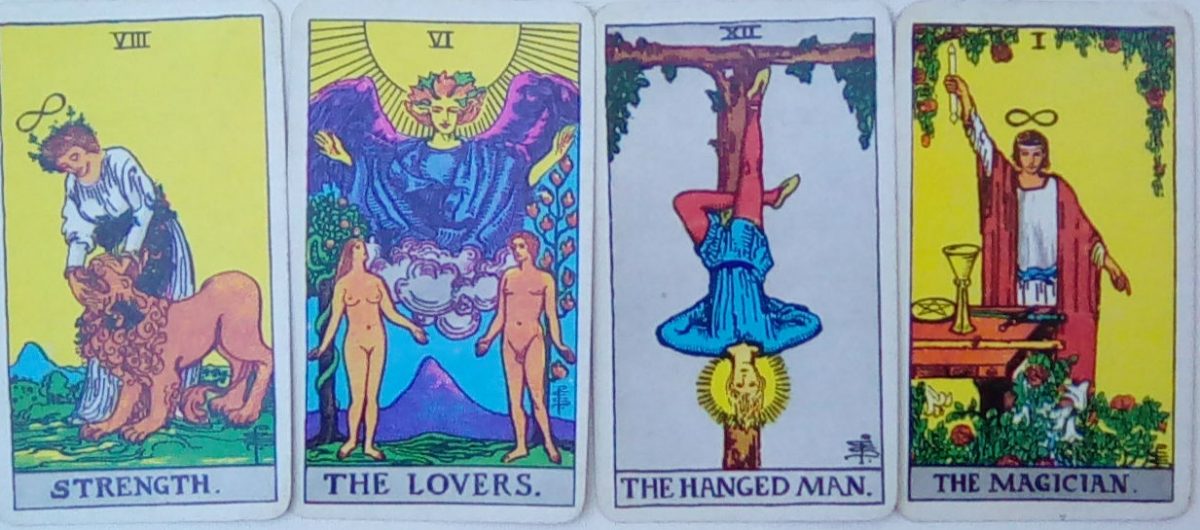
A few years ago I was reading a fascinating book called, “You Are Not Your Brain,” and the authors made a statement that was positively shocking to me: “To this day, scientists and psychologists cannot agree on exactly what a thought is.”
At first blush, that sounds completely ridiculous because we all know what thoughts are. They’re . . . um . . . they’re like . . . these little things that jump up in our heads and live in our brains, right?
There . . . I solved that one. You’re welcome.
Seriously, though, there really isn’t a good working definition of what a thought actually is. There’s a sort of reductionist explanation of how our nervous systems and brains produce thoughts. We can hook someone up to a brain monitor and see which parts of their brains light up with activity when they’re thinking about a particular subject. Perhaps their fear center – the amygdala – lights up because they’re thinking of something really scary. Or their prefrontal cortex – the thinking brain – lights up because they’re doing some heavy problem solving.
That doesn’t really do anything but describe the process of making the idea, though. It doesn’t tell us what the finished product is. That theory – that the brain makes ideas – exists cheek by jowl with the stimulus/response model where something in our environment makes us think certain things. Perhaps we see a picture of Donald Trump and we think, “Ohhh, scary clown,” which makes us think of circuses which makes us think of Stephen King horror novels about murderous clowns which makes us think about our overdue library book.
That concept seems to be counter-intuitive when we think about . . . well . . . intuition. When we have intuitions or flashes of insight, it feels as if they’ve popped right up in our brains without anything else making them happen. When someone asked Einstein how he invented the theory of relativity he said, “Oh, it just dropped in while I was playing the piano.”
For centuries, human beings viewed some types of ideas in just that way: as something that came into our minds from an outside source. That’s why the word, “inspire,” means to have something breathed into you. The notion was that something out there – perhaps the Universe or the Gods or the fairies – inserted the idea into your mind.
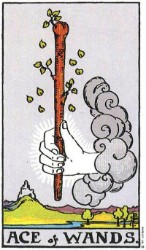
That’s what’s portrayed in the Tarot card, The Ace of Wands. Wands represent ideas and this is an idea or thought coming into the world in its purest form of mental energy. It’s, “divinely inspired.”
That STILL doesn’t tell us exactly what an idea IS, though. It’s just talking about it’s source, rather than it’s contents.
Now, the Theosophists and Victorian occultists had very specific ideas of exactly what an idea is. They viewed ideas as thought-forms, which is to say, individual little packets of energy produced by our brains and emotions and auric fields. And – important point – they felt that they were independent of the human being once they were produced.
We’ve all seen those cartoons where there’s a person having a thought that appears as a bubble with text in it, hovering over the character’s head. That’s a convenient way to visualize what the Theosophists were talking about. Every time that we have a thought, it’s like our bio-field – our brains, emotional energies, energy bodies – are extruding a little, tiny thought-form bubbles that exists outside of us.
Most of the bubbles don’t last very long because they don’t contain much energy. Let’s face it, many of us are NOT thinking about the theory of relativity while we play the piano. Instead, we’re having really profound thoughts like, “Where’d I put my car keys? Need a cup of coffee. Gotta walk the dog. Did I do the laundry?” So these are little bubbles that appear for a moment, pop, and disappear.
When the thought forms are really heavily charged with energy, though, they stick around. How do they get charged? Well, through emotions and through repetition.
Suppose you just went to bed with someone and you had a super-duper, unbelievable, I-think-my-ears-just-fell-off orgasm at the exact moment that you thought, “I love you.” That, “I love you,” thought is super-charged with energy and it will last. Ditto, if you’ve been badly shocked or frightened by something. The more intense the emotion, the more of an energetic charge the thought-form has and the longer it will exist.
We can also charge the thought-forms with energy by thinking of them over and over and over. On a positive note, we can see that happen when someone thinks of their lover constantly, as we tend to do in the early stages of falling in love. The obsessive thinking keeps adding energy to that same, “I love you,” thought-form and makes it’s last. On a negative note, we can see the same pattern with chronic anxiety and depression. Constantly thinking of things that frighten us or make us sad just increases the charge in the thought-forms and so the depression will linger long after the original cause.
Two of the early Theosophists, Annie Besant and Charles Leadbeater, published a book called, “Thought Forms.” It had illustrations of the forms as they emerged from people’s auras, as seen by psychic mediums. Here’s one of a peaceful thought:

And here’s one of an angry thought.

I would have liked to have seen one of a horny thought – sort of astral pornography, I guess – but the Victorians didn’t roll that way.
So is all of this true? Maybe. It certainly forms the basis for much of what we call visualization and manifestation, as well as the concepts of either cursing or blessing someone. I’ll be writing more about that in the immediate future but for the time being it’s a fun concept to play with. What if our thoughts are actual things that exist in our personal energy space and exert an influence on us and those around us? How can we change the negative thought-forms and increase the positive-forms? Can we pick up someone else’s thought-forms, much like a virus?
Before you dismiss the idea out of hand, remember what we started off with here: the most preeminent psychologists and scientists in the world have absolutely no idea what a thought is. The theory of thought-forms is just as good – and maybe better – than most of their theories.

Remember that my e-book, “Just the Tarot,” is still available – dirt cheap! – on Amazon. In fact, I’m sending thought-forms at you right now. You should buy this book . . . you should buy this book . . . you should buy this book . . .
 Just the Tarot