Trauma, The Tower, and The Shit Happens Factor

The causes of trauma and how to deal with it.

Philosophers and religious leaders have long been fascinated with what we might call the, “shit happens,” factor in life.  Perhaps it’s because of our human tendency toward binary thinking, but most creeds will fall into one of two categories:  life is good and the universe is benevolent and loving; or life is hard and the universe is cold, capricious, and/or meaningless.  The more spiritual religions tend toward the first view that life is good and the more primitive religions tend toward the view that life is hard.

If we look at it objectively, life is pretty good, pretty much most of the time.  Unless we have the severe misfortune of living in a war zone or a climate disaster, most of us don’t have something terrible happening to us, right around 98% of the time.  Most of us aren’t starving to death, suffering from a terrible disease, or in a constant series of car wrecks.  To the extent that we’re unhappy or dissatisfied, it’s because of our own view of the world and not because something exterior is wrong.

It’s fairly easy, then, to build a case for the idea that life is good and the universe is benevolent and loving.  Food is good, drink is good, sex is good, friends are good, creative fulfillment is good.  Butterflies are good, birds are good, crystals and candles and incense and vibrators are good.  There are a LOT of things about life that are good, and very few things that are bad.

Most of the time.  But shit happens.  Sometimes, really SERIOUS shit happens.

We can be walking along, singing a song, happy and free, when suddenly a speeding ice cream truck jumps the curb, runs over us and we’re in the hospital for months.  And while we’re there, we lose our job, our house and car are repossessed, and our partner runs off to Tierra del Fuego with a tattoo artist.

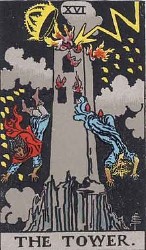
That kind of an experience is exemplified in The Tower card.  It’s the kind of an experience where everything in our lives is absolutely blasted into dust and we’re left standing there, psychically naked and bleeding, realizing that everything we believed in, everything we took to be solid and dependable, was nothing more than an illusion.
There’s a word for what happens to us internally when we go through that kind of experience:  trauma.  Gabor Mate’, who is one of the leading experts on trauma, says that trauma is a perfectly normal reaction to a completely abnormal event.  

There are several components to trauma that have to be unpacked.  First of all, it’s not a mild or everyday experience.  We tend to overuse the word and talk about how a scary movie was traumatizing or it was traumatizing to spend Thanksgiving with relatives we don’t like.  That’s not it.  Trauma is caused by events that completely overwhelm the individual’s resources and leave her feeling absolutely powerless.  These are things like rape, beatings, war, abandonment or abuse as a child, the death of a partner.  These are HUGE events in a person’s life.

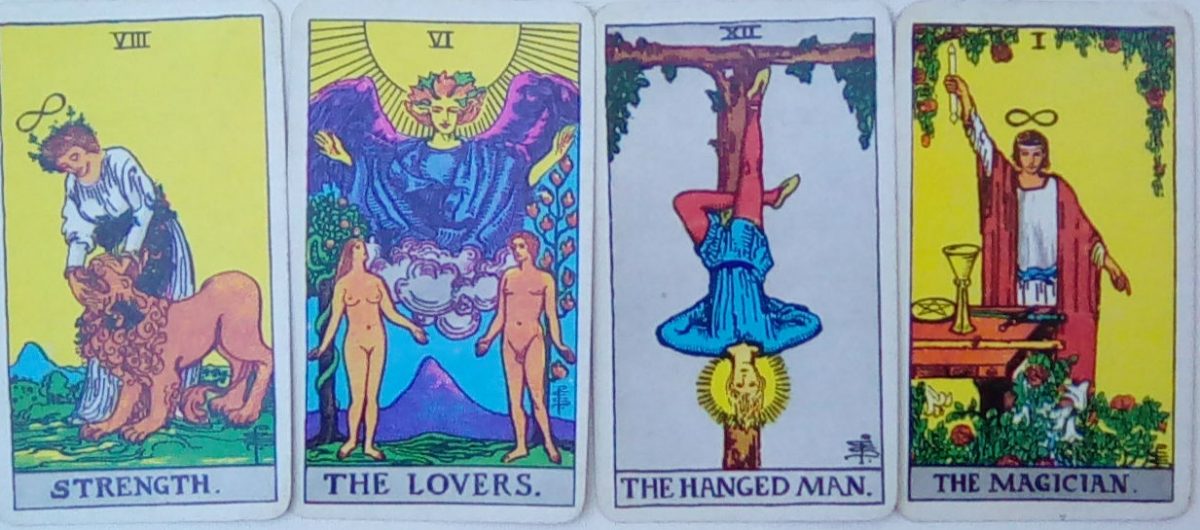
Another element in trauma is a sort of a psychic frozenness, a process where the person gets stuck in the traumatic experience.  A very important point here is that deep suffering does not necessarily equal trauma.  In the Tarot card, The Hanged Man, we see someone who has gone through very deep suffering but has come out on the other side with profound emotional and spiritual growth.  He didn’t get stuck in the pain, he grew from it.

Put another way, he had the emotional and spiritual tools that were necessary to deal with the pain, therefore he wasn’t overwhelmed by it, therefore he wasn’t traumatized.

If we look at it on a purely physiological level, there’s a defined sequence of events that takes place in our brains when we’re confronted by a dangerous event.

1 – The amygdala (the so-called, “lizard brain”) starts the fight or flight reaction.  We’re flooded with stress hormones, our hearts race, our hands shake. We either attack what’s threatening us or we run away from it.  Either way, we resolve the danger.

2 – The amygdala shuts down the fight or flight reaction and our bodies and brains return to a normal state.

3 – The hippocampus, which is the part of our brains that controls memory, basically says, “Whew, glad that’s over,” and files it away as a completed event.

4 – Just in case that sequence doesn’t happen, the prefrontal cortex, which is like the CEO of our brains, says, “HEY!  It’s over.  Settle down, kids.”

We know from functional brain scans that this normal sequence doesn’t take place in trauma.  The amygdala starts the fight or flight reaction but it never ends it.  The hippocampus never properly files away the experience as being over and so we keep re-experiencing the traumatic event in the form of flashbacks and anxiety triggers.  And the prefrontal cortex shows markedly diminished activity so it never says, “Hey, there’s nothing out there to threaten you.”

That’s why a combat veteran may end up cowering in a corner from hearing fireworks on the 4th of July.  That’s why a rape victim may go into a full blown panic attack when she sees a harmless stranger in a parking garage.  That’s why so many trauma victims become alcoholics and drug addicts in an attempt to numb what they’re feeling.  Because, in a very real sense, it’s NOT over for them.  They’re still living in active fight or flight mode, they’ve never been able to digest the event as a memory, and they’re not able to intervene rationally and say, “There’s no danger.”

So what can we do about all of that?  What can we do to draw ourselves out of the disaster of The Tower card and into the spiritual wisdom of The Hanged Man?

First and foremost, a good therapist can be invaluable.  Remember, the trauma happened because the person felt overwhelmed and didn’t have the resources to deal with it.  A good therapist can start to fill up our emotional and spiritual tool boxes and give us those resources that we didn’t have when we were overwhelmed.  We can learn to reframe the experience, to intervene with compulsive anxiety patterns, to stop in the middle of a panic attack and really tell ourselves, “There is NOTHING wrong.  Breathe deeply.  Relax.”

There are a couple of simple techniques we can use at home, as well.  Harvard Medical School and Dr. Dawson Church have both demonstrated that EFT Tapping sessions can dramatically reduce the presence of the stress hormone cortisol and calm the activity of the amygdala.  Tapping basically takes us out of the endless loop of the fight or flight reaction and begins to turn the traumatic event into a neutral memory.  There are resources for tapping all over the internet but a good place to start is with Rick Ortner, who’s done so much to disseminate the technique.

Another simple technique is mindfulness meditation.  Like tapping, mindfulness meditation reduces cortisol and calms the amygdala’s fight or flight response.  Even more dramatically, though, after only 8 weeks of practicing mindfulness meditation, the amygdala actually shrinks and the prefrontal cortex grows.  Literally, anxiety and fear are physically shrinking while rational thought is growing.  Again, there are resources all over the internet for practicing mindfulness, but here’s a nice guided meditation from Great Meditations to get you started.

Most of us who are on a spiritual path prefer to think that life is basically good and that the universe has an underlying energy of love and creativity.  Nonetheless, shit happens.  To all of us, sooner or later.  We don’t have to make it a continuing feature of our lives, though.  We can move out of painful experiences stronger, wiser, and more evolved than when they occurred and get back to enjoying butterflies and birds, crystals and incense, good friends and vibrators.  L’chaim!
The Hanged Man, Eckhart Tolle, Byron Katie, and Getting Shazammed

Exploring rapid versus gradual spirit growth and how we have to be our own miracles.

Have you ever been really, really, REALLY unhappy for a REALLY long period of time?  One of those stretches in life where you feel like nothing’s going right, nobody loves you, and the future looks like a whole lot of storm clouds and very few rainbows?

In the South, they’d say, “By god, I’m so down I’d have to look up to see a snake’s belly.”

The Hanged Man shows someone who’s been through that experience.  He’s suffered so deeply that he’s barely survived and now he’s about to travel down a road of spiritual rebirth.  In the meantime, he’s just hanging there in space and time trying to figure out what it all meant and why it happened.

Willam James, the founder of American Pragmatism, wrote a lot about what The Hanged Man goes through in his book, The Varieties of Religious Experience: A Study in Human Nature (Penguin American Library)  He called it a conversion experience.  In simple terms, that just means that a miserable, unhappy, deeply depressed, highly dysfunctional human being is somehow converted into a person who is happy, joyous and free.

 The most fascinating examples of it are when the conversions appear to happen very rapidly.  A person is full of despair and totally heart sick on Tuesday, but they wake up on Wednesday full of joy and love.

Shazam!  Brand new person!

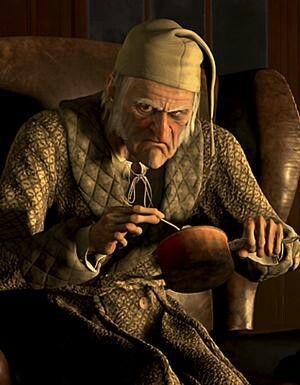
The classic example of that, of course, is Ebeneezer Scrooge.  I’ve often wondered if Dickens hadn’t read Varieties of Religious Experience.  “Hmmm . . . miserable son-of-a-bitch turns into a happy, compassionate person over-night . . . what an interesting plot . . .”

We can find modern day examples of that experience in a couple of the New Thought leaders:  Eckhart Tolle and Byron Katie.  Tolle was, by his own account, an overly sensitive, deeply depressed, frequently suicidal person.  Katie was an alcoholic drug addict who found herself locked in the attic of a woman’s rehab facility because the other women in the house were afraid of her.  In both cases, they suddenly, “woke up,” one day, finally understanding what life is all about and totally joy-full.

Shazam And A Half!!!!

Of course, the thing they don’t much talk about is that it wasn’t an overnight miracle.  In fact, both of them had been stewing in their own misery for years and years and years before something popped, before that shift in consciousness occurred.  The shift in consciousness took on the qualities of a, “miracle,” simply because the shift appeared to happen so rapidly, but it had been processing in their subconscious minds for a very long time.

Now, I’m not meaning to denigrate either of them or diminish the help that they’ve provided to other people.  I’m actually a huge fan of Eckhart Tolle, but the fact remains that both he and Katie have done a very good job of marketing their, “miracles,” to other people.  Tolle is currently offering a virtual spiritual retreat for ONLY $997.00 (that’s a $300 discount by the way, and DON’T WORRY, you can put it on your Visa, Mastercard, or American Express.)  Katie offers a 9 day workshop for ONLY $3,500 dollars or, alternatively, you can stay at her, “Turn Around House,” for 28 days at ONLY $20,000.

There’s another saying in the South, which is, “Never trust a fat preacher.”  Since I’ve gotten old and fat, I’m going to modify that to, “Never trust a preacher who wears a Rolex.”  

In other words, if someone is selling you spirituality, if they’ve decided that you can put a price on miracles – and it’s exactly $997.00 – it’s appropriate to approach with caution.

Tolle has a deep background in philosophy and psychology and he IS a very profound thinker.  Katie, not so much.  In both cases, though, they aren’t just selling their philosophies or their ideas – they’re selling their miracles.  They’re saying, “HEY!  I was a miserable, unhappy bastard and I got Shazammed.  If you sit real close to me, it might happen to you, too.”  And there’s a definite messianic flavor to their gatherings and their followers.

The unfortunate thing, though, is that you can’t borrow someone else’s miracle.  You can’t even buy it.  Not even for $20,000.  You kind of have to make your own.

Another person who had what appeared to be a, “rapid,” conversion experience was Bill Wilson, the founder of Alcoholics Anonymous.  After decades of hopeless alcoholism, dozens of jobs lost, and hundreds of relationships destroyed, he had a sudden spiritual revelation while lying in a hospital bed waiting to die.  In a phrase, “he got struck sober,” and he never had another drink.

Wilson realized that by far and away, most people will never have a sudden, dramatic conversion experience like he had.  Using Varieties of Religious Experience as a sort of a manual, though, he set out to create a method to consciously create slow, gradual conversion experiences in other alcoholics.  The result of that effort was the now famous 12 Step Program.

And the price of it is . . . nothing.  It’s absolutely free.  Well, they do appreciate it if you drop a dollar in the basket when they pass it, but you don’t have to.

I’m not suggesting that everyone should go out and adopt the 12 Step Program for their lives, and neither would Bill Wilson.  In fact, he designed it specifically for people who were serious alcoholics, and by serious he meant, “almost dead.”

Where I think we can get some helpful insight, though, is that Wilson designed a program for spiritual change that involves a sort of a miracle in slow motion.  He was wise enough to realize that his, “sudden,” conversion was the result of many years of deep suffering and affliction.  He tried to set up a program that would shorten that period of suffering, but he never denied that the suffering was a necessary part of the whole package for alcoholics.

And isn’t that a drag?

I would LOVE to get Shazammed.  I’d love it if an angel would suddenly appear to me at night and say, “Danny, boy, you’re cured.”  Or maybe Glenda, the Good Witch of the North, could whack me with her wand and tell me to just click my goddamned heels together. 

 I mean, damn, why can’t I have one of those really FAST miracles?  

Because – for most people – they never happen.  Most of us have to take the slow, sometimes intensely painful, sometimes tedious – occasionally joyous – route of creating our own miracles.  We have to take the time to sit down with our therapists and do our own emotional work, we have to actually sit our butts down on the meditation pillows and do our own spiritual work. We have to create the miracle that is us.

In a very real sense, we have to design our own programs.  Maybe they’ll involve 12 Steps.  Maybe they’ll involve 36 Steps. Or 210 Steps.  But they’ll never involve 1 Step.  And they sure as hell shouldn’t involve $20,000.  

The bad news is that miracles can take a lot of work.  You can’t catch one by sitting next to someone else who had one. The good news is that they’re free. 

Well . . . maybe a dollar.

Disclaimer: “As an Amazon Associate I earn from qualifying purchases.”

Getting Real – The Hanged Man

An exploration of the loss of false identity and the need to create an authentic self as exemplified in The Hanged Man tarot card.

I said in my original definition of The Hanged Man that having this archetype blow through your life is a lot like getting hit in the face with a two by four.  It involves an experience that is so painful, so truly devastating that you have to totally reevaluate how you relate to life and the souls around you.  

In other words, you have to have a new framework for your existence.  

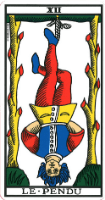
We tend to focus on the central figure of The Hanged Man – the individual hanging from one foot with his hands tied behind him – and not see the background of the picture which includes the frame from which he is hanging.  The frame, though, is every bit as important as the person.

A.E. Waite chose to design the frame in a shape which is very much like a cross and evocative of Jesus, but that’s not how the frame was shown in the older cards.  It normally consisted of two living trees, one on each side, with a beam laid across their tops. It wasn’t a cross and had zippity doo dah to do with Jesus.

We can, perhaps, get a better grasp of what the inventors of the Tarot were getting at if we look at The Hanged Man from the old Marseille deck.


The name is Le Pendu, the hanging one.  It’s related to a slew of our modern words such as pendant, pendulum, dependent, and depend.  The commonality is that they all describe something that hangs from something else.

We all have a central point that our worlds (as we perceive them) hang from.  You might call it your, “identity.” Or perhaps your, “social fabric.” It’s made up of a myriad of factors that, blended together, make up the way that we see the world and our places in it.

“I’m a conservative hispanic catholic from New Mexico.”

OR

“I’m a liberal jew from Marin County.”

OR

“I’m an african american wiccan from Alabama.”

There are literally millions upon millions of variations, with each of us picking out and identifying with the things that make us feel unique and influence the way we perceive the world and our lives.  “This is who I am.”

The Hanged Man has had a forced realization that everything he believed in, everything he thought of as, “myself,” was an illusion.  Maybe it was a divorce that caused him to see that. Maybe it was the death of a child. Maybe it was an illness. Whatever it was he KNOWS that his previous life wasn’t real.

No, you aren’t your sports car because that can be taken away from you.

And you aren’t your house.

Or your brand new computer.

Or your family.

Or your religion.

Or even the color of your skin because, in case you haven’t noticed, you’re not taking that with you when you leave this beautiful world.

The Hanged Man has had that kind of a shocking realization.  That none of it’s really REAL. Everything he dePENDED on can vanish in the blink of an eye.  Everything he hung his identity from was an illusion. He’ll never see the world in the same way again.

And now he has to put himself back together, only this time in a way that IS real and that can’t be taken away from him.  He needs to reclaim his soul.

When you look at the trees in the old Marseille card it’s obvious that the branches have  been cut off. Everything that was once his life has been pruned away. BUT . . . the tips of the branches also look very much like buds in the Spring.  Full of life and ready to grow again.

Here’s how Eckhart Tole put it in The Power of Now: A Guide to Spiritual Enlightenment:

“Ego is no more than identification with form, which primarily means thought forms . . . What a liberation to realize that, ‘the voice in my head,’ is not who I am.  Who am I then? The one who sees that.”

That’s the Hanged Man.

Just the Tarot by Dan Adair – a kindle ebook available on Amazon

Disclaimer: “As an Amazon Associate I earn from qualifying purchases.”

The Hanged Man – Suffering and Rebirth

The meaning of The Hanged Man card in the Tarot, including definitions for the upright and reversed positions.

hangedman

A young man hangs suspended by one foot from a tee shaped cross of living wood.  His hands appear to be tied behind his back and a glowing nimbus surrounds his head.

Upright: The key word in the description above is, “suspended.”  This card indicates a time out, a period during which the questioner may, “suspend,” life for a while and take a break to rethink and re-create his or her life.  The suspension of activities precedes a change in the person’s life and attitudes.

This actually happens fairly frequently in our society and in some cases we describe it as a mid-life crisis.  A person wakes up one morning and thinks, “What in the hell am I doing with my life? This sucks.” And, in more radical instances, they may quit their jobs, walk away from everything, and join a monastery or meditation center for a while to sort things out.

Even without taking it to those extremes this card represents a self-imposed period of sacrifice and relative isolation in order to grow spiritually or mentally.  On a romantic level it may indicate walking away from relationships for a while in order to become a more balanced person and have better relationships in the future.  On an employment level it may signal a need to quit a job that you don’t like and retrain for something that you will like. In any event, it always signals temporary sacrifice that allows the questioner to grow and improve in the future.

REVERSED:  Take a careful look at the sacrifices that you are making in life and be sure that they’re worth it and that something better will emerge as a result of them.  It may also indicate a strong desire for change without any ability to make it happen. A time when you’d really like something different to emerge but you just can’t take a break from your responsibilities and make it happen.

If you have questions about this card or its meaning in one of your readings, please don’t hesitate to leave a comment.  I’ll get back to you as soon as I can.

A Few More Thoughts About The Hanged Man:

There are actually two components to The Hanged Man.  One is suffering and the other involves a period of retreat leading to a spiritual rebirth.

In my experience many of the Tarot definitions which you find today – particularly those with a heavy New Age emphasis – tend to overplay the spiritual rebirth part and underplay the suffering.  It is, after all, the suffering which causes the spiritual rebirth in the first place.

A person who draws The Hanged Man in a reading has gone through the emotional equivalent of being hit in the face with a two by four.  They have gone through something that was so shocking, so devastating that it’s knocked them out of the orbit of their normal lives. They have to pull back, retreat, and rethink what their lives are all about.

I began pulling The Hanged Man on a consistent basis after the death of my life partner.  We’d been together for 19 years and suddenly the center of my universe, my reason for being, was gone.  The grief was excruciating, something I hope I never have to go through again and, at its’ core, was the knowledge that life would never be the same.  It took months of meditating, journaling, and pondering before I began to crawl out of that horrible black hole to put my existence back in order.

That’s the kind of incident that precedes The Hanged Man appearing in a person’s reading.  For some it may be a divorce or finding their spouses were cheating on them. For others it may be the sudden realization that they’ve been living a life without meaning or purpose and that our time on this earth plane is limited.

First there is the pain.  Then there’s a retreat from normal life which probably starts on the very basic level of licking your wounds and trying to not go crazy.  And then there’s an extended period of questioning what life is about, what your values are, and how you want to live.

The Hanged Man doesn’t move through your life quickly.  It’s not something that’s over within a few days or a few weeks.  This card can show months or even years of rebirth and regrowth. The good news is that you come out of the other side of it a much stronger and much better person.

“Just the Tarot,” by Dan Adair – a kindle ebook available on Amazon