The Ten of Wands, Energy Healing, and Over-Thinking Enchiladas

Using energy healing to overcome overthinking.

I find myself understanding the poor dude in the 10 of Wands more and more as time goes by.

In the Tarot, the four suits of cards represent different realms of the human experience.  Swords = personal power.  Cups = emotions. Pentacles = material possessions.  And wands = ideas.

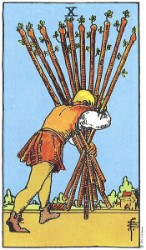
So we see this guy in the 10 of Wands who has SO MANY ideas that he can barely stagger along under the weight of them.  His head is pressed firmly into the bundle of wands and he can’t even see what’s going on around him.  He’s just trudging toward a distant destination, hoping he’s going in the right direction and trying to put one foot in front of the other.  His ideas own him, not the other way around.

I was watching an interview with Eileen McKusick, author of, “Electric Body, Electric Health,” and she flat out said, “Overthinking is a cultural brain virus.  Overthinking never, ever solves anything.”  Naturally, my reaction was, “I’ll need to overthink that statement.”

She’s right, though.  What we refer to as, “thinking,” usually means shuffling around a lot of different concepts, trying to make them fit some sort of a coherent pattern.  It’s like a Rubik’s Cube that we keep flipping and flipping and flipping, hoping that all of the squares will line up. 

But conceptualizing is just one part of a much larger process and when we get stuck in that one part, it doesn’t work.  We can never, ever solve anything by just thinking at it.

Somewhere along the line in human evolution -probably about the time we began to develop alphabets and writing – we started to pull out of our bodies and into our heads.  Which is to say that we started to think of our heads, our brains and thoughts, as being somehow separate from our bodies.  Philosopher Gilbert Ryle referred to that as, “the ghost in the machine.”

That name is so apt because most of us suffer from this incredible, mass hallucination that there’s some separate, non-material, “self,” much like a ghost, that sort of rides around in our bodies, as if they were machines that we’re driving.  The ghost, of course, lives in our heads and we peer out at the world through our eyes, just as if they were windshields.

We call the ghost in our heads our, “selves,” or our, “personalities,” or even our, “souls.”  So there’s a ghost that’s our REAL self and then there’s the body, which we’re sort of temporarily driving around in.  That scene is very much like our real self landed at the Earth Airport and went straight to the Hertz Rent a Body so that we’d have a cool ride to tool around in.  “Hey, I’ll take something with fins and a lot of chrome.  Bucket seats.”

We even see that dualism in New Age philosophy, right?  How often have we heard that expression, “You’re not a body that has a Soul;  you’re a Soul that has a body?”  Which is a nice shift toward the spiritual, but it still maintains that strange hallucination that our bodies are somehow NOT our real selves. 

Which is exactly what McKusick was getting at:  we’re not just our brains and we’re not just our bodies – we’re our body/brains/nervous systems/emotions/thoughts/memories, Soul – the whole enchilada.

Or perhaps I should say, “the Soul Enchilada.”

She’s an energy worker who uses the energy of sound to heal us.  Like most energy workers, she heals from the outside in, which is contrary to some New Age thinking.  The basic New Age formula for life runs like this:

Our beliefs create our thoughts.

Our thoughts create our emotions.

Our emotions create our vibrations.

Our vibrations create what we draw into our lives.

New Agers have tended to jump in at the level of thought and say, “Well, if we change our thoughts, we change our emotions, which changes our vibrations, which changes our lives.”  Also known as the power of positive thinking and it’s true.

Energy healers like McKusick, though, are flipping the script on that.  They’re saying, “If we change our vibrations, we change our emotions, which changes our thoughts.”  She’s taking the same holistic approach – we’re all one great big electromagnetic vibration and if you change one thing, you change all of it – but she’s working from the vibration inward to the thoughts.

Her idea is that sound is a form of energy and so are we.  When we listen to certain sound frequencies that are coherent, solid frequencies, it reorganizes the energy in our bioelectric field into a solid, coherent vibration.  As our vibrations become more coherent, so do our emotions and our thoughts.

Does it work?  I don’t know, yet.  I’m spending a significant part of my day banging away on my Tibetan meditation bowl and grooving on the rising and falling of the sounds.  It does seem to be very soothing and it does take me out of my head and into my body.

And now that I’ve over-thought it, I like it.  I really do.

Please remember that my amazing e-book, Just the Tarot, is still available on Amazon for MUCH less than an order of enchiladas. Hell, it’s less than a side of refried beans. What an incredible bargain!
Bundles of Sticks, Ajahn Brahm, and the Ten of Wands

Finding closure on experiences that don’t make any sense.

Should we carry our past with us or just throw it away?

The Ten of Wands shows a person plodding along, carrying a large bundle of sticks.  The, “sticks,” are wands, the suit of the Tarot that represents ideas, so he’s actually carrying a massive number of ideas.  

If we take a little closer look at the card we notice a few odd things about it.  First, he’s not at all carrying the sticks the way that we’d expect.  If we pick up a big old honker of a load of sticks, we’d throw them over our shoulder, right?  Instead,  he’s carrying them in front of himself, with his head pressed into the bundle. 

Second, the sticks are all crossed up at the bottom and going in different directions at the top.  If someone asked us to lug a large pile of sticks across the yard, we’d probably throw a rope around them and tie them together, not carry them in a loose, unwieldy mess.

Third, he’s definitely not watching where he’s going.  His head is tilted down, as if he’s watching each step he’s taking, rather than keeping his eyes on his destination.

So just by looking at the face of the card, we can deduce quite a few things about it.  This guy is probably an intellectual, or at least someone who thinks a great deal, because he has many, many ideas that he’s carrying around.  His ideas don’t really, “fit,” together, and they’ve become quite a burden for him.  In fact, he’s so involved with carrying his ideas that he really has no idea where he’s going.  He’s so lost in his ideas that he has no perspective on his life.

The Australian Buddhist monk, Ajahn Brahm, tells a funny story about sticks.  When he was a novice monk he was strolling through the forest with his teacher, the head monk at the monastery where he was studying.  The master suddenly picked up a stick from the forest floor and asked, “How heavy is this stick, Ajahn Brahm?”  And then he threw it away and asked, “How heavy is it now?”

The point, of course, is that something is, “heavy,” only when we hold on to it.  It’s the act of PICKING IT UP AND CARRYING IT that makes it heavy.  We don’t look at a stick on the ground and say, “Oh, crap, that’s heavy.”  We only say it when we try to pick it up.  It’s our act of grasping something that makes it seem heavy, not the thing itself.

Human beings are natural storytellers.  We all reflexively try to make sense out of our lives and weave the events we experience into a coherent, sensible narrative.  We have an innate drive to try to make sense out of what happens to us and so we’re constantly reviewing our pasts and rearranging the puzzle pieces of our lives into some sort of a rational structure.

We don’t just say, “Well, I lost my fucking mind and decided to quit my job, leave my husband, and move to Montana to grow dental floss.  Just for no particular reason.”  Instead, we say, “After several years of marriage I felt a yearning for solitude and spiritual growth that could only be satisfied by disconnecting from social obligations that had become increasingly mundane.”  

That feels ever so much better.

We need to feel that it all makes sense, somehow.

From a Buddhist perspective, constantly trying to make sense out of our pasts is tantamount to picking up that stick.  It only becomes heavy, it only becomes a burden, when we grasp it and carry it around with us.  In fact, Ajahn Brahm actually recommends writing, “this is my past,” on a stick and throwing it as far away as we can.  Just let it go.  When we’re not carrying it, it’s not heavy.

Now, modern psychology has a different take on it.  Therapists tell us that it IS important to try to make sense out of what’s happened to us and to strive for a sense of meaningfulness in our lives.  Bottom lining it, that’s why we go to therapists:  because our lives aren’t making any sense and we need someone to help us sort it all out.

I suspect that for most of us, the truth lies somewhere in the middle.  If we wake up one morning and have no past, we may have suffered a psychotic break.  Or, in the case of people like Eckhart Tolle, perhaps we’ve had a massive revelation, a huge psychic shift that made us realize how absurd our previous thinking was.

For those of us who are neither psychotics nor enlightened spiritual masters, though, just tossing our pasts out the window isn’t an option.  It seems we can’t just NOT think about it.

Which brings us to that tired, but still valid, word:  closure.

We think of closure as having worked through a problem or a process in life until we’ve made sense of it, until it fits logically into our coherent narrative of what our lives mean.  If we go through a divorce, for instance, we may go to a therapist and try to figure out why it happened.  What was our role in the relationship breaking apart?  What was our spouses role?  What did we do wrong?  What did we do right?  What can we learn from it to make our future relationships better?  Eventually, when we’ve talked through all of those issues, we start to achieve closure and we’re ready to move on from it.  We haven’t necessarily thrown the stick away, but we’ve made it a hell of a lot lighter to carry.

There are other issues, though, that we can never seem to make any sense out of.

– If you were badly abused as a child, that doesn’t make any sense.  You didn’t do anything to deserve it and there’s no logical or emotional reason it should have happened to you.

-If you’re an open and loving person and you got chewed up and spit out by a malignant narcissist, that doesn’t make any sense.  You didn’t ask for it, you didn’t deserve it, and it shouldn’t have happened.

-If the new boss from hell fires you from your dream job because he’s a sexist or a sadist, that doesn’t make any sense.  You were a great employee, there’s no justice in it, and it shouldn’t have happened.

So there’s a kind of a subclass of experiences that we all have that we could call, “doesn’t make any sense,” experiences.  Those are the experiences that get really, “sticky.”  Those are the experiences that we pick up and carry with us.  We go over and over and over them, trying to figure them out, trying to make them somehow fit into our narratives, our story.  But they never do.

“Doesn’t make any sense,” experiences are the ones that are most likely to wound us spiritually and emotionally.  They keep us stuck.  They keep us wounded.  They keep us living in pain.

Oddly, though, they’re also the experiences that are easiest to let go of, if we think of them in the right way.  If we’ve honestly, sincerely, conscientiously tried to figure them out and we can’t do it, we can just say, “Well, fuck it.  This doesn’t make any sense.”  And then we can put that experience in a nice, “doesn’t make any sense,” box, tie a brightly colored, “doesn’t make any sense,” ribbon around it, and toss it in the nearest river.

Maybe we’re not enlightened or smart enough to throw all of our, “sticks,” away, but we can throw some of them away.  We can consciously choose which parts are valuable and which parts are worthless.  We can drop some of the burden and make it a little easier to move forward in our lives.  

And that’s a good start.

The Ten of Wands, Mike Dooley, and Becoming a Topless Cellist

This is a post about Mike Dooley’s concepts of choosing our goals, visualizing them, and manifesting them. It discusses the Ten of Wands tarot card as a representation of someone who has too many goals and needs to narrow her focus while remaining open to all possibilities.

If you’re a Great Thinker – and most of us at least believe that we are – you probably have a lot of Great Ideas.  In fact, you may have too many.  Way too many.  Let’s talk about that a little bit.

Mike Dooley has a wonderful book called Choose Them Wisely: Thoughts Become Things! As the title implies, what we think will inevitably manifest in our physical lives, sometimes more quickly, sometimes more slowly, but what we think will become our physical realities.  

Now, the Tarot slices our everyday lives into four quarters represented by the Minor Arcana.  The suit of Cups represent our emotions, Pentacles represent our relationship with physical possessions, Swords represent our physical drives and aggressions, and Wands represent our ideas, our thoughts.

The Ten of Wands is a wonderful representation of someone who has way too many Great Ideas.  Each wand represents a thought and this poor son of a bitch has SO many thoughts going on in his head that he can barely stagger along his path.  He’s literally weighted down with all of his wonderful, fabulous, potentially AMAZING thoughts.  So much so that he can’t even lift up his head and look at the world around him.  All he can do is carry the burden of his thoughts and stare at the path that he’s on, hoping he doesn’t stumble and fall and – goddess forbid – lose his stupefying collection of Great Ideas.

The bad thing about having too many Great Ideas is that it can be just as discouraging as having too few Great Ideas.  It can paralyze us.  We have so many options swimming around in our heads that we just really can’t decide which direction to go in – so we go nowhere.  It’s like we’re saying to ourselves, “Well, I could be a Great Artist, but if I put all of that time and energy into being a Great Artist then I won’t have any time and energy to put into being a Great Writer.”

So we sit around on our asses and worry about that and – in the meantime – we don’t write and we don’t paint.  We’re stuck.  

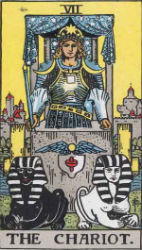
We can actually see a pretty good representation of this with The Chariot card.  You can take one look at this guy and tell that he has some Great Ideas.  I mean, look at those shoulder pads!  Who wouldn’t want a jacket with Moon shoulders?  He’s glorious!  But if you take a little closer look, you see that the Sphinxes aren’t harnessed to anything and he doesn’t have any reins in his hands.  He looks fabulous, but he’s not going anywhere because he doesn’t have any direction, he doesn’t have any focus.  He just can’t decide which way to go.

One of Dooley’s ideas about getting out of the trap of having too few options can also be useful in dealing with having too many options.  Make up a list of your options, of all of the things that you could possibly do to move forward in your life, and then choose the three LEAST SUCKY options and move forward with those.

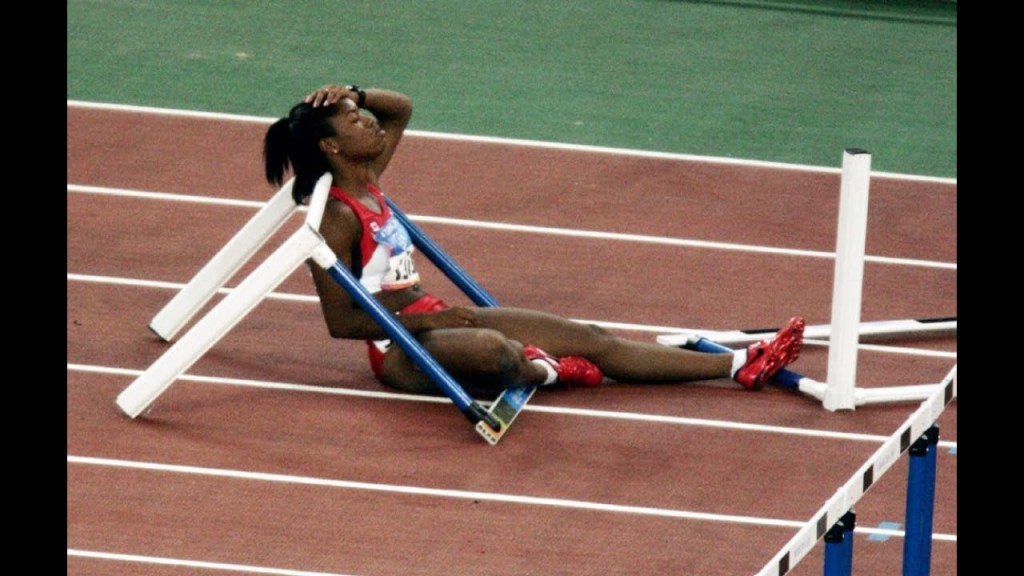
If you have too many Great Ideas, that may sound like a daunting task, but it really isn’t.  My experience is that a lot of my Great Ideas can be slotted under the category of, “Probably Ain’t Gonna Happen.”  For instance, when I was in Junior High School, I got it into my head that I wanted to jump hurdles on the track team.  And I would have been absolutely amazing at it except for the fact that everyone in my family has short legs and I kept jumping into the hurdles instead of over them. 

In the same sense, if you’ve always dreamed of being a porn star and you have a small penis, that, “Probably Ain’t Gonna Happen.”  It doesn’t mean that there’s anything wrong with my short legs or your small penis, it’s just not a good fit.  So to speak.

So we can winnow out a lot of our Great Ideas from the get-go.  And, as we do that, we find that a lot of them are actually pretty Sucky Ideas.  Eventually, as we continue to work on our lists of Great and Sucky Ideas, we’ll come down to the three that are the least Sucky and we can move forward with those.

This is the point where a lot of us get paralyzed again.  Should I really give up on my life-long dream of being a world famous Juggler on the Ed Sullivan Show, just because Ed Sullivan is dead?  Am I making a dreadful mistake in abandoning my idea of being a Topless Cellist at Carnegie Hall?

This is also where Mike Dooley came up with a genius concept:  IT DOESN’T MATTER.  

No matter what we choose, it doesn’t matter.  The main thing is to choose something and then start moving forward with it.  That’s probably the single most important thing that we can do:  get off of our asses and start moving.  And, as we begin to move forward – with ANYTHING – the Universe will provide the next step and then the next step and then the next step and eventually we end up exactly where we want to be.

That takes a tremendous load off of our shoulders, especially if we’re Great Thinkers with lots of Great Ideas.  We really don’t have to decide too much.  We don’t have to spend endless hours analyzing our options, playing scenario tapes in our heads, and fretting over possible disasters.  All we have to do is figure out a couple of our least sucky options and start moving toward them.  We provide the moving feet and the Universe provides the path to walk on.

As Dooley put it, “Do WHAT you can, with WHAT you’ve got, from WHERE you are, and it will ALWAYS be enough.”

And we can overcome any hurdles.  Or, if we’ve got short legs,  we can learn to run sprints.  It’s all good.  It’s all just right.

Disclaimer: “As an Amazon Associate I earn from qualifying purchases.”