Sex and The Devil Card – Time for a New Definition?

This is an exploration of the meaning and definition of The Devil tarot card. Is it time to de-sexualize it?

It may be time to take the sex out of The Devil card, or at least scale it way back.

When we look at the traditional definitions of The Devil, he’s a pretty horny guy.  He’s linked with illicit affairs, cheating on your spouse, sexual “perversions,” and a variety of scandalous behaviors that good, decent folks just don’t do!

But maybe he’s been typecast.

THE LOVERS AND THE DEVIL – SAME COUPLE ON A DIFFERENT DATE
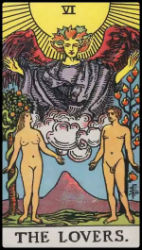
If you hold up The Lovers and The Devil side by side, you can’t help but notice that they’re the same couple.  

In The Lovers, they’re radiant and glowing.  They even have an angel hovering over them to let us know that their love is blessed by heaven above.

Fast forward to The Devil and we see them with chains, horns, and flaming tails.  There’s a serious, “We may have made some questionable choices,” vibe.

Which begs the question:  what happened to these two?  Did they skip couples therapy and just dive straight into the underworld?  Did he leave the toilet seat up one too many times?

A QUICK HISTORY LESSON

The Tarot as we know it shows up in the 1450s – prime time for the Catholic Inquisition.  This was NOT an era noted for swingers or free love.  Sexual morality was tightly policed:  adultery, premarital affairs, straying outside of monogamy, even masturbation could get you killed by the Bible Police.

So when Tarot artists painted two nude figures on a card, everyone knew what that meant.  It meant . . . you know . . . S – E – X.  But, nude figures with angel = good, approved sex and nude figures with devil = bad, nasty sex.  

Boom – association locked in.

FAST FORWARD TO MODERN TIMES

But here we are in the 21st Century and, my oh my, how things have changed.

Remember just a few years ago when people were totally titillated by the book (and movie) “Fifty Shades of Gray?”  It’s nothing but an exploration of bondage and domination dressed up as a novel and – despite the fact that it may have been one of the worst written books in history – it sold over 150 million copies.

We know that people were doing a lot more than just reading it, too, because emergency room visits related to sex toys jumped up by over 50%.  They were actively checking out those techniques, not just reading about them.

We also know that over a third of Americans admit to cheating on their spouses.  And there’s no doubt that THOSE stats are way under reported.

Only about 5% of Americans report being virgins on their wedding nights.  What was once mandatory is now more of a museum exhibit.

And monogamy?  Still popular but VERY flexible in its applications.  Given the divorce rates, it’s obvious that we’re more into serial monogamy than actual this-is-for-life monogamy.

In a nutshell, we’ve outgrown the black-and-white, “good sex versus bad sex” binary thinking.  The Devil’s definition is starting to feel more than a little outdated.

SO WHAT DOES THE DEVIL REALLY MEAN?

Here’s a thought:  maybe The Devil isn’t about sex gone wrong.  Maybe it’s about love gone wrong.

Look closely at the card:  the chains around the couple’s necks are so loose that they could slip them off at any time.  Which means that they’re staying bound by choice.  Or by fear.

That’s the real Devil.  The loveless marriage that drags on because it’s easier to stay than to leave.  The codependent relationship that’s fueled more by desperation than devotion.  The romantic partnership that’s built on money, appearances or habit instead of love.

Those are the heavy chains that we put on ourselves.  Not fiery lust, but destructive attachments that slowly erode our joy.

FINAL WORD: TIME TO RETIRE THE SCANDAL?

Maybe it’s time to let The Devil out of the dungeon of outdated sexual shame.  He’s got bigger (and scarier) fish to fry.  The next time this card lands in a spread, don’t ask, “Who’s cheating on who?”  Instead, ask:  “Where in my life am I bound by something that no longer serves me?”

That’s The Devil’s true temptation: not passion or sex, but the CHOICE to stay stuck in a loveless relationship when freedom is only a tug away.

“Just the Tarot,” by Daniel Adair – a kindle ebook available on Amazon

Dear Prudence – The Mysterious Case of the Missing Tarot Card

An examination of the mysterious Prudence Card that vanished from the original Tarot decks.

The Prudence Tarot Card

Did you know that there was a card that simply vanished out of the Tarot deck?  Poof!  Like it never existed, and its existence isn’t even known, except to a few historians and Tarot scholars.

THE PRUDENCE CARD

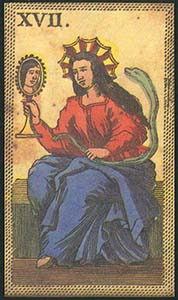
The card was known as, “Prudence,” and – as you can see – it depicted a woman looking into a mirror while a snake keeps her company.  A very strange image, indeed.

It appeared in one of the first known Tarot decks, known as the Visconti-Sforza deck.  This was about the year 1450 and, although the images were crude by today’s standards, for the most part they represent the same themes we see in our modern Tarot decks.  Except for Prudence.  What in the hell is SHE doing in there?

WHY PRUDENCE WAS INCLUDED

To understand why Prudence made her way into the Tarot, we really have to look at what was happening in Europe in the 1400s.

Can you say, “Inquisition?”  Sure you can.  

This was a time when the Catholic Inquisition was in full swing and even the hint of fortune telling could get you burned at the stake as a witch.  The Tarot is – quite obviously – a tool for divination and so they needed to disguise what it really was.

The first ploy was to say that it was just a simple card game.  You know . . . it’s just poker, only with archetypes.  Nothing to see here.

The second trick was to include so much Christian imagery that the priests and torturers would be thrown off of the scent.  In order to do that, they included the ‘four cardinal virtues’ of the Catholic Church.  They are:

JUSTICE

TEMPERANCE

FORTITUDE (AKA Strength)

PRUDENCE

Put quite simply, these cards are nothing but camouflage for the real, original Tarot deck.  

SO WHAT HAPPENED TO HER?

The obvious question here is, “Why did Prudence disappear?”  Why did the other, “virtue cards,” remain while she went away to wherever ex-Tarot-cards live?

Most scholars suggest that the messages she was meant to convey – reflection, wisdom, self-knowledge – were simply absorbed by other cards.   They feel that The Hermit card in particular had all of those qualities, so perhaps Prudence simply wasn’t necessary.  

In modern terms, we could say that her job description was eliminated.  Which sounds like bullshit, doesn’t it?

My personal theory is that Prudence may have been just a little too Pagan for their purposes.  It’s a very strange card. The image of a woman, a snake and a mirror conjure up memories of mythological creatures like Medusa or Hathor.  Perhaps the artist who created the Visconti-Sforza deck was tipping his hand a little too much with this depiction and they needed to hide her.

Whatever the reason, Prudence faded into obscurity, leaving the Tarot a little leaner, but much more mysterious.

PROBLEMS FOR THE OCCULTISTS

The presence of Prudence would have created a major problem for the Victorian occultists – who really brought the Tarot back to life – had they known about her.

They were bound and determined that there was some secret, ancient path hidden away in the Tarot cards and – by god – they were going to find it.  In the 19th century, Eliphas Levi had correlated the 22 cards of the Major Arcana with the 22 letters of the Hebrew alphabet.  He went on to create an elaborate system where he divided the 22 cards into three groups of 7, which echoed the Kabbalistic Tree of Life.

Arthur Edward Waite, who published the Waite deck that we’re all so familiar with, was so determined to make the deck fit into a numerology scheme that he actually changed the order of the cards.  He flipped the numbers so that Strength took the place of Justice and Justice became Strength.  Who cares about history, right?

And, after all of the many years they put into organizing the 22 cards of the Major Arcanum into tidy systems, it turns out there were actually 23 cards.

Well, hell.

CLOSING THOUGHTS

The disappearance of Prudence is more than just a historical footnote.  It reminds us that our knowledge of the Tarot is constantly evolving and it leaves some tantalizing questions.

Why did this ONE card disappear, and not the other virtue cards?

Was the Tarot truly designed as a mystical system disguised as a game?

Does it carry Egyptian or even Atlantean symbols that were concealed from the religious authorities?

The mystery endures and the Tarot invites us to keep looking.

“Just the Tarot,” by Daniel Adair – A kindle ebook available on Amazon