David Carradine, The Higher Self, and Holes Which Don’t Exist

A brief exploration of the meaning of life as illustrated by a Chinese instruction manual.

A few years ago I was assembling a shelf that had been manufactured in China and trying to decode the instructions manual for putting it together.  There were the usual directives – “insert screws A into holes B” – and I was following them quite efficiently when I read a line that stopped me dead in my tracks:

“DO NOT PUT THE BOLT WHICH IS NOT SUPPLIED INTO THE HOLE WHICH DOES NOT EXIST.”

I stared at that sentence for several moments and realized that I had to stop and think about it because it just sounded so . . . profound.  Particularly since it had come from China which, as we all know, is a Land of Mystery which is virtually overrun with Wise Sages who utter Profound Things pretty much all of the time.

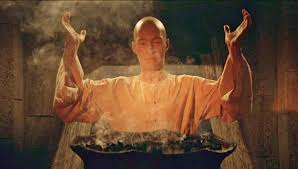
Had a Taoist Priest somehow infiltrated the Chinese shelf factory and quietly scattered deep truths in all of the instruction manuals?  I immediately visualized Master Po, the Shaolin priest on the old Kung Fu television series, looking at young David Carradine and saying, “When you can place the bolt which is not supplied into the hole which does not exist, then it will be time for you to go, Grasshopper.”

Sadly, as much as I turned the phrase over and over in my mind, I was unable to glean any universal wisdom from it.  It could be that I just haven’t reached the level of clarity and insight that will allow me to penetrate to its true meaning.  Or it might have been a typo.

In either case, the memory always makes me think about instruction manuals and the fact that all human beings come into the world supplied with them.

One of the most discomfiting experiences in life is to suddenly pop into a little higher realm of thought and wonder, “What in the holy FUCK am I doing here?”  That can also be expressed as, “What’s the meaning of life?”  Or, “Does life HAVE any meaning?  Or even, “What’s it all about, Alfie?”

All human beings yearn for meaning in one form or another.  We want to feel that we’ve somehow made a difference, that we’ve learned something, that we’ve touched other people’s hearts and spirits in our strange little trips through the Earth School.  When we actually stop and ask ourselves if our lives really mean anything, it can feel like we’re waking up on a train that’s hurtling along in the dark of night, we have NO idea how we got on the train, we don’t know where the train’s going, we don’t seem to have any ID cards in our wallets and, for some peculiar reason, we can’t quite remember who we are.

Life without a sense of meaning reduces us to feeling, as Alan Watts put it, as if we’re some sort of strange living tubes that suck in food at one end and excrete it at the other for no apparent purpose until we die.

Of course, one answer to that is to become Existentialists.  We can proclaim that life has NO meaning other than that which we personally give it and that we somehow find our meaning by embracing our meaninglessness.  That way we can go from the position of, “I don’t have a fucking clue,” to the position of, “I don’t have a fucking clue and isn’t it amazing of me to admit it?”

I mean, it’s not much of a position to take in life, but at least it’s a position.  Plus, if you’re an Existentialist, you get to be tragically hip, dress in a lot of dark clothes and frequently gaze off into the distance as if you’re in deep thought, when you’re really just thinking about what to eat for lunch.

There’s an alternative position, though, which some of the Eastern religions take and which has sort of filtered its way into the New Age/New Thoughts movements.  And that’s that we know precisely why we’re here but we’ve just forgotten.

I know, I know . . . it sounds a little far fetched.  How could we possibly forget what our purpose in life is?  Well, we forget where we put our car keys all of the time and they’re a lot easier to keep track of.

Think of it this way:  we’re hanging around out in the universe in between incarnations and we think, “Hey, you know what?  I think I’m going to incarnate on Earth!  That could be fun!  And I have this particular lesson that I need to learn and Earth might just be the perfect place to learn it.”

So before we reincarnate, we run through our pre-incarnation check list so that we can maximize our chances of learning what we need to learn.  “Let’s see . . . do I want to be born into a rich family or a poor family?  What race do I want to be?  What country do I want to be born into?  Should my parents be good people or assholes?  Do I want a penis or a vagina?  Decisions, decisions, decisions . . .”  

Then, when we’ve got everything figured out, we wait for the next opportunity to jump into a body.  “Oh, boy, here comes that sperm cell and it looks like it’s going to get to the egg and it’s getting closer and it’s crossing the finish line and – YES! – the next incarnation mission has successfully launched!  That’s one small step for man and one giant step for . . .”  

Well, you get the idea.  If all goes well and we make it through the next nine months of gestation – SHAZAM! – here we are on planet Earth, a human being, all ready to learn our lessons and fulfill our purpose for being here.  

Only, somewhere along the line, we forgot what our purpose was.

How embarrassing.  Don’t tell anyone.

Fortunately (or not, depending on our perspective), there are a lot of distractions here on planet Earth and we go on a lot of mini-missions.  We start with things like, “I wanna get fed and I want my diapers changed.”  Then, as we get older, we concentrate on things like, “I want to get laid and I want to get OUT of this goddamned high school.”  And then we move on to, “I want a partner.  I want a house.  I want a car.  I want a new computer.  I want a better job.”

It all gets very complex but, still, every once in a while, that little voice pops up and asks, “Does this mean anything?  Is this really what I’m supposed to be doing?”

It’s a terrifying question but it’s even more terrifying when we feel like there’s an answer but we can’t quite put our finger on it.

Which is where a spiritual practice comes in.

Most spiritual practitioners will tell us that that part of us, the one who said, “Hey, I think I want to incarnate on Earth and hang out there for a while,” is still with us, right here, right now, just waiting for us to ask it what in the hell we’re doing here.  You know . . . if we can pause long enough from eating and having sex and shopping on Amazon.

Some religions call it a, “Soul,” which I don’t much care for because the christian fundamentalists have pretty much yucked that up.  Other practices might refer to it as our, “Higher Self,” or our Spirit.  

People who meditate a lot will tell us that when we sit long enough watching our thoughts we become aware of the fact that there is another, “us,” sitting and watching and THAT’S the Higher Self.  Not our bodies, not our emotions, not our thoughts, but another, “us,” who is profoundly wise and deeply connected with our purpose for being here.

People who blast off on an acid trip or take a lot of magic mushrooms will frequently encounter that Higher Self and maybe zip around the astral plane with it.  Shamans who go on Spirit Quests are looking to have a little conversation with their Souls.  Even brain researchers like Jeffrey M. Schwartz posit the existence of a, “Wise Counselor,” who’s here to guide us and floats above our everyday lives.

The point is that the Wise Counselor, the Higher Self, the Spirit . . . that’s who’s got our instruction manuals.  That’s the part of us who knows why in the hell we’re here and what we’re supposed to be doing.  That’s the part of us who can tell us how to put the bolt which is not supplied into the hole which doesn’t exist.

So it becomes vitally important that we engage with that part of our being.  That we actively seek answers through whatever means will get us into communication with our Higher Selves.  For some of us that might mean meditation.  For others, ecstatic dance or yoga.  For others, psychedelics.  There is ALWAYS a gate for each one of us that leads us back to our Higher Selves.  We just have to look for it.

Once we find it, once we accomplish our purpose here in Earth school, once we learn how to put the bolt which is not supplied into the hole which doesn’t exist, then it will be time for us to go.

Grasshopper.

The Hermit: “For What Does It Profit a Man to Gain the Whole World But Lose His Soul?”

I am fortunate enough to live in one of the most beautiful places in the United States, the Trinity Alps of far Northern California.  There are gorgeous rivers and streams and lakes, mountains, two national forests, a plethora of eagles, hawks, ravens, bears, trout, and salmon.  And there are only 13,000 people living in the entire county so you can still actually spend hours walking in the woods or sitting by a river by yourself.

We have thousands of tourists come through every summer and a sizable minority of them are just plain miserable.  It’s either too hot or it’s too cold, there aren’t enough cashiers in the grocery store, the ATM wasn’t working, the water in the river is too cold to swim in, it’s too quiet, it’s boring, the internet isn’t fast enough, etc., etc., etc.

It’s kind of sad.  These people have spent thousands of dollars to go to a beautiful, tranquil place to get away from their problems for a few weeks and it turns out that the main problem they have is . . . them.  They’re just not happy people. And they brought themselves with them.

Like the old cliche’ says, “No matter where you go, there you are.”

The Hermit is about a period of withdrawal from the world.  About getting out of the stream of time and events for a while so that you can either figure out or remember who you really are.  But, as we can surmise from the unhappy tourists in Trinity County, there’s a little more involved with that than just running away from home.

A researcher named Marsha Sinetar wrote a fascinating book on the subject called, “Ordinary People As Monks and Mystics, Lifestyles For Self-Discovery.”  She put ads in several papers across the country seeking out people who had chosen to withdraw from everyday life and based the book on her interviews with them.

Several things become obvious as you read through the book.  The first is that these people experienced a massive reordering of what they considered to be valuable (also known as, “their values.”)  At some point in their lives they simply decided that the new car, the big house, the fancy computers, the pay raise at the job, and yes, even the marriage to the, “perfect spouse,” and 2.5, “perfect children,” were all bullshit.  All of the things that we might ordinarily consider important and satisfying and fun had become unimportant distractions to them.

What BECAME important to them were, oddly, the things that used to be part of the human birthright but which many of us have lost in modern life.  Time alone. Time to think. Time to meditate. Being in nature. Reading. Silence. Contemplation.

And – again, oddly – claiming  these simple things which used to be free to every human being actually, “cost,”  them a fair amount. Most of them had to walk away from the high paying jobs and start doing part time jobs and learn to live on less money and with fewer possessions.  They walked away from the social status and from the concept that they were, “important people,” as defined by others and walked toward the concept of being, “important people,” as defined by their own hearts.  

Some of them became alienated from their families who refused to accept their new lifestyles.  “Why are you living out in the woods with a dog instead of finding a good husband and having kids?  What’s wrong with you?”

These are mainly seen as sacrifices by people on the outside looking in, though.  To the participants in the study they were very small sacrifices to make for having the luxuries of time and solitude.  

“Time, not money, seemed to be the element most coveted for their new life. . . they didn’t have to be financially secure, they just had to FEEL secure . . .”

And that was one of the biggest takeaways for me from this book.  Modern life, as most of us know it, is a thief. It steals our TIME and in doing so it steals our ability to think about who we are and why we’re here.  In exchange it gives us, “things,” – toys, computers, cars, houses, money – and then it hypnotizes us into thinking that those things are actually us, actually the life that it just stole from us.  

The Hermit is about throwing away the trinkets and finding the gold.  Taking back your time and your Self and your Soul.

Getting Real – The Hanged Man

An exploration of the loss of false identity and the need to create an authentic self as exemplified in The Hanged Man tarot card.

I said in my original definition of The Hanged Man that having this archetype blow through your life is a lot like getting hit in the face with a two by four.  It involves an experience that is so painful, so truly devastating that you have to totally reevaluate how you relate to life and the souls around you.  

In other words, you have to have a new framework for your existence.  

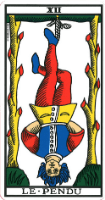
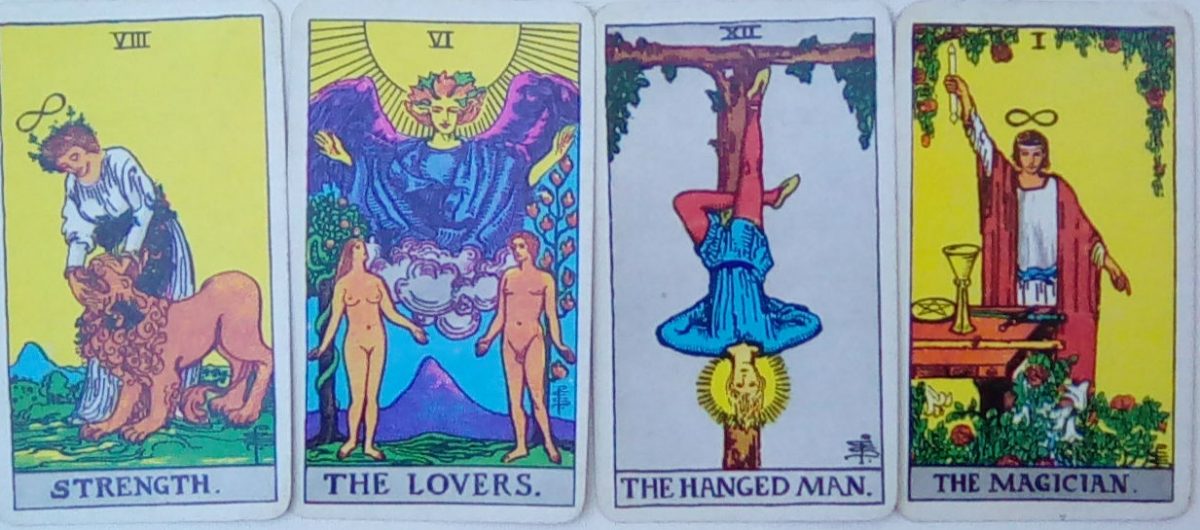
We tend to focus on the central figure of The Hanged Man – the individual hanging from one foot with his hands tied behind him – and not see the background of the picture which includes the frame from which he is hanging.  The frame, though, is every bit as important as the person.

A.E. Waite chose to design the frame in a shape which is very much like a cross and evocative of Jesus, but that’s not how the frame was shown in the older cards.  It normally consisted of two living trees, one on each side, with a beam laid across their tops. It wasn’t a cross and had zippity doo dah to do with Jesus.

We can, perhaps, get a better grasp of what the inventors of the Tarot were getting at if we look at The Hanged Man from the old Marseille deck.


The name is Le Pendu, the hanging one.  It’s related to a slew of our modern words such as pendant, pendulum, dependent, and depend.  The commonality is that they all describe something that hangs from something else.

We all have a central point that our worlds (as we perceive them) hang from.  You might call it your, “identity.” Or perhaps your, “social fabric.” It’s made up of a myriad of factors that, blended together, make up the way that we see the world and our places in it.

“I’m a conservative hispanic catholic from New Mexico.”

OR

“I’m a liberal jew from Marin County.”

OR

“I’m an african american wiccan from Alabama.”

There are literally millions upon millions of variations, with each of us picking out and identifying with the things that make us feel unique and influence the way we perceive the world and our lives.  “This is who I am.”

The Hanged Man has had a forced realization that everything he believed in, everything he thought of as, “myself,” was an illusion.  Maybe it was a divorce that caused him to see that. Maybe it was the death of a child. Maybe it was an illness. Whatever it was he KNOWS that his previous life wasn’t real.

No, you aren’t your sports car because that can be taken away from you.

And you aren’t your house.

Or your brand new computer.

Or your family.

Or your religion.

Or even the color of your skin because, in case you haven’t noticed, you’re not taking that with you when you leave this beautiful world.

The Hanged Man has had that kind of a shocking realization.  That none of it’s really REAL. Everything he dePENDED on can vanish in the blink of an eye.  Everything he hung his identity from was an illusion. He’ll never see the world in the same way again.

And now he has to put himself back together, only this time in a way that IS real and that can’t be taken away from him.  He needs to reclaim his soul.

When you look at the trees in the old Marseille card it’s obvious that the branches have  been cut off. Everything that was once his life has been pruned away. BUT . . . the tips of the branches also look very much like buds in the Spring.  Full of life and ready to grow again.

Here’s how Eckhart Tole put it in The Power of Now: A Guide to Spiritual Enlightenment:

“Ego is no more than identification with form, which primarily means thought forms . . . What a liberation to realize that, ‘the voice in my head,’ is not who I am.  Who am I then? The one who sees that.”

That’s the Hanged Man.

Just the Tarot by Dan Adair – a kindle ebook available on Amazon

Disclaimer: “As an Amazon Associate I earn from qualifying purchases.”