Animal Companions, Heart Chakras, and Learning to Love

Our pets abilities to heal our Souls.

“I’ve known several Zen Masters and they were all cats.” – Eckhart Tolle

The image in The Fool tarot card shows a person dancing with joy at the edge of a cliff.  It’s meant to portray a Soul that’s so fully in the Flow that, even if she were to dance off of the cliff into thin air, she wouldn’t fall.  It’s a beautiful card, but we seldom take much note of the little dog that dances right along with The Fool.

In her book, “Animal Soul Contracts: Sacred Agreements for Shared Evolution”, Tammy Billups addresses the idea that animals come into our lives for specific reasons and they’re often instrumental in helping us to recover and evolve.  As she puts it, we have a Soul Contract with our animals.  We heal them and they heal us.

She tells the story of a man who was living alone when a stray dog suddenly showed up on his doorstep.  He took the dog in and they formed a strong, loving bond. The one problem was that the dog developed terrible separation anxiety and suffered greatly whenever his new owner had to leave the house.

He finally contacted Ms. Billups in the hope that she could work with the dog and help it to feel more secure.  In the course of treating the dog, though, the man had a sudden epiphany:  every relationship he’d ever had ended up with his lover walking away from him.  He had severe abandonment issues of his own and so he’d attracted an abandoned dog.  He started therapy and, as he learned to deal with his own fears of abandonment, the dog healed from its separation anxieties.

She posits that animals – and particularly that class of animals that we refer to as our, “pets,” – have a very deep and ancient Soul connection with human beings.  They not only mirror who we are, as the dog did with the young man, but they also point us toward a better way of existing in the world.

One thing that they provide to us abundantly is pure, unconditional love.  Getting that kind of love as an infant is vital to the development of a healthy, well adjusted human being.  Sadly, though, we have a lot of people in our world who were beaten more than they were hugged as children.  We emerge as adults who are convinced that (a) we can’t be loved; (b) somehow it’s our fault, rather than the fault of our crazy parents; and (c) it’s never safe to reach out to other people for love.

And then a puppy or a kitten shows up in our lives and loves us unconditionally.  The dog or the cat doesn’t give a flip about how smart we are or how we dress or how much money we have or any of the other parameters we may find in human relationships.  They just love us, totally and unconditionally, for who we are.  And, yeah, we learn that lesson on a deep Soul level:  it’s safe to love and to receive love.  They fill that hole in our hearts that’s been there since we were babies.

Another example that Ms. Billups gives is that highly empathetic people (and particularly empaths) will tend to attract highly empathetic animals.  We run into that sometimes with an animal that literally seems to be peering straight into our Souls when it looks at us.  There’s a sort of a tickle in our energy systems and a voice that says, “This dog somehow understands exactly who I am and what I’m feeling.”

The common bond is that both animals and empathetic people are primarily, “feelers,” rather than just thinkers.  We exist on that energy level of emotions and almost instantly perceive the hidden vibrations in another being.  And the, “training,” that we receive from that kind of an animal is to learn to keep our own vibrations as loving and kind as possible because they’re feeling them just as much as we are.

Which brings me to the part of Ms. Billups discussion that really blew me away, which is emotional support animals.

We’ve seen a fairly substantial increase in the presence of emotional support animals as a result of the wars in Iraq and Afghanistan.  Many of the troops were returning home with severe PTSD and social anxiety.  Psychologists found that pairing them with animals – usually dogs – helped to soothe their nervous systems and allowed them to interact more peacefully in social settings.

It makes sense, even on a superficial level.  If we’re feeling extreme anxiety, the presence of a calm, loving animal would obviously settle us down.  Ms. Billups takes that a step further, though.

She says that some animals, especially emotional support animals, are able to hold what she calls a, “transformational healing presence.”  In other words, it isn’t just their presence as a trusted companion that’s calming down the person’s nervous system.  Rather, these are animals that are SO evolved that they’re able radiate calmness, serenity and love out of their very core.

We can actually see that with our own eyes.  The next time that you encounter someone with a support dog in a store, stop and look at the people around you.  Most of them will suddenly slow down, smile, and begin to radiate calmness of their own.  It isn’t just because they think the dog is cute, either.  Rather, they’re walking into that energy field of a healing presence that the dog is holding and it transforms them.

There’s a lesson in there for humans, as well.  It takes work – sometimes a lot of work – but we can become that same sort of a transformational healing presence in the world.  Through therapy, affirmations, meditation, and working with our heart chakras, we can nurture a core energy that’s calm, loving, and compassionate.

We don’t need to develop a philosophy or a method around that.  We don’t need to become gurus or convince anyone that they should behave in this way or that way.  All that we need to do is to build the love in our hearts and radiate it out into the world.

One of the neat things about that is, like the support dog in the store, we can step out of all of that judgment about who’s going to receive the love.  The dog isn’t standing there thinking, “Oh, that one’s a Republican – no love for him.”  Or, “Uh, oh, it’s a liberal, shut down the love.”  It’s there for anyone who wants to receive it, no questions asked.  And if someone doesn’t want to receive it, the dog doesn’t get upset or neurotic about it – she just keeps shining that light.

So I’m going to start paying a lot more attention to the animals in my life and begin actively looking for the messages that they’re bringing me.  Perhaps I’ll put my cat in my lap the next time I meditate and see if she has anything she’d like to add.  I’m guessing she does.
The Emperor, Psilocybin, and Butterfly Warriors

A look at the role of psilocybin in erasing toxic masculinity.

And then there’s the amazing case of Mark Matzeldelaflor.

Mark was a Navy Seal.  In case you’re not familiar with that, the Seals and the Green Berets are the ultimate warriors.  Incredible athletes, highly disciplined and impeccably trained, they are considered the finest combat soldiers in the world.  

Mark was also a professional sniper in the Seals.  His job was to kill other human beings by shooting them with high powered rifles, as rapidly and effectively as possible, and he was very good at it.

After serving two tours in Iraq, he left the military and returned to the West Coast, where he became an emotional and spiritual shipwreck.  He drifted from one meaningless job to another, drank too much, suffered from horrible PTSD and sank into depression and suicidal ideation.

Then one day a buddy of his said, “Hey, man, why don’t you take some Magic Mushrooms with me”. And it all went away.  All of the trauma, all of the depression, the alcoholism, the PTSD – it vanished from his heart and brain like . . . well . . . magic.

Mark immediately started trying to use his new world view to help other veterans and started an organization called Guardian Grange.  The idea is to use the discipline and talents that they’ve acquired in the military but channel that into helping to save the earth.  And their first project is . . . a refuge for monarch butterflies.

Now, I’ve written quite a bit here about toxic male role models and I find this story so amazing from that perspective.  When we think of the classic toxic male, we tend to envision a guy who’s taken a few too many steroids, muscular, swaggering, fairly devoid of emotions, unable to admit any vulnerabilities, and a bully.

That kind of a guy becomes a sort of a silly cartoon when you put him up against the reality of a Navy Seal.  These are men who can run or swim for hours with no rest, survive in a jungle or desert with no food, and kill with no mercy or compunction.

So how does someone who is literally a stone cold killer suddenly become a Butterfly Warrior?  It’s fascinating to think about, isn’t it?

The normal cultural model for male/female behavior is based on hormones.  To put it in a nutshell, men are chock full of testosterone and that makes us aggressive, dominant, and violent.  Women are flooded with estrogen, and that makes them passive, nurturing, and weak.  That model was given a huge boost by Sigmund Freud, a man who wanted to fuck his own mother and thought the clitoris was utterly unimportant in female sexuality.

Despite it’s rather shaky logic and dubious proponents, that remains the model that most people operate out of:  we’re simply predetermined products of our hormones.  But what if we’re not?

Scientists are just now beginning to really dig into what psilocybin does to the human brain.  They know, for instance, that it has some sort of a strong interaction with serotonin and pleasure receptors, meaning that it makes us happier.  They know that it vastly increases the connectivity between different parts of the brain, so that parts of our brain that don’t usually, “talk to each other,” are suddenly communicating.  They know that it suppresses activity in other parts of the brain, such as the portion that maintains our sense of self and ego.

Still, there’s much more that we DON’T know about how Magic Mushrooms affect our brains than what we DO know.  Somehow it erases depression, anxiety, PTSD, and suicidal ideation.  And – I suspect – it may also erase toxic male role modeling.

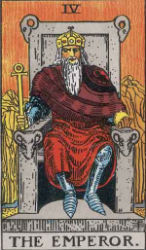
My symbol for the Male Archetype in our culture is The Emperor.  He’s strong, he’s heavily armored, he’s living in a barren environment, and he’s very much alone.  He rules, but he’s paid a heavy price for his crown.  He is, above all else, disconnected.

One of the best descriptions I’ve read of what psilocybin does to the human brain is that it’s just like a snow globe.  It picks up our brains, gives them a good shake, and a lot of our normal neural pathways are disrupted and fly off in totally new directions.  If you’re more into mechanistic models, it seems to instantly rewire our brain patterns.

Dig what Mark said in that interview:  “I just reconnected to nature and my past, where I was like a kid in the woods.”  That description is what we hear from many other people who have taken psilocybin:  an instant sense of reconnection with the earth and with meaning.

Now, there’s no suggestion that psilocybin caused a huge drop in Mark’s testosterone levels or that he suddenly became a eunuch and that’s what took away his aggression or his toxic male role modeling.  He simply instantly learned how to be a male in an entirely different way than what WE ARE TAUGHT that it means to be a male.

All of this is strongly indicative that, “manhood,” is much more in our heads than it is in our testicles.  Toxic masculinity may very well consist of a series of enculturated neural pathways that are so deeply burned into our brain tissue that they’re nearly impossible to overcome.  Unless someone picks up that snow globe and gives it a good shake.

We can’t expect that taking psilocybin will turn our culture around anytime soon.  For one thing, we’re taught from the cradle that some form or another of toxic masculinity is good, that this is the way that a real man behaves.  For another, there’s no money to be made by the pharma industries where psilocybin in concerned.  It’s out there and it’s relatively cheap, so why manufacture it?

Still, it’s a start.  If a man who was the most efficient killing machine the military can manufacture can suddenly turn into a warrior for butterflies that’s . . . a miracle.  

There’s hope.

Another way to almost instantly expand your consciousness is to buy my ebook, Just the Tarot, available dirt cheap on Amazon.

The Knight of Swords, Fight or Flight, and Getting Frumious Bandersnatches Out of Our Heads

Ending the endless cycle of stress.

I had a, “learning dream,” about the Knight of Swords last night and it was very interesting.  Learning dreams – for me at least – are quite different from ordinary dreams.  They’re dreams that answer questions that we really need solutions to, and sometimes we don’t even know it.  In my world, they’re instructions from Spirit Guides and Mentors who are helping me along my path.  In your world, you may see them as a sort of intuitive understanding of truths that have eluded you in waking life.

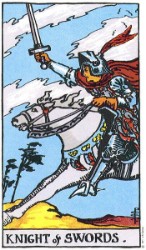
The Knight of Swords shows a Knight in full armor, sword extended, in a balls out gallop.  It’s a totally concentrated, furious charge toward whatever he or she means to conquer.  If you look carefully, you’ll see that the eyes of the horse are rolled backward, as if to say, “Okay, you’ve got the spurs, you’re in charge, but WHAT IN THE FUCK are you doing?”

Now, aggression is a perfectly normal part of human life, so much so that the Tarots suit of swords can be seen as representing a variety of aggressive ego states.  Aggression is, after all, one half of the famous Fight or Flight reaction.  There are times when it seems that we have no choice but to fight to defend ourselves or to stand up for what we consider to be right.  

But what happens when we get, “stuck,” in that reaction?  What happens when we live in a state of Fight or Flight?

Well, we start to break down and fall apart.  Our bodies are constantly flooded with stress hormones and we develop high blood pressure, heart problems, and sleep deficits.  Our minds become paranoid, habitually anxious, and we start to feel increasingly isolated and alone.  It’s not pretty.

The revelation that came to me in my dreams last night is that there are really two elements operating in concert when we get stuck in Fight or Flight. The first is the internal dialogue.   Buddhists refer to that as, “monkey mind,” the constant, chattering thoughts that will really mess up your meditation sessions.  Eckhart Tolle discusses it quite a bit in terms of, “ego,” which he views as a sort of an artificial construct of the mind that was a result of a wrong turn in our evolution.

Whatever you want to call it, it’s there:  an endless stream of thoughts that tend to operate just below the level of our conscious control.  And we really can’t do much about that.  As Emily Fletcher says in Stress Less, Accomplish More: The 15-Minute Meditation Programme for Extraordinary Performance the mind thinks involuntarily in the same way that the heart beats involuntarily.  Thoughts are a natural by-product of the mind, in the same way that waves are a natural by-product of the ocean.

The second element in a stuck Fight or Flight reaction is the body, that wonderful amalgam of proteins and hormones and electrons that’s constantly whizzing around creating and recreating our physical selves.  More specifically, we’re talking about that part of the body that’s intimately connected with Fight or Flight, the amygdala in the brain and the stress hormones.

When we’re confronted with something that the brain interprets as being dangerous, the amygdala jumps up and screams, “Holy Shit!  Watch out!  It’s a Frumious Bandersnatch!”  And then our brain dumps about 80 million gallons of adrenaline and cortisol into our systems, our blood pressure shoots up, we become hyper-focussed and we’re ready, by god, to fight!

All of that’s good when we’re confronting Bandersnatches and Jabberwocks and we need to stay alive.  But we were never meant to live in Fight or Flight for extended periods of time.  We were meant to engage in intense physical activity – fighting or running – that burns up the adrenaline and the cortisol rapidly and allows us to return to a normal state of consciousness. 

When we live through an extended period of stress – military combat or a marriage from hell or taking care of a loved one who is dying by inches for years – then the Fight or Flight reaction becomes habitual.  It becomes our normal way of behaving and of perceiving the world.

It becomes a self-feeding cycle that operates independently of what’s really going on in our world.

The first thing that happens is that the quality of our internal dialogues change.  We begin to see the world, “through a glass darkly,” and it shows up in the quiet chatter at the backs of our minds.

My life is so fucked up.

I can’t get a break.

I’m such a loser.

Why does this shit keep happening to me?

The kicker is that the Fight or Flight system in our brains is so ancient that it’s literally pre-verbal.  It evolved long, long before we developed speech or nuances in thought.  So it’s not hearing, “the world was a dangerous place,” or, “I’m having obsessive thoughts about something that’s over.”  All it’s hearing is, “There is danger,” and it’s continually dumping more and more stress hormones into our bodies so that we can respond to the danger.

And there’s a feed-back loop that starts up.  Our bodies are incredibly stressed from the hormones and our brains pick up that stress and interpret it as, “Something’s wrong.  Something’s dangerous.”  Which in turn makes the amygdala jump up and scream, “Holy Shit!  It must be another Frumious Bandersnatch!  Dump some more stress hormones!”

At a certain point it really does become almost like an independent, autonomous personality that we can’t control any longer.  Our circumstances may change completely.  We may be OUT of combat, we may have divorced the horrible, abusive spouse, we may have gone through the death of a partner and emerged on the other side of the grief.  But that Fight or Flight personality just keeps on trucking.

The problem is two pronged – the inner dialogue and the body – and so the solution needs to be two pronged.  First of all, we need to be very, very conscious of our inner dialogue and start transforming it.  It’s like a radio operating at a very low volume that we only half hear.  TURN IT UP.  Listen to it.  Start flipping every negative thought into a positive affirmation.  When we can turn that constant stream of negatives into a constant stream of positives, it interrupts the self-feeding cycle and starts to shut down the stress reaction.

Second, soothe the hell out of our bodies.  I mean that literally.  If we’ve lived through years of stress, our bodies are pretty tortured by it.  Take the time for hot baths, listen to quiet, peaceful music, take naps, lie in the grass, visualize beautiful scenes, masturbate or make love, BE GENTLE.  The more we soothe our bodies, the fewer stress hormones we’ll have.  The fewer stress hormones we have, the more our inner dialogues will change to healthy, grateful thoughts.

Like any big change in behavior, it can feel very complicated at first, but it’s not.  It’s really just a matter of transforming ourselves into the kinds of people that we’d LOVE to live with.  Because . . . you know . . . we are the people we live with, and who wants to live with a depressed roommate?

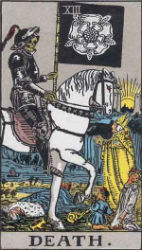
The Ten of Swords, the Death Card, Child Abuse and Forgiveness

It’s hard to put an exact figure on it because child abuse tends to operate in the darkness, but most statistics indicate that about one in five people were abused as children. That abuse can, of course, be a broad spectrum of behaviors from physical abuse to emotional and social abuse to sexual abuse, or a combination of all of those. And therapists will take different approaches in treating those abuses, depending upon the type and severity.

We can simplify that by just lumping it all under one word: trauma. Victims of child abuse suffered severe trauma at a point in their lives when they were totally ill-equipped to process it intellectually or psychologically. Child abuse is normally committed by those who are closest to us – our parents, siblings, uncles, teachers, priests, pastors – and so it involves a deep betrayal of the most basic sense of trust. It leaves its victims with an enduring, often unconscious, feeling that the world is NOT a safe place and that we can never feel secure or at peace, even in our own homes. To use a current phrase, we suffer from Post Traumatic Stress Disorder, just like people who have been in combat for extended periods of time.

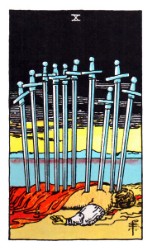
Eventually, that lack of trust in life, that basic inability to ever really relax into safety, will cause us to build impenetrable walls that destroy the quality of life. We are so wounded that we just can’t let other people all the way into our lives because they might hurt us, too. Very much like the figure in the Ten of Swords, the battle is over and we lost. And how could we not? We were just children when the battle took place.

We may seek help through therapy or spiritual resources in an attempt to remove the toxins, to tear down the walls of distrust and fear. If we’re blessed with a really good therapist or a wonderful teacher, we may actually make progress with our issues and begin to engage in life in a more open, loving way. We still feel wounded, though, pierced with countless swords of pain when we recall what happened to us as children.

And then an odd thing happens somewhere along the journey: our abusers die. Abusers, like everyone else, are ultimately mortal and they age and die like everyone else.

When that happens it can be a very odd time in our lives. There may initially be a real feeling of catharsis, a sort of a joyful crying out into the world: “I’m still here and you’re not, you son of a bitch.” Or there may be a total numbness and lack of grief. After all, they taught us the value of learning to feel nothing again and again and again while they beat us. Later, if we go into therapy, there may be a deep regret: “Why didn’t I confront him when he was still alive? Why didn’t I ever ask her why she couldn’t love me?”

At the end of the day, though, they’re dead. As the coroner in Wizard of Oz put it, “She isn’t simply merely dead, she’s really most sincerely dead.”

Or is she?

The terrible truth of the matter is that, for most of us, they go on living in our own heads and hearts long, long after they’re physically dead. There are constant inner dialogues with them, sometimes dozens a day, that we carry on as if they were right there in the room with us, instead of lying in a grave. There are the critical, shaming voices that intrude on our every activity.

“That was stupid.”

“Can’t you do anything right?”

“Well, THAT was typical. You screwed up again.”

Many times these inner critics have become so natural to us, so much a part of our existences, that we don’t even realize that they aren’t us. They’re the disembodied voices of our dead abusers.

So how do we ever get rid of them? How do we ever get to a point where we can say, “You know what? You’re dead. Go away now?” The answer for me came in the form of forgiveness, but not forgiveness in the normal sense of the word. At least not the way I’d ever thought about it.

At first, the idea of forgiving your abusers feels grotesque, even outrageous. “Wait a minute . . . I was a little tiny, helpless kid and this person beat me (fucked me, fondled me, burned me, shamed me – fill in the blank with your particular form of abuse.) Why in hell should I forgive them? Just because they’re dead?”

Well, there are two reasons and, oddly, neither one of them has a thing to do with the abuser.

First of all, yes, they’re dead. Yes, in a physical sense, they really ARE most sincerely dead. Whatever they are now, they aren’t any longer the specific person who abused us.

And that means that, as Louise Hay pointed out, all that they are right now is thought constructs in our heads. That’s it: they are literally just our memories now and they have no existence beyond that. When that really hit me, when I finally GOT that, my first thought was, “Wow! I’m CHOOSING to live with my abusers. All they are is my thoughts and I’m in charge of my thoughts. This is a choice to continue the abuse.”

And once I got that, I realized that if I continued to keep those thought patterns alive, it was a CONSCIOUS choice to live with abuse.

That’s where forgiveness comes in. Louise Haye also pointed out that forgiveness is, ultimately, an act that takes place in our own minds. We don’t tend to think of it that way. We tend to think of it as always involving another person and it usually has a lot of drama attached. It goes something like this:

“I forgive you for the fact that – even though I was deeply in love with you, had your three children, and was a good and faithful wife who adored you with all of her heart – you just couldn’t keep your dick in your pants and you screwed my best friend. That slut.”

In other words, we’re SAYING that we’re forgiving the other person, but we’re really not. What we’re really doing is pointing out what a total piece of shit the other person is and saying that we’ll live with that, as long as they feel good and guilty about what they did wrong. It’s a power thing disguised as a kindness thing.

Real forgiveness, though, is truly letting it go, not choosing to live in it, and that’s why it’s so important in healing the wounds of abuse. It means recognizing that we’re keeping the abusers alive in our own minds, acknowledging what they did to us and honoring ourselves as survivors, and then just . . . letting them go . . . for once and for all . . . back into Universe. “If hating you means I’m keeping you alive, then I can let go of that hatred. I forgive you, I bless you, I release you.” And in doing that, we’re really blessing ourselves. We’re really releasing ourselves from the prisons they built in our minds.

You can invent your own rituals for doing that. I like to use Nick Ortner’s Meridian Tapping with three rounds of what they did to me and three rounds of letting them go. You might prefer to build a Day of the Dead Altar with their picture on it. Talk to the picture, tell them what they did and how it felt, and then throw the picture away.

Light a candle, meditate on the abuser and then release him or her as you blow out the flame.

Do a Buddhist Sur Ceremony and release them with love and compassion.

They don’t exist anymore. We’re free.