The Lady Pope Who Wasn’t Supposed to Be
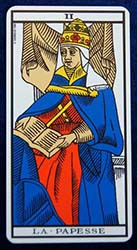
There she is—sitting calmly on her throne, robed like a pope, crowned like a queen, and holding an open book in her lap. Her name? La Papesse—The Popess. And she’s right there in the second card of the Tarot de Marseille, as if that’s a totally normal thing.
Spoiler: it wasn’t.
In the deeply patriarchal world of medieval Europe, the idea of a female pope was about as welcome as a lightning storm at Easter Mass. Women weren’t allowed in the priesthood, let alone the papacy. And yet, someone slipped this mysterious, serene woman into one of the most enduring tarot decks in history. Not just as a background figure, but as a Major Arcana—a gatekeeper to mysteries, positioned right after The Magician.
So how did La Papesse get past the spiritual bouncers?
Some say she’s a nod to the medieval legend of Pope Joan—the woman who supposedly disguised herself as a man, rose through the clerical ranks, and accidentally gave birth during a papal procession (oops). Historians mostly file that story under “colorful fiction,” but even fiction has staying power when it touches a nerve. Whether she was real or not, Pope Joan became a symbol of something that wouldn’t go away: the unspoken presence of feminine wisdom in a church that tried very hard to pretend it didn’t exist.
And that, dear reader, may be exactly what La Papesse is doing in the tarot. Sitting there quietly, book in hand, saying nothing—but also saying everything.
The Divine Feminine in Disguise
Let’s be honest: “Popess” is not a job title you hear every day. Even in a medieval tarot deck full of crowned figures, mythical beasts, and flying body parts, La Papesse still raises eyebrows. And that’s probably the point.
Because she’s not just a curiosity—she’s a symbolic insurgent.
In a time when religious authority was reserved strictly for men, slipping a female spiritual leader into the tarot wasn’t just bold—it was sly. If the Church said, “No women allowed,” the tarot quietly responded, “Cool story. Here’s one holding the Book of Secrets.”
Look closely and you’ll see: La Papesse isn’t just playing dress-up. She’s the real deal. She’s seated, grounded, radiating calm authority. The book in her lap? It’s open, but not for just anyone. This is hidden knowledge, sacred mystery, the kind of truth you don’t shout from a pulpit—you whisper behind a veil.
And oh yes—there’s often a veil behind her too, in later versions like the Rider-Waite-Smith deck where she evolves into The High Priestess. That veil is no accident. It’s the boundary between outer appearances and inner reality. Between dogma and direct experience. Between religion and… well, something deeper.
Maybe that’s why La Papesse feels like a divine trickster in holy robes—a way for the Goddess to sneak herself back into a story that tried to write her out. A kind of spiritual photobomb. She’s not angry. She’s not loud. She’s just there, like she’s always been, waiting patiently while the world catches up.
High Priestess vs. Hierophant: The Sacred Split
If La Papesse is the quiet keeper of spiritual truth, then The Hierophant is the guy with the microphone and the rulebook. You know the type—fancy hat, formal robes, sitting on a throne flanked by devotees. He’s not whispering behind veils. He’s declaring doctrine. Loudly.
In the tarot’s symbolic landscape, these two form a kind of spiritual odd couple.
On one side: the High Priestess (formerly La Papesse), guardian of the inner mysteries. She represents intuition, silence, dreams, the moon, and the feminine path of going within. No sermons. No commandments. Just you and your inner voice having a deep conversation.
On the other: the Hierophant (a.k.a. The Pope), representative of the outer structure of religion. He’s about tradition, hierarchy, sacred rituals, and the authority of institutions. He doesn’t just speak for God—he’s got a line of succession to prove it.
And here’s where things get fun.
If the High Priestess is the essence of spirituality—private, personal, often mysterious—then the Hierophant is what happens when that spirituality gets dressed up in official garb and turned into an organization.
You could say he’s spirituality in drag.
(And yes, the Goddess is laughing.)
It’s not a judgment—it’s an observation. Religion, at its best, is a ritualized way to connect to the sacred. But it borrows its power from something deeper, older, and quieter: that inner knowing, that wordless communion with the Mystery that no cathedral could ever fully contain.
So the next time you see these two cards in a spread, you might ask yourself: Am I being called to tune in… or to follow the program? One isn’t necessarily better than the other—but they’re very different energies. One whispers. The other chants.
And both, in their own way, are trying to bring the divine into human hands.
Drag as Divine Theater
Let’s talk about drag.
Real drag—the kind you see on stages and in parades—isn’t just about wigs and sequins. It’s ritual in heels. A transformation. A larger-than-life performance that says, “This is a costume, honey—but don’t be fooled. I’m showing you something real.”
Now think about religion.
The incense, the chanting, the golden goblets and embroidered vestments. The Latin. The choreography. The sacred props and elaborate entrances. Let’s be honest: religion is serving ceremony. And at its best, it’s doing exactly what drag does—turning up the volume on identity to invoke something beyond the everyday.
But here’s the twist: spirituality doesn’t need all that.
Spirituality can happen in silence. In nature. In dreams. In the moment you look at the stars and suddenly feel like you belong. It’s raw, receptive, feminine in essence—not because it’s about women, but because it flows instead of forcing. It listens instead of preaching. It descends like a dove, not marches like a bishop.
So when we say religion is spirituality in drag, we’re not mocking either one. We’re pointing out the costume change—and asking, Do we recognize who’s beneath the robes?
Because sometimes the High Priestess puts on a miter and becomes the Hierophant. And sometimes, behind all the stained glass and psalms, it’s still La Papesse, still holding the book, still smiling faintly as we play dress-up with the Divine.
The Goddess has always known how to play along.
A Word from the Goddess (She’s Smiling)
So here we are, circling back to La Papesse—that calm, veiled figure with the open book and the closed mouth. She never says a word, but somehow you can hear her perfectly.
She doesn’t need to raise her voice. She’s been here the whole time.
Through the centuries of bells and bulls, of councils and creeds, she sat quietly behind the veil, holding the thread of something older than any religion: the mystery at the heart of being. The part no doctrine can define, no priest can own, and no building can contain.
The Goddess never left. She just adapted.
Sometimes she put on papal robes. Sometimes she showed up as Mary, or Sophia, or Shekhinah, or Kali, or Isis, or just as a sudden knowing in your bones. And sometimes she let herself be hidden in plain sight—as a tarot card. A whisper of the sacred feminine preserved in a deck that survived inquisitions, revolutions, and centuries of shuffle.
And still, she waits—not with impatience, but with that timeless serenity of someone who knows exactly who she is.
So if you ever feel like religion has become a little too loud, too rigid, too ceremonial, too performative… just know that the real presence is still there, quietly inviting you inward. Into the mystery. Into the silence. Into the place where wisdom isn’t taught—it’s remembered.
Pull the card. Light the candle. Lift the veil.
And maybe—just maybe—you’ll hear her laugh.
 Just the Tarot